
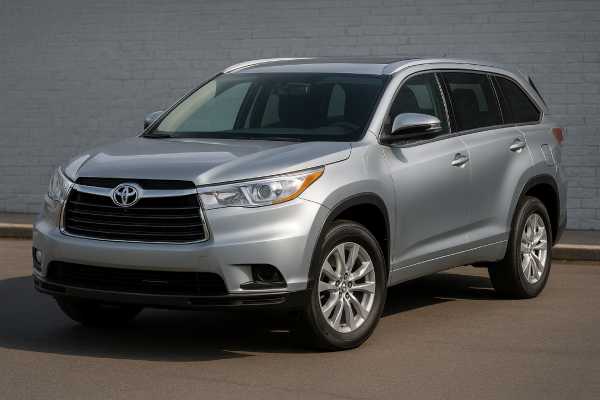
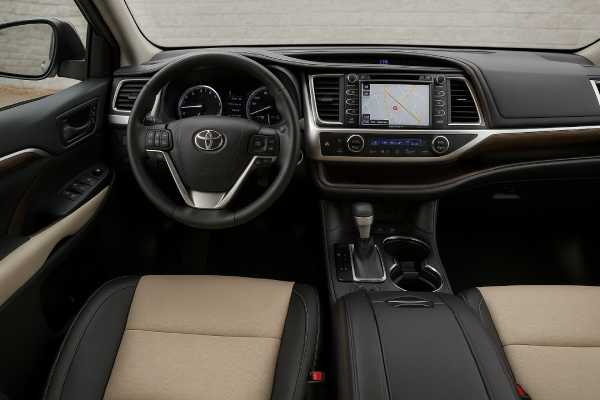
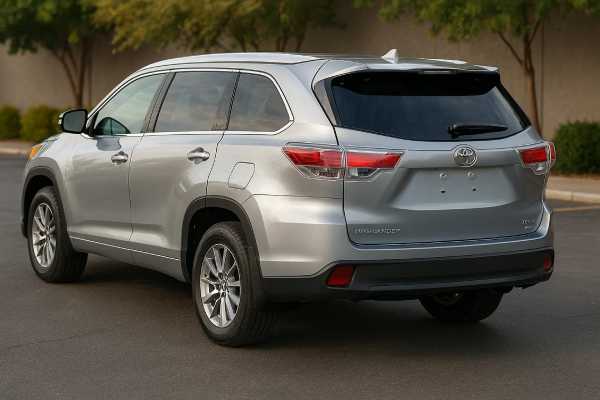
The third-generation Toyota Highlander introduced a cleaner design, a quieter cabin, and a family-friendly interior. In base FWD form with the 1AR-FE 2.7-litre four-cylinder and a 6-speed automatic, it focuses on ride comfort, usable space, and low running costs. While the V6 is the performance choice, the 2.7 l model is the value play for drivers who rarely tow, live on flatter terrain, and prize smoothness over speed. Its longer wheelbase improves stability, and thoughtful touches—like a dash-wide storage shelf and a one-touch second-row slide—make daily use simple. Safety scores are strong, visibility is good for a three-row SUV, and ownership is straightforward thanks to timing-chain service, long-life spark plugs, and widely available parts. If you want seven or eight seats, predictable handling, and reasonable fuel economy without hybrid complexity, the ASU50 FWD is an easy SUV to live with.
Fast Facts
- Calm ride, quiet cabin, and intuitive controls; seating for up to eight.
- Low operating costs: long-life fluids, timing chain, and simple FWD driveline.
- Strong safety record; child-seat-friendly second row with LATCH anchors.
- Caveat: four-cylinder feels strained when fully loaded or towing; plan passes.
- Typical oil interval: 10,000 miles / 12 months on 0W-20 (shorter in severe use).
Guide contents
- Highlander ASU50 detailed overview
- ASU50 specs and data
- Highlander trims, options and safety
- Reliability and service actions
- Maintenance and buyer’s guide
- Driving and performance
- How it compares to rivals
Highlander ASU50 detailed overview
Toyota repositioned the third-generation Highlander around comfort and family usability. Compared with its predecessor, the ASU50’s structure is stiffer, the suspension tuning is more mature, and the cabin noise level drops notably at highway speeds. The base FWD 2.7 l model uses the 1AR-FE four-cylinder with Dual VVT-i paired to a 6-speed automatic. It is geared for smooth part-throttle response and quiet cruising more than urgent acceleration. Around town, the transmission’s logic favors early upshifts; steady-state driving at 45–70 mph (72–113 km/h) is hushed, with low engine rpm.
Packaging is a major reason buyers choose the Highlander. Access to the second and third rows is simple thanks to wide rear doors and a long wheelbase (109.8 in / 2,790 mm) that opens up legroom. The second row (bench or captain’s chairs, depending on trim) slides and reclines; when folded, the load floor is flat, and the seat-fold levers are easy to reach from the hatch. The low cargo lip helps when lifting strollers or coolers. Up front, storage is thoughtful: a dash-length shelf captures phones and sunglasses, a large center bin swallows a small handbag, and the cupholders are sized for real-world bottles.
Ride and handling balance leans toward comfort, not sport. The standard 18-inch wheels with 60-profile tires absorb sharp edges well, and body motions are gently controlled. Steering is accurate and light at parking speeds, with a reassuring on-centre feel on the highway. Brakes are easy to modulate; pedal travel is consistent even in stop-and-go traffic. The FWD layout keeps maintenance simple—no transfer case, PTU, or rear differential to service—while traction control and stability control step in cleanly if a front wheel spins on wet paint or slush. For families who want a calm, predictable crossover with three rows and a mainstream service plan, the ASU50 fits neatly.
ASU50 specs and data
Engine and Performance (ICE-only)
| Item | Detail |
|---|---|
| Engine code | 1AR-FE |
| Layout and valvetrain | Inline-4, DOHC, Dual VVT-i, 16 valves |
| Bore × stroke | 90.0 × 105.0 mm (3.54 × 4.13 in) |
| Displacement | 2.7 L (2,672 cc) |
| Induction | Naturally aspirated |
| Fuel system | Port fuel injection (PFI) |
| Compression ratio | ~10.0:1 |
| Max power | 185 hp (138 kW) @ ~5,800 rpm |
| Max torque | ~252 Nm (186 lb-ft) @ ~4,100 rpm |
| Timing drive | Chain (no scheduled replacement) |
| Emissions/efficiency basis | EPA ratings (U.S.) |
| Rated economy | ~20 mpg city / 25 mpg hwy / 22 mpg combined (11.8 / 9.4 / 10.7 L/100 km) |
| Real-world highway @ 120 km/h (75 mph) | ~9.0–9.5 L/100 km (26–25 mpg US), weather and load dependent |
| Aerodynamics | Coefficient of drag not officially published for this trim |
Transmission and Driveline
| Item | Detail |
|---|---|
| Transmission | 6-speed automatic (U760E family) with manual-select gate |
| Final drive ratio | ~3.94:1 (typical application) |
| Drive type | Front-wheel drive (FWD) |
| Differential | Open; brake-based torque management |
| Refuel to full | ~5 minutes (pump-dependent) |
Chassis and Dimensions
| Item | Detail |
|---|---|
| Platform/chassis | XU50 series (ASU50 FWD) |
| Suspension (front/rear) | MacPherson strut / Double-wishbone (trailing arm) |
| Steering | Electric-assist rack-and-pinion |
| Brakes | 4-wheel disc with ABS, EBD, Brake Assist |
| Wheels/tires | 245/60 R18 standard; 245/55 R19 available on higher trims |
| Ground clearance | ~203 mm (8.0 in) |
| Length / Width / Height | ~4,855 mm / 1,925 mm / 1,730 mm (191.1 / 75.8 / 68.1 in) |
| Wheelbase | 2,790 mm (109.8 in) |
| Turning circle (kerb-to-kerb) | ~11.4 m (37.4 ft) |
| Curb weight | ~1,820–1,950 kg (4,010–4,300 lb), trim-dependent |
| GVWR | ~2,585–2,720 kg (5,700–6,000 lb) |
| Fuel tank | ~73 L (19.2 US gal / 16.0 UK gal) |
| Cargo volume (SAE) | 13.8 ft³ behind 3rd / 42.3 ft³ behind 2nd / 83.7 ft³ max (≈391 / 1,197 / 2,370 L) |
Performance and Capability
| Item | Detail |
|---|---|
| 0–60 mph / 0–100 km/h | ~9.3–9.8 s (typical test range) |
| Top speed | ~180 km/h (112 mph), speed-limited |
| Braking 100–0 km/h | ~38–41 m (125–135 ft), tire-condition dependent |
| Towing capacity | 680 kg (1,500 lb) |
| Payload | ~590–750 kg (1,300–1,650 lb) depending on VIN label |
| Roof load | ~68 kg (150 lb) with OEM crossbars |
Fluids and Service Capacities
| System | Specification | Capacity (approx.) |
|---|---|---|
| Engine oil | SAE 0W-20, API SP/SN | ~4.4 L (4.6 US qt) with filter |
| Engine coolant | Toyota Super Long Life Coolant (pink), 50/50 premix | ~8–9 L (8.5–9.5 US qt) total system |
| Automatic transmission | Toyota ATF WS | Drain-and-fill ~3.5–4.0 L (3.7–4.2 US qt) |
| Brake fluid | DOT 3 (DOT 4 acceptable if fully flushed) | Fill to MAX; flush on interval |
| A/C refrigerant | R-134a | ~550–650 g (19–23 oz), label-specific |
| A/C compressor oil | ND-OIL 8/ND-OIL 11 (per label) | As specified (≈120 mL / 4.1 fl oz) |
| Spark plugs | Iridium (long-life); gap 1.1 mm (0.043–0.044 in) | — |
| Key torque (examples) | Wheel lug nuts 103 Nm (76 lb-ft); oil drain 39 Nm (29 lb-ft); spark plugs 18–22 Nm (13–16 lb-ft) | — |
Electrical
| Item | Detail |
|---|---|
| Alternator output | ~130 A (model-year dependent) |
| 12 V battery | Group-size varies by supplier; ~45–60 Ah typical |
Safety and Driver Assistance
| Item | Detail |
|---|---|
| Crash ratings | Strong IIHS results in core tests; Top Safety Pick status in many configurations through 2016 |
| Headlights | Halogen reflectors; output depends on aim and lens clarity |
| Restraints | Dual-stage front, front seat-side, and full-length curtain airbags |
| Child seats | LATCH anchors (2nd row outboard) plus top tethers; check fit for three-across |
| ADAS | Pre-TSS era: no AEB or lane centring on 2014–2016; rearview camera widely fitted |
Notes: Capacities and ratings vary with build options (tow prep, rear HVAC, wheels). Always verify by VIN, under-hood labels, and your owner’s literature.
Highlander trims, options and safety
Trim overview (2014–2016, FWD focus):
- LE (2.7 l standard): Cloth seating, 18-inch wheels, rearview camera, Bluetooth audio, three-zone HVAC with rear controls, 8-passenger bench. The four-cylinder is most common here.
- LE Plus (2.7 l available, V6 optional): Power liftgate, upgraded audio, leather-trimmed steering wheel, fog lamps, improved interior materials.
- XLE (V6): Adds leather seating, heated front seats, sunroof, navigation, proximity entry/start; four-cylinder generally not offered.
- Limited / Limited Platinum (V6): 19-inch wheels, JBL audio, ventilated front seats, driver aids (blind-spot monitoring, rear cross-traffic alert), panoramic roof on Platinum.
Mechanical and functional differences by trim:
- Wheels/tires: 18-inch setup brings better ride and winter-tire choice. 19-inch (Limited) sharpens initial response but transmits a bit more impact on broken pavement.
- Seating configurations: LE and LE Plus typically offer an 8-passenger bench; higher trims often use captain’s chairs (7-passenger).
- Tow capability: Four-cylinder FWD remains 1,500 lb (680 kg); V6 with tow package reaches 5,000 lb (2,268 kg).
- Brakes and suspension: Caliper sizing and pad compounds vary slightly with wheel packages; alignment specs are shared.
Quick identifiers:
- VIN/engine code: The 1AR-FE four-cyl is listed on the emissions label and VIN build sheet.
- Interior tells: Simpler cluster graphics on LE/LE Plus; smaller head unit on early builds; storage-shelf dash is common across trims.
- Exterior cues: LE typically with black grille inserts and 18-inch alloys; Limited adds chromed details and 19-inch wheels.
Year-to-year highlights:
- 2014 launch: New platform, improved interior packaging, standard rearview camera across the range.
- 2015: Feature shuffles and audio updates; Entune software revisions.
- 2016: Further infotainment tweaks, expanded availability of driver-assist alerts (BSM/RCTA) on upper trims.
Safety ratings context:
The third-gen Highlander earned strong results in IIHS moderate overlap frontal, side, roof strength, and head restraints. Small-overlap performance was competitive for the class. Because these years precede Toyota Safety Sense (with automatic emergency braking), many configurations earned Top Safety Pick rather than Top Safety Pick+. NHTSA star ratings for frontal and side tests are favorable for most build combinations. Always confirm by VIN, as option content (curtain airbags, seat configurations, and camera systems) can influence specific outcomes.
ADAS availability and service implications:
Blind-spot monitoring and rear cross-traffic alert, where fitted, rely on radar modules in the rear corners; bumper cover repairs or repaints require correct sensor mounting and verification. Camera aiming is straightforward on these pre-TSS models. After suspension work or subframe movement, zero-point calibration for steering angle and yaw rate sensors is recommended.
Reliability and service actions
The ASU50 FWD four-cylinder is simpler than AWD and V6 variants, which helps long-term reliability and lowers routine costs. Most issues are age- and mileage-related rather than design flaws.
Common to occasional issues (with prevalence and cost guidance):
- Water pump seepage (occasional • medium): Look for pink crust at the weep hole and dried coolant around the timing cover. Remedy: replace pump and refresh Toyota SLLC; inspect belt.
- Serpentine belt and idler noise (occasional • low): Chirp or squeal at cold start. Remedy: belt replacement and pulley check; confirm tensioner travel.
- Front lower control arm rear bushings (common • medium): Cracks lead to thumps on potholes and vague steering. Remedy: press bushings or replace arms; align afterward.
- Wheel bearings (occasional • medium): Speed-related growl that changes in turns. Remedy: hub assembly replacement.
- Brake rotor rust lip/uneven pad transfer (common • low): Frequent short trips promote corrosion. Remedy: periodic highway stops to clean rotors; resurface/replace as needed.
- EVAP system codes (occasional • low/medium): Loose cap, purge valve sticking, or charcoal canister saturation. Remedy: smoke-test, verify purge/vent operation, and replace components as required.
- Door lock actuators and liftgate struts (occasional • low/medium): Weak operation or failure with age. Remedy: replace affected actuator or strut pair.
- Infotainment quirks (occasional • low): Reboots or Bluetooth pairing issues. Remedy: software update or unit reset; check TSBs for head-unit firmware.
Transmission/drive concerns:
- Shift flare or harsh 2–3 on cold mornings (occasional • low/medium): ATF WS aging and adaptive values can contribute. Remedy: drain-and-fill, relearn procedure, check for TSB-specified calibration updates.
- Torque converter shudder (rare • medium): Felt around 35–50 mph light throttle. Remedy: ATF exchange and adaptation reset; further diagnosis if persistent.
Cooling and HVAC:
- Heater core flow reduction (occasional • medium): Coolant neglect can lead to reduced cabin heat. Remedy: chemical flush consistent with Toyota guidance; replace coolant and bleed properly.
- A/C performance fade (occasional • medium): Condenser fin damage or low R-134a. Remedy: leak check, recharge to spec, verify condenser airflow and cabin filter condition.
Corrosion watchpoints:
- Rear subframe seams and exhaust flanges in salt-belt regions; periodic underbody wash helps.
- Tailgate bottom hem and door edges—clean drains seasonally.
Recalls, TSBs, and extended coverage (headlines you may encounter):
- Seat belt anchor/third-row structural campaigns on certain build ranges.
- Airbag wiring or inflator supplier actions on specific VIN blocks.
- Software updates for shift quality or head-unit reliability.
- Fuel-system evaporative component checks in hot-climate states.
Verification:
Before purchase or after a move across states/provinces, run an official VIN recall check and request a dealer campaign history printout. Keep paperwork with the vehicle file.
Maintenance and buyer’s guide
Practical maintenance schedule (distance/time, whichever comes first)
- Engine oil and filter: 10,000 miles / 12 months on 0W-20; 5,000 miles / 6 months for heavy city, dusty areas, or frequent short trips.
- Engine air filter: Inspect 15,000 miles; replace 30,000 miles (earlier in dust).
- Cabin filter: Every 15,000–20,000 miles; more often if you park under trees.
- Spark plugs (iridium): 120,000 miles (192,000 km).
- Coolant (SLLC): First at 100,000 miles / 10 years; then every 50,000 miles / 5 years.
- ATF WS: Inspect at 60,000 miles; drain-and-fill every 60,000–90,000 miles if you plan long-term ownership.
- Brake fluid: Flush every 3 years.
- Brake hardware: Clean/lube slide pins annually; inspect pads/rotors at each tyre rotation.
- Tyre rotation and alignment: Rotate 5,000–7,500 miles; align annually or with tyre replacement.
- 12 V battery: Test annually after year three; replace at first sign of slow crank or erratic electronics.
- Belts and hoses: Inspect at every oil change after 60,000 miles; replace by condition (often 90,000–120,000 miles).
- PCV valve: Inspect at 60,000–90,000 miles; replace if sticking.
Fluid specifications and quick references
- Oil: SAE 0W-20 full synthetic meeting API SP/SN Plus.
- Coolant: Toyota Super Long Life (pink), premixed 50/50.
- ATF: Toyota ATF WS only.
- Brake fluid: DOT 3 (or DOT 4 if fully flushed).
- Torque highlights: Wheel nuts 103 Nm (76 lb-ft); drain plug 39 Nm (29 lb-ft); spark plugs 18–22 Nm (13–16 lb-ft).
Buyer’s inspection checklist
- Road test: Smooth shifts, no shudder at 35–50 mph, straight tracking, and quiet wheel bearings.
- Engine bay: No coolant crust at the water pump, belt runs true, and no oil seep at cam cover.
- Cooling: Clean, pink coolant; fans cycle correctly; cabin heat stable at idle.
- Chassis: Control arm bushings intact, no clunks over sharp bumps, even tyre wear.
- Brakes: Firm pedal with linear response; parking brake holds on a slope.
- Interior: All seat-fold mechanisms work; sliding second row moves easily; no rattles from the tailgate.
- Electronics: Camera image clear, all windows and locks operate, infotainment boots reliably and pairs via Bluetooth.
- Underside: Minimal rust on subframes/exhaust; splash shields present and secure.
Recommended configurations
- Value pick: LE or LE Plus FWD with 18-inch wheels for best ride, tire cost, and winter-tire options.
- If you tow or face steep grades: Consider the V6 (still on the XU50 platform) for stronger performance and a 5,000-lb rating when equipped with the tow package.
Long-term durability outlook
With routine fluids and attention to suspension wear items, the ASU50 FWD commonly reaches 200,000+ miles (320,000+ km). The timing chain, iridium plugs, and simple FWD driveline keep costs predictable.
Driving and performance
Ride, handling, and NVH
The suspension tuning aims for composure and comfort. Impacts are rounded off, and the body settles quickly after larger undulations. On straight highways, the Highlander tracks confidently with little need for correction. Wind and road noise are well managed for the class; the cabin stays calm at 65–75 mph (105–120 km/h), especially on 18-inch tires.
Powertrain character
The 1AR-FE is tuned for smoothness. Around town, it feels adequate and unobtrusive, with gentle throttle mapping that makes it easy to drive smoothly. The 6-speed automatic prefers early upshifts and low rpm cruising; kickdown is decisive when you ask for it, but wide-open acceleration is more measured than brisk. Fully loaded with passengers and luggage, you will plan merges and passes a bit earlier than in the V6.
Real-world economy
Drivers commonly see 22–24 mpg US (10.7–9.8 L/100 km) in mixed use, rising to 26–27 mpg US (9.0–8.7 L/100 km) on steady 65–70 mph runs with light winds. Urban short-trip use and winter blends can drop results into the high-teens mpg. Proper tire pressures, 5,000–7,500-mile rotations, and keeping roof accessories off when not needed all help.
Key metrics that shape the verdict
- 0–60 mph: roughly mid-9-second range, depending on load and conditions.
- 100–0 km/h braking: around 38–41 m (125–135 ft) with healthy tires and pads.
- Turning circle: ~11.4 m (37.4 ft) aids parking-lot maneuvering.
Traction and stability
FWD traction is fine on dry or wet pavement, especially with good all-season tires. In snow-belt regions, a dedicated winter tire transforms starts and stops. Stability control programming is progressive rather than intrusive; torque management via the brakes trims inside-wheel spin neatly when pulling out of angled junctions.
Load and towing
The four-cylinder FWD is rated to 1,500 lb (680 kg); think small utility trailers, light boats, and bike carriers. Expect a 20–30% fuel-economy penalty when towing and on steep grades. With a full cabin, the transmission will hold lower gears longer to maintain pace—normal behavior. Watch payload limits on the door-jamb label if you regularly carry seven or eight people plus cargo.
How it compares to rivals
- Highlander V6 (same generation): Noticeably quicker and rated to tow 5,000 lb, with similar comfort and safety. It burns more fuel in city use but feels more relaxed when fully loaded or driving at altitude.
- Honda Pilot (2016): Roomier third row and strong V6. The Toyota’s cabin is quieter on coarse pavement, and the four-cylinder’s maintenance costs are lower; Pilot’s real-world mpg trails the Highlander four-cyl.
- Kia Sorento (2016): Slightly smaller footprint; four-cyl and V6 options. Sorento can be better-equipped per dollar but rides firmer on big wheels; Highlander’s resale and service network are strengths.
- Hyundai Santa Fe (2014–2016): Agile and nicely trimmed; turbo models offer strong torque but can have higher long-term complexity. The Highlander’s ride isolation and cabin quietness are advantages.
- Ford Explorer (2016): Broad powertrain range including turbo fours and V6s; more tech options but higher drivetrain complexity and mixed long-term repair costs. Toyota emphasizes simplicity and consistency.
References
- 2016 Toyota Highlander 2016 (EPA Ratings)
- 2016 Toyota Highlander 4-door SUV 2016 (Safety Rating)
- 2016 Toyota Highlander Quick Reference Guide 2016 (Owner’s Guide)
- Recalls 2025 (Recall Database)
Disclaimer
This article is for informational purposes and is not a substitute for professional diagnosis or repair. Specifications, torque values, service capacities, and maintenance intervals can vary by VIN, market, and equipment level. Always verify details against your vehicle’s official service documentation and under-hood labels.
If this guide helped you, please consider sharing it with fellow owners on Facebook or X/Twitter to support xcar’s work.