
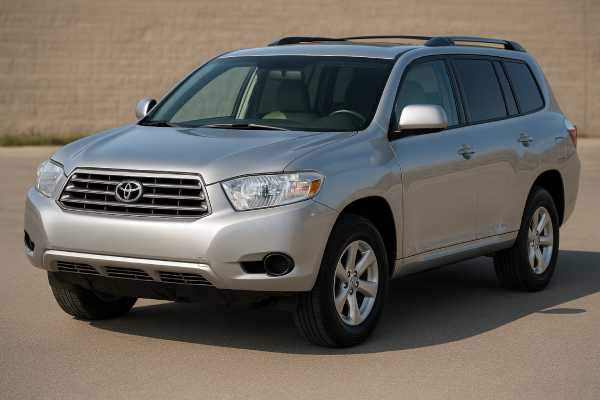
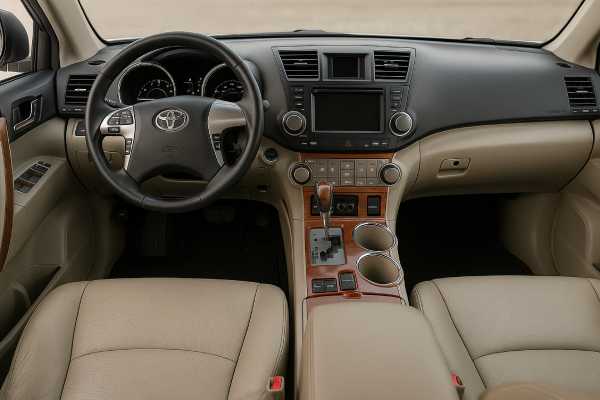
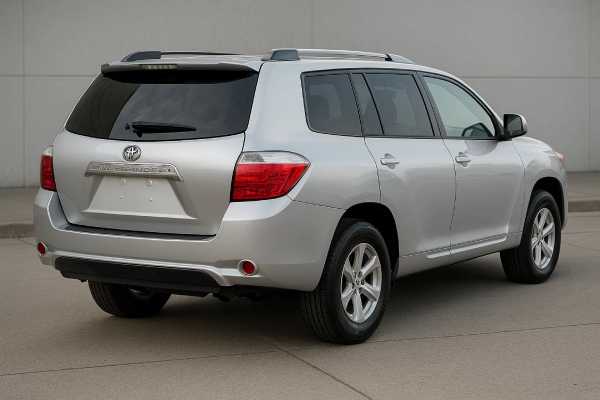
The second-generation Toyota Highlander (GSU40, front-wheel drive) pairs a robust 2GR-FE 3.5-liter V6 with a smooth 5-speed automatic, three rows of practical seating, and the long-haul durability Toyota buyers expect. From 2008 through 2010, the FWD V6 remained the sweet spot for performance and total ownership cost: 270 hp, confident passing power, and real-world economy that holds up on the highway. Families appreciate the configurable interior (including the stowable “Center Stow™” second-row seat), generous cargo space, and a quiet ride. Owners and techs value chain-driven cams, accessible service points, and widely available parts. Safety performance is strong for its era, and towing up to 5,000 lb with the factory prep package makes the Highlander a genuine weekend hauler. This guide focuses on U.S./Canada market data for the 2008–2010 FWD V6 and covers the specs that matter, known issues, service intervals, and what to check before you buy.
Fast Facts
- Strong 2GR-FE V6 (270 hp) with smooth low-to-midrange torque; relaxed highway passing and hill climbs.
- Spacious, flexible interior; 95.4 ft³ max cargo (seats down) and comfortable second row for adults.
- Proven safety record for the generation; stability control and full-length curtains standard.
- Watch for aging water pumps and VVT-i oil hose campaign completion on early-build 2GR-FE engines.
- Typical oil service: every 5,000 miles / 6 months with API SM or better; use Toyota WS ATF for the automatic.
Explore the sections
- Highlander GSU40 overview
- Engine and technical specs
- Trims, options, and safety
- Reliability and service actions
- Maintenance and buyer’s guide
- Driving and real-world mpg
- How it compares to rivals
Highlander GSU40 overview
The 2008–2010 Toyota Highlander FWD (chassis code GSU40) is the front-drive configuration of Toyota’s three-row crossover. Its 2GR-FE 3.5-liter V6 makes a rated 270 hp and is paired to an electronically controlled 5-speed automatic. Unlike truck-based SUVs of the time, the Highlander rides on a car-derived platform with independent suspension at all four corners, tuned for comfort and stability rather than off-road articulation. Buyers who don’t need all-wheel drive often prefer the GSU40 for its lower curb weight, slightly better fuel economy, and simpler driveline.
In daily use, the FWD Highlander is about ease: light steering in parking lots, secure tracking at speed, and excellent visibility. The 17- or 19-inch wheel packages keep impacts muted while keeping body roll in check. Inside, it is a genuinely family-sized cabin with a low cargo floor, wide liftgate, and smart small-item storage. With the second and third rows folded, capacity expands to one of the class leaders for the era, and the square opening makes boxy items easy to load.
The V6 itself is a highlight. The 2GR-FE uses dual VVT-i (variable valve timing), aluminum block/heads, timing chains (no belt replacements), and port fuel injection—straightforward for maintenance and tolerant of mixed driving cycles. Tow ratings reach up to 5,000 lb when equipped with the official tow prep package (transmission cooler, heavy-duty alternator specification on certain packages, and wiring), and the 5-speed automatic’s gearing provides predictable downshifts on grades. Safety-wise, the Highlander achieved strong marks for its generation with standard stability control, curtain airbags for all rows, and healthy body rigidity.
If you are shopping today, focus on well-maintained examples with complete service documentation (especially coolant, spark plugs, and fluid services), evidence of the VVT-i oil hose campaign on early builds, and a dry water pump. The FWD layout eliminates rear driveline wear items and simplifies long-term costs while maintaining the capability most owners use.
Engine and technical specs
Below are the key technical figures for the 2008–2010 Highlander FWD V6 (GSU40). Values reflect typical U.S./Canada market specifications for the 2GR-FE and factory equipment of the period.
Engine and Performance
| Item | Specification |
|---|---|
| Code | 2GR-FE |
| Layout & cylinders | 60° V6, DOHC, 24 valves; dual VVT-i |
| Valves per cylinder | 4 |
| Bore × stroke | 94.0 × 83.0 mm (3.70 × 3.27 in) |
| Displacement | 3.5 L (3,456 cc) |
| Induction | Naturally aspirated |
| Fuel system | Sequential multiport electronic fuel injection |
| Compression ratio | 10.8:1 |
| Max power | 270 hp (201 kW) @ ~6,200 rpm |
| Max torque | 336 Nm (248 lb-ft) @ ~4,700 rpm |
| Timing drive | Chains (no scheduled replacement) |
| Rated efficiency (combined) | ≈ 11.8 L/100 km (20 mpg US / 24 mpg UK) |
| Real-world highway @ 120 km/h (75 mph) | ~10.7–12.4 L/100 km (19–22 mpg US), depending on load/tires |
| Aerodynamics (Cd, approx.) | ~0.34 (typical for body style/era) |
Transmission and Driveline
| Item | Specification |
|---|---|
| Transmission | 5-speed automatic, ECT-i (electronically controlled) |
| Drive type | Front-wheel drive (FWD) |
| Final drive | ~3.48:1 (application-typical) |
| Differential | Open (front) |
| Refuel to full | Gasoline; ~19.2 US gal tank (72.5 L) |
Chassis and Dimensions
| Item | Specification |
|---|---|
| Suspension | Front: MacPherson strut; Rear: MacPherson strut (Sport trim firmer tuning) |
| Steering | Rack-and-pinion, variable-assist |
| Brakes | 4-wheel ventilated discs; ABS with EBD and Brake Assist |
| Wheels/Tires | 245/65 R17 or 245/55 R19 (factory) |
| Ground clearance | 206 mm (8.1 in) |
| Length / Width / Height | 4,785 / 1,910 / ~1,730 mm (188.4 / 75.2 / ~68.1 in) |
| Wheelbase | 2,790 mm (109.8 in) |
| Turning circle (curb-to-curb) | 11.8 m (38.7 ft) |
| Curb weight (V6 FWD) | ~1,895–1,960 kg (4,178–4,321 lb), trim-dependent |
| GVWR | ~2,720 kg (5,997 lb) |
| Fuel tank | 72.5 L (19.2 US gal / ~16.0 UK gal) |
| Cargo volume (SAE) | 10.3 / 42.3 / 95.4 ft³ (3rd up / 3rd down / max) ≈ 292 / 1,197 / 2,702 L |
Performance and Capability
| Metric | Result (typical) |
|---|---|
| 0–60 mph / 0–100 km/h | ~7.3–7.8 s / ~7.8–8.3 s |
| Top speed (governed) | ~185–190 km/h (115–118 mph) |
| 60–0 mph braking | ~125–140 ft (tire-dependent) |
| Towing capacity (braked) | Up to 2,268 kg (5,000 lb) with tow prep; lower without |
| Payload (typical range) | ~715–860 kg (1,575–1,895 lb), trim-dependent |
| Roof load (dynamic) | ~68–75 kg (150–165 lb), check door-jamb label |
Fluids and Service Capacities
| System | Specification / Capacity |
|---|---|
| Engine oil | API SM (or better), ILSAC; SAE 5W-30 commonly specified; ~6.1 L (6.4 US qt) with filter |
| Coolant | Toyota Super Long Life Coolant (pink, premix); ~8.8–11.0 L depending on rear A/C and tow pack |
| Automatic transmission | Toyota ATF WS; total fill ~8.8–9.0 L (2WD) |
| A/C refrigerant | R-134a; charge per under-hood label; ND-Oil 8 (PAG) compressor oil |
| Key torque (typical) | Wheel nuts 103 Nm (76 lb-ft); spark plugs ~25 Nm (18 lb-ft) |
Electrical
| Item | Specification |
|---|---|
| Alternator | ~130 A (application-typical; spec varies by equipment) |
| 12 V battery | Group 24F, ~55–65 Ah (CCA varies by climate) |
| Spark plugs | Long-life iridium; gap 1.0–1.1 mm (0.039–0.043 in) |
Safety and Driver Assistance (period equipment)
| Area | Details |
|---|---|
| Crash ratings | Strong marks for the generation; see Safety section for ratings summary |
| Headlight rating | Not separately rated in this era |
| ADAS/active safety | ABS, EBD, Brake Assist, Vehicle Stability Control (VSC), Traction Control (TRAC); Hill-start Assist (HAC). No factory AEB/ACC/Lane Keep in 2008–2010. |
| Child-seat | Lower anchors and tethers (LATCH) on outboard second-row seats; third-row top tethers where equipped |
Trims, options, and safety
Trims and equipment (2008–2010, FWD V6 focus)
- Base: 17-inch wheels, cloth seating, manual A/C (tri-zone on many), stability/traction control, full-length curtain airbags, power windows/locks, keyless entry, cruise control, AUX audio. Third row commonly included; check build.
- Sport (2008–2009) / SE (2010): 19-inch wheels with all-season tires, sport-tuned suspension, leather-wrapped wheel/shift, fog lamps, roof rails, unique trim/badging.
- Limited: 19-inch wheels, leather seating (heated front), power driver/passenger adjustments, JBL audio/nav options, auto climate, Smart Key (availability varies), power liftgate on some builds.
Option packages and mechanical differences
- Tow Prep Package: Additional cooling and hardware for rated 5,000-lb towing. Confirm presence of the aux cooler and proper hitch wiring; not all aftermarket hitches include the cooling capacity.
- Wheel/Tire packages: 17-inch tires for softer ride and winter performance; 19-inch for sharper steering response.
- Seating: Second-row bench with center stow seat or captain’s chairs (market- and trim-dependent).
- Audio/infotainment: Base audio to JBL premium with available navigation; rear DVD entertainment on higher trims.
Quick identifiers
- VIN/build data: Chassis code GSU40 confirms FWD V6. AWD V6 is GSU45; avoid mixing parts.
- Interior tells: Sport/SE typically shows black headlamp surrounds, 19-inch wheels, and firmer ride tuning; Limited carries wood-tone accents and additional power features.
Year-to-year notes
- 2008: Launch year for this generation in North America. Trims: Base, Sport, Limited.
- 2009: Equipment shuffles; similar mechanicals.
- 2010: Sport trim transitions to SE nomenclature in many markets; a 4-cyl engine joined the line (not covered here). V6 FWD continues.
Safety Ratings (high-level)
- Insurance-industry tests of the 2008–2010 Highlander show Good results in key crashworthiness categories for this generation (moderate overlap front, original side, head restraints; roof strength rated “Good” on tested configurations). The 2008 Highlander earned a Top Safety Pick under that year’s criteria.
- Federal testing for the period recorded strong occupant protection and typical midsize SUV rollover scores. Always verify specific ratings for your model year and equipment, because curtain airbags and stability control were pivotal to the strongest results.
Driver assistance and child-seat provisions
- Standard VSC/TRAC, ABS with EBD and Brake Assist, and HAC (Hill-Start). No factory automatic emergency braking or adaptive cruise control for 2008–2010.
- LATCH anchors in the second row with accessible top tethers; third row features top tethers (positions vary). Use seat- and position-specific instructions from the owner’s manual for proper routing and anchor load limits.
Reliability and service actions
The 2GR-FE V6/5-speed automatic combination is generally long-lived when fluids and cooling components are kept in spec. Below is a prioritized map of what owners and inspectors should know.
Common to notable issues (mapped by prevalence and impact)
- Water pump seep/leak (common; medium cost)
- Symptoms: Pink crust at pump weep hole, coolant odor, gradual coolant loss, belt splash.
- Cause: Bearing and seal wear with age/mileage; common around 80k–140k miles.
- Remedy: Replace pump, inspect serpentine belt and idlers; refill/bleed with Toyota Super Long Life Coolant.
- VVT-i oil supply hose campaign on early 2GR-FE (occasional but high risk if ignored)
- Symptoms: Sudden oil leak, pressure warning, noise.
- Cause: Early production used a rubber-section oil feed hose to the VVT-i actuator that could degrade.
- Remedy: Confirm completion of Toyota’s Limited Service Campaign (steel line update). If uncertain, run a VIN recall/campaign check and inspect visually.
- Front strut mounts / sway bar links (occasional; low-to-medium cost)
- Symptoms: Clunk on sharp bumps or steering inputs.
- Cause: Bushing wear.
- Remedy: Replace affected links/mounts; align if needed.
- Brake rotor pulsation (occasional; low cost)
- Symptoms: Steering wheel shimmy under braking from highway speeds.
- Cause: Uneven pad material deposition or rotor thickness variation, often from heat cycling on long descents or aggressive use.
- Remedy: Proper pad bed-in; machine/replace rotors and use quality pads; torque wheel nuts evenly (76 lb-ft).
- HVAC blend door/cable noise (occasional; low cost)
- Symptoms: Clicking behind dash, inconsistent temperature blend.
- Cause: Actuator gear wear.
- Remedy: Replace affected actuator; recalibrate if needed.
- Battery and charging (occasional; low cost)
- Symptoms: Slow crank in cold weather or after short-trip use.
- Cause: Aging Group 24F battery; short cycles.
- Remedy: Load-test battery annually after year 4; alternator output check; keep terminals clean.
Automatic transmission behavior
- The 5-speed ECT-i is durable. Harsh 2–3 shifts or flare are uncommon on stock vehicles. If present, inspect fluid condition (WS), engine/trans mounts, and update control software when applicable. Proactive drain-and-fill service at 60k–90k miles helps shift quality over time (though “lifetime” fluid messaging was common in the era).
Corrosion watch points
- Rear subframe hardware and exhaust flanges in salted regions; liftgate lower seam; front crossmember. Inspect and treat early.
Recalls / campaigns to verify (VIN check recommended)
- Floor mat/accelerator pedal interference: Ensure proper all-weather mat fitment and retention posts; dealer remedies were provided.
- Power window master switch: Inspect recall completion for switch lubrication/overheat risk.
- Spiral cable (airbag clock spring): Certain VIN ranges received replacement; verify.
- VVT-i oil hose (2GR-FE): Confirm Limited Service Campaign update (steel line).
Pre-purchase requests
- Full service history with dates/miles.
- Evidence of cooling system service and a dry water pump.
- Transmission fluid service history (WS fluid), even though not called for on time alone.
- Proof of recall/campaign completion via VIN check and dealer records.
- Brake thickness/rotor runout measurements and recent tire date codes.
- Battery test printout and charging check.
Maintenance and buyer’s guide
A preventative approach keeps the Highlander GSU40 dependable past 200k miles. The table below summarizes a practical schedule aligned with typical Toyota guidance for the era; always verify your VIN-specific manual.
Practical maintenance schedule (FWD V6, typical service)
| Item | Interval (distance/time) | Notes |
|---|---|---|
| Engine oil & filter | Every 5,000 miles / 6 months | API SM or better; common viscosity 5W-30. Use quality filter; reset maintenance minder. |
| Engine air filter | 30,000 miles / 3 years (inspect at 15k/annual) | Shorter if dusty climates. |
| Cabin air filter | 15,000–20,000 miles / 1 year | Keeps HVAC efficiency and evaporator clean. |
| Coolant (SLLC pink) | First at ~100,000 miles / 10 years; then every 50,000 miles / 5 years | Inspect reservoir level every oil change. |
| Spark plugs (iridium) | 120,000 miles / ~10 years | Gap ~1.0–1.1 mm; torque ~25 Nm (18 lb-ft). |
| Serpentine belt & pulleys | Inspect at 60,000 miles; replace ~90,000–120,000 miles | Replace sooner if cracking or noise; inspect tensioner. |
| ATF (Toyota WS) | Drain/fill every 60,000–90,000 miles (practical) | Warm-level check procedure; avoid universal fluids. |
| Brake fluid | 2–3 years | Moisture control and pedal feel. |
| Brake pads/rotors | Inspect every 10,000–15,000 miles | Even torque on wheel nuts (103 Nm / 76 lb-ft). |
| Tires/rotation | 5,000–7,500 miles | Keep even wear; check alignment annually or after impacts. |
| Alignment | Annually or with tire set | Look for inner-edge wear on 19-inch tires. |
| 12 V battery | Test annually from year 4; replace ~6–7 years typical | Group 24F; ensure clean grounds. |
| PCV valve | Inspect around 100,000 miles | Replace if sticky or oil-fouled. |
| Cooling system hoses | Inspect at each service; replace ~10 years | Swollen ends or soft spots are cues. |
| Engine mounts | Inspect at ~120,000 miles | Excess movement → vibration on shift engagement. |
Fluid specifics and quick capacities (typical for the 2GR-FE FWD)
- Oil: API SM/GF-4 or better; 5W-30 commonly specified; ~6.1 L (6.4 qt) with filter.
- Coolant: Toyota SLLC (pink); ~8.8–11.0 L depending on options.
- ATF: Toyota WS; total ~8.8–9.0 L (do not overfill; follow warm-check procedure).
- Fuel: Regular unleaded recommended; 72.5 L (19.2 gal) tank.
Buyer’s checklist
- Engine bay: Dry pump and timing cover areas; clean coolant reservoir; no oil mist near VVT-i feed line (verify steel line on early builds).
- Driveline: Smooth shifts, no flare; no clunk on Park→Drive; no groan at steering lock (pump/belt).
- Chassis: Even tire wear; tight front end; quiet strut mounts.
- Brakes: No highway-speed pulsation; confirm pad thickness and rotor condition.
- Body: Liftgate lower seam and rear subframe hardware for rust; windshield cowl drains clear.
- Interior: Rear A/C and blend functions; folding seat mechanisms; power liftgate if equipped.
- Records: Coolant, plugs, transmission fluid, and recall/campaign proofs.
Durability outlook
With regular fluids, timely water pump replacement, and attention to suspension wear items, the Highlander FWD V6 routinely exceeds 200,000 miles with original major components. The chain-driven 2GR-FE minimizes big-ticket timing service, and parts availability is excellent.
Driving and real-world mpg
Ride, handling, and NVH
On 17-inch tires, the Highlander prioritizes compliance: it rounds off sharp edges and suppresses secondary motions over patched pavement. The 19-inch package increases initial impact feel and steering response, but the chassis remains tuned for family comfort rather than canyon carving. Straight-line stability is strong, aided by a long wheelbase and conservative alignment. Typical cabin noise at 70–75 mph is modest for the class; wind rustle around the mirrors is more noticeable than tire drone, especially on OE-style all-seasons.
Powertrain character
The 2GR-FE is eager without being peaky. Throttle response is crisp in the midrange, with noticeable surge from 3,000 to 5,000 rpm for merging and grades. The 5-speed automatic’s logic is conservative in normal mode, prioritizing low revs; a firmer pedal gets quick, clean downshifts to 4th or 3rd. Kickdown from 60 mph is prompt enough for two-lane passing, and the V6 remains smooth to redline. In stop-and-go, creep control is gentle and predictable; the torque converter locks early at steady cruise to save fuel.
Braking feel
Pedal travel is medium and linear with confident bite on quality pads. Heat capacity is adequate for family use and light towing; long mountain descents benefit from manual “S” range selection and cooling pauses to manage rotor temperatures.
Efficiency in the real world (FWD V6)
- City: ~14.7–16.8 L/100 km (14–16 mpg US / 17–19 mpg UK) depending on trip length and climate.
- Highway 60–70 mph (100–115 km/h): ~9.8–10.7 L/100 km (22–24 mpg US / 26–29 mpg UK) with 17-inch tires, light cargo, and correct alignment/pressures.
- Highway 75 mph (120 km/h): ~10.7–12.4 L/100 km (19–22 mpg US / 23–26 mpg UK), mildly sensitive to headwinds and roof loads.
- Mixed: ~11.2–12.4 L/100 km (19–21 mpg US / 23–25 mpg UK).
Cold weather and short trips can reduce city economy by 10–20%. Roof boxes and crossbars add a visible highway penalty. The 19-inch tire package also trims ~0.5–1.0 mpg US versus equivalent 17-inch tires.
Towing and loads
With the tow prep package, the GSU40 manages a 3,500–4,000 lb camper or boat confidently on moderate grades if driven within GCWR and using weight distribution where required. Expect a 25–40% fuel-economy penalty at highway speeds with a tall trailer. Monitor ATF temperature after long pulls (if you have an add-on gauge) and downshift preemptively on climbs/descents.
How it compares to rivals
In the 2008–2010 midsize three-row crossover field, the Highlander FWD V6 sits at the intersection of power, efficiency, and long-term cost.
Against Honda Pilot (2009–2011)
- The Highlander’s V6 is stronger off the line and quieter under load, while the Pilot’s steering feel is a touch more connected. Pilot’s third row is slightly roomier; Highlander counters with a quieter cabin and better highway efficiency. Reliability is strong for both; parts costs are broadly similar.
Against Ford Flex (2009–2010)
- Flex offers a lower roof with excellent third-row space and a truly large cargo floor; however, the Highlander is lighter, easier to park, and simpler to maintain long term. The Toyota’s V6/5-speed combo is less complex than early turbocharged options and returns steadier real-world mpg.
Against Chevrolet Traverse/GMC Acadia (2009–2010)
- GM’s large-triplets provide maximum interior volume and tow ratings, but carry more mass and, in period, higher odds of transmission and steering system repairs. The Highlander trades some outright space for a gentler ownership curve and better resale.
Against Mazda CX-9 (2008–2010)
- The CX-9 feels sportier with communicative steering; the Highlander rides softer, is quieter at cruise, and has broader parts availability. Fuel economy is comparable; Toyota’s 2GR-FE has the edge on maintenance accessibility.
Bottom line
Buyers prioritizing quiet comfort, predictable operating costs, and strong V6 performance will find the 2008–2010 Highlander FWD V6 among the most balanced picks of its era. If you need AWD traction or routinely tow in the mountains, consider the AWD variant—but otherwise the GSU40’s simplicity is a long-term asset.
References
- Gas Mileage of 2008 Toyota Highlander 2008 (EPA fuel economy)
- 2008 Toyota Highlander 4-door SUV 2008 (Safety Rating)
- Check for Recalls: Vehicle, Car Seat, Tire, Equipment 2025 (Recall Database)
- Look up Safety Recalls & Service Campaigns by VIN 2025 (VIN Recall Lookup)
- 2008 Highlander Specifications 2007 (Manufacturer Specifications)
Disclaimer
This article is for informational purposes and does not replace professional diagnosis, inspection, or repair. Specifications, torque values, and service intervals can vary by VIN, build date, market, and equipment. Always verify against the official owner’s manual, service manual, technical service bulletins, and the under-hood labels for your specific vehicle. If you found this helpful, consider sharing it with other owners on Facebook or X/Twitter to support xcar’s work.