
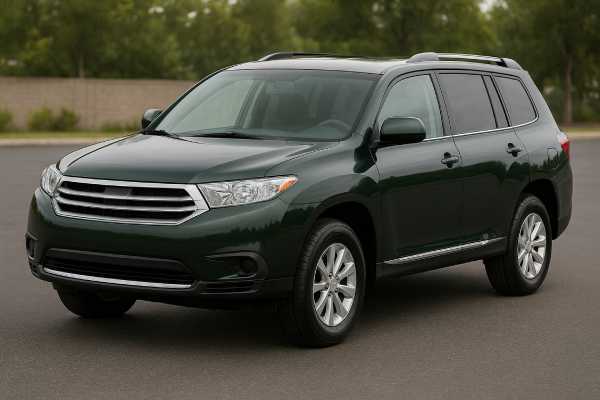
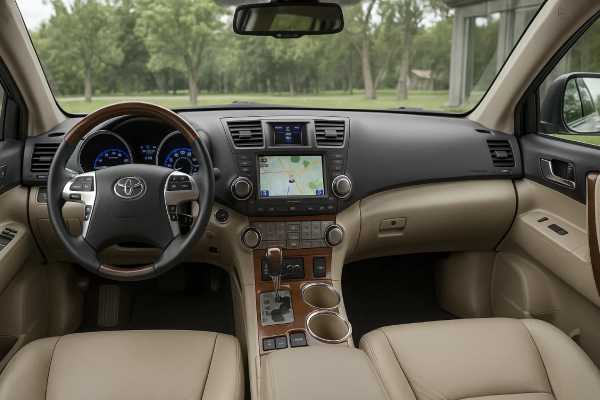
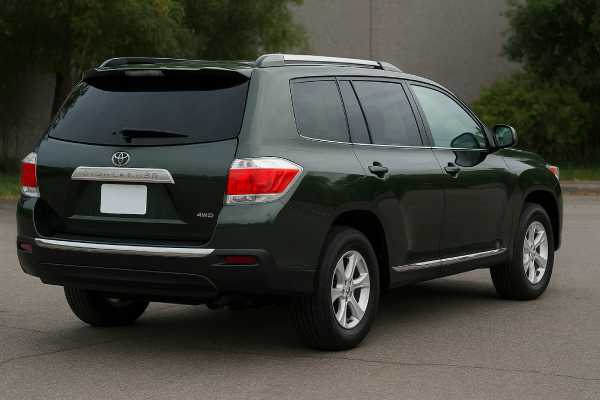
The 2011–2013 facelift of the second-generation Toyota Highlander refined a proven formula: a quiet, family-friendly three-row SUV with car-like manners and above-average durability. In FWD GSU40 form it pairs the 2GR-FE 3.5-liter V6 (270 hp) with a 5-speed automatic, delivering easy passing power and straightforward serviceability. The refresh brought revised styling, a simplified trim walk (Highlander, SE, Limited), improved feature content, and continued emphasis on low running costs. Owners value the robust timing-chain V6, flexible cabin (second-row bench or captain’s chairs), and consistent real-world economy for a seven-passenger vehicle. This guide focuses on the 2011–2013 FWD V6 facelift—covering specifications, dimensions, performance, safety, maintenance strategy, reliability patterns, and how it stacks up against key rivals—so shoppers know what to expect and owners have a practical reference for upkeep.
Fast Facts
- Smooth 3.5-liter V6 with strong mid-range; timing chain, no scheduled replacement.
- Spacious, quiet cabin; flat cargo floor and split-fold seating make family hauling easy.
- 5,000 lb (2,268 kg) tow rating with factory Towing Prep Package; 2,000 lb (907 kg) otherwise.
- Watch for age-related cooling, suspension bushings, and accessory-drive service around 90–120k miles.
- Typical oil and filter service: every 5,000–7,500 miles (6–12 months), per maintenance guide and usage.
What’s inside
- Highlander GSU40 facelift overview
- GSU40 V6 specs and data
- Trims, options and safety tech
- Reliability and common issues
- Maintenance and buyer’s guide
- Driving impressions and performance
- Highlander vs rivals 2011–2013
Highlander GSU40 facelift overview
Toyota’s 2011 update sharpened the Highlander’s look and cleaned up the lineup without changing its core hardware. The FWD GSU40 uses Toyota’s 2GR-FE 3.5-liter DOHC V6 with dual VVT-i, rated at 270 hp (201 kW) and 248 lb-ft (336 Nm). It drives the front wheels through an electronically controlled 5-speed automatic. The pairing is tuned for relaxed, predictable response rather than headline performance, and it’s well-matched to commuting, family trips, and light towing when equipped with the factory Towing Prep Package.
Cabin packaging is a strength. Adults fit comfortably in rows one and two, while row three is best for kids or short trips. The second row slides fore/aft and folds, and cargo versatility is excellent thanks to a wide tailgate opening and low load floor. Ride quality is supple over broken pavement, the cabin is quiet at highway speeds, and steering is light for easy parking. Brakes are confidence-inspiring in daily use.
The facelift period added useful features—available rearview camera, Bluetooth audio/phone, power liftgate on higher trims, and 19-inch wheel packages—while keeping ownership simple: regular gasoline, common service fluids, and a timing chain that doesn’t require a scheduled replacement. Insurance and running costs remain moderate for the class. If you want a comfortable, straightforward three-row crossover that just works, the 2011–2013 Highlander FWD V6 remains a smart, low-drama choice.
GSU40 V6 specs and data
Engine and performance (ICE)
| Item | Detail |
|---|---|
| Code | 2GR-FE (V6, 60°) |
| Layout & valvetrain | Transverse front-engine, DOHC 24-valve, dual VVT-i |
| Displacement | 3.5 L (3,456 cc) |
| Induction & fuel | Naturally aspirated; port fuel injection (EFI) |
| Max power | 270 hp (201 kW) @ ~6,200 rpm |
| Max torque | 336 Nm (248 lb-ft) @ ~4,700 rpm |
| Timing drive | Chain (no scheduled replacement) |
| Recommended fuel | 87 AKI regular unleaded |
| Rated economy (FWD V6 auto) | 20 mpg US combined / 18 city / 24 highway (11.8 / 13.1 / 9.8 L/100 km) |
| Real-world highway @ 75 mph | ~20–22 mpg US (11.8–10.7 L/100 km), load and wind dependent |
Transmission and driveline
| Item | Detail |
|---|---|
| Transmission | 5-speed automatic (ECT-i), torque-converter automatic |
| Drive type | Front-wheel drive (FWD) |
| Differential | Open (front) |
| Tow ratings | 2,000 lb (907 kg) standard; 5,000 lb (2,268 kg) with Towing Prep Package (HD cooling, wiring) |
| Refuel to full | Standard gasoline pump; 19.2 US gal tank (see below) |
Chassis and dimensions
| Item | Detail |
|---|---|
| Platform | Second-generation Highlander (XU40 series) |
| Suspension (F/R) | Independent MacPherson strut / Independent multi-link |
| Steering | Electric power-assisted rack and pinion |
| Brakes | 4-wheel discs, ABS with EBD and Brake Assist |
| Wheels/Tires | 245/65R17 (17-inch); 245/55R19 (19-inch) available |
| Ground clearance | 203 mm (8.0 in) |
| Approach/Departure | 28° / 24° (typical factory data) |
| Length / Width / Height | 4,785 mm / 1,908 mm / ~1,730 mm (188.4 in / 75.2 in / ~68.1 in) |
| Wheelbase | 2,790 mm (109.8 in) |
| Fuel tank | 72.7 L (19.2 US gal / 16.0 UK gal) |
| Cargo volume (SAE) | 10.3 / 42.3 / 95.4 ft³ (292 / 1,198 / 2,702 L) — 3rd row up / 3rd down / 2nd & 3rd down |
Performance and capability
| Metric | GSU40 FWD V6 (typical) |
|---|---|
| 0–60 mph (0–97 km/h) | ~7.5–8.0 s (conditions and load dependent) |
| Top speed | Electronically limited; class-typical |
| Braking 62–0 mph | Class-typical; stable and repeatable with quality tires |
| Towing | 2,000–5,000 lb as noted above |
| Roof load | Check crossbar rating; typical OE rack supports light cargo carriers |
Fluids and service capacities (essentials)
| System | Specification | Capacity (approx.) |
|---|---|---|
| Engine oil | API SN or newer, Toyota-approved 0W-20 full synthetic (many owners maintain 5k-mile intervals) | ~6.1 L (6.4 US qt) with filter |
| Engine coolant | Toyota Super Long Life Coolant (pink), premixed 50/50 | System capacity varies; service via drain/fill per guide |
| ATF (auto) | Toyota WS (World Standard) | Drain/fill quantity varies by service method |
| A/C refrigerant | R-134a | Charge amount per under-hood label |
| Brake fluid | DOT 3 (Toyota Genuine or equivalent) | Fill to “MAX”, flush interval by time/usage |
Key torque examples (critical fasteners): wheel lug nuts ~103 Nm (76 lb-ft); engine oil drain plug ~39 Nm (29 lb-ft). Always verify by VIN in the service manual.
Electrical
| Item | Detail |
|---|---|
| 12V battery | Group size commonly 24F; CCA varies by brand |
| Spark plugs | Iridium long-life; typical 120k-mile service window; gap set to spec at installation |
Safety and driver assistance
| Area | Detail |
|---|---|
| Crash ratings | Achieved a “Top Safety Pick” in its era with Good ratings in major IIHS categories (applies to 2008–2013 generation) |
| Airbags | Front, side-torso (front), full-length side curtain (all rows), knee airbag availability varies by market/year |
| Active safety | ABS, Traction Control (TRAC), Vehicle Stability Control (VSC); tire pressure monitoring |
| ADAS | Era-typical: no factory AEB/ACC/Lane Keep; available backup camera on many trims |
Trims, options and safety tech
Trim structure (2011–2013 FWD V6):
- Highlander (base): 17-inch wheels, cloth seating, manual climate (later years add Bluetooth), 50/50 split third row, 40/20/40 second row with center seat.
- SE: Adds power moonroof, power liftgate (availability varies by year), upgraded audio with 6.1-inch display on later models, fog lights, power driver’s seat, leather-wrapped wheel, and sportier exterior details.
- Limited: Leather-trimmed seating, tri-zone automatic climate, JBL premium audio and navigation availability, Smart Key (push-button start on select builds), 19-inch wheels, additional chrome/exterior trim.
Key option packages and identifiers
- Towing Prep Package (FWD): Heavy-duty engine cooling, additional fan capacity, pre-wiring/hitch provisions, and 200-w alternator spec on some builds. Badging is minimal; confirm via build sheet or under-hood hardware (larger radiator, added coolers).
- Rear-seat Entertainment: Flip-down screen with wireless headphones (varies by year).
- Navigation / Display Audio: Generation and screen size changed within the facelift; later units add Bluetooth streaming and camera integration.
- Seating: Second-row bench (8-passenger) standard on many base models; captain’s chairs with center-stow console common on SE/Limited.
Mechanical distinctions by trim:
The powertrain remains the same across trims. Wheels/tires change the ride/steering feel more than any suspension tuning. The 19-inch package looks upscale but rides firmer and is more expensive to tire-replace; the 17-inch package is most compliant and winter-friendly.
Safety content and ratings:
All facelift models include ABS, stability control, and full-length curtain airbags. A backup camera becomes widely available and increasingly standard in later facelift years. This generation earned strong crash results in IIHS testing for moderate overlap front, side, roof strength, and head restraints. Headlight performance was not part of IIHS’s later headlight rating program during these model years. For child seats, LATCH anchors are accessible in the second row; the third row accepts boosters but is tighter for rear-facing seats.
Year-to-year notes:
- 2011: Exterior refresh and trim reshuffle (SE introduced); feature updates start to roll in (Bluetooth availability improves).
- 2012: Minor adjustments to equipment packaging and infotainment; press materials emphasize simplified lineup.
- 2013: Display Audio more prevalent, camera integration more common; last year before the 2014 redesign.
Reliability and common issues
The 2GR-FE V6 and the XU40 chassis are proven and generally durable with routine care. The list below groups items by prevalence and cost impact, notes typical mileage/age windows, and gives quick symptom → cause → fix summaries.
Common / low–medium cost
- Front suspension bushings and strut mounts (90–140k miles): Clunks over sharp bumps or low-speed creaks → age-related rubber wear → replace mounts/bushings; align afterward.
- Brake pulsation (variable mileage): Steering wheel shake on braking → uneven rotor thickness or pad deposits → machine or replace rotors/pads; torque wheels properly to avoid recurrence.
- Accessory-drive components (90–120k miles): Chirps or whine on cold start → belt and idler/tensioner wear → replace belt/tensioner; inspect pulleys.
Occasional / medium cost
- Water pump seep/leak (V6): Pink coolant traces at pump weep hole or low coolant warning → mechanical seal wear → replace pump and gasket; renew SLLC coolant.
- EVAP system faults: Check-engine light with small leak code → loose cap or cracked purge/vent hose → smoke test, replace hose/cap as needed.
- Door lock actuators: Intermittent or non-functioning locks → motor wear → replace affected actuator(s).
Rare / higher cost (monitor)
- Heater core or A/C evaporator concerns (age/climate dependent): Fogging, sweet smell (heater) or weak cooling (evaporator) → internal restriction or leak → confirm with pressure tests; core/evap replacement is labor intensive.
- Steering intermediate shaft feel/noise: Notchy feel at parking speeds → shaft splines dry → lubricate/replace shaft if persistent.
Transmission
The 5-speed automatic is generally reliable with regular fluid service (Toyota WS). Driving symptoms like harsh 2–3 shifts or delayed engagement are uncommon on well-maintained facelift vehicles; rule out low fluid quality/level and consider software updates or valve body service only after basic checks.
Body and corrosion
Overall corrosion resistance is good. Inspect tailgate lower seam, rear subframe hardware, and exhaust flanges in road-salt regions. Roof rack mounting points and hatch struts should be checked for wear on older vehicles.
Recalls, TSBs, and campaign actions
Campaigns vary by VIN and year; notable items for the era include floor-mat/pedal interference actions and occasional accessory-hitch wiring checks. Always run a VIN lookup and confirm completion in dealer records before purchase. For persistent drivability or infotainment quirks, ask a dealer to check for the latest ECU/TCU/audio software updates.
Pre-purchase checklist
- Full maintenance history (oil interval, coolant service, ATF service).
- VIN recall/TSB printout with completion proof.
- Cold-start inspection for pump/bearing noises and coolant seep.
- Suspension/brake wear items and tire tread age (especially 19-inch fitments).
- Evidence of towing and whether the factory Towing Prep Package is present.
Maintenance and buyer’s guide
Practical service schedule (baseline)
(Adjust for severe use, climate, and per the official maintenance guide.)
- Engine oil and filter: Every 5,000–7,500 miles / 6–12 months with Toyota-approved 0W-20; severe use (short trips/cold) favors 5,000.
- Engine air filter / Cabin filter: Inspect every 10,000; replace 15,000–30,000 miles (dusty climates sooner).
- Coolant (SLLC pink): First replacement typically at 100,000 miles / 10 years, then 50,000 miles / 5 years thereafter.
- Spark plugs (iridium): 120,000 miles typical.
- Fuel filter: In-tank/filter-for-life; replace only if diagnosed.
- Serpentine (aux) belt: Inspect every oil change after 60k; replace 90–120k miles or on cracks/noise.
- Automatic transmission fluid (Toyota WS): Inspect by color/odor; many owners service 60–90k miles with a drain-and-fill (use the correct level procedure).
- Brake fluid: Flush 2–3 years. Inspect pads/rotors each tire rotation.
- Tires and alignment: Rotate 5,000 miles, align annually or if uneven wear/steering pull appears.
- 12V battery: Test annually after year 4; typical life 4–6 years.
- Wheel bearings/ball joints/bushings: Inspect 60–90k miles and at any NVH complaint.
Fluid snapshots (decision-makers)
- Oil: Toyota-approved 0W-20 synthetic; capacity about 6.1 L (6.4 qt) with filter.
- Coolant: Toyota Super Long Life Coolant (pink), premixed; avoid mixing with green or universal.
- ATF: Toyota WS only; use the service port and level-set at temperature per procedure.
- Brake: DOT 3.
- A/C: R-134a; charge to label spec.
Essential torque references (verify by VIN)
- Wheel lug nuts ~103 Nm (76 lb-ft).
- Oil drain plug ~39 Nm (29 lb-ft).
- Spark plug install torque ~18 Nm (13 lb-ft) on clean, dry threads.
Buyer’s quick guide
- Best values: Well-maintained SE or Limited with service records and the Towing Prep Package if you tow.
- Avoid: Neglected fluids, mismatched tires, aftermarket wiring for tow lights without proper modules, and vehicles showing coolant residue around the water pump.
- Rust watch points: Hatch lower seam, underbody hardware in salt states.
- Reconditioning common: Front struts/mounts, belt/tensioner, brake rotors/pads, hatch struts, engine air/cabin filters, and battery.
Durability outlook
With regular fluid service and timely wear-item replacement, the facelift Highlander FWD V6 commonly delivers 200k+ miles (320k+ km) of dependable use. Parts availability is excellent, and the powertrain’s widespread use across Toyota/Lexus keeps costs predictable.
Driving impressions and performance
Ride and refinement
The Highlander favors comfort. The chassis filters sharp edges well, and wind/road noise are low at freeway speeds. Body motions are tidy for a three-row crossover—especially on the 17-inch tire package—while 19-inch wheels trade a bit of compliance for looks and steering precision.
Steering and braking
Light, consistent steering effort suits tight parking lots, and on-center stability is calm on long highway drives. Pedal feel is linear; fade resistance is fine for family use. Quality tires make a noticeable difference in stopping distances and wet traction.
Powertrain character
Toyota’s 2GR-FE is smooth, with easy torque from 2,000–5,000 rpm and a quiet top-end. The 5-speed automatic prefers unobtrusive upshifts and avoids gear-hunting; kickdown is decisive when you need to pass. There’s no turbo lag to manage, and drivetrain NVH remains subdued even on grades.
Real-world economy
Owners typically see 19–22 mpg US mixed (12.4–10.7 L/100 km), 18–20 mpg around town, and 20–24 mpg on the highway depending on speed, load, and weather. Cold temps, roof boxes, and winter tires can lower economy by several mpg; conversely, steady 60–65 mph cruising often beats the combined rating.
Towing and load behavior
With the Towing Prep Package, 5,000 lb (2,268 kg) trailers are feasible with a weight-distributing hitch and good brake controller setup. Expect a 15–30% fuel-economy penalty when towing or fully loaded on grades. Cooling systems in tow-package vehicles are robust; keep the radiator and condenser clean for best performance.
Highlander vs rivals 2011–2013
Honda Pilot (second gen, 2009–2015): Pilot offers a roomier third row and eight-seat comfort with a flatter floor, but its 3.5-liter V6 and 5-speed auto feel more strained when loaded. Cabin noise is higher. Maintenance costs are similar; Highlander’s V6 is a touch smoother and often more efficient in mixed driving.
Ford Explorer (fifth gen, 2011–2015): Explorer moves to a unibody platform with more modern infotainment and available advanced features. However, early MyFord Touch systems can be glitchy, and turbo engines add complexity. The Highlander’s naturally aspirated V6 is simpler to maintain and typically more reliable long-term.
Mazda CX-9 (first gen, 2007–2015): The CX-9 is the driver’s choice with sharper steering and body control, but its V6 can be thirstier. Interior space is similar. Toyota counters with lower NVH and ownership costs.
Chevrolet Traverse (first gen, 2009–2017): Traverse fits more cargo and has a larger footprint, but transmission and electrical gremlins are more common. Highlander holds value better and usually costs less to keep on the road past 100k miles.
Bottom line: If your priorities are quiet comfort, straightforward upkeep, and durable hardware, the facelift Highlander FWD V6 remains one of the most balanced picks in the class. Rivals may offer more tech or sportier handling, but few match its blend of refinement, packaging, and reliability.
References
- 2012 Toyota Highlander Product Information 2012 (Product Information)
- Gas Mileage of 2013 Toyota Highlander 2013 (EPA Fuel Economy)
- 2011 Toyota Highlander 2011 (Safety Rating)
- Vehicle Detail Search – 2011 TOYOTA HIGHLANDER SUV FWD | NHTSA 2011 (Recall Database)
- 2013 Highlander – Owners’s Manual 2013 (Owner’s Manual)
Disclaimer
This guide is for informational purposes only and is not a substitute for professional diagnosis or repair. Specifications, capacities, torque values, and service intervals can vary by VIN, model year, equipment, and market. Always verify against your vehicle’s official service documentation and labels, and consult a qualified technician before performing maintenance or repairs.
If this helped, consider sharing it with friends on Facebook or X/Twitter—your support helps xcar keep producing detailed, owner-focused guides.