
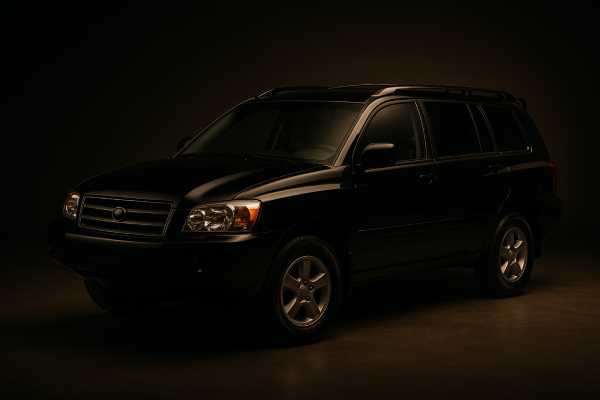
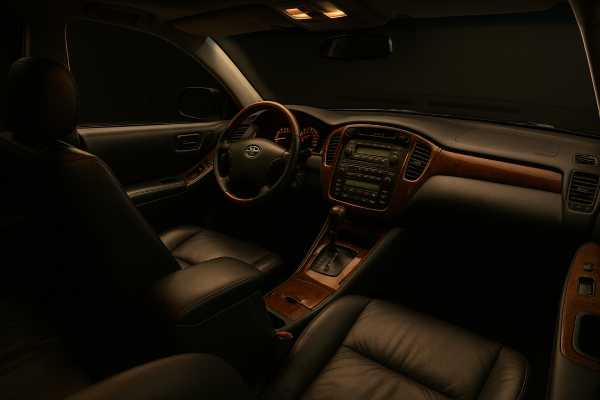
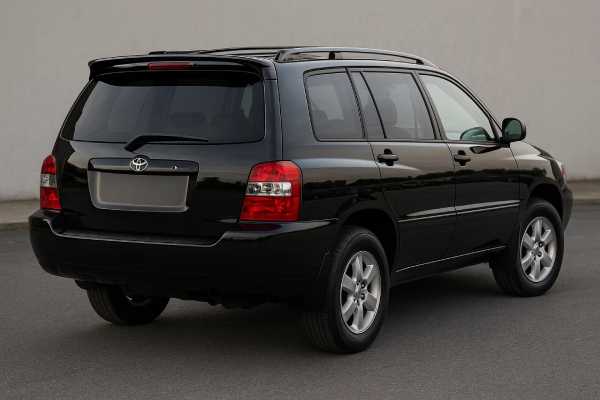
The facelift 2006–2007 Toyota Highlander FWD (MCU20) with the 3MZ-FE 3.3-liter V6 is the “use it for everything” version of the first-generation Highlander. It keeps the family-friendly, Camry-based unibody, but adds the smooth, torquey V6 that many owners prefer for highway merges, mountain drives, and towing. At 215 hp, the V6 gives the Highlander the reserve the four-cylinder trims lack, and the 5-speed automatic introduced on these later models helps both performance and economy. You still get an easy-to-park footprint, flat load floor, and available third row, and—because this is FWD, not AWD—you avoid the extra weight and servicing of rear driveline components. For buyers in moderate climates who want reliability and more power than the 2.4, this is the sweet spot. The main thing to remember: the 3MZ-FE uses a timing belt, so budgeting for belt-and-water-pump service is smart.
Quick Specs and Notes
- 3MZ-FE 3.3-liter V6, 215 hp (160 kW) and strong midrange torque, paired with 5-speed automatic.
- FWD layout reduces weight and service complexity versus AWD, while keeping 3,500 lb tow potential when properly equipped.
- Spacious, flexible interior with five seats standard and available third row; good safety equipment after facelift.
- Timing belt and water pump typically due around 90,000 miles / 9 years; verify on used units.
- Routine engine oil change: 5,000 miles / 6 months with correct API and viscosity.
Start here
- Highlander V6 FWD overview
- Specifications and technical data
- Trims, safety and driver assistance
- Reliability, issues and service actions
- Maintenance and buyer’s guide
- Driving and performance
- How the V6 compares to rivals
Highlander V6 FWD overview
When Toyota updated the first-gen Highlander for 2006–2007, the biggest win for shoppers was the availability of the 3.3-liter 3MZ-FE V6 in a package that still felt like a car to drive. Earlier Highlanders were already proven for reliability, but the four-cylinder variants could feel taxed when loaded or driven at altitude. The facelift V6 Highlander solves that without forcing you into AWD or a much larger SUV. It uses the transverse V6 layout from other Toyota family vehicles of the period, keeps to a low step-in height, and preserves the airy, minivan-like cabin.
The 3MZ-FE is a 60-degree, all-aluminum V6 with VVT-i and a timing belt. It is a refined engine—quiet at cruise, linear in delivery, and responsive enough for big-city ramps. Because this is an FWD model (MCU20), you do not have a transfer or rear differential to service, and curb weight stays lower than on comparable AWD models, helping fuel economy and brake life. For many owners, that combination—more power but no AWD complexity—is the reason to buy this exact spec.
Inside, the Highlander keeps to the straightforward Toyota approach of the era: wide, flat floor; second-row that folds easily; and, on many vehicles, a compact third row that bumps seating to seven. The square rear opening is a real asset if you frequently haul baby gear, sports equipment, or weekend project materials. The facelift brought nicer trim, more consistent side/curtain airbag fitment, and widespread stability control.
For daily use, the V6 FWD Highlander slots right between a Camry and a full-size SUV: more cargo and seating flexibility than the sedan, yet a smaller, thriftier footprint than something like a Sequoia or 4Runner. That is why so many of these run well past 200,000 miles—owners simply never have a reason to replace them once they build a service routine around the belt, fluids, and brakes.
Specifications and technical data
Engine and performance (ICE-only)
| Item | Detail |
|---|---|
| Engine code | 3MZ-FE |
| Configuration | 60° V6, aluminum block and heads, DOHC, 24 valves |
| Displacement | 3.3 L (3,311 cc) |
| Valvetrain | DOHC with VVT-i (intake) |
| Induction | Naturally aspirated |
| Fuel system | Sequential multi-port fuel injection |
| Compression ratio | ~10.8:1 (typical 3MZ-FE) |
| Max power | 215 hp (160 kW) @ ~5,800 rpm |
| Max torque | ~301 Nm (222 lb-ft) @ ~4,400 rpm |
| Timing drive | Belt (timing belt, replace on schedule) |
| Firing order | 1–2–3–4–5–6 (V6) |
| EPA economy (FWD V6) | Around 19 mpg city / 25 mpg highway / ~21–22 mpg combined (12.4–9.4 L/100 km) |
| Real-world highway @ 120 km/h (75 mph) | Typically 21–23 mpg US (11.2–10.2 L/100 km), load and tires dependent |
The 3MZ-FE is noticeably stronger than the 2.4. It moves the Highlander more authoritatively from a stop, and because peak torque arrives around 4,400 rpm, kickdowns for passing feel a lot less strained. The higher compression ratio and VVT-i favor both efficiency and response, so owners often report highway numbers close to the official ratings if the vehicle is lightly loaded.
Transmission and driveline
| Item | Detail |
|---|---|
| Transmission | 5-speed automatic, electronically controlled (typical Toyota U151E family) |
| Drive type | FWD (transverse engine) |
| Final drive ratio | Short enough for brisk response, tall 5th for highway economy |
| Differential | Integrated front differential, open type |
| Traction/stability | TRAC and Vehicle Stability Control (VSC) commonly fitted on facelift models |
| Refuel to full | ~5 minutes (gasoline) |
The 5-speed automatic is one of the quiet strengths of this configuration. Compared with the 4-speed on the four-cylinder, you get better spacing, which helps keep the V6 in its sweet spot and also aids towing.
Chassis and dimensions
| Item | Detail |
|---|---|
| Platform | XU20 Highlander unibody, Camry-based |
| Suspension (front) | MacPherson strut |
| Suspension (rear) | MacPherson strut |
| Steering | Power-assisted rack-and-pinion |
| Brakes | Front ventilated discs; rear solid discs; ABS with EBD and Brake Assist |
| Wheels/tires | Commonly 225/70R16; some trims with alloy wheels |
| Ground clearance | ≈ 185 mm (7.3 in) |
| Length | ≈ 4,689 mm (184.6 in) |
| Width | ≈ 1,826 mm (71.9 in) |
| Height | 1,700–1,750 mm (67–69 in), roof-rail dependent |
| Wheelbase | 2,715 mm (106.9 in) |
| Turning circle | ≈ 11.4 m (37.4 ft) |
| Curb weight | Heavier than 2.4 FWD: typically ~1,740–1,790 kg (3,840–3,950 lb) depending on seating |
| GVWR | Door-jamb label; often ~2,350–2,420 kg (5,180–5,335 lb) |
| Fuel tank | 72.5 L (19.1 US gal / 15.9 UK gal) |
| Cargo volume | Flat, boxy area; 5-seat models most generous; 3-row models sacrifice some floor height |
Performance and capability
| Metric | Value |
|---|---|
| 0–100 km/h (0–62 mph) | ~8.5–9.0 s (FWD, healthy engine, light load) |
| 0–60 mph | ~8.0–8.5 s |
| Top speed | ~180 km/h (112 mph) limited by gearing/tires |
| Braking 100–0 km/h | Stable, ABS-controlled; distance depends heavily on tire condition |
| Towing capacity | 1,500 lb (680 kg) standard; up to 3,500 lb (1,588 kg) with tow package/coolers |
| Payload | ≈ 400–520 kg (880–1,150 lb), seating and options dependent |
| Roof load | Typically 68–75 kg (150–165 lb) on factory rails/crossbars |
Fluids and service capacities
| System | Specification / Capacity |
|---|---|
| Engine oil | 5W-30 (per cap/manual) ~5.0 L (5.3 US qt) with filter for V6 |
| Coolant | Toyota Super Long Life Coolant (pink), premixed 50/50; ~7–8 L (7.4–8.4 US qt) |
| Automatic transmission | Toyota ATF Type WS; drain/refill quantity depends on method |
| Power steering | Toyota-approved fluid; check reservoir and hoses |
| Brake fluid | DOT 3 |
| A/C refrigerant | R-134a (follow under-hood label for charge) |
| A/C compressor oil | Toyota-specified ND-oil type, charge per manual |
| Key torque specs | Wheel lugs ≈ 103 Nm (76 lb-ft); oil drain ≈ 37 Nm (27 lb-ft) |
Electrical
| Item | Detail |
|---|---|
| Alternator | Sized for HVAC, rear defogger, and accessory loads |
| 12V battery | Maintenance-free, group size per build; test annually in cold climates |
| Spark plugs | Long-life iridium; gap ~1.0–1.1 mm (0.039–0.043 in) |
Safety and driver assistance
- Dual front airbags, front seat-mounted side airbags, and side curtain airbags widely available after refresh.
- ABS with EBD and Brake Assist standard on most 2006–2007 V6 models.
- Vehicle Stability Control is strongly recommended—verify on the specific vehicle.
- LATCH points in second row; check third-row belt routing and anchor locations when fitted.
- Halogen headlamps; keep lenses clear and aim correct for best night performance.
Trims, safety and driver assistance
In North America, V6 Highlanders of this period were typically offered in Base, Sport, and Limited-style equipment levels, with some equipment shifting slightly year-to-year. Because we are discussing the FWD V6, most examples will be more feature-rich than four-cylinder bases, but less mechanically complex than AWD Limiteds.
Base FWD V6 identifiers:
- 3.3L V6 badging and 5-speed automatic.
- 16-inch wheels and all-season tires.
- Manual A/C, cloth interior.
- 5-passenger seating standard; optional third row.
- Stability control, ABS/EBD, and traction control on many vehicles—confirm dashboard telltales.
Sport/Limited-style additions (market dependent):
- Alloy wheels (16–17 in), color-keyed exterior trim.
- Power driver’s seat, upgraded fabrics or leather.
- JBL or premium audio with more speakers.
- Moonroof, roof rails, convenience bundle.
- Third-row seat more commonly installed.
- Some Limiteds add heated seats and more elaborate interior trim.
Safety and crashworthiness points:
- Facelifted Highlanders have strong frontal crash performance and a stable passenger compartment.
- Side impact performance improves significantly with the presence of side and curtain airbags—confirm they are present.
- Head restraint effectiveness is typical for the era; tall drivers should check actual adjustment.
- Tire Pressure Monitoring System becomes more common toward 2007; confirm the system functions at key-on.
Driver assistance and service implications:
- These models predate radar- and camera-based ADAS.
- The most service-relevant systems are ABS and VSC. After suspension, steering, or alignment work, a zero-point calibration for the yaw/steering-angle sensor may be necessary.
- ABS/VSC lights after brake or hub service often point to nicked wheel-speed sensor wiring or a misseated sensor.
Year-to-year changes that matter:
- 2006 update: refreshed exterior, improved interior trim, better availability of side/curtain airbags.
- 2007: TPMS more common, minor audio changes.
- Mechanically, the FWD V6 recipe stays consistent: 3.3L 3MZ-FE, 5-speed automatic, FWD, same basic suspension.
Reliability, issues and service actions
The V6 Highlander of this era is a durable machine, but it is not identical in ownership profile to the four-cylinder versions. There are some V6-specific service events to plan for, and a few age-related problems to watch for.
Common / high-priority items
- Timing belt replacement (common, predictable): The 3MZ-FE uses a belt, not a chain. Toyota’s typical interval is around 90,000 miles (145,000 km) or 9 years. Smart owners do the water pump, idlers, and tensioner at the same time. Skipping this is the number one “hidden” cost on used examples—ask for proof.
- Oil leaks at valve cover and front engine area (occasional): Heat and age harden gaskets. Symptom: oil film, smell on warmup. Remedy: gasket replacement, often combined with plug-tube seal service.
- Intake/throttle deposits (occasional): Higher-mileage V6s can develop throttle-body and idle-air deposits, leading to rough idle or stalling right after start. Cleaning and idle relearn fix it.
Cooling and accessories
- Radiator and hoses (age-related): Original radiators approach end-of-life after 15–18 years. Plastic end tanks can seep. Replace radiator, upper/lower hoses, and cap together; refill with Toyota SLLC.
- Heater and HVAC controls: Blower resistors or the blower motor itself can age out. Easy to diagnose—fan speeds fail or you hear squeaks.
- A/C system: R-134a components are reliable but take damage from front-end impacts; always evacuate and recharge to spec.
Transmission / driveline
- The 5-speed automatic in these is robust when serviced. Fluid described as “lifetime” under ideal conditions still ages. A conservative drain-and-fill every 60,000–90,000 miles keeps shifts clean.
- No rear differential on FWD means one less fluid to buy, one less leak to chase, and lower risk of corrosion on rear driveline parts.
Suspension and steering
- Strut mounts, sway-bar links, and rear bushings are common wear areas. Noises over driveway entries, wandering on the highway, or irregular tire wear are your clues.
- Wheel bearings can hum, especially on vehicles that have run wider aftermarket tires.
Corrosion hotspots
- In salt-prone regions: lower control-arm hardware, exhaust flanges, brake backing plates, and line clips. Inspect underneath before committing to a purchase.
TSBs, recalls, and extended coverage
- Owners should run the VIN through the official recall portal to confirm all safety campaigns are done.
- Some 3MZ-FE applications had TSBs for drivetrain feel or MIL lights related to EVAP or oxygen sensors. Using OE-level sensors usually prevents recurrence.
- Airbag or seatbelt campaigns can exist on certain build months—verify with a current lookup.
Pre-purchase checks
- Ask specifically: “When was the timing belt and water pump last replaced?” If the answer is vague, negotiate.
- Check for ATF color and smell. Very dark or burnt-smelling fluid suggests neglect.
- Verify all warning lights (ABS, VSC, TRAC, TPMS) light up at key-on and go out after start.
- Inspect engine mounts—V6 torque and age can crack them, causing vibration.
- Road test from cold to hot—some issues (like minor transmission flare) show only when fully warm.
Maintenance and buyer’s guide
A simple, disciplined service plan is the best way to make an MCU20 V6 run for 200,000–300,000 miles.
Recommended maintenance rhythm
- Engine oil and filter: Every 5,000 miles / 6 months. V6s run warmer and benefit from shorter intervals, especially in city use.
- Engine air filter: Inspect 15,000 miles / 12 months, replace 30,000–45,000 miles.
- Cabin air filter: Replace 15,000–20,000 miles / 12–18 months.
- Coolant (Toyota SLLC): Initial long-life up to 100,000 miles / 10 years, then 50,000 miles / 5 years.
- Spark plugs (iridium): 120,000 miles / 10–12 years; inspect coil boots.
- Serpentine belt: Inspect 30,000 miles / 3 years; replace 60,000–90,000 miles or if glazed/cracked.
- Automatic transmission (ATF WS): Drain-and-fill 60,000–90,000 miles.
- Brake fluid: Replace every 3 years.
- Brake pads/rotors: Inspect with every tire rotation; measure rotor thickness/runout.
- Tire rotation/alignment: Rotate 5,000–7,500 miles; align annually or after suspension work.
- 12V battery: Test annually; typical life 4–6 years.
- Timing belt + water pump: 90,000 miles / 9 years—non-negotiable for long-term reliability.
Fluid quick list
- Engine oil: 5W-30, ~5.0 L
- Coolant: Toyota SLLC, premixed
- ATF: Toyota WS
- Brake: DOT 3
- Power steering: Toyota-approved
- Wheel lugs: ~103 Nm (76 lb-ft)
Buyer’s inspection checklist
- Proof of timing belt service: invoice should list belt, water pump, tensioner, idlers, and coolant.
- Check for oil leaks around the timing cover and valve covers.
- Listen to the 5-speed auto during light throttle upshifts and kickdowns. Should be consistent, no harsh bangs.
- Underbody corrosion—FWD cars are better than AWD in this respect, but lines and hardware still rust.
- HVAC and electronics—make sure all blower speeds, A/C, rear washer/wiper, sunroof (if fitted), and power seats work.
- Third row (if present): seats should fold flat easily; belts and latches intact.
What to seek
- 2006–2007 FWD V6 with stability control and side/curtain airbags.
- Documented timing belt.
- Recent brakes and struts if mileage is over 150,000.
- Unmodified intake/exhaust.
What to avoid or price lower
- No timing-belt proof.
- Persistent check-engine lights for EVAP or catalyst without diagnosis.
- Unusual transmission behavior when hot.
- Heavy aftermarket wheels or lift kits—these add stress to hubs and suspension.
Driving and performance
The best word for how the V6 FWD Highlander drives is easy. Steering is light, visibility is very good, and the 3.3L V6 provides the sort of reserve that makes you more relaxed in traffic.
Ride and handling:
The MacPherson-strut layout and relatively soft bushings make for a comfortable ride over broken pavement. Body roll is present but controlled, and the Highlander does not heel over as much as taller, truck-based SUVs. Straight-line stability at highway speeds is good, especially with fresh struts and an alignment to factory specs.
Powertrain character:
Unlike the four-cylinder, the V6 does not need to rev hard just to keep up. Light throttle keeps you with traffic, and when you press deeper, the 5-speed drops to the right gear without much hunting. The engine note is smooth and subdued—most noise at highway speed is from tires and wind. The 5-speed also helps in hilly areas because it has more ratios to choose from.
Real-world efficiency:
Owners typically report 19–22 mpg US mixed (12.4–10.7 L/100 km). At 65–70 mph, 23–25 mpg US (10.2–9.4 L/100 km) is realistic for a healthy, lightly loaded vehicle on correct tires and with roof racks removed. Heavier wheels/tires, constant cargo, or urban short trips will pull it down to 16–18 mpg (14.7–13.1 L/100 km).
Braking and NVH:
Brakes are confidence-inspiring for normal family use. Pedal feel stays consistent if fluid is changed every three years. Older tires and worn strut mounts will add noise, but these are straightforward fixes.
Load and towing:
When factory-equipped and in good mechanical health, the FWD V6 Highlander can tow up to 3,500 lb (1,588 kg). At that weight, expect a 20–30% increase in fuel use and longer braking distances—leave room. Because this is FWD, making sure the transmission fluid is fresh and the cooling system is in top shape is more important. Keep tongue weight correct to maintain front-end traction.
How the V6 compares to rivals
Versus Highlander 2.4 FWD:
The V6 is quicker, quieter, and tows more. The 2.4 has lower running costs (no timing belt, slightly better fuel economy). If you never tow and live somewhere flat, the 2.4 is enough. Otherwise, the 3.3 V6 is the better long-term choice.
Versus Highlander AWD V6:
AWD adds traction but also weight, drag, and fluid services. In mild climates, the FWD V6 is simpler and cheaper to own. In snowbelts, AWD may be worth the added complexity.
Versus Honda Pilot (2006–2007):
Pilot offers more usable third-row space and standard V6 power, but it is bigger and thirstier, and timing-belt service is similar in cost. The Highlander wins for ease of parking and slightly better refinement.
Versus Nissan Murano (first gen):
Murano’s VQ V6 is strong, but the CVT of that period scares some buyers. Toyota’s 5-speed conventional automatic is a lower-risk long-term bet.
Versus Toyota RAV4 V6 (2006–2007):
RAV4 V6 is lighter and can be quicker, but the Highlander’s cabin is more family-friendly, and the ride is calmer. If you often carry five people, the Highlander wins.
Overall, the 2006–2007 Toyota Highlander FWD (MCU20) with the 3.3L V6 is the balanced version: enough power for any normal commute or family trip, better equipment, simple FWD running gear, and very well-understood service needs.
References
- Toyota Owner’s Manuals 2007 (Owner’s Manual)
- 2007 Toyota Highlander 2007 (Fuel Economy)
- 2007 Toyota Highlander 2007 (Safety Rating)
- Toyota Safety Recall and Service Campaign Lookup (Recall Database)
Disclaimer
This article is intended for informational purposes only and does not replace professional diagnosis, factory repair procedures, or safety inspections. Specifications, torque values, capacities, and service intervals can vary by VIN, production month, equipment package, and market. Always confirm against your vehicle’s official Toyota service information and the latest technical bulletins.
If this guide helped you, please share it with other Highlander owners on Facebook or X/Twitter to support xcar’s work.