
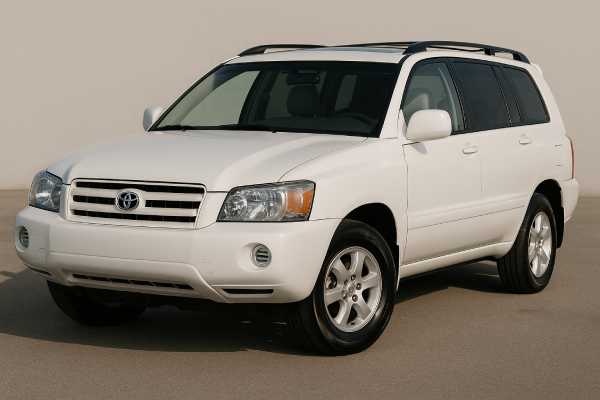
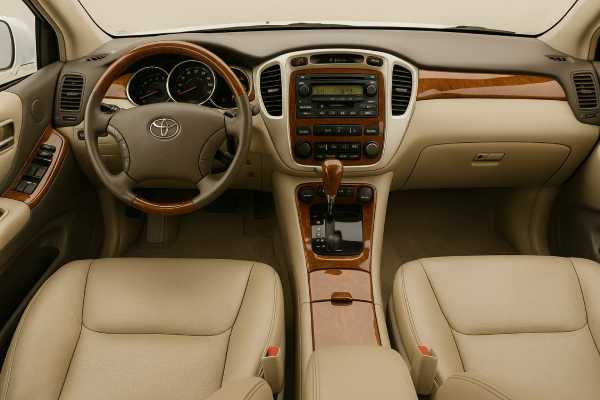
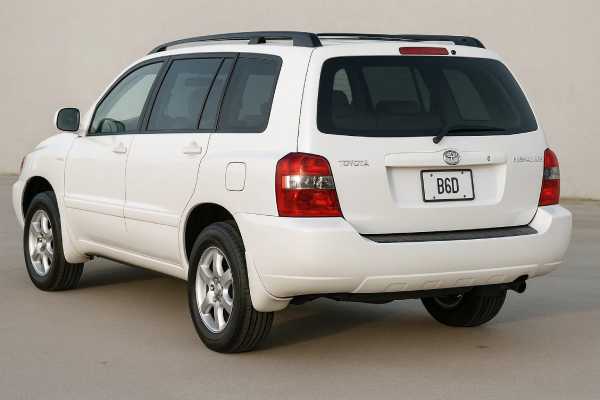
The 2004–2005 Toyota Highlander FWD with the 3MZ-FE 3.3-liter V6 arrived with the facelift and five-speed automatic, bringing stronger mid-range torque, quieter cruising, and a broader feature spread than early models. It rides on the Camry platform, so it feels car-like in daily use, yet offers a tall driving position, flexible cabin, and genuine long-distance comfort. Owners prize these years for their balance of reliability and simplicity—no turbocharger, no direct injection, and service access that independent shops know well. This guide focuses on the front-wheel-drive V6 (MCU20), covering specifications, performance, real-world ownership patterns, maintenance priorities, and how it stacks up against rivals of the era. If you want a midsize crossover that’s easy to live with, tows modestly, and keeps running costs predictable, this V6 Highlander remains a smart, value-led choice—provided you verify belt service, cooling health, and recall actions.
Quick Specs and Notes
- Proven 3.3-liter V6 (3MZ-FE): smooth, durable, strong mid-range; five-speed automatic reduces revs at highway speeds.
- Comfortable, quiet ride with car-like manners; versatile cabin with optional third row and flat fold cargo floor.
- Moderate towing: up to 3,500 lb (1,588 kg) when properly equipped; transmission cooler recommended.
- Watch items: timing belt due ~90,000 miles (145,000 km) or 9 years; inspect water pump and cam seals while in there.
- Routine interval anchor: engine oil and filter every 5,000 miles (8,000 km) or 6 months.
Navigate this guide
- Detailed Overview
- Specifications and Technical Data
- Trims and Options, Safety and Driver Assistance
- Reliability, Common Issues and Service Actions
- Maintenance and Buyer’s Guide
- Driving and Performance
- How Toyota Highlander Compares to Rivals
Highlander 3.3 FWD in detail
Toyota’s facelifted first-generation Highlander added the 3MZ-FE 3.3-liter V6, an aluminum DOHC 24-valve engine with variable valve timing on the intake side. Output rose to 230 hp (172 kW) and about 242 lb-ft (328 Nm), a useful bump over the earlier 3.0 V6. Paired with the U151E five-speed automatic, the front-wheel-drive configuration cruises more relaxed than four-speed versions, with lower engine speed at 65–75 mph (105–120 km/h) and fewer kickdowns for passing.
The platform is Camry-based, so the ride is supple and road noise is well suppressed for the era. Steering is light but consistent, suspension tuning favors comfort, and body control is tidy at family-car speeds. Inside, you’ll find generous glass area, intuitive controls, and a low cargo floor. Two-row models offer excellent everyday usefulness; the optional third row suits occasional use for children. With the second row split folding and nearly flat load space, it moves from school-run duty to home-improvement errands without fuss.
Where these years shine is “predictable ownership.” There’s a timing belt rather than a chain, and it can be proactively replaced along with the water pump, idlers, and seals on a schedule. No high-pressure fuel pump, no turbo cooling complexity, and no exotic chassis bushings. Fluids are conventional (Toyota T-IV ATF for the transaxle and pink Super Long Life coolant), and parts support is superb.
As a used buy, the Highlander V6 FWD rewards service history and gentle care. Confirm belt replacement, check cooling system condition, and look for evidence of transmission fluid service. If those boxes are ticked—and the body is clean—this is a crossover you can drive for years with limited surprises.
Highlander 3.3 FWD specs and data
Engine and Performance (ICE)
| Item | Specification |
|---|---|
| Code | 3MZ-FE |
| Layout & cylinders | 60° V6, DOHC, 24 valves, VVT-i (intake) |
| Displacement | 3.3 L (3,311 cc) |
| Bore × stroke | 92.0 × 83.0 mm (3.62 × 3.27 in) |
| Compression ratio | ~10.8:1 |
| Induction | Naturally aspirated |
| Fuel system | Multi-point electronic fuel injection (EFI) |
| Max power | 230 hp (172 kW) @ ~5,800 rpm |
| Max torque | 328 Nm (242 lb-ft) @ ~3,600 rpm |
| Timing drive | Belt (replace on interval) |
| Emissions/efficiency standard | EPA-rated (model-year specific) |
| EPA fuel economy (typical) | ~20 mpg combined (US) ≈ 11.8 L/100 km; ~18/24 mpg city/hwy (US) ≈ 13.1/9.8 L/100 km |
Transmission and Driveline
| Item | Specification |
|---|---|
| Transmission | U151E 5-speed automatic with lock-up torque converter |
| Drive type | FWD (front transaxle) |
| Final drive | Conventional open differential (brake-based traction control) |
| Towing (properly equipped) | Up to 3,500 lb (1,588 kg) |
Chassis and Dimensions
| Item | Specification |
|---|---|
| Front/rear suspension | MacPherson strut / MacPherson strut |
| Steering | Hydraulic rack-and-pinion, power assist |
| Brakes (F/R) | Ventilated disc / solid disc; ABS with EBD and Brake Assist |
| Wheels/tires (typical) | 225/70R16 on 16×6.5 in; optional 225/65R17 on 17×6.5 in |
| Ground clearance | ~185 mm (7.3 in) |
| Length × width × height | ~4,690 × 1,820 × 1,730 mm (~184.6 × 71.7 × 68.1 in) |
| Wheelbase | ~2,715 mm (~106.9 in) |
| Turning circle (curb-to-curb) | ~11.4 m (~37.4 ft) |
| Curb weight (range) | ~1,660–1,710 kg (~3,660–3,770 lb) |
| Fuel tank | ~72 L (19.1 US gal / 15.9 UK gal) |
| Cargo volume (SAE, 2-row) | ~1,124 L (39.7 ft³) seats up / ~2,285 L (80.6 ft³) seats down |
Performance and Capability
| Metric | Value (typical) |
|---|---|
| 0–60 mph / 0–100 km/h | ~7.8–8.2 s (ambient/tires/load dependent) |
| Top speed (governed) | ~180 km/h (112 mph) |
| Braking 62–0 mph (100–0 km/h) | ~39–42 m (~128–138 ft) on quality all-seasons |
| Towing capacity | See above (with tow prep and hitch) |
| Roof load | Check factory crossbar rating; many fit 68–75 kg (150–165 lb) with OE bars |
Fluids and Service Capacities
| System | Specification / Capacity |
|---|---|
| Engine oil | 5W-30 (API SL or later); ~4.7–4.9 L (5.0–5.2 US qt) with filter |
| Coolant | Toyota Super Long Life (pink), premixed 50/50; ~8–9 L (~8.5–9.5 US qt) total |
| Transmission (U151E) | Toyota Type T-IV ATF; drain-and-fill ~3.5–4.0 US qt; total fill ~8.5–9.0 US qt (approx.) |
| A/C refrigerant | R-134a; ~650–750 g (23–26 oz) typical charge |
| A/C compressor oil | ND-8 (PAG 46); ~120 mL (4.1 fl oz) |
| Key torque values | Wheel lug nuts ~103 Nm (76 lb-ft); spark plugs ~18 Nm (13 lb-ft); oil drain plug ~39 Nm (29 lb-ft) |
Electrical
| Item | Specification |
|---|---|
| Alternator output | ~100–130 A (equipment dependent) |
| 12V battery | Group 24F (typical), ~550–650 CCA |
| Spark plugs | Iridium long-life (e.g., SK20R11/IFR6A11), gap 1.1 mm (0.044 in) |
Safety and Driver Assistance
| Area | Notes |
|---|---|
| Crash ratings | Strong moderate-overlap performance for the generation; side-impact results vary by airbag fitment (see Safety section below). |
| Head restraints | Earlier head-restraint ratings trend Marginal/Poor; check seat design and adjustment. |
| Systems | ABS, EBD, Brake Assist standard; stability control (VSC) and traction control (TRAC) widely available/standard depending on trim and year; no AEB, ACC, or lane systems in this era. |
Trims, options, safety tech
Trim structure (2004–2005, FWD V6 focus): Most examples are Base or Limited. The Base brings cloth seating, 16-inch wheels, manual HVAC, and a power driver seat on many builds. The Limited adds leather, heated front seats, auto HVAC, power moonroof, 17-inch wheels, JBL audio, and additional trim detailing. Seven-passenger seating (third row) was optional, as were side-impact and side-curtain airbags—important for side-impact protection. A Towing Prep Package (auxiliary transmission cooler, heavy-duty radiator/alternator on some builds, wiring provisions) is common on V6s and desirable if you’ll tow near 3,500 lb (1,588 kg).
Mechanical/functional differences to watch:
- Wheels/tires: Base 16-inch package rides softer and is cheaper to replace; Limited 17-inch package tightens steering response slightly.
- Brakes/suspension: No special performance trims; suspension tuning is comfort-oriented across the line.
- Seating: Two-row models offer class-leading cargo ease; the third row folds into the floor but reduces flat load depth slightly.
- Infotainment: JBL premium audio upgrade appears on many Limiteds; navigation was limited in availability—most cars use standard head units.
Year-to-year highlights (FWD V6):
- 2004 (facelift launch for 3.3): New 3.3-liter V6 and five-speed automatic. Styling refresh to bumpers, grille, lamps, and cabin details.
- 2005: Feature packaging and options reshuffled; widespread availability of stability control and side/curtain airbags depending on inventory.
Safety ratings (generation context):
- Moderate overlap frontal: Strong structure and restraint performance for this era.
- Side impact: Vehicles with optional side torso and curtain airbags perform markedly better than those without. Prioritize cars so equipped.
- Head restraints/seats: Earlier designs often rate Marginal/Poor; adjust head restraint high and close to the head for best protection.
Child-seat and cargo points:
- LATCH lower anchors on the second row outboard seats; use seatbelt plus top tether on third-row positions where applicable.
- The cargo floor sits low and nearly flat when seats are folded, making it easy to slide in strollers, bikes, or boxes.
- If you will tow, confirm a genuine hitch, correct wiring, and the auxiliary cooler presence (or retrofit).
Reliability, issues, service actions
Overall outlook: The 3MZ-FE Highlander earns a reputation for long service life with routine maintenance. Most problems are age-and-mileage items rather than design flaws, and parts availability is excellent.
Common (plan for it):
- Timing belt service (every ~90k miles/145k km or 9 years): replace the belt, tensioner/idlers, and water pump; renew cam/crank seals if sweating. Cost: medium.
- External coolant seep at water pump: often discovered during belt service—replace pump and gasket, inspect thermostat and hoses. Cost: medium (combined with belt).
- Valve cover gasket leaks: oil weep onto exhaust shields or rear bank; replace gaskets and spark-plug tube seals. Cost: medium.
- Oxygen sensors / catalytic efficiency codes (P0420/P0430): aging sensors and/or tired cats; diagnose with live data before replacing cats. Cost: low→high depending on parts choice.
Occasional (watchful waiting):
- Alternator aging / battery weakness: dim lights, slow cranking; test charging system, fit correct 24F battery (~550–650 CCA). Cost: low→medium.
- Front strut mounts/bushings and rear shock wear: thumps over sharp edges; quality struts restore ride. Cost: medium.
- Steering intermediate shaft clunk: grease or replacement shaft cures it. Cost: low→medium.
- Evap system faults: loose cap, purge/vent valve sticking, or charcoal canister saturation; smoke test and component replace as needed. Cost: low→medium.
Rare but notable:
- U151E shift flare or harshness: most respond to correct ATF level/quality and the latest calibration; valve-body wear shows up at high miles or heavy tow use. Cost: low (service) → high (VB work).
- Radiator trans cooler seep (age): proactive radiator replacement is inexpensive insurance before frequent towing in hot climates.
Software and calibrations: Powertrain control updates exist to refine shift scheduling and idle/driveability. Confirm the ECM/TCM calibration status during pre-purchase inspection; dealers and capable independents can check and reflash.
Recalls and service actions: First-gen Highlanders of these years may be covered by safety campaigns (airbags, components, or labeling) depending on VIN. Always run an official VIN recall check and confirm completion documents in the service file.
Pre-purchase checklist, targeted:
- Belt service documented? What parts were included (pump, idlers, seals)?
- Cooling system condition (no pink crust, stable temp, fans OK).
- Transmission: warm road test for 2–3 and 3–4 shifts, hill downshifts, and converter lock-up; inspect ATF color/odor.
- Oil leaks: rear bank valve cover, oil cooler O-ring.
- Suspension: clunks over speed bumps, uneven tire wear; look for cheap struts.
- Brakes: firm pedal, even rotor surfaces, ABS light off.
- Electrical: charging at ~13.8–14.4 V, clean grounds; no accessory wiring hacks.
- Body: liftgate lower seam, wheel-arch lips, and subframe corrosion (salt states).
- Safety: verify side/curtain airbags; confirm child-seat anchor locations and condition.
Maintenance and buyers guide
Core service schedule (practical):
- Engine oil + filter: every 5,000 miles (8,000 km) or 6 months; 5W-30 meeting modern API specs.
- Engine air filter: inspect 15,000 miles (24,000 km); replace 30,000 miles (48,000 km) or as needed.
- Cabin filter: 15,000–20,000 miles (24,000–32,000 km), more often in dusty climates.
- Coolant (SLLC pink): first change at 100,000 miles (160,000 km) / 10 years; then every 50,000 miles (80,000 km) / 5 years.
- Spark plugs (iridium): 120,000 miles (193,000 km).
- Timing belt kit + water pump: 90,000 miles (145,000 km) or 9 years.
- Brake fluid: replace every 3 years regardless of mileage.
- ATF (U151E, T-IV): drain-and-fill every 60,000–80,000 miles (96,000–128,000 km), more often with towing; avoid universal fluids that don’t explicitly meet T-IV.
- Serpentine belt and hoses: inspect annually; typical replacement around 90,000–120,000 miles (145,000–193,000 km).
- Alignment + tire rotation: rotate every 5,000 miles (8,000 km) with oil service; check alignment yearly or after impacts.
- 12V battery: test annually after year 4; many last 4–6 years.
- Brake pads/rotors: inspect each service; replace in axle sets with quality parts to keep pedal feel consistent.
Fluid quick reference and capacities (decision drivers):
- Engine oil: 4.7–4.9 L (5.0–5.2 US qt).
- Coolant: ~8–9 L (~8.5–9.5 US qt).
- Automatic transmission: drain ~3.5–4.0 US qt; total ~8.5–9.0 US qt.
- Power steering: ATF (as specified) to correct level; check for seep at rack ends.
- A/C: R-134a ~650–750 g; ND-8 oil.
Essential torques (handy):
- Wheel lugs: ~103 Nm (76 lb-ft).
- Spark plugs: ~18 Nm (13 lb-ft) on clean, dry threads (iridium).
- Oil drain plug: ~39 Nm (29 lb-ft).
Always verify against your exact VIN service documentation.
Buyer’s guide (what to seek/avoid):
- Seek: documented timing-belt/water-pump service; coolant and ATF care; two-owner cars with organized records; side/curtain airbags; stability control; towing prep (if you tow).
- Consider: two-row models if you want maximum cargo usability; 16-inch wheels for ride comfort and tire cost.
- Avoid or budget for: neglected belt service; warning lights for evap or catalyst (dig in first); mismatched tires; aftermarket springs or cheap struts; corrosion at subframe mounts in salt-belt cars.
Durability snapshot: With routine maintenance, these Highlanders commonly run past 200,000 miles (320,000 km) on original long-block. Expect consumables (struts, alternator, radiator) on time rather than surprises.
Driving and performance
Ride, handling, NVH: The Highlander rides softly yet keeps decent body control. Impacts are rounded off, the cabin stays quiet at 70 mph (113 km/h), and wind noise is restrained for a boxier shape. Steering is light and consistent—easy to place in parking lots, steady on the highway. Brakes are progressive; pedal feel improves with quality pads and fresh fluid.
Powertrain character: The 3MZ-FE V6 is smooth and eager above 2,500 rpm. It makes its best work in the mid-range, so everyday passing is confident without big downshifts. The U151E five-speed helps: first is short enough for clean launches, and fifth gears it down for relaxed cruising. Kickdown comes quickly when you lean into the throttle; shift feel is unobtrusive when the ATF is healthy.
Real-world economy: Expect around 18–21 mpg US (13.1–11.2 L/100 km) in mixed suburban use. At 70–75 mph (113–120 km/h) highway, many owners see 21–24 mpg US (11.2–9.8 L/100 km) depending on wind, tires, and load. Winter fuel and short trips can drop results a few mpg; careful tire pressures and fresh air filter help.
Key metrics that shape the verdict:
- 0–60 mph: about 7.8–8.2 s for a healthy FWD V6 on all-season tires.
- 50–80 mph passing: brisk for the class thanks to mid-range torque and the five-speed’s ratios.
- Braking 62–0 mph: around 39–42 m (128–138 ft) with quality components.
- Turning circle: ~11.4 m (37.4 ft), easy U-turns on city streets.
Load and towing: With proper hitch and coolers, a 2,500–3,000 lb (1,135–1,360 kg) camper or boat is well within comfort. Plan on a 20–35% fuel-economy penalty when towing at highway speeds, and respect transmission temps—downshift earlier on grades and avoid converter slip. A weight-distributing hitch is unnecessary at light loads but pay attention to tongue weight.
Traction and control: As FWD, snowy-hill starts depend on tires; fit good three-peak mountain/snowflake all-seasons or dedicated winters in cold climates. Stability control is effective without being intrusive; it trims wheelspin early to keep the nose tracking.
How Toyota Highlander compares to rivals
Honda Pilot (2004–2005): The Pilot’s third row is roomier and its ride slightly firmer. The J35 V6 is durable, but some transmissions in this era needed attention. Fuel economy is similar; the Highlander rides quieter and is easier to park.
Nissan Murano (2004–2005): Sportier steering and style, but early CVTs can be a long-term risk. Highlander’s conventional automatic and simpler service needs make it a safer high-mileage bet.
Ford Explorer (2004–2005, V6): Body-on-frame Explorer tows more and is better off-pavement but rides rougher and drinks more. Highlander suits daily commuting and family duty far better, with fewer age-related drivetrain surprises.
Subaru Outback (2005): Standard AWD, car-like drive, and sharp steering. Highlander counters with a larger cabin and easier ingress/egress; long-term, Toyota’s V6/auto pair is simpler than turbo or head-gasket-prone Subaru four-cylinders of the era.
Hyundai Santa Fe (2005): Value leader new, but earlier materials and rust resistance trail Toyota. As a used buy, Highlander’s resale remains higher for reasons: quieter cabin, stronger V6, and richer aftermarket/parts support.
Bottom line: If your priorities are quiet comfort, predictable maintenance, and longevity with modest towing, the 2004–2005 Highlander FWD 3.3 sits near the top of the class. If you need a truly adult-friendly third row or more standard safety tech, a later generation may fit better—but costs more.
References
- Gas Mileage of 2004 Toyota Highlander 2004 (Fuel Economy)
- Gas Mileage of 2005 Toyota Highlander 2005 (Fuel Economy)
- 2004 Toyota Highlander 2004 (Safety Rating)
- Check for Recalls: Vehicle, Car Seat, Tire, Equipment 2025 (Recall Database)
Disclaimer
This guide is for informational purposes only and is not a substitute for professional diagnosis or repair. Specifications, torque values, fluid capacities, and service intervals vary by VIN, market, production date, and equipment. Always verify procedures and values against your official service documentation and parts catalog before performing work. If this article helped you, please consider sharing it with friends and fellow owners on Facebook or X/Twitter to support xcar’s work.