
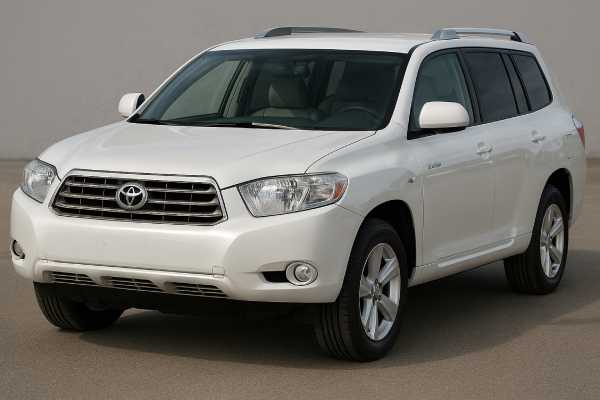
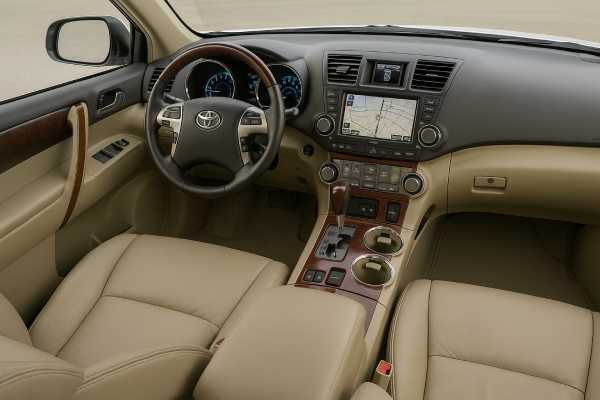
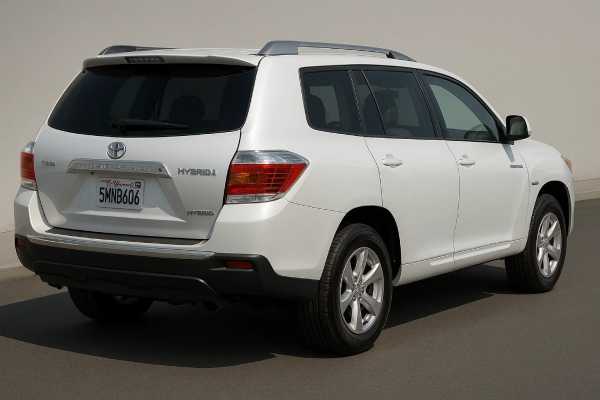
The 2008–2010 Toyota Highlander Hybrid 4WD-i (chassis MHU48) pairs Toyota’s robust 3.3-liter 3MZ-FE V6 with Hybrid Synergy Drive and an electrically driven rear axle. The result is a midsize three-row SUV that blends real-world efficiency with family-friendly space and Toyota’s reputation for long-term durability. Net output is 270 hp, delivered through an eCVT with a planetary gearset; the rear motor adds on-demand traction without a mechanical prop shaft. Seven seats, an available 19-inch wheel package, and a quiet cabin make it a straightforward daily driver. Owners value the smooth low-speed electric assist, strong around-town economy, and comparatively low maintenance needs. Key items to plan for on these model years include timing-belt service for the V6, cooling-system upkeep (engine and hybrid loops), and age-related wear on hybrid auxiliary components. If you want a practical, efficient, and simple-to-own three-row SUV from this era, this Highlander Hybrid belongs on the short list.
Fast Facts
- Strong city fuel economy (≈ 27 mpg US / 8.7 L/100 km) with smooth electric assist and quiet eCVT operation.
- Proven 3.3-L V6 + NiMH hybrid system; simple on-demand 4WD-i rear motor adds traction without complexity.
- Spacious, flexible interior (3 rows) with up to ~2.66 m³ (94.1 ft³) max cargo.
- Plan for timing-belt replacement at ~90,000 miles / 144,000 km (or 6 years) on the 3MZ-FE V6.
- Inspect hybrid cooling pumps and 12 V battery around 10–12 years as preventative maintenance.
Explore the sections
- Highlander Hybrid MHU48 overview
- Highlander Hybrid specs and data
- Highlander Hybrid trims and safety
- Reliability and known issues
- Maintenance and buyer’s guide
- Driving and performance
- Rivals and alternatives
Highlander Hybrid MHU48 overview
Toyota launched the second-generation Highlander Hybrid for 2008 with the MHU48 platform. It retains a transverse layout and uses Toyota’s Hybrid Synergy Drive to blend a 3.3-liter DOHC V6 with one front traction motor-generator plus a separate rear electric motor. The front axle combines engine and electric power through a planetary eCVT, while the rear motor (4WD-i) contributes traction when needed, without a driveshaft or transfer case. This keeps packaging efficient and reduces mechanical complexity.
With 270 hp net system output, performance is confident for a three-row family SUV, and the hybrid system’s instant torque helps launch the vehicle smoothly and quietly. The eCVT avoids shift shock and keeps the engine in its efficient range. Around town, the Highlander Hybrid often moves off under electric assistance and then blends in the V6 unobtrusively, which owners appreciate in stop-and-go traffic and residential areas.
Cabin packaging is straightforward: two front buckets, a second row with a center “removable seat/stowable console” on most trims, and an occasional-use third row. Acoustic glass and well-tuned engine mounts deliver low NVH. Feature content varies by trim, but even base models include stability control, side curtain airbags for all rows, and key convenience features; Limited models add upscale touches like leather, available 19-inch wheels, premium audio, and more driver aids for the era.
Efficiency is a highlight. The hybrid favors city driving where regenerative braking and electric assist shine, yet highway consumption remains competitive. Towing is rated up to 1,587 kg (3,500 lb) with the proper equipment. Ground clearance is SUV-appropriate, and approach/departure angles are adequate for trailheads and snow, though the system is tuned for on-road traction rather than rock-crawling.
Ownership priorities for these years are predictable: replace the V6 timing belt on schedule, refresh coolant in both engine and hybrid loops at the recommended intervals, and test the 12-volt battery routinely. The NiMH pack generally ages well; its thermal management is simple and robust if the cooling path is kept clear. The brake-by-wire system includes a conventional hydraulic backup; periodic brake-fluid replacement and using the vehicle regularly helps maintain consistent pedal feel.
Highlander Hybrid specs and data
Engine and Performance
| Item | Specification |
|---|---|
| Code | 3MZ-FE V6 + Hybrid Synergy Drive (front MG + rear MGR) |
| Engine layout & cylinders | 60° V6, DOHC, 24 valves; VVT-i |
| Valves per cylinder | 4 |
| Bore × stroke | 92.0 × 83.0 mm (3.62 × 3.27 in) |
| Displacement | 3.3 L (3,311 cc) |
| Induction | Naturally aspirated |
| Fuel system | Sequential multi-port EFI |
| Compression ratio | ~10.8:1 |
| Max engine power* | ~208 hp (155 kW) @ ~5,600 rpm |
| Max engine torque* | ~287 Nm (212 lb-ft) @ ~4,400 rpm |
| Front traction motor (MG2)** | ≈ 123 kW (165 hp); ≈ 335 Nm (247 lb-ft) |
| Rear motor (MGR)** | ≈ 50 kW (67 hp); ≈ 130 Nm (96 lb-ft) |
| System net power | 270 hp (200 kW) |
| Hybrid battery | NiMH, ~288 V, ≈ 45 kW peak |
| Rated efficiency (EPA) | 26 mpg combined (27 city / 25 highway) ≈ 9.0 / 8.7 / 9.4 L/100 km |
| Real-world highway @ 120 km/h (75 mph) | Typically ~24–26 mpg US (9.0–9.8 L/100 km), weather/load dependent |
| Aerodynamics | Cd — not published; frontal area n/a |
- Engine-only outputs shown for the 3MZ-FE in hybrid tune.
** Motor ratings shown for traction motors; actual output varies with state of charge and temperature.
Transmission and Driveline
| Item | Specification |
|---|---|
| Transmission | eCVT (planetary power split) |
| Gear ratios | Not fixed ratios (electronic power-split) |
| Final drive | Not applicable (eCVT with MG set) |
| Drive type | 4WD-i (front hybrid transaxle + independent rear electric motor) |
| Differentials | Open; rear motor uses a reduction gearset |
| Refuel to full | ~5 minutes (gasoline) |
Chassis and Dimensions
| Item | Specification |
|---|---|
| Suspension (front/rear) | MacPherson strut / MacPherson strut |
| Steering | Electric power-assisted rack-and-pinion |
| Brakes | 4-wheel discs with regenerative blending (ABS, EBD, BA) |
| Wheels/Tires | 17 in: P225/65R17; 19 in (Limited): P245/55R19 |
| Ground clearance | ≈ 206 mm (8.1 in) |
| Length / Width / Height | ~4,785 / 1,910 / 1,760 mm (188.4 / 75.2 / 69.3 in) |
| Wheelbase | ~2,790 mm (109.8–110.0 in) |
| Turning circle | ~11.9 m (39.0 ft) curb-to-curb |
| Curb weight | ≈ 2,045–2,105 kg (4,508–4,641 lb), trim-dependent |
| GVWR | ≈ 2,720–2,725 kg (≈ 6,000 lb) |
| Fuel tank | ~65 L (17.2 US gal / 14.3 UK gal) |
| Cargo volume (SAE) | ~0.29 / 1.20 / 2.66 m³ (10.3 / 42.3 / 94.1 ft³) — behind 3rd / 2nd / 1st rows |
Performance and Capability
| Item | Specification |
|---|---|
| 0–100 km/h (0–62 mph) | ≈ 8.0–8.5 s (typical independent tests) |
| Top speed | ~177–180 km/h (110–112 mph), governed |
| Braking 100–0 km/h | n/a (varies with tires; regen + friction) |
| Towing capacity | 1,587 kg (3,500 lb) with tow prep |
| Payload | See door-jamb label; varies by trim/options |
| Roof load | ~68–75 kg (150–165 lb) with OE crossbars (check your rack rating) |
Fluids and Service Capacities (essentials)
| System | Specification / Notes |
|---|---|
| Engine oil | SAE 5W-30, API SM (period spec); capacity ~4.7–5.0 qt (4.5–4.7 L) with filter |
| Engine coolant | Toyota Super Long Life Coolant (pink); replace at long-life intervals |
| Inverter/e-motor coolant | Toyota SLLC (separate loop); service per schedule or pump replacement |
| Hybrid transaxle | Toyota ATF WS (drain/fill as a preventative service) |
| A/C refrigerant | R-134a; charge per under-hood label |
| Key torque (lug nuts) | ~103 Nm (76 lb-ft); always confirm by VIN/service info |
Electrical
| Item | Specification |
|---|---|
| Alternator | None (DC-DC converter charges 12 V system) |
| 12 V battery | Sealed lead-acid; capacity varies by supplier; trunk-area location |
| Spark plugs | Iridium (e.g., Denso SK20R11 / NGK IFR6A11); gap ~1.0–1.1 mm (0.039–0.043 in) |
Safety and Driver Assistance
| Item | Details |
|---|---|
| Crash ratings (IIHS) | Strong results in moderate overlap front, side, roof strength, and head restraints in this era; eligible for Top Safety Pick with stability control and side airbags present |
| Headlights (IIHS) | Performance varies by trim/headlamp type (halogen projectors common) |
| Airbags | Front, front-seat side, full-length side curtains (all three rows) |
| Child seats | LATCH anchors in 2nd row; top tethers provided |
| Stability/traction | VSC stability control, TRAC, ABS/EBD/BA standard |
| ADAS (period) | Available backup camera; sonar; no factory AEB/ACC/LKA on 2008–2010 |
Highlander Hybrid trims and safety
Trims (North America, 2008–2010):
- Base (4WD-i): Cloth, 17-inch wheels, three-zone climate control, keyless entry, stability control, 3-row airbags, regenerative brakes, eCVT, tow prep availability.
- Limited (4WD-i): Leather, power driver seat, available 19-inch wheels, premium audio, auto-dim mirror, heated seats, Smart Key on later builds, and more soft-touch trim.
Options included a power liftgate, navigation, rear DVD, moonroof, and convenience packages. Wheel/tire packages shifted ride/handling (19-inch wheels bring crisper response but a firmer edge on broken pavement).
Mechanical/functional differences by trim:
Both grades share the 270-hp hybrid powertrain and 4WD-i hardware. Limited models most often carry the larger wheel option, additional sound insulation, and more feature content, but towing and basic chassis specs remain the same when identically equipped.
Quick identifiers:
- VIN code: Hybrid models designate MHU48 in product literature; confirm by VIN and under-hood labeling.
- Badging: “HYBRID” fender badges, unique hybrid grille and cluster, “4WD-i” references in manuals.
- Interior tells: Hybrid-specific Energy Monitor screens, eCVT shift gate, Ready indicator in cluster.
Year-to-year notes:
- 2008: Launch of the new-generation hybrid with three rows and revised styling.
- 2009: Running updates to audio and options; feature packaging aligned with demand.
- 2010: Equipment tweaks and option reshuffling; tow and efficiency ratings unchanged.
Safety ratings and child-seat accommodation:
The Highlander platform of this era performs well in crash testing, with stability control, side airbags, and curtain airbags standard. LATCH anchors are easy to access in the second row; third-row tether provisions vary by seating configuration and are primarily for booster-age use. Always verify car-seat fit, especially with the removable second-row center seat.
ADAS and calibration considerations:
These model years predate modern AEB/ACC/LKA suites. After windshield replacement, perform a proper road test to ensure wiper-linked speed control and rain-sensor behavior (if equipped) function correctly. After rear-impact repairs, confirm parking sonar calibration. Backup camera alignment should be checked after liftgate or bumper work.
Reliability and known issues
Overall pattern: The 2008–2010 Highlander Hybrid is recognized for long service life when basic maintenance is followed. Most age-related issues are predictable wear or simple electric-pump replacements rather than major hybrid failures.
Common (plan for them):
- Timing belt service (3MZ-FE): The V6 uses a belt (not a chain). Skipping the ~90k-mile interval risks rough running from slipped timing. Symptoms: belt age, cracking, ticking from the cover area. Remedy: Replace belt, tensioner, idlers, and water pump together; refresh coolant.
- Hybrid electric water pump(s): Electric coolant pumps (engine loop and inverter loop) can grow noisy or set temperature-related faults as brushes/bearings age. Symptoms: whine or growl from pump, elevated temps under load, warning lamps. Remedy: Replace pump(s), bleed the system with the correct service procedure.
- 12-volt auxiliary battery aging: Weak 12-V batteries cause odd hybrid behavior (no-Ready, dash lights). Remedy: Test yearly after ~5–6 years; replace proactively when capacity falls.
Occasional:
- Brake actuator/accumulator noise or codes: Brake-by-wire components can develop internal leaks or accumulator wear. Symptoms: frequent pump cycling, soft pedal, stored C-series ABS codes. Remedy: Verify with scan tool; replacement/bleed per service manual.
- Front suspension consumables: Strut mounts and stabilizer links wear by ~100–150k miles. Remedy: Replace in pairs; align afterward.
- HV battery cooling path restriction: Dust/pet hair can reduce airflow. Symptoms: pack running hotter, reduced EV assist on hot days. Remedy: Inspect and clean intake paths; ensure cabin filters are fresh.
Rare but notable:
- Rear electric drive unit noises: Bearing or reduction-gear whine can appear under steady load with high mileage. Remedy: Diagnose tire/road noise vs. gear noise; fluid check if applicable; specialized repair.
- Inverter/converter faults: Uncommon on these years; often preceded by coolant circulation issues. Remedy: Professional diagnostics; verify pump operation before condemning electronics.
Recalls/field actions to verify by VIN:
- Floor-mat/accelerator pedal interference (driver’s mat anchoring and pedal shape): Ensure proper mat retention hooks and updated parts where applicable.
- Airbag/seat-related campaigns (select builds): Confirm completion records with an official VIN lookup.
Ask the seller for a printed VIN recall check and service history; cross-check with dealer records.
Pre-purchase inspection priorities:
- Cold start, hybrid Ready behavior, and silent EV crawl test.
- Cooling loops: look for pink residue (SLLC) at hose joints and pump weep holes.
- Brake actuator cycling frequency during a static test.
- Tire matching (brand/size/tread) to keep the hybrid AWD system happy.
- Door seals, sunroof drains, and tailgate function (water intrusion check).
- Tow package presence and condition of the hitch loom if fitted.
Maintenance and buyer’s guide
Practical maintenance schedule (distance/time = whichever comes first):
- Engine oil & filter: Every 5,000–7,500 miles / 6–12 months (SAE 5W-30, API SM/SN). Short-trip or cold-climate use favors 5,000-mile intervals.
- Engine air filter: Inspect at 15,000 miles / 24,000 km; replace 30,000–45,000 miles, sooner in dusty use.
- Cabin air filter: Replace 15,000–20,000 miles (24,000–32,000 km) or annually.
- Spark plugs (iridium): 120,000 miles / 192,000 km.
- Coolant (engine SLLC): First at ~100,000 miles / 160,000 km, then every ~50,000 miles / 80,000 km. Replace with Toyota SLLC and bleed properly.
- Inverter/e-motor coolant: Inspect with engine loop; replace on the same cadence or when components are serviced.
- Timing belt kit (belt, idlers, tensioner, water pump): ~90,000 miles / 144,000 km or 6 years.
- Serpentine/aux belts and hoses: Inspect every oil service; replace if cracked/glazed or at 90,000–120,000 miles.
- Hybrid transaxle (preventative): Drain/fill Toyota ATF WS at 60,000–100,000 miles if keeping long-term.
- Brake fluid: Replace every 3 years; follow the hybrid bleed procedure.
- Brake pads/rotors: Inspect each tire rotation; hybrids can show uneven pad glazing from regen—clean/grease slides.
- Tires: Rotate every 5,000–7,500 miles; maintain even wear across axles to protect 4WD-i logic.
- Alignment checks: Annually or after impacts/tire replacements.
- 12-V battery test: Annually after year five; replace at signs of low reserve.
- PCV, throttle body, MAF: Clean at ~60,000-mile intervals if idle quality drifts.
Fluid pointers and capacities (decision-grade):
- Oil: 4.7–5.0 qt (4.5–4.7 L) with filter; torque drain plug sensibly and re-check level warm.
- Fuel: 65 L (17.2 US gal).
- Coolant: Toyota SLLC only; avoid mixing. Use a vacuum-fill tool where possible to minimize air pockets in hybrid loops.
- A/C: R-134a; charge to the label. Hybrid compressor is high-voltage electric—use the correct POE oil only.
Buyer’s checklist (used):
- Full timing-belt/water-pump documentation (date/miles).
- Hybrid pump replacements, coolant history, brake-fluid flush receipts.
- Matching tires, even wear, and no TPMS sensors disabled.
- Quiet brake actuator (no frequent buzzing at rest).
- Clean HV battery intake, no hybrid warning lights after extended test drive.
- VIN recall printout and a recent state/provincial inspection.
- For Limited models on 19-inch tires: check for curb rash and ride-quality preferences vs. 17-inch wheels.
Recommended years/trims:
Any well-maintained 2008–2010 is a safe pick. Choose Limited if you want more comfort features; select Base for simpler tires and lower replacement costs. Prioritize examples with documented belt/pump service and coolant refreshes.
Durability outlook:
With routine care, the 3MZ-FE hybrid drivetrain commonly exceeds 200,000 miles (320,000 km). NiMH packs often last 12–15 years; replacements and module-level repairs are available if needed. Expect typical consumables—struts, links, bushings—on schedule rather than systemic surprises.
Driving and performance
Ride and handling, NVH:
The Highlander Hybrid favors comfort and stability. The added mass of the hybrid hardware actually helps ride compliance over small chatter. Body motions are well-controlled for an 8-passenger-class SUV, with mild understeer at the limit. Electric power steering is light at parking speeds and suitably weighted on the highway; feedback is modest but consistent. Cabin noise is low in EV creep and subdued at cruise thanks to tall gearing via the eCVT’s operating strategy and good sound insulation.
Powertrain character:
Throttle tip-in is smooth; the hybrid system masks the initial torque hole of a naturally aspirated V6 by adding electric assist. The eCVT keeps engine revs near the torque peak during hard acceleration, which sounds different from stepped automatics but is effective. Transitions between engine-off gliding and engine-on propulsion are clean once warm. In cold weather, expect more engine running until the system reaches temperature.
Efficiency:
In mixed suburban use, owners often see mid-20s to high-20s mpg US (≈ 9–10 L/100 km) if they anticipate traffic and lift early to harvest regen. On the highway at 60–65 mph (100–105 km/h), mid-20s mpg is typical; at 70–75 mph (113–120 km/h) expect ~24–26 mpg US (≈ 9.0–9.8 L/100 km), influenced by temperature, wind, and roof-rack use. Winter operation shortens EV-only moments and can drop economy several mpg; pre-warming and tire pressure management help.
Key metrics (context):
- 0–60 mph: commonly in the low-8-second range with 17-inch tires and a light load.
- Braking: consistent, with firm pedal once you acclimate to the regen-to-friction blend; performance depends heavily on tire brand and rotor condition.
- Turning circle: ~39 ft (11.9 m) is manageable in parking structures.
Traction and control:
4WD-i is tuned for on-road confidence. The rear electric motor adds traction at launch or when the front slips; it is excellent in rain and snow with proper all-season or winter tires. Snow mode and stability-control tuning allow a little wheel slip before intervention; the system is not meant for deep ruts or sandy climbs, though ground clearance and approach angles cover typical trailhead access.
Load and towing:
With the correct prep, the Highlander Hybrid tows up to 3,500 lb (1,587 kg). Keep an eye on transmission and inverter cooling by ensuring pumps are healthy; expect a noticeable consumption penalty when towing (often +25–35%). Downshift logic is simulated by the eCVT; long grades are handled cleanly if you moderate speed and leave room for cooling.
Rivals and alternatives
- Lexus RX 400h (2006–2008) / RX 450h (2010): Shares Toyota’s hybrid architecture with a more premium interior and two-row layout. If you do not need a third row, the RX offers a quieter cabin and more features; Highlander Hybrid counters with seven-seat flexibility.
- Ford Escape Hybrid AWD (2008–2010): Smaller footprint and lower tow rating but excellent city economy. Better for urban commuters who do not need three rows.
- Conventional midsize SUVs (Honda Pilot, Nissan Pathfinder, Chevrolet Traverse of the era): Similar space with simpler drivetrains, generally lower city mpg. The hybrid Highlander will save fuel in stop-and-go and offers smoother low-speed operation.
- Later Highlander Hybrid (2011+ 3.5-L/2GR-FXE, then 2014+ 2.5-L hybrid generations): Newer safety tech and efficiency gains if budget allows, but higher purchase price. The 2008–2010’s value lies in straightforward upkeep and proven components.
References
- Fuel Economy of the 2010 Toyota Highlander Hybrid 4WD 2010 (EPA Ratings)
- 2008 Toyota Highlander 2008 (Safety Rating)
- Toyota Highlander Adds New Options on Base Grade Models for 2010 2009 (Pressroom)
- Highlander 09 2009 (Specifications)
- HIGHLANDER Hybrid 2013 (Emergency/Technical Guide)
Disclaimer
This guide is for informational purposes and does not replace professional diagnosis or repair. Specifications, torque values, service intervals, and procedures can vary by VIN, market, build date, and installed equipment. Always verify details against your vehicle’s official service and owner documentation before performing work. If this article helped you, please consider sharing it with other owners on Facebook or X/Twitter to support xcar’s work.