
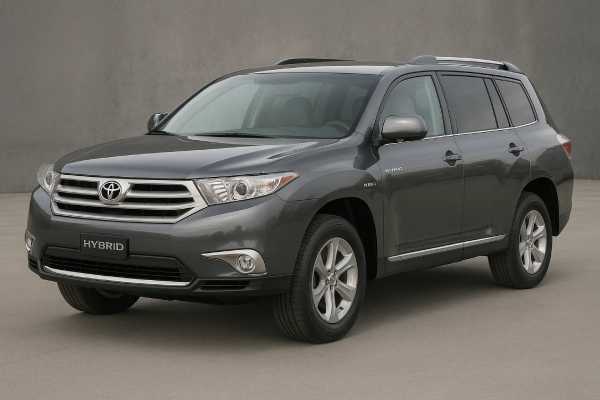
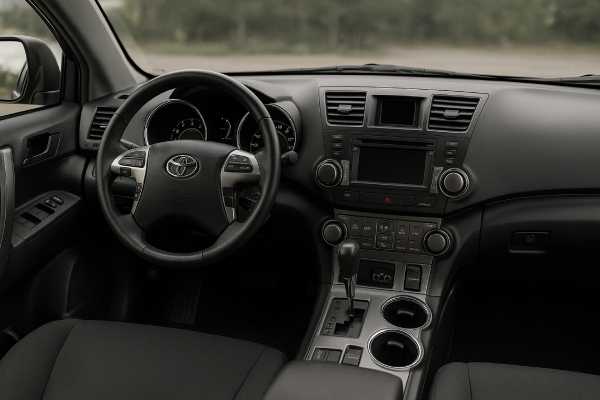
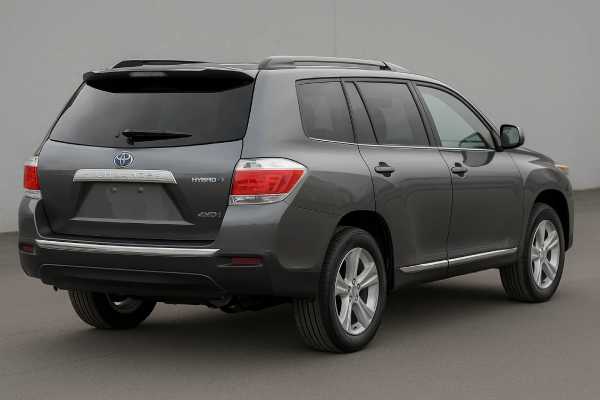
The facelifted 2011–2013 Toyota Highlander Hybrid 4WD-i blends three-row practicality with Toyota’s proven Hybrid Synergy Drive for owners who want SUV space without typical SUV thirst. Under the hood sits the 2GR-FXE 3.5-litre V6 running the Atkinson cycle, paired with front and rear electric motors for on-demand all-wheel drive (no prop shaft or transfer case). The result is confident starts, smooth eCVT acceleration, and quiet cruising. The hybrid adds weight but also torque fill and regenerative braking, so day-to-day drivability feels relaxed and refined. Inside, the facelift improved materials and infotainment while keeping the straightforward controls families value. If your usage leans toward commuting, car-pool duty, and winter traction rather than heavy towing, the Highlander Hybrid offers a compelling long-term proposition with lower fuel and brake costs and fewer wear parts than many competitors. This guide covers the technical details, service planning, reliability patterns, safety notes, and how it stacks up against rivals.
Owner Snapshot
- Smooth, quiet power with electric torque and standard 4WD-i traction.
- Real-world 27–30 mpg US (8.7–7.8 L/100 km) is common for mixed driving.
- Lower brake wear thanks to regenerative braking; long-life iridium plugs and timing chain.
- Watchpoints: cooling pumps (engine and inverter) and age-related suspension bushings.
- Typical oil interval: 10,000 miles / 12 months on 0W-20 (shorter in severe use).
Navigate this guide
- Highlander Hybrid in detail
- Highlander Hybrid specs and data
- Highlander Hybrid trims, options and safety
- Reliability and service actions
- Maintenance and buyer’s guide
- Driving and real-world performance
- How it compares to rivals
Highlander Hybrid in detail
Toyota made the Highlander Hybrid the quiet achiever of the lineup. The 2GR-FXE V6 uses an Atkinson-cycle cam strategy and high expansion ratio to prioritize efficiency, while permanent-magnet motors provide immediate torque and enable electric-only creep in traffic or parking. The eCVT transaxle blends engine and motor power seamlessly; once up to speed the engine settles into a low, steady rpm while the motors handle fine adjustments. The rear axle is driven by a dedicated motor (4WD-i), so there’s no driveshaft or mechanical coupling; the system can feed rear torque proactively at launch or reactively when the fronts slip.
The facelift for 2011 brought updated front and rear styling, improved cabin trim, and broader availability of the Display Audio head unit with Bluetooth. Packaging remains a strength: a flat luggage floor, wide hatch, easily folded second row, and an occasional-use third row. The hybrid battery sits under the second row, preserving cargo height. Ride tuning emphasizes isolation over sport, with calm highway manners and tidy body motions in normal driving. Families appreciate the hybrid’s low operating noise and the way regenerative braking takes bite out of pad and rotor wear. If you need 5,000 lb towing or frequent mountain towing, the conventional V6 is the better tool; otherwise, the hybrid’s balanced performance, economy, and winter traction make it the smart daily choice.
Highlander Hybrid specs and data
Powertrain and Efficiency (HEV)
| Item | Detail |
|---|---|
| Engine code | 2GR-FXE (Atkinson-cycle V6) |
| Cylinders and valvetrain | V6 DOHC, Dual VVT-i, 24 valves |
| Bore × stroke | 94.0 × 83.0 mm (3.70 × 3.27 in) |
| Displacement | 3.5 L (3,456 cc) |
| Induction | Naturally aspirated |
| Fuel system | Port fuel injection (PFI) |
| Compression ratio | ~12.5:1 effective (Atkinson strategy) |
| Engine output | ~245 hp (183 kW) @ ~6,000 rpm; ~317 Nm (234 lb-ft) @ ~4,800 rpm |
| Traction motors | Front MG2 PMSM; rear MGR PMSM (AWD-i) |
| Generator | Front MG1 (engine start and charge) |
| Hybrid system net | ~280 hp (209 kW) combined |
| System voltage | 288 V NiMH pack (boosted to ~650 V DC by inverter) |
| Battery chemistry | Nickel-metal hydride (NiMH), liquid-cooled |
| Rated economy (EPA) | ~28 mpg city / 28 mpg highway / 28 mpg combined (≈8.4 L/100 km combined) |
| Real-world highway @ 120 km/h | ~8.5–9.0 L/100 km (28–26 mpg US), conditions dependent |
| Aerodynamics | Not officially published for this variant |
Transmission and Driveline
| Item | Detail |
|---|---|
| Transmission | eCVT (planetary power-split), Hybrid Synergy Drive |
| Transaxle family | P31x (application-specific) |
| Drive type | AWD-i (electric on-demand all-wheel drive) |
| Front differential | Open; integrated with transaxle |
| Rear axle | Electric motor with single-speed reduction; no prop shaft |
| Final reduction (front) | ~3.5:1 (application-specific) |
| Refuel to full | ~5 minutes (pump-dependent) |
Chassis and Dimensions
| Item | Detail |
|---|---|
| Platform code | MHU48 (Hybrid 4WD-i) |
| Suspension (front/rear) | MacPherson strut / Dual-link MacPherson strut with trailing arms |
| Steering | Electric-assist rack-and-pinion; light at low speed, stable on-centre |
| Brakes | 4-wheel disc with regenerative braking; ABS, EBD, Brake Assist |
| Wheels and tyres (tires) | 245/65 R17 (standard) • 245/55 R19 (available) |
| Ground clearance | ~203 mm (8.0 in) |
| Length / Width / Height | ~4,785–4,790 mm (188.4–188.6 in) / ~1,910 mm (75.2 in) / ~1,760 mm (69.3 in) |
| Wheelbase | 2,790 mm (109.8 in) |
| Turning circle | ~11.4 m (37.4 ft) kerb-to-kerb |
| Curb weight | ~2,020–2,140 kg (4,455–4,720 lb), equipment-dependent |
| GVWR | ~2,720–2,810 kg (6,000–6,195 lb), trim-dependent |
| Fuel tank | ~65 L (17.2 US gal / 14.3 UK gal) |
| Cargo volume (SAE) | ~292 L (10.3 ft³) behind 3rd; ~1,197 L (42.3 ft³) behind 2nd; ~2,700 L (95.4 ft³) max |
Performance and Capability
| Item | Detail |
|---|---|
| 0–60 mph / 0–100 km/h | ~7.3–7.8 s (typical road test range) |
| Top speed | ~180 km/h (112 mph), speed-limited |
| Braking 100–0 km/h | ~38–41 m (125–135 ft) with healthy tyres and pads |
| Towing capacity | Up to 1,588 kg (3,500 lb) when properly equipped |
| Payload | ~540–680 kg (1,190–1,500 lb), VIN/label specific |
| Roof load | ~68 kg (150 lb) with OEM crossbars |
Fluids and Service Capacities
| System | Specification | Capacity (approx.) |
|---|---|---|
| Engine oil | SAE 0W-20, API SN/SP | ~6.1 L (6.4 US qt) with filter |
| Engine coolant | Toyota Super Long Life Coolant (pink) | ~9–10 L (9.5–10.6 US qt) |
| Inverter/ECU coolant | Toyota SLLC (separate loop) | ~3–4 L (3.2–4.2 US qt) |
| Hybrid transaxle (eCVT) | Toyota ATF WS | ~4–5 L (4.2–5.3 US qt) service fill |
| Rear e-axle reduction | Toyota ATF WS | ~0.8–1.0 L (0.8–1.1 US qt) |
| Brake fluid | DOT 3 (DOT 4 acceptable if fully flushed) | Fill to MAX; flush on interval |
| A/C refrigerant | R-134a | ~550–650 g (19–23 oz), label-specific |
| A/C compressor oil | ND-OIL 11 (POE, electric compressor) | As specified (≈120 mL / 4.1 fl oz) |
| Spark plugs | Iridium, long-life; gap 1.1 mm (0.043–0.044 in) | — |
| Key torque (examples) | Wheel lug nuts 103 Nm (76 lb-ft); oil drain 39 Nm (29 lb-ft); spark plugs 18–22 Nm (13–16 lb-ft) | — |
Important: Capacities and torques vary by year/VIN and equipment (rear HVAC, tow prep). Always verify against under-hood labels and official service data.
Electrical
| Item | Detail |
|---|---|
| 12 V supply | DC-DC converter (no alternator) to auxiliary battery |
| Auxiliary battery | AGM type, ~45–60 Ah (form factor varies by supplier) |
| High-voltage battery | NiMH, ~288 V nominal; service disconnect at pack |
| Spark plug service | ~120,000 miles (192,000 km) typical interval |
Safety and Driver Assistance
| Item | Detail |
|---|---|
| Crash testing | Strong results in IIHS core tests; 2013 Highlander earned Top Safety Pick |
| Headlights | Halogen reflectors (aim and lens clarity affect performance) |
| Restraints | Dual-stage front, front seat-side, full-length side curtain airbags; active front head restraints |
| Child seats | LATCH anchors (2nd row outboard) and top tether points |
| Stability and braking | VSC stability control, TRAC, ABS, EBD, Brake Assist; regenerative braking integration |
| ADAS | Pre-AEB era: no factory AEB/ACC/LKA; rearview camera availability improved post-facelift |
Highlander Hybrid trims, options and safety
Trim walk (2011–2013):
- Hybrid (Base): 17-inch alloys, cloth seating, tri-zone HVAC (front and rear), keyless entry, cruise control, Display Audio availability depending on year, third-row seating.
- Hybrid Limited: Leather upholstery, heated front seats, power liftgate, Smart Key with push-button start, JBL audio, auto-dim mirror, 19-inch wheels, additional brightwork and sound insulation.
Key option content and identifiers:
- Wheels/tyres: 17-inch setup prioritizes ride and winter tyre choice; 19-inch adds response and style at the cost of slightly firmer impact feel.
- Audio/infotainment: Late-run vehicles more often have a 6.1-inch Display Audio head unit with Bluetooth audio; navigation availability varies by region and package.
- Tow prep: Hybrid tow rating tops out at 3,500 lb (1,588 kg); verify receiver, wiring, and cooling content.
- Visual tells: Hybrid badging on front doors and tailgate; unique instrument cluster with power/charge gauge; under-hood orange HV cables; absence of alternator and power-steering fluid reservoir.
Safety ratings and notes:
- IIHS: This generation maintained Good ratings in the moderate overlap frontal, side, roof strength, and head restraints tests through 2013; 2013 earned Top Safety Pick when equipped as tested.
- NHTSA: Ratings vary by model year and equipment after the 2011 protocol change; most Hybrid 4WD-i examples scored well in frontal and side tests. Always verify by VIN.
Systems and service implications:
- Airbags and restraints: Confirm post-collision sensor mounting and wiring integrity.
- Child seats: The 2nd row outboard positions offer LATCH; third row uses seat belts and tethers as applicable—trial-fit seats you intend to use.
- Calibration after service: These years do not use camera-based lane or pre-collision systems, reducing calibration overhead versus newer SUVs; wheel alignment and steering angle sensor zero-point resets remain important after suspension or subframe work.
Reliability and service actions
Overall, the Highlander Hybrid enjoys a strong reputation for longevity when serviced on schedule. Age and mileage now make preventive cooling and suspension work worthwhile.
Hybrid system and cooling
- Inverter coolant pump wear (occasional, medium cost): Watch for intermittent reduced power and warning lights; check for flow in the inverter reservoir and pump noise. Replace pump, bleed the inverter loop with the correct procedure.
- Engine water pump seepage (occasional, medium): Pink crust near the pump weep hole or on the timing cover. Replace the pump and refresh Toyota SLLC.
- Radiator and hoses (age-related, low/medium): End tanks and upper hose can harden and seep after a decade; replace proactively if swollen or cracked.
Battery, charging, and electrical
- HV battery aging (rare to occasional, high cost if neglected): Long storage and sustained heat accelerate imbalance; look for inconsistent state-of-charge swings or DTCs for module blocks. Active owners keep the pack healthy with regular use and intact cooling ducts.
- DC-DC converter and 12 V battery (occasional, low/medium): Weak auxiliary battery triggers spurious warnings; test annually after year three and replace with an AGM unit.
- Jump-start polarity error (rare, high): Incorrect jump-start can damage inverter electronics. Use the designated posts and follow the manual.
Brakes and chassis
- Regenerative braking quirks (normal characteristic): Initial light braking is regen-heavy; at very low speeds the system blends to friction. If pedal feels inconsistent, bleed the hydraulic system and ensure slide pins are lubricated.
- Front lower control arm rear bushings (common, medium): Cracks cause clunks and vague steering. Replace bushings or complete arms; align afterward.
- Wheel bearings (occasional, medium): Listen for a speed-related growl; replace the hub assembly.
- Strut mounts/top hats (occasional, medium): Popping over speed bumps; refresh mounts and consider new struts around 90–120k miles.
Powertrain and eCVT
- Transaxle fluid aging (preventive, low/medium): While “lifetime” is often quoted, a periodic ATF WS drain-and-fill helps long-term smoothness and magnet cleanliness.
- Rear e-axle noise (rare, medium): Dryness or contamination can produce a faint whine; verify fluid level/condition and service with ATF WS.
Corrosion and body
- Rear subframe seams and exhaust flanges in salt states warrant inspection. Regular underbody washdowns help.
Recalls, TSBs, and extended coverage
- Expect campaign history for floor-mat/pedal interference on earlier years carried into the generation, airbag inflator-related work on certain VINs, and occasional software updates for HVAC or hybrid control. Always run an official VIN check and request a dealer campaign printout.
Pre-purchase checks
- Full maintenance records, especially for coolant (engine and inverter loops), spark plugs, and transaxle fluid.
- HV system scan for hybrid ECU codes, freeze-frame data, and battery block voltages.
- Clean, pink SLLC in both reservoirs; no leaks at pumps or radiator end tanks.
- Quiet wheel bearings, tight control arm bushings, and even tyre wear.
- Functioning rear HVAC and a healthy auxiliary 12 V battery.
Maintenance and buyer’s guide
Practical maintenance schedule (distance/time, whichever comes first)
- Engine oil and filter: 10,000 miles / 12 months on 0W-20; 5,000 miles / 6 months if lots of short trips, extreme temps, or towing.
- Engine air filter: Inspect 15,000 miles; replace 30,000 miles (earlier in dusty regions).
- Cabin filter: Every 15,000–20,000 miles; more often with pets/pollen.
- Coolant (engine loop): First at 100,000 miles / 10 years, then every 50,000 miles / 5 years.
- Inverter coolant: Same cadence as engine loop unless contamination or component replacement dictates earlier service.
- Spark plugs (iridium): 120,000 miles (192,000 km).
- Hybrid transaxle ATF WS: Inspect at 60,000 miles; drain-and-fill every 60,000–90,000 miles if keeping long-term.
- Rear e-axle fluid: Inspect 60,000 miles; refresh by 90,000–120,000 miles.
- Brake fluid: Flush every 3 years regardless of mileage.
- Brake hardware: Clean/lube slide pins annually; hybrids under-use friction brakes, so rust and uneven wear can sneak up.
- Tyre rotation and alignment: Rotate every 5,000–7,500 miles; align annually or with tyre replacement.
- 12 V battery test: Annually after year three; hybrids are sensitive to low-voltage events.
- Drive belt (engine accessories): Inspect 60,000 miles; replace by condition around 90,000–120,000 miles.
Fluid specifications and quick references
- Oil: SAE 0W-20 full synthetic meeting API SN+/SP.
- Coolant: Toyota Super Long Life Coolant (pink), premixed 50/50.
- ATF: Toyota ATF WS (transaxle and rear e-axle reduction).
- A/C compressor oil: ND-OIL 11 only—avoid PAG contamination.
- Torque highlights: Wheel nuts 103 Nm (76 lb-ft); drain plug 39 Nm (29 lb-ft); spark plugs 18–22 Nm (13–16 lb-ft).
Buyer’s checklist
- Road test: Smooth engine-motor transitions, no hesitation under moderate throttle, consistent brake blend at low speeds.
- Cooling: No crusting at water pumps; inverter reservoir shows visible flow with the system running.
- HV battery health: Stable state-of-charge gauge behavior; scan tool shows tight voltage spread across blocks.
- Chassis: No clunks over sharp bumps, straight tracking on highway, and quiet wheel bearings.
- Electrical: All warning lights prove-out, rear camera functional, and auxiliary battery voltage healthy after an overnight sit.
- Body: Even panel gaps, intact under-engine splash shield, and minimal subframe rust scale.
Recommended configurations
- Best daily-driver value: Hybrid Base on 17-inch wheels for ride comfort, winter-tyre choice, and lower replacement cost.
- If you tow or load heavily: Respect the 3,500-lb limit and consider an auxiliary transaxle cooler if you operate in desert heat; if you regularly tow near max, the non-hybrid V6 with 5,000-lb rating may suit better.
Durability outlook
With routine fluid care and preventive cooling service, the Highlander Hybrid commonly runs well past 200,000 miles (320,000 km). The simplicity of 4WD-i (no transfer case), electric A/C compressor, and regenerative braking all help curb long-term wear and tear.
Driving and real-world performance
Ride, handling, and NVH
Ride tuning is calm and composed. Small bumps are rounded off, and highway expansion joints pass with a gentle thump rather than a crash. Straight-line stability is confident at 65–75 mph (105–120 km/h). Steering is light at parking speeds, with predictable build-up off centre. In corners, the hybrid’s extra mass shows as a little more roll than the FWD four-cylinder, but the chassis remains secure and easy to place.
Powertrain character
From a stop, electric torque helps the Highlander feel eager, and the eCVT keeps the engine in its sweet spot without hunting. Around town you’ll see frequent engine-off coasting; in traffic creep and gentle manoeuvres, the hybrid often moves on electricity alone. On-ramp merges are smooth and brisk, especially with a healthy traction battery. Passing at speed is more about steady thrust than a downshift kick; plan passes with a firm, sustained pedal.
Efficiency in the real world
In mixed suburban/highway use, owners commonly report 27–30 mpg US (8.7–7.8 L/100 km) in mild weather on 17-inch tyres. Winter cold, short trips, roof racks, and snow tyres can pull averages down into the mid-20s mpg (US). At a steady 75 mph (120 km/h), expect 26–27 mpg US (9.0–8.7 L/100 km) if winds are calm. Brake wear is typically low thanks to regen; tyre life depends more on alignment and rotation discipline than powertrain.
Traction and control
4WD-i engages the rear motor proactively from a stop and reactively if the fronts slip, giving surefooted snow starts and confidence on wet leaves or gravel. There’s no low-range; stability control intervenes sensibly when surfaces get slick. For true off-road use, ground clearance and approach/departure angles remain the limiting factors.
Load and towing
With 3,500 lb (1,588 kg) max towing, think small campers, boats, and utility trailers. Expect a noticeable economy penalty under tow (often +25–35% consumption), and monitor temperatures on long grades in hot weather. With seven aboard and luggage, the hybrid remains composed; braking confidence stays high, though stopping distances naturally increase.
How it compares to rivals
- Toyota Highlander V6 (non-hybrid): Quicker in sustained high-load driving and rated to 5,000 lb towing with the tow package. The hybrid counters with lower fuel and brake costs, quieter commuting, and standard 4WD-i.
- Lexus RX 450h (same era): Shares core hybrid architecture with a more luxurious cabin and a two-row layout. The Highlander is roomier (third row and larger cargo), easier to service at mainstream rates, and often cheaper to buy used.
- Honda Pilot (2009–2015): Strong and simple V6 with eight seats and good towing, but thirstier and louder at highway speeds. Hybrid Highlander is more efficient and quieter; Pilot’s third row is roomier.
- Ford Explorer (2011–2015, non-hybrid): Broad tech and engine choice but higher complexity and mixed long-term repair costs. Toyota’s hybrid system has a longer reliability track record.
- Mazda CX-9 (2010–2015): Best steering feel and agile handling; less efficient and only two rows until later generations. Highlander Hybrid rides softer and costs less to run.
References
- 2013 Toyota Highlander Hybrid 4WD 2013 (EPA Ratings)
- 2013 Toyota Highlander 4-door SUV 2013 (Safety Rating)
- 2013 Toyota Highlander Hybrid Quick Reference Guide 2013 (Owner’s Guide)
- Recalls 2025 (Recall Database)
Disclaimer
This article is for informational purposes and is not a substitute for professional diagnosis or repair. Specifications, capacities, torque values, service intervals, and procedures vary by model year, VIN, market, and equipment. Always verify details against your vehicle’s official service documentation and under-hood labels.
If this guide helped you, please share it with fellow owners on Facebook or X/Twitter to support xcar’s work.