
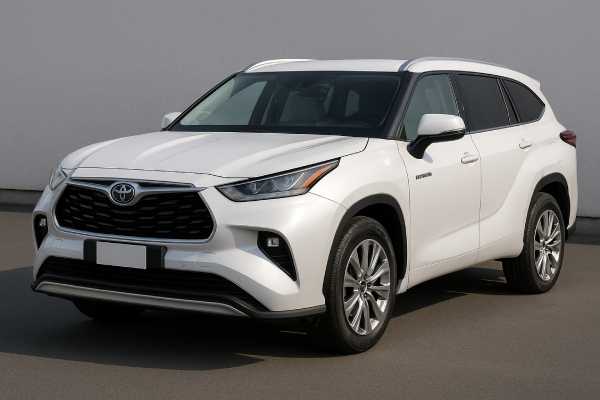
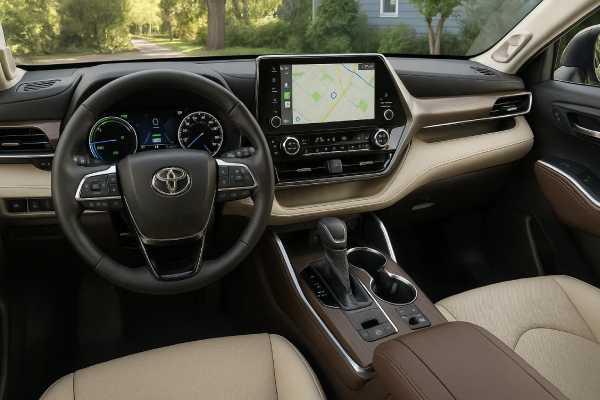
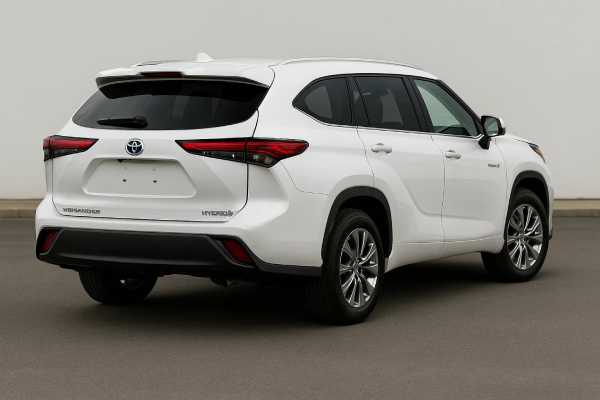
The fourth-generation Toyota Highlander Hybrid FWD pairs a proven A25A-FXS 2.5-liter Atkinson-cycle engine with Toyota’s latest eCVT hybrid transaxle to deliver three-row space with compact-SUV fuel bills. Across 2020–2025 it stays focused on quiet ride quality, family-friendly packaging, and predictable ownership costs. Drivers get easy manners, excellent real-world economy, and a spacious cabin that works for car-seats, carpools, and long highway slogs. Updates through the cycle add larger screens, sharper driver-assistance, and steady refinement without disrupting the formula. The FWD hybrid is the efficiency leader of the range: simple front-axle e-drive, lighter curb mass than AWD, and fewer wear items. Towing is a useful 3,500 lb, and cargo space is generous with rows folded. If you want an all-weather tank, the AWD Hybrid is there; if you want the best mpg and lowest running costs, the FWD Hybrid is the sweet spot.
At a Glance
- Excellent economy for a three-row: mid-30s mpg (≈ 6.5–7.0 L/100 km) when driven smoothly.
- Calm, quiet ride with easy steering; simple front-drive hybrid layout lowers complexity.
- Family-first packaging: adult-friendly second row, flat load floor, generous cubbies.
- Watch for infotainment lag on early years; verify recall/updates before buying used.
- Oil change every 10,000 miles/12 months with 0W-16; rotate tires every 5,000 miles.
Explore the sections
- Highlander Hybrid FWD overview
- Highlander Hybrid FWD specs
- Highlander trims and safety tech
- Reliability and service actions
- Maintenance and buyer’s guide
- Driving and efficiency
- How it compares to rivals
Highlander Hybrid FWD overview
The 2020–2025 Highlander Hybrid FWD (chassis code AXUH70) is the efficiency-maximizing member of the Highlander family. It combines Toyota’s 2.5-liter A25A-FXS four-cylinder with a pair of motor-generators in a planetary eCVT transaxle driving the front wheels. Net system output is 243 hp (181 kW). Compared with the gasoline V6 (2020–2022) and later 2.4-liter turbo (2023–present) on non-hybrids, the hybrid trades peak power for dramatically lower consumption and smooth, quiet progress in traffic.
Packaging is a strong suit. The hybrid battery sits under the second row so the third row remains usable and the cargo floor stays low. Two-row and three-row tasks are handled well: 16 cu ft behind the third row fits a weekly shop; drop rows for over 80 cu ft of flat space. Most trims also include standard driver-assistance (Toyota Safety Sense 2.5+ or later), making the FWD hybrid a safe, calm long-distance hauler.
Why FWD? It is the lightest, simplest configuration and returns the best fuel economy. The AWD Hybrid adds an independent rear electric motor for traction, but the FWD keeps the fewest components, often the lowest price, and slightly better ride/efficiency. For households in temperate climates or those running quality all-season tires, the FWD hybrid’s traction and stability systems are more than adequate in rain or light snow.
Highlander Hybrid FWD specs
Below are specification tables focused on the 2020–2025 Highlander Hybrid with front-wheel drive in the North American market. Values can vary slightly by trim, model year, and equipment.
Engine and Performance
| Item | Detail |
|---|---|
| Code | A25A-FXS (Atkinson-cycle) |
| Layout & cylinders | Inline-4, DOHC, 16 valves, dual VVT-iE |
| Bore × stroke | 87.5 × 103.4 mm (3.44 × 4.07 in) |
| Displacement | 2.5 L (2,487 cc) |
| Induction | Naturally aspirated (Atkinson cycle) |
| Fuel system | D-4S (direct + port injection) |
| Compression ratio | ~14.0:1 |
| Max power (engine) | ≈ 186 hp (139 kW) @ ~6,000 rpm |
| Max torque (engine) | ≈ 237 Nm (175 lb-ft) @ ~4,400–5,200 rpm |
| Net hybrid system power | 243 hp (181 kW) |
| Timing drive | Chain |
| Rated efficiency (EPA, FWD Hybrid) | 36 mpg combined (36 city / 35 highway) ≈ 6.5 L/100 km (6.5 / 6.7) |
| Real-world highway @ 120 km/h (75 mph) | ~7.2–7.8 L/100 km (30–33 mpg US) depending on load and temps |
| Aerodynamics (typical) | Cd ≈ 0.33; frontal area ~2.8 m² (≈ 30 ft²) |
Note: Battery chemistry varies by year/trim; Toyota used Ni-MH on some lower trims and Li-ion on others. Pack is mounted under the second row to preserve cargo height.
Hybrid system and driveline
| Item | Detail |
|---|---|
| Transaxle | eCVT (planetary) with MG1/MG2 motor-generators |
| Drive type | FWD |
| Final drive | ~3.0–3.3 (varies by year/trim) |
| Differential | Open (front) |
| Refuel to full | ~5 minutes (typical gasoline fill) |
Chassis and Dimensions
| Item | Detail |
|---|---|
| Platform | TNGA-K |
| Suspension (front/rear) | MacPherson strut / multi-link |
| Steering | Electric rack-and-pinion; ~14–15:1 ratio |
| Brakes | 4-wheel discs with regen; front ≈ 340 mm (13.4 in) vented, rear ≈ 338 mm (13.3 in) solid/vented by trim |
| Wheels/Tires | 18-in (235/65R18) or 20-in (235/55R20) |
| Ground clearance | ~203 mm (8.0 in) |
| Length / Width / Height | ≈ 4,950 / 1,930 / 1,730–1,745 mm (194.9 / 76.0 / 68.1–68.7 in) |
| Wheelbase | 2,850 mm (112.2 in) |
| Turning circle (curb-to-curb) | ≈ 11.4 m (37.4 ft) |
| Curb weight (typical) | ~1,880–1,950 kg (4,145–4,300 lb) |
| GVWR (typical) | ~2,720–2,760 kg (6,000–6,085 lb) |
| Fuel tank | 65 L (17.1 US gal / 14.2 UK gal) |
| Cargo volume (SAE) | 453 / 1,371 / 2,388 L (16.0 / 48.4 / 84.3 ft³) — 3rd up / 3rd down / 2nd & 3rd down |
Performance and Capability
| Item | Detail |
|---|---|
| 0–100 km/h (0–62 mph) | ~8.1–8.5 s (varies with load/tires) |
| Top speed | ~180 km/h (112 mph) governed |
| Braking 100–0 km/h | ~36–38 m (118–125 ft) on quality all-seasons |
| Towing capacity | 1,588 kg (3,500 lb) braked; ~680 kg (1,500 lb) unbraked (typical) |
| Payload | ~565–640 kg (1,245–1,410 lb) depending on trim |
| Roof load | ~75 kg (165 lb) with approved crossbars |
Fluids and Service Capacities
| System | Specification | Capacity (approx.) |
|---|---|---|
| Engine oil | 0W-16, API SP / ILSAC GF-6B | ~4.5 L (4.8 US qt) with filter |
| Coolant (engine/inverter) | Toyota Super Long Life Coolant (pink), premixed 50/50 | ~7–8 L (7.4–8.5 US qt) each loop combined varies by year |
| Hybrid transaxle | Toyota ATF WS | ~3.5–4.0 L (3.7–4.2 US qt) drain/fill |
| A/C refrigerant | R-1234yf | ~650–750 g (23–26 oz) |
| A/C compressor oil | ND-Oil 11 (PAG) | ~80–120 mL (2.7–4.1 fl oz) |
| Key torque specs | Wheel lug nuts: ~103 Nm (76 lb-ft); Oil drain plug: ~40 Nm (30 lb-ft); Spark plugs: ~18 Nm (13 lb-ft) |
Capacities and torques vary by VIN/options. Always verify against the service manual for the specific vehicle.
Electrical
| Item | Detail |
|---|---|
| DC-DC converter rating | ~150 A peak (varies) |
| 12V battery | AGM, ~45–60 Ah; common group size H5/47 (varies by audio/tow options) |
| Spark plug | Long-life iridium; gap ~0.8–1.0 mm (0.031–0.039 in) |
Safety and Driver Assistance
| Item | Detail |
|---|---|
| Crash ratings (IIHS) | Strong results; multiple model years earned Top Safety Pick or Top Safety Pick+ depending on headlights and test year changes |
| Headlight ratings | Good/Adequate on premium LED units; earlier halogens can rate lower |
| ADAS suite | Toyota Safety Sense 2.5+ or later: AEB with pedestrian/cyclist detection, full-speed adaptive cruise, lane departure alert with steering assist, lane tracing assist (centering), road sign assist; blind-spot monitor and rear cross-traffic alert on most trims; surround-view and parking assist available on upper trims |
Highlander trims and safety tech
Trim walk (FWD Hybrid, 2020–2025): LE, XLE, Limited, Platinum. (The sporty XSE applied to gas models; the Hybrid offered a Bronze Edition in select years.) All trims share the 243-hp hybrid powertrain and eCVT; differences center on wheels/tires, upholstery, infotainment screens, headlights, and convenience/safety content.
- LE (value play): Cloth seating, 8-in infotainment (larger screens on later years), manual liftgate, 18-in wheels, Toyota Safety Sense 2.5+, basic LED headlights on most years, Blind-Spot Monitor availability varies early on but is widely standard later.
- XLE (sweet spot): SofTex, power driver’s seat with lumbar, heated front seats, wireless charging (later), confident tire/wheel package (still 18s for ride comfort), BSM/RCTA standard, available moonroof.
- Bronze Edition (select years): Style-focused package based on XLE with bronze-tone wheels and interior accents; hybrid-only; adds power liftgate and unique mats.
- Limited: Premium LED headlights, JBL audio, ventilated front seats (later years), genuine leather, hands-free liftgate, front/rear parking sensors.
- Platinum: Panoramic roof, 12.3-in screen and digital cluster on later models, head-up display, surround-view monitor, wiper de-icer, large mirror-integrated camera display.
Year-to-year highlights:
- 2021: Enhanced Toyota Safety Sense 2.5+ logic; feature tweaks and package reshuffles.
- 2022: Bronze Edition appears for Hybrid; continued feature migration to lower trims.
- 2023: New Toyota Audio Multimedia system on upper trims with faster processor, crisper graphics, wireless Apple CarPlay/Android Auto, and expanded voice assistant; larger 12.3-in displays available.
- 2024–2025: Minor feature alignment and USB-C upgrades; driver-assist tuning updates continue.
Safety ratings in brief: Early fourth-gen Highlander models earned top IIHS awards (often Top Safety Pick+) when equipped with the premium LED headlight packages; ratings evolved as IIHS added tougher side and nighttime tests. Shoppers should check the exact trim/headlight combination for the target year—upper trims with the best LEDs generally score highest. Multiple airbags (front, side, curtain, driver knee, and front passenger seat cushion) and strong child-seat anchors (LATCH) are standard. Advanced AEB recognizes vehicles, pedestrians, and cyclists in more conditions on newer software/hardware.
Identifiers and codes:
- VIN: 10th digit = model year; look for “AXUH70” in documentation for FWD hybrids.
- Badges: “HYBRID” fender/door badges; Bronze Edition has unique bronze wheels/trim.
- Interior tells: Blue-accented Toyota logos, hybrid-specific energy/EV screens, and EV mode button.
Reliability and service actions
Toyota’s hybrid hardware has a long track record of low failure rates when serviced with correct fluids and filters on schedule. The Highlander Hybrid FWD is no exception. Most owners report quiet, drama-free operation well past 150,000 miles with routine consumables. Still, every used purchase benefits from a targeted inspection. Below are common items organized by prevalence and cost impact.
Common / low–medium cost
- Brake feel changes (gentle pulsation or longer travel): Often related to pad glazing or uneven rotor deposits after repeated short trips; regen can mask early pad issues. Remedy: De-glaze/replace pads and rotors, perform proper bed-in, update brake software if applicable.
- 12V battery weakness (3–5 years): Hybrids are hard on small 12V batteries due to frequent cycling. Remedy: Test annually; replace with AGM of correct group size; keep terminals clean.
- Infotainment lag or Bluetooth drops (early years): Older head units can freeze or lag. Remedy: Apply multimedia firmware updates; 2023+ units are significantly quicker.
Occasional / medium cost
- Water pump seepage (engine): Pink crust around pump weep hole; audible chirp. Remedy: Replace pump, belt check; use Toyota SLLC.
- Front wheel bearings (higher mileage/rough roads): Growl that rises with speed. Remedy: Replace hub/bearing assembly; torque axle nut to spec and reset alignment if needed.
- Cabin HVAC performance dips: Cabin and engine air filters overdue or evaporator odor. Remedy: Replace filters; sanitize HVAC box; verify blend-door operation.
Rare / higher cost
- Inverter coolant pump or transaxle fluid leaks: Uncommon, but monitor for DTCs and pink residue. Remedy: Replace pump/seals; refill/bleed hybrid cooling loops with vacuum equipment.
- Hybrid battery module imbalance (very high mileage/heat): Sub-pack voltage variation or reduced EV assist. Remedy: Warranty may apply on newer vehicles; otherwise pack repair/replacement. Keep battery intake clear and avoid chronic deep heat.
Software and calibrations that matter
- Powertrain and ADAS software updates improve throttle mapping, lane-centering smoothness, and camera/radar performance; ask dealers to check for the latest calibrations during service visits.
- Multimedia updates (pre-2023) fix stability and phone compatibility; the 2023+ platform moves to a newer architecture and is more robust.
Recalls and service campaigns
- Front bumper cover retention (select model years): Under certain conditions, the lower bumper may detach; remedy involves revised retention hardware and inspection of mounting points. Confirm via official VIN check and dealer records.
- Always run a VIN through the official recall site and ask for a campaign completion printout; retain it with service history.
Pre-purchase checklist
- Full maintenance history (oil changes, coolant, brake fluid, filters), recall/TSB proof, recent hybrid cooling service if opened, tread depth and even wear, brake rotor thickness, and a scan for historical DTCs.
- Check for interior wear (third-row latches, seat tracks), liftgate operation, and sunroof drains (if equipped).
- Road test: Listen for wind noise from mirrors, mild eCVT whine (normal), and any vibration around 70–75 mph (often tires).
Maintenance and buyer’s guide
Practical maintenance schedule (typical U.S./Canada conditions)
- Engine oil and filter: 10,000 miles / 12 months with 0W-16 (severe use or short trips: 5,000 miles).
- Tire rotation and inspection: 5,000 miles; check alignment annually or after impacts.
- Cabin air filter: 12 months or 15,000 miles; sooner in dusty/pollen-heavy areas.
- Engine air filter: Inspect 15,000 miles; replace 30,000 miles (sooner in dust).
- Brake fluid: Replace every 3 years regardless of miles; hybrids can trap moisture due to less heat.
- Coolant (engine/inverter): First change around 100,000 miles / 10 years, then every 50,000 miles / 5 years (verify by VIN).
- Spark plugs (iridium): 120,000 miles / 12 years; check gap if misfire felt.
- Hybrid transaxle ATF WS: Not an official “lifetime” fluid—many owners choose a precautionary drain/refill every 60,000–100,000 miles to manage wear metals.
- Belts/hoses: Inspect at every oil change; replace if cracking, glazing, or noise.
- 12V battery test: Annually after year three; replace proactively before winter if weak.
- HV system checks: Keep battery intake clear; scan for hybrid system DTCs at least annually.
Fluids snapshot
- Engine oil: 0W-16 API SP / ILSAC GF-6B; capacity ~4.5 L (4.8 qt) with filter.
- Coolant: Toyota Super Long Life (pink); premix only.
- Transaxle: Toyota ATF WS; careful fill level check at temperature.
- A/C: R-1234yf; ND-Oil 11.
Essential torque values (quick reference)
- Wheel lug nuts: ~103 Nm (76 lb-ft)
- Oil drain plug: ~40 Nm (30 lb-ft)
- Spark plug: ~18 Nm (13 lb-ft)
Buyer’s tips
- Best value: XLE Hybrid FWD balances equipment, ride comfort (18-in tires), and price.
- Seek: Vehicles with documented oil changes, coolant history, and fresh cabin/engine filters; firmware updates applied; even tire wear.
- Avoid: Evidence of curb strikes (toe-out feathering), mismatched tires, or heavy aftermarket electrical work.
- Durability outlook: With routine service and gentle warm-ups, 200,000 miles is realistic for the hybrid drivetrain; brakes and tires last longer than on non-hybrids thanks to regen and smooth torque delivery.
Driving and efficiency
Ride, handling, NVH: The Highlander Hybrid FWD prioritizes calm progress. The TNGA-K chassis is stiff, which lets the suspension tune for compliance without float. Steering is light in parking lots and stable on highway centers. With 18-inch tires, impacts are rounded off and cabin noise stays low; 20-inch packages look sharp but pass more texture into the cabin. Brake feel is consistent once you acclimate to the regen-to-friction handoff; it is linear and easy to modulate in traffic.
Powertrain character: Off-the-line response is immediate thanks to MG2 torque, and the eCVT blends power seamlessly. Push hard and the four-cylinder hums at a steady rpm—typical of hybrids. Normal and Eco modes keep the drivetrain relaxed; Sport mode sharpens throttle mapping and holds more electrical assist for passing. The front-drive layout saves about 100–150 lb and avoids the rear e-motor’s added drag, which helps efficiency and ride.
Real-world economy: Drivers commonly see 34–38 mpg mixed (6.2–6.9 L/100 km) in moderate weather; steady 75-mph cruise returns around 30–33 mpg (7.2–7.8 L/100 km). Short, cold trips penalize mpg; a few minutes of pre-conditioning and careful throttle help. Roof boxes and heavy 20-inch wheel/tire packages can trim 1–2 mpg at highway speeds.
Key metrics: Passing from 50–80 mph is confident when the battery is topped; the eCVT snaps to the right ratio and blends in engine power without a kickdown delay. Panic stops are straight, and fade resistance is aided by regen taking the first bite of speed. The FWD hybrid tracks steadily with a trailer up to 3,500 lb (1,588 kg) when loaded correctly; use Tow/Haul aids, keep speeds moderate, and anticipate longer stopping distances.
Traction and control: In rain and light snow, the traction control and brake-based torque vectoring provide secure, predictable launches. For frequent deep-snow or steep-grade use, the AWD Hybrid with rear e-motor is the better fit; the FWD shines in efficiency and simplicity.
How it compares to rivals
Kia Sorento Hybrid (FWD/AWD): Two-motor turbo hybrid with lively low-rpm punch and crisp steering; smaller third row and less cargo depth than Highlander. Highlander wins on overall space, long-term hybrid reputation, and quieter ride; Sorento counters with sportier character and lower entry price.
Hyundai Santa Fe Hybrid (two-row): Excellent tech and warranty, but no three-row option in hybrid trims (until related longer models). If you do not need row three, Santa Fe Hybrid undercuts on price; if you do, Highlander Hybrid remains the practical pick.
Ford Explorer Hybrid: Higher tow rating (up to ~5,000 lb) and more V6 grunt, but lower fuel economy in everyday use. Highlander Hybrid feels smoother, quieter in city driving, and costs less to run; Explorer Hybrid suits drivers who tow more often.
Honda Pilot (gas) and Nissan Pathfinder (gas): Both are strong non-hybrid three-rows with competitive space; neither matches the Highlander Hybrid’s economy. If you prioritize mpg and low routine service costs, the Toyota hybrid is the clear winner; if maximum acceleration or towing above 3,500 lb is essential, a non-hybrid competitor (or Highlander gas/turbo) may fit better.
Verdict: For families who value peace, space, and fuel savings, the Highlander Hybrid FWD is one of the easiest three-row SUVs to live with. Choose 18-inch wheels for ride comfort, keep the maintenance simple and on time, and it will quietly get on with the job for years.
References
- Highlander Adds XSE Grade and Updated Toyota Safety Sense 2.5+ for 2021 2021 (Press Release)
- Gas Mileage of 2021 Toyota Highlander 2021 (Fuel Economy)
- 2020 TOP SAFETY PICKs and TOP SAFETY PICK+ 2020 (Safety Rating)
- RCLRPT-23V720-5852.PDF 2023 (Recall Report)
Disclaimer
This article is for informational purposes and is not a substitute for professional diagnosis or repair. Specifications, torque values, fluid types, and service intervals can vary by VIN, model year, trim, and equipment. Always confirm details in your vehicle’s official service documentation and follow current safety and repair procedures. If this guide helped, please consider sharing it on Facebook or X/Twitter to support xcar’s work.