
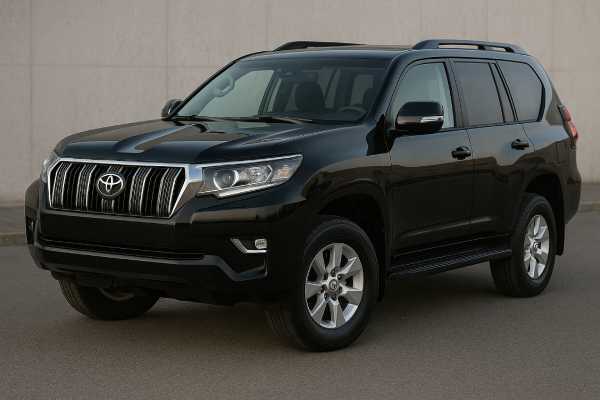
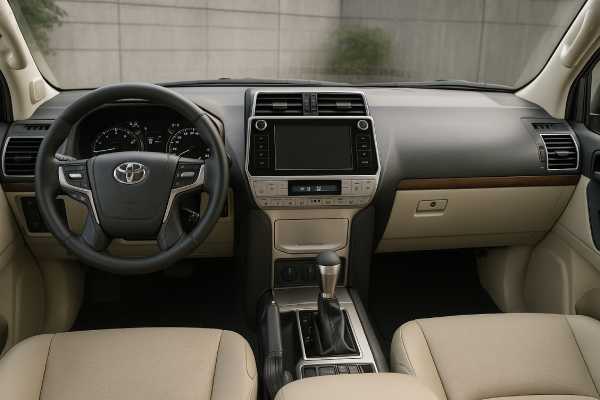
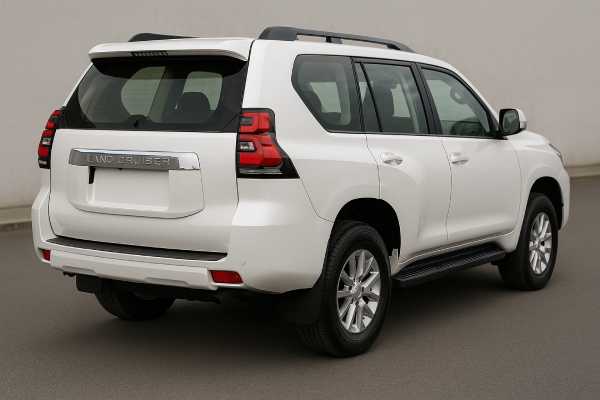
The facelifted Toyota Land Cruiser (GRJ150) from 2015 to 2018 blends proven body-on-frame durability with incremental refinement. Under the bonnet sits Toyota’s 1GR-FE 4.0-litre V6 petrol—quiet, tractable, and paired to a robust full-time 4×4 driveline with low range and available locking differentials. The 2015 refresh sharpened exterior styling, improved NVH isolation, and broadened driver-assistance provision on higher trims while keeping the hard-wearing cabin and flexible seven-seat layouts buyers expect. For European buyers—our baseline for this article—the petrol V6 is a niche but desirable alternative to the common diesel, prized for smoothness, cold-weather reliability, and lower complexity. Owners value the Land Cruiser’s consistent ride quality on rough surfaces, long-lived suspension hardware, and unusually high towing stability for its class. This guide distills the technical data, known issues, service tactics, and comparative insights you need to choose, maintain, and get the best from a GRJ150 facelift Land Cruiser.
Fast Facts
- Ladder frame, full-time 4×4 with low range delivers real off-road ability while staying quiet and composed on long motorway trips.
- 1GR-FE V6 is smooth, tolerant of short-trip use, and avoids DPF/AdBlue complexity; timing chain, not a belt.
- Payload and tow confidence are strong for the class; braked towing up to 3,000 kg (6,614 lb) when correctly equipped.
- Watch for KDSS hydraulic leaks on vehicles with the system; coolant seep from V6 water pump is another common wear item.
- Oil changes at 10,000 km / 12 months (whichever comes first) keep the V6 happy under mixed city/highway use.
What’s inside
- GRJ150 Facelift Overview
- GRJ150 Specs and Data
- Trims, Options, and Safety
- Reliability and Known Issues
- Maintenance and Buying Guide
- On-road and Off-road Drive
- Rivals and Alternatives
GRJ150 Facelift Overview
Toyota’s 2015–2018 facelift of the J150-series Land Cruiser preserves the formula that built the nameplate’s reputation: a tough, separate ladder frame with a well-sealed body, long-travel suspension, and a conservative 4×4 system engineered for repeatable traction on real terrain. The facelift sharpened the nose, modernised lighting, and added extra sound insulation, while cabin updates focused on clearer instrumentation, improved multimedia, and better perceived quality without compromising wipe-clean ruggedness.
The 1GR-FE 4.0-litre V6 petrol used here is the Dual VVT-i evolution with aluminium block/heads and a timing chain. In European tune it emphasises mid-range torque and smoothness rather than headline figures; it is notably tolerant of short, cold journeys that can challenge modern diesels. Paired to Toyota’s five-speed automatic and a full-time 4×4 transfer case with a lockable centre differential plus low range, it delivers clean, predictable control on wet grass, snow, and steep rocky tracks.
Packaging remains a strong point. Five- and seven-seat layouts offer a wide, flat cargo space with the second row folding easily and the third row either side-folding (earlier cars) or floor-folding (markets/years vary). Ride comfort is consistent across surfaces thanks to compliant springs and tall tyre sidewalls; models with KDSS (Kinetic Dynamic Suspension System) add flatter cornering without sacrificing articulation off-road. The Land Cruiser’s towing manners are exemplary for its size because of a long wheelbase, conservative damper tuning, and a stout cooling package.
The facelift also expanded driver-assistance availability: hill-start assist remained standard; downhill assist control and trailer stability assist were widely available; and some markets received lane departure alert and pre-collision braking on higher trims. Lighting performance improved with projector or LED units depending on grade. In short, the GRJ150 facelift is the rugged, easy-to-live-with choice for buyers who prefer petrol refinement and long-term simplicity over the incremental economy of a diesel.
GRJ150 Specs and Data
Below are Europe-baseline specifications for the 2015–2018 facelift petrol V6 (1GR-FE). Where figures vary by seat count, wheel/tyre package, or market fitment, ranges are shown.
Engine and Performance (ICE)
| Item | Value |
|---|---|
| Code | 1GR-FE (Dual VVT-i), Euro 5/6 depending on year |
| Layout & cylinders | 60° V6, aluminium block/heads, DOHC, 24 valves |
| Bore × stroke | 94.0 × 95.0 mm (3.70 × 3.74 in) |
| Displacement | 4.0 L (3,956 cc) |
| Induction | Naturally aspirated |
| Fuel system | Sequential multi-point fuel injection (MPI) |
| Compression ratio | ~10.4:1 |
| Max power (Europe) | 249 hp (183 kW) @ ~5,600 rpm |
| Max torque (Europe) | ~387 Nm (285 lb-ft) @ ~4,400 rpm |
| Alternate rating often quoted* | 282 hp (207 kW) / ~387–393 Nm (285–290 lb-ft) @ similar rpm |
| Timing drive | Chain (no scheduled replacement) |
| Emissions/efficiency standard | Euro 5/6 (by year) |
| Rated combined economy (typical EU figures) | ~12.0–13.0 L/100 km (19.6–18.1 mpg US / 23.5–21.7 mpg UK) |
| Real-world highway @ 120 km/h (75 mph) | ~12.5–14.5 L/100 km (18.8–16.2 mpg US / 22.6–19.4 mpg UK) |
| Aerodynamics | Cd ~0.35–0.36; frontal area ~2.7–2.8 m² (29–30 ft²) |
*Higher power ratings (e.g., 282 hp) are common in non-European publications; use the European figure when registering/insuring an EU-market vehicle.
Transmission and Driveline
| Item | Value |
|---|---|
| Transmission | 5-speed automatic (A750F ECT-i) |
| Gear ratios | 1st 3.520; 2nd 2.042; 3rd 1.400; 4th 1.000; 5th 0.716; Rev 3.224 |
| Final drive ratio (typical) | ~3.91–4.30 (varies by tyre/axle option) |
| Drive type | Full-time 4×4 with lockable Torsen-type centre differential and low range (≈2.566:1) |
| Differentials | Open front; Torsen centre (lockable); rear open or e-locker (by trim/option) |
| Refuel to full (typical) | ~5–7 min at forecourt pump |
Chassis and Dimensions
| Item | Value |
|---|---|
| Front suspension | Double wishbone, coil springs, anti-roll bar (KDSS variable bar on equipped models) |
| Rear suspension | 4-link live axle, coil springs, anti-roll bar (KDSS on equipped models) |
| Steering | Rack-and-pinion with hydraulic assist; ~3.0–3.2 turns lock-to-lock |
| Brakes | Ventilated discs front/rear; front ~338 mm (13.3 in), rear ~312 mm (12.3 in) |
| Wheels/tyres | Common: 265/65 R17 or 265/60 R18; 16–19 in rim options by grade |
| Ground clearance | ~215 mm (8.5 in) |
| Angles (approach/departure/breakover) | ~31° / 25° / 22° (tyre/bumper dependent) |
| Length × width × height | ~4,780–4,840 × 1,885 × 1,845–1,850 mm (188.2–190.6 × 74.2 × 72.6–72.8 in) |
| Wheelbase | 2,790 mm (109.8 in) |
| Turning circle (kerb-to-kerb) | ~11.6 m (38.1 ft) |
| Kerb (curb) weight | ~2,090–2,215 kg (4,608–4,882 lb) |
| GVWR | ~2,930–2,990 kg (6,460–6,592 lb) |
| Fuel tank | 87 L (23.0 US gal / 19.1 UK gal) |
| Cargo volume (VDA, 5-seat) | ~621 L (21.9 ft³) seats up; ~1,934 L (68.3 ft³) seats down |
| Cargo volume (7-seat) | ~104 L (3.7 ft³) behind 3rd row; ~553 L (19.5 ft³) behind 2nd row |
Performance and Capability
| Item | Value |
|---|---|
| 0–100 km/h (0–62 mph) | ~10.0–10.8 s (tyres/weight/options) |
| Top speed | ~175–180 km/h (109–112 mph) |
| Braking 100–0 km/h | ~39–42 m (128–138 ft) on road-tyres in good conditions |
| Towing (braked/unbraked) | Up to 3,000 / 750 kg (6,614 / 1,653 lb) when correctly equipped |
| Payload | Typically ~600–720 kg (1,323–1,587 lb) by trim |
| Roof load | ~80–100 kg (176–220 lb) with approved bars |
Fluids and Service Capacities
| System | Specification | Capacity* |
|---|---|---|
| Engine oil | Toyota-approved 5W-30 (API SN or higher); 0W-20 in cold climates acceptable | ~5.8–6.1 L (6.1–6.4 US qt) |
| Coolant | Toyota Super Long Life Coolant (pink); 50/50 mix | ~10–12 L (10.6–12.7 US qt) |
| Automatic transmission | Toyota ATF WS; drain/fill vs. overhaul differs | ~4.0 L (4.2 US qt) service; ~10–12 L (10.6–12.7 US qt) dry |
| Transfer case | 75W-90 GL-5 (or Toyota spec equivalent) | ~1.4–1.6 L (1.5–1.7 US qt) |
| Front differential | 75W-85/90 GL-5 | ~1.5 L (1.6 US qt) |
| Rear differential | 75W-85/90 GL-5 | ~3.0 L (3.2 US qt) |
| A/C refrigerant | R-134a | ~650–750 g (23–26 oz) |
| A/C compressor oil | ND-OIL 8 (or Toyota equivalent) | ~120–150 mL (4.1–5.1 fl oz) |
*Capacities vary slightly by sub-model and cooler packages; verify by VIN.
Key torque examples: wheel nuts ~131 Nm (97 lb-ft); engine oil drain ~40 Nm (30 lb-ft); spark plugs ~18–22 Nm (13–16 lb-ft).
Electrical
| Item | Value |
|---|---|
| Alternator | ~130–150 A (equipment dependent) |
| 12V battery | Typically 70–90 Ah, DIN H5/H6 form factor; cold-climate options higher CCA |
| Spark plug | Iridium (e.g., Denso SK20HR11); gap 1.1 mm (0.043 in) |
Safety and Driver Assistance
| Item | Value |
|---|---|
| Crash testing | No Euro NCAP rating published for this body/version during this period; not evaluated by IIHS |
| Headlights | Projector halogen or LED (by trim/year) |
| ADAS availability | Hill-start assist (standard), Downhill Assist (widely available), Trailer Sway Control (available), Lane Departure Alert and Pre-Collision warning/braking (availability improved over the facelift on higher trims); rear camera/parking sensors by trim |
Trims, Options, and Safety
Trim walk (Europe, typical): Naming varies by country, but content commonly ladders from a durable “Utility”/“Active” grade to mid “Icon”/“Life” and top “Invincible”/“Executive.” Petrol V6 availability was limited and often tied to higher trims or specific order channels.
- Entry/Utility/Active: Fabric seats, 17-inch wheels, manual HVAC (or simple auto), basic audio, full-time 4×4 with low range, hill-start assist, stability/traction control, and a rear differential often open by default. Steel wheels were still common on true base models (five-seat).
- Mid/Icon/Life: 18-inch alloys, dual-zone climate, better infotainment with navigation, rear camera, power driver’s seat, roof rails, privacy glass. Downhill Assist Control and trailer sway control more common.
- Top/Invincible/Executive: Leather seating, heated fronts (often heated rears), premium audio, sunroof, LED headlights (market dependent), KDSS, rear diff locker availability, crawl control/terrain select in some packages, and more complete ADAS (lane departure alert, pre-collision functions). Seven seats standard or optional.
Functional distinctions that matter:
- KDSS vs. standard anti-roll bars: KDSS uses hydraulically linked anti-roll bars to allow softer off-road articulation with flatter on-road cornering. It adds weight and complexity but improves body control in crosswinds and when towing.
- Rear differential locker: If you routinely see mud, ruts, or snowbound lanes, the locker is the single most valuable traction option—more decisive than tyre changes alone.
- Wheel/tyre packages: The 17-inch wheel with 265/65 tyre offers the best blend of ride, sidewall protection, and snow/gravel traction. The 18-inch package looks sharper but rides a touch firmer and can be louder on coarse surfaces.
Year-to-year highlights within the facelift window (2015–2018):
- 2015 MY (launch of facelift): Revised front fascia/bonnet/lighting, improved sound insulation, updated dashboards and infotainment.
- 2016 MY: Incremental multimedia updates; trim rationalisation in some markets.
- 2017 MY: Availability of enhanced safety features expanded on upper trims; petrol 4.0 V6 EU output referenced at ~249 hp (183 kW).
- 2018 MY (end of period): Option and colour reshuffles; ADAS packages more common.
Safety equipment (all years): ABS, EBD, stability control, traction control, multiple airbags (front, side, curtain; driver knee common), ISOFIX/LATCH anchors, tyre-pressure warning, and emergency brake signal. Many seven-seat versions add curtain coverage to the third row. Vehicles with crawl control integrate hill-descent logic for very steep grades.
Quick identifiers: VIN series starting with JTE for European-market builds; the 1GR engine code on the VIN plate; wheel design, headlamp type, and KDSS hardware visible behind the front wheels help place trim. An e-locker switch on the lower dash confirms rear locker fitment. “Invincible/Executive” badging and leather with memory seats also mark high trims.
Reliability and Known Issues
The GRJ150’s reputation for longevity is deserved, but like any heavy 4×4 there are patterns worth knowing. Prevalence and cost ranges assume typical European use.
Engine and cooling (common → occasional):
- Water pump seep (common; low–medium cost): Pink crust around pump weep hole or faint coolant smell after shutdown. Cause is normal seal wear. Remedy: replace pump and gasket; renew SLLC coolant; inspect idlers and belt.
- Intake/throttle body fouling (occasional; low cost): Rough idle or soft tip-in after many short trips. Cleaning the throttle body and MAF, followed by ECU idle relearn, restores response.
- Coil-on-plug misfire (occasional; low–medium): Rough running and a stored misfire code, usually at higher mileage or after deep water crossings. Replace affected coil(s) and fit fresh iridium plugs.
- PCV and slight oil dampness (occasional; low): Oil film near cam covers on older cars. Monitor, renew PCV, and replace cam cover gaskets if needed.
Fuel and induction:
- Hot-soak start-up stumble (rare; low): Brief roughness after a hot shut-down on very warm days. Software updates or injector cleaning usually resolve.
Driveline and transmission (common → occasional):
- A750F service neglect (common; medium): Harsh 2–3 shift, flare on light throttle, or converter shudder after heavy towing. Fresh Toyota WS fluid (double drain-and-fill), pan clean, and adaptation reset typically cure.
- Front prop shaft slip-yoke clunk (occasional; low): Felt on stop/start creep. Greasing the slip joint at service often eliminates it; replacement yoke if persistent.
- Rear diff whine (occasional; medium): Grows with load; check fluid level/condition, bearing wear, and backlash. Locker-equipped axles should be cycled monthly to keep actuators healthy.
Suspension, steering, and brakes:
- KDSS seep/leak (occasional; medium–high): Damping loss, oily cylinder. Replace affected cylinder/lines; system bleed with correct procedure.
- Lower control arm/ball joint wear (occasional; medium): Shimmy under braking or tyre feathering. Renew arms and get a precise alignment.
- Caliper slide corrosion (common in salted areas; low): Uneven pad wear. Service and grease slides; consider stainless inserts where available.
Body and electrical:
- Tailgate/door seals (occasional; low): Wind hiss or dust ingress on gravel roads. Replace seals or adjust latches.
- Parking sensors and camera (occasional; low): Moisture intrusion. Clean connectors; replace individual sensors if waterlogged.
- Heated seat elements (rare; low–medium): Open circuit; repair loom or replace element.
Software and calibrations: Periodic ECU/TCU updates address driveability (idle quality, shift feel) and integrate better trailer sway control thresholds on some years. After repair of throttle body, EGR-related components (where fitted), or transmission service, complete the appropriate relearn/procedure to avoid false fault codes.
Corrosion hotspots (salted climates): Rear frame cross-members, lower radiator support, brake hard-lines at clips, and body seams behind rear wheel arch liners. Annual wash-downs (including chassis) and cavity wax on vulnerable seams pay dividends.
Recalls/field actions: Campaigns vary by VIN and market. Always check against the official recall portal using the vehicle’s registration or VIN and confirm completion in dealer records. Many cars from this era have completed airbag and sensor-related campaigns already.
Pre-purchase requests: Ask for documented services (engine oil every year, ATF changes for frequent towing), diff/transfer oils within the last 60,000 km, recent brake/coolant service, and evidence of KDSS work if fitted. Inspect tyres for even wear and verify locker/KDSS operation on a test drive.
Maintenance and Buying Guide
Practical maintenance schedule (EU typical; adapt to duty cycle):
- Engine oil and filter: Every 10,000 km or 12 months. Use Toyota-approved 5W-30 (or 0W-20 in cold climates if specified).
- Engine air filter: Inspect every 15,000 km; replace 30,000–45,000 km (earlier for dusty use).
- Cabin filter: Replace every 15,000–20,000 km or annually.
- Coolant (SLLC pink): Replace every 5 years/100,000 km, then every 3 years/60,000 km thereafter.
- Spark plugs (iridium): 90,000–120,000 km (check gap and condition; replace sooner if misfire history).
- Fuel filter: In-tank strainer on petrol V6—inspect/replace only if performance issues or at high mileage.
- Aux/serpentine belt and hoses: Inspect every service; replace belt ~90,000–120,000 km or at first cracking/noise.
- Automatic transmission (A750F): Light duty: drain-and-fill every 60,000–80,000 km; heavy towing/off-road: every 40,000–60,000 km.
- Transfer case and diffs: Replace oils every 60,000 km (30,000–40,000 km if deep-water use). Cycle the rear locker monthly to prevent stiction.
- Brake fluid: Every 2 years regardless of mileage.
- Brake pads/rotors: Inspect each service; typical pad life 30,000–60,000 km road use; off-road/towing shortens life.
- Tyre rotation and alignment: Rotate every 10,000–12,000 km; check alignment annually or after impacts.
- Valve clearances: Hydraulic lifters—no periodic adjustment; listen for abnormal tick and diagnose rather than adjust.
- 12-V battery: Test annually from year three; many last 5–7 years in temperate climates.
Fluids summary (decision-useful):
- Engine oil: 5W-30 API SN+ or higher (ACEA A5/B5 acceptable where specified). Capacity ~5.8–6.1 L with filter.
- ATF: Toyota WS only; mixing fluids risks shift quality.
- Diff/transfer: Quality GL-5 gear oil, 75W-85/90 depending on climate.
- Coolant: Toyota SLLC (pink), pre-mix 50/50.
- Brake fluid: DOT 4.
Essential torques (owner-level): Wheel nuts ~131 Nm; spark plugs ~18–22 Nm; front prop shaft flange bolts ~65–70 Nm; diff drain/fill plugs typically ~39–49 Nm (confirm by VIN).
Buyer’s checklist:
- Frame and underbody: Look for corrosion at rear cross-members, brake lines, and radiator support.
- KDSS system (if fitted): Inspect cylinders/lines for dampness; test on a bumpy road for knocks.
- Driveline: Check for slip-yoke clunk, rear diff whine, and clean engagement of low range and centre diff lock.
- Cooling system: Inspect water pump and thermostat housing for pink residue; check coolant colour (clear pink, not rusty/brown).
- Tyres and alignment: Even wear across both axles; excessive inner shoulder wear points to control arm bushings or alignment.
- Electrics: Verify all parking sensors, camera, heated seats, and folding mirrors—moisture and age can cause intermittent behaviour.
- Service proof: Annual oil changes; axle/transfer oils within last 60,000 km; ATF history if it towed.
- Towing prep: Prefer factory tow wiring and an uprated cooling pack if you plan to pull near 3,000 kg.
Durability outlook: With normal use and annual servicing, 300,000 km without major engine/driveline teardown is a realistic expectation. The petrol V6’s simplicity, lack of DPF/AdBlue, and chain-driven cams reduce high-mileage risk versus contemporary diesels, especially for short-trip or low-annual-mileage owners.
On-road and Off-road Drive
Ride, handling, and NVH: The GRJ150’s long wheelbase and tall-sidewall tyres filter potholes and ripples better than most crossovers. On motorways it tracks straight with a gently weighted steering feel; the helm is light at parking speeds yet secure at 120–130 km/h. Body roll is present but predictable; KDSS-equipped vehicles feel flatter without becoming harsh. Wind and road noise are modest given the shape, helped by additional insulation in the facelift.
Powertrain character: The 1GR-FE is smooth and quiet at idle, with meaningful pull from 1,800 rpm and a broader surge from ~3,000 to 5,000 rpm. There’s no turbo lag to time around; response is clean, especially once warm. The five-speed automatic prefers short-shifting to keep revs low; kickdown is decisive if you push through the detent. On hills, select S and hold 3rd or 4th to avoid hunting; on descents, the transmission offers helpful engine braking—particularly in low range.
Real-world efficiency: Expect around 13–15 L/100 km (18–16 mpg US / 22–19 mpg UK) in mixed European driving with winter tyres and short trips; long summer motorway runs at 110–120 km/h often return 11.5–13.0 L/100 km (20–18 mpg US / 24–22 mpg UK). Cold weather, roof boxes, AT tyres, and headwinds can add 1–2 L/100 km. Gentle driving and correctly inflated tyres make a noticeable difference.
Braking and control: Pedal feel is progressive with steady bite; repeated hard stops are limited more by tyre choice than fade. Stability control calibration is conservative on wet roundabouts but gives room for measured throttle on gravel. Trailer sway control is unobtrusive and helpful.
Traction and modes: Full-time 4×4 with a lockable centre diff feels stable on snow and greasy lanes. Engage the centre lock on loose surfaces; use low range for steep climbs/descents. With the rear locker, the Land Cruiser walks through crossed-axle ruts that halt many SUVs. Crawl control and terrain modes—where fitted—further simplify technical driving. Tyres matter: the standard highway-terrain set is quiet; switching to light AT rubber (e.g., 265/65 R17) lifts snow and mud traction substantially with only a small noise penalty.
Load and towing: The chassis is calm with a two-axle caravan or a loaded utility trailer. Temperature management is robust; keep the transmission in S to maintain gear on grades. Budget a 15–25% fuel-use penalty for steady A-road towing, more in hills or headwinds. With a roof tent and weekend kit, expect an extra 1–2 L/100 km on the motorway.
Rivals and Alternatives
Land Rover Discovery 4 / Discovery (L319/L462): More supple air-suspension ride and a plush cabin, but ownership can be costlier as electronics and air systems age. Towing stability is excellent; off-road electronics are clever, yet the Toyota’s simpler hardware ages more gracefully for remote travel.
Jeep Grand Cherokee (WK2): Strong V6/V8 and diesel options with an upscale feel. Quadra-Drive II models with ELSD are capable; however, underbody protection and cooling packages vary. The Toyota’s ladder frame and conservative cooling give it an edge for heavy, repeated off-road use.
Mitsubishi Shogun/Pajero (V80): Similar ladder-frame ethos and reliable drivetrain with a friendlier used price. On-road refinement and cabin ergonomics lag, and safety/ADAS tech is older.
Volkswagen Touareg (7P) and Audi Q7 (4L): Quicker and more efficient on road with premium interiors; both are unibody with sophisticated AWD and air suspension options. Excellent for long road trips, but they lack low range on most trims and aren’t as confidence-inspiring off-road or for long-term rough use.
Nissan Pathfinder (R52, EU): More crossover than classic 4×4 in this generation; better mpg but limited off-road hardware. The Land Cruiser is the obvious choice for towing and tracks.
Bottom line: If you value a petrol engine’s refinement and the confidence of a traditional 4×4 chassis—without the diesel ownership overhead—the GRJ150 facelift Land Cruiser stands almost alone in Europe. It is not the quickest or thriftiest, but it is consistently capable, predictable, and built to endure.
References
- Improved performance and equipment for new Toyota Land Cruiser 2017 (Press Kit)
- Owner’s Manual | Customer Information 2015–2018 (Owner’s Manual)
- Vehicle Safety Recalls | Toyota UK 2015–2018 (Recall Database)
- Land Cruiser (200 Series, 2010–2024) 2021 (Technical and Model Archive)
Disclaimer
This article is for informational purposes and is not a substitute for professional diagnosis or repair. Specifications, torque values, fluid capacities, and service procedures vary by VIN, model year, market, and equipment level. Always verify details against your vehicle’s official service literature and consult a qualified technician when in doubt.
If you found this guide useful, please consider sharing it with fellow enthusiasts on Facebook or X/Twitter to support xcar’s work.