
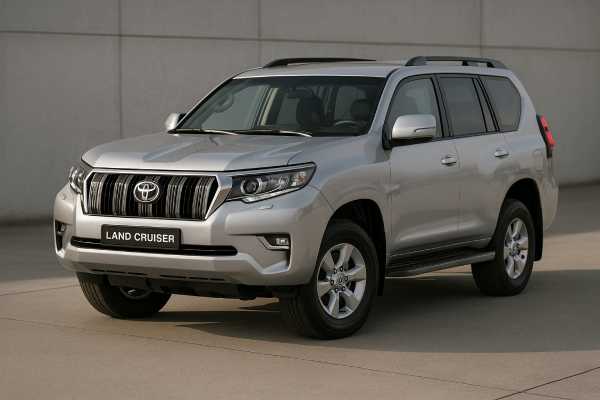
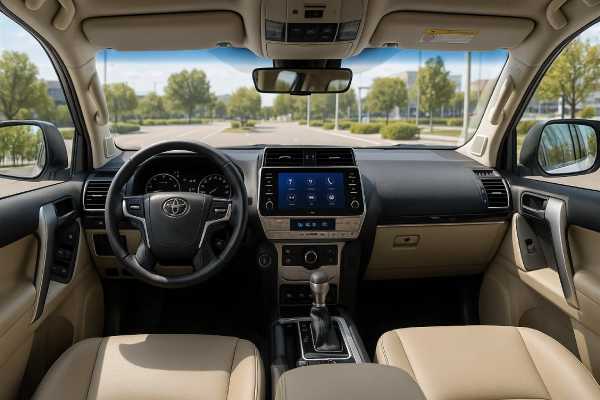
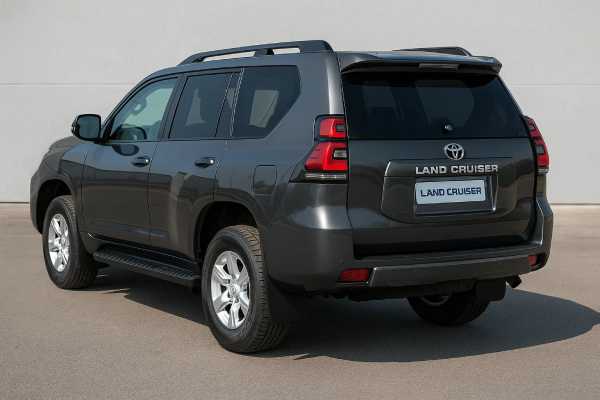
The 2020–2024 facelift of the Toyota Land Cruiser (GDJ150) pairs traditional body-on-frame strength with a cleaner, more powerful 2.8-litre 1GD-FTV turbodiesel. With 204 hp (150 kW) and up to 500 Nm, it tows confidently, cruises quietly, and climbs rough tracks with old-school dependability and modern driver aids. Permanent four-wheel drive with a locking centre differential, low-range gearing, and optional rear locker keep you moving when surface grip fades. Inside, the facelift brought smarter infotainment with Apple CarPlay/Android Auto, a clearer instrument display, and an expanded Toyota Safety Sense suite. Owners value its longevity, parts availability, and high resale, especially when maintained on time and driven regularly enough to keep the diesel after-treatment healthy. If you need a single SUV to handle family, work, winter, and trails, the GDJ150 remains one of the most rounded choices—sturdy rather than flashy, and engineered for decades of service.
Fast Facts
- Strong 4×4 hardware: permanent 4WD, low range, centre Torsen LSD; rear diff lock and KDSS available.
- Proven 1GD-FTV diesel: 204 hp, up to 500 Nm; relaxed highway manners and excellent towing poise.
- Safety and tech: Toyota Safety Sense (AEB, adaptive cruise, lane support), plus smartphone integration.
- Diesel ownership caveat: short, cold urban trips can stress DPF/EGR—prefer regular motorway runs and correct oil.
- Typical oil service: every 10,000 miles (16,000 km) or 12 months, whichever comes first.
Quick navigation
- Land Cruiser 2.8 diesel overview
- GDJ150 specs and data
- Land Cruiser trims and safety
- Reliability and known issues
- Maintenance and buyer’s guide
- Driving impressions and efficiency
- How it compares to rivals
Land Cruiser 2.8 diesel overview
The facelifted GDJ150 Land Cruiser (2020–2024) focuses on useful upgrades rather than reinvention. The headline change is the revised 1GD-FTV 2.8-litre turbodiesel: power rises to 204 hp (150 kW) and torque to 500 Nm with the 6-speed automatic, trimming the 0–100 km/h run to the high-9-second bracket in five-door models and improving in-gear response for overtakes and towing. NVH (noise, vibration, harshness) improves with better combustion control and torque-converter calibration.
Chassis fundamentals remain classic Land Cruiser: a boxed ladder frame, double-wishbone front suspension and a four-link, coil-sprung rear axle. The permanent 4WD system uses a Torsen limited-slip centre differential with a lock function, plus a traditional two-speed transfer case for low-range work. Depending on trim and options, buyers could add a locking rear differential, Crawl Control, Multi-Terrain Select (surface-specific traction strategies), Multi-Terrain Monitor cameras, and KDSS (Kinetic Dynamic Suspension System) for larger wheel articulation off-road while controlling roll on-road.
Inside, the facelift brings a more responsive touchscreen with Apple CarPlay/Android Auto, clearer graphics on the multi-information display, and higher-grade upholstery and trim on upper models. Toyota Safety Sense expands to include pedestrian/cyclist detection for the pre-collision system, intelligent adaptive cruise control, lane support, road sign assist and automatic high beam, bringing active safety closer to modern crossover benchmarks while keeping analogue robustness.
Real-world ownership strengths are predictability, parts supply, and residual values. The GDJ150 is not the most luxurious or quickest SUV, but it keeps performing with fewer surprises than many rivals. The main ownership caveat is diesel after-treatment: DPF/EGR systems prefer regular longer trips and correct low-SAPs oil; misuse brings soot accumulation and higher maintenance. Kept warm and exercised, the 2.8 D-4D is economical for its size and extremely durable.
GDJ150 specs and data
Engine & Performance (ICE)
| Item | Detail |
|---|---|
| Code | 1GD-FTV (D-4D) |
| Layout & valvetrain | Inline-4, DOHC, 16 valves |
| Bore × stroke | 92.0 × 103.6 mm (3.62 × 4.08 in) |
| Displacement | 2.755 L (2,755 cc) |
| Induction | Single turbocharger (VGT), intercooler |
| Fuel system | Common-rail direct injection |
| Compression ratio | 15.6:1 |
| Max power | 204 hp (150 kW) @ 3,000 rpm |
| Max torque | 500 Nm (369 lb-ft) @ 1,600–2,800 rpm (6-speed automatic) |
| Timing drive | Chain |
| Emissions standard | Euro 6d (select markets); AdBlue/SCR + DPF |
| WLTP combined (typical range) | 9.1–10.2 L/100 km (≈ 23–26 mpg US / 28–31 mpg UK) |
| Real-world highway @ 120 km/h | ~10.5–11.5 L/100 km (≈ 20–22 mpg US / 24–26 mpg UK) depending on tyres, load, roof gear |
| Aerodynamics | Cd not officially published (box-frame SUV) |
Transmission & Driveline
| Item | Detail |
|---|---|
| Transmission | 6-speed automatic (Aisin), manual available in limited markets |
| Gear ratios (6AT) | 1st 3.600 • 2nd 2.090 • 3rd 1.488 • 4th 1.000 • 5th 0.687 • 6th 0.580 • Rev 3.732 |
| Drive type | Permanent 4×4 with lockable centre differential |
| Transfer case | High/Low range; low-range reduction ~2.57:1 |
| Differentials | Centre Torsen LSD (lockable); open rear (available locking rear diff by trim/option) |
| Traction systems | A-TRC, VSC; optional Multi-Terrain Select, Crawl Control |
Chassis & Dimensions (5-door)
| Item | Detail |
|---|---|
| Suspension (front/rear) | Double wishbone / 4-link live axle; KDSS and AVS/air rear available by trim |
| Steering | Power-assisted rack; relaxed highway ratio |
| Brakes | Ventilated discs front/rear; ABS, EBD, BA |
| Wheels/Tyres | 265/65 R17 or 265/55 R19 (market/trim) |
| Ground clearance | ~215 mm (8.5 in) |
| Angles (approx.) | Approach 31° • Departure 25° • Breakover 22° |
| Length/Width/Height | ~4,840 / 1,885 / 1,845 mm (190.6 / 74.2 / 72.6 in) |
| Wheelbase | 2,790 mm (109.8 in) |
| Turning circle (kerb-to-kerb) | ~5.8 m (19.0 ft) |
| Curb weight (typical) | ~2,205–2,430 kg (4,861–5,357 lb) |
| GVWR | ~2,990 kg (6,592 lb) |
| Fuel tank | 87 L (23.0 US gal / 19.1 UK gal) |
| Cargo volume (5-seat, VDA) | Approx. 640 L (22.6 ft³) seats up; >1,600 L (56.5 ft³) seats folded (by trim/seating) |
Performance & Capability
| Metric | Value |
|---|---|
| 0–100 km/h (0–62 mph) | ~9.9 s (5-door, 6AT) |
| Top speed | ~175 km/h (108 mph) |
| Braking 100–0 km/h | Not officially published (tyre-dependent); strong fade-resistance on quality pads |
| Towing capacity (braked/unbraked) | 3,000 kg / 750 kg (6,614 / 1,653 lb) |
| Payload (typical range) | ~560–780 kg (1,235–1,720 lb) |
| Roof load | ~80–100 kg (176–220 lb) with approved rails |
Fluids & Service Capacities (typical EU values; verify by VIN)
| System | Specification | Capacity |
|---|---|---|
| Engine oil | ACEA C2, 0W-30 (Toyota spec), low-SAPs | ~7.3–7.7 L (7.7–8.1 US qt) |
| Coolant | Toyota Super Long Life Coolant (pink) 50/50 | ~11–13 L (11.6–13.7 US qt) |
| ATF | Toyota ATF WS | ~3.1 L drain/refill (~8–9 L dry) |
| Transfer case | 75W (Toyota LF) | ~1.4–1.5 L (1.5–1.6 US qt) |
| Front/Rear diff | 75W-85/90 GL-5 (per spec) | ~1.5 L / ~3.0 L |
| A/C refrigerant | R-134a | ~550–650 g (19–23 oz) |
| A/C compressor oil | ND-OIL 8 (typical) | ~120 mL (4.1 fl oz) |
| Key torque examples | Wheel nuts ~131 Nm (97 lb-ft); engine drain plug ~39–42 Nm (29–31 lb-ft) |
Electrical
| Item | Detail |
|---|---|
| Alternator output | ~130 A (model-dependent) |
| 12 V battery | ~70–95 Ah DIN, AGM or flooded (size varies by trim/climate) |
| Glow plugs | Ceramic/steel, ECU-controlled (no spark plugs on diesel) |
Safety & Driver Assistance
| Area | Highlights |
|---|---|
| Structure & airbags | Ladder frame with reinforced body; front, side, curtain, driver’s knee (third-row coverage by trim) |
| Toyota Safety Sense | Pre-Collision System (pedestrian/cyclist), Intelligent Adaptive Cruise Control, Lane Departure Alert/Lane Trace Assist, Automatic High Beam, Road Sign Assist |
| Other systems | Blind Spot Monitor, Rear Cross Traffic Alert (upper trims); Trailer Sway Control; TPWS |
| Ratings note | The 2020–2024 facelift was not newly rated by Euro NCAP under its latest protocol; treat earlier ratings as non-comparable across protocols. Headlight/IIHS ratings do not apply to EU-market Prado. |
Land Cruiser trims and safety
Trim structure (Europe/UK, 2020–2024)
Line-ups vary by market, but a typical two-grade structure was Active (utility-leaning) and Invincible (luxury/off-road kit). Some markets also offered Commercial/Utility two-seat vans and occasional specials (e.g., “Invincible X” or limited editions).
Active (core features)
- Permanent 4WD with lockable centre differential and low range, A-TRC and VSC.
- 17-inch alloys, full-size spare; roof rails; side steps.
- Toyota Safety Sense including PCS with pedestrian/cyclist detection, intelligent ACC, LDA/LTA, AHB, RSA.
- Dual-zone climate, rear camera, 4.2-inch MID; Apple CarPlay/Android Auto via updated multimedia.
- Cloth seats; 5-seat standard, optional 7-seat depending on market.
Invincible / upper trims (adds or substitutes)
- Off-road pack availability: Crawl Control, Multi-Terrain Select, Multi-Terrain Monitor, rear differential lock, Body Angle Monitor.
- Chassis tech: KDSS for articulation; AVS with rear air suspension on some specs.
- 19-inch wheels, LED lighting, upgraded parking sensors, multi-view camera.
- Leather upholstery, power/heated/ventilated front seats, memory driver’s seat; enhanced TFT display.
- Premium audio (JBL), navigation with eCall, enhanced connectivity.
Mechanical and functional differences that matter
- Locking rear diff: pivotal for rock steps, mud ruts, and cross-axle situations; often bundled with Crawl Control/MTS in an off-road pack.
- KDSS: hydraulically decouples anti-roll bars at low speed to increase articulation, then re-couples for flatter on-road cornering; reduces the usual compromise of tall SUVs.
- AVS/air rear: helps high-load ride comfort and self-leveling when towing or with seven occupants.
- Tow ratings: 3,000 kg braked was the common five-door figure; ensure the tow pack, cooling pack, and hitch coding are present when shopping used.
Year-to-year changes (high-level)
- 2020 (MY2021 introduction): engine uprated to 204 hp with torque increase to 500 Nm (auto); multimedia updated; Toyota Safety Sense expanded.
- 2021–2022: smartphone mirroring widely enabled; incremental equipment reshuffles (LED headlamps, sensors) by trim.
- 2023–2024: run-out specifications with simplified options; pricing and minor feature packs adjusted before the next-gen model’s arrival.
Safety ratings and child-seat provisions
- ISOFIX anchors on second-row outboard seats; top-tether points by seat layout.
- Curtain airbag coverage varies with third-row fitment; check trim spec sheets.
- ADAS calibration after windscreen or radar replacement: plan for dynamic/static calibration; many functions rely on a correctly aligned forward camera/radar.
Quick identifiers (used buyers)
- VIN/Build: GDJ150 (5-door); engine code 1GD visible on data plate.
- Interior tells: off-road buttons (Crawl/MTS), “Rear Diff Lock” switch, KDSS warning label underbody, AVS/air controls near the shifter.
- Exterior: 19-inch wheels and LED headlamps typically signal upper trims; camera lenses in grille/mirrors indicate Multi-Terrain Monitor.
Reliability and known issues
The GDJ150 is generally durable, with a powertrain designed for long service life when maintained properly and driven sufficiently to keep after-treatment healthy. Below are the themes to watch, mapped by prevalence and cost impact. Mileage bands assume typical European use.
Engine and after-treatment (1GD-FTV)
- DPF soot accumulation (common; low→medium cost): Frequent short, cold trips prevent passive regeneration. Symptoms: rising oil level, increased fuel consumption, regeneration attempts, DPF warnings. Root cause: incomplete burn-off. Remedy: perform an extended drive (60–80 km at steady load), ensure correct low-SAPs 0W-30 oil, update ECU software if available; forced regeneration at service if needed. Prevent with regular motorway use.
- EGR valve/cooler fouling (common; medium): Symptoms: rough idle, reduced performance, soot smell, codes for EGR flow. Cause: soot and condensates. Remedy: EGR cleaning or replacement; software updates may refine EGR duty cycle. Pair with intake/throttle body clean on higher-mileage vehicles.
- Intake manifold deposits (occasional; medium): Symptoms: flat mid-range, hesitation, P2002/P0401 types. Remedy: clean manifold and MAP passages; check PCV function.
- Injector sealing washers (occasional; medium): Symptoms: “chuffing” sound, diesel smell, black staining (blow-by). Remedy: replace seals/bolts; check compression; re-torque per service data.
Cooling & lubrication
- Thermostat/viscous fan clutch ageing (occasional; low): leads to slow warm-up or high temps when towing in summer. Replace consumables proactively by 8–10 years.
- Oil cooler and hoses (rare; medium): seepage with age; inspect during service.
Transmission & driveline
- 6-speed automatic (generally robust): light converter shudder can present with aged ATF under heavy towing (rare). Remedy: early ATF service (WS), software updates.
- Transfer case/diff breathers (occasional; low): blocked breathers cause seals to weep after off-road water crossings. Remedy: clean/extend breathers; replace seals if contaminated.
- Rear axle control-arm bushes (common wear; low): knocks and vague rear steer at ~80–120k miles; replacement restores composure.
- KDSS leaks (occasional; medium): look for oily residue near accumulators/lines; repair kits or component replacement required; not catastrophic but not cheap.
Chassis, body, and electrics
- Frame/suspension corrosion hotspots (common in salted climates; cost varies): rear cross-member, spring seats, and inner chassis rails. Remedy: thorough inspection, cavity wax early in life; treat and underseal properly; avoid heavily corroded frames.
- Parking brake shoe wear/adjustment (common; low): weak hold on steep hills—adjust or renew shoes/drum hats.
- Door loom fatigue (occasional; low): repeated flex on driver’s door can break wires; repair harness.
Software and calibration
- Powertrain ECU updates target DPF logic, EGR behavior and drivability; ADAS components (front camera/radar) require calibration after windscreens, front repairs, or alignment changes. Keep multimedia firmware current for CarPlay/Android Auto stability.
Recalls and service campaigns
- Campaigns vary by VIN and market over time. Always run a VIN recall check and ask the seller for printed dealer completion records. Prioritize completion of airbag, fuel, or braking-related items as soon as possible.
Pre-purchase checks to request
- Full service history with stamps/invoices; proof of recent oil and fuel-filter services.
- Evidence that differential/transfer oils were serviced if the vehicle towed or did regular off-road work.
- DPF history (no persistent warnings, no excessive forced regens), and a healthy 12 V battery (critical for regeneration cycles and ADAS).
Maintenance and buyer’s guide
Practical maintenance schedule (typical EU guidance; adjust by duty cycle)
- Engine oil & filter: every 10,000 miles (16,000 km) / 12 months. Use ACEA C2 0W-30; confirm viscosity for climate.
- Fuel filter: 20,000–30,000 miles (32–48k km) / 2 years; sooner if poor fuel quality suspected.
- Engine air filter: inspect every service; replace 20,000–30,000 miles or sooner in dusty use.
- Cabin filter: 12 months or when airflow/odour worsens.
- Coolant (SLLC): first change 100,000 miles (160,000 km) / 10 years, then 5-year intervals; check concentration before winter.
- Serpentine/aux belt & hoses: inspect each service; replace 60,000–90,000 miles (96–145k km) or at first cracking/noise.
- ATF (WS): “lifetime” under light use, but best practice is 60,000–90,000 miles (96–145k km) if towing/off-roading; use genuine spec and correct level procedure.
- Transfer case & diffs: 40,000–60,000 miles (64–96k km) in heavy use; otherwise inspect for colour/metal and set a 6-year refresh.
- Brake fluid: 24 months regardless of mileage.
- Brake pads/rotors: inspect every service; replace when below minimum thickness or if vibration appears—fit quality parts for heat tolerance when towing.
- Wheel alignment and tyre rotation: rotate 6,000–8,000 miles (10–13k km); check alignment annually or after pothole/off-road events.
- Glow plugs/battery: test at 4–5 years; replace weak units to avoid cold-start stress.
- Timing drive: chain-driven; no scheduled replacement—inspect for correlation faults, rattle, metal in oil. Replace components only if out of spec or noisy.
- Body & frame preservation: annual underbody wash and inspection; top-up cavity wax in salted regions.
Essential fluids & fasteners (at-a-glance)
- Oil: ACEA C2 0W-30, approx. 7.3–7.7 L with filter.
- ATF: Toyota WS; keep pan and strainer clean; level set at temperature via overflow.
- Coolant: Toyota SLLC (pink) 50/50; bleed properly with heater valves open.
- Diffs/transfer: GL-5 75W-85/90 (per spec), LF75W in transfer; fill to plug level.
- Torques: wheel nuts ~131 Nm; engine drain plug ~39–42 Nm; diff plugs ~49 Nm (typical). Always confirm by VIN/service data.
Buyer’s guide checklist
- Underbody: rust at frame rails, cross-members, rear trailing-arm mounts; look for fresh underseal hiding scale.
- Driveline: fluid leaks at transfer/diff seals; breathers clear; no driveline clunks when transitioning on/off throttle.
- Suspension: KDSS lines/dampers dry; rear control-arm bushes not cracked; no steering play.
- Powertrain: smooth cold start, no white smoke after warm-up, stable idle; no persistent DPF messages; oil level not rising between services.
- Cooling: no coolant smell; radiator and intercooler fins straight; viscous fan clutch engages when hot.
- Electronics: ADAS warning-free; camera/radar calibrations recorded after windscreen work.
- Tow history: check hitch coding, electrics, and transmission fluid condition if a towbar is fitted.
Which years/trims to target
- 2021–2022 6AT models strike the best balance of equipment and value; look for off-road pack (rear locker, Crawl, MTS) if you trail-drive.
- Active vs Invincible: Active is simpler and lighter; Invincible adds comfort tech and the most capable off-road aids. Choose by use case.
- Avoid? Not a specific year—avoid examples with persistent DPF issues, frame rust, or incomplete recall/service history. A clean, maintained high-miler often beats a neglected low-miler.
Durability outlook
- With proper fluids and a usage pattern that allows regular regenerations, 300,000+ km (186,000+ miles) without major engine/gearbox work is realistic. The limiting factors are typically corrosion and suspension wear, not core powertrain failure.
Driving impressions and efficiency
Ride, handling, NVH
The GDJ150’s personality is calm and composed. The boxed frame and long-travel suspension filter rough roads better than most crossovers. On 17-inch tyres it absorbs sharp edges and speed humps with a gentle secondary motion; 19-inch tyres look smart but introduce more patter. KDSS-equipped versions keep roll moderate without stiff primary ride, giving confidence on winding roads. Straight-line stability is excellent at motorway speeds, helped by conservative steering geometry and a long wheelbase. Cabin noise is low for a body-on-frame SUV: diesel thrum is muted once warm; wind and tyre noise dominate at 120 km/h but remain easy to live with. Brakes feel strong and consistent with decent pedal travel—pad compound choice has a big effect on dust and bite.
Powertrain character
The 1GD-FTV’s revised mapping and hardware give a flexible mid-range. There’s little drama off the line, but from 1,600–3,000 rpm the engine pulls hard with a flat torque plateau. The 6-speed automatic is tuned for smoothness and low revs; kickdown is decisive in Sport mode, and manual control via the lever is useful on grades or when engine-braking downhill. There’s no turbo “hit”—just linear thrust; in technical off-road sections, low range lets the converter multiply torque cleanly without stalling.
Efficiency in the real world
Expect 9.1–10.2 L/100 km WLTP combined depending on wheel/trim and driving pattern. Real-world mixed driving commonly lands around 9.5–11.0 L/100 km (21–25 mpg US / 25–30 mpg UK) if you keep speeds sensible and tyres at the correct pressures. Cold weather, roof racks, mud-terrain tyres, and short trips push consumption upward quickly. In steady 120 km/h motorway travel, ~10.5–11.5 L/100 km is typical. Long, hot climbs when towing can nudge into the low 12s until the grade eases.
Towing and load
With 3,000 kg braked capacity and a stout ladder frame, the GDJ150 tows confidently. The long wheelbase and A-TRC help stability in crosswinds; Trailer Sway Control is a useful safety net, not a substitute for proper noseweight and weight distribution. When loaded for a family holiday, the rear air suspension (if fitted) maintains stance; even on coils the Land Cruiser carries weight with less squat than many unibody rivals. Plan for a ~15–25% fuel-consumption penalty when towing mid-weight caravans/boats at motorway pace.
Traction and control
On dirt, snow, and wet grass, the combination of permanent 4WD, centre diff lock, and brake-based A-TRC gets you far. The rear locker is a force multiplier for diagonal ruts and rock steps. Crawl Control acts like an off-road cruise control, letting you concentrate on steering as it modulates throttle and brakes; Multi-Terrain Select adjusts the traction strategy to suit surfaces like mud, sand, or rock. Ground clearance and approach/departure angles are generous for a factory SUV; a full-size spare on a swing-out carrier (market-dependent) is invaluable away from tarmac.
Key metrics at a glance
- 0–100 km/h: ~9.9 s (5-door auto)
- 50–80 mph (80–130 km/h) passing: confident in 4th–5th; plan one-gear kickdown for best results
- 100–0 km/h braking: strong, repeatable on quality pads; heavy mud-terrain tyres lengthen distances
- Turning circle: tight for size (~5.8 m kerb-to-kerb)
How it compares to rivals
Land Rover Defender 110 D250 (3.0 diesel, 8AT)
The modern Defender is quicker, quieter, and more luxurious, with adaptive air suspension and a slick 8-speed. It also offers more modern crash-test pedigree and a broader option matrix. However, complexity, parts pricing, and out-of-warranty costs tilt in the Land Cruiser’s favour for long-term ownership, especially if you value simple, proven hardware and wide independent-shop support. Off-road, a locker-equipped GDJ150 keeps pace surprisingly well; the Defender’s cameras and terrain electronics are superb but rely heavily on software health.
Jeep Wrangler Unlimited (2.2/2.0 turbo, 8AT, part-time 4×4)
Wrangler has excellent approach/breakover angles and locking axles, with a more playful feel and huge aftermarket. Yet on European motorways the Land Cruiser rides more quietly, tracks straighter, and tows far better. The Prado’s permanent 4WD is friendlier in mixed weather; the Wrangler’s part-time system should not be used in 4H on high-grip tarmac.
Mercedes-Benz G-Class (G 350 d/G 400 d)
The G-Class is vastly more expensive but brings triple lockers and a plush cabin. For expedition use where budget is secondary, it’s brilliant. For rational ownership, the GDJ150’s purchase/maintenance costs and parts ecosystem are far lighter, while still offering excellent reliability and genuine 4×4 credentials.
Big-picture takeaway
If you prize longevity, towing stability, and off-road effectiveness with low drama, the Land Cruiser stands apart. Rivals may be faster, posher, or more tech-forward, but few match its combination of hardware depth, serviceability, and total cost predictability over a long horizon.
References
- TOYOTA LAND CRUISER TECHNICAL SPECIFICATIONS 2021 (Technical Data)
- TOYOTA LAND CRUISER INTRODUCTION 2021 (Press Pack)
- TOYOTA LAND CRUISER EQUIPMENT SPECIFICATIONS 2021 (Equipment List)
- Land Cruiser | The Ultimate SUV | Toyota UK 2025 (Model Page)
- Recalls | Owners | Toyota UK 2025 (Recall Database)
Disclaimer
This guide is for informational purposes only and is not a substitute for professional diagnosis or repair. Specifications, torque values, fluid capacities, and service intervals vary by VIN, market, model year, and equipment. Always confirm procedures and numbers against your vehicle’s official owner’s manual and service documentation, and follow all safety instructions.
If this article helped you, please consider sharing it with fellow owners on Facebook or X/Twitter to support xcar’s work.