
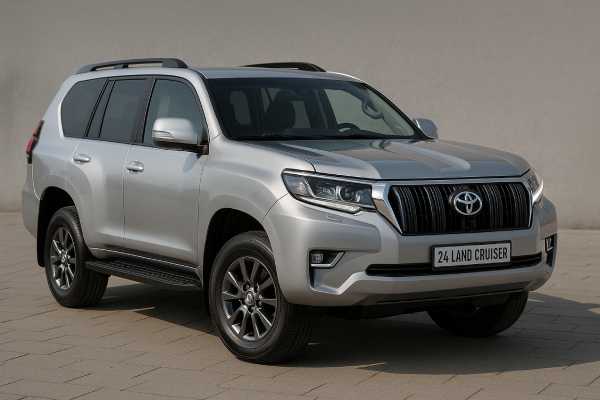
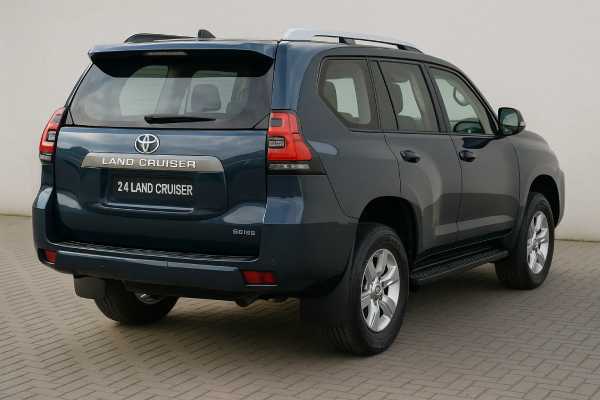
The 2020–2024 Toyota Land Cruiser (GDJ155) is the short-wheelbase, three-door counterpart to the five-door GDJ150, built for buyers who want classic Land Cruiser toughness in a more compact footprint. Its updated 1GD-FTV 2.8-litre D-4D turbodiesel produces 204 hp (150 kW) and up to 500 Nm, matched to a six-speed automatic and permanent four-wheel drive with low range and a lockable centre differential. The facelift improved drivability, refinement, and active safety while keeping the ladder-frame chassis, long-travel suspension, and dependable hardware that define the nameplate. With a tight turning circle, lighter curb mass than the five-door, and outstanding approach and departure angles, the GDJ155 feels agile off-road yet composed on the motorway. It will not out-gadget luxury rivals, but its serviceability, parts availability, and long-term durability make it a pragmatic, keep-forever 4×4—especially if you value mechanical honesty over fashion and need real towing and trail capability in a smaller package.
At a Glance
- Compact three-door ladder-frame SUV with permanent 4×4, low range, and optional rear diff lock; excellent approach/departure geometry.
- Updated 2.8 D-4D (204 hp, up to 500 Nm) delivers strong mid-range torque and relaxed cruising.
- Toyota Safety Sense features and smartphone integration modernize a proven platform.
- Caveat: diesel after-treatment (DPF/EGR/SCR) prefers longer, hot runs; repeated short trips can trigger regenerations.
- Typical oil service: 10,000 miles (16,000 km) or 12 months, with fuel filter every 20,000–30,000 miles (32–48k km).
Guide contents
- GDJ155 detailed overview
- Specifications and technical data
- Trims, options and driver assistance
- Reliability, issues and service actions
- Maintenance and buyer’s guide
- Driving impressions and efficiency
- How it compares to rivals
GDJ155 detailed overview
The GDJ155 is the short-wheelbase (SWB) Land Cruiser derivative, positioned for regions that value manoeuvrability on tight trails and in older European city centres while retaining genuine expedition hardware. Compared to its five-door sibling, the three-door body reduces overall length and mass, shortens the wheelbase, and improves breakover and departure angles. The facelift introduced in 2020 focused on powertrain refinement—raising output to 204 hp (150 kW) and torque to 500 Nm in the automatic—along with multimedia upgrades (Apple CarPlay/Android Auto) and an expanded Toyota Safety Sense suite.
Under the body sits a boxed ladder frame. The front suspension is a double-wishbone layout, and the rear uses a four-link solid axle with coils. Options like KDSS (Kinetic Dynamic Suspension System) hydraulically modulate the anti-roll bars to blend on-road flatness with off-road articulation. A traditional two-speed transfer case delivers low-range gearing, the centre differential is a Torsen-type unit with a lock function, and many markets offer a locking rear differential. These aren’t marketing features; they define how the car moves on loose gravel, deep snow, and rock.
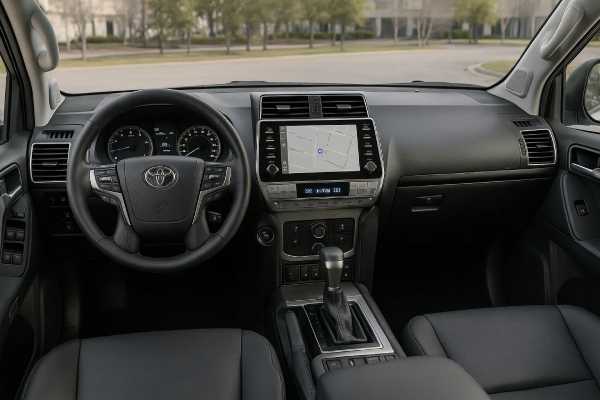
Inside, the GDJ155 is a five-seat cabin with a two-row layout. The shorter body sacrifices some cargo length versus the five-door, but it gains a tighter turning circle and a more playful, point-and-shoot character on narrow lanes. The facelift’s infotainment finally brought modern phone mirroring and quicker responses, while trims added LED lighting and more cameras for articulation checks and tight-space parking. Ride isolation is better than most unibody crossovers on broken roads; the frame and long-travel suspension take the sting out of potholes and corrugations.
Ownership appeal is less about gadgets and more about predictable costs. Consumables are truck-grade but widely available. Independent specialists know the platform well. Diesel after-treatment prefers routine hot runs—if your use case is all five-minute school trips in winter, this is not the ideal powertrain. If you do mixed driving, tow, and rack up motorway miles, the 2.8 D-4D is a faithful, economical companion.
Specifications and technical data
Engine & Performance (ICE)
| Item | Detail |
|---|---|
| Code | 1GD-FTV (D-4D) |
| Layout & valvetrain | Inline-4, DOHC, 16 valves |
| Bore × stroke | 92.0 × 103.6 mm (3.62 × 4.08 in) |
| Displacement | 2.755 L (2,755 cc) |
| Induction | Variable-geometry turbocharger, intercooler |
| Fuel system | Common-rail direct injection |
| Compression ratio | 15.6:1 |
| Max power | 204 hp (150 kW) @ ~3,000 rpm |
| Max torque (6AT) | 500 Nm (369 lb-ft) @ 1,600–2,800 rpm |
| Timing drive | Chain |
| Emissions/after-treatment | Euro 6d with DPF + SCR (AdBlue) |
| WLTP combined (typical) | 9.1–10.2 L/100 km (≈ 23–26 mpg US / 28–31 mpg UK) |
| Real-world highway @ 120 km/h | ~10.5–11.5 L/100 km (≈ 20–22 mpg US / 24–26 mpg UK) |
| Aerodynamics | Cd not formally quoted (box-frame SUV) |
Transmission & Driveline
| Item | Detail |
|---|---|
| Transmission | 6-speed automatic (Aisin); limited manual availability by market |
| Gear ratios (6AT) | 1st 3.600 • 2nd 2.090 • 3rd 1.488 • 4th 1.000 • 5th 0.687 • 6th 0.580 • Rev 3.732 |
| Drive type | Permanent 4×4 with lockable centre differential |
| Transfer case | High/Low range, low-range reduction ≈ 2.57:1 |
| Differentials | Torsen centre LSD (lockable); rear diff lock available by trim/option |
| Traction systems | A-TRC, VSC; optional Multi-Terrain Select, Crawl Control |
| Replenishment | Refuel to full ~5–7 min typical from near-empty |
Chassis & Dimensions (GDJ155, three-door)
| Item | Detail |
|---|---|
| Frame | Body-on-frame (boxed ladder) |
| Suspension (front/rear) | Double-wishbone / 4-link live axle with coils; KDSS available |
| Steering | Rack-and-pinion power steering; relaxed motorway ratio |
| Brakes | Ventilated discs front/rear; ABS, EBD, BA |
| Wheels/Tyres (common) | 265/65 R17 or 265/55 R19 (by trim) |
| Ground clearance | ~205 mm (8.1 in) |
| Angles (approx.) | Approach 31° / Departure 26° / Breakover 22° |
| Length / Width / Height | ~4,395 / 1,885 / 1,845 mm (173.1 / 74.2 / 72.6 in) |
| Wheelbase | 2,450 mm (96.5 in) |
| Turning circle (kerb-to-kerb) | ~5.8 m (19.0 ft) |
| Curb weight (typical) | ~2,040–2,210 kg (4,497–4,872 lb) |
| GVWR | ~2,900–2,990 kg (6,393–6,592 lb) |
| Fuel tank | 87 L (23.0 US gal / 19.1 UK gal) |
| Cargo volume (VDA, 5-seat) | ~380–430 L (13.4–15.2 ft³) seats up; >1,500 L (53.0+ ft³) seats folded |
Performance & Capability
| Metric | Value |
|---|---|
| 0–100 km/h (0–62 mph) | ~9.9 s (6AT) |
| Top speed | ~175 km/h (108 mph) |
| Braking 100–0 km/h | Tyre-dependent; strong fade resistance with quality pads |
| Towing capacity (braked/unbraked) | 3,000 kg / 750 kg (6,614 / 1,653 lb) |
| Payload (typical) | ~600–760 kg (1,323–1,676 lb) |
| Roof load | ~80–100 kg (176–220 lb) with approved rails/crossbars |
Fluids & Service Capacities (typical EU values; confirm by VIN)
| System | Specification | Capacity |
|---|---|---|
| Engine oil | ACEA C2 0W-30 (low-SAPs) | ~7.3–7.7 L (7.7–8.1 US qt) |
| Coolant | Toyota Super Long Life Coolant (pink), 50/50 | ~11–13 L (11.6–13.7 US qt) |
| ATF | Toyota ATF WS | ~3.1 L drain/refill (≈ 8–9 L dry) |
| Transfer case | LF 75W (Toyota spec) | ~1.4–1.5 L (1.5–1.6 US qt) |
| Front/Rear diff | GL-5 75W-85/90 (per spec) | ~1.5 L / ~3.0 L |
| A/C refrigerant | R-134a | ~550–650 g (19–23 oz) |
| A/C compressor oil | ND-Oil 8 | ~120 mL (4.1 fl oz) |
| Key torque specs | Wheel nuts ~131 Nm (97 lb-ft); drain plug ~39–42 Nm (29–31 lb-ft); diff plugs ~49–60 Nm (36–44 lb-ft) |
Electrical
| Item | Detail |
|---|---|
| Alternator output | ~130 A (by trim/equipment) |
| 12 V battery | ~70–95 Ah DIN; AGM/flooded by climate/trim |
| Glow plugs | ECU-controlled (no spark plugs on diesel) |
Safety & Driver Assistance
| Area | Highlights |
|---|---|
| Structure & airbags | Ladder frame with reinforced body; front/side/curtain (row coverage by seating); driver’s knee airbag |
| Toyota Safety Sense | Pre-Collision System (pedestrian/cyclist), Intelligent Adaptive Cruise Control, Lane Departure Alert/Lane Trace Assist, Automatic High Beam, Road Sign Assist |
| Additional systems | Blind Spot Monitor, Rear Cross Traffic Alert (upper trims); Trailer Sway Control; TPWS |
| Ratings note | The facelifted GDJ155 was not newly rated under Euro NCAP’s most recent protocol; earlier scores aren’t directly comparable. Headlight/IIHS ratings don’t apply to this EU-market variant. |
Trims, options and driver assistance
Typical European line-up (2020–2024)
Exact names vary by country, but the SWB generally mirrors the five-door’s Active (utility-leaning) and Invincible (luxury/off-road kit) structure, with occasional market-specific editions and Commercial variants.
Active (core content)
- Permanent 4×4 with lockable centre diff and low range; A-TRC, VSC, Trailer Sway Control.
- 17-inch wheels, full-size spare, roof rails, side steps.
- LED daytime running lights; halogen/LED headlamp mix by year.
- Dual-zone climate, rear camera, 4.2-inch multi-info display.
- Updated multimedia with Apple CarPlay/Android Auto.
- Toyota Safety Sense features as per market roll-out.
- Five-seat layout; fabric upholstery.
Invincible / upper trims (adds)
- Rear differential lock, Crawl Control, Multi-Terrain Select, Multi-Terrain Monitor cameras (off-road pack).
- KDSS (where offered) and, on some specs, AVS with self-levelling rear air.
- 19-inch alloys, comprehensive LED lighting, front/rear parking sensors, 360° camera.
- Leather upholstery, power/heated/ventilated seats, memory driver’s seat.
- Premium audio (often JBL), navigation, and enhanced TFT driver display.
Functional differences that matter
- Rear diff lock: transforms diagonal-rut and rocky ascent performance; if you off-road regularly, prioritise it.
- KDSS: meaningfully increases articulation while maintaining flat cornering on-road.
- AVS/self-levelling: helpful when towing or carrying heavy cargo, keeping headlight aim and rear ride height consistent.
- Tow pack/cooling: ensure coded tow electrics and auxiliary cooling for frequent towing near 3,000 kg.
Year-to-year highlights
- 2020: introduction of the higher-output 204 hp tune and updated multimedia; Toyota Safety Sense expanded (pedestrian/cyclist detection, improved ACC).
- 2021–2022: feature reshuffles; wider fitment of LED lighting and smartphone mirroring; camera/sensor availability broadened on upper trims.
- 2023–2024: run-out editions; simplified option packs as the next generation approached.
Child-seat and practicality notes
- ISOFIX on the second-row outboard seats with top-tether points; check trim if you need three child seats across (the SWB cabin is narrower than a full-size SUV).
- Rear door aperture is large enough for rear-facing seats; confirm pram length against the shorter cargo bay.
ADAS calibration after service
- Windscreen replacement, front-end repairs, or suspension height changes may require camera/radar calibrations. Budget time for static/dynamic procedures after such work.
Reliability, issues and service actions
The GDJ155’s powertrain and chassis are built for longevity, but diesel after-treatment and European winter use create patterns worth watching. Below, items are grouped by prevalence and cost impact for 2020–2024 SWB models.
Common (low → medium cost)
- DPF soot accumulation on short-trip usage:
Symptoms: rising oil level between services, frequent/failed regenerations, higher fuel use, DPF warnings.
Cause: insufficient exhaust temperature for passive regeneration.
Remedy: regular 60–80 km motorway runs at steady load; verify ACEA C2 0W-30 oil; perform forced regen and software updates when indicated. - EGR valve/cooler fouling:
Symptoms: rough idle, reduced performance, EGR flow codes.
Remedy: clean or replace EGR components; pair with intake/MAP passage clean on high-milers. - Parking brake shoe wear/adjustment:
Symptoms: weak hold on hills.
Remedy: adjust shoe clearance; replace shoes/rotors when worn.
Occasional (medium cost)
- Injector sealing washer leaks (“black death” staining):
Symptoms: chuffing sound, diesel smell, carbon around injectors.
Remedy: replace copper washers/bolts; clean seat faces; re-torque to spec. - Rear control-arm bushes wear (~80–120k miles / 130–190k km):
Symptoms: knocks, vague rear steer, uneven tyre wear.
Remedy: press-in bushes or complete arms; align afterwards. - KDSS hydraulic seepage (salted climates):
Symptoms: clunks over diagonals, visible wetness on lines/accumulators.
Remedy: renew leaking lines/components; bleed system.
Rare (medium → high cost)
- Torque-converter shudder under heavy tow with aged ATF:
Symptoms: light vibration at ~1,500–2,000 rpm, steady throttle.
Remedy: temperature-correct ATF WS service; verify software; consider converter only if symptoms persist. - Thermostat/viscous fan clutch ageing:
Symptoms: slow warm-up in winter, rising temps on long summer grades.
Remedy: replace thermostat/clutch on condition (8–10 years typical).
Corrosion watchpoints (salted roads)
- Rear cross-member, inner chassis rails, spring seats, brake lines.
Action: annual underside wash and cavity wax; avoid examples with heavy scale hidden by fresh underseal.
Software/ECU and multimedia
- Powertrain ECU updates refine DPF logic and drivability; multimedia firmware updates improve CarPlay/Android Auto stability. Keep both current.
Recalls and service campaigns
- Campaigns vary by market and VIN. Always run an official VIN recall check and request a printed dealer report. Prioritise closures affecting airbags, fuel delivery, and braking.
Pre-purchase checks to request
- Full service history (oil, fuel filter, diff/transfer oils if used for towing or off-road).
- DPF history (no persistent warnings, normal oil level), 12 V battery test result.
- Evidence of ADAS calibrations after windscreen or front-end work.
- Underbody photos on a lift (cross-members, mounts, brake lines).
Maintenance and buyer’s guide
Baseline maintenance (typical EU schedule; adapt to duty cycle)
- Engine oil & filter: 10,000 miles (16,000 km) / 12 months; ACEA C2 0W-30 low-SAPs.
- Fuel filter: every 20,000–30,000 miles (32–48k km) / 2 years (more often if poor fuel suspected).
- Engine air filter: inspect at each service; replace 20,000–30,000 miles (dusty use sooner).
- Cabin filter: 12 months or when airflow/odour degrades.
- Coolant (SLLC, pink): first change 100,000 miles (160,000 km) / 10 years, then every 5 years.
- Serpentine/aux belt & hoses: inspect every service; replace 60,000–90,000 miles (96–145k km) or at first cracking/noise.
- ATF (WS): lifetime under light use; best practice 60,000–90,000 miles (96–145k km) for towing/off-road vehicles (temperature-correct level method).
- Transfer case & diffs: 40,000–60,000 miles (64–96k km) in heavy use; otherwise inspect and refresh on a 6-year horizon.
- Brake fluid: every 24 months, regardless of mileage.
- Brake pads/rotors: inspect at rotations; use quality compounds for towing and mountain descents.
- Tyres/Alignment: rotate 6,000–8,000 miles (10–13k km); align annually or after impacts/suspension work.
- Glow plugs & 12 V battery: test at 4–5 years; weak components hinder cold starts and DPF regens.
- Timing drive: chain—no scheduled replacement; monitor for correlation faults or noise.
- Body/frame care: annual underside wash, drain plug checks, cavity wax top-ups in salted regions.
Fluid specs quick-reference
- Oil: ACEA C2 0W-30, ~7.3–7.7 L with filter.
- ATF: Toyota WS only; follow overflow/temperature procedure.
- Coolant: Toyota SLLC (pink) 50/50; bleed with heater circuits open.
- Diffs/transfer: GL-5 75W-85/90 (per spec); LF75W in transfer.
- Essential torques: wheel ~131 Nm (97 lb-ft); drain plug ~39–42 Nm (29–31 lb-ft); diff plugs ~49–60 Nm (36–44 lb-ft).
Buyer’s checklist (SWB-specific emphasis)
- Underbody: frame rails, rear cross-member, spring perches, tank straps, brake lines.
- Driveline: look for wetness at diff/transfer seals; ensure breathers aren’t blocked (post-wading).
- Suspension: KDSS lines/accumulators dry; rear control-arm bushes not split; shocks free of weep.
- Powertrain: smooth cold start without excessive smoke; no DPF messages; stable idle; oil level not rising.
- Cooling: no coolant smell; clear radiator/intercooler fins; fan clutch engages when hot.
- Electronics: no ADAS warnings; confirm camera/radar calibrations after glass/bumper work.
- Tow use: inspect hitch and wiring; sample ATF for colour/odour if frequent towing is claimed.
Which years/trims to target
- 2021–2022 examples offer the sweet spot of equipment and price, with the 204 hp tune and matured infotainment.
- Active vs Invincible: Active is simpler and lighter; Invincible adds the rear locker, Crawl/MTS, and comfort tech—choose by usage.
- Avoid? No black-list years—avoid individual vehicles with persistent DPF faults, rust, or missing service/recall paperwork.
Longevity outlook
- With correct oil, hot cycles that permit DPF regeneration, and sensible fluid changes, the 1GD-FTV/6AT/ladder-frame recipe readily exceeds 300,000 km (186,000 miles) without major powertrain work. Long-term limiting factors are typically corrosion and bushing wear, not core engine or gearbox failure.
Driving impressions and efficiency
Ride, handling, NVH
On 17-inch tyres the SWB Land Cruiser feels settled and supple, absorbing sharp edges without thumping. The short wheelbase adds a hint of fore-aft pitch on undulating roads but also sharpens turn-in on tight lanes. KDSS versions keep roll modest without resorting to stiff springs, preserving comfort on broken surfaces. Straight-line stability is excellent up to 120 km/h (75 mph); wind and tyre noise become the dominant sounds, but cabin conversation remains easy.
Powertrain character
The 2.8 D-4D’s strength is a wide torque plateau. From 1,600 to ~3,000 rpm, it pulls cleanly with little lag. The six-speed automatic is tuned for smoothness; in Sport it holds gears longer and responds faster to throttle. Manual selection is useful on long grades or when descending in low range. There’s no dramatic turbo surge, just steady thrust that makes light work of overtakes once you’re in the meat of the torque.
Real-world economy
Expect ~9.5–11.0 L/100 km (21–25 mpg US / 25–30 mpg UK) in mixed driving if tyres are at spec and you avoid roof boxes. At a steady 120 km/h, ~10.5–11.5 L/100 km is typical. Winter cold starts, short trips, mud-terrain tyres, and roof racks can push consumption into the low 12s until conditions improve. Keep the DPF happy with occasional long runs.
Towing and load
Rated to 3,000 kg braked, the SWB tows confidently thanks to its ladder frame, permanent 4×4, and Trailer Sway Control. The shorter wheelbase is still stable with sensible noseweight and a quality hitch. Plan for a ~15–25% fuel-use penalty with mid-weight trailers at motorway pace; downshift proactively on long climbs to keep EGTs and transmission temps in check.
Traction and control
On wet grass, snow, or rocky climbs, the combination of centre diff lock, A-TRC, and gearing gets you a long way. The rear locker is a force multiplier in cross-axle situations. Crawl Control functions like a low-speed cruise that meters throttle and brake so you can place tyres precisely; Multi-Terrain Select tailors traction logic to mud, sand, or rock. Ground clearance and factory angles are generous for a showroom vehicle—choose tyres to suit your terrain and protect the underbody if you venture beyond green lanes.
Key impressions at a glance
- 0–100 km/h: ~9.9 s (6AT)
- 50–80 mph (80–130 km/h) passing: brisk with a one-gear kickdown
- 100–0 km/h braking: strong and repeatable with quality pads; heavy A/T or mud-terrain tyres lengthen distances
- Turning circle: ~5.8 m kerb-to-kerb—handy in old towns and tight forestry tracks
How it compares to rivals
Land Rover Defender 90 D250
Quick and refined with air suspension and lavish tech, the Defender 90 is the SWB style icon. It is also complex and expensive to run out of warranty. For buyers prioritising low-drama ownership over cutting-edge features, the GDJ155’s simpler hardware and independent-shop ecosystem are compelling. Off-road, a locker-equipped Land Cruiser keeps up more often than you’d expect.
Jeep Wrangler 2-door (2.0T/2.2D)
Wrangler’s approach/breakover/departure angles are excellent and the aftermarket is vast. However, part-time 4×4 (no 4H on dry tarmac), noisier long-distance manners, and towing limitations make it less rounded for European mixed use. The Land Cruiser rides quieter, tows more competently, and feels less stressed as mileage mounts.
Mercedes-Benz G-Class (G 350 d/G 400 d)
Triple diff locks and a luxury interior make the G the dream toy—at a huge price. The Land Cruiser offers 80–90% of the all-terrain ability many owners will ever use, with purchase/maintenance costs that are dramatically lower and reliability that encourages real mileage rather than occasional posing.
Big takeaway
If your shortlist demands real 4×4 hardware, tow readiness, and decade-long dependability in a compact footprint, the GDJ155 is the rational choice. Rivals may be faster or plusher, but few match this blend of mechanical depth, serviceability, and predictable total cost.
References
- TOYOTA LAND CRUISER TECHNICAL SPECIFICATIONS 2021 (Technical Data)
- TOYOTA LAND CRUISER INTRODUCTION 2021 (Press Pack)
- TOYOTA LAND CRUISER EQUIPMENT SPECIFICATIONS 2021 (Equipment List)
- Toyota Land Cruiser Powers up for Autumn with new Engine and Equipment Features 2020 (News Release)
- Land Cruiser | The Ultimate SUV 2025 (Model Page)
Disclaimer
This article is for informational purposes only and is not a substitute for professional diagnosis or repair. Specifications, torque values, fluid capacities, and service intervals vary by VIN, model year, market, and equipment. Always verify against your vehicle’s official owner’s manual and service documentation and follow all safety procedures.
If this guide helped you, please consider sharing it on Facebook or X/Twitter to support xcar’s work.