
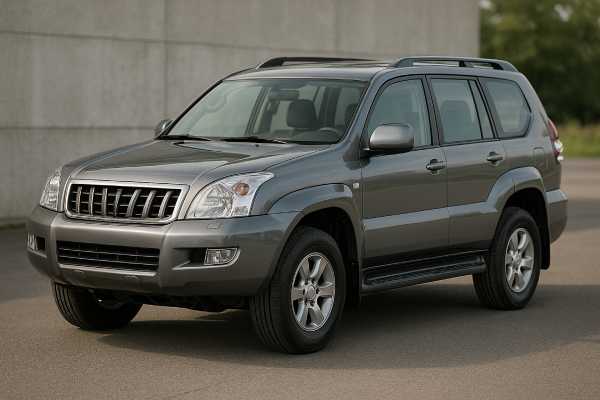
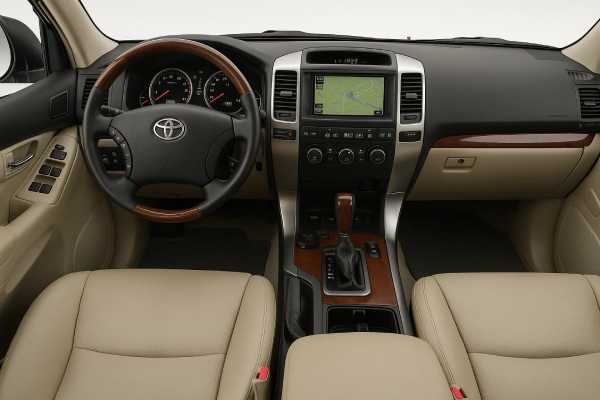
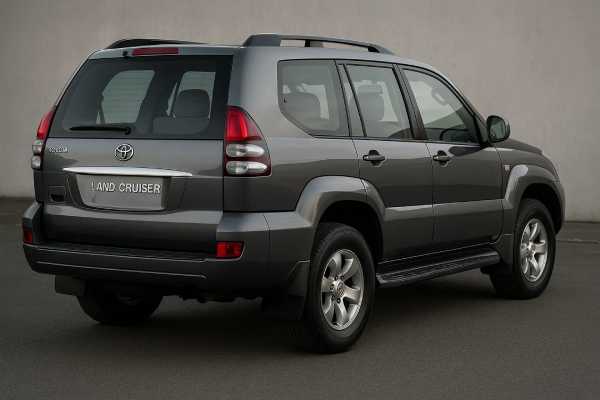
The 2007–2009 Toyota Land Cruiser (KDJ120) with the 1KD-FTV 3.0-litre D-4D turbo-diesel is the pragmatic heart of the 120-series. It marries a ladder-frame chassis and permanent four-wheel drive to a refined common-rail diesel that pulls hard from low rpm, returns sensible economy, and has a deep parts ecosystem. The late-cycle facelift improved noise insulation, equipment packaging and emissions calibration while keeping the recipe simple: a two-speed transfer case with low range, centre differential lock, and traction control that works credibly on uneven ground. Most five-door models seat seven and tow confidently when maintained. Ownership is straightforward if you respect diesel fundamentals—clean fuel, healthy cooling and regular fluid service. Do that, and the KDJ120 D-4D feels unburstable, whether commuting, touring or taking a loaded trailer through the Alps. This guide focuses on the facelifted European-market diesel (173 hp) and distills the specs, reliability patterns and maintenance priorities that matter for buyers today.
Top Highlights
- Strong 1KD-FTV: 173 hp (127 kW) and 410 Nm from ~1,600 rpm; relaxed cruising and towing up to 3,000 kg (market dependent).
- Proven hardware: body-on-frame, full-time 4×4 with low range and centre diff lock; A-TRC, VSC and hill aids on many trims.
- Caveat: injector seats/SCV wear and EGR/soot build-up need attention by 150,000–200,000 km; budget for diagnostics, not guesswork.
- Typical timing belt: 150,000 km / 90,000 miles (or 9 years) with tensioner/idlers; inspect water pump concurrently.
Explore the sections
- KDJ120 D-4D overview
- KDJ120 specs and data
- Grades, options and safety tech
- Reliability map and actions
- Maintenance and buyer guide
- Driving and real performance
- Rivals and alternatives
KDJ120 D-4D overview
The facelift (2007–2009) brought the most mature iteration of the 120-series diesel. Under the bonnet, the 1KD-FTV is a 2,982 cc, DOHC 16-valve common-rail four with a variable-geometry turbo and intercooler. In facelift European trim it’s rated at 173 hp (127 kW) at 3,400 rpm and about 410 Nm (302 lb-ft) from roughly 1,600–2,800 rpm, depending on gearbox. The engine’s character is defined by a wide, usable torque band, a robust timing-belt layout with a generously sized oil pump, and calibrations that favour longevity over peak output. It’s responsive from idle, happy at 2,000–2,400 rpm for motorway work, and tolerant of load if the cooling pack is clean and the fuel system is healthy.
The 120-series platform is classic Land Cruiser: a boxed ladder frame with independent double-wishbone front suspension and a four-link solid rear axle. Permanent four-wheel drive (full-time) is standard, using a torque-sensing centre differential that can be manually locked; a low-range reduction enables controlled descents and tight switchbacks. Active Traction Control (A-TRC) uses brake-based wheel-speed logic to shuffle torque across axles when you lift a wheel; Vehicle Stability Control (VSC), Hill-start Assist (HAC) and—on many autos—Downhill Assist (DAC) add confidence on slick or steep surfaces.
Inside, the five-door body typically offers seven seats (2-3-2) with side-folding third-row chairs to preserve load-floor length. The facelift sharpened cabin materials, added a clearer multi-information display on mid trims and, on the flagship grade, bundled comfort tech (Bluetooth phone, parking camera, privacy glass and dark exterior accents). Practicality is excellent: a nearly flat load area, abundant tie-downs, and a tailgate that opens wide. With the second row folded, the cargo bay swallows bikes, boxes and recovery gear with ease; with five seats in use, you still have genuine family holiday space.
Dimensions suit Europe’s roads and trails. Typical five-door figures: 4,850 mm long on a 2,790 mm wheelbase, about 1,875 mm wide and ~1,890 mm high. Ground clearance is roughly 220 mm; approach/departure/breakover angles of about 32°/25°/22° make light work of ruts and ramps when the centre diff is locked. Braked towing capacity is commonly rated up to 3,000 kg in many markets (always verify by VIN and towbar plate); roof load is about 80 kg. With care, these trucks demonstrate the steady, unflustered behaviour that built the Land Cruiser’s reputation—and they do it without modern complexity.
KDJ120 specs and data
Below are scannable, decision-grade tables for the facelifted five-door KDJ120 (1KD-FTV 173 hp) with typical European equipment. Always verify key numbers by VIN and build sheet.
Engine and performance (ICE-only)
| Item | Specification |
|---|---|
| Code | 1KD-FTV (D-4D common-rail) |
| Layout & cylinders | Inline-4, DOHC, 16 valves (4 per cyl) |
| Bore × stroke | 96.0 × 103.0 mm (3.78 × 4.06 in) |
| Displacement | 2.982 L (2,982 cc) |
| Induction | Variable-geometry turbo, intercooler |
| Fuel system | High-pressure common-rail direct injection |
| Compression ratio | ~17.9:1 (market calibration) |
| Max power | 173 hp (127 kW) @ 3,400 rpm |
| Max torque | ~410 Nm (302 lb-ft) @ ~1,600–2,800 rpm |
| Timing drive | Belt (replace at interval) |
| Emissions standard | Euro IV (facelift calibrations) |
| Rated efficiency (combined) | Manual: ~8.5–8.8 L/100 km (27.7–26.8 mpg US / 33.3–32.1 mpg UK); Auto: ~9.2–9.6 L/100 km (25.6–24.5 mpg US / 30.9–29.4 mpg UK) |
| Real-world highway @ 120 km/h | ~9.0–10.0 L/100 km (26.1–23.5 mpg US / 31.3–28.2 mpg UK) on OE-size tyres |
| Aerodynamics | Cd ≈ 0.37–0.39 (boxy SUV profile) |
Transmission and driveline
| Item | Specification |
|---|---|
| Drive type | Permanent 4×4 (full-time) with lockable centre differential |
| Transfer case | High 1.000 / Low 2.566; manual centre-diff lock |
| Manual transmission | R151F 5-speed |
| R151F gear ratios | 1st 4.313; 2nd 2.330; 3rd 1.436; 4th 1.000; 5th 0.838; Rev 4.220 |
| Automatic (facelift) | A750F 5-speed torque-converter automatic |
| A750F gear ratios | 1st 3.520; 2nd 2.042; 3rd 1.400; 4th 1.000; 5th 0.716; Rev 3.224 |
| Final drive ratio | Typical 3.909 (front/rear); confirm by axle code |
| Differential layout | Open front/rear; Torsen-type centre with lock; rear diff lock availability varies by market |
Chassis and dimensions
| Item | Specification |
|---|---|
| Suspension (front/rear) | Double-wishbone coil / 4-link live axle coil (rear air springs on select grades) |
| Steering | Power rack-and-pinion; ratio ~15.6:1 |
| Brakes | Ventilated discs front/rear; ABS with EBD and Brake Assist |
| Wheels/tyres (OE) | 265/65 R17 on 17 × 7.5 in alloy |
| Ground clearance | ~220 mm (8.7 in) |
| Angles (approach/departure/breakover) | ~32° / ~25° / ~22° |
| Length × width × height | 4,850 × 1,875 × ~1,890 mm (190.9 × 73.8 × 74.4 in) |
| Wheelbase | 2,790 mm (109.8 in) |
| Turning circle (kerb-to-kerb) | ~11.4 m (37.4 ft) |
| Kerb (curb) weight | ~2,050–2,200 kg (4,519–4,850 lb), by spec |
| GVWR | ~2,850 kg (6,283 lb) |
| Fuel tank | 87 L (22.99 US gal / 19.14 UK gal); sub-tank fitment varies by market |
| Cargo volume (VDA) | ~620 L (21.9 ft³) seats up (5-seat mode) |
Performance and capability
| Item | Manual | Automatic |
|---|---|---|
| 0–100 km/h (0–62 mph) | ~11.5 s | ~12.5 s |
| Top speed | ~175 km/h (109 mph) | ~175 km/h (109 mph) |
| Towing capacity (braked/unbraked) | Up to 3,000 / 750 kg (6,614 / 1,653 lb) | Up to 3,000 / 750 kg (market/trim dependent) |
| Payload | Typically 600–800 kg (1,323–1,764 lb) by spec | |
| Roof load | ~80 kg (176 lb) |
Fluids and service capacities (verify by VIN)
| System | Specification | Capacity (approx.) |
|---|---|---|
| Engine oil | ACEA A3/B4 or C2/C3 (DPF-equipped markets), 5W-30/5W-40 per climate | ~7.5–7.9 L (7.9–8.3 US qt) incl. filter |
| Coolant | Toyota Super Long Life Coolant (pink), 50/50 mix | ~11–12 L (11.6–12.7 US qt) |
| Manual gearbox | GL-4/GL-5 75W-90 | ~2.7 L (2.9 US qt) |
| Automatic (A750F) | Toyota ATF WS (earlier 4-speeds use Dexron III) | ~11–12 L total dry; 3–4 L partial drain/fill |
| Transfer case | GL-4/GL-5 75W-90 | ~1.4 L (1.5 US qt) |
| Front differential | GL-5 75W-90 | ~1.5–1.6 L (1.6–1.7 US qt) |
| Rear differential | GL-5 75W-90 (LSD additive if applicable) | ~3.0–3.3 L (3.2–3.5 US qt) |
| A/C refrigerant | R-134a | Charge by label; typically ~700–800 g |
| A/C compressor oil | ND-OIL 8 (typical) | Per component label |
| Key torque specs | Wheel nuts 131 Nm (97 lb-ft); engine drain plug ~40 Nm (29 lb-ft); injector hold-down bolts: follow service manual sequence/angle |
Electrical
| Item | Specification |
|---|---|
| Alternator output | ~100–130 A depending on trim/equipment |
| 12 V battery | ~70–90 Ah DIN/EN; cold-climate fitments vary |
| Glow plugs | 11 V type; test on symptom; replace as a set when faulted |
| Spark plug (ICE) | Not applicable (diesel) |
Safety and driver assistance
| Item | Specification |
|---|---|
| Crash ratings | No published Euro NCAP/IIHS star rating specific to this late 120-series diesel variant |
| Airbags | Front, side (front), and curtain airbags (rows 1–3 on many 7-seaters) |
| Active safety | ABS, EBD, Brake Assist; VSC stability; A-TRC traction control |
| Hill aids | HAC standard on many trims; DAC on certain automatics |
| Child seats | ISOFIX (outer second-row) plus top tethers |
| Headlights | Halogen reflectors; condition and bulb choice significantly affect night performance |
Grades, options and safety tech
Grade structure and key equipment. In many European markets the facelift line-up was organised around LC3 / LC4 / LC5 with a late-cycle flagship grade. The flagship added dark exterior accents, privacy glass, Bluetooth phone integration and a rear parking monitor, while keeping the mechanical specification familiar. Typical highlights across the range:
- Driveline: full-time 4×4 with centre diff lock; low-range selector; A-TRC and VSC on most trims.
- Suspension: double-wishbone front, four-link rear; rear air springs and TEMS adaptive damping on higher grades (helps with towing/rake).
- Wheels/tyres: OE 17-inch alloys with 265/65 R17 tyres; most snow-chain-approved sizes remain within arches—check manual for axle restrictions.
- Cabin tech: climate control (often dual-zone), cruise control, multi-information display; flagship adds camera and higher-power audio.
Mechanical differences that influence ownership. Rear air suspension stabilises pitch and maintains ride height under tongue weight, a real benefit for caravans and boats. The trade-off is age-related airbag porosity and height-sensor wear; many owners proactively renew bags and links around 10–15 years. Manual transmissions (R151F) use a dual-mass flywheel (DMF); clutches feel civil when fresh but will shudder when the DMF ages. Automatics (A750F) tow beautifully and benefit from regular ATF service rather than “fill-for-life.”
Year-to-year changes. The diesel was upgraded to Euro IV calibration before the facelift window, and by 2007–2009 the 173 hp tune and five-speed automatic were established in many markets. Minor running changes included insulation tweaks, feature bundling (e.g., Bluetooth and parking camera on high trims), and accessory integration for tow wiring. A few countries saw the petrol V6 discontinued before platform change; the 3.0 D-4D carried through to the end of the 120.
Safety systems and service notes. This generation’s ADAS is deliberately simple—no radar AEB or lane-centric aids—so post-repair calibrations revolve around the yaw/accel zero-point calibration (after alignment/ride-height changes) and standard SRS checks (squib resistance, DTC clearing after seat/steering work). ISOFIX anchors sit in the outer second-row positions with top-tether points; third-row fitment varies—always confirm anchor presence in the car you are buying. Headlamp performance depends on clean lenses and correct aim; halogen reflectors reward high-quality bulbs and clean power/grounds.
Quick identifiers when shopping.
- VIN/engine code: KDJ120 = 3.0 D-4D; 173 hp facelift cars are late build.
- Cabin tells: rear air/TEMS buttons near the shifter on high trims; multi-information display with updated graphics; Bluetooth phone button on steering wheel (late flagship).
- Exterior cues: dark-finish grille/headlamp internals and privacy glass on the flagship; 17-inch OE wheels with chunky sidewalls.
Reliability map and actions
The KDJ120’s durability is real, but diesel specifics and age now shape the fault pattern. Below are the issues that matter, mapped by prevalence and cost, with concise symptom → likely cause → remedy guidance.
Engine and fuel system
- Injector seat/copper washer wear (common • medium). Chuffing sound, exhaust smell in cabin, carbon around injector bases, hard cold start. → Combustion blow-by past injector seats. → Remove injectors, clean bores, fit updated copper washers/bolts to spec, code injectors and run pilot-learn.
- SCV (suction control valve) wear (common • low–medium). Intermittent surge/stall, limp mode under light throttle, poor hot restarts. → SCV in supply pump sticks as tolerances open. → Replace SCV with updated part; clear adaptations; confirm rail pressure tracking in live data.
- EGR/intake soot build-up (common • low–medium). Flat mid-range, smoke, P0400-range DTCs. → EGR valve and manifold fouling. → Clean EGR/throttle body/intake; verify MAP sensor, check boost hoses and intercooler for oil pooling.
- Cracked exhaust manifold (occasional • medium). Metallic tick on cold start fading warm. → Heat-cycled manifold. → Replace manifold/gaskets and hardware; inspect studs/shields.
- Cooling system aging (occasional • medium). Pink residue, coolant smell, creeping temps on grades. → Water pump weep, radiator efficiency loss. → Replace pump/thermostat and hoses as needed; flush and refill with correct SLLC; ensure viscous fan clutch locks properly.
- DPF concerns (market-dependent • low–medium). Frequent regens, rising oil level. → Short trips and clogged DPF (where fitted). → Complete forced regen after cause fix; check differential pressure sensor and exhaust leaks; advise usage pattern changes.
Driveline, transmission and chassis
- ATF cross-contamination risk (rare • high). Milky ATF, slipping shifts. → Internal radiator ATF cooler failure on old radiators. → Replace radiator proactively at age; add external cooler if towing heavy; full ATF exchange/rebuild if contaminated.
- ATF age/shift feel (common • low). Harsh cold shifts, flare. → Old WS fluid. → Staged drain/fills; reset adaptations.
- DMF/clutch wear (manual) (occasional • medium). Rattle at idle, shudder on take-off. → DMF and clutch age. → Replace DMF and clutch kit; avoid low-rpm lugging.
- Front lower arm bushes/ball joints (common • medium). Wander, shimmy under braking, tyre edge wear. → Bushing/ball-joint wear. → Renew with quality parts; align to factory caster.
- Wheel bearings (occasional • medium). Hum rising with speed, play at 12/6 o’clock. → Water ingress/heavy tyres. → Replace bearings/seals; torque correctly.
- Transfer case actuator (occasional • low–medium). Slow or stuck range shifts. → Infrequent cycling/moisture. → Exercise monthly; service/replace actuator if seized.
Electrical and body
- Aging battery/grounds (common • low). Random ABS/VSC lamps, weak cranking. → Battery past prime; corroded grounds. → Test battery annually after year 4; clean grounds; fit correct Ah/CCA replacement.
- Rear door harness fatigue (occasional • low). Intermittent tailgate electrics. → Harness flex at hinge. → Repair loom; fit relief sleeve.
- Rear air suspension (if fitted) (occasional • medium). Uneven ride height, compressor overrun. → Porous airbags, tired height sensors. → Renew airbags and links; recalibrate heights.
Corrosion hotspots (salt climates)
- Rear frame cross-member, spring perches, fuel-tank straps.
- Brake lines over rear axle and along frame rails.
- Tailgate lower seam and spare-wheel carrier.
Action: annual inspection, cleaning and protective treatment; replace tank straps/lines before failure.
Software and calibrations
- ECM updates address driveability (pilot injection timing, idle quality) and aftertreatment logic on DPF-equipped markets. If cold-start knock or frequent regens persist after mechanical fixes, confirm the latest ECM calibration and run adaptation procedures (injector coding, pilot learn, zero-point yaw/accel where applicable).
Recalls, TSBs and verification
- Scope varies by VIN and market. Always run the vehicle through the official recall portal using its registration/VIN, and confirm completion on dealer records. Keep printed proof with the service file.
Pre-purchase checks to request
- Full service history with timing-belt proof; injector work (washers/injector codes) documented; SCV and EGR/intake cleaning history; coolant and ATF replacement dates; front suspension refresh; rear air health (if equipped); and a corrosion report with photos of rear rails, tank straps and brake lines.
Maintenance and buyer guide
A KDJ120 rewards routine care with very low drama. The schedule below targets mixed European use; shorten intervals for heavy towing, dusty tracks or frequent short trips.
Service schedule (time/distance = whichever comes first)
- Engine oil and filter: every 10,000–15,000 km (6,000–10,000 miles) or 12 months; ACEA A3/B4 or C2/C3 (DPF markets) in 5W-30/5W-40 appropriate to climate.
- Fuel filter/water separator: inspect each oil service; replace 30,000–40,000 km (2–3 years) or sooner with poor fuel. Drain water in winter.
- Engine air filter: inspect 15,000 km; replace 30,000–45,000 km (earlier in dust).
- Cabin filter: 12–24 months.
- Timing belt (1KD-FTV): replace at 150,000 km / 90,000 miles or 9 years; renew tensioner/idlers; inspect water pump for play/weep.
- Serpentine/aux belts and hoses: inspect every service; replace 120,000–150,000 km or on condition.
- Coolant (SLLC, pink): first change at 5 years / 100,000 km, then 3–4 years / 50,000–60,000 km. Bleed thoroughly.
- Manual gearbox oil (R151F): 75W-90 every 60,000–90,000 km or 5 years.
- Automatic ATF (A750F, WS): staged drain/fills 60,000–90,000 km or 5–6 years; add external cooler if towing frequently.
- Transfer case and differentials: 75W-90 GL-5 every 60,000–90,000 km; replace early after water crossings.
- Brake fluid: every 2 years (DOT 3/4).
- Brakes: inspect pads/rotors every 15,000 km; clean/lube slider pins annually.
- Alignment and tyre rotation: rotate 10,000 km; align annually or after suspension work.
- Glow plugs: test on symptom; replace as a set if one fails; check relay.
- 12 V battery: test annually after year 4; typical replacement 4–6 years.
Fluid quick-reference
- Engine oil: ~7.5–7.9 L including filter.
- Coolant: ~11–12 L SLLC (50/50).
- ATF (A750F): total ~11–12 L; partial change 3–4 L.
- Diffs/t-case: front ~1.5–1.6 L; rear ~3.0–3.3 L; t-case ~1.4 L.
Essential torque values (commonly used; verify by VIN)
- Wheel nuts 131 Nm (97 lb-ft).
- Engine drain plug ~40 Nm (29 lb-ft).
- Front caliper carrier bolts ~107–123 Nm (79–91 lb-ft).
- Injector clamp bolts: follow service manual angle-torque sequence.
Buyer’s checklist
- Cold start and idle: no excessive diesel knock; injector correction values within spec; no fuel knock DTCs; no visible blow-by from breather.
- Fuel system health: clean injector seats (no black tar), updated copper washers; recent fuel-filter service.
- Cooling pack: no pink crust at pump or radiator seams; stable temps under load; viscous fan engages when hot.
- Transmission: manual free of DMF rattle; auto shifts cleanly when cold and hot; ATF red/brown (not milky).
- 4×4 system: verify centre diff lock and low range; no binding on tarmac with centre diff unlocked; actuator cycles smoothly.
- Suspension/steering: tight on corrugations; no shimmy under braking; even tyre wear; lower arms and ball joints recently addressed on higher-mileage trucks.
- Brakes: straight, consistent pedal; rear pipes not pitted; parking brake holds on a slope.
- Corrosion: rear cross-member, tank straps, brake lines, tailgate lower seam; borescope inside frame rails if possible.
- Electrics: clean grounds; healthy battery; no intermittent ABS/VSC lamps in history.
Durability outlook
A well-kept KDJ120 D-4D will comfortably exceed 300,000 km (186,000 miles) on its original long-block. The main variables in long-term cost are injector/SCV health, front-end bushings/ball joints, rear airbag age (if fitted), and corrosion prevention. Address these proactively and ownership stays predictable.
Driving and real performance
Ride, handling and NVH. The 120 rides with a calm, long-travel character that suits broken B-roads and unruly motorways. The double-wishbone front end keeps steering precise enough for a tall, body-on-frame SUV; the live rear axle contributes to traction and load stability. On quality all-terrains, small-amplitude bumps are absorbed cleanly and body motion is well-damped; larger undulations are handled with one tidy heave. TEMS (where fitted) reins in pitch with a trailer and keeps the body settled on successive crests. Tyre choice dominates cabin noise at 120 km/h: quiet highway-terrains make the cabin feel almost saloon-like; aggressive A/Ts add a steady hum.
Powertrain character. The 1KD-FTV is defined by easy torque and crisp part-throttle response. There’s minimal lag thanks to the variable-geometry turbo, and the engine pulls stoutly from 1,500 rpm to just past 3,000 rpm. The five-speed auto’s logic is conservative but predictable; a firmer pedal gets a clean two-gear drop for overtakes, while manual control in hilly country keeps EGTs in check. The manual R151F is truck-honest: long travel but positive gates; it rewards driving the torque curve rather than chasing rpm.
Real-world economy and range. Expect ~9.0–10.0 L/100 km (26–24 mpg US / 31–29 mpg UK) at a steady 120 km/h on OE-size tyres without roof loads. Mixed suburban/extra-urban use returns 9.5–11.5 L/100 km (24.8–20.5 mpg US). Winter tyres, short trips and roof boxes add +0.5–1.5 L/100 km. With the 87 L tank, practical motorway ranges of 700–900 km are normal, depending on terrain and tyre choice.
Traction and control. Off-road, A-TRC’s brake-based logic is well-calibrated for diagonal wheel-lift; keep a steady throttle and let it work. Locking the centre diff removes wind-up on loose climbs, and low range gives excellent crawl control for step-ups and descents. DAC adds reassurance on steep, slick slopes (where fitted); airing down and tyre selection do more for confidence than any button here.
Load and towing. With the correct towbar and electrics, the 120 is a steady tow at 2,000–3,000 kg. Rear air (if fitted) keeps the rake neutral; without it, quality springs and correctly set tongue weight do the same job. Watch coolant and ATF temps on long grades in summer and refresh pads/fluid before a big trip. Fuel use under tow typically increases 30–50%; plan your ranges accordingly.
Key metrics worth knowing. In stock form the diesel five-door does 0–100 km/h in ~11.5–12.5 s (manual vs auto). More relevant is the muscular mid-range: ~410 Nm from low rpm gives calm, low-rev motorway overtakes and confident climbs without thrashing the engine.
Rivals and alternatives
Mitsubishi Shogun/Pajero 3.2 Di-D (2007–2009). Unibody with integrated frame sections; sharper on tarmac with a very good Super Select 4×4 system. The Mitsubishi often costs less to buy, but interior robustness and long-term corrosion resistance tend to favour the Toyota, especially in salty climates. The Toyota’s parts supply and aftermarket support are broader in Europe.
Land Rover Discovery 3 TDV6. Brilliant axle articulation and an air-suspended ride that feels more “luxury car.” However, complex air-suspension hardware and electronics increase ownership risk. The KDJ120 gives up some suppleness and cabin theatre but wins on predictable running costs and field serviceability.
Nissan Pathfinder R51 2.5 dCi. Plenty of space and fair value; chain-driven diesel with decent economy. Common corrosion at chassis points and some drivetrain issues make condition more variable. The Land Cruiser’s interior materials and towing composure tend to hold up better.
Jeep Grand Cherokee WK 3.0 CRD. Compact footprint and comfy seats; Mercedes-sourced diesel with good torque. The Toyota’s cabin space, load practicality and rugged suspension tuning make it the better family tourer, and long-term parts pricing is typically kinder.
Verdict. The KDJ120’s edge is reliability and real-world utility. If you value new-car infotainment and the latest ADAS, newer platforms will charm you. If you want a diesel 4×4 that just works—on school runs, Alpine ski trips and rocky lanes—with predictable costs, the 120-series D-4D earns its reputation.
References
- Revised Engines For Toyota Land Cruiser 2006 (Press Release)
- Land Cruiser Invincible: Toyota’s New Headline Act 2007 (Press Release)
- Check if a vehicle, part or accessory has been recalled 2018 (Recall Database)
- Owner’s Manual 2025 (Owner’s Manual)
Disclaimer
This article is for informational purposes only and is not a substitute for professional diagnosis, repair or official service literature. Specifications, capacities, torque values, intervals and procedures vary by VIN, market and equipment. Always verify details in your vehicle’s official owner’s manual and service documentation. If you found this helpful, please consider sharing it on Facebook or X/Twitter to support xcar’s work.