
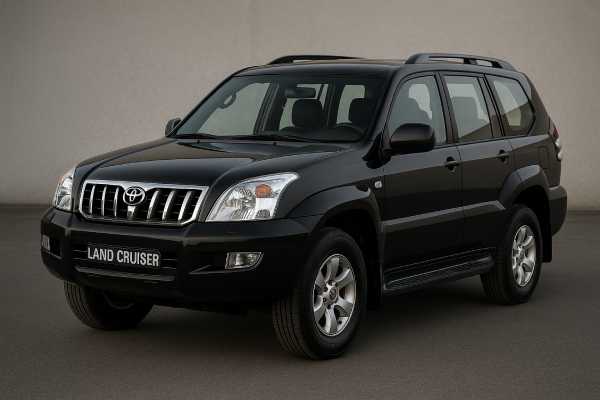
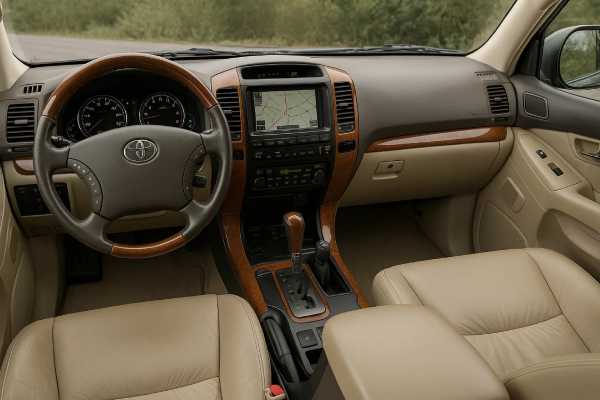
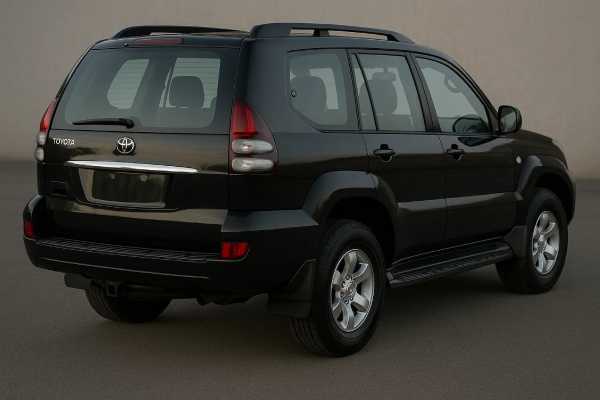
The Toyota Land Cruiser KDJ125 (J120-series short-wheelbase) distills the Prado formula into a compact, highly capable diesel 4×4. Its 1KD-FTV 3.0 D-4D common-rail turbodiesel delivers useful low-rpm torque, paired with a stout ladder frame, full-time four-wheel drive, and a two-speed transfer case. Owners value its blend of everyday usability and long-distance dependability: tight turning for a body-on-frame SUV, comfortable ride tuning, and excellent packaging for two rows. This generation also ushered in multi-airbag protection and stability systems that made it easier to drive in poor weather. If you need a short, maneuverable Land Cruiser that still tows and climbs like the name suggests, the KDJ125 is a sweet spot. Below you will find clear specs, dimensions, service data, and buying guidance specific to the 2003–2006 diesel—so you can judge condition, compare trims, and plan maintenance with confidence.
Top Highlights
- Strong 1KD-FTV torque (343 Nm / 253 lb-ft) from 1,600 rpm; effortless towing and hill work.
- Full-time 4×4 with lockable center differential and low range; compact wheelbase aids maneuverability.
- Robust chassis and components; long service life with routine fluid changes.
- Watch for timing-belt age/miles and fuel-system cleanliness; diesel injectors are sensitive to poor fuel.
- Engine oil and filter: every 10,000 miles / 12 months (16,000 km / 12 months) under normal use.
Explore the sections
- KDJ125 overview 2003–2006
- KDJ125 specs and data
- KDJ125 trims, safety and ADAS
- Reliability and service actions
- Maintenance and buyer’s guide
- Driving and performance
- Rivals and alternatives
KDJ125 overview 2003–2006
Toyota’s KDJ125 sits within the J120 family (often called “120-series Prado”). The “KDJ” prefix denotes the 1KD-FTV 3.0-liter D-4D diesel; “125” identifies the short-wheelbase three-door body. Compared with the five-door (KDJ120), this model sacrifices a third row and some luggage length to gain a tighter turning circle, better breakover, and a lighter curb weight. Underneath is a traditional Land Cruiser recipe: a separate ladder frame, independent double-wishbone front suspension, and a solid rear axle on trailing links and coils. Full-time 4WD with a lockable Torsen-type center differential and a two-speed transfer case (high and 2.566:1 low) keeps traction predictable on road and powerful off it.
The 1KD-FTV is a 16-valve DOHC turbodiesel with high-pressure common-rail direct injection and an intercooler. In this early tune it produces about 161 bhp (120 kW) at 3,400 rpm and 343 Nm (253 lb-ft) from 1,600–3,200 rpm, prioritizing response and drivability over peak output. Buyers could choose a 5-speed manual or 4-speed automatic; axle ratios vary by configuration to balance economy and towing. Equipment expanded notably during the run: multiple airbags, stability control, and comfort features such as climate control moved deeper into the range, and a 2005 update refined trim content and options. For owners today, the KDJ125 remains a practical two-row Land Cruiser that tows confidently, fits in tighter spaces, and—when maintained—delivers the long-haul durability this badge is known for.
KDJ125 specs and data
Engine and Performance (ICE-only)
| Item | Detail |
|---|---|
| Code | 1KD-FTV (D-4D common-rail turbodiesel) |
| Layout & cylinders | Inline-4, DOHC, 16 valves; turbocharged with intercooler (VGT) |
| Displacement | 3.0 L (2,982 cc) |
| Bore × stroke | 96.0 × 103.0 mm (3.78 × 4.06 in) |
| Compression ratio | 18.4 : 1 |
| Induction | Turbo, air-to-air intercooler |
| Fuel system | Common-rail direct injection (~1,350 bar) |
| Max power | 161 bhp / 120 kW @ 3,400 rpm (≈163 PS) |
| Max torque | 343 Nm (253 lb-ft) @ 1,600–3,200 rpm |
| Timing drive | Belt-driven camshafts (service interval; see Maintenance) |
| Emissions standard (period) | Euro 3 (typical for MY03–MY05) |
| Rated economy (Imperial mpg) | Urban 21.6; Extra-urban 34.9–34.4; Combined 30.1 (3-dr) / 29.7 (5-dr) |
| Rated economy (L/100 km; mpg US) | Urban ≈ 13.1 L/100 km (18.0 mpg US); Extra-urban ≈ 8.1–8.2 L/100 km (29.1–28.6 mpg US); Combined ≈ 9.4–9.5 L/100 km (25.1–24.7 mpg US) |
| Real-world highway @ 120 km/h (75 mph) | Typically 9.5–10.5 L/100 km (24.8–22.4 mpg US; 29.8–26.9 mpg UK), depending on tyres, roof load, and wind |
Transmission and Driveline
| Item | Detail |
|---|---|
| Drive type | Full-time 4×4 with lockable center differential; 2-speed transfer (H/L) |
| Low-range ratio | 2.566 : 1 |
| Center / rear differential | Torsen-type center; rear open; rear diff-lock availability varies by market/grade |
| Manual transmission | 5-speed (typical code R151F) |
| Manual gear ratios | 1st 3.830, 2nd 2.062, 3rd 1.436, 4th 1.000, 5th 0.838, Rev 4.220 |
| Automatic transmission | 4-speed (A343F family) with lock-up |
| Automatic gear ratios | 1st 2.804, 2nd 1.531, 3rd 1.000, 4th 0.753, Rev 2.393 |
| Final drive ratios | 4.100 or 4.300 (varies by body/gearbox); V6 petrol used 3.909 (for reference) |
Chassis and Dimensions
| Item | 3-door (KDJ125) | 5-door (KDJ120) |
|---|---|---|
| Body | 2 rows, 5 seats | 2 or 3 rows, 5–8 seats |
| Suspension (f/r) | Double wishbone / 4-link solid axle, coils | |
| Steering | Rack-and-pinion, hydraulic assist; overall 19.8:1 | |
| Steering turns (lock-to-lock) | 3.41 | 3.41 |
| Turning circle (kerb-to-kerb) | 10.8 m (35.4 ft) | 11.2 m (36.7 ft) |
| Brakes (f/r) | Ventilated discs 338 mm / solid discs 312 mm | |
| Wheels/tyres (typical) | 265/65 R17 or 265/70 R16; steel or alloy depending on grade | |
| Length | 4,395 mm (173.0 in) | 4,810 mm (189.4 in) or 4,850 mm (190.9 in, wide-body) |
| Width | 1,790 mm (70.5 in) | 1,870 mm (73.6 in) or 1,885 mm (74.2 in, wide-body) |
| Height (unladen) | 1,845 mm (72.6 in) | 1,845–1,850 mm (72.6–72.8 in, roof rails) |
| Wheelbase | 2,450 mm (96.5 in) | 2,790 mm (110.0 in) |
| Track (f/r) | 1,515 / 1,520 mm | 1,570 / 1,580 mm |
| Ground clearance | 222 mm (8.7 in) | 207 mm (8.1 in) |
| Approach / departure / breakover | 36° / 34° / 26° | 31° / 26°–27° / 22° |
| Kerb (curb) weight | ~1,980–2,045 kg (4,365–4,506 lb) | ~2,105–2,170 kg (4,641–4,784 lb) |
| GVWR (typical) | ~2,510–2,670 kg (5,534–5,886 lb) | ~2,850–2,960 kg (6,283–6,526 lb) |
| Fuel tank | 87 L (19.1 UK gal / 23.0 US gal) | 87 L (19.1 UK gal / 23.0 US gal) |
| Cargo volume (VDA) | Seats up ≈ 310 L (10.9 ft³); seats down ≈ 1,060 L (37.4 ft³) | Seats up ≈ 621 L (21.9 ft³); seats down ≈ 2,321 L (82.0 ft³) |
Performance and Capability
| Item | 3-door | 5-door |
|---|---|---|
| 0–100 km/h (0–62 mph) | ~12.7 s (M/T), ~12.8 s (A/T) | |
| Top speed | ~166 km/h (103 mph) M/T; ~171 km/h (106 mph) A/T | |
| Towing capacity (braked/unbraked) | 2,500 kg / 750 kg (5,512 / 1,653 lb) | 2,500 kg / 750 kg |
| Roof load | 100 kg (220 lb) | 100 kg (220 lb) |
| Braking distance (typical) | Class-appropriate; varies with tyres/load—verify on test |
Fluids and Service Capacities (values vary slightly by axle/option; verify by VIN)
| System | Spec / Type | Capacity |
|---|---|---|
| Engine oil | ACEA B3/B4 5W-30 or 5W-40 meeting Toyota approvals | ~7.5–8.0 L (7.9–8.5 US qt) incl. filter |
| Engine coolant | Ethylene glycol, phosphate-organic hybrid; 50/50 mix | ~9.5–10.5 L (10.0–11.1 US qt) |
| Manual transmission (R151F) | GL-4/GL-5 75W-90 | ~2.8–3.0 L (3.0–3.2 US qt) |
| Automatic transmission (A343F family) | Toyota ATF Type T-IV | ~7.5–8.5 L (7.9–9.0 US qt) total fill |
| Transfer case | GL-4/GL-5 75W-90 | ~1.3–1.5 L (1.4–1.6 US qt) |
| Front / Rear differential | GL-5 75W-90 (rear LSD if fitted per spec) | ~1.5 L front / ~3.1 L rear |
| A/C refrigerant | R-134a | ~650–700 g (22.9–24.7 oz) |
| A/C compressor oil | ND-OIL8 (PAG) | ~120–150 mL (4.1–5.1 fl oz) |
| Key torque values | Wheel nuts 131 Nm (97 lb-ft); drain plugs typically 39–49 Nm—confirm per unit |
Electrical
| Item | Detail |
|---|---|
| Alternator output | Typically 100–120 A depending on equipment |
| 12V battery | ~70–95 Ah (CCA varies by climate pack); DIN/H-series form factor |
| Glow plugs | 11 V type; observe pre-heat indicator before cranking |
Safety and Driver Assistance (hardware)
| Feature | Status |
|---|---|
| Airbags | Front, side, curtain, and driver knee (availability by trim/year; multi-airbag setups common after 2003 launch) |
| ABS / EBD / Brake Assist | Standard across most grades |
| Stability / traction systems | VSC and A-TRC available/standard on higher trims and later years |
| Child seats | ISOFIX/LATCH anchorages on outer rear seats |
| Headlights | Halogen reflector; factory leveling on many trims |
| Crash ratings | No IIHS testing; Euro NCAP coverage for this specific SWB variant and period is limited—treat equipment levels and structure as the key proxies |
KDJ125 trims, safety and ADAS
Trims and options (baseline Europe/UK)
Toyota structured grades to balance utility and comfort. Naming varied by country, but a common UK pattern was LC2, LC3, LC4, and LC5:
- LC2 (utility-leaning): cloth seating, manual A/C or single-zone climate, steel wheels, ABS/EBD/BA, part-time features such as rear diff-lock availability depending on pack, audio with CD.
- LC3: alloys, cruise control on many builds, improved audio, roof rails, body-color exterior pieces.
- LC4: adds multi-airbag coverage (including curtains), VSC with A-TRC, automatic climate control, upgraded instrumentation, more convenience electrics.
- LC5 (flagship): leather, power seats (often heated), premium audio and navigation options, parking sensors on some markets, and the broadest safety spec as standard.
Mechanical and functional differences by trim/year
- Towing and axle ratios: Diesels typically use 4.10 or 4.30 finals; tow kits add cooling and electrics. Maximum braked trailer rating is generally 2,500 kg, with 100 kg roof load.
- Wheels and tyres: 16- or 17-inch packages; the 17-inch tyres improve steering response on-road but add a touch of ride firmness and snow/rough-track noise.
- Differential options: A rear locking differential may be market- or pack-dependent; all models include a lockable center diff and low range.
- 2005 model-year update: Trim content improved (audio, navigation, comfort touches), stability/traction coverage broadened on upper grades, and minor exterior/interior finishes were refreshed.
Safety ratings summary and child-seat notes
- Crash-test landscape: These vehicles pre-date widespread IIHS SUV testing and have limited Euro NCAP entries for the exact SWB diesel. Where tested, large body-on-frame SUVs of this era generally prioritized occupant cell strength and restraint coverage over soft-nose pedestrian scores.
- Airbag count/placement: Multiple airbags—including side and curtain—became common across mid/high trims; always confirm by VIN or physical inspection.
- ISOFIX / LATCH: Outer second-row ISOFIX with top tether provision is typical; middle seat usually belt-only.
- ADAS calibration after service: If the vehicle has VSC/traction, wheel-speed sensors and steering-angle sensor zero-point may require initialization after alignment, rack replacement, or battery disconnection.
Reliability and service actions
Overall view: The KDJ125’s chassis and driveline are notably durable. Most age-related issues trace back to deferred maintenance, harsh environments (salt, heavy towing), or diesel fuel quality. Prioritize a complete service history and a thorough underbody check.
Common → symptoms → root cause → remedy
- Cold-start rattle; black smoke under load → injector pilot correction out of range → wear from age/fuel contamination → professional injector bench test; replace injectors/seals as a set; code new trim values; fit OEM fuel filter and verify supply/return pressures.
- Diesel knock after overnight park; fuel in oil → copper injector seat leak on early builds → combustion gas past seat → replace seats/bolts to updated spec; change oil and filter; check crankcase dilution percentage.
- Hard start; intermittent no-start → suction control valve (SCV) on the supply pump sticking → pressure regulation fault → replace SCV; verify rail pressure and perform idle learn.
- Hesitation around 1,500–2,000 rpm → EGR valve and intake soot build-up → short-trip urban use → remove and clean EGR/throttle body; consider periodic highway drives; ensure software calibration is current where applicable.
- Driveline vibration on throttle lift → worn rear prop-shaft slip yoke or U-joints → age, off-road contamination → lubricate/replace; balance prop-shaft; re-torque flange bolts.
- Front-end clunk → lower control-arm rear bushing deterioration; sway-bar links → heavy use/age → press in quality bushings; replace links; align.
- Steering pull after curb strike → camber/caster shift from LCA eccentric bolts seized → corrosion → heat/replace eccentric bolts and sleeves; apply anti-seize; re-align and initialize steering-angle sensor if needed.
- Rear axle weep → axle-seal lip wear → dust/mud → replace seals; inspect breather operation.
Corrosion hotspots
- Rear chassis rails, body mounts, and cross-members; fuel-filler neck; brake lines on inner sills; leading edges of rear control arms; lower door seams and tailgate hem. Rustproofing and regular fresh-water rinsing (after winter or off-road) pay dividends.
Recalls, TSBs, and updates (high-level)
- Airbag and safety-system campaigns: Some J120s fall under global Takata-related or sensor/ECU field actions depending on VIN. Always verify by VIN on the official recall checker (see References).
- Calibration updates: Powertrain ECUs may receive idle quality, smoke reduction, or EGR driveability refinements during dealer visits. Ask for a printout of current calibration IDs.
- Fuel-system bulletins: Market-specific TSBs address injector seat procedures, leak checks, and SCV diagnostics.
Pre-purchase verification
- Official VIN recall/field action check; dealer records.
- Proof of timing-belt replacement by mileage and time; age matters.
- Fresh engine oil, fuel filter, and clean air filter; service receipts.
- Axle, transfer, and transmission fluid history—especially if used to tow.
- Underside rust inspection on a lift; borescope within chassis rails if in salt regions.
- Warm and cold starts; listen for injector tick and watch rail pressure/idle correction via scan.
Maintenance and buyer’s guide
Practical maintenance schedule (typical for this generation; confirm by VIN/manual)
- Engine oil and filter: every 10,000 miles / 12 months (16,000 km / 12 months). Severe duty (short trips, heavy towing, dusty) → 5,000–7,500 miles.
- Fuel filter: inspect every 10,000 miles; replace 20,000–30,000 miles or annually with poor-fuel exposure. Drain water separator routinely.
- Engine air filter: inspect 10,000 miles; replace 20,000–30,000 miles (more often in dust).
- Cabin filter: 15,000–20,000 miles or annually.
- Timing belt (1KD-FTV): replace 90,000–100,000 miles (144–160,000 km) or 9 years, whichever first; replace tensioner/idler; inspect water pump.
- Serpentine belt: inspect every service; typically 60,000 miles for replacement; check idler/tensioner bearings.
- Coolant: genuine long-life coolant; first change 100,000 miles / 10 years, then 50,000 miles / 5 years.
- Manual transmission oil: every 60,000 miles / 6 years; GL-4/GL-5 75W-90.
- Automatic transmission ATF: 60,000 miles / 6 years drain-and-fill if towing or city heat cycles; sooner if fluid overheated.
- Transfer case / differentials: 40,000–60,000 miles depending on water crossings/towing; GL-5 75W-90 (rear LSD-approved oil if fitted).
- Brake fluid: 2 years regardless of mileage; bleed sequentially.
- Brake pads/rotors: inspect each service; fronts typically 30–50k miles depending on tyre and load.
- Tyres: rotate 5,000–7,500 miles; re-torque wheel nuts to 131 Nm (97 lb-ft); align annually or after impacts.
- Valve clearances: hydraulic, no routine adjustment—listen for abnormal noise; investigate if out of spec.
- 12V battery: test annually after 4–5 years; ensure clean earths and good alternator output.
Fluid specifications and capacities (quick reference)
See the Fluids table above for types and typical fills. Always confirm with the VIN-matched service information, as axle and transmission variants alter volumes.
Buyer’s checklist
- Underbody/frame: surface vs structural rust; probe rear rails, cross-members, tow points.
- Cooling system: check for pink crust at water pump weep hole; verify steady temperature under load.
- Fuel system: smooth cold starts; no excessive white/black smoke; balanced injector corrections on scan.
- Driveline: feel for clunks on take-up; inspect prop-shaft slip yoke and U-joints; no weeps at pinion/transfer.
- Steering and suspension: play in LCAs and sway links; seized alignment eccentrics.
- Brakes: even rotor faces; ABS light on key cycle; no spongy pedal (fluid age).
- Electrical: healthy charging voltage; working glow cycle; no airbag/VSC lights.
- Interior and seals: damp carpets (sunroof drains, tailgate), seat mechanisms, rear door check straps.
- Preferred examples: documented belt service, fresh fluids, minimal rust protection needed, and evidence of injector seat work where applicable.
Durability outlook
With quality fluids and timely belt/filter service, the KDJ125 commonly exceeds 200,000+ miles (320,000+ km) on original major components. Age-related rubber and injector wear are normal service items; chassis longevity hinges on rust prevention.
Driving and performance
Ride, handling, and NVH
For a ladder-frame 4×4, the KDJ125 rides comfortably. The double-wishbone front end controls body motions well over broken tarmac, while the coil-sprung solid rear axle keeps articulation for tracks and ruts. Steering is light at parking speeds and settles on the motorway; the short wheelbase improves agility without making it nervous, though big bumps mid-corner can still unsettle the body—expected for the class. Tyre choice matters: all-terrains add noise and soft response; highway-terrains quiet the cabin and sharpen turn-in.
Powertrain character
The 1KD-FTV builds torque just off idle; peak pull from 1,600 rpm means you short-shift and surf the midrange. The 5-speed manual is the driver’s pick for engine braking on descents and for keeping revs in the sweet spot. The 4-speed automatic is smooth and tough; with a 0.753 overdrive it relaxes cruising, but will kick down earlier on grades. Low range is well chosen (2.566:1) for controlled climbs and descents.
Real-world economy
Expect 25 mpg US / ~9.4 L/100 km in mixed use for a stock, well-maintained truck on road-biased tyres; winter, roof gear, and A/T tyres can push that to 22–23 mpg US (~10–10.5 L/100 km). Urban stop-go settles near 18 mpg US (~13 L/100 km). Gentle B-roads and 60 mph cruising can flirt with 29 mpg US (~8.1 L/100 km).
Capability and load/tow
On a 2,500 kg (braked) trailer, the diesel’s low-rpm torque and cooling capacity keep temps stable if you downshift early and maintain revs. Stability control trims wheelspin on wet ramps, and the compact wheelbase makes tight site work easier—mind rear overhang on sharp breakovers. Plan for a 15–25% fuel-use penalty when towing near the limit, and ensure fresh diff/transfer oils before a long haul.
Rivals and alternatives
- Land Rover Discovery 3 TDV6 (2004–2006): More space and independent suspension all-round, with a quieter cabin; higher maintenance complexity and cost as vehicles age.
- Mitsubishi Pajero/Shogun 3.2 Di-D: Comparable ladder-frame toughness and off-road systems; simpler drivetrain but less refined cabin and ergonomics.
- Nissan Patrol (Y61) 3.0 Di: Sturdy axles and a reputation for durability; EU-market parts availability can vary by year; ride is more truck-like.
- Toyota Land Cruiser KDJ120 (5-door): Same core mechanicals with more room and cargo; longer wheelbase trades a touch of agility for stability.
Choose the KDJ125 if you value a shorter footprint with authentic Land Cruiser hardware, low-rpm diesel torque, and a service-friendly platform that rewards preventive maintenance.
References
- Microsoft Word – Land Cruiser UK launch pack 2003 2003 (Press Pack)
- Toyota Land Cruiser Powers Up For 2005 Model Year 2004 (Press Release)
- Recalls | Owners | Toyota UK 2024 (Recall Checker)
- Owner’s Manual | Customer Information | Toyota UK 2024 (Owner’s Manuals Portal)
Disclaimer
This guide is for informational purposes and does not replace professional diagnosis or repair. Specifications, torque values, fluid capacities, and service intervals vary by VIN, market, model year, and equipment. Always verify against your vehicle’s official service documentation and follow manufacturer procedures.
If this article helped, please consider sharing it with fellow owners on Facebook or X/Twitter to support xcar’s work.