

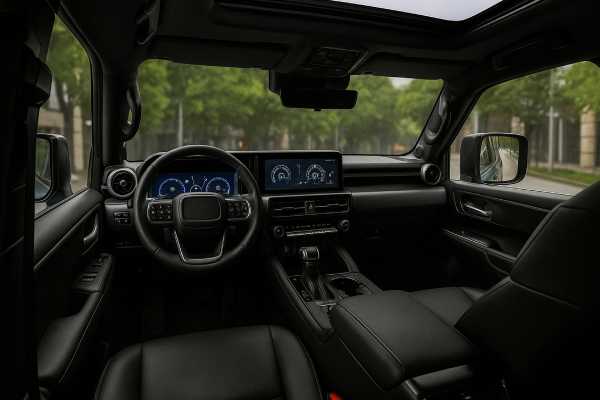
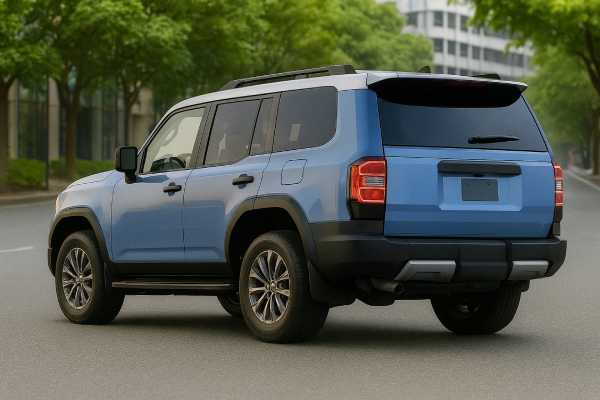
The 2024–present Toyota Land Cruiser (TJH250) brings the nameplate back to its roots: a tough, mid-size 4×4 that balances modern tech with genuine durability. Built on the TNGA-F ladder frame and powered by the i-FORCE MAX hybrid 2.4-liter turbo four, it delivers strong low-rpm torque, real transfer-case gearing, and a locking center differential—plus an available rear e-locker and stabilizer bar disconnect for added articulation. Inside, the layout is straightforward and hard-wearing, with the latest Toyota infotainment and safety suite. Ownership highlights include respectable efficiency for a body-on-frame 4×4, a flat cargo floor, and simplified trim strategy. Buyers should still approach it as a capable off-roader: tires and alignment matter, and heavy accessories will affect range and braking distances. If you want a modern Land Cruiser that fits in garages, pulls 6,000 lb (2,721 kg), and is easy to maintain, the TJH250 is the sweet spot.
At a Glance
- Robust TNGA-F frame, full-time 4×4 with low range; 465 lb-ft (630 Nm) for confident towing and trails.
- Useful tech for rough terrain: Crawl Control, Multi-Terrain Select, available rear locker, and stabilizer bar disconnect.
- Real-world highway economy typically around low-20s mpg (≈ 11–12 L/100 km) when stock and properly aligned.
- Watch tire load/index and pressures; off-road tires and roof gear can drop mpg by 10–20%.
- Routine service cadence: inspections and rotation about every 5,000 mi (8,000 km); oil and filter about every 10,000 mi (16,000 km) or 12 months.
Explore the sections
- Land Cruiser 250 Overview
- TJH250 Specs and Data
- Land Cruiser Trims and Safety
- Reliability, Issues, and Actions
- Maintenance and Buyer’s Guide
- Driving and Performance
- How It Compares
Land Cruiser 250 Overview
The TJH250 Land Cruiser brings a carefully chosen set of mechanicals aimed at daily drivability and long-term toughness. Its i-FORCE MAX hybrid pairs a turbocharged 2.4-liter four-cylinder with an integrated electric motor inside an 8-speed automatic, feeding a full-time four-wheel-drive system with a two-speed transfer case. The combination is tuned for early torque delivery, which makes stop-and-go driving relaxed and hill starts easy, even with a trailer or a full load of passengers and gear.
Compared with past U.S. Land Cruisers, this generation is tidier to park, lighter on its feet, and more efficient, yet it retains key trail hardware. A locking center differential is standard; most trims also include a locking rear differential and an electronic stabilizer bar disconnect to improve articulation when you need clearance and wheel travel. Crawl Control and Multi-Terrain Select provide stable, slow-speed traction on rock, mud, and snow, while Downhill Assist Control helps manage steep descents without cooking the brakes.
Cabin packaging is straightforward: a two-row layout, supportive seats, and easy-to-clean materials. The load floor is square and flat with the second row folded, and tie-downs are placed where they’re actually useful. Infotainment is Toyota’s latest interface with wireless phone integration and modern driver assistance features.
Towing tops out at 6,000 lb (2,721 kg), a sensible match to the frame, brakes, and hybrid cooling. If you plan to add steel bumpers, a winch, or a rooftop tent, consider upgrading to LT-rated tires and schedule more frequent brake inspections. The Land Cruiser rewards owners who keep alignment in spec, choose tires thoughtfully, and stick to a realistic service cadence. Do that, and it is an unusually versatile SUV: quiet enough for long trips, composed in bad weather, and mechanically honest off-road.
TJH250 Specs and Data
Engine and Performance
| Item | Detail |
|---|---|
| Code | i-FORCE MAX hybrid (T24A-FTS + traction motor) |
| Layout & cylinders | Inline-4, DOHC, 16-valve |
| Bore × stroke | 87.5 × 99.5 mm (3.44 × 3.92 in) |
| Displacement | 2.393 L (2,393 cc) |
| Induction | Turbocharged with intercooler |
| Fuel system | D-4ST direct and port injection |
| Compression ratio | 11.1:1 |
| Max power | 326 hp (243 kW) @ 6,000 rpm |
| Max torque | 630 Nm (465 lb-ft) @ ~1,700 rpm |
| Timing drive | Chain |
| Recommended fuel | Premium unleaded (91+ AKI) |
| Rated efficiency (EPA) | 10.2 L/100 km (23 mpg US / 27.6 mpg UK) combined; 22 city / 25 highway mpg |
| Real-world highway @ 120 km/h (75 mph) | Commonly ~11–12 L/100 km (20–23 mpg US), stock tires and alignment |
Transmission and Driveline
| Item | Detail |
|---|---|
| Transmission | 8-speed automatic with integrated electric motor |
| Gear ratios | 1st 4.41 • 2nd 2.80 • 3rd 1.95 • 4th 1.51 • 5th 1.27 • 6th 1.00 • 7th 0.79 • 8th 0.65 • Reverse 3.64 |
| Drive type | Full-time 4×4 with locking center differential |
| Transfer case | Two-speed, 1.00:1 (High) / 2.57:1 (Low) |
| Rear differential | Electronic locking (standard or available by trim) |
| Traction aids | Crawl Control, Downhill Assist Control, Multi-Terrain Select |
Chassis and Dimensions
| Item | Detail |
|---|---|
| Front suspension | Independent double-wishbone |
| Rear suspension | Multi-link solid axle with coil springs; outboard twin-tube shocks |
| Steering | Electric power rack-and-pinion |
| Brakes | 17-in ventilated discs front and rear; electronic parking brake |
| Wheels and tires (typical) | 18×7.5 in with 245/70R18 (1958) • 18×7.5 in with 265/70R18 • 20×8.0 in with 265/60R20 (Premium) |
| Ground clearance | 211 mm (8.3 in) running |
| Angles (approach/breakover/departure) | Up to 31° / 25° / 22° (by trim/wheel) |
| Length / Width / Height | 4,990 mm / 1,940–1,980 mm / 1,925–1,935 mm (196.5 in / 76.4–78.0 in / 75.8–76.2 in) |
| Wheelbase | 2,850 mm (112.2 in) |
| Turning circle (curb-to-curb) | ~12.2 m (40.0 ft) |
| Curb weight | ~2,285 kg (5,038 lb) |
| GVWR | ~3,050 kg (6,725 lb) |
| Fuel tank | 68 L (18.0 US gal / 15.0 UK gal) |
| Seating | 5 |
Performance and Capability
| Metric | Value |
|---|---|
| 0–100 km/h (0–62 mph) | Typical mid-8s with all-terrain tires; traction dependent |
| Towing capacity | 2,721 kg (6,000 lb) braked |
| Payload | Trim and options dependent; check the door-jamb label |
Fluids and Service Capacities
| System | Specification | Capacity (approx.) |
|---|---|---|
| Engine oil | SAE 0W-20 synthetic, API SP / ILSAC GF-6 | 5.3 L (5.6 US qt) with filter |
| Engine coolant | Toyota Super Long Life (premixed 50/50) | Refer to service manual; bleed per hybrid procedures |
| Automatic transmission | Toyota WS ATF | Service by level/temperature method |
| Transfer case & differentials | Toyota gear oil per spec; replace when water-crossing or severe use | By fill-to-level |
| A/C refrigerant | R-1234yf | Charge by weight; label under hood |
| Spark plugs | Iridium | Long-life interval; torque per manual |
Electrical
| Item | Detail |
|---|---|
| High-voltage battery | Nickel-metal hydride, compact pack for hybrid assist |
| 12V battery | AGM in modern packaging; test annually in cold climates |
| Alternator | Belt-driven; hybrid provides supplemental electrical power |
| Spark plug gap | Set to spec; do not re-gap iridium unless specified |
Safety and Driver Assistance
| Area | Detail |
|---|---|
| Crash ratings | As of this writing, U.S. federal and IIHS ratings may be pending or partial for the current generation; consult the latest databases before purchase. |
| Headlights | Projector/LED units; output varies by trim equipment |
| ADAS suite | Toyota Safety Sense (TSS) with Pre-Collision (pedestrian/cyclist), Full-Speed Adaptive Cruise, Lane Tracing Assist, Lane Departure Alert with Steering Assist, Road Sign Assist, Proactive Driving Assist, Blind Spot Monitor with Rear Cross-Traffic Alert; rear automatic braking available. |
| Child-seat provisions | Outboard LATCH anchors, three top tethers; check seat and base fit due to seat bolster shape |
Land Cruiser Trims and Safety
Trim structure (North America):
- 1958: Round headlights, cloth/SofTex-style durable seating, heated front seats and wheel, 8-in infotainment, full-time 4×4 with low range and locking center differential. Crawl Control and Multi-Terrain Select included. Rear locker available in many build combinations; check the window sticker for “locking rear differential.”
- Land Cruiser: Rectangular headlight treatment, 12.3-in infotainment, ventilated front seats, additional cameras, and more trail tech. Rear e-locker and stabilizer bar disconnect are typically included here, improving articulation and traction.
- First Edition (launch): Limited production with heritage details, roof rack and recovery accents, and comprehensive off-road kit. Feature content largely mirrors or exceeds the Land Cruiser grade.
Mechanical and functional differences to note:
- Wheels/tires: 1958 commonly ships on 245/70R18 all-seasons; upper trims often move to 265-section tires, with 20-inch wheels available (Premium-type). For mixed pavement/trail use, many owners prefer 265/70R18 all-terrain tires on 18-inch wheels to preserve sidewall and ride.
- Sway-bar disconnect (SDM): Enabled on most non-1958 builds; increases front suspension droop off-road.
- Lockers: The center differential locks via the transfer-case control; the rear e-locker is trim- or option-dependent.
- Tow package: Factory wiring and hitch support the 6,000-lb rating; use a weight-distributing hitch as loads approach 75–80% of maximum to maintain level stance and braking performance.
Year-to-year changes (typical early cycle):
- 2024: Launch year with 1958, Land Cruiser, and First Edition.
- 2025+: Running updates largely software and feature availability; confirm rear locker/SDM content on specific VINs.
Safety ratings—what to expect and check:
- Large, body-on-frame SUVs can have headlamp variance by trim and pedestrian AEB performance that is sensitive to weather and tire choice. Always verify the latest IIHS headlight and AEB tables for your exact build.
- Federal (NHTSA) star ratings may lag model launch; ratings can post mid-cycle. Confirm before purchase if this matters to you.
ADAS calibration after service:
- Windshield replacement, front bumper repairs, ride-height changes, and alignment corrections can require camera/radar calibration. After any collision or glass work, request a calibration printout.
- If you lift or significantly alter tire diameter, expect to recalibrate driver assistance thresholds and check for steering-angle and millimeter-wave radar alignment.
Reliability, Issues, and Actions
Overall picture: The TJH250’s hybrid-turbo powertrain is built for torque density and uses conservative cooling, with robust under-body protection. The TNGA-F frame and multi-link rear axle are proven across related models. Most early-ownership problems tend to be setup or accessory related rather than core hardware.
Common / occasional concerns (by prevalence and cost):
- Alignment drift and tire wear (common / low–medium): A-T tires with aggressive tread can feather on incorrect toe. Symptom: steering nibble and growl at 50–70 mph. Remedy: torque suspension fasteners to spec after 500–1,000 miles, set toe near zero for highway use, rotate every 5,000–6,000 miles.
- Brake judder after heavy descents (occasional / low–medium): Heat input during long downhill sections can create uneven pad transfer. Symptom: shake under light braking. Remedy: bed pads properly; if glazed, resurface or replace pads/rotors. Consider lower-temperature friction for heavy towing in mountains.
- Accessory-induced parasitic draw (occasional / low): Light bars, fridges, or dashcams wired to constant 12V can drain the battery. Symptom: weak start after weekends. Remedy: fused switched circuits or DC-DC management; verify sleep current below spec.
- Hybrid cooling airflow restrictions (occasional / medium): Mud-packed condensers or intercoolers raise temps and reduce performance. Remedy: gentle low-pressure wash from radiator side out; avoid fin damage; check that skid plates and recovery gear do not block airflow.
- Turbo plumbing / clamp seepage (occasional / low): After heavy off-road vibration, charge-pipe joints can seep oil mist. Remedy: inspect and re-torque clamps at services; replace seals if weeping persists.
- Windshield camera view blocked (common / low): Dust, snow, or accessories in the wiper sweep can disable Lane Tracing/PCS. Remedy: clean glass in the camera zone and avoid mounting brackets in the shaded area.
Rare but important checks:
- Water ingress at door seals after deep wading (rare / medium): Check carpet, grommets, and drain plugs after water crossings. Dry promptly to prevent odor and corrosion.
- HV battery cooling path (rare / medium): With excessive pet hair/dust, cabin intake filters can clog and add noise. Keep cabin filter fresh; vacuum intake grills.
Software and calibration items:
- ECU/TCU updates: Running updates may refine shift logic, idle stop behavior, and AEB sensitivity. Ask the dealer to check your VIN for campaigns during service visits.
- ADAS updates: After windshield or bumper service, confirm calibration completion and printouts.
Recalls, TSBs, and coverage:
- Always run the official VIN lookup before purchase or after any ownership change to verify recall status. Keep documentation of completed Field Service Actions, especially for safety equipment and ECU updates.
- Powertrain warranty and hybrid component coverage are robust; consult your Warranty & Maintenance Guide for time/mileage and exclusions (wear items, misuse, alterations).
Pre-purchase checks (used or demo units):
- Complete service history, especially oil-change timing; proof of differential/transfer case service if significant water crossings or dust exposure.
- Underside inspection: frame rails, lower control arm pockets, skid plate fasteners, exhaust hangers, and signs of impact or crushing on pinch welds.
- Electronics: verify camera and sonar functions; test all terrain modes; confirm locker engagement.
- Tires: check date codes and load ratings; mismatched sets can confuse traction control.
Maintenance and Buyer’s Guide
Practical maintenance schedule (time/distance whichever comes first):
- Every 5,000 mi / 6 months (8,000 km): Rotate tires (cross-pattern if non-directional), inspect brakes, suspension, steering, driveline, and skid-plate fasteners; top fluids; check alignment if steering changed.
- Every 10,000 mi / 12 months (16,000 km): Engine oil and filter (0W-20 synthetic); inspect engine air filter; replace cabin filter if dusty; comprehensive under-carriage inspection.
- 30,000–40,000 mi (48,000–64,000 km): Replace engine air filter (earlier in dust), cabin filter, brake fluid flush (prudent every ~3 years), clean cooling stacks.
- 60,000 mi (96,000 km): Replace transfer-case and differential oils, especially if towing or water-crossing; inspect wheel bearings and prop-shaft joints; coolant check and hoses.
- 100,000–120,000 mi (160,000–192,000 km): Spark plugs (iridium long-life), coolant service per guide; inspect accessory belts, idlers, and tensioners; replace if any noise/play.
- Annually before winter: Battery test, wiper blades, under-body wash to remove salt; recalibrate TPMS thresholds for winter tires.
Fluids quick sheet:
- Engine oil: SAE 0W-20 synthetic (API SP, ILSAC GF-6); ~5.3 L (5.6 qt) with filter.
- ATF: Toyota WS; service by temperature method.
- Transfer/diffs: Toyota gear oil to spec; change earlier with severe duty.
- Coolant: Toyota Super Long Life (pre-mix 50/50); bleed per hybrid procedures.
- Brake fluid: DOT 3/4; flush on condition or ~36 months.
- A/C: R-1234yf; charge by label.
Essential torques (always verify by VIN):
- Wheel lugs typically around 131 Nm (97 lb-ft); re-torque after 50–100 miles on new wheels.
- Skid plate and suspension fasteners: torque to spec with the vehicle at ride height after any bushing service.
Buyer’s checklist:
- Driveline slack and clunks: Small lash is normal with body-on-frame 4×4; repeated metallic clunks under gentle throttle may signal joint or mount wear.
- Cooling pack cleanliness: Shine a light through the condenser/intercooler; clean fins from the engine side outward.
- Frame and hardware: Look for scrapes on cross-members, bent tie-downs, or crushed pinch welds from poor jack placement.
- Electronics and cameras: Test 360° view, rear camera washer (if equipped), and all parking sensors.
- Towing readiness: Confirm receiver, 7-pin wiring, brake-controller compatibility, and tire load index for your trailer’s tongue weight.
Recommended configurations (use-case based):
- Daily driver / light trails: 265/65R18 highway-terrain, stock ride height, all-weather mats, recovery points front/rear.
- Overland weekender: 265/70R18 all-terrain C-load, modest skid protection, portable air, and a weight-distributing hitch for 4,000–6,000 lb trailers.
- Snowbelt commuter: Narrower winter tires on 18-in wheels, under-body corrosion protection, and frequent wash cycles.
Durability outlook: With sensible service and tire choices, expect long brake-rotor life, stable alignment, and few hybrid system complaints. The powertrain was designed to provide truck-grade torque with passenger-car refinement, and the chassis is friendly to long-mileage ownership.
Driving and Performance
Ride, handling, and NVH: On pavement, the Land Cruiser is quieter than older body-on-frame SUVs thanks to stronger frame nodes and better isolation. Straight-line stability is excellent; crosswinds have little effect when tires are balanced and properly inflated. The steering is light at parking speeds and settles with reassuring weight on the highway. Expect some body motion on sharp impacts—normal for a coil-sprung solid rear axle—but damping control is good, especially on 18-inch tires.
Powertrain character: The hybrid’s electric assist fills in below 2,000 rpm, so it steps off smartly without revving. The turbo comes on smoothly; there’s minimal lag, and the 8-speed picks tall gears early when cruising. Downshifts are decisive in Sport; in Normal the calibration favors quietness. On two-lane highways, 50–80 mph (80–130 km/h) passing is confident, especially if you plan a kickdown to 5th or 6th before the maneuver.
Efficiency: In mixed driving, many owners see 21–24 mpg US (11–12 L/100 km) with OE-type tires. Sustained 75-mph runs return around 20–23 mpg US depending on wind, grade, and roof loads. A-T tires with aggressive tread and roof racks can trim economy by a few mpg; proper alignment and tire pressure claw much of that back. Cold weather imposes a further 5–15% penalty until the powertrain is at temperature.
Traction and control: On dirt and snow, the blend of full-time 4×4, low-range gearing, and hybrid torque lets the Land Cruiser climb steadily with little throttle. Multi-Terrain Select changes throttle maps and brake traction control logic; Crawl Control is best for picking through rocks without worrying about left-foot braking. When unlocked, the stabilizer bar disconnect adds feel and grip by letting the front axle articulate—especially helpful with ruts and offset bumps. The rear locker is your “get out of jail” tool for cross-axle situations; engage it straight ahead on low-traction surfaces to avoid driveline bind.
Load and towing: With 6,000 lb (2,721 kg) max capacity, the Land Cruiser tows medium boats and campers comfortably. Keep tongue weight ~10% and watch rear-axle load. On long grades, downshift early to keep ATF temperatures moderate; the hybrid assist helps with initial pull but cannot replace correct gear selection. Expect a 15–30% consumption penalty while towing at highway speeds—more with headwinds and high-frontal-area trailers.
How It Compares
Versus Ford Bronco (2-door/4-door): The Bronco offers more tire clearance out of the box and customizable axles/lockers, with a livelier steering feel on-road. The Land Cruiser counters with a quieter cabin, full-time 4×4, and better towing manners. Efficiency is broadly competitive; the Toyota’s hybrid assist helps in stop-and-go.
Versus Jeep Wrangler (JL/4xe): Wrangler Rubicon variants can match or exceed trail hardware and articulation. However, wind noise, steering wander, and ride quality are trade-offs. The Land Cruiser’s structure and NVH are more family-friendly, with consistent brake feel and simpler daily livability. If your use is 80% street / 20% trail, the Toyota is easier to live with.
Versus Land Rover Defender 110: Defender brings sophisticated traction software and plush road manners, plus higher towing in some specs. It also carries a complexity and long-term maintenance cost premium. The Land Cruiser’s simpler hardware and dealer network are advantages for long-term ownership focused on reliability.
Versus Lexus GX 550: The GX is the Land Cruiser’s more powerful cousin with a twin-turbo V6, higher tow rating, and luxury tuning. The Toyota is lighter, more efficient, and typically less costly to outfit for trails. Choose GX for frequent heavy towing and highway miles; choose LC for balanced duty with lower operating costs.
Bottom line: If you want a modern, mid-size body-on-frame SUV that’s truly comfortable as a daily driver yet uncompromising on reliability and trail credibility, the TJH250 Land Cruiser is one of the few that nails the brief.
References
- The Evolution of a Legend: The All-New 2024 Land Cruiser 2024 (Press Release)
- Gas Mileage of 2024 Toyota Land Cruiser 2024 (EPA/DOE)
- 2024 Land Cruiser Product Information 2024 (Product Information)
- Vehicle Detail Search – 2024 TOYOTA LAND CRUISER HYBRID | NHTSA 2024 (Ratings/Database)
- Maintenance Plans | Toyota Owners 2024 (Maintenance Program)
Disclaimer
This guide is for informational purposes only and is not a substitute for professional diagnosis, repair procedures, or official service documentation. Specifications, torque values, capacities, and maintenance intervals vary by VIN, market, trim, and equipment. Always verify details against your vehicle’s Warranty and Maintenance Guide, owner’s manual, and official service information before performing work.
If you found this helpful, please share it with fellow enthusiasts and owners on Facebook or X/Twitter to support xcar’s work.