
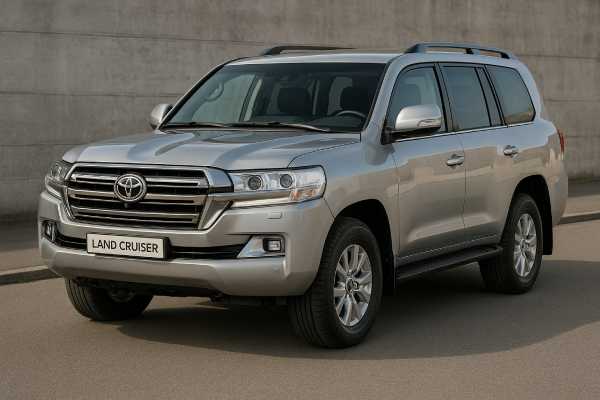
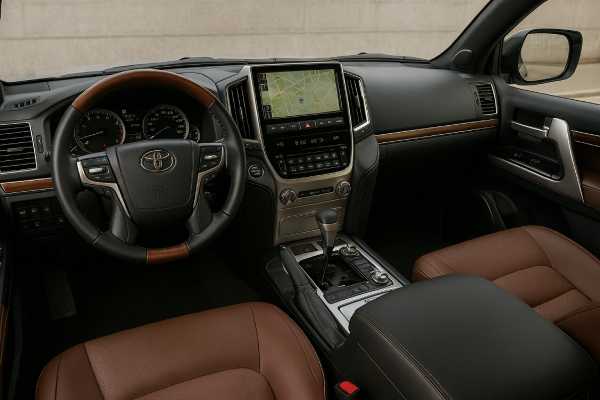
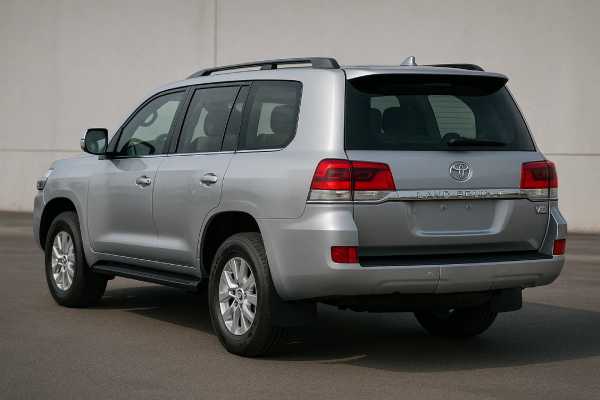
The 2016–2021 Toyota Land Cruiser (URJ200 facelift) is the last U.S.–market 200-Series—and a high-water mark for old-school durability with modern driver aids. Under the hood lives Toyota’s 3UR-FE 5.7-liter V8 (381 hp) paired to an 8-speed automatic and full-time 4×4 with a locking Torsen center differential and low range. KDSS hydraulic sway-bar control preserves on-road composure yet lets the suspension articulate off-road. Inside, it’s eight-passenger luxury: heated and ventilated leather front seats, robust climate control, and Toyota’s long-running reputation for longevity. From family road-trips to trailheads, it tows up to 8,100 lb and shrugs off abuse that would retire lighter SUVs. Fuel economy is modest and service items are truck-grade, but the platform’s reliability, parts support, and resale value remain exceptional. If you want a body-on-frame SUV that still feels engineered for decades, this generation Land Cruiser is the one to study.
Fast Facts
- Robust 5.7-liter V8, 8-speed, full-time 4×4 with low range; KDSS standard for stability and articulation.
- Tows up to 8,100 lb (3,674 kg); roomy eight-seat cabin with high-grade materials and hardware.
- Caveat: real-world fuel economy ~14–16 mpg (US) mixed (16.8–14.7 L/100 km); premium service parts.
- Typical interval: engine oil 10,000 miles / 12 months (tire rotation and inspection every 5,000 miles / 6 months).
Navigate this guide
- Detailed Overview: Land Cruiser 5.7 V8
- Specs and Technical Data (URJ200)
- Trims, Options and Safety Tech
- Reliability, Issues and Service Actions
- Maintenance and Buyer’s Guide
- Driving Impressions and Performance
- How Land Cruiser Compares to Rivals
Detailed Overview: Land Cruiser 5.7 V8
The 2016 facelift brought meaningful hardware and safety updates to the 200-Series. Most important is the shift to an 8-speed automatic that better matches the 3UR-FE 5.7-liter DOHC V8 (381 hp @ 5,600 rpm; 401 lb-ft @ 3,600 rpm). The transmission widens the overall ratio spread, trims revs at highway cruise, and keeps the big V8 in its torque plateau when towing or climbing. The transfer case remains a two-speed, full-time 4×4 setup with a locking Torsen center differential and a low-range ratio for technical terrain, complemented by A-TRAC brake-based traction control, Crawl Control, Multi-Terrain Select, and Downhill Assist Control.
Chassis tuning balances traditional toughness with plushness. KDSS (Kinetic Dynamic Suspension System) hydraulically modulates front and rear anti-roll bars: stiff when you need flat cornering on pavement, freer off-road to allow wheel travel. The suspension is long-travel: double-wishbone front and 4-link solid rear axle with coils, tuned to keep a nearly 6,000-lb SUV composed on broken surfaces.
Cosmetically, the facelift adds LED headlamps and a new front clip, plus minor interior redesigns to the center stack and steering wheel controls. Inside you’ll find heated/ventilated front seats, a cool box in the console on most years, and four-zone climate control. The third row is 50/50 split; cargo expands to over 80 ft³ with both rear rows folded.
Safety and assistance improve substantially with Toyota Safety Sense-P (PCS with pedestrian detection, DRCC, LDA, AHB) made standard from 2016, joined by Blind Spot Monitor and Rear Cross-Traffic Alert. It’s comprehensive for the era without over-automating the driving experience.
A brief note on markets: in North America the 200-Series came only with the 5.7-liter gasoline V8. (Diesels available in other regions are out of scope here.) For 2020–2021, Toyota added the Heritage Edition, a styling/packaging variant with bronze wheels and trim changes (details in Section 3). The platform bows out after model year 2021 in North America, replaced later by the lighter, turbo-hybrid 250-Series—making this the final V8 Land Cruiser sold here.
Specs and Technical Data (URJ200)
Engine & Performance
| Item | Specification |
|---|---|
| Code | 3UR-FE |
| Layout & valvetrain | V8, DOHC, 32 valves, Dual VVT-i |
| Displacement | 5.7 L (5,663 cc) |
| Bore × stroke | 94.0 × 102.0 mm (3.70 × 4.02 in) |
| Induction | Naturally aspirated |
| Fuel system | Sequential multi-port fuel injection (PFI) |
| Compression ratio | 10.2:1 |
| Max power | 381 hp (284 kW) @ 5,600 rpm |
| Max torque | 544 Nm (401 lb-ft) @ 3,600 rpm |
| Timing drive | Chain |
| Emissions/efficiency standard | EPA ratings (U.S.) |
| Rated fuel economy (EPA) | 13 city / 17 hwy / 14–15 combined mpg (US) → 18.1 / 13.8 / 15.7–15.0 L/100 km (approx.) |
| Real-world highway @ 75 mph | ~16 mpg (US) (14.7 L/100 km), wind/grade dependent |
| Aerodynamics | Cd ~0.36–0.37 (typical for class; not a Toyota-quoted performance spec) |
Notes: EPA values vary slightly by year/option content. The 8-speed models generally show 13/17/14–15 mpg (US).
Transmission & Driveline
| Item | Specification |
|---|---|
| Transmission | 8-speed automatic (AB60F) with manual mode |
| Gear ratios (1–8 / R) | 4.596 / 2.724 / 1.863 / 1.464 / 1.231 / 1.000 / 0.824 / 0.685 / 3.739 (R) |
| Final drive ratio | 3.91:1 (front & rear) |
| Transfer case | Two-speed, full-time 4×4; low range ~2.62:1 |
| Center diff | TORSEN limited-slip, lockable |
| Rear diff | Open (A-TRAC brake control simulates locking) |
| Drive type | 4×4 (full-time) |
| Replenishment time | Refuel: ~5–7 minutes from near-empty (typical) |
Chassis & Dimensions
| Item | Specification |
|---|---|
| Frame | Body-on-frame |
| Suspension (front/rear) | Double-wishbone / 4-link solid axle with coils, KDSS hydraulic sway-bar control |
| Steering | Hydraulic rack-and-pinion; turning circle 11.8 m (38.7 ft) |
| Brakes | Ventilated discs; front ~353 mm (13.9 in), rear ~345 mm (13.6 in) |
| Wheels/Tires | 285/60 R18 on 18×8.0 in alloys (Heritage Edition: unique 18-in bronze/BBS wheels) |
| Ground clearance | 225 mm (8.9 in) |
| Angles | Approach 30° / Departure 20° |
| Length / Width / Height | 4,951 / 1,980 / 1,880 mm (194.9 / 78.0 / ~74.0 in) |
| Wheelbase | 2,850 mm (112.2 in) |
| Curb weight | ~2,640–2,700 kg (5,820–5,950 lb) by year/equipment |
| GVWR | ~3,350 kg (≈7,385 lb) |
| Fuel tank | 93 L (24.6 US gal / 20.5 UK gal) |
| Cargo volume | VDA/SAE ~455 L (16.1 ft³) seats up / 2,314 L (81.7 ft³) seats down |
Performance & Capability
| Metric | Value |
|---|---|
| 0–100 km/h (0–62 mph) | ~7.4–7.8 s (conditions & tire spec dependent) |
| Top speed | ~180–210 km/h (112–130 mph), limited |
| 100–0 km/h braking | ~40–43 m (131–141 ft) typical |
| Towing capacity | 3,674 kg (8,100 lb) (braked) |
| Payload (typical) | ~600 kg (1,300–1,350 lb) |
| Roof load | ~68–75 kg (150–165 lb) with factory rails/crossbars |
Fluids & Service Capacities
| System | Spec & Capacity (typical for MY2016–2021 3UR-FE/AB60F) |
|---|---|
| Engine oil | SAE 0W-20 full synthetic; 7.5–7.9 L (8.0–8.4 US qt) incl. filter (owner’s manual lists ~7.9 qt) |
| Coolant | Toyota Super Long Life Coolant (pink); ~16–17 L (17.0–18.0 US qt) after full drain |
| Automatic transmission | Toyota ATF WS; drain/fill varies (~4–5 L / 4–5 qt), full dry capacity ~11–12 L |
| Transfer case | Toyota ATF WS; ~1.5–1.7 L (1.6–1.8 qt) |
| Front differential | GL-5 75W-85; ~1.3–1.5 L (1.4–1.6 qt) |
| Rear differential | GL-5 75W-85; ~3.0 L (3.2 qt) |
| A/C refrigerant | R-134a; charge typically ~650–750 g (23–26 oz); compressor oil ND-Oil 8 (~120 mL / 4 fl oz) |
| Key torque specs | Oil drain plug ~40 Nm (30 lb-ft); wheel lugs 131 Nm (97 lb-ft); diff drain/fill ~49–60 Nm (36–44 lb-ft) |
Always verify exact capacities/torques by VIN and service manual; small running changes and dealer TSB updates occur.
Electrical
| Item | Specification |
|---|---|
| Alternator | ~130–150 A (by MY/accessories) |
| 12-V battery | ~70–80 Ah, Group 27F form factor common |
| Spark plugs | Iridium, long-life; gap ~0.8 mm (0.031 in); change 120,000 miles (see maintenance section) |
Safety & Driver Assistance (overview)
- Crash-test ratings: The 2016–2021 Land Cruiser was not routinely rated by IIHS and typically does not show a published star rating in NHTSA’s database for these years.
- Headlights: LED low/high beams with washers; formal IIHS headlight grading not published for this model.
- ADAS suite (standard 2016+): Pre-Collision System with Pedestrian Detection (PCS), Dynamic Radar Cruise Control (DRCC), Lane Departure Alert (LDA), Automatic High Beams (AHB); Blind Spot Monitor and Rear Cross-Traffic Alert widely fitted.
- Airbags & restraints: Dual-stage front, seat-mounted side (front), curtain (all rows), driver’s knee and front passenger seat cushion; LATCH outboard 2nd-row; TPMS monitors all five tires (incl. spare).
Trims, Options and Safety Tech
Model years 2016–2019: One fully-equipped Land Cruiser grade in North America. Mechanical content is fixed: 3UR-FE V8, AB60F 8-speed, full-time 4×4 with locking Torsen center diff, KDSS, 18-inch wheels/285-section tires, tow package with oil cooler and wiring, Crawl Control/Multi-Terrain Select, four-zone climate, leather seating, and a long roster of convenience features (heated steering wheel; heated/ventilated front seats; power moonroof; premium JBL audio; backup camera; parking sensors). Rear-seat entertainment was standard at launch and later became deleteable in some years.
2019 running changes: Minor infotainment and trim updates; equipment rationalization.
2020–2021 Heritage Edition (HE): Cosmetic/packaging variant that keeps the same chassis and driveline. Key identifiers:
- Bronze-finish 18-in wheels (or forged BBS in some documentation), unique grille/black-out trim, special badging, roof rack (varies by year).
- Seating: 2020 HE initially 5-passenger (no third row) to increase cargo; 2021 HE offered 8-passenger configuration optional.
- Tires/wheels: Same 285/60R18 size; wheel design differs.
- Equipment deletes: In some builds the cool box and running boards are deleted for the HE aesthetic.
- Tow rating and mechanicals: unchanged (8,100 lb towing; same KDSS/4×4).
Quick identifiers (VIN/build): URJ200 = gasoline V8; country of origin codes usually Japan; build codes for colors and trim live on the driver door jamb label and can confirm Heritage Edition packages. The 8-speed and revised steering wheel/center stack are easy tells for 2016+ facelift trucks.
Safety ratings & test bodies: U.S. 200-Series Land Cruiser is rarely crash-tested due to low volume. Owners should rely on equipment content (TSS-P, airbags, stability systems) and Toyota’s published tow-/payload compliance. Always check VIN recall status before purchase.
Child-seat practicality: Two LATCH anchors in the 2nd-row outboard positions; 3rd-row top tether provision varies by seatback and year. Wide second row and rear-door openings make it one of the easier full-size SUVs for rear-facing seats. Verify space if using the cool box (it slightly narrows the center position).
ADAS calibration after service: Windshield replacement, front bumper/radar service, and suspension height changes (e.g., spring/coilover swaps) may require PCS/DRCC camera/radar recalibration. Use Toyota procedures; road-test verification is essential.
Reliability, Issues and Service Actions
The URJ200 is renowned for durability. Still, a few patterns and official actions are worth noting. Below, items are grouped by prevalence and cost impact for 2016–2021.
Common (low–medium cost)
- Water pump seepage (80–120k miles): Pink crust at the weep hole; sweet coolant smell. Remedy: Replace pump and gasket; inspect serpentine belt/idlers at the same time.
- Front brake rotors/pads wear (heavy SUVs, urban cycles): Pulsation or longer stops under tow. Remedy: High-quality rotors/pads; bed-in correctly; check caliper slide pins and torque.
- Battery aging (4–6 years): Slower cranking; erratic TPMS/ABS warnings during start. Remedy: Load-test; replace Group 27F with equal or higher CCA; clean grounds.
Occasional (medium cost)
- KDSS hydraulic seep/leak (age/mileage/road salt): Clunks over diagonal bumps; visible wetness at cylinders/accumulators or lines. Remedy: Inspect for corrosion; replace affected line/cylinder; re-bleed system.
- Exhaust manifold tick (thermal cycling): Brief cold-start tick; cracks or gasket leaks are less common but do occur. Remedy: Replace gasket/fasteners or manifold as necessary.
- Steering rack seep (higher mileage, off-road use): Fluid weep near boots. Remedy: Re-seal/replace rack; align afterwards.
Rare (medium–high cost)
- Secondary air injection system faults (much more common on pre-2014 vehicles; rare on 2016+): Limp mode/codes at cold start. Remedy: Diagnose pump/valves; update parts if failed.
- Torque converter shudder / shift flare (uncommon on AB60F when serviced): Usually heat or fluid-age related. Remedy: Confirm software up to date; perform ATF WS temperature-controlled service; evaluate converter only if symptoms persist.
Recalls, TSBs, extended coverage (highlights)
- Low-pressure fuel pump recall (Denso module): Certain 2018–2019 Land Cruiser units were included at various phases of Toyota’s multi-year campaign; the remedy is fuel pump replacement with an improved part. Always run the VIN—Toyota adjusted coverage over time.
- Seat belt tension sensor harness (front passenger) and related airbag recalls (select 2008–2019 vehicles): May deactivate passenger airbags; remedy involves inspection/replacement of components.
- Accessory weight labeling (2016 with distributor-installed equipment): Load-carrying capacity label update required.
How to verify completion: Use Toyota’s official recall portal or the NHTSA VIN lookup. Ask sellers for dealer printouts showing recall and TSB history by VIN, plus the most recent 100-point inspection.
Pre-purchase checks to request
- Full service history (oil changes annually/10k mi; differential/transfer services if towed or off-road).
- VIN recall/TSB proof and last coolant/ATF entries.
- Front suspension/bushing play, KDSS leaks, rack seep, and evidence of off-road impacts (skid plates, crossmembers).
- Frame and underbody corrosion (road-salt regions); check rear crossmember and brake lines.
- Cooling system (pump, radiator end tanks, heater hoses/tees).
- Tires: uneven wear from underinflation/heavy loads; verify date codes and that the full-size spare is sound (TPMS monitors it).
Maintenance and Buyer’s Guide
Baseline schedule (normal service; adjust for severe/towing/dusty use)
- Engine oil & filter: 0W-20 synthetic, every 10,000 miles or 12 months; rotate tires and inspect chassis every 5,000 miles / 6 months.
- Engine air filter: Inspect 15,000–20,000 miles; replace 30,000–45,000 miles (more often in dust).
- Cabin filter: 15,000–20,000 miles or annually.
- Coolant (SLLC pink): First change 100,000 miles / 10 years, then 50,000 miles / 5 years thereafter.
- Spark plugs: 120,000 miles (192,000 km) iridium.
- ATF (WS): Toyota doesn’t mandate a change under “normal” use; many owners perform a temperature-correct drain/fill at 60,000–100,000 miles for longevity.
- Front/rear differentials & transfer case: 30,000–60,000 miles if towing/off-road; up to 90,000 miles in light use.
- Brake fluid: Every 2–3 years; check pad thickness at each tire rotation.
- Serpentine belt & coolant hoses: Inspect from 60,000 miles; replace on condition by 90,000–120,000 miles.
- KDSS hydraulic system: Inspect lines/cylinders at each service for corrosion or seepage; no routine fluid change specified.
- 12-V battery: Load-test annually after year 4; typical life 4–6 years.
- Alignment & tires: Rotate 5,000 miles; align annually or after tire/wheel/suspension work. Maintain the spare at spec pressure.
Fluid specs quick-reference
- Engine oil: SAE 0W-20, API SN/SN Plus or newer; ~7.9 US qt with filter.
- Coolant: Toyota SLLC (pink), pre-mixed; ~16–17 L system fill after a full drain.
- ATF: Toyota WS only; follow temperature procedure for correct level.
- Diffs: GL-5 75W-85 (Toyota Hypoid Gear Oil LT).
- A/C: R-134a with ND-Oil 8.
Essential torque values
- Wheel lugs 97 lb-ft (131 Nm); oil drain ~30 lb-ft (≈40 Nm); diff/transfer plugs ~36–44 lb-ft (49–60 Nm). Always replace aluminum crush washers and verify per service manual.
Buyer’s guide: what to seek/avoid
- Best-bet years: 2018–2021 for newest electronics, remaining parts support window, and Heritage Edition availability. 2016–2017 offer the same fundamental driveline at lower prices.
- Heritage Edition: Choose for styling and simplified equipment (some prefer the 2020 5-seat cargo area). Mechanically equal to the standard model.
- Avoid? There are no “bad” years here, but prioritize documented maintenance, clean underbody, and VIN-clear recall status over mileage alone.
- Common reconditioning items: Tires (285-width replacements can be pricey), front brake service, water pump, fluids baseline (engine/ATF/diffs/transfer), and shock absorbers by 100–120k.
Long-term durability outlook
Expect 300,000-mile potential with routine care. The 3UR-FE’s chain drive, generous sump, and low-specific-output tune favor longevity. Chassis and interior materials are overbuilt. Budget for consumables sized for an 8-passenger, 6,000-lb SUV and the occasional hydraulic/KDSS service in salted climates.
Driving Impressions and Performance
Powertrain character: The 5.7-liter V8 is classic Toyota: quiet at idle, torquey from 2,000 rpm, and content to lug up grades without hunting. The 8-speed is decisive in low gears and relaxed in top; kickdown is quick enough for two-lane passes, yet the logic prioritizes smoothness over aggression. Manual mode is handy off-road for engine braking. There’s no turbo lag to manage—response is linear.
Ride, handling, NVH: On pavement the Land Cruiser feels planted and serene. KDSS keeps body motions tidy in sweepers and freeway ramps; the ride remains supple over broken pavement. Straight-line stability is excellent: the long wheelbase, hydraulic steering, and weight calm gusts and truck ruts. Road noise is low for an A/T-tire SUV; wind rush is modest up to U.S. interstate speeds. Under hard braking the pedal is firm; repeated high-speed stops or mountain descents benefit from downshifts and spacing.
Off-road behavior: With low range, Crawl Control, Multi-Terrain Select, and generous approach/breakover clearances, the 200-Series climbs and descends with little drama on factory tires. A-TRAC mimics lockers competently until you add larger tires or very uneven diagonals; airing down and careful line choice maintain momentum. The underbody protection is stout for a stock vehicle; rock-sliders and a front skid upgrade are common if you wheel often.
Real-world economy:
- City: 12–13 mpg (US) (19.6–18.1 L/100 km) typical suburban driving.
- Highway (65–75 mph / 105–120 km/h): 16–18 mpg (US) (14.7–13.1 L/100 km), wind and elevation dependent.
- Mixed: 14–16 mpg (US) (16.8–14.7 L/100 km).
Cold weather, roof racks, and A/T or off-road tires can reduce figures ~5–15%.
Towing & load: Rated at 8,100 lb with integrated sway control. The V8 holds speed on moderate grades in 5th/6th; transmission temps remain stable with a properly set brake controller and weight-distribution hitch as loads approach 6,000–8,000 lb. Expect 25–40% fuel-economy penalty under moderate tow.
How Land Cruiser Compares to Rivals
Lexus LX 570 (J200)
- What’s similar: Same 5.7-liter V8, 8-speed, frame, and much of the hardware.
- What’s different: Adaptive suspension/Active Height Control on many LX trims, more sound deadening and luxury features. Price and weight are higher; off-road geometry slightly worse on some variants due to aero trim and steps.
- Verdict: LX is the luxury twin; the Land Cruiser’s simpler, KDSS-based setup is arguably more robust for hard use.
Chevrolet Tahoe/Suburban & GMC Yukon (K2XX/T1XX)
- Pros vs. LC: Better official fuel economy; wider dealer network; lower entry price; more cargo behind the 3rd row.
- Cons vs. LC: Less underbody robustness and off-road features from factory (unless Z71/AT4); long-term reliability less consistent.
- Verdict: Excellent family haulers; not built to shrug off abuse like a 200-Series.
Nissan Armada (Y62)
- Pros: Lower purchase price for similar size/power; decent towing.
- Cons: Interior/infotainment (pre-refresh) trails; off-road hardware is simpler; resale weaker.
- Verdict: Value alternative if you don’t need Toyota’s overbuilt chassis and resale strength.
Ford Expedition (U553)
- Pros: Strong EcoBoost torque; roomy interior; better mpg; advanced tow features.
- Cons: Turbo heat-soak and service complexity under heavy use; off-road models rely on electronics and tires more than hardware.
- Verdict: Road-trip champ; Land Cruiser still wins for expedition abuse.
Land Rover Range Rover / LR4–Discovery
- Pros: Superb ride/handling, luxury, and traction electronics; strong off-road geometry on specific trims.
- Cons: Reliability and long-term ownership costs can be unpredictable beyond warranty.
- Verdict: Dynamic and plush; Land Cruiser is the pragmatic, keep-forever tool.
References
- 2016 Toyota Land Cruiser: A Luxurious Bridge Between Civilization and Adventure 2015 (Press Release)
- 2016 Toyota Land Cruiser Product Information 2015 (Product Information)
- Gas Mileage of 2018 Toyota Land Cruiser 2018 (EPA Ratings)
- SAFETY RECALL 20TA02 (Interim Notice 20TB02) 2020 (Recall)
- 2021 WARRANTY & MAINTENANCE GUIDE 2021 (Warranty & Maintenance Guide)
Disclaimer
This article is for informational purposes only. It is not a substitute for professional diagnosis, service, or repair. Specifications, torque values, fluid capacities, and maintenance intervals can vary by VIN, model year, market, and equipment. Always confirm against your vehicle’s official owner’s manual and service documentation, and follow applicable safety procedures.
If this guide helped you, please consider sharing it on Facebook or X/Twitter to support xcar’s work.