
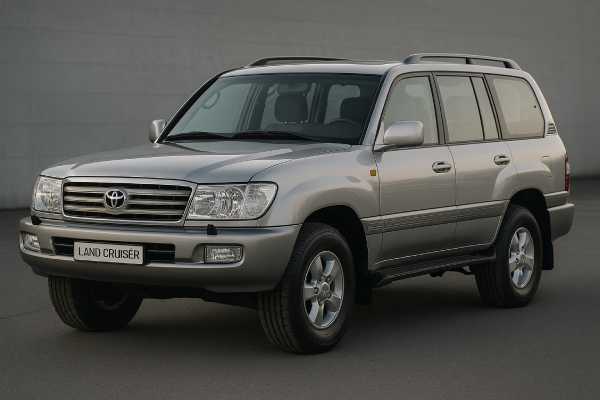
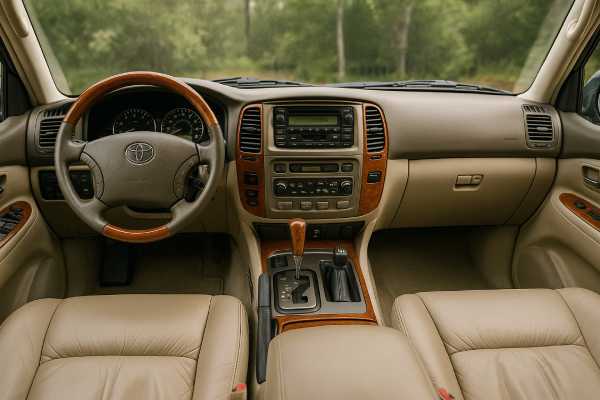
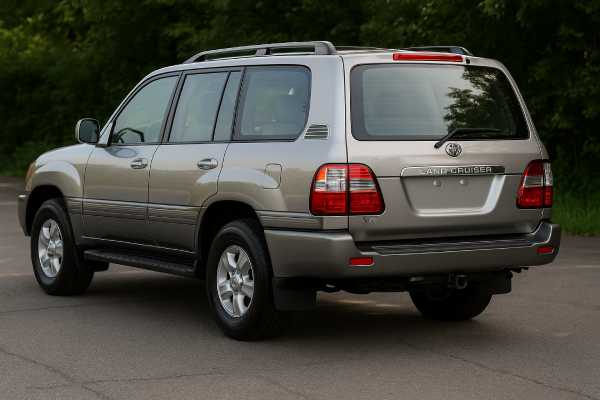
The UZJ100 Land Cruiser represents a pivotal shift in Toyota’s flagship 4×4: the first Land Cruiser with an independent front suspension in North America, paired with the durable 2UZ-FE 4.7-liter V8 and a full-time 4×4 driveline. Built on a stout ladder frame with a live rear axle, it blends everyday comfort with genuine long-distance and off-road capability. Owners praise its longevity, parts support, and towing manners, while accepting that a 5,000-plus-lb, body-on-frame SUV powered by a naturally aspirated V8 will never sip fuel. If you are cross-shopping used full-size SUVs for travel, family duty, or overlanding, the 1998–2002 Land Cruiser offers a rare combination of refinement, durability, and resale strength—provided you buy a well-maintained example and keep ahead of timing-belt and cooling-system service.
At a Glance
- Proven 2UZ-FE V8, robust driveline, and long parts support; many examples exceed 300,000+ miles (482,803+ km).
- Comfortable highway cruiser with stable on-road manners; capable 4×4 with low range and locking center differential.
- Exceptional build quality and resale value; interior materials hold up well with age.
- Expect thirsty fuel use (typical 12–15 mpg US / 19.6–15.7 L/100 km) and higher tire/brake costs than smaller SUVs.
- Timing belt at 90,000 miles (144,000 km) or 9 years is the key interval; do water pump and idlers together.
Explore the sections
- UZJ100 Land Cruiser Overview
- UZJ100 Specs and Data
- Trims, Options and Safety
- Reliability and Known Issues
- Maintenance and Buyer’s Guide
- Driving and Performance
- Land Cruiser vs Rivals
UZJ100 Land Cruiser Overview
The 1998–2002 Toyota Land Cruiser (chassis code UZJ100 in North America) introduced the 2UZ-FE 4.7-liter V8 to the nameplate and brought independent front suspension (IFS) to improve ride and steering precision. Underneath, it remained a traditional Land Cruiser: a boxed ladder frame, a full-time 4×4 system with a lockable center differential, a two-speed transfer case, and a four-link live rear axle with coils. In the cabin, it offered eight-passenger seating, available third-row jump seats, and a feature set focused on durability and day-to-day usability rather than gimmicks.
Ownership appeal centers on breadth of ability. It’s easy to drive around town, tracks confidently on interstates, and can tow a mid-size camper or boat. On trails or snow-covered roads, the combination of low-range gearing, traction control (on later years), and generous suspension travel delivers predictable traction. Unlike many of its contemporaries, the Land Cruiser’s interior materials, switchgear, and weather sealing typically remain solid well past 200,000 miles (321,869 km), and the 2UZ-FE is renowned for smoothness and long service life if maintained.
Key differences within this 1998–2002 window are modest but relevant. Early years are simpler and highly durable; beginning in 2000, stability control and enhanced traction control were added, improving foul-weather security. Throughout this span you’ll find a four-speed automatic and the same 230 hp V8. In short, if you want the classic 100-Series feel—refined yet truck-tough—without later-model complexity, these are the years to target.
UZJ100 Specs and Data
Below are scannable, North America–specific specifications for the 1998–2002 Land Cruiser with the 2UZ-FE V8. Figures are typical for stock vehicles in good condition; small variations by model year and equipment are normal.
Engine and Performance
| Item | Specification |
|---|---|
| Code | 2UZ-FE |
| Engine layout & cylinders | 90° V8, aluminum heads, iron block, DOHC, 32 valves (4 per cyl) |
| Bore × stroke | 94.0 × 84.0 mm (3.70 × 3.31 in) |
| Displacement | 4.7 L (4,663 cc) |
| Induction | Naturally aspirated |
| Fuel system | Multi-port electronic fuel injection (MPFI) |
| Compression ratio | 9.6:1 |
| Max power | 230 hp (172 kW) @ 4,800 rpm |
| Max torque | 434 Nm (320 lb-ft) @ 3,400 rpm |
| Timing drive | Belt (interference-safe design; follow replacement interval) |
| Emissions/efficiency standard | U.S. Tier 1 era (varies by state) |
| Rated efficiency (combined) | 18.1 L/100 km (13 mpg US / 15.6 mpg UK) |
| Real-world highway @ 120 km/h (75 mph) | ~14–16 mpg US (16.8–14.7 L/100 km) depending on tires/rack/load |
Transmission and Driveline
| Item | Specification |
|---|---|
| Transmission | 4-speed automatic (A343F) |
| Gear ratios (1/2/3/4/R) | 2.804 / 1.531 / 1.000 / 0.753 / 2.393 |
| Transfer case | HF2A full-time 4×4 with lockable center diff; low range 2.488:1 |
| Final drive ratio | ~4.30:1 (front and rear; small year/build variances possible) |
| Drive type | Full-time 4×4 |
| Differentials | Open front/rear; locking center diff; A-TRAC brake-based traction from 2000 |
| Refuel to full (typical) | ~5 minutes at pump |
Chassis and Dimensions
| Item | Specification |
|---|---|
| Frame | Ladder frame, welded box-section |
| Suspension (front/rear) | IFS, double wishbone with torsion bars / 4-link solid axle with coils |
| Steering | Hydraulic rack-and-pinion |
| Brakes | 4-wheel vented discs; ABS |
| Wheels/tires (typical) | 16 × 8 in alloys; 275/70R16 tires |
| Ground clearance | ~9.8 in (249 mm), stock tires |
| Angles (approach/departure/breakover) | ~32° / 24° / 21° (approx., tire-dependent) |
| Length / Width / Height | ~4,880 mm / 1,940 mm / 1,860 mm (192.5 / 76.4 / 73.2 in) |
| Wheelbase | 2,850 mm (112.2 in) |
| Turning circle (curb-to-curb) | ~11.4 m (37.4 ft) |
| Curb weight | ~2,380–2,540 kg (5,247–5,600 lb) |
| GVWR | ~3,110 kg (6,860 lb) |
| Fuel tank | ~96 L (25.4 US gal / 21.2 UK gal) |
Performance and Capability
| Item | Specification |
|---|---|
| 0–100 km/h (0–62 mph) | ~10.5 s (stock tires) |
| Top speed | ~180 km/h (112 mph) governor-limited |
| Braking (100–0 km/h; 62–0 mph) | Typical full-size SUV distances on all-terrain tires |
| Towing capacity (braked) | 2,948 kg (6,500 lb) with proper equipment |
| Payload (typical) | ~540–635 kg (1,190–1,400 lb) |
| Roof load | ~91 kg (200 lb) with proper crossbars |
Fluids and Service Capacities
| System | Specification / Capacity |
|---|---|
| Engine oil | API SJ/SL 5W-30; ~6.5 L (6.9 US qt) with filter |
| Coolant | Toyota Long Life (red, ethylene glycol); ~11–12 L (11.6–12.7 US qt), 50/50 mix |
| Automatic transmission | Toyota ATF Type T-IV; service drain ~2–3 L (2–3 US qt); overhaul fill ~9–10 L (9.5–10.6 US qt) |
| Transfer case | ATF (Type T-IV); ~1.5–1.6 L (1.6–1.7 US qt) |
| Front differential | 75W-90 GL-5; ~1.5–1.6 L (1.6–1.7 US qt) |
| Rear differential | 75W-90 GL-5; ~3.0 L (3.2 US qt) |
| A/C refrigerant | R-134a; typical charge ~900–1,050 g (32–37 oz) |
| A/C compressor oil | ND-OIL 8 (PAG); ~200 mL (6.8 fl oz) |
| Key torque specs | Wheel lugs ~131 Nm (97 lb-ft); oil drain ~39 Nm (29 lb-ft); diff drain/fill ~49 Nm (36 lb-ft) |
Electrical
| Item | Specification |
|---|---|
| Alternator output | ~100 A |
| 12V battery | Group 27F (typical), ~70–80 Ah, ~650–720 CCA |
| Spark plugs | Long-life iridium; gap ~1.1 mm (0.044 in) |
Safety and Driver Assistance
| Area | Notes |
|---|---|
| Crash ratings | Limited formal test coverage for these years; verify by VIN for any updates |
| Stability/traction | ABS standard; Vehicle Stability Control (VSC) and Active TRAC added in the early 2000s within this span |
| Airbags | Dual front airbags standard; later years add child-seat anchors; side airbags become more common after 2002 in this line |
| Child-seat provisions | Tether anchors; LATCH availability aligns with early-2000s adoption |
| ADAS (modern systems) | Not equipped (no AEB/ACC/LKA); rely on driver skill and proper tires |
Trims, Options and Safety
Trims and options. In North America, the Land Cruiser was sold largely as a single, well-equipped grade with option packages rather than multiple trims. Common equipment includes leather seating, power front seats, automatic climate control, a power moonroof, and 16-inch alloys on 275/70R16 tires. Popular add-ons include a factory tow receiver and wiring, roof rack crossbars, and third-row jump seats (removable), as well as a premium audio head unit. Navigation became more prevalent toward the latter part of this window; whether you want it is personal—many owners retrofit modern head units with CarPlay/Android Auto while retaining factory speakers and steering-wheel controls.
Mechanical/functional differences. All models feature a full-time 4×4 system with a lockable center differential and low range. Starting around model year 2000, stability control (VSC) and Active TRAC traction control appeared, which enhance wet/snow traction and help on uneven terrain by braking a spinning wheel to shift torque. Axle ratios hover around 4.30:1. There is no factory rear locker in typical North American 100-Series Land Cruisers, though aftermarket selectable lockers are common.
Quick identifiers. A UZJ100 will show a 4.7L V8 under the hood with timing-belt covers up front, torsion bars visible under the front, and a coil-sprung live axle with panhard rod in the rear. VIN and emission labels reflect 4.7-liter V8 gasoline certification. Interior “tells” include the classic three-spoke wheel, center diff lock button (with a low-range lever), and, on later years, a VSC/TRAC indicator.
Year-to-year highlights (1998–2002).
- 1998–1999: Launch spec; four-speed A343F automatic; ABS; dual front airbags; full-time 4×4 with locking center diff.
- 2000: Stability control (VSC) and Active TRAC traction control introduced; minor equipment updates.
- 2001–2002: Feature refinements (audio/navigation availability, interior detail updates). Powertrain remains 230 hp/320 lb-ft.
Safety ratings summary. Formal crash-test data for these specific years is sparse compared with modern SUVs. You should not assume a rating applies across years; check the VIN for year-specific information. The big safety advances here are passive robustness (rigid structure, weight) and the introduction of stability control and refined traction systems around 2000.
Safety and ADAS notes.
- Airbags: Dual front airbags throughout; side-impact airbags are more common in later 100-Series years (beyond 2002).
- Child-seat anchorage: Tether anchors present; standardized LATCH anchors arrive in line with early-2000s adoption.
- Brakes/ABS: Four-wheel discs with ABS are standard; with age, fresh pads/rotors and quality tires matter far more than specs.
- ADAS calibration: VSC/TRAC components require zero-point calibration after some service tasks (steering angle, ride-height changes); many scan tools can perform it quickly.
Reliability and Known Issues
The 2UZ-FE V8 and A343F automatic are among Toyota’s most durable combinations. Failures tend to be age-related wear, not inherent defects. Below is a field-driven map of what to watch on 1998–2002 examples, organized by prevalence and cost/effort.
Powertrain (common to occasional).
- Timing belt due/overdue → Symptom: belt age unknown, coolant seep at pump, chirps → Cause: neglected interval (90k mi/144k km or 9 years) → Remedy: timing-belt kit with water pump, idlers, tensioner, cam/crank seals; reset service sticker.
- Starter contacts wear → Symptom: intermittent click/no-crank, especially warm → Cause: solenoid contacts erode; starter buried under intake → Remedy: rebuild contacts/ plunger or replace starter; pair with intake gaskets.
- Valve cover gasket seepage → Symptom: oil smell, damp covers → Cause: aged gaskets → Remedy: replace gaskets; clean PCV; verify torque.
- Radiator upper tank cracking → Symptom: pink crust, cooling smell → Cause: age/thermal cycles → Remedy: replace radiator; renew cap and thermostat; bleed carefully.
- Oxygen sensor aging → Symptom: fuel economy dips, check engine light (lean/rich codes) → Remedy: replace upstream sensors in pairs; confirm with scan-tool fuel trims.
Driveline and chassis (common).
- Front suspension/steering wear → Symptom: wander, clunks, uneven tire wear → Cause: worn inner/outer tie-rods, rack bushings, upper/lower control arm bushings/ball joints → Remedy: refresh worn components; perform alignment with proper caster.
- Front CV boots → Symptom: grease sling → Cause: torn boots from age or lifted geometry → Remedy: reboot or replace; set ride height within sensible range if torsion-bar cranked.
- Driveline vibrations → Symptom: shudder at certain speeds → Cause: worn U-joints, dry slip yokes, out-of-balance tires → Remedy: lube drive shafts (zerks), replace U-joints, road-force balance tires.
- A-TRAC/VSC quirks (2000+) → Symptom: warning lights after suspension changes → Cause: zero-point calibration required → Remedy: scan-tool zero-point reset on level surface.
Body and electrical (occasional).
- Tailgate and rear hatch rust → Symptom: bubbling at seams/under glass → Cause: moisture traps/road salt → Remedy: rust repair; cavity wax; replace weatherstrips if needed.
- Door lock actuators → Symptom: slow or no lock/unlock → Cause: weak internal motors → Remedy: replace actuator assemblies or motor inserts.
- Sunroof drains → Symptom: damp headliner/A-pillars → Cause: clogged drains → Remedy: clean and verify water test.
Recalls, TSBs, extended coverage. This generation did not see the sweeping airbag and electronics campaigns later models did, but recall scope always varies by year/build. Always run the VIN for open recalls and confirm dealer completion records. Emissions-related campaigns (e.g., throttle body or evaporative system on certain Toyota V8s) and service communications exist; having a complete dealer printout adds confidence.
Pre-purchase checks (request paperwork).
- Proof of timing-belt/water-pump service with mileage/date.
- Cooling system renewal (radiator/hoses/cap/thermostat), recent brake work, and ATF/differential/transfer fluid services.
- Alignment specs and tire age; steering/suspension work with alignment sheets.
- VIN recall report and any factory campaign printouts.
- Clean frame rails/rear substructure and lower tailgate seams (rust), plus under-car inspection for leaks.
Maintenance and Buyer’s Guide
Practical maintenance schedule (time/distance). Use severe-service intervals if you tow, idle, or drive short trips. Distances are miles (km).
- Engine oil & filter: 5,000 mi (8,000 km) / 6 months with 5W-30 meeting API SJ/SL; shorter if dusty or towing.
- Engine air filter: Inspect 15,000 mi (24,000 km); replace 30,000 mi (48,000 km) or sooner if dusty.
- Cabin filter: Inspect 15,000–20,000 mi (24,000–32,000 km); replace 30,000 mi (48,000 km).
- Spark plugs (iridium): 60,000–90,000 mi (96,000–145,000 km); inspect at 60k and replace by 90k.
- Timing belt kit: 90,000 mi (144,000 km) or 9 years; replace water pump, idlers, tensioner, cam/crank seals.
- Serpentine/aux belts & hoses: Inspect every oil change; replace 90,000–120,000 mi (145,000–193,000 km) or if cracked.
- Coolant: Toyota Long Life (red) every 2–3 years / ~30,000 mi (48,000 km) after first change; pressure-test cap annually.
- Automatic transmission (A343F): Drain/fill 30,000–60,000 mi (48,000–96,000 km) depending on use; clean pan/strainer if opened.
- Transfer case & differentials: 30,000–60,000 mi (48,000–96,000 km); sooner if water crossings or heavy towing.
- Brake fluid: Replace every 2 years; flush thoroughly after caliper or ABS work.
- Brake pads/rotors: Inspect at each tire rotation; Land Cruiser weight is hard on front pads when towing.
- Tire rotation & alignment: Rotate 5,000–7,500 mi (8,000–12,000 km); annual alignment or after suspension work.
- Steering/suspension: Lube driveshaft zerks at each oil change; inspect rack boots, ball joints, control-arm and panhard bushings.
- 12V battery: Test annually after year 4; typical replacement at 5–6 years in temperate climates.
Fluid specifications and capacities (quick reference).
- Engine oil: API SJ/SL 5W-30; ~6.5 L (6.9 qt).
- ATF: Toyota Type T-IV (A343F); ~2–3 L drain, ~9–10 L overhaul fill.
- Transfer case: ATF Type T-IV; ~1.5–1.6 L.
- Diffs: 75W-90 GL-5; front ~1.5–1.6 L; rear ~3.0 L.
- Coolant: Toyota Long Life (red); ~11–12 L.
- A/C: R-134a; ~900–1,050 g; ND-OIL 8 PAG oil ~200 mL.
- Essential torque values: wheel lugs ~131 Nm (97 lb-ft); oil drain ~39 Nm (29 lb-ft); differential plugs ~49 Nm (36 lb-ft).
Buyer’s checklist.
- Service history: Timing belt/water pump; coolant service; ATF and axle fluids; documented brake work.
- Frame and body: Look along inner frame rails, rear spring perches, and tailgate lower seam for rust; check sunroof drains.
- Driveline: Smooth shifts, quiet U-joints, no clunk on throttle transitions; center diff lock engages and disengages cleanly.
- Steering/suspension: No rack leaks; proper caster (drives straight, returns to center); even tire wear.
- HVAC & electronics: Climate control, rear A/C, all window regulators, central locking actuators, and instrument illumination.
- Tires & wheels: Quality LT tires with recent date codes; avoid mismatched sizes with full-time 4×4.
What to seek/avoid. Look for documented belt service and cooling system refresh, and a tight front end (tie-rods, bushings, and ball joints). Avoid neglected rigs with mixed tires, clunky driveline play, and “mystery” electrical add-ons. Mild suspension refreshes (quality shocks, stock-height torsion-bar setting, fresh control-arm bushings) make these trucks feel nearly new again.
Long-term durability outlook. With routine fluids and timely belt service, 2UZ-FE trucks commonly exceed 300,000 miles (482,803 km) on original long blocks and transmissions. Corrosion and deferred maintenance—not fundamental design—usually decide lifespan.
Driving and Performance
Ride and handling, NVH. On pavement, the 100-Series rides with a pleasing, gently controlled motion. The IFS filters small chatter better than the solid-axle 80-Series, yet the live rear axle maintains excellent load-carrying and tow stability. Steering is steady and appropriately weighted; with fresh bushings and alignment, it tracks straight with minimal wander. Wind and road noise are modest for a full-size SUV; tire choice (all-terrain vs highway) and roof racks make the largest difference at freeway speeds.
Powertrain character. The 2UZ-FE’s charm is smooth torque and quiet operation, not outright speed. Throttle response is linear; the four-speed A343F favors relaxed upshifts and tall gearing, keeping revs low in cruise. Kickdown is decisive enough for passing but not abrupt. In low range, the engine’s tractability makes slow-speed maneuvering simple and predictable.
Efficiency. Real-world consumption varies widely with tire type/size, cargo, roof gear, and terrain. Stock trucks often return ~12–13 mpg US in mixed driving (19.6–18.1 L/100 km), 14–16 mpg US (16.8–14.7 L/100 km) at 65–75 mph (105–120 km/h) on highway trips, and lower numbers with lifts, armor, or oversized tires. Cold weather and short trips can knock another 1–2 mpg off those figures.
Traction and control. In snow and on loose surfaces, the full-time 4×4 system with a lockable center diff is a strong baseline. From 2000 on, VSC and A-TRAC assist in split-mu situations and off-camber climbs by braking a spinning wheel to bias torque. These systems prefer steady throttle and light steering inputs; learn their behavior before tackling technical terrain. Proper all-terrain tires matter more than any electronic aid.
Load and towing. Within the 6,500-lb (2,948-kg) tow rating, the Land Cruiser feels composed, with good temperature control on long grades if the cooling system is healthy. Expect a 20–35% fuel-economy penalty with moderate trailers and more with heavy frontal area. A weight-distributing hitch, trailer brakes, and conservative speeds are recommended.
Key metrics owners care about.
- 0–60 mph (0–97 km/h): Typically high-9s to low-10s in stock form.
- 50–80 mph (80–129 km/h) passing: Adequate with a downshift; plan ahead when towing.
- Turning circle: About 37.4 ft (11.4 m), easier to maneuver than its size suggests.
- Brake feel: Consistent; quality pads/rotors and fresh fluid greatly influence confidence on long descents.
Land Cruiser vs Rivals
Lexus LX 470 (sibling). Mechanically similar and equally durable, the LX 470 adds more luxury trim and (often) Adaptive Height Control (AHC). AHC rides well when healthy but adds complexity and cost; many LX owners convert to conventional springs/shocks later. If you want simplicity, the Land Cruiser’s steel springs are appealing.
Chevrolet Tahoe/Suburban (GMT800). Abundant and cheaper to buy. They tow well and are less costly to service at domestic dealers, but interior and long-term trim durability are not at Land Cruiser levels. 4×4 systems and front-end components can be more maintenance-intensive in heavy use.
Ford Expedition (first gen). Spacious and common with lower entry prices; powertrains are adequate, and parts are inexpensive. However, corrosion resistance and interior longevity lag, and off-road depth is shallower (geometry, articulation, and low-range usability).
Land Rover Discovery II / Range Rover P38a. Strong off-road geometry and available lockers/air suspension give capability; interiors are charming. Reliability and parts costs are the trade-offs, and electrical/air-suspension issues are common as these trucks age. The Toyota’s powertrain and electrical robustness are generally superior.
Nissan Patrol (not widely sold in North America). Where available, it’s a legitimate rival with stout axles and a reputation for toughness. In North America, the Land Cruiser wins on support, parts availability, and resale.
Bottom line. The 1998–2002 Land Cruiser prioritizes durability, road-trip comfort, and real capability over outright speed or gadgetry. If you value those traits—and can accept the fuel bills—it remains a benchmark used SUV.
References
- Gas Mileage of 1998 Toyota Land Cruiser 1998 (Fuel Economy)
- 2002 TOYOTA LANDCRUISER 4 DR AWD 2002 (Recall Database)
- 208 95 lt trk groups 2011 (Homologation/CAFE Data)
- Strong New Arguments For Toyota Land Cruiser Amazon 2002 (Manufacturer Publication)
Disclaimer
This guide is for informational purposes and is not a substitute for professional diagnosis or repair. Specifications, torque values, service intervals, and procedures vary by VIN, model year, market, and equipment. Always verify details against your vehicle’s official owner’s manual and service documentation.
If this article helped you, please consider sharing it with fellow enthusiasts on Facebook or X (Twitter) to support xcar’s work.