
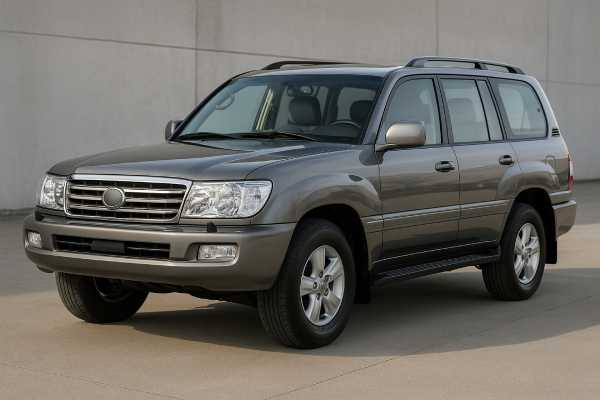
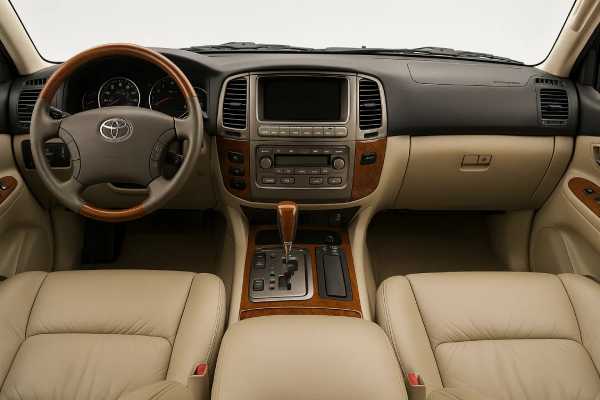
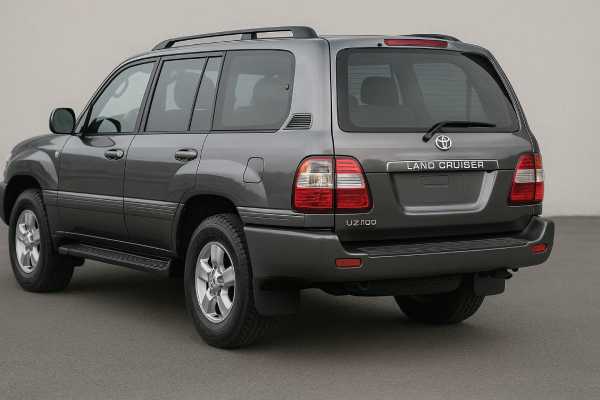
The 2006–2007 facelift of the UZJ100 Land Cruiser represents the final and most polished years of Toyota’s 100-Series in North America. It blends proven body-on-frame toughness with a smoother, more refined drive than earlier generations. The 2UZ-FE 4.7-liter V8 gained VVT-i in the mid-cycle updates, delivering 275 hp through a 5-speed automatic and full-time 4×4 with a lockable center differential and low range. Independent front suspension improves on-road comfort without abandoning the Land Cruiser’s off-road mission, while generous towing and payload figures make it a confident long-haul family and adventure rig. Inside, the eight-passenger cabin is quiet, durable, and well-equipped for its time, with leather seating and side-curtain airbags widely available. Ownership strengths center on longevity, parts availability, and a vast knowledge base. To get the best experience from this platform, keep up with fluids, the timing belt service, and checks for age-related wear on cooling, steering, and driveline components.
Top Highlights
- Robust 2UZ-FE V8 with timing belt, full-time 4×4, and low range for dependable trail capability.
- Comfortable highway ride; independent front suspension and 5-speed automatic smooth out daily driving.
- High durability and parts support; many examples exceed 200,000 miles (320,000 km) with routine care.
- Watch for timing belt (90,000 mi / ~145,000 km) and water pump service needs as the truck ages.
- Oil change interval: 5,000 miles (8,000 km) or 6 months with quality 5W-30.
Navigate this guide
- Land Cruiser UZJ100 Overview
- UZJ100 Specifications and Technical Data
- Trims, Options, and Safety
- Reliability, Common Issues and Actions
- Maintenance and Buyer’s Guide
- Driving and Performance
- How It Compares to Rivals
Land Cruiser UZJ100 Overview
The 2006–2007 Land Cruiser closes the 100-Series chapter with a highly resolved package. Under the hood is Toyota’s 2UZ-FE 4.7-liter aluminum-head, iron-block V8, running VVT-i for broader torque and cleaner emissions. Power routes through the A750F 5-speed automatic into a full-time 4×4 system with a lockable center differential and a two-speed transfer case. Toyota’s A-TRAC brake-based traction control, Vehicle Stability Control (VSC), and ABS are integrated to handle mixed surfaces, snow, and moderate trail work without drama.
The facelift years focus on refinement more than headline changes. Ride comfort is notably better than classic solid-axle Land Cruisers thanks to independent front suspension, while the rear retains a robust solid axle with coils for load and articulation. The cabin is quiet and durable, seating up to eight with third-row jump seats that can be folded or removed to free cargo space. Standard equipment was generous, and most trucks include leather, power features, and premium audio; navigation and rear entertainment were common additions.
Capability remains the centerpiece. With ~9.8 in (250 mm) of ground clearance, low range, and a stout frame, the UZJ100 handles forest roads, sand, snow, and overlanding loads confidently. On pavement, it cruises at modern freeway speeds with relaxed gearing and predictable steering. Towing is rated to approximately 6,500 lb (2,948 kg) with proper equipment, and payload sits around 1,100–1,200 lb (500–545 kg) depending on configuration. The trade-offs are straightforward: fuel economy is truck-like, access to the third row is old-school, and some wear items (timing belt, cooling system, rack seals) demand timely attention as vehicles reach two decades of service. Still, no other SUV of the era pairs this level of durability with such an easygoing daily drive.
UZJ100 Specifications and Technical Data
Engine and Performance (2UZ-FE 4.7 V8)
| Item | Specification |
|---|---|
| Code | 2UZ-FE (VVT-i) |
| Layout & cylinders | 90° V8, DOHC, 32 valves (4 per cyl), aluminum heads / cast-iron block |
| Bore × stroke | 94.0 × 84.0 mm (3.70 × 3.31 in) |
| Displacement | 4.7 L (4,663 cc) |
| Induction | Naturally aspirated |
| Fuel system | Sequential multi-port fuel injection |
| Compression ratio | ~10.0:1 |
| Max power | 275 hp (205 kW) @ ~5,400 rpm |
| Max torque | 450 Nm (332 lb-ft) @ ~3,400 rpm |
| Timing drive | Belt (rubber; interference-safe but service-critical) |
| Emissions / efficiency | EPA gasoline; regular unleaded recommended |
| EPA rating (2006–2007) | ~12 city / 15 highway / 13 combined mpg US (19.6 / 15.7 / 18.1 L/100 km) |
| Real-world at 75 mph (120 km/h) | ~14–16 mpg US (16.8–14.7 L/100 km) depending on tires/rack/load |
| Aerodynamics | Approx. Cd ~0.40–0.41; frontal area ~3.0 m² (est.) |
Transmission and Driveline
| Item | Specification |
|---|---|
| Transmission | A750F 5-speed automatic (floor shift, gated) |
| Gear ratios | 1st 3.520, 2nd 2.042, 3rd 1.400, 4th 1.000, 5th 0.716, Rev 3.224 |
| Transfer case | 2-speed (high/low); low range ~2.488:1 |
| Final drive ratio | ~4.30:1 (typical) |
| Drive type | Full-time 4×4 with lockable center differential |
| Differentials | Open front/rear; A-TRAC brake-actuated traction control |
| Refuel to full | ~5–10 min depending on pump flow (25.4 US gal / 96 L tank) |
Chassis and Dimensions
| Item | Specification |
|---|---|
| Frame | Ladder frame with body-on-frame construction |
| Suspension (front/rear) | Double-wishbone IFS with torsion bars / 4-link solid axle with coils |
| Steering | Rack-and-pinion, hydraulic assist |
| Brakes | 4-wheel discs; front ~338 mm (13.3 in) vented; rear ~312 mm (12.3 in) |
| Wheels / tires (typical) | 17 × 8 in alloys; 275/65 R17 all-terrain or highway-terrain |
| Ground clearance | ~250 mm (9.8 in) |
| Angles (approx.) | Approach ~30°, departure ~24°, breakover ~21° |
| Length × width × height | ~4,890 × 1,940 × 1,860 mm (~192.5 × 76.4 × 73.2 in) |
| Wheelbase | 2,850 mm (112.2 in) |
| Turning circle (kerb-to-kerb) | ~12.1 m (39.7 ft) |
| Curb weight | ~2,550–2,590 kg (5,625–5,710 lb) |
| GVWR | ~3,110 kg (6,860 lb) |
| Fuel tank | 96 L (25.4 US gal / 21.1 UK gal) |
| Cargo volume* | Seats up ~590 L (20.8 ft³); max ~2,570 L (90+ ft³) *approx., seats stowed/removed |
Performance and Capability
| Item | Specification |
|---|---|
| 0–60 mph / 0–100 km/h | ~8.6 s / ~9.3 s (typical test) |
| Top speed | ~180 km/h (112 mph) electronically limited |
| 100–0 km/h (62–0 mph) | ~40–44 m (130–145 ft), tire-dependent |
| Towing capacity (braked) | ~2,948 kg (6,500 lb) with Class III/IV hitch and wiring |
| Payload | ~500–545 kg (1,100–1,200 lb), configuration-dependent |
| Roof load (dynamic) | ~68–75 kg (150–165 lb) with OEM rack and crossbars |
Fluids and Service Capacities**
| System | Spec / Type | Capacity (approx.) |
|---|---|---|
| Engine oil | 5W-30 (API SJ/SL/SM); high-quality synthetic acceptable | ~6.6–6.8 US qt (6.2–6.4 L) with filter |
| Engine coolant | Toyota Super Long Life Coolant (pink), 50/50 premix | ~12–13 L (12.7–13.7 US qt) |
| Automatic transmission | Toyota ATF WS | Service drain ~3.5–4.0 L (3.7–4.2 qt); dry fill ~10–11.5 L (10.5–12.1 qt) |
| Transfer case | GL-4/GL-5 as specified | ~1.4–1.6 L (1.5–1.7 US qt) |
| Front differential | GL-5 75W-90 (typ.) | ~1.5–1.6 L (1.6–1.7 US qt) |
| Rear differential | GL-5 75W-90 (typ.) | ~3.0–3.2 L (3.2–3.4 US qt) |
| A/C refrigerant | R-134a | ~650 g (23 oz) ± tolerance |
| A/C compressor oil | PAG (ND-OIL 8) | ~150–180 mL (5–6 fl oz) |
| Key torque values | Wheel lug nuts ~131 Nm (97 lb-ft); oil drain plug ~39 Nm (29 lb-ft) | — |
**Capacities vary slightly by build; verify with service documentation for your VIN.
Electrical
| Item | Specification |
|---|---|
| Alternator | ~130 A |
| 12 V battery | Group 27F (typical), ~80 Ah, ~700+ CCA |
| Spark plugs | Iridium (e.g., Denso SK20R11 / NGK IFR6A11); gap ~1.1 mm (0.043 in) |
Safety and Driver Assistance
| Area | Details |
|---|---|
| Crash ratings | No widely published IIHS/Euro NCAP ratings for 2006–2007 LC100; focus on equipment and condition |
| Headlights | Halogen reflectors; no IIHS headlight score for these years |
| Passive safety | Dual front airbags; front side and side-curtain airbags (3-row coverage on most builds); front/rear outboard pretensioners |
| Active safety | ABS with EBD, Brake Assist; VSC stability control; A-TRAC traction control; center diff lock; tire-pressure monitoring (late runs) |
| Child seats | LATCH lower anchors (2nd row), top tether points |
Trims, Options, and Safety
Trims and packages. In these final 100-Series years, the Land Cruiser was effectively a single well-equipped grade in North America. Most examples include leather upholstery, heated front seats, power moonroof, premium audio, and third-row jump seats. Common options and packages included:
- Navigation / premium audio: In-dash navigation with an upgraded amplifier and additional speakers.
- Rear-seat entertainment: Roof-mounted DVD screen with wireless headphones.
- Tow preparation: 7-pin wiring, Class III/IV receiver, trans cooler (often standard or dealer-installed).
- Appearance / roof gear: Crossbars and running boards were widespread; all-terrain tire packages were dealer favorites.
Mechanical specification did not vary by trim; the 2UZ-FE, A750F, and full-time 4×4 with low range were standard across the board. Early 100-Series U.S. trucks offered a rear diff lock; by these facelift years, Toyota relied on A-TRAC and the lockable center differential instead.
Year-to-year notes (2006 → 2007):
- Equipment mostly steady; late-run trucks may add minor audio or connectivity tweaks.
- Color/trim availability and wheel finishes changed slightly; core mechanicals are unchanged.
- 2007 marks the last U.S. model year before the 200 Series (’08-on) replaced the 100.
Safety equipment and ADAS. Toyota prioritized fundamental active safety: ABS/EBD, Brake Assist, VSC, and A-TRAC. A-TRAC is particularly effective off-pavement, braking an individual spinning wheel to send torque across open diffs. The center differential can be locked for consistent torque split on loose surfaces, and low range is ideal for technical climbs and controlled descents. Passive safety is solid for the era, with front, side, and curtain airbags common; check that 3-row trucks have the curtain coverage you expect, since equipment can vary by build.
Child-seat and anchors. The second row provides LATCH lower anchors and top tether points; the third-row jump seats (when fitted) are not LATCH positions. Always confirm anchor locations and weight limits in the owner materials, especially if you’ve removed or reinstalled the third-row seats to make cargo space.
Identification tips.
- VIN/build plate: UZJ100 chassis code; 5-speed automatic and VVT-i V8 for 2006–2007.
- Exterior tells: 17-inch alloys, facelift grille/lighting details, and often a factory roof rack.
- Interior tells: Navigation hard buttons around the screen on equipped trucks; 3-row jump seats folded to the side or removable.
Reliability, Common Issues and Actions
The 100-Series Land Cruiser is one of the most durable full-size SUVs of its era. Most concerns on 2006–2007 examples reflect age, miles, or use rather than fundamental design flaws. Below is a practical, severity-aware map of common findings.
Engine and fuel (ICE-specific).
- Timing belt and water pump — common, medium severity: Service due around 90,000 miles (145,000 km) or 9 years. Many owners replace the water pump, tensioner, and idlers with the belt. Symptoms: no warning until failure; belt inspection and age/mileage history are critical. Action: replace belt kit and pump proactively; use quality parts.
- Valve cover and cam seals — occasional, low/medium: Oil weep at gasket perimeters or front seals with age. Action: reseal when evidence appears; combine with spark plug service if covers are off.
- Cooling system aging — common, medium: Radiator plastic end tanks and hoses harden; tanks can crack at high miles. Action: preventive radiator/hoses/thermostat replacement around 150k–200k mi; refill with Toyota SLLC and bleed properly.
- Intake/MAF sensitivities — occasional, low: Dusty use and aftermarket oiled filters can foul the MAF. Action: clean MAF, use an OEM-style paper filter.
Driveline, transmission, and axles.
- ATF condition — occasional, low/medium: “Lifetime” WS fluid can shear with heat (towing, mountain grades). Action: periodic drain-and-fill every 60k–90k mi if used for towing or heavy loads; ensure correct fluid temperature check when setting level.
- Transfer case actuator seep — occasional, low: Oil at actuator housing; often manageable. Action: monitor; reseal during transfer case service if leakage progresses.
- Front CV boots and wheel bearings — common, low/medium: Boots crack with angle and age; bearings may hum after big-tire use. Action: inspect each oil change; replace boots/bearings as needed.
- Front differential abuse failures — rare but high severity: Aggressive driving on high-traction surfaces with locked center diff or oversized tires can stress the front diff. Action: sensible use; re-gear if running larger tires; ensure correct lubrication and torques.
Steering and suspension.
- Steering rack leaks — common with age, medium: Weep at seals; play develops at inner tie rods. Action: rebuild/replace rack and tie rods; align afterward.
- Rear control arm bushings / panhard — occasional, medium: Clunks or wander at speed. Action: fresh bushings tighten handling.
- Shocks/springs — common wear, low/medium: Originals often tired by 100k–150k mi. Action: quality replacements restore control and comfort.
Electrical and HVAC.
- Alternator aging — occasional, medium: Voltage sag under load at high mileage. Action: test under accessory load; replace with OE-quality units.
- HVAC blend motors — occasional, low/medium: Stuck mode or temperature door. Action: diagnose actuator; replace as required.
- Door lock actuators — occasional, low: Slow or inoperative locks. Action: actuator replacement is straightforward.
Corrosion hotspots (climate-dependent).
- Frame rails near rear crossmember, spare-tire area, radiator support, and tailgate lower seam. Inspect body mounts and brake lines in road-salt regions. Treat early to prevent perforation.
Recalls, TSBs, and coverage.
- Use the official recall lookup to check VIN-specific actions and completion. Items on older SUVs vary by build year and region; always verify in dealer records and via official channels before purchase or after a change of ownership.
Pre-purchase requests.
- Full service history (timing belt/water pump dates, coolant type).
- Transmission, diff, and transfer case fluid records.
- Evidence of recall/TSB completion (VIN lookup).
- Recent brake, steering rack, and suspension bushing work.
- Rust inspection photos (frame rails, crossmembers, tailgate).
- Tire age (DOT codes) and alignment reports; driveline vibration tests.
Maintenance and Buyer’s Guide
Baseline service plan (typical). Adjust for climate, load, and usage.
- Engine oil and filter: Every 5,000 miles (8,000 km) or 6 months with 5W-30.
- Engine air filter: Inspect every oil change; replace ~30,000 miles (48,000 km) or sooner in dust.
- Cabin filter: 15,000–20,000 miles (24,000–32,000 km) or 18 months.
- Spark plugs (iridium): ~90,000 miles (145,000 km).
- Timing belt kit + water pump: 90,000 miles (145,000 km) / ~9 years.
- Coolant (SLLC pink): First at ~100,000 miles (160,000 km) / 10 years, then 50,000 miles (80,000 km) / 5 years thereafter.
- ATF (WS): No fixed interval under “normal” use; for towing, mountain travel, or heat, drain-and-fill every 60,000–90,000 miles (96,000–145,000 km).
- Transfer case and differentials: 30,000–60,000 miles (48,000–96,000 km), sooner if deep-water crossings or towing.
- Brake fluid: Every 2–3 years regardless of mileage.
- Belts and hoses: Inspect each oil change; replace ~6–8 years or at first cracks/swelling.
- Alignment and rotation: Rotate tires every 5,000 miles (8,000 km); align annually or with new tires/suspension.
- 12 V battery: Test annually after year 4; typical life 4–6 years.
Fluid picks and notes.
- Oil: 5W-30 meeting API SN/SN+ or better; high-quality synthetics handle heat well when towing.
- Differentials: GL-5 75W-90 fits most climates; consider 75W-110 in heavy towing and heat.
- Transfer case: Follow the spec listed under your VIN; do not substitute ATF if gear oil is specified (and vice versa).
- Coolant: Use Toyota SLLC pink; avoid mixing with green or universal coolants.
DIY torque reminders (essentials).
- Wheel lug nuts: ~131 Nm (97 lb-ft).
- Oil drain plug: ~39 Nm (29 lb-ft).
- Front/rear diff fill plugs: snug to spec; always crack fill before drain.
- Skid plates: re-torque after service to avoid rattles.
Buyer’s checklist.
- Engine bay: Look for pink crust at radiator seams, dried coolant traces, and oil around valve covers.
- Underbody: Surface rust is common; probe frame and crossmembers for scale. Inspect brake lines and fuel lines in salty regions.
- Steering/suspension: Rack seepage, torn CV boots, and bushing play are typical; test for wander and clunks.
- Driveline: Verify center diff lock operation and quiet bearings at highway speeds.
- Electrical: Confirm all windows, mirrors, sunroof, seat heaters, and HVAC functions; scan for codes.
- Interior: Check third-row hardware if seats were removed for cargo; ensure belts and anchors remain intact.
- Tires and gearing: Oversized tires affect drivability and fuel economy; if fitted, ask about re-gearing and speedometer correction.
Recommended specs to seek.
- Unmodified or lightly and sensibly upgraded trucks (quality suspension, stock-ish tire size).
- Documented timing belt service and recent radiator/hoses.
- Evidence of clean frame care in winter climates.
Driving and Performance
Ride and handling. On pavement, the facelift UZJ100 feels settled and confident. The IFS front end filters sharp impacts better than solid-axle predecessors, while the rear coil-spring live axle maintains load capacity and composure. Steering is light to moderate with predictable on-center behavior; alignment and good bushings are essential to keep it tracking straight. Braking performance is consistent with four large discs and Brake Assist; fresh pads/rotors and good tires make a noticeable difference in stopping distances for a ~2.6-ton SUV.
Powertrain character. The 2UZ-FE V8 is tuned for smooth torque rather than drama. Throttle response is linear, with most thrust arriving from ~2,000–4,000 rpm. The A750F 5-speed shifts cleanly and resists hunting on rolling highways; kickdown is decisive for two-lane passes. The low-range gearing and center-diff lock are confidence multipliers on climbs, deep snow, and rutted access roads.
Real-world consumption. Expect numbers close to the period EPA ratings: roughly 12 mpg city / 15 mpg highway / 13 mpg combined (US), translating to 19.6 / 15.7 / 18.1 L/100 km. At a steady 75 mph (120 km/h) on all-terrain tires and a roof rack, many owners see 14–16 mpg US (16.8–14.7 L/100 km). Cold weather, headwinds, and roof loads move the needle. Mixed off-pavement travel is often 10–13 mpg US (23.5–18.1 L/100 km) depending on terrain.
Traction and control. A-TRAC is impressively effective at maintaining forward motion with open diffs; a gentle throttle foot lets the system work without excessive wheelspin. Lock the center diff on loose surfaces to prevent front/rear wind-up and to keep torque split consistent. The system’s manners in snow and mud are excellent for a stock SUV, especially on quality all-terrain tires.
Towing and load behavior. With a rated 6,500 lb (2,948 kg) tow capacity, the UZJ100 pulls camping trailers and boats confidently when equipped with a brake controller and weight-distribution setup. Keep trans temps in mind on long grades; a fresh WS fluid and clean cooler are cheap insurance. Fuel consumption climbs by 30–50% under moderate trailer loads, and stopping distances lengthen, so plan ahead.
How It Compares to Rivals
Lexus LX 470 (2006–2007). The closest twin to the UZJ100, sharing the 2UZ-FE and A750F. Many LX trucks include Active Height Control (AHC) and more luxury trim. If you value extra comfort and find a well-maintained AHC system, the LX can be a compelling alternative; if you prefer simpler suspension and slightly lower running costs, the Land Cruiser is the safer bet.
Land Rover LR3 (Discovery 3). Excellent articulation and a sophisticated Terrain Response system with an airy cabin, but higher ownership risk as trucks age (air suspension, electronics). The Toyota costs more up front for clean examples, but typically less to keep on the road over a decade.
Range Rover (L322 4.4/4.2SC). Plush, capable, and charismatic. When sorted, they are superb grand tourers; when neglected, maintenance can overwhelm. The Land Cruiser trades gadgetry for durability and resale stability.
Mercedes-Benz G-Class (G500 of the era). True locking differentials and ladder-frame heritage match the Toyota’s mission, but purchase and parts costs are significantly higher. Ride comfort and interior noise are more utilitarian than the UZJ100.
Full-size American SUVs (Tahoe/Suburban, Expedition). More interior space and cheaper parts, but the Land Cruiser’s long-term build quality, off-road geometry, and resale are typically stronger. For pure road-trip volume, the domestics win; for 20-year durability, many shoppers favor the Toyota.
Bottom line. If you want a V8 4×4 that can drive across a continent on Friday and reach a remote trailhead on Saturday—with a reputation for standing the test of time—the facelift UZJ100 remains a standout.
References
- Check for Recalls: Vehicle, Car Seat, Tire, Equipment | NHTSA 2025 (Recall Database)
- Vehicle List 2007 (Fuel Economy)
- Vehicle List 2006 (Fuel Economy)
Disclaimer
This guide is for informational purposes and is not a substitute for professional diagnosis or repair. Specifications, torque values, capacities, and maintenance intervals vary by VIN, market, and equipment level; always confirm details in your official Toyota service documentation and owner materials before performing work. If you found this useful, please share it with fellow enthusiasts on Facebook or X/Twitter to support xcar’s work.