
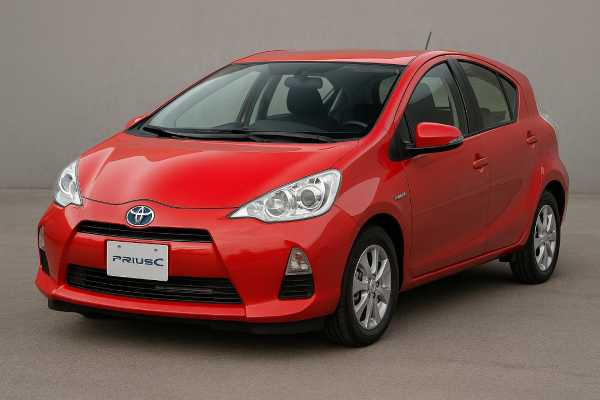
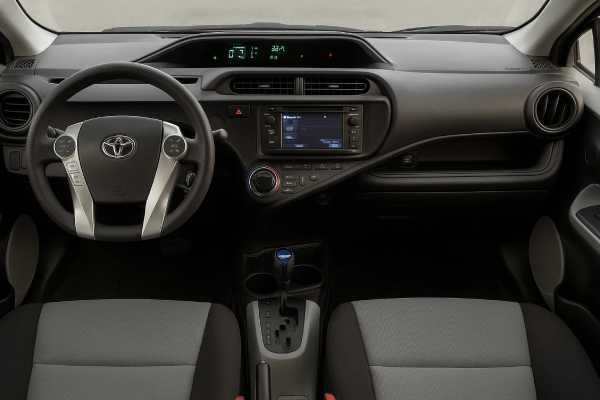
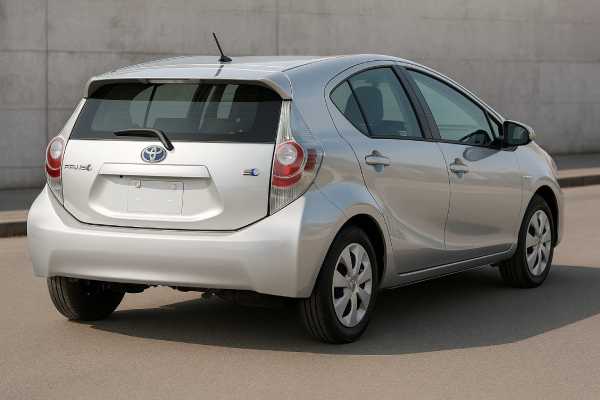
The 2012–2014 Toyota Prius c (NHP10) packages Toyota’s proven Hybrid Synergy Drive into a city-sized hatchback that emphasizes low running costs, nimble packaging, and easy ownership. It pairs the 1NZ-FXE 1.5-liter Atkinson-cycle four-cylinder with an electric drive motor and a compact NiMH battery, delivering a combined 99 hp and real-world efficiency that routinely tops 45–50 mpg (US). Compared with the larger Prius liftback, the Prius c is shorter and lighter, with simplified packaging and lower purchase costs, yet it retains hybrid essentials like regenerative braking and EV-only creep/low-speed capability. Owners value its durability, inexpensive consumables, and wide parts availability. There are trade-offs: highway noise is more noticeable, and acceleration is modest. But for urban and suburban duty cycles—including rideshare, commuting, and errands—the NHP10’s blend of practicality and thrift is hard to beat.
Fast Facts
- Excellent city economy (often 50+ mpg US) and low total cost of ownership.
- Simple, durable hybrid system with proven 1NZ-FXE engine and NiMH battery.
- Surprising cargo flexibility for size (up to ~17.1 ft³ seats up); easy maneuvering in tight streets.
- Watch for clogged HV-battery cooling fan in dusty/pet-hair environments; clean every 30,000–60,000 miles.
- Typical oil and filter interval: 10,000 miles or 12 months with 0W-20 (5,000 miles severe use).
Navigate this guide
- Detailed Overview
- Specifications and Technical Data
- Trims and Options, Safety and Driver Assistance
- Reliability, Common Issues and Service Actions
- Maintenance and Buyer’s Guide
- Driving and Performance
- How Prius c Compares to Rivals
Prius c 2012–2014 Detailed Overview
Toyota developed the Prius c (code NHP10) to make full-hybrid technology accessible in a subcompact footprint. Instead of downsizing a conventional powertrain, Toyota adapted its hybrid architecture around a 1.5-liter Atkinson-cycle inline-four (1NZ-FXE), a compact permanent-magnet motor-generator (MG2) driving the front wheels, and a 144-volt nickel-metal hydride traction battery. Power flows through a planetary gearset eCVT (no fixed ratios) that blends engine and motor torque seamlessly. In city driving—where stop-and-go predominates—the Prius c harvests braking energy efficiently and often operates its engine at efficient load points or shuts it off entirely, maximizing fuel savings.
Packaging is a core appeal. The Prius c is about 157 in long with a tidy 100.4-in wheelbase, so it fits anywhere a subcompact does, yet it offers useful rear legroom and a flat cargo floor with up to ~17 cubic feet behind the second row. Low curb mass and low rolling resistance tires help economy, while electric power steering and a tight turning circle simplify urban driving. Trim strategy is straightforward (One/Two/Three/Four), with higher grades adding convenience tech like Smart Key, a 6.1-in display with navigation/Entune, and, where fitted, 16-in alloy wheels that quicken steering.
Safety is typical Toyota for the time: a reinforced passenger cell, nine airbags (including a driver’s knee airbag), and Vehicle Stability Control with ABS/EBD and Brake Assist. While the Prius c’s structure predates widespread deployment of small-overlap crash countermeasures in the class, it performs solidly in the common moderate-overlap and side tests for its era. Ownership economics are standout: long brake life thanks to regen, modest tire sizes, inexpensive filters/fluids, and broad aftermarket support. For shoppers focused on city MPG, hassle-free reliability, and hatchback practicality, the 2012–2014 Prius c makes a compelling used buy.
Specifications and Technical Data
Powertrain & Efficiency (HEV)
| Item | Specification |
|---|---|
| Engine code | 1NZ-FXE (Atkinson-cycle) |
| Engine layout & valvetrain | Inline-4, DOHC, 16-valve; chain-driven cams |
| Bore × stroke | 75.0 × 84.7 mm (2.95 × 3.33 in) |
| Displacement | 1.5 L (1497 cc) |
| Induction & fuel | Naturally aspirated; multi-port fuel injection (PFI) |
| Compression ratio | ~13.0–13.4:1 |
| Max engine output | ~73 hp (54 kW) @ ~4800–5200 rpm |
| Max engine torque | ~111 Nm (82 lb-ft) @ ~3600 rpm |
| Electric drive (MG2) | Permanent-magnet synchronous motor, ~45 kW (60 hp) |
| MG2 peak torque | ~169 Nm (~125 lb-ft) from 0 rpm (brief peak) |
| System output | 99 hp (74 kW) combined |
| Hybrid battery | Nickel-metal hydride (NiMH), ~144 V nominal, ~0.87 kWh |
| System voltage | ~144 V traction system; DC-DC converts to 12 V |
| Aerodynamics | Cd ~0.28 (model/trim dependent) |
| Rated economy (EPA) | ~53 mpg city / 46 mpg hwy / 50 mpg combined (US) |
| Real-world highway @ 120 km/h (75 mph) | ~5.2–5.9 L/100 km (45–40 mpg US / 54–48 mpg UK), temp/topography dependent |
Transmission & Driveline
| Item | Specification |
|---|---|
| Transmission | eCVT (planetary power-split), no fixed gear steps |
| Final drive | ~3.5–4.5 (effective), model-year/tyre dependent |
| Drive type | Front-wheel drive (FWD) |
| Differential | Open front differential |
| Replenishment time | Refuel to full ~3–5 min (9.5 gal tank) |
Chassis & Dimensions
| Item | Specification |
|---|---|
| Front suspension | MacPherson strut, coil springs, stabilizer bar |
| Rear suspension | Torsion beam, coil springs |
| Steering | Electric power steering (EPS), rack-and-pinion |
| Brakes (front/rear) | Ventilated disc / drum with ABS, EBD, BA |
| Wheel/Tire packages | 175/65R15 (steel or alloy); select trims with 16-in alloys |
| Ground clearance | ~140 mm (5.5 in) |
| Length / Width / Height | ~3995 / 1695 / 1445 mm (157.3 / 66.7 / 56.9 in) |
| Wheelbase | 2550 mm (100.4 in) |
| Turning circle (kerb-to-kerb) | ~9.6 m (31.5 ft) |
| Curb weight | ~1125–1155 kg (2480–2550 lb) |
| Fuel tank | ~36 L (9.5 US gal / 7.9 UK gal) |
| Cargo volume (seats up) | up to ~485 L (~17.1 ft³), SAE |
Performance & Capability
| Metric | Value |
|---|---|
| 0–100 km/h (0–62 mph) | ~11.3–12.0 s (typical road test range) |
| Top speed | ~170–175 km/h (105–109 mph, limited) |
| Braking 100–0 km/h | Class-typical; regen blends with hydraulic system |
| Towing / Roof load | Not rated for towing in NA; modest roof accessories only (observe rack ratings) |
Fluids & Service Capacities
(Always confirm by VIN and under-hood labels.)
| System | Specification / Capacity |
|---|---|
| Engine oil | SAE 0W-20, ILSAC GF-5/6; ~3.5–3.7 L (3.7–3.9 US qt) with filter |
| Engine/inverter coolant | Toyota Super Long Life Coolant (pink), 50/50; capacity varies by model year—observe service manual; first change typically at 100,000 miles (10 years), then 50,000 miles (5 years) |
| Transaxle (eCVT) fluid | Toyota ATF WS; ~3.5–4.0 L (3.7–4.2 US qt) on drain-and-fill |
| Brake fluid | DOT 3 (Toyota Genuine or equiv.); flush ~2–3 years |
| A/C refrigerant | R-134a; charge per under-hood label; electric compressor requires ND-OIL 11 |
| Key torque values | Wheel lugs ~103 Nm (76 lb-ft); oil drain plug ~39 Nm (29 lb-ft); spark plugs ~18–22 Nm (13–16 lb-ft) |
Electrical
| Item | Specification |
|---|---|
| Alternator | None (DC-DC converter from HV to 12 V) |
| 12 V battery | AGM type, ~35–45 Ah, compact form factor |
| Spark plugs | Iridium (e.g., Denso SK16R11 / NGK IFR5A11); gap ~1.0–1.1 mm (0.039–0.043 in) |
Safety & Driver Assistance
| Feature / Rating | Notes |
|---|---|
| Airbags | 9 total (front, side, curtain, driver knee) |
| Stability/traction | VSC + TRAC; ABS with EBD and Brake Assist |
| Child-seat | LATCH anchors outboard rear seats |
| Crash ratings | Strong results in contemporaneous moderate-overlap and side tests; small-overlap test not fully applicable to early years in this class |
| Headlights | Halogen reflector on most trims; aim condition affects performance |
| ADAS | Prevalent era safety tech; AEB/ACC/lane support generally not fitted on 2012–2014 Prius c in NA |
Trims and Options, Safety and Driver Assistance
Trim walk (North America, 2012–2014)
Toyota kept the lineup simple with four grades:
- Prius c One – Baseline efficiency spec. 15-in steel wheels with covers, manual A/C, basic audio with USB/AUX, multi-information display with Eco scoring, tilt-telescopic steering, power windows/locks, fabric seats.
- Prius c Two – Adds 60/40 split rear seat, cruise control, enhanced audio with 6 speakers, height-adjustable driver’s seat, tonneau cover, and some trim touches that make daily use more comfortable.
- Prius c Three – Key tech step: 6.1-in Display Audio with navigation/Entune capability, Smart Key with push-button start (driver door on many builds), upgraded multi-info display functions, and steering-wheel controls.
- Prius c Four – Range topper. Available 16-in alloy wheels (varies by build), SofTex-trimmed seats with heated front cushions in many markets, fog lights, auto climate on some configurations, and enhanced audio. Sunroof availability was limited by market.
Options and identifiers
- Wheels/steering: Most cars wear 175/65R15 tires; select higher-grade builds offered 16-in alloys that quicken the steering ratio.
- Infotainment: The 6.1-in Display Audio unit with Bluetooth and optional navigation/Entune appears on Three/Four; lower trims can often be retrofitted with OEM-style head units.
- Convenience: Smart Key (driver door), backup camera (late availability in some regions), and auto A/C appear as you move up the trims.
- Badging/VIN: “Prius c” badge at tail; NHP10 appears in documentation and parts catalogs; build plates show plant and model code.
Year-to-year notes (2012–2014)
- 2012 launch: four-grade structure; 53/46/50 mpg EPA rating; nine airbags; Display Audio introduced on upper trims.
- 2013: Feature tweaks and package reshuffles; running changes to Entune software and minor trim updates; backup camera availability increases late in cycle depending on region.
- 2014: Minor cosmetic and equipment adjustments; continued emphasis on Display Audio and connectivity; wider availability of comfort features on Three/Four.
Safety and driver assistance (summary)
The Prius c includes a comprehensive Star Safety System for its time: VSC, TRAC, ABS with EBD and Brake Assist, plus Smart Stop Technology (brake override). Nine airbags are standard, including a driver’s knee airbag and front seat-mounted side airbags, along with front/rear side curtain airbags. LATCH anchors support two child seats outboard, with a top tether at the center position.
In independent testing for the era, the Prius c performed well in moderate-overlap frontal and side-impact categories for subcompacts of its generation. Early-cycle models did not incorporate the later small-overlap structural updates common after 2015 in the class. Headlights are conventional halogen reflectors; alignment and lens condition significantly affect nighttime performance.
Reliability, Common Issues and Service Actions
The NHP10 is widely regarded as one of the most durable hybrid subcompacts of its time. Its strengths are a conservative Atkinson-cycle engine (1NZ-FXE), a simple air-cooled NiMH traction battery, and Toyota’s long-running power-split eCVT with no clutches or belts to service. That said, age and mileage reveal typical patterns worth understanding.
What tends to go right (and why)
- Hybrid transaxle (eCVT): The power-split unit is robust with proper fluid (ATF WS). Many units exceed 200k–300k miles without internal work.
- NiMH battery: The pack’s chemistry and thermal loads are gentle in commuting cycles. Cells age gradually; balanced charging in the hybrid ECU limits stress.
- Brakes: Regenerative braking offloads the hydraulic system. Pads and rotors often last unusually long for the segment if driven smoothly.
Common/occasional issues (by system)
- HV-battery cooling fan contamination (common, low–medium cost)
- Symptoms: Loud fan, reduced EV assistance, pack overheating codes under load.
- Cause: Dust/pet hair accumulation in the rear-mounted intake and squirrel-cage fan.
- Remedy: Clean the intake screen/ducts and fan every 30k–60k miles in dusty or pet environments; replace if bearings noisy.
- 12-V battery aging (common, low cost)
- Symptoms: Intermittent no-ready events, flickering displays, odd warning lights.
- Cause: Small AGM battery with frequent short trips.
- Remedy: Test annually after 4–5 years; replace proactively with an AGM of the correct form factor.
- Engine water pump seep (occasional, medium cost)
- Symptoms: Pink crust at pump weep hole, slow coolant loss, chirp noise.
- Cause: Age-related seal wear.
- Remedy: Replace the pump and belt; refresh SLLC coolant and bleed.
- PCV and throttle body deposits (occasional, low cost)
- Symptoms: High idle flare, rough cold starts, minor oil consumption.
- Cause: EGR-less 1NZ-FXE still sees vapors and low-load operation.
- Remedy: Clean throttle body/MAF at 60k–90k miles; replace PCV valve if sticky.
- Rear drum brake shoe wear/adjustment (occasional, low cost)
- Symptoms: Longer pedal travel, parking brake needing more clicks.
- Remedy: Clean, inspect, and adjust drums at tire rotations; replace hardware when glazed.
- A/C service care (occasional, medium cost)
- Notes: Electric compressor uses ND-OIL 11; never mix PAG oil or use non-hybrid service methods. Incorrect oil can short the compressor.
Rare but noteworthy
- Inverter/DC-DC converter faults: Rare on Prius c compared to some other hybrid generations, but voltage spikes/overheat can trip faults.
- Remedy: Confirm latest calibration; inspect coolant flow/connector integrity; dealer diagnostics recommended.
- Coolant valve/thermostat issues: Stuck valves can slow cabin heat or set temp codes in cold climates.
- Remedy: Replace valve/thermostat; burp system carefully.
Software/calibration updates
- Periodic hybrid ECU and engine ECU updates address drivability refinements, readiness monitors, and diagnostic robustness. When purchasing, ask a dealer to check for the latest calibrations by VIN.
Recalls/field actions (high level)
- Over the 2012–2014 window, campaigns in this segment commonly targeted software robustness for hybrid control and component inspections. Always run a VIN recall search and request proof of completion from the seller’s records.
Pre-purchase requests
- Full maintenance history (oil changes, coolant age, brake fluid intervals).
- Confirmation of HV-battery fan cleaning and 12-V battery age.
- VIN recall check and ECU calibration status.
- Evidence of proper A/C service (ND-OIL 11 only).
- Hybrid health check printout (if available).
Maintenance and Buyer’s Guide
Practical maintenance schedule (distance/time)
(Adjust for severe service: lots of short trips, dusty roads, extreme heat/cold.)
- Engine oil & filter: 10,000 miles / 12 months with 0W-20 (use 5,000 miles if many short trips/cold starts).
- Engine air filter: Inspect 15,000; replace 30,000–45,000 miles (sooner in dust).
- Cabin filter: 15,000–20,000 miles or 12–18 months; more often with pets.
- Coolant (SLLC): First at 100,000 miles / 10 years, then 50,000 miles / 5 years (engine/inverter per factory guidance).
- Spark plugs (iridium): 120,000 miles (inspect earlier if misfire).
- Serpentine/accessory belt: Inspect 60,000 miles; replace if cracked/noisy.
- Transaxle (ATF WS): Drain-and-fill at 60,000–100,000 miles is prudent for longevity (not always listed, but widely practiced).
- Brake fluid: Flush every 2–3 years; monitor moisture content.
- Brake pads/rotors/drums: Inspect at each rotation; regen extends pad life.
- Tire rotation & alignment: Rotate 5,000–10,000 miles; alignment check annually or after impacts.
- 12-V battery: Test yearly after year 4; expect 5–7 years life typical.
- HV-battery cooling fan/duct: Inspect/clean 30,000–60,000 miles in dusty or pet-hair environments.
- HV system: Visual check of orange-cable integrity at services; professional only for HV work.
Fluids and capacities (decision-critical highlights)
- Oil: 0W-20 full synthetic, ~3.5–3.9 qt with filter.
- Coolant: Toyota SLLC (pink) 50/50; do not mix with other coolants.
- ATF: Toyota WS only; ~3.5–4.0 L on drain-fill.
- A/C: R-134a, ND-OIL 11; correct oil is essential for the electric compressor’s insulation.
Buyer’s checklist (what to look for)
- HV battery & fan: Listen for noisy fan; scan for hybrid battery codes and check block voltages if possible. Inspect the rear intake for lint/pet hair.
- 12-V system: Load-test battery; low voltage creates ghost warnings.
- Cooling: Look for pink residue at water pump; confirm steady cabin heat and normal warm-up.
- Brakes: Smooth regen transition; no ABS faults. Rear drums should be even, not grabby.
- A/C: Cold at idle and in EV—if weak, verify correct oil history.
- Steering & suspension: Tight EPS feel, no clunks over sharp bumps; even tire wear suggests good alignment.
- Body/corrosion: Check rear hatch seam, underbody pinch welds, and subframe for rust (snow-belt cars).
- Title/accident: Verify hatch/trunk floor integrity—battery is nearby; water intrusion is a red flag.
- Records: Oil changes with 0W-20, coolant age, brake fluid cycles, HV fan cleaning, and any ECU update receipts.
Recommended years/trims
- For 2012–2014, condition and maintenance matter more than trim. Two offers a balanced feature set and light curb weight; Three/Four add connectivity and comfort. Cars with documented HV-fan cleaning and coolant services tend to be the safest buys.
Durability outlook
Expect 200,000+ miles with routine care. Hybrid packs generally age gracefully; in hot climates, prioritize cars with clean HV intakes and garage storage. Transaxles respond well to periodic WS fluid refreshes even when not explicitly required.
Driving and Performance
Ride, handling, NVH
The Prius c’s mission is urban efficiency, and its chassis tuning reflects that. The car feels light and cooperative at city speeds, with an easygoing ride over broken pavement. The torsion-beam rear keeps costs and mass down; body motions are well controlled provided tires are in good shape. Steering is quick enough around town and stable on the highway, though straight-ahead on-center feel is tuned for ease rather than sport. Wind and road noise are more noticeable than in larger hybrids—thin glass and light sound deadening save weight—but the cabin remains perfectly acceptable for daily commuting.
Powertrain character
The Atkinson-cycle 1NZ-FXE prioritizes efficiency over peak power. Step-off is clean thanks to electric torque, and throttle mapping is predictable. Under hard acceleration, the eCVT holds engine revs near efficient load points, which some drivers perceive as “drone.” In normal use, the engine transitions on/off smoothly and the car spends a surprising amount of time in low-load EV assistance. The handoff between regen and friction braking is well sorted; brake feel is consistent once you’re acclimated to the hybrid blend.
Real-world economy
Owners routinely report 45–55 mpg (US) mixed, with 50+ mpg in urban use when trips are long enough for warm-up. On steady highway runs at 100–120 km/h (60–75 mph), expect 4.7–5.9 L/100 km (50–40 mpg US / 60–48 mpg UK) depending on grade, temperature, and wind. Cold weather short trips can cut mpg by 10–25% until coolant and cabin reach temperature; using seat heaters reduces HVAC loads.
Key metrics that shape the verdict
- 0–60 mph: ~11–12 s depending on load and conditions—adequate for merging, not fast.
- Passing 50–80 mph: Plan ahead; exploit the eCVT’s willingness to hold power.
- Braking: Strong, consistent stops with good tire grip; regen harvests most city decel.
- Turning circle: ~31.5 ft (9.6 m)—excellent for U-turns and tight parking garages.
Load/towing
In North America, the Prius c is generally not tow-rated. With passengers and cargo aboard, braking and cooling remain stable in temperate weather; long mountain grades benefit from “B” mode for added engine braking and thermal margin.
How Prius c Compares to Rivals
Toyota Prius (ZVW30) vs Prius c (NHP10)
The standard Prius is larger, quieter, and quicker, with higher combined output and more highway comfort. The Prius c counters with lower purchase price, easier city parking, and equal or better city mpg. If you need adult-friendly rear legroom and a calmer highway ride, the liftback wins; if you emphasize urban errands and thrift, the c is the sweet spot.
Honda Insight (2nd gen, 2010–2014)
Insight uses Honda’s early IMA mild-hybrid system with less EV capability. Real-world mpg is good but typically trails the Prius c in city use, and the ride can feel firmer over rough patches. The Prius c’s power-split hybrid offers smoother EV transitions, stronger regen, and generally lower long-term hybrid component failure rates.
Non-hybrid subcompacts (Toyota Yaris, Honda Fit, Hyundai Accent of the era)
Modern small gas cars are simple and cheap to maintain, but in heavy city driving their fuel and brake costs usually exceed the Prius c’s. The Fit offers superior cargo versatility with its “Magic Seat,” and some non-hybrids are quieter on the highway. If your duty cycle is mostly highway at higher speeds, a quiet non-hybrid may be competitive; for urban stop-and-go, the Prius c’s savings compound.
Ford C-Max Hybrid (2013–2014)
Bigger, stronger, and more comfortable—but also more complex and heavier. In mixed/highway use the C-Max can be efficient, but urban mpg and long-term simplicity favor the Prius c. Buyers deciding between them should prioritize space and acceleration (C-Max) versus simplicity and city mpg (Prius c).
Bottom line
Among used hybrid subcompacts, the Prius c balances durability, economy, and low ownership friction. Choose it if you live in dense areas, value minimal maintenance drama, and can accept modest acceleration and a simpler cabin.
References
- Toyota Prius c Completes the Prius Family of Vehicles 2012 (Pressroom/Manufacturer)
- 2014 Prius c Owner’s Manual 2014 (Owner’s Manual)
- 2013 Toyota Prius c – Quick Reference Guide 2013 (Quick Reference Guide)
Disclaimer
This article is for informational purposes and does not replace professional diagnosis or repair. Specifications, torque values, capacities, and service intervals vary by VIN, market, equipment, and running changes. Always verify details against your vehicle’s official service documentation and under-hood labels. If you found this guide useful, please share it on Facebook or X/Twitter to support xcar’s work.