
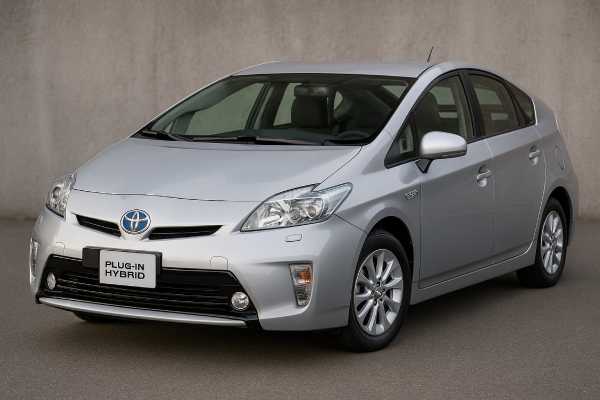
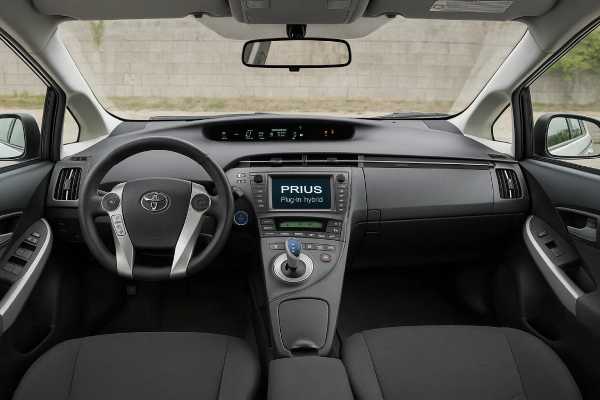
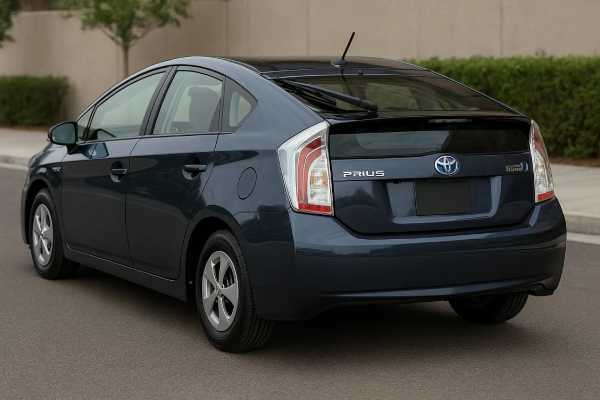
The first-generation Toyota Prius Plug-in Hybrid (ZVW35) took the proven third-gen Prius platform and added a small lithium-ion battery you could charge from a wall outlet. The result was short-hop electric driving with the long-distance flexibility and efficiency of Toyota’s Hybrid Synergy Drive. Owners prize its real-world fuel savings, low maintenance needs, and the ease of living with a familiar Prius—just with a charge port. If you are evaluating a used plug-in hybrid for commuting, this model strikes a practical balance: about 11 miles (17–18 km) of EV driving when charged, 50 mpg (4.7 L/100 km) in hybrid mode, and the same five-door versatility as the regular liftback. This guide focuses on the North American version (where sold), with notes where Europe differs, and distills what matters most: hard specs, safety and driver assists, known issues, maintenance planning, and how the Prius Plug-in stacks up against rivals.
Fast Facts
- EV driving for short trips; 50 mpg (US) once the battery is depleted; simple, durable eCVT powertrain.
- Proven 2ZR-FXE Atkinson-cycle engine and Toyota’s robust hybrid components keep running costs low.
- Cabin is practical and quiet; cargo floor slightly higher than non-plug-in due to the battery.
- Watch for recalls and software updates on the hybrid system; confirm high-voltage fuse campaign completion.
- Typical charging: ~3 hours on 120 V; ~1.5 hours on 240 V.
Explore the sections
- Prius Plug-in detailed overview
- Prius Plug-in specifications
- Prius Plug-in trims and safety
- Reliability and known issues
- Maintenance and buyer’s guide
- Driving and efficiency
- Prius Plug-in vs rivals
Prius Plug-in detailed overview
The ZVW35 Prius Plug-in Hybrid (often shortened to “Prius Plug-in” or “Prius PHV”) adds a chargeable lithium-ion battery to the third-generation Prius liftback and tweaks control software to prioritize electric driving at low and moderate loads. Importantly, it keeps the same compact, efficient hybrid transaxle (eCVT with a power-split device), the long-life 2ZR-FXE 1.8-liter Atkinson-cycle engine (rated at 98 hp / 73 kW alone), and Toyota’s two motor-generators. Combined system output remains 134 hp (100 kW), identical to the non-plug-in, but the driving experience differs at urban speeds: the car can run EV-only for several miles if you start with a full charge and keep a light right foot.
Charging is deliberately simple: a J1772 port on the passenger rear quarter accepts household 120-volt Level 1 or 240-volt Level 2 AC. Because the battery is modest (about 4.4 kWh usable), recharge times are short—roughly three hours on a standard 120-volt outlet and about ninety minutes on Level 2. That makes topping up easy at home or work, and because the car behaves like a regular Prius when the pack is depleted, there is no range anxiety. You can drive across the state at 50 mpg on gasoline if needed.
Packaging is clever. The battery sits over the rear axle and slightly raises the cargo floor versus the regular Prius, trimming a little luggage space but preserving the hatchback’s usability. Seating remains for five, and the interior controls will be instantly familiar to any third-gen Prius driver. Trim strategy in North America is straightforward—“Base” (later simply “Prius Plug-in”) and “Advanced”—with the latter adding features like heated SofTex seats, a premium audio/nav stack, and advanced cruise/safety options depending on model year.
Where the Prius Plug-in shines is cost control. There is no turbocharger, no multi-speed automatic, and no complex clutch pack; the eCVT’s planetary gearset is robust, and the engine runs a low-stress Atkinson cycle. Brake wear is low thanks to aggressive regeneration in daily driving. Oil change intervals are long by conventional standards, and most service tasks mirror the standard Prius. For used-car shoppers, that predictability is a big part of the appeal—especially when combined with class-leading efficiency in stop-and-go commutes.
In short: if your daily trips include frequent short drives with charging opportunities, the Prius Plug-in can deliver remarkably low running costs without changing your routine. If you sometimes skip charging, it still behaves exactly like a thrifty hybrid.
Prius Plug-in specifications
Below are the key technical data points specific to the 2012–2016 Prius Plug-in Hybrid for the North American market. Where relevant, we include dual units to simplify comparison.
Powertrain & Efficiency
| Item | Detail |
|---|---|
| Code | 2ZR-FXE (ICE) + Hybrid Synergy Drive (ZVW35) |
| Engine layout & cylinders | Inline-4, DOHC, 4 valves/cyl |
| Bore × stroke | 80.5 × 88.3 mm (3.17 × 3.48 in) |
| Displacement | 1.8 L (1798 cc) |
| Induction | Naturally aspirated (Atkinson cycle) |
| Fuel system | Sequential multi-port fuel injection |
| Compression ratio | 13.0:1 (approx.) |
| Max power (system) | 134 hp (100 kW) |
| Max torque (ICE) | ~142 Nm (105 lb-ft) @ 4000 rpm (engine) |
| Electric motor(s) | Dual motor-generator set (PMSM) integrated in eCVT |
| System voltage (hybrid) | ~200–210 V nominal |
| Battery chemistry / capacity | Lithium-ion, ~4.4 kWh total (usable portion smaller) |
| Rated efficiency (hybrid mode) | ~4.7 L/100 km (50 mpg US / 60 mpg UK) |
| Rated efficiency (EV) | ~29 kWh/100 mi (18 kWh/100 km) |
| Rated electric range | ~11 miles (≈ 18 km) combined |
| Real-world highway @ 120 km/h (75 mph) | 5.0–5.6 L/100 km (47–42 mpg US / 56–50 mpg UK) typical |
| Aerodynamics | Cd ≈ 0.25; frontal area ≈ 2.2 m² (23.7 ft²) |
Transmission & Charging
| Item | Detail |
|---|---|
| Transmission | eCVT (planetary power-split) |
| Drive type | Front-wheel drive (FWD) |
| Differential | Open (electronic brake-based torque control) |
| Onboard charger (AC) | Up to ~3.3 kW (typical 120 V/12 A or 240 V Level 2) |
| DC fast charge | Not supported |
| Replenishment time | DC: — ; AC 0–100% ≈ 1.5 h (240 V) / ≈ 3 h (120 V) |
Chassis & Dimensions
| Item | Detail |
|---|---|
| Suspension (front/rear) | MacPherson strut / Torsion beam |
| Steering | Electric power steering; ~14–15:1 ratio (typical) |
| Brakes | Front ventilated disc; rear solid disc (regenerative integration) |
| Wheels/Tires | 195/65 R15 on 15-in rims (common); aero covers |
| Ground clearance | ~135 mm (5.3 in) |
| Length / Width / Height | ~4480 × 1745 × 1490 mm (176.4 × 68.7 × 58.7 in) |
| Wheelbase | 2700 mm (106.3 in) |
| Turning circle (kerb-to-kerb) | ~10.4 m (34.2 ft) |
| Curb weight | ~1435–1465 kg (3160–3230 lb) depending on trim/year |
| GVWR | ~1810 kg (≈ 3990 lb) |
| Fuel tank | 40 L (10.6 US gal / 8.8 UK gal) |
| Cargo volume | ≈ 622 L (22.0 ft³) seats up (SAE); rear seats folded ~1120 L (≈ 39–40 ft³) |
Performance & Capability
| Metric | Value |
|---|---|
| 0–100 km/h (0–62 mph) | ~11.2–11.5 s |
| Top speed | ~180 km/h (≈ 112 mph) |
| Braking distance (100–0 km/h) | ~37–40 m (≈ 121–131 ft), tire-dependent |
| Towing capacity | Not rated in North America |
| Payload | ~360–400 kg (≈ 790–880 lb) typical |
| Roof load | ~45–50 kg (≈ 100–110 lb) with approved racks |
Fluids & Service Capacities
| Fluid | Specification | Capacity (approx.) |
|---|---|---|
| Engine oil | 0W-20 (API SN/SN Plus or newer); synthetic | ~4.2 L (4.4 US qt) w/ filter |
| Engine coolant (ICE loop) | Toyota Super Long Life Coolant (pink), premix 50/50 | ~6.5–7.0 L (≈ 6.9–7.4 US qt) |
| Inverter/e-motor coolant | Toyota Super Long Life Coolant (separate loop) | ~3.0–3.8 L (≈ 3.2–4.0 US qt) |
| Transaxle (eCVT) | Toyota ATF WS | ~3.4–3.7 L (≈ 3.6–3.9 US qt) for drain/fill |
| A/C refrigerant | R-134a | ~0.50 kg (17–18 oz) |
| A/C compressor oil | ND-11 (insulating) | ~120 mL (≈ 4.1 fl oz) |
| Key torque specs | Wheel lugs ~103 Nm (76 lb-ft); oil drain plug ~27 Nm (20 lb-ft) |
Electrical
| Item | Detail |
|---|---|
| Alternator | None (DC-DC converter supplies 12 V) |
| DC-DC converter | ~100–120 A output (typical for HSD) |
| 12 V battery | AGM, ~45 Ah (group S46B24R style), trunk-mounted |
| Spark plugs | Iridium (e.g., SK16R11 / IFR5A11 equivalent); gap ~1.0 mm (0.039 in) |
Safety & Driver Assistance
| Category | Detail |
|---|---|
| Crash ratings | Strong scores in core tests for the Prius platform in the period; verify by year. |
| Headlight rating (IIHS) | Not rated on early model years; later assessments varied by beam/projector type. |
| ADAS suite (availability) | Dynamic radar cruise (DRCC), lane keep assist (LKA), pre-collision system (PCS), backup camera; typically optional on Advanced trim; blind spot/rear cross-traffic not widespread for this generation. |
| Child-seat provisions | Rear LATCH anchors and top tethers; outboard ISOFIX in EU-market cars. |
| Braking & stability | Four-wheel discs with regenerative blending, ABS, EBD, BA, VSC/traction control. |
Prius Plug-in trims and safety
Trims and options (North America): The Prius Plug-in launched with two straightforward trims. The Base model prioritized value and efficiency: fabric seats (later SofTex optional in some packages), 15-inch low-rolling-resistance tires, touchscreen audio with Bluetooth, automatic climate control, smart key, and the J1772 charge port with the portable 120-V cable. Stepping up to the Advanced trim added details that many used buyers want today: SofTex heated front seats, integrated navigation with premium audio, head-up display on some years, Safety Connect telematics, and availability of Dynamic Radar Cruise Control (DRCC) and Pre-Collision System (PCS). Wheel/tire packages remained 15-inch for efficiency; there was no performance-brake or sport-suspension option from the factory.
Quick identifiers: Look for a charge port door on the passenger-side rear quarter, “Plug-in Hybrid” badging, and a slightly raised cargo floor panel. The instrument cluster and HVAC controls mirror the standard Prius. The VIN and door-jamb labels can confirm production dates and trim; Advanced trims often have additional steering-wheel controls and HUD housing at the base of the windshield.
Year-to-year changes: Content was incremental. Earlier cars center on basic EV/hybrid functionality with limited driver assist; later model years improved infotainment stacks and connectivity, but core mechanicals and battery remained consistent. Exterior and interior refresh items from the 2012-2015 Prius liftback carried over.
Safety ratings: The Prius platform for these years performed well in major crashworthiness categories used at the time, achieving high marks in moderate overlap, side, roof strength, and head restraints tests, with stability control and ABS standard. Headlight performance and small-overlap testing either were not rated early on or varied by headlamp specification; check an individual car’s build and test year if these factors influence your purchase decision. For federal ratings, rollover resistance typically sat around four stars given the low center of gravity for a hybrid hatchback.
Safety and ADAS equipment: 7-airbag layout (dual front, side, curtains, driver knee) is standard across the line. PCS of this era is a forward-collision warning/pre-tensioning system rather than modern automatic emergency braking; do not assume full-speed AEB. DRCC maintains gap in highway traffic, and LKA offers gentle steering assist within clearly marked lanes at speed. After bodywork or windshield replacement, note that radar sensor alignment and camera aiming may require calibration procedures—plan for this if buying a car that recently had a front-end repair. For child seats, the rear outboard LATCH anchors are easy to access; the center position uses a lap-shoulder belt with a top tether only.
What to verify on a test drive: Smooth EV-to-ICE transitions, consistent brake pedal feel (regen to friction), proper DRCC operation if equipped, and that any safety recalls and hybrid system software updates have been completed. Request dealer printouts showing completion; these updates materially improve reliability and are often free.
Reliability and known issues
The Prius Plug-in shares its core architecture with the high-volume third-gen Prius—a major reliability advantage. Still, a careful buyer should account for age-related wear and a few hybrid-specific service actions.
Common / occasional / rare issues (by prevalence and cost):
- Common | Low–Medium cost:
- 12-V auxiliary battery aging. Symptoms include intermittent “Ready” refusal or warning messages, especially after short trips. Remedy: Test and replace with AGM-spec battery when resting voltage is low or load test fails.
- Brake pad corrosion lip or uneven rotor wear (low-use vehicles). The Prius relies heavily on regenerative braking; friction brakes may corrode when seldom used. Remedy: Periodic high-speed controlled stops to exercise pads; resurface/replace when pulsation or uneven wear appears.
- Occasional | Medium cost:
- Inverter/hybrid ECU software vulnerability addressed by recall/service campaign. Affected vehicles received inverter software updates (and hardware repair in defined cases) to improve robustness under certain electrical load events. Remedy: Confirm recall/software campaign completion by VIN; update if pending.
- HV battery state-of-health variation with age and heat. Although the Prius Plug-in’s lithium-ion pack is relatively small and conservatively managed, cells age. Symptoms: Reduced EV range, earlier ICE engagement. Remedy: Professional SOH assessment; module/pair diagnosis; in-warranty replacement history if applicable.
- Occasional | Low–Medium cost:
- EV fuse fracture recall (high-load repeated EV use). The plug-in battery’s EV fuse could fracture after extended high-load EV driving (long hill climbs, etc.). Symptoms: Warning lights, reduced power, possible stall in certain scenarios. Remedy: VIN-verified recall; fuse kit replacement as specified.
- Rare | Medium–High cost:
- Brake booster/accumulator concerns (platform-wide, by lot/year). Certain Toyota field programs addressed internal malfunctions of the booster/booster pump on related Prius models and some Prius PHV vehicles. Symptoms: Multiple brake warnings, altered pedal assist. Remedy: Check coverage history and dealer tests; components replaced as per program if criteria met.
Driveline and eCVT: The Prius power-split eCVT has an excellent durability record. Noise from the transaxle is uncommon; gear oil changes (though not always listed as required) can be part of a preventive routine around 100,000–120,000 miles (160,000–190,000 km), especially for high-mileage cars.
Cooling systems: Hybrids have two coolant loops—one for the engine, one for the inverter/motor electronics. Air pockets after service can cause hotspots. Ensure both loops are properly bled when coolant is replaced and that the inverter pump runs smoothly (listen for pitch change and confirm coolant movement in the reservoir with the car in “Ready”).
Software and calibrations: Toyota periodically released ECU/TCU/ABS updates that sharpen drivability, protect power electronics, and address diagnostic edge cases. A dealer can scan for calibration levels and apply updates; many are tied to campaigns at no cost. After windshield or front-radar service, calibration of LKA/DRCC sensors may be required to restore correct ADAS behavior.
Corrosion hotspots: The underbody and exhaust hardware are well-coated, but in road-salt regions, inspect subframe attachment points, rear torsion beam mounts, and brake lines where they pass under plastic covers. The hatch opening weatherstrip can collect debris; clean drains to prevent moisture buildup.
Pre-purchase checks to request:
- VIN report showing completion of hybrid-system software updates and EV fuse replacement campaign.
- Full service history with recent engine oil, engine/inverter coolant, and brake fluid documentation.
- High-voltage battery SOH printout (dealer or hybrid specialist).
- Evidence of HV system isolation checks after any collision repairs.
- Tire age and condition (LRR tires help range/MPG).
- If equipped, DRCC/PCS functional checks and radar/camera calibration records after windshield/front repairs.
Maintenance and buyer’s guide
Practical maintenance schedule (distance/time):
(Always confirm against VIN-specific documentation.)
- Engine oil & filter: Every 10,000 miles / 12 months (16,000 km / 12 months) with 0W-20; inspect level monthly.
- Engine air filter / Cabin filter: Inspect 15,000 miles (24,000 km); replace ~30,000 miles (48,000 km) or sooner in dusty climates.
- Coolant (engine & inverter loops): Replace around 100,000 miles (160,000 km) or 10 years first, then at ~50,000-mile/5-year intervals; bleed both loops correctly.
- Spark plugs: Iridium plugs typically at ~120,000 miles (190,000 km).
- Fuel filter: In-tank strainer—inspect only if drivability concerns; generally “lifetime.”
- Timing components: Chain-driven; no scheduled replacement. Inspect for chain rattle at high mileage (rare).
- Serpentine/accessory belt: Inspect annually; replace on condition (the hybrid has fewer belts than conventional cars).
- Transaxle (ATF WS): Optional drain/fill at ~100,000–120,000 miles (160,000–190,000 km) as preventive maintenance.
- Brake fluid: Replace every 3 years regardless of mileage; regen reduces pad wear, but fluid ages.
- Brake pads/rotors: Inspect at tire rotations; watch for corrosion lip on low-use vehicles.
- Tires & alignment: Rotate every 5,000–7,500 miles (8,000–12,000 km); maintain pressures for range/MPG.
- 12-V battery: Load test annually after year 4; many last 5–7 years.
- HV/drive-unit reduction gear oil: Not separately serviced beyond transaxle ATF; follow ATF guidance above.
- Inverter/drive unit/battery cooling: Keep grilles and cooling paths free of debris; inspect coolant pumps.
- Regen-brake corrosion check: Twice yearly in salty climates.
- Traction-battery health check: At major services; monitor range trends and DTC history.
Fluid specs and capacities (quick reference):
- Oil: 0W-20 synthetic, ~4.2 L with filter.
- ATF WS: ~3.4–3.7 L (drain/fill).
- Engine coolant: ~6.5–7.0 L; Inverter coolant: ~3.0–3.8 L.
- A/C: R-134a ~0.50 kg; oil ND-11.
Essential torque values:
- Wheel lugs ~103 Nm (76 lb-ft); oil drain plug ~27 Nm (20 lb-ft). For suspension and brake caliper hardware, defer to service manual torque charts.
Buyer’s checklist (used):
- Recall status: Confirm all hybrid-system campaigns and EV-fuse recall completion.
- Battery health: Ask for a traction-battery SOH report; drive the car fully charged and observe EV range.
- Cooling systems: Look for pink coolant residue at hose joints; ensure both loops reach temperature and fans cycle normally.
- Brake feel: Smooth, progressive pedal with no grittiness; verify consistent regen hand-off at low speeds.
- Charging gear: Ensure the OEM 120-V portable EVSE is present and functional; test a Level 2 session if possible.
- Tires: Matching low-rolling-resistance set with even wear; mismatched tires can reduce EV range/MPG noticeably.
- Interior electronics: Navigation/audio head unit, Bluetooth, and HVAC blend doors; check the backup camera clarity.
- Underside: Inspect for corrosion, especially in road-salt regions, and for any crash repairs near the battery and charge port.
Recommended configurations: An Advanced trim with documented recall updates and a healthy 12-V battery is a sweet spot for features and value. There are no significant mechanical differences by trim—focus on condition, maintenance history, and battery health.
Long-term outlook: With routine fluids and attention to the cooling systems, these cars routinely cross 150,000–200,000 miles (240,000–320,000 km) with original hybrid components. The small lithium-ion pack’s conservative management helps longevity; range will decline gradually with age, but the car remains an efficient hybrid even as EV-only miles taper.
Driving and efficiency
Ride, handling, NVH: The Prius Plug-in rides quietly and predictably. The small battery’s mass near the axle slightly improves rear-end composure over sharp bumps compared with some non-plug-in trims. Straight-line stability is solid at highway speeds, and wind noise is well controlled thanks to a low drag profile (Cd ≈ 0.25). The steering is light and consistent rather than sporty; on-center feel is adequate for commuting. Braking feel—a common hybrid talking point—is well tuned here: initial pedal travel blends regeneration and friction smoothly, with firm stopping power when you push deeper.
Powertrain character: In EV mode, the car is smooth and silent up to typical city speeds. Push past the EV envelope (heavy throttle, grades, high speed), and the 1.8-liter Atkinson engine joins discreetly. The eCVT keeps the engine in its efficient band; what you hear under sustained climbs is the familiar steady “hybrid hum,” not shift shock. There is no turbo lag (none fitted), and throttle mapping is gentle in Eco mode, snappier in Power mode—useful for merging. EV-to-ICE transitions are among the segment’s smoothest for the era.
Real-world efficiency and range:
- City commuting: With a daily opportunity to charge at home or work, many owners see EV-only operation for short trips and 70–90+ mpg (US) blended averages on commutes inside the EV range.
- Highway (60–75 mph / 100–120 km/h): Expect ~47–52 mpg (US) once the battery is depleted, depending on speed, temperature, and tires.
- Mixed driving: Blended numbers typically land in the mid-50s to mid-60s mpg (US) when you charge regularly and drive moderately.
- Cold weather: EV range and MPG dip in sub-freezing conditions as the engine runs for cabin heat and the battery chemistry slows. Pre-conditioning while plugged in and using seat heaters help.
Charging performance: The onboard AC charger is modest by modern standards but perfectly matched to the 4-ish kWh pack. A 120-V outlet will refill the battery while you sleep; a 240-V Level 2 station turns around a depleted pack in roughly 1.5 hours. There is no DC fast charging on this generation, which is appropriate given the small battery. Because recharge time is short, topping up opportunistically—during a gym session or lunch—yields tangible fuel savings.
Key performance metrics: 0–60 mph happens in the low-11-second range (similar to the regular Prius once the pack is spent), with the electric motor providing a pleasant initial step-off in EV mode. Passing from 50–80 mph (80–130 km/h) requires planning, but the chassis remains stable and brakes are confidence-inspiring in daily use. The turning circle of ~34 ft (10.4 m) makes tight urban maneuvers easy.
Load and towing: There is no factory tow rating in North America. With passengers and luggage aboard, the car remains composed; regeneration on long descents helps brake temperatures, but packing heavy cargo will trim EV range slightly. If you frequently haul at highway speeds, ensure tire pressures are set correctly to protect efficiency and handling.
Prius Plug-in vs rivals
Chevrolet Volt (2011–2015): The original Volt offers ~35–38 miles (56–61 km) of EV range—far more than the Prius Plug-in—and a true EV-first drivetrain with a larger battery. It is quicker and can run highway commutes gas-free. However, the Volt’s rear seat is tighter, cargo space is smaller, and long-term operating costs can be higher if you keep it for many years (larger, costlier battery; more complex transaxle). If your commute fits the Volt’s EV range most days, it’s compelling; if you mix short city trips with frequent road travel, the Prius Plug-in’s simplicity and long-haul efficiency are hard to beat.
Ford C-Max Energi / Fusion Energi: These PHEVs deliver ~19–21 EV miles in many conditions and offer a more conventional driving feel. They can be quiet and comfortable, but packaging tradeoffs (cargo volume with battery intrusion, especially in the Fusion trunk) are more noticeable. Reliability records are mixed compared with the Prius family, and parts/support for certain model-specific items can be pricier as the cars age.
Hyundai/Kia PHEVs of the era (limited availability): Early models were rarer in North America and often carried smaller batteries or shorter EV range than later generations. In the used market, warranty coverage timing and parts availability should be considered carefully.
Regular Prius (non-plug-in): If you have no reliable place to charge, the standard Prius remains an outstandingly efficient choice with slightly more cargo flexibility. But if you can charge for cheap electricity (home off-peak, workplace, or solar), the Prius Plug-in’s blended costs are typically even lower in city life.
Bottom line: The Prius Plug-in is not the longest-range PHEV of its time; it is the least complicated, most Toyota-like way to add meaningful EV miles to a proven hybrid. For many commuters, that combination wins the total-cost-of-ownership contest.
References
- 2012 Toyota Prius Plug-in Hybrid 2012 (EPA Data)
- 2015 Toyota Prius Plug-in Hybrid 2015 (EPA Data)
- 2012 Toyota Prius 4-door hatchback 2012 (Safety Rating)
- Part 573 Safety Recall Report 17V-718 2017 (Recall Report)
- TECHNICAL INSTRUCTIONS FOR SAFETY RECALL H0R 2017 (Recall Technical Instructions)
Disclaimer
This article is for informational purposes only and is not a substitute for professional diagnosis or repair. Specifications, torque values, maintenance intervals, and procedures can vary by VIN, model year, market, and equipment. Always verify details against your vehicle’s official service documentation and follow manufacturer safety guidance when working on high-voltage hybrid systems.
If you found this guide useful, please consider sharing it with fellow owners and shoppers on Facebook, X/Twitter, or your favorite forum—your support helps xcar produce more in-depth, owner-focused resources.