
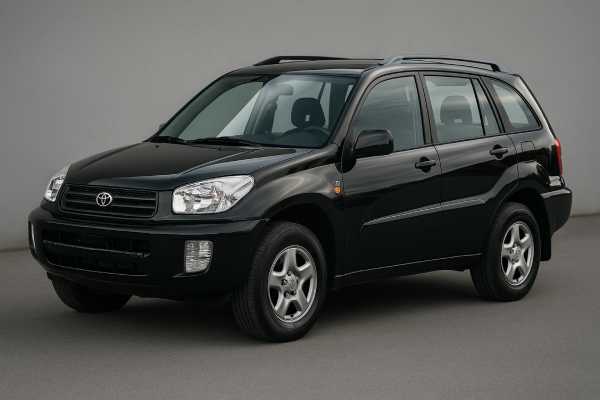
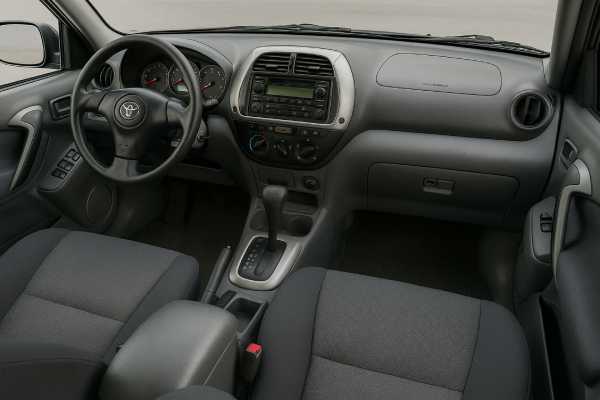
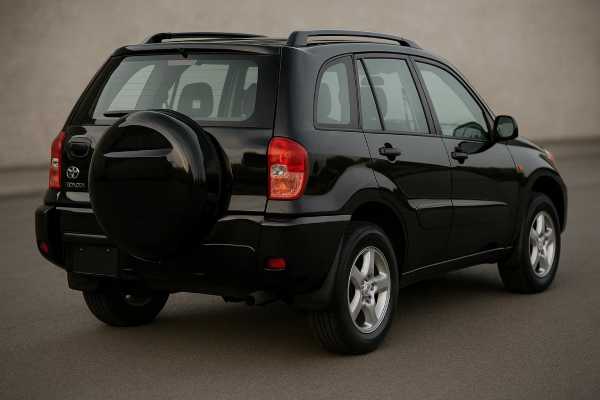
The second-generation Toyota RAV4 with the 2.0-litre D-4D diesel (engine code 1CD-FTV) brought strong mid-range torque to the compact SUV that helped define the class. In 2001, the model gained full-time all-wheel drive with a five-speed manual only, a light, car-like monocoque, and independent suspension at all four corners. The result is a practical daily driver that handles winter and gravel with ease, returns frugal fuel economy for its era, and is simple to service compared with later common-rail diesels. Buyers should focus on documented timing-belt changes, clean fueling, and attention to EGR/soot management. If you want a small SUV that still feels nimble and mechanical, the XA20 AWD D-4D is a smart, budget-friendly pick—especially in five-door form for family use and towing up to 1,500 kg (braked).
At a Glance
- Strong torque band: 250 Nm from ~1,800–3,000 rpm; relaxed highway cruising.
- Proven full-time AWD with optional rear Torsen LSD; confident on snow and dirt.
- Efficient for its age: ≈7.1 L/100 km combined (≈33 mpg US / 39.8 mpg UK).
- Watch items: timing belt interval, EGR/soot buildup, clutch wear on tow-used cars.
- Service anchor: timing belt and water pump around 90,000–105,000 km or 5–6 years.
Jump to sections
- RAV4 AWD D-4D overview
- AWD 1CD-FTV specifications
- Trims, options, safety suite
- Reliability and field fixes
- Maintenance and buying advice
- Driving and real-world economy
- How RAV4 compares
RAV4 AWD D-4D overview
The 2001–2003 RAV4 AWD D-4D sits at the intersection of simple mechanicals and modern diesel efficiency. It pairs Toyota’s first-generation common-rail 1CD-FTV (2.0-litre, 16-valve, DOHC, variable-nozzle turbo) with a full-time mechanical all-wheel-drive system. The AWD layout uses an on-demand centre coupling that can shuffle torque fore-aft when front tyres slip; most cars left the factory with open differentials, and some markets offered an optional rear Torsen limited-slip differential that improves traction exiting low-grip corners.
Two body styles were offered in Europe—three-door for a shorter wheelbase, playful feel, and five-door for family usability. Seating flexibility is a hallmark: split rear seats that slide, fold, tumble, and can be removed entirely deliver small-SUV cargo volume that punches above its footprint. The cabin design leans pragmatic—clear analog gauges, durable plastics, and supportive seats—while the ride height provides the “command” view without the top-heavy motions of ladder-frame 4x4s.
On the road, the diesel’s broad 250 Nm plateau means fewer downshifts and steady progress with light throttle. The five-speed manual (diesel only) is geared for economy: long fifth gear keeps revs modest at motorway speeds. Braked towing up to 1,500 kg is realistic if you respect cooling and clutch limits. Safety kit is of its time—front airbags, ABS with EBD, and optional stability control on select trims—so the ownership mindset should include good tyres, fresh brakes, and cautious load management.
For shoppers today, the sweet spot is a five-door with complete service records, evidence of timing-belt and water-pump replacement, and clean running (minimal smoke, quick cold starts). Avoid cars with persistent EGR-related roughness or neglected diesel hygiene. Properly maintained, the XA20 diesel AWD delivers long-term durability, cheap parts, and honest, versatile transport.
AWD 1CD-FTV specifications
Engine and Performance (ICE)
| Item | Specification |
|---|---|
| Code | 1CD-FTV (D-4D common-rail turbo-diesel) |
| Layout & cylinders | Transverse inline-4, DOHC, 4 valves per cylinder |
| Bore × stroke | 82.2 × 94.0 mm (3.24 × 3.70 in) |
| Displacement | 2.0 L (1,995–1,995 cc typical; listed 1,995–1,999 cc) |
| Induction | Variable-nozzle turbocharger; intercooler |
| Fuel system | Common-rail direct injection |
| Compression ratio | ~18.6:1 |
| Max power | 116 hp (85 kW) @ 4,000 rpm |
| Max torque | 250 Nm (184 lb-ft) @ 1,800–3,000 rpm |
| Timing drive | Belt (cam) |
| Emissions/standard | Euro Step III period standard |
| Rated economy (combined) | ≈7.1 L/100 km (≈33 mpg US / 39.8 mpg UK) |
| Real-world @ 120 km/h (75 mph) | ~6.8–7.6 L/100 km (≈31–35 mpg US / 37–42 mpg UK), wind/tyres dependent |
| Aerodynamics | Cd ≈ 0.35 / frontal area — |
Transmission and Driveline
| Item | Specification |
|---|---|
| Transmission | 5-speed manual only (diesel) |
| Gear ratios | 1st 3.833 · 2nd 2.045 · 3rd 1.333 · 4th 0.972 · 5th 0.731 · Rev 3.583 |
| Final drive ratio | ~4.562–4.933 typical (varies by market; verify by VIN) |
| Drive type | Full-time AWD with viscous-type centre coupling |
| Differentials | Open front/rear; optional rear Torsen LSD in some markets |
| Refuel to full (typical) | ~5 min (diesel pump; tank 57 L) |
Chassis and Dimensions
| Item | 3-door | 5-door |
|---|---|---|
| Suspension (F/R) | MacPherson strut / double wishbone with trailing arms | Same |
| Steering | Rack-and-pinion; ratio ~16:1; 2.9 turns lock-to-lock | Same |
| Brakes (F/R) | Ventilated disc 302 mm / solid disc 298 mm | Same |
| Wheels/Tyres | 16 in steel or alloy; 215/70 R16 (std) or 235/60 R16 (wide) | Same |
| Ground clearance | ~190–200 mm (7.5–7.9 in) with 215–235 section tyres | Same |
| Length | 3,865–4,200 mm (152–165 in) | 4,250–4,260 mm (167.3–167.7 in) |
| Width | 1,735 mm or 1,785 mm wide-pack (68.3 / 70.3 in) | Same |
| Height (AWD) | 1,695–1,700 mm (66.7–66.9 in) | 1,705–1,710 mm (67.1–67.3 in) |
| Wheelbase | 2,360–2,380 mm approx. (short-wheelbase markets) | 2,490 mm (98.0 in) |
| Turning circle | 5.0 m (16.4 ft) | 5.3 m (17.4 ft) |
| Kerb (curb) weight | 1,315–1,425 kg (2,899–3,142 lb) | 1,370–1,485 kg (3,020–3,274 lb) |
| GVWR | 1,785 kg (3,935 lb) | 1,925 kg (4,243 lb) |
| Fuel tank | 57 L (12.5 US gal / 10.0 UK gal) | 57 L (12.5 US gal / 10.0 UK gal) |
| Cargo volume (seats up) | 150 L (5.3 ft³) | 410 L (14.5 ft³) |
| Cargo (seats folded) | 230 L (8.1 ft³) | 520 L (18.4 ft³) |
| Cargo (seats removed) | 690 L (24.4 ft³) | 970 L (34.3 ft³) |
Cargo figures are VDA-style and reflect seat-removal versatility uncommon in modern rivals.
Performance and Capability
| Metric | Value |
|---|---|
| 0–100 km/h (0–62 mph) | ~12.1 s |
| Top speed | ~170 km/h (106 mph) |
| Braking 100–0 km/h | ~39–42 m (varies with tyres/pads) |
| Towing capacity | 1,500 kg (3,307 lb) braked / 640 kg (1,411 lb) unbraked |
| Payload (typical) | ~400–450 kg (880–990 lb) depending on trim |
| Roof load | ~75 kg (165 lb) with OEM rails/crossbars |
Fluids and Service Capacities
| System | Spec and capacity |
|---|---|
| Engine oil | ACEA B4 (or C3 low-SAPS if DPF retrofitted), 5W-30/5W-40; ~5.9 L (6.2 US qt) with filter |
| Coolant | Ethylene glycol OAT/HOAT premix 50/50; ~6.5 L (6.9 US qt) |
| Manual gearbox/transfer | GL-4/GL-5 75W-90; ~2.3–2.5 L (2.4–2.6 US qt) |
| Rear differential | GL-5 75W-90; ~0.9–1.0 L (0.95–1.06 US qt) |
| A/C refrigerant | R-134a; ~500–550 g (17.6–19.4 oz); PAG oil ~120 mL (4.1 fl oz) |
| Key torque specs | Wheel nuts 103 Nm (76 lb-ft); oil drain ~39 Nm (29 lb-ft); glow plug ~15 Nm (11 lb-ft) |
Electrical
| Item | Value |
|---|---|
| Alternator | ~90 A |
| 12 V battery | ~60 Ah (CCA 500–600 A), JIS/EN size to tray |
| Glow plugs | 4, quick-heat type; ECU-controlled |
Safety and Driver Assistance
| Item | Detail |
|---|---|
| Crash ratings (period) | Independent tests of the era rated structure solid in offset frontal impacts; pedestrian protection modest by modern norms. |
| IIHS note (body family) | 2001 RAV4 4-door achieved “Acceptable” overall in 40 mph frontal offset; structure “Good”. |
| Airbags | Dual front; some trims added side airbags later in cycle |
| Braking and stability | ABS with EBD standard; traction/stability control availability varied by trim/market |
| Child seats | ISOFIX/LATCH provisions in later build phases; verify anchor count by VIN |
| Headlights | Halogen reflector; beam performance varies with bulb condition/aim |
Trims, options, safety suite
Trims and equipment (Europe baseline). Equipment naming varied by country, but common patterns included value-led base models, mid-grade with alloys and convenience features, and high-grade with wide-pack tyres (235/60 R16), sport seats, and cosmetic extras. Diesel AWD cars were manual only. Key option packs to look for:
- Rear Torsen LSD (select markets): Desirable for snow or gravel—better traction leaving junctions and on steep, loose climbs.
- Wide-pack wheels/tyres: 235/60 R16 improves lateral grip but can add road noise and slightly hurt economy.
- Safety add-ons: Some late-2002/2003 cars bundled side airbags and stability control; availability varied, so confirm by VIN and build sheet.
- Practicality: Roof rails, removable rear seats, rear 12 V power outlet, and cargo tie-downs were popular factory fitments.
Mechanical/functional differences by trim. Gear ratios are constant across diesel AWDs, but unsprung mass and tyre section change feel and braking distances. Cars with wide-pack tyres may steer a bit heavier near parking speeds and track better at motorway pace. Suspension tune remained comfort-oriented; there were no factory “sport” dampers, but some high-grade cars had slightly firmer coils.
Year-to-year highlights (2001–2003).
- 2001: D-4D AWD introduced; five-speed manual; early cars most basic for airbags/ESP options.
- 2002: Option availability expanded in many EU markets (side airbags, LSD, navigation/audio upgrades).
- 2003: Running changes ahead of the facelift: trim content reshuffles; some lighting/trim revisions; diesel output unchanged.
Safety ratings in context. Early-2000s protocols differ materially from modern ones. The RAV4’s unit body managed offset frontal loads well for its time, while pedestrian protection and side-impact measures reflect the period. Head restraints and seat geometry are notably better on later seats; if you are tall, check for whiplash-mitigation headrest designs on late-build cars. Always evaluate safety by tyres, brakes, alignment, and lighting condition—fresh rubber and aligned beams make a bigger real-world difference than option trivia.
ADAS calibration after service. This generation has no camera or radar ADAS. After suspension, steering, or brake work, perform a straightforward alignment check and ABS fault-code scan. If the car has optional stability control, a steering-angle sensor zero-point calibration (via scan tool) may be required after alignment.
Reliability and field fixes
At a glance: The AWD D-4D is robust if serviced correctly. Most issues trace to deferred maintenance, poor diesel fuel hygiene, or age-related rubber and electrical wear. Map issues by prevalence and cost:
- Common · low–medium cost: EGR soot buildup; intake manifold deposits; vacuum hoses cracking; front drop-link bushings; rear trailing-arm bush wear; wheel-bearing hum (rear more often).
- Occasional · medium cost: Dual-mass flywheel rattle; clutch slip after heavy towing; alternator voltage dips; fuel filter housing air leaks causing morning rough start.
- Rare · high cost: Injector return leak and difficult hot starts; turbo VNT vane sticking (often recoverable with careful cleaning and proper drive cycles); head-gasket breach after prolonged overheating.
Typical failure points (symptom → cause → remedy).
- Stumble/hesitation at 1,800–2,200 rpm: Soot-loaded EGR and intake → Remove and clean EGR valve and intake runners; update gaskets; adopt higher-quality diesel and periodic “Italian tune-up” drive cycles.
- Hard cold starts, white smoke: Air ingress at fuel filter head or tired glow plugs → Replace filter housing O-rings or head; test glow system; fit OEM-equivalent plugs.
- Intermittent overboost limp: VNT actuator stickiness from soot/rust → Gentle mechanical free-up, then sustained high-load drive; if persistent, remove turbo for cleaning and check vacuum lines/solenoid.
- Rattle at idle with clutch out: Dual-mass flywheel wear → Replace with new DMF and clutch kit; consider clutch fork/guide tube inspection.
- Clutch slip when towing hills: Worn disc/pressure plate → Replace clutch; observe cooling and gear choice when towing near 1,500 kg.
- Rear axle whine: Age-related bearing wear or low oil level → Refill with GL-5 75W-90 to spec and replace bearings if noise persists.
- Cooling creep on summer grades: Partially blocked radiator/bug screen → Backflush radiator; ensure under-tray airflow intact; renew thermostat and cap if old.
Software and calibrations. This generation uses comparatively simple ECU logic. Dealer reflashes addressed drivability and smoke in some markets; if idle quality is poor or smoke persists after mechanical fixes, ask a specialist to check injector coding and ECU version.
Corrosion hotspots. Front subframe mounts, rear trailing-arm brackets, inner wheel arches, and the lip around the tailgate glass can show rot in salt climates. Inspect brake-line clips on the rear axle and the seam sealer at the rear floor.
Recalls/TSBs and coverage. Campaigns varied by country; common items in period included airbag ECU updates (market-dependent) and seatbelt anchorage checks on certain VINs. Always run the official VIN check and ask the selling dealer to print the campaign/TSB completion record. For diesels, there were service notes on fuel filter service procedures to prevent air leaks after element changes.
Pre-purchase requests. Ask for: complete service history; timing belt/water pump proof; recent gearbox/diff oil services; glow plug/injector test results; alignment and tyre age; battery test; and any turbo/EGR work history. A fresh diesel fuel filter and two key fobs are small but telling signs of a cared-for car.
Maintenance and buying advice
Practical service schedule (distance/time, whichever comes first).
- Engine oil and filter: Every 10,000–15,000 km or 12 months (shorter for heavy city, towing, or lots of cold starts).
- Fuel filter: Every 30,000–40,000 km or 2 years; drain water separator at each oil change.
- Air filters: Engine air every 30,000 km (inspect at each oil change); cabin filter every 20,000–25,000 km.
- Coolant: Replace every 5 years or 100,000 km; maintain 50/50 mix.
- Timing belt and water pump: 90,000–105,000 km or 5–6 years; inspect idlers and tensioner, renew cam and crank seals if seeping.
- Aux/serpentine belt: Inspect annually; replace at 90,000–120,000 km or upon cracking/noise.
- Manual gearbox and rear diff oils: Replace every 60,000–80,000 km, sooner for frequent towing.
- Brake fluid: Every 2 years; inspect pads/rotors each tyre rotation.
- Tyre rotation and alignment: Rotate every 10,000–12,000 km; align annually or after suspension work; maintain even circumferences on AWD.
- Valve clearances: Hydraulic lifters generally maintenance-free; inspect only if noisy/hard starts remain after glow/fuel checks.
- 12 V battery: Test annually after 4 years; expect replacement window at 5–7 years.
Fluid notes and capacities (decision-making highlights).
- Oils: Use ACEA B4 (or C3 if a DPF retrofit exists) diesel-rated oils. Capacity ~5.9 L.
- Gear oils: 75W-90 GL-4/GL-5, gearbox/transfer ~2.3–2.5 L; rear diff ~0.9–1.0 L.
- Coolant: OAT/HOAT long-life; ~6.5 L total.
- A/C: R-134a ~0.5–0.55 kg; PAG oil ~120 mL.
- Torques: Wheel nuts 103 Nm; engine drain ~39 Nm; glow plug ~15 Nm.
Buyer’s checklist.
- Engine: Cold-start within 2–3 seconds, minimal smoke. No diesel knock at hot idle. Even injector correction values (scan tool).
- Turbo/VNT: Smooth boost rise; no limp with sustained acceleration. Vacuum lines pliable and uncracked.
- Cooling: Fan cycles correctly; no staining at radiator end tanks; heater hot at idle.
- Clutch/DMF: No shudder or slip on a third-gear roll-on at ~1,500 rpm; no clatter at idle with clutch engaged.
- AWD/driveline: No binding on tight circles in a car park; equal tyre sizes/brands and similar tread depth.
- Chassis: Quiet over speed bumps; rear axle silent; front drop-links not knocking.
- Brakes/ABS: Straight stops; no ABS warning; uniform rotor wear.
- Body: Check inner rear arches, tailgate seams, subframe mounts, rear brake lines, and windscreen corners.
- Electrics: Heated rear screen, blower speeds, rear wiper, and instrument backlights all working.
- Papers: Belt/water pump receipt; fuel filter history; VIN campaign printout; at least two keys.
Durability outlook. With clean diesel habits, timely belt and fluid service, and intact cooling, the 1CD-FTV often clears 300,000 km with original bottom end and turbo. The AWD hardware is likewise long-lived if tyres are matched and diff oil is kept fresh. Most owners will spend modestly on wear items (clutch, suspension rubbers, bearings) spread over years.
Driving and real-world economy
Ride, handling, NVH. The XA20 rides like a contemporary hatchback with extra suspension travel. Body motions are contained, and the rear double-wishbone keeps the tyres planted over mid-corner bumps better than many beam-axle rivals. Steering is light off-centre and tidily linear once loaded; straight-line stability is good on 215-section tyres and rock-steady on the wide-pack 235s. Cabin noise is period-diesel moderate: a distant thrum on cold start that fades when warm, some road roar on coarse-chip asphalt, and a touch of wind rustle from the mirrors at motorway speed.
Powertrain character. The value here is torque. The engine’s 250 Nm plateau from roughly 1,800 to 3,000 rpm makes short work of hills without dropping to third. There is little lag once the VNT wakes up; throttle response is smooth and predictable. The five-speed manual prefers clean, unhurried shifts and rewards anticipation—let the torque carry you and you will rarely chase the redline.
Braking and control. Big-for-class front discs give repeatable stops if you run quality pads and flush fluid regularly. ABS is straightforward; stability control, if fitted, intervenes gently. On snow and gravel, the full-time AWD—with good winter tyres—pulls cleanly from junctions and tight climbs. A rear Torsen LSD, where present, adds confidence on diagonal-slip surfaces.
Economy in the real world. Expect:
- City: ~8.0–9.0 L/100 km (28–26 mpg US / 34–31 mpg UK).
- Highway 100–120 km/h (60–75 mph): ~6.4–7.6 L/100 km (37–31 mpg US / 44–37 mpg UK) depending on tyres, roof bars, and load.
- Mixed: ~7.0–7.8 L/100 km (34–30 mpg US / 41–36 mpg UK).
Cold weather, short trips, oversized tyres, and roof-mounted accessories can add 5–15% to these figures.
Towing and load. Up to 1,500 kg braked is approved, but smart practice keeps caravan weights closer to 1,200–1,300 kg, balances tongue load to ~7–10% of trailer mass, and uses third/fourth gear on long grades to manage temperatures. Plan a 15–25% fuel-use penalty when towing at motorway speeds.
How RAV4 compares
In the early-2000s compact SUV field, the RAV4 AWD D-4D’s strengths were ride quality, traction, packaging, and economy. Here is where it stands against common rivals:
- Honda CR-V (petrol-only in many EU markets then): Smoother petrol and a roomier cargo bay, but higher fuel use and fewer snow-belt traction options; off-boost torque advantage goes to the D-4D.
- Land Rover Freelander TD4: Comfortable and capable, but ownership risk and parts costs are typically higher; RAV4 wins for long-term reliability and fuel economy, LR edges interior plushness.
- Nissan X-Trail 2.2 dCi: Strong diesel punch and space to match, but some early dCi injector/turbo issues; RAV4 drives lighter and is simpler to maintain.
- Hyundai Santa Fe 2.0 CRDi (small overlap in size/class): Good value and kit, but heavier; RAV4 feels nimbler with better residuals.
Who should buy it.
- Drivers in snowy or rural regions who want simple AWD you can trust.
- Budget-minded owners who prefer a manual gearbox and easy DIY service.
- Towing light trailers or small boats within the 1,500 kg limit.
If you demand modern ADAS, ultra-quiet cabins, or automatic gearboxes, you will be happier in a later generation.
References
- RAV4 D-4D Diesel – Toyota Media Site 2001 (Press Release)
- Toyota Launches D-4D Diesel Engine For RAV4 – Toyota Media Site 2001 (Press Release)
- RAV4-gen2-launch-pack-2000.pdf 2000 (Press Pack)
- Toyota RAV4: A pioneering original for 30 years 2024 (Historical Overview)
- 2001 Toyota RAV4 4-door SUV 2001 (Safety Rating)
Disclaimer
This article is for informational purposes only and is not a substitute for professional diagnosis or repair. Specifications, capacities, torque values, and maintenance intervals can vary by VIN, market, build date, options, and prior repairs. Always verify procedures and numbers against your vehicle’s official service information before performing work.
If you found this helpful, please consider sharing it on Facebook or X/Twitter to support xcar’s independent guides.