
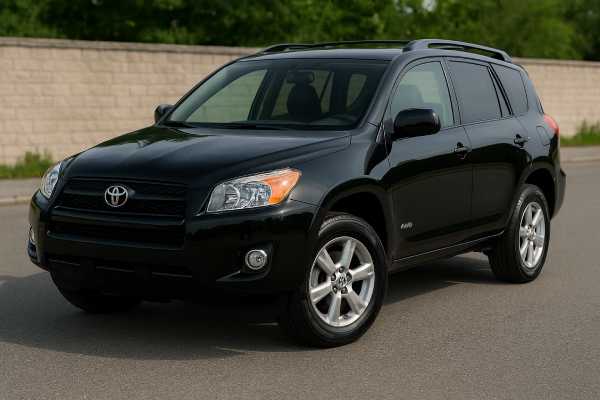
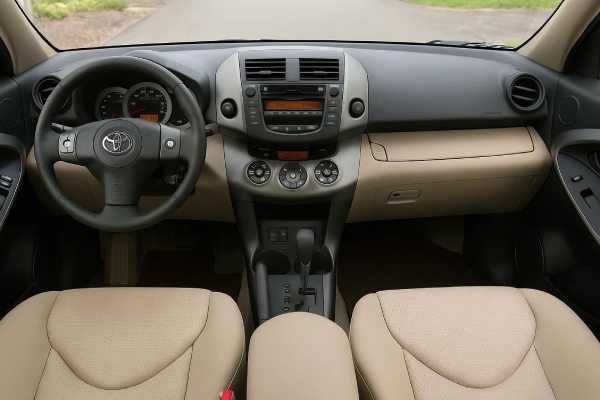
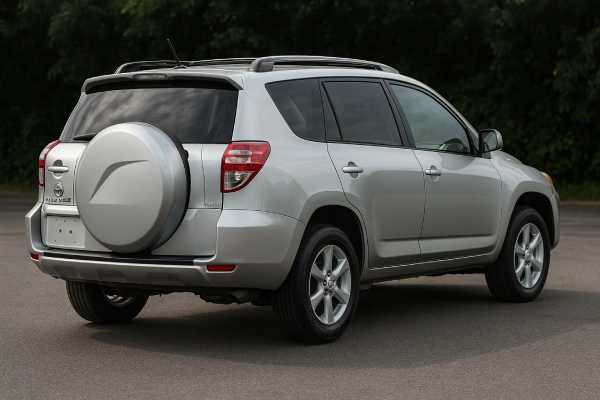
The third-generation Toyota RAV4 with the 3.5-liter 2GR-FE V6 and on-demand AWD remains one of the quickest compact crossovers of its time and, with careful upkeep, one of the most durable. The V6’s broad torque band and the five-speed automatic deliver easy passing power and confident merging, while the Active Torque Control 4WD system adds traction in snow, rain, and on loose surfaces without the complexity of a traditional transfer case. Inside, the long-wheelbase body offers generous cargo space and, in some years, an optional third row. Ownership is straightforward: fluids are common, service access is good, and parts are widely available. Shoppers should verify recall completion for the rear suspension arms and check for rust where road salt is used. If you want a compact SUV that tows more than most rivals of its era, accelerates like a hot hatch, and still returns respectable fuel economy, the V6 AWD RAV4 is a standout pick.
At a Glance
- Strong, proven 2GR-FE V6; quick 0–60 mph (~6–7 s) and confident highway passing.
- Spacious cargo bay (SAE ~36.4 ft³ seats up / ~73.0 ft³ seats down) and solid 3,500 lb (1,588 kg) tow rating with Tow Prep.
- Simple, reliable on-demand 4WD with manual lock mode for low-speed traction.
- Watch for completed rear lower suspension arm recall; inspect arms and alignment history.
- Typical oil change interval: 5,000–10,000 mi (8,000–16,000 km) depending on driving and oil type; rotate tires every 5,000–7,500 mi.
What’s inside
- RAV4 AWD V6 overview
- RAV4 AWD V6 specifications
- RAV4 AWD trims and safety
- Reliability and service actions
- Maintenance and buyer’s guide
- Driving and performance
- How RAV4 V6 compares
RAV4 AWD V6 overview
Toyota’s third-generation RAV4 (XA30, 2006–2012) brought a long-wheelbase body to North America, a cavernous cargo hold, and—most unusually for the class—a muscular 3.5-liter V6. Paired with a five-speed automatic and an on-demand all-wheel-drive system branded Active Torque Control 4WD, the V6 RAV4 delivered acceleration that embarrassed many sport compacts of its day while preserving daily-driver manners. The AWD hardware is light and simple: the vehicle is primarily front-drive until slip or throttle input calls for rear torque via an electronically controlled coupling. A dashboard “LOCK” button mechanically commands near-50:50 front/rear torque at low speeds for launching on snow or mud, then the system reverts to normal above neighborhood speeds. There is no low range or traditional center differential to maintain.
The 2GR-FE V6 is one of Toyota’s best-regarded engines: an aluminum 60-degree DOHC V6 with dual VVT-i, chain-driven cams, and port fuel injection. In the RAV4 tune it’s rated at 269 hp and 246 lb-ft, which gives the small SUV a relaxed, understressed character in everyday use. The broad torque—peaking at 4,700 rpm but useful from well below—makes short work of grades and trailers within its 3,500-lb tow rating when equipped with the Tow Prep package (larger alternator and cooling upgrades). Unlike later downsized turbo fours, the V6’s response is immediate, with no lag, and the five-speed automatic favors smoothness over constant hunting.
Cabin packaging was a strong suit. The long wheelbase enabled a huge, low load floor, and 2006–2012 models offered an occasional-use third row on some trims and years. Ergonomics are simple, sightlines are excellent, and the cabin’s hard-wearing finishes tend to hold up. The right-hinged side-opening rear door can be awkward on curbside loading, but it also carries the full-size spare outside the cabin.
For safety, stability control (VSC), traction control (TRAC), and ABS were standard, and side curtain airbags became standard across the lineup starting with 2007 models. IIHS testing for this generation shows strong protection in the then-current crash protocols, supporting the RAV4’s reputation as a safe family hauler when maintained.
Where does the AWD V6 RAV4 fit today? If you want a used compact SUV that balances longevity, performance, and simple ownership, it’s hard to beat. Its drivetrain is overbuilt for the vehicle’s size, the AWD system requires little attention beyond fluid service, and parts availability is excellent. The main caveat is ensuring recall work on the rear suspension arms is complete and properly documented (more on that below), plus the usual rust checks in salt states. Get those items right, and this RAV4 can be both quick and quietly dependable for years.
RAV4 AWD V6 specifications
Engine and Performance (ICE-only)
| Item | Specification |
|---|---|
| Code | 2GR-FE |
| Layout & cylinders | 60-degree V6, DOHC, dual VVT-i, 4 valves/cyl |
| Bore × stroke | 94.0 × 83.0 mm (3.70 × 3.27 in) |
| Displacement | 3.5 L (3,456 cc) |
| Induction | Naturally aspirated |
| Fuel system | Port fuel injection (PFI) |
| Compression ratio | ~10.8:1 |
| Max power | 269 hp (201 kW) @ 6,200 rpm |
| Max torque | 334 Nm (246 lb-ft) @ 4,700 rpm |
| Timing drive | Chain |
| Emissions / efficiency standard | EPA ratings (model-year specific) |
| Rated economy (AWD V6) | ~10.7 L/100 km combined (22 mpg US / 26 mpg hwy / 19 mpg city) |
| Real-world highway @ 120 km/h (75 mph) | ~9.4–10.7 L/100 km (25–22 mpg US) depending on load, tires, and wind |
Transmission and Driveline
| Item | Specification |
|---|---|
| Transmission | 5-speed automatic, electronically controlled (typ. U151F) |
| Drive type | On-demand 4WD (Active Torque Control 4WD) |
| Differential(s) | Open front and rear; electronically controlled rear coupling |
| 4WD lock | Driver-selectable low-speed lock mode; auto-cancels at higher speeds |
| Final drive | Model-year/trim specific (numerical ratio varies slightly) |
| Refuel to full | ~5 minutes (typical gasoline refill) |
Chassis and Dimensions
| Item | Specification |
|---|---|
| Front / rear suspension | MacPherson strut / double-wishbone with trailing links |
| Steering | Rack-and-pinion, power-assisted |
| Brakes | Vented front discs / solid rear discs (ABS, EBD, Brake Assist) |
| Wheels / tires (common) | 225/65R17 or 235/55R18 (trim dependent) |
| Ground clearance | ~190–200 mm (7.5–7.9 in), by trim |
| Length / width / height | ~4,600 × 1,815 × 1,685 mm (181.1 × 71.5 × 66.3 in) |
| Wheelbase | 2,660 mm (104.7 in) |
| Turning circle | ~10.6 m (34.8 ft) |
| Curb weight | ~1,585–1,690 kg (3,495–3,725 lb), by year/trim |
| GVWR | ~2,100–2,250 kg (4,630–4,960 lb), by year/trim |
| Fuel tank (gasoline) | 60 L (15.9 US gal / 13.2 UK gal) |
| Cargo volume (SAE) | ~1,030 L (36.4 ft³) seats up / ~2,067 L (73.0 ft³) seats down |
Performance and Capability
| Metric | Value |
|---|---|
| 0–100 km/h (0–62 mph) | ~6.5–6.9 s (tire/load dependent) |
| Top speed | ~180–190 km/h (110–118 mph), electronically limited (typical) |
| Braking 100–0 km/h (62–0 mph) | Class-typical distances when on fresh all-seasons; monitor rotor/pad health |
| Towing capacity (braked) | Up to 1,588 kg (3,500 lb) with Tow Prep; otherwise lower |
| Payload | ~385–475 kg (850–1,050 lb), by trim |
| Roof load | ~45–75 kg (100–165 lb), by accessory crossbar rating |
Fluids and Service Capacities (essentials)
| System | Specification | Capacity (approx.) |
|---|---|---|
| Engine oil | API SN/SN+ or later; 5W-30 (0W-20 acceptable in cold climates if permitted for MY) | ~5.7–6.4 US qt (5.4–6.1 L), verify by VIN |
| Engine coolant | Toyota Super Long Life (pink), 50/50 premix | ~8–9 L total fill, verify by VIN |
| ATF (auto) | Toyota ATF WS (World Standard) | Drain/fill ~3–4 L; total ~7–8 L (typical) |
| Rear coupling / rear diff | Toyota specified gear oil / ATF per TSB; inspect for seepage | As specified; refill to level |
| A/C refrigerant | R-134a | ~450–600 g (16–21 oz), model-year specific |
| A/C compressor oil | ND-Oil 8 (typical) | As specified |
| Key torque values | Wheel lug nuts ~103 Nm (76 lb-ft); oil drain plug ~39 Nm (29 lb-ft) |
Capacities vary by model year, production date, and equipment. Always confirm by VIN and service literature before ordering fluids.
Electrical
| Item | Specification |
|---|---|
| Alternator output | Higher output with Tow Prep (ample for trailer lights) |
| 12V battery | Group size commonly 35; ~48–60 Ah; CCA varies by supplier |
| Spark plugs | Iridium, long-life; service interval typically ~120,000 mi (193,000 km) |
| Plug gap | Pre-set iridium (do not regap unless specified) |
Safety and Driver Assistance
| Item | Details |
|---|---|
| Crash ratings (IIHS era tests) | Good in moderate overlap front and side; Acceptable in roof strength; Good head restraints/seats |
| Headlights (IIHS) | Vary by trim; typical halogen performance for the era |
| Passive safety | Front, side, and curtain airbags; front active head restraints |
| Active safety | ABS with EBD and Brake Assist; VSC stability control; TRAC traction control |
| Child seat provisions | Lower anchors (LATCH); top tether anchors; roomy second row for rear-facing seats |
RAV4 AWD trims and safety
Trims and options (North America): During 2006–2012, the AWD V6 was commonly offered across Base, Sport, and Limited grades. Mechanical spec is essentially identical—same engine, transmission, and AWD hardware—so the differences are primarily equipment and chassis tune:
- Base: Cloth seats, 17-inch wheels, manual HVAC, basic audio. Many Base V6s were ordered with the Tow Prep package (larger alternator and cooling upgrades) and roof rails.
- Sport: 18-inch wheels and a slightly firmer suspension calibration; available JBL audio, moonroof, and appearance accents. Ground clearance is similar, but the shorter sidewall tires add steering crispness at the expense of ride on broken pavement.
- Limited: Dual-zone automatic climate control, available leather, Smart Key, upgraded JBL audio, and cosmetic upgrades. Many Limiteds include heated seats and mirror defrosters for cold climates.
Packages and identifiers:
- Tow Prep package (seek this for towing): larger alternator and cooling hardware, pre-wiring for a trailer converter.
- Third-row seat (selected years): folds flat; strictly occasional-use; verify presence and belt hardware.
- JBL audio (8 speakers with sub on some years): quick ID by JBL badge on head unit and extra rear panel grille.
- Sport wheels (235/55R18): simple visual tell for the Sport grade.
- Build codes / VIN: The V6 engine code 2GR appears in parts catalog lookups; VIN and door-jamb stickers show payload and axle ratings for your exact vehicle.
Year-to-year notes:
- 2006: First model year of XA30 in North America; side airbags were optional, so verify equipment; early examples are the oldest in age-related items (rubber, paint, plastics).
- 2007–2008: Side curtain airbags became standard; incremental feature shuffles.
- 2009–2010: Four-cylinder changed to 2AR-FE, but V6 powertrain continued; running updates to audio and minor trim.
- 2011–2012: Final years for XA30 in North America; equipment packaging updated; check for full recall completion during these years’ ownership history.
Safety ratings and systems:
- Structure and restraints: IIHS rates this generation Good in moderate overlap front and side tests, reflecting robust occupant protection for the period. Roof strength results are Acceptable, consistent with many compact SUVs of the era.
- Airbags: Front, side, and curtain airbags; front active head restraints to mitigate whiplash.
- Child seats: Lower anchors (LATCH) and top tethers across the bench; the long-wheelbase cabin eases fitment of rear-facing seats.
- ADAS: Advanced driver assistance (AEB, ACC, LKA) was not fitted to this generation; rely on core safety systems and good tires.
- Headlights: Halogen reflectors are typical; ensure lenses are clear and aim is correct after any front-end work.
Calibration implications after service:
- After a rear suspension arm replacement or alignment, steering-angle and yaw-rate sensors may require a calibration procedure; many shops perform this during alignment, but ask for a printout.
- If you have a steering wheel off-center after recall work or heavy suspension service, request a straight-ahead calibration and verify tire pressures match the door-jamb placard.
Reliability and service actions
The AWD V6 RAV4 earns a strong reliability reputation when serviced on time. Below is a practical map of what owners and buyers should know.
Powertrain (ICE specifics):
- 2GR-FE V6 durability: The chain-driven cams, wide bearing surfaces, and conservative specific output make this engine tolerant of long mileage. Many examples exceed 200,000 miles with routine oil changes.
- Oil consumption: Generally low; if you see rising consumption, inspect PCV function, valve cover gaskets, and external leaks before assuming internal wear.
- Cooling system: The pink Toyota Super Long Life coolant has a long change interval, but hoses, plastic tees, and radiator end tanks age; replace preventively around the second decade or earlier in hot climates.
- Water pump seep: A minor weep at the pump weep hole is not uncommon as miles accumulate; catch it before coolant contaminates the serpentine belt.
- Ignition coils and plugs: Coils are robust; misfire under load often traces to aged iridium plugs beyond service life. Replace plugs as a set; torque correctly on aluminum heads.
Transmission / AWD:
- 5-speed automatic: Known for smooth, durable operation. If you feel a flare on 2–3 upshifts when hot, start with a fluid condition check and a drain-and-fill using Toyota ATF WS.
- Rear coupling / differential: Listen for growl or rumble at steady speeds; inspect for weeps at seals. Fluid service every ~50–60k miles helps longevity, especially with towing or frequent AWD engagement.
- 4WD lock use: Reserve for low-speed launches on slick surfaces; the system auto-disengages as speed rises.
Chassis / body:
- Rear lower suspension arm recall: Certain 2006–2011 models were recalled for corrosion and thread damage risk on Rear Lower Suspension Arm No. 1. The updated remedy replaces both arms and encapsulates them, followed by an alignment and labels. Verify completion by VIN and dealer records.
- Wiper system recall (select 2009–2012): Interim and final remedies replaced front wiper linkage/crank components; confirm completion.
- Corrosion hot spots: Subframe mounting points, rear suspension hardware, and the lip of the side-hinged rear door in salt states. Inspect thoroughly.
Electrical / accessories:
- Battery and grounds: Age-related corrosion at battery tray and hold-down; replace tray/hold-down if deformed and check main grounds after winter.
- HVAC blend/recirc motors: Clicks or mis-positioning indicate an actuator near end of life; replacement is straightforward with glovebox removal.
- TPMS sensors: Original sensors in this era are likely at or beyond battery life—budget for replacements with new tires.
Software and calibrations:
- ECM/TCM updates in this generation are limited versus later cars. If you have drivability complaints (idle quality, cold shifts), ask a dealer to check for calibration updates by VIN.
Severity and cost tiers (rule-of-thumb):
- Common/low: Brake rotors/pads, sway bar links, hatch struts, serpentine belt, TPMS sensors.
- Occasional/medium: Water pump, rear wheel bearings, radiator end-tank seep.
- Rare/high: Transmission internal failures, engine bottom-end wear—usually tied to severe neglect or extreme overheating.
Pre-purchase checklist:
- VIN recall check and proof of rear suspension arm remedy.
- Four-wheel alignment report dated after any rear-arm replacement.
- Service history with oil changes and coolant/ATF dates.
- Rust inspection: subframes, suspension arms, rear door seam.
- Tires and brakes: even wear, rotor thickness, tire age codes.
- Road test: smooth 2–3 upshift when hot, quiet highway cruise, no humming from rear.
- Tow Prep evidence if you plan to tow: look for seven-pin wiring or documentation, upgraded cooling.
Maintenance and buyer’s guide
Practical maintenance schedule (distance/time = whichever comes first):
- Engine oil and filter: 5,000–7,500 mi (8,000–12,000 km) on conventional/synthetic blend; up to 10,000 mi (16,000 km) on full synthetic with ideal highway use. Check level every 1,000 mi in the first month after purchase.
- Engine air filter: Inspect every 15,000 mi (24,000 km); replace 30,000–45,000 mi depending on dust.
- Cabin filter: 12 months/15,000 mi (24,000 km), more often in pollen/dust.
- Spark plugs (iridium): 120,000 mi (193,000 km) typical; verify plug spec and torque.
- Coolant (SLLC, pink): First change 100,000 mi (160,000 km) then every 50,000 mi (80,000 km) or 5 years. Inspect hoses annually after year 10.
- ATF (WS): Drain-and-fill every 50,000–60,000 mi (80,000–100,000 km) for longevity, sooner if towing or lots of stop-and-go.
- Rear diff/coupling fluids: 50,000–60,000 mi (80,000–100,000 km) in severe service (towing, frequent AWD events).
- Brake fluid: Replace every 2–3 years; flush after any caliper or hose replacement.
- Brake pads/rotors: Inspect at each tire rotation; replace as a set per axle; torque lugs properly to prevent rotor distortion.
- Serpentine belt and idler: Inspect every 30,000 mi (48,000 km); replace at first cracks or glazing.
- Aux belts/hoses: Inspect annually; replace proactively by year 10–12.
- Alignment and tire rotation: Rotate every 5,000–7,500 mi; align annually or after suspension work/curb strikes.
- 12V battery: Load-test annually after year 3; typical life 4–6 years.
- A/C service: Replace cabin filter regularly; evacuate/charge only if performance drops and leaks are verified.
- Timing components: Chain-driven; no scheduled replacement. Inspect for chain rattle only if codes/noise suggest correlation issues.
Fluid references (decision-grade):
- Oil: API SN/SN+/SP, 5W-30 is a safe baseline; 0W-20 acceptable in cold climates if your MY allows it.
- Coolant: Toyota Super Long Life (pink). Avoid mixing with green or universal; if mixed, perform a full flush.
- ATF: Toyota WS (World Standard) only. Avoid universal fluids.
- Brake fluid: DOT 3 or DOT 4 (fresh, sealed container).
- PS fluid: Electric or hydraulic varies by year; if reservoir present, use Dexron-type ATF as specified on cap/manual.
- Differentials/coupling: Follow VIN-specific guidance; use the specified gear oil or ATF where applicable.
Buyer’s guide—what to inspect in person:
- Underbody and suspension: Look closely at rear lower suspension arms, eccentric cam hardware, and subframe. Fresh epoxy-coated arms typically indicate the recall remedy.
- Cooling stack: Check for bent fins or corrosion on the A/C condenser and radiator; leaks at plastic end tanks are a bargaining chip.
- Exhaust and heat shields: Rattle at idle often comes from loose heat shields—cheap to fix.
- Driveline vibes: Feel for vibration under steady throttle at 45–65 mph; could be tires, rear coupling, or early wheel bearing wear.
- Steering feel: On a flat road, the vehicle should track straight with minimal correction; heavy toe-in/out suggests alignment or bushing issues.
- Tires: Uneven inner-edge wear in back can point to poor alignments after rear-arm work.
- Interior electrics: Test all windows/locks, mirror heaters, rear defogger, and HVAC mode doors.
Recommended years/trims to target:
- 2010–2012 Limited or well-equipped Sport V6 AWD with documented Tow Prep if you plan to tow. These years benefit from running fixes and will most likely have recalls completed.
- Avoid heavily rusted early production in salt states unless pricing accounts for suspension hardware replacement and fastener extraction.
Long-term outlook:
With documented cooling, ATF, and diff/coupling services, the V6/AWD RAV4 is a 200k–300k-mile candidate. Rust and deferred maintenance—not the core engine or gearbox—retire most of these trucks.
Driving and performance
Ride, handling, NVH:
The long wheelbase and relatively low curb weight for the class give this RAV4 a planted highway demeanor. Straight-line stability is solid, and crosswinds are manageable with only light corrections. The Sport grade’s 18-inch tires add initial turn-in bite but transmit more sharp-edged impacts; Base and Limited on 17s ride more quietly on patched pavement. Body control is competent rather than sporty—roll is moderate, and the chassis prefers smooth steering inputs. On noise, expect the V6 to be hushed at cruise (1,900–2,200 rpm in top gear at highway speeds) with a pleasant induction note under throttle; tire roar on coarse asphalt is the main noise source as tires age.
Powertrain character:
Throttle response is immediate—no turbo to spool—and the five-speed automatic holds gears when asked without frantic hunting. Kickdown is decisive for two-lane passes, and the V6’s midrange makes short on-ramps feel long. Around town, the powertrain rarely exceeds 3,000 rpm unless you’re in a hurry; the result is relaxed, low-effort commuting. Engine braking in “4”/“3” gears on grades is useful when towing or descending mountain passes.
AWD behavior and traction:
Active Torque Control 4WD is front-biased in normal driving. At the first hint of slip or with quicker throttle application, the rear coupling engages smoothly. The LOCK mode is valuable for extracting the car from deep snow or mud at low speeds; it disengages automatically as speed rises, preserving component life. Stability and traction control are well-tuned for all-seasons; on winter tires, the RAV4 V6 AWD feels secure and predictable.
Real-world efficiency:
You can expect roughly 19–21 mpg US city (12.4–11.2 L/100 km), 25–27 mpg US highway (9.4–8.7 L/100 km), and 22–23 mpg US mixed (10.7–10.2 L/100 km) in temperate weather on OE-size tires. Cold weather, short trips, and roof racks can trim those numbers by 10–20%. Towing a light trailer (e.g., 1,500–2,000 lb) typically reduces highway economy by ~20–30% depending on frontal area.
Performance metrics that matter:
- 0–60 mph: Mid-6-second range with good pavement and average driver—still quick for a compact SUV.
- 50–80 mph passing: Strong; downshift + surge, completed in a few seconds with safe margin.
- Braking feel: Firm, linear pedal when pads/rotors are fresh; if you notice steering wheel shake under braking, check rotor thickness variation and lug-nut torque history.
- Turning circle: About 34–35 ft, making U-turns and parking-lot maneuvers simple for a vehicle with this interior volume.
Load and towing:
With Tow Prep and a well-set brake controller on heavier loads, the RAV4 V6 is happy at 2,000–3,000 lb trailers. Stability remains good at legal highway speeds with a properly loaded trailer (10–15% tongue weight), but budget for longer stopping distances and earlier downshifts on grades. Keep transmission and rear-drive fluids fresh if you tow regularly, and re-torque hitch hardware after the first few hours of towing.
How RAV4 V6 compares
Honda CR-V (same era, 2.4L I-4): The CR-V counters with a refined ride and a tidy cabin, but it cannot match the RAV4 V6 for straight-line pace or tow rating. For snowy commutes, both AWD systems are effective; the Toyota’s manual lock mode is helpful for extracting the car at low speeds.
Subaru Forester (EJ25 era): Standard AWD and confident winter traction are strengths. Ride/handling balance is appealing, but many Foresters of this era cannot tow as much as the RAV4 V6, and the Toyota’s port-injected V6 avoids the oil consumption variability found in some flat-four Subarus.
Ford Escape (3.0L V6 or I-4): The V6 Escape offers similar straight-line performance but typically lower long-term reliability scores and smaller cargo volume. The Toyota’s interior may feel plainer, but it tends to age more gracefully.
Chevrolet Equinox / GMC Terrain (V6): Quiet cabins and relaxed highway manners, yet heavier curb weights and mixed long-term reliability. The RAV4’s simpler AWD hardware and proven V6 give it a durability edge for high-milers.
Hyundai Santa Fe / Kia Sorento (V6): Roomy and often better-equipped for the price; later years improved reliability, but earlier examples vary. The Toyota’s resale value and parts ecosystem remain best-in-class.
Bottom line: If you value quick acceleration, generous cargo space, a class-leading tow rating for the time, and low drama ownership, the AWD V6 RAV4 is still an excellent buy—provided recalls are complete and underbody rust is controlled.
References
- 2012 Toyota RAV4 Product Information – Toyota USA Newsroom 2012 (Product Information)
- Gas Mileage of 2012 Toyota RAV4 2012 (EPA Ratings)
- 2012 Toyota RAV4 4-door SUV 2012 (Safety Rating)
- Check for Recalls: Vehicle, Car Seat, Tire, Equipment 2025 (Recall Database)
Disclaimer
This guide is for informational purposes only and is not a substitute for professional diagnosis or repair. Specifications, torque values, fluid types, and service intervals vary by VIN, production date, market, and equipment. Always confirm procedures and quantities against your official Toyota service documentation and the label information on your specific vehicle. If this article helped, please consider sharing it with other owners on Facebook, X/Twitter, or your favorite forum—your support helps xcar keep producing detailed, owner-focused guides.