
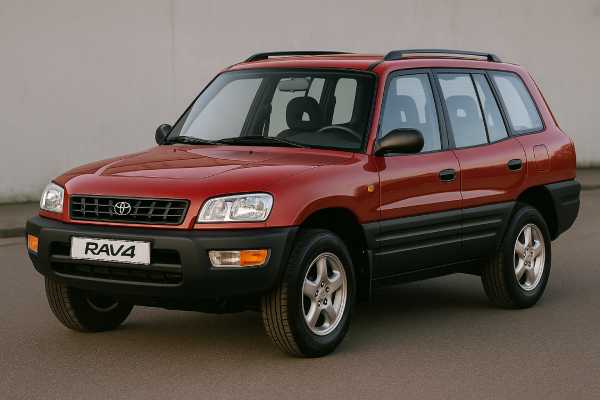
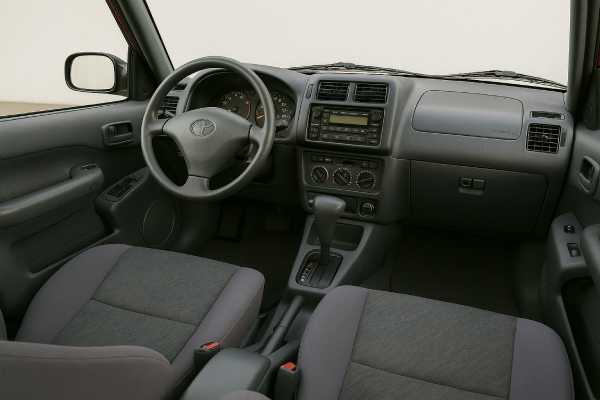
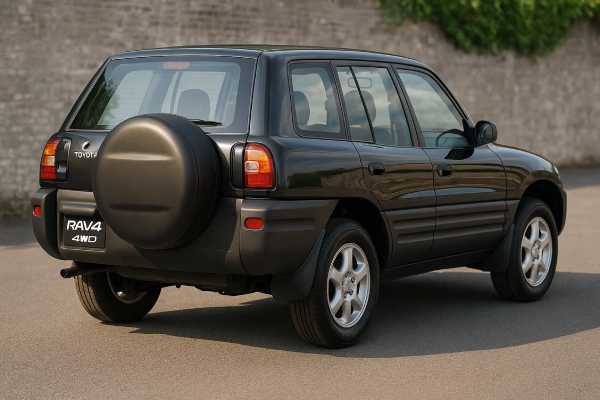
The facelifted first-generation Toyota RAV4 (1998–2000) is one of the vehicles that defined the compact crossover class in North America. With a car-derived unibody, full-time four-wheel drive, and the durable 3S-FE 2.0-liter four-cylinder, it balances simple engineering with everyday usefulness. Owners value its maneuverability, tall seating position, and low running costs. The 1998 update added revised bumpers, lighting, interior trim, and small feature changes while keeping the proven mechanical package. It is not fast, but it’s honest: light steering, predictable chassis responses, and a practical cabin that works for commuting, winter driving, or light trails. If you want a small SUV you can maintain at home, this RAV4 still makes sense—especially with complete service records and its timing-belt replacement kept current. In this guide, you will find a focused breakdown of specifications, performance, reliability patterns, maintenance planning, and how it stacks up against period rivals.
Quick Specs and Notes
- Compact size with full-time 4WD and a viscous-coupling center differential; confident in snow and light off-pavement.
- Proven 3S-FE 2.0-liter DOHC I-4 (timing belt) noted for longevity and parts availability.
- Easy to live with: tight turning circle, tall seating, simple controls, and good outward visibility.
- Watch the service history for timing-belt age/mileage and cooling-system condition; inspect for rear-brake wear and exhaust leaks.
- Oil and filter every 5,000–7,500 miles (8,000–12,000 km) or 6–12 months, adjusted for climate and usage.
Explore the sections
- Detailed Overview
- Specifications and Technical Data
- Trims and Options, Safety and Driver Assistance
- Reliability, Common Issues and Service Actions
- Maintenance and Buyer’s Guide
- Driving and Performance
- How Toyota RAV4 Compares to Rivals
Detailed Overview
The 1998–2000 facelift of the first-generation RAV4 kept the original recipe intact: a Corolla-derived platform, fully independent suspension, and available full-time four-wheel drive. For North America, the 4WD model uses a viscous-coupling center differential to manage fore-aft torque split automatically; there is no low range, but traction on wet, snow-covered, or unpaved roads is markedly better than most front-drive compacts of the time. The chassis tuning favors stability and predictability over raw grip, which pairs well with the modest output of the 3S-FE.
The iron-block/aluminum-head 3S-FE 2.0-liter is a square-bore (86 × 86 mm), 16-valve DOHC design with multi-port fuel injection. In this application it’s rated at 120 hp (89 kW) and about 170 Nm (125 lb-ft). Real thrust lives in the midrange, so the five-speed manual feels livelier than the four-speed automatic. Even so, the RAV4’s character is about efficiency and durability, not speed. A timing belt drives the cams, which means periodic replacement; however, many owners appreciate the belt’s quietness and the engine’s reputation for high mileage when maintained.
Inside, the tall roof and low cowl create a bright, airy cabin. The boxy shape yields upright seating and decent cargo space for the footprint. Visibility is excellent, and controls are simple and logically laid out. Cabin materials are workmanlike rather than plush; the focus is on longevity and easy cleaning. With 16-inch wheels and compliant sidewalls, ride quality is forgiving over broken pavement. Noise is present at highway speeds (period-typical), but wind and road sounds are steady rather than droning. Overall, the facelifted RAV4 remains a pragmatic, low-stress companion for daily use and winter duty—easy to park, economical to run, and straightforward to service.
Specifications and Technical Data
Engine and Performance (ICE-only)
| Item | Detail |
|---|---|
| Code | 3S-FE |
| Layout & cylinders | Inline-4 (I-4), DOHC, 16 valves |
| Bore × stroke | 86.0 × 86.0 mm (3.39 × 3.39 in) |
| Displacement | 2.0 L (1,998 cc) |
| Induction | Naturally aspirated |
| Fuel system | Multi-port fuel injection (MPFI) |
| Compression ratio | ~9.5:1 (market/calibration dependent) |
| Max power | 120 hp (89 kW) @ ~5,400 rpm |
| Max torque | ~170 Nm (125 lb-ft) @ ~4,400 rpm |
| Timing drive | Belt (cambelt) |
| Emissions/efficiency standard | U.S. EPA gasoline (period Tier-1/LEV calibrations) |
| Rated efficiency (typical) | Combined ~23–24 mpg US (10.2–9.8 L/100 km); City ~21–22 mpg; Hwy ~26–27 mpg |
| Real-world highway @ 120 km/h (75 mph) | ~24–26 mpg US (9.8–9.0 L/100 km), tires and wind load sensitive |
Notes: The 3S-FE responds well to fresh plugs, clean air filter, correct ignition timing, and a healthy oxygen sensor; all can shift economy by 1–2 mpg.
Transmission and Driveline
| Item | Detail |
|---|---|
| Transmissions | 5-speed manual; 4-speed automatic |
| Drive type | Full-time 4WD (viscous-coupling center differential) |
| Differential(s) | Open front/rear; center viscous coupling; no low range |
| Final drive | Application-specific; short overall gearing for tractability |
| Refuel to full (typical) | 5–7 min (gasoline) |
Chassis and Dimensions
| Item | Detail |
|---|---|
| Suspension (front/rear) | MacPherson strut / Double wishbone with trailing links |
| Steering | Power rack-and-pinion; light to moderate effort |
| Brakes | Ventilated front discs / rear drums; 4-wheel ABS optional |
| Wheels/Tires | 16-in rims; typical 215/70R16 all-season |
| Ground clearance | ~190 mm (7.5 in) |
| Length / Width / Height | ~4,115 mm × 1,695 mm × 1,650 mm (162.0 × 66.7 × 65.0 in) |
| Wheelbase | 2,200 mm (86.6 in) |
| Turning circle (curb-to-curb) | ~10.2 m (33.5 ft) |
| Curb weight (typical range) | ~1,225–1,310 kg (2,700–2,890 lb), body/transmission dependent |
| Fuel tank | ~58 L (15.3 US gal / 12.7 UK gal) |
| Cargo volume (seats up / down) | ~760 / 1,640 L (26.8 / 57.9 ft³), method varies by source |
Performance and Capability
| Metric | Figure |
|---|---|
| 0–100 km/h (0–62 mph) | ~11.5–12.5 s (setup dependent) |
| Top speed | ~170 km/h (106 mph) |
| Braking 100–0 km/h (62–0 mph) | ~39–43 m (128–141 ft), tire condition dependent |
| Towing capacity (max) | 680 kg (1,500 lb) |
| Roof load | ~50–75 kg (110–165 lb), check specific rack rating |
Fluids and Service Capacities (guide)
| System | Specification | Capacity (approx.) |
|---|---|---|
| Engine oil | API SJ (or later), 5W-30 common; verify by climate | ~3.8–4.3 L (4.0–4.5 qt) with filter |
| Coolant | Toyota Long Life (red) or equivalent; 50/50 premix typical | ~5.5–6.5 L (5.8–6.9 qt) |
| Automatic transmission | Dexron III-spec ATF (period); service via drain/refill | ~2.5–3.0 L (2.6–3.2 qt) per drain (partial) |
| Manual transmission | GL-4/GL-5 gear oil (75W-90 typical) | ~2.1–2.5 L (2.2–2.6 qt) |
| Rear differential | GL-5 75W-90 | ~0.9–1.1 L (1.0–1.2 qt) |
| A/C refrigerant | R-134a; oil ND-Oil 8 | Charge: label-specific (typ. ~550–650 g / 19–23 oz) |
| Key torque specs | Wheel lugs ~103 Nm (76 lb-ft); oil drain plug ~39 Nm (29 lb-ft) |
Always confirm the under-hood label and service manual for your exact VIN; capacities vary slightly by year, body, and transmission.
Electrical
| Item | Detail |
|---|---|
| Alternator output | ~70–80 A (application dependent) |
| 12V battery | Group 35/26R common; 45–60 Ah; CCA varies by climate |
| Spark plugs | Nickel or iridium (as specified); gap ~1.1 mm (0.043 in) |
Safety and Driver Assistance
| Topic | Detail |
|---|---|
| Crash ratings (period) | Acceptable/Good structure for class; no modern side curtain testing on early models |
| Headlights (period) | Halogen reflectors; performance varies with aim and lens clarity |
| Restraints | Dual front airbags; front pretensioners; rear child-safety locks |
| Child seats | Provisions for child seat fitment; top-tether kits available; LATCH not yet standardized on these years |
| ADAS (modern features) | Not available (no AEB/ACC/LKA); ABS optional; traction/stability control not fitted on most models |
Trims and Options, Safety and Driver Assistance
Trims and feature themes (North America, 1998–2000)
Toyota offered the RAV4 in two primary body styles in this period—two-door (including a soft-top) and four-door—each available in front-drive or 4WD. Feature content generally stepped up with body style and option groups rather than radically different drivetrains. Common identifiers:
- Exterior clues: Facelift bumpers and headlamps (1998 onward), body-color mirrors on higher-content builds, roof rails on many four-door 4WDs, and 16-inch alloys on popular packages.
- Interior tells: Cloth upholstery with patterned inserts, basic rotary HVAC, an analog cluster with clear markings. Some cars received a leather-wrapped steering wheel and upgraded audio with CD later in the run.
- Mechanical options: 5-speed manual standard fit on many units; 4-speed automatic widely available. ABS is frequently found on higher-spec cars or cold-weather packages. A rear-mounted spare with swing-gate is universal; there’s no low-range transfer case.
Year-to-year highlights (facelift window)
- 1998: Styling refresh inside and out; incremental NVH refinements; option mix shuffled.
- 1999: Minor package changes; wheel designs and fabrics updated; ABS take-rate rises.
- 2000: Late-run feature tweaks and colors; mechanical spec unchanged ahead of the second-generation model.
Safety ratings—how to interpret them on an older SUV
Period crash testing reflects the standards of the day and differs from modern small-overlap or side-impact protocols. The RAV4’s structure and restraint systems perform sensibly for a late-1990s compact SUV, but owners should understand that it lacks side airbags, curtain airbags, electronic stability control, and advanced head restraints. Headlight performance depends heavily on lens condition and aim; plastic lenses may haze with age and benefit from restoration or replacement. ABS—when fitted—shortens stops and keeps steering control on slippery surfaces; verify wheel-speed sensor integrity and ring cleanliness after axle/brake work.
Child-seat and restraint notes
These years predate universal LATCH anchors in North America. Many vehicles accept top-tether kits; ask a dealer to check period accessory availability or TSBs for anchor retrofit guidance. Use rear outboard positions for most child seats, verify belt-locking method, and follow seat maker instructions closely.
ADAS and calibration implications
No camera/radar systems exist here; alignment and steering-angle sensor calibrations are not part of routine work. ABS tone rings and wheel-speed sensors are the main electronic pieces—handle carefully during hub or axle replacement to avoid warning lamps or ABS faults.
Reliability, Common Issues and Service Actions
The facelifted XA10 RAV4 is widely regarded as durable when maintained. Age, neglected fluids, and corrosion are now the biggest enemies. Below is a practical, severity-aware map of what to expect.
Engine (3S-FE) — Common to Occasional
- Oil seepage (common, low–medium severity): Valve-cover gaskets and cam seals harden with age → light oil film or smell. Remedy: Replace gaskets/seals; clean breather system; verify PCV function.
- Timing-belt age (common, medium severity): Belts time out with age, not only miles → risk of sudden no-start. Remedy: Replace belt, idler(s), tensioner, and water pump as a job set at the recommended interval or 7–9 years if mileage is low.
- Idle instability (occasional, low): Carbon at throttle body/idle-air passages; tired plugs. Remedy: Clean throttle body and IAC passages; refresh plugs and check base timing.
- Exhaust leaks (occasional, medium): Flange gaskets and hardware corrode → rasping noise. Remedy: Replace gaskets/hardware; inspect heat shields.
Cooling system — Common
- Radiator plastic end-tank aging (common, medium): Heat cycling causes cracks at the crimp → slow coolant loss. Remedy: Replace radiator; renew thermostat and cap; pressure test.
- Heater core and hoses (occasional, medium): Original hoses soften or crack → odors, damp passenger footwell. Remedy: Systematically replace hoses; bleed carefully to avoid air pockets.
Fuel/ignition — Occasional
- Oxygen sensor aging (occasional, low): Slow response worsens economy and emissions. Remedy: Replace with correct-spec sensor; clear codes; verify heater circuit.
- Distributor O-ring and internal wear (occasional, medium): Oil leak or intermittent miss. Remedy: Reseal or replace distributor assembly; set base timing.
Transmission and driveline — Generally robust
- 4AT shift quality (occasional, low–medium): Old ATF → flare/shudder. Remedy: Drain/refill ATF in stages; adapt; avoid aggressive “flushes” on unknown history.
- 5MT clutch wear (mileage-dependent, medium): High engagement, slip under load. Remedy: Replace clutch disc/pressure plate/release bearing; inspect rear main seal.
- Front CV boots (common, low): Outer boots split with age → grease loss. Remedy: Replace boots or half-shafts; inspect seals.
- Wheel bearings (occasional, medium): Growl at speed. Remedy: Press-in replacement; ensure correct preload and ABS tone ring integrity.
Chassis and brakes — Known patterns
- Rear drum brake maintenance (common, low): Out-of-adjustment or glazed shoes → long pedal travel. Remedy: Proper shoe arc/adjustment; replace hardware springs; flush fluid.
- Strut top mounts/bushings (common, medium): Clunks over sharp bumps. Remedy: Replace mounts/bushes; align afterward.
- Corrosion hotspots (rust-belt vehicles) (occasional to common): Rear subframe mounts, exhaust hangers, brake lines. Remedy: Inspect on lift; treat or replace; coat lines where legal.
Electrical — Age-related
- Grounds and connectors (occasional, low): Green corrosion → intermittent sensors. Remedy: Clean/burnish grounds, apply dielectric grease.
- Alternator output (occasional, medium): Low charge at idle with accessories. Remedy: Test/replace alternator and belt.
Recalls, TSBs, and extended coverage
- Takata front airbag inflators (applicability by VIN): Aging propellant can rupture in a crash → free inflator replacement at dealers. Action: Run an official VIN recall check and ensure documentation.
- Seatbelt/seat anchorage service actions (market-specific): Verify completion via dealer records where applicable.
- ABS sensor harness routing (rare): Inspect wiring and grommets after axle or strut service.
Pre-purchase checks to request
- Proof of timing-belt/water-pump replacement (date/miles).
- Cooling-system service (radiator, hoses, thermostat).
- Brake fluid flush and rear-drum condition.
- Fresh gear oils (manual/differentials) or ATF drain/refill history.
- Complete recall/TSB printout and dealer confirmation.
- Underside corrosion and exhaust condition photos.
- Battery and charging test values.
Maintenance and Buyer’s Guide
Practical service schedule (distance/time = whichever comes first)
(Adjust for severe use: frequent short trips, extreme cold/heat, dusty roads, towing, or mountain driving.)
- Engine oil and filter: 5,000–7,500 miles (8,000–12,000 km) / 6–12 months; 5W-30 is common.
- Engine air filter: Inspect 12 months / 15,000 miles (24,000 km); replace as needed.
- Cabin/pollen filter: If fitted, 12 months; some early units may lack a cabin filter—retrofit screens help.
- Spark plugs: 30,000 miles (48,000 km) for copper; 60,000–100,000 miles (96,000–160,000 km) for iridium (if specified).
- Coolant: 2–3 years or per long-life coolant spec; test annually for freeze/boil protection and pH.
- Timing belt (and pump/idlers): 60,000–90,000 miles (96,000–145,000 km) or 7–9 years; replace water pump and seals with the belt.
- Accessory/serpentine belts and hoses: Inspect every oil change; replace at first signs of cracking, glazing, or swelling.
- Manual gearbox oil / rear differential oil: 60,000 miles (96,000 km) or 5 years; sooner if water ingress suspected.
- Automatic transmission (4AT): Drain/refill ATF every 30,000–50,000 miles (48,000–80,000 km) depending on use; avoid unknown “flushes.”
- Brake fluid: Flush every 2 years; keeps ABS valves clean and corrosion at bay.
- Brake shoes/pads and rotors/drums: Inspect at 10,000–15,000 miles (16,000–24,000 km); rear drums need proper adjustment and hardware renewal.
- Alignment and tire rotation (215/70R16 common): Rotate every 5,000–7,500 miles (8,000–12,000 km); align annually or after suspension work.
- Valve clearances: Hydraulic lash is not used here; clearance checks are not routine on this engine—follow service manual if noise or performance issues appear.
- 12-V battery: Test annually after year 4; replace proactively in cold climates.
Fluids at a glance (decision-maker list)
- Engine oil: API SJ (or later), 5W-30, capacity ~4.0–4.5 qt with filter.
- Coolant: Toyota Long Life (red) / compatible; 50/50 premix; ~6 qt system.
- 4AT: Dexron III equivalent; partial drain ~2.6–3.2 qt.
- 5MT & rear diff: GL-5 75W-90; follow VIN-specific capacity.
- Brake: DOT 3 (DOT 4 acceptable if system clean and dry).
- A/C: R-134a; ND-Oil 8; charge by weight on the under-hood label.
Buyer’s checklist (what to inspect or ask for)
- Rust: Rear subframe mounts, brake/fuel lines, exhaust flanges, and tailgate lower seam.
- Cooling: Check for pink/white staining around radiator crimps and water-pump weep hole.
- Driveline: CV boots intact; no diff seepage; no humming wheel bearings.
- Brakes: Even shoe wear; firm pedal; ABS self-test light behavior on startup.
- Suspension: Strut top mounts and rear trailing-arm bushings for play/noise.
- Electrics: Charging voltage 13.8–14.6 V; clean grounds.
- Documents: Timing-belt proof, fluid services, recall printout, and a clean title.
Long-term durability outlook
With the 3S-FE serviced on schedule and cooling/fluids kept fresh, 200k–300k miles (320k–480k km) is realistic. The vehicles that suffer are those with perished cooling parts, skipped timing-belt jobs, and corrosion left to spread. A well-maintained 4WD facelift RAV4 remains one of the lower-risk 1990s SUVs to own.
Driving and Performance
Ride, handling, and NVH
The facelift RAV4’s light footprint and long-travel suspension make it forgiving on rough city streets. Body roll is present but linear; the chassis telegraphs weight transfer honestly, so you always know what the tires are doing. Straight-line stability is good up to typical U.S. highway speeds, and crosswinds are only mildly noticeable thanks to the upright body. Noise levels reflect the era: engine sound above ~4,000 rpm and some tire roar on coarse asphalt. New door seals, fresh struts, and quality tires help noticeably.
Steering and braking feel
Steering effort is light at parking speeds and builds modestly on-center. The rack isn’t quick, but the turning circle is tight enough to make urban maneuvering a breeze. With healthy front discs, adjusted rear drums, and fresh DOT 3/4 fluid, pedal feel is firm and progressive. ABS—when equipped—keeps the RAV4 straight and steerable on split-mu surfaces; if you feel pulsing underfoot, that’s normal ABS modulation.
Powertrain character
The 3S-FE prefers to work between 2,500–4,500 rpm. In traffic, the five-speed manual takes advantage of the engine’s midrange and makes the RAV4 feel more responsive; the four-speed automatic is geared for economy and will kick down for hills or passing. There’s no turbo lag to discuss—just linear, modest thrust. Keep in mind the RAV4’s age: intake cleanliness, good plugs, and correct base timing transform drivability more than any bolt-on.
Real-world economy
Expect roughly 21–24 mpg US city / 25–28 mpg US highway (11.2–9.0 L/100 km) for a healthy 4WD example on all-season tires at proper pressures. Winter fuel, short trips, and roof racks can knock 1–3 mpg off. Manual transmissions usually do 0.5–1.0 mpg better in mixed driving when geared sensibly.
Traction and light off-road
On snow and gravel, the full-time 4WD with viscous coupling provides secure, fuss-free traction. There’s no low range or locking differential, so this is not a rock crawler. Fitting quality all-terrain tires and watching approach/departure angles lets the RAV4 comfortably handle trailheads, forest roads, and unplowed city streets. Wheelspin management is old-school: steady throttle, smooth steering, and momentum.
Load and towing
With a 1,500-lb (680-kg) tow rating and a short wheelbase, keep trailer tongue weight conservative and speeds moderate. Fresh brake fluid and pads are strongly recommended before towing. Expect a noticeable economy penalty (10–25%) under load or at high altitude; downshift early on grades to keep coolant and ATF temperatures in check.
How Toyota RAV4 Compares to Rivals
Honda CR-V (first gen, 1997–2001)
- Pros vs. RAV4: Slightly larger cargo area and rear seat space; rear disc brakes more common; clever picnic table load floor.
- Cons: Real-world fuel economy often similar; AWD engagement is reactive (dual-pump) rather than full-time.
- Takeaway: If space trumps size, the CR-V edges it; for predictable 4WD feel and tight city agility, the RAV4 is nicer.
Subaru Forester (first gen, 1998–2002)
- Pros vs. RAV4: Standard AWD across the board; boxer engine character; more torque down low.
- Cons: Head-gasket concerns on some EJ25 engines; ride can be busier on broken pavement.
- Takeaway: A great snow car when sorted; RAV4 typically has fewer major engine repair risks.
Isuzu Rodeo/Honda Passport
- Pros vs. RAV4: Traditional SUV proportions, higher towing, available V6.
- Cons: Heavier, thirstier, and larger; ride and maneuverability less city-friendly.
- Takeaway: If you truly need body-on-frame tow capacity, look there; otherwise the RAV4 is cheaper to run and park.
Ford Escape (first gen arrives 2001)
- Pros vs. RAV4: More power in later trims, modernized packaging.
- Cons: Later arrival, early-run teething issues; heavier fuel use.
- Takeaway: If cross-shopping used today, the XA10 RAV4 often feels simpler and more robust as it ages.
Ownership fit
Pick the facelift RAV4 if you value simplicity, city maneuverability, winter confidence, and parts availability. Skip it if you need modern ADAS, high towing capacity, or highway-quiet luxury. A clean, rust-free example with documented belt and fluid services remains one of the smarter 1990s SUV purchases.
References
- Fuel Economy of the 2000 Toyota RAV4 4WD 2025 (Fuel Economy)
- 1998 Toyota RAV4 2025 (Safety Rating)
- Part 573 Safety Recall Report 20V-033 2020 (Recall Report)
- Vehicle Detail Search – 1999 TOYOTA RAV4 | NHTSA 2025 (Recall Database)
Disclaimer
This article is for informational purposes only and is not a substitute for professional diagnosis or repair. Specifications, torque values, fluid types/capacities, and service intervals can vary by VIN, year, market, equipment, and running changes. Always verify against your vehicle’s official service documentation, under-hood labels, and the latest manufacturer publications.
If you found this guide helpful, please share it with fellow enthusiasts and owners on Facebook or X/Twitter to support xcar’s work. Thank you!