
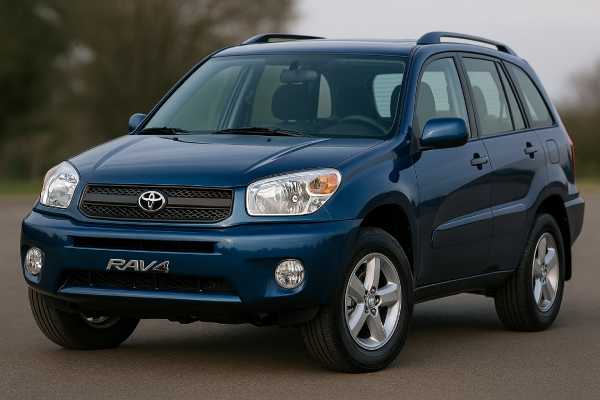
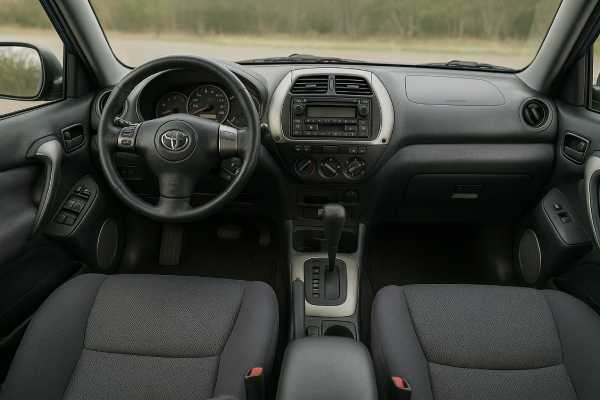
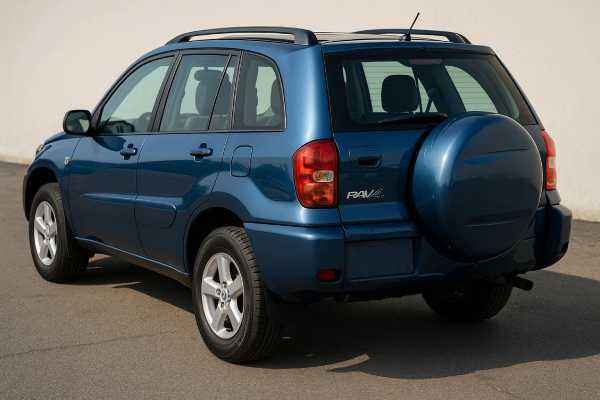
The facelifted 2003–2005 Toyota RAV4 AWD (XA20) with the 1CD-FTV 2.0-litre D-4D diesel blends compact-SUV practicality with dependable, all-weather traction. Its strengths are everyday torque, tidy exterior dimensions, and a cabin that wears mileage well. The facelift tightened chassis tuning, improved sound deadening, and broadened availability of safety features such as stability control and curtain airbags on better-equipped grades. This diesel AWD combination was a European mainstay (diesel RAV4s were not sold new in North America), so the figures and trim names here reflect European practice. Expect relaxed cruising, predictable handling, and frugal long-distance running when serviced on time. Age brings attention points—timing-belt scheduling, EGR deposits, suction-control valve wear, and dual-mass flywheel fatigue—but parts remain available and most jobs are straightforward for a competent workshop. For buyers who value simplicity, traction, and sensible running costs, this late-XA20 RAV4 remains a smart, durable choice.
Owner Snapshot
- Strong low-rpm pull (250 Nm) with permanent AWD makes winter and wet-road driving calm and predictable.
- Compact footprint (4265 mm) and square cargo bay keep it easy to park yet useful for family duty.
- Facelift added stability control availability and curtain airbags on upper trims for meaningful safety gains.
- Caveat: ageing diesel ancillaries—EGR, suction control valve, and dual-mass flywheel—may need attention by high miles.
- Typical service: oil and filter every 10,000 miles / 12 months; timing belt about 60,000 miles / 5 years.
On this page
- RAV4 AWD D-4D 2003–2005
- RAV4 AWD Specs and Data
- RAV4 AWD Trims and Safety
- Reliability and Service Actions
- Maintenance and Buyer’s Guide
- Driving and Performance
- How It Compares to Rivals
RAV4 AWD D-4D 2003–2005
The facelifted XA20 RAV4 arrived with subtle exterior changes (revised bumpers, grille, and lamps) and usefully improved cabin refinement. Underneath, calibration tweaks to steering and suspension preserved the model’s friendly character while making motorway miles quieter and more settled. Diesel AWD versions use Toyota’s 1CD-FTV 2.0-litre common-rail four rated at 116 hp (85 kW) and 250 Nm (184 lb-ft). The torque plateau from roughly 1800 rpm suits mixed driving and reduces shift frequency compared with many petrol rivals of the era.
AWD hardware is simple and robust. The RAV4 uses a permanent all-wheel-drive layout with a centre viscous-coupling unit that apportions torque as front and rear axle speeds differ. There is no low range or driver-selectable mode, but on wet tarmac, gravel, or snow-dusted roads the system’s unobtrusive engagement is exactly what most owners want: a calm step-off without wheelspin and trustworthy traction when camber changes or mid-corner puddles try to unsettle the car. Braking remained straightforward with disc brakes all round and conservative ABS tuning.
Inside, the five-door body gives a square, tall load space with a low sill. The rear bench splits and folds; in many trims the seat modules unclip entirely to free up a long, flat floor for bulky cargo. Ergonomics are period-Toyota: simple rotary HVAC controls (automatic climate on top trims), clear gauges, and large buttons that can be used with winter gloves. The driving position is upright with excellent outward visibility, which—together with the compact length—makes the RAV4 relaxing in tight car parks and old city centres.
As a used buy, the late-XA20 diesel AWD appeals because the fundamentals last. A car with full history, timely belt service, and a clean bill of health on diesel ancillaries tends to run cheaply. Proactive attention to EGR deposits, a tired suction-control valve, and clutch/DMF wear keeps it feeling crisp. Suspension bushes and rear brake sliders deserve periodic care in salted climates. If you find a car with stability control and curtain airbags (both rolled out more widely with the facelift), that is a worthwhile bonus for safety-minded buyers.
RAV4 AWD Specs and Data
Figures apply to the 2003–2005 facelift Toyota RAV4 AWD (XA20), 1CD-FTV 2.0 D-4D, 5-speed manual, five-door. Minor variation by trim, wheel and market is normal.
Engine and Performance
| Item | Value |
|---|---|
| Code | 1CD-FTV |
| Engine layout and cylinders | Inline-4, DOHC, 16 valves; 4 valves per cylinder |
| Bore × stroke | 82.2 × 94.0 mm (3.24 × 3.70 in) |
| Displacement | 2.0 L (1995 cc) |
| Induction | Turbocharged with intercooler |
| Fuel system | Common-rail direct injection (D-4D) |
| Compression ratio | ~18.6:1 |
| Max power | 116 hp (85 kW) @ 4000 rpm |
| Max torque | 250 Nm (184 lb-ft) @ 1800–3000 rpm |
| Timing drive | Belt (replace at interval) |
| Emissions standard (period) | Euro 3 era (market dependent) |
| Rated combined economy | ~6.9–7.3 L/100 km (34–33 mpg US / 41–39 mpg UK) |
| Real-world highway @ 120 km/h (75 mph) | ~7.5–8.5 L/100 km (31–28 mpg US / 38–33 mpg UK) |
| Aerodynamics | Cd ≈ 0.35 |
Transmission and Driveline
| Item | Value |
|---|---|
| Transmission | 5-speed manual |
| Gear ratios (1st → 5th / R) | ~3.8 / 2.0 / 1.3 / 1.0 / 0.82 / ~3.6 |
| Final drive ratio | ~4.56 |
| Drive type | Permanent AWD with centre viscous coupling |
| Differentials | Open front and rear; viscous-coupled centre |
| Replenishment time (refuel) | ~5–10 minutes (57 L tank) |
Chassis and Dimensions
| Item | Value |
|---|---|
| Suspension (front / rear) | MacPherson strut / Double wishbone with trailing arms |
| Steering | Hydraulic rack-and-pinion; ~16:1; ~2.9 turns lock-to-lock |
| Brakes (front / rear) | Ventilated discs ~275–295 mm (10.8–11.6 in) / Solid discs ~281–290 mm (11.1–11.4 in) |
| Wheels and tyres | 215/70 R16 (typical); some trims 235/60 R16 |
| Ground clearance | ~180–195 mm (7.1–7.7 in), wheel and tyre dependent |
| Length / Width / Height | 4265 mm / 1735–1785 mm / 1685–1715 mm (167.9 / 68.3–70.3 / 66.3–67.5 in) |
| Wheelbase | 2490 mm (98.0 in) |
| Turning circle (kerb-to-kerb) | ~10.6 m (34.8 ft) |
| Kerb (curb) weight | ~1420–1535 kg (3131–3384 lb) |
| GVWR | ~1925 kg (4244 lb) |
| Fuel tank | 57 L (15.1 US gal / 12.5 UK gal) |
| Cargo volume (VDA) | 410 L seats up (14.5 ft³) / 520 L folded (18.4 ft³) / up to ~970 L seats removed (34.3 ft³) |
Performance and Capability
| Metric | Value |
|---|---|
| 0–100 km/h (0–62 mph) | ~12.0–12.4 s |
| Top speed | ~170–175 km/h (106–109 mph) |
| 100–0 km/h braking distance | Tyre- and condition-dependent; test to verify |
| Towing capacity | 1500 kg braked (3307 lb) / ~640 kg unbraked (1411 lb) |
| Payload | ~400–450 kg (880–992 lb) |
| Roof load | ~75 kg (165 lb), bar system dependent |
Fluids and Service Capacities
| System | Specification and Capacity |
|---|---|
| Engine oil | ACEA B4 (or C3 where DPF fitted in select markets), 5W-30 preferred; ~5.8–6.0 L (6.1–6.3 US qt) with filter |
| Coolant | Toyota LLC/SLLC; typical 50/50 mix; ~6–7 L (6.3–7.4 US qt) |
| Manual transmission oil | API GL-4/GL-5 75W-90; ~2.0–2.3 L (2.1–2.4 US qt) |
| Transfer case | API GL-5 75W-90; ~0.8–1.0 L (0.85–1.06 US qt) |
| Rear differential | API GL-5 75W-90; ~0.9–1.0 L (0.95–1.06 US qt) |
| A/C refrigerant | R134a; typical charge ~500 g (17.6 oz) |
| A/C compressor oil | ND-OIL 8 (PAG); ~120 mL (4.1 fl oz) |
| Key torque values | Wheel nuts 103 Nm (76 lb-ft); Oil drain plug ~39–40 Nm (29–30 lb-ft) |
Electrical
| Item | Value |
|---|---|
| Alternator output | ~90–100 A |
| 12 V battery | ~60–70 Ah DIN (H6 form factor common); verify by VIN |
| Glow plugs | 4-unit system; follow OE spec for heat range |
Safety and Driver Assistance
- Crash ratings: Early-2000s independent European tests of this generation returned a solid adult-occupant star rating typical for the class, with notably strong side-impact results when side and curtain airbags were fitted. (Period protocols used stars and points rather than today’s percentages.)
- Headlight performance: Period-average halogen reflector units; aim and bulb choice matter for night confidence.
- ADAS suite: ABS and EBD standard; Vehicle Stability Control (VSC), Traction Control (TRC) and Brake Assist (BA) available or standard on upper trims post-facelift. No AEB, lane-keeping, or adaptive cruise on this era.
- Child-seat provisions: ISOFIX lower anchors and top-tether points (fitment varies by trim); check for intact plastic guides and correct tether routing behind the rear seatback.
RAV4 AWD Trims and Safety
Trim structure (facelift years, Europe): Toyota rationalised the range to XT2, XT3, and XT4 (plus local special editions). All diesel AWD cars share the 1CD-FTV and a 5-speed manual; differences are mostly equipment, wheels and tyres, and safety feature availability.
- XT2: Cloth seats, manual air-conditioning, 16-inch steel wheels with 215/70 tyres, roof rails, front electric windows, remote locking, dual front airbags. After the facelift, front side and curtain airbags were widely introduced.
- XT3: Adds alloy wheels (often with 235/60 R16 tyres), fog lamps, steering-wheel audio controls, rear electric windows on five-door, upgraded audio with CD.
- XT4: Gains VSC/TRC/BA, automatic climate control, leather or leather-trimmed seats in many markets, heated mirrors, and options such as a sunroof. If you value active safety, prioritise an XT4 or a market-equivalent grade with stability control.
Mechanical or functional differences by trim: Gear ratios and final drive are broadly common across diesel manuals; braking hardware is shared. Wheel and tyre packages differ (215-section vs 235-section), which subtly affects steering weight and ride. Tow ratings are trim-agnostic but may vary with cooling package and hitch certification; verify on the VIN plate.
Quick identifiers: Facelift cars show revised bumper and grille design, new wheel styles, and interior metallic accents. Inside, XT3/XT4 steering wheels typically have audio buttons; XT4 adds automatic climate and, where fitted, leather. Build plates list model code, engine (1CD), and GVWR.
Year-to-year changes:
- 2003 (facelift introduction): Styling update, broader fitment of side and curtain airbags, and rollout of stability control on upper trims. NVH improvements and detail tweaks to steering/suspension calibration.
- 2004: Equipment packs rationalised; special editions (e.g., “Granite,” “XT-R” in some markets) bundled appearance and convenience features.
- 2005: Final model-year refinements before the next-generation XA30 replaced the XA20 for 2006.
Safety ratings context: While headline star counts were competitive at launch, the biggest real-world upgrade for facelift cars is the availability of VSC and head-protecting airbags. If a given market offered a base diesel without these items, the difference in crash-avoidance capability and side-impact protection is material—hence the advice to target cars with these features.
Child safety and calibration notes: ISOFIX anchors simplify installation. If the car has VSC, remember that steering-angle and yaw-rate sensors need a zero-point calibration after an alignment, steering-column work, or airbag module replacement; most capable scan tools can perform this.
Reliability and Service Actions
A well-maintained RAV4 AWD D-4D is generally durable. Age- and mileage-related items cluster around diesel ancillaries, clutch/DMF wear, and corrosion in salted climates. Below, issues are mapped by prevalence and severity/cost (Low/Medium/High), with typical mileage/age bands.
Common (Medium):
- EGR and intake soot build-up (short-trip and urban use; 60k–100k miles): sluggish response, smoke, rising consumption. Remedy: remove and clean EGR valve and intake elbow/manifold; renew gaskets; consider periodic long runs to sustain exhaust temperatures.
- Suction Control Valve (SCV) wear on the supply pump (80k–140k miles): hot/cold hard-start, hesitation, rail-pressure errors under load. Remedy: replace the SCV pair with the updated kit; clear DTCs and perform rail-pressure/idle learn.
- Dual-mass flywheel (DMF) fatigue (stop-start city duty; 90k–160k miles): rattle at idle, judder on take-off, shudder when lugging in higher gears. Remedy: replace clutch and DMF as a set; inspect rear main seal; reset clutch pedal free play.
- Timing belt overdue (time-lapse failures more than mileage): belt glaze or cracking. Remedy: belt, idlers, tensioner, and water pump at interval; torque and bleed cooling system correctly.
Occasional (Medium):
- Injector leak-back or nozzle wear (age/fuel quality): long crank, diesel knock, smoke. Remedy: leak-off test; refurbish or replace injectors; code injectors to ECU.
- Turbo VNT mechanism sticking (long low-load use): overboost/underboost codes, limp mode. Remedy: clean/recondition; verify vacuum hoses and control solenoid integrity.
- MAF sensor contamination: flat spots and poor economy. Remedy: replace with OE-quality sensor; avoid oiled aftermarket filters.
AWD-specific (Occasional to Rare):
- Prop-shaft centre bearing noise (age-hardened rubber): droning or vibration at motorway speeds. Remedy: replace centre bearing support; check U-joints.
- Transfer case or rear differential seepage: damp casing, burning-oil smell on exhaust. Remedy: renew seals; refill with GL-5 75W-90; check breather for blockage.
- Viscous-coupling degradation (high mileage or overheated from mismatched tyres): binding on tight turns (“crow-hop”), especially when warm. Remedy: confirm even tyre sizes and tread depths; if symptoms persist, replace viscous-coupling unit.
Rare (Low to Medium):
- Cooling system seepage (aged hoses, water pump weep): sweet smell, drops under front bumper. Remedy: proactive pump replacement with belt; renew hoses and clamps.
- Rear brake caliper slider seizure (salted climates): uneven pad wear. Remedy: clean and grease slides annually; replace boots.
Software and calibrations: This era uses simpler ECUs but benefits from correct post-repair procedures: injector coding, rail-pressure learn after SCV replacement, and VSC zero-point calibration after alignment. If stability-control and ABS lamps illuminate together after suspension work, a zero-point reset often resolves it.
Recalls, service campaigns, and verification:
- Power window master switch moisture/overheat campaigns affected various Toyotas in the mid-2000s; some regional RAV4s were included depending on build.
- Airbag-related campaigns existed on certain Toyota models from this period; run the VIN through the official checker for your market and seek dealer confirmation of closure.
- Always verify status via an official VIN recall portal and keep printed proof with the service history.
Pre-purchase requests: Ask for documented oil services every 12 months/10k miles, proof of belt and water-pump replacement within the last 5 years, recent fuel and air filters, and any injector leak-off test results. For AWD health, road-test with full-lock turns to check for binding, and inspect for even tyre sizes and similar tread depths on all four corners.
Maintenance and Buyer’s Guide
A practical, preventive schedule keeps the 1CD-FTV and AWD hardware healthy. Distances below are guides; adjust for severe service (short trips, towing, dusty roads, extreme cold).
Core schedule (time / distance):
- Engine oil and filter: 12 months / 10,000 miles with ACEA B4 (or C3 where DPF is fitted) 5W-30.
- Engine air filter / Cabin filter: Inspect yearly; replace 24 months / 20,000 miles (sooner in dusty cities).
- Fuel filter: 3–4 years / 30,000–40,000 miles.
- Timing belt kit and water pump: 5 years / ~60,000 miles.
- Aux/serpentine belt and hoses: Inspect annually; replace at first signs of cracking, noise, or coolant weep.
- Coolant: Toyota SLLC typically 10 years / 100,000 miles first fill, then 5 years / 50,000 miles; older LLC generally 2–3 years—confirm by coolant type.
- Manual transmission oil: 60,000–80,000 miles (GL-4/GL-5 75W-90).
- Transfer case and rear differential oils: 60,000–80,000 miles (GL-5 75W-90).
- Brake fluid: 24 months regardless of mileage.
- Brake pads and rotors: Inspect at every service; clean and lubricate slider pins annually in salted climates.
- Tyre rotation and alignment: 10,000–12,000 miles; rotate front-to-rear. Maintain even tyre sizes/tread depths to protect the viscous-coupling unit.
- 12 V battery: Test annually from year five; typical replacement window 5–7 years.
- Glow plugs and pre-heat system: Test if starting deteriorates; replace as a set using correct torque and anti-seize practice.
- EGR and intake cleaning: Plan for 60,000–80,000 miles, earlier with short-trip use.
Useful specs for decision-making:
- Engine oil: ACEA B4/C3 5W-30; ~5.8–6.0 L with filter.
- Coolant: Toyota LLC/SLLC; ~6–7 L.
- Manual gearbox: ~2.0–2.3 L 75W-90.
- Transfer case / Rear diff: ~0.8–1.0 L each, GL-5 75W-90.
- Key torques: Wheel nuts 103 Nm (76 lb-ft); oil drain ~39–40 Nm (29–30 lb-ft).
Buyer’s inspection checklist:
- Cold start quality and smoke: long crank or rough idle suggests SCV or injector leak-back.
- Clutch and DMF: rattle at idle with clutch engaged, judder on take-off, or harsh vibration at low rpm in higher gears.
- Boost control and vacuum plumbing: steady in-gear pull without limp mode; inspect vacuum lines and actuators.
- AWD health: no binding on tight turns; check prop-shaft centre bearing and U-joints; confirm matched tyres.
- Cooling system: look for pink (SLLC) or red (LLC) coolant, dry pump weep hole, and clean hose joints.
- Brakes and suspension: even pad wear; free-moving rear sliders; intact rear trailing-arm bushes; quiet top mounts.
- Corrosion hotspots: rear subframe mounts, inner wheel arches, brake lines, and tailgate seam; treat early surface rust.
- Safety equipment: confirm presence of curtain airbags and VSC on your target car and verify recall closure by VIN.
Long-term durability outlook: With on-time belt service, periodic EGR cleaning, and attention to SCV/injector health, many RAV4 AWD D-4Ds reach 200–300k km (125–185k miles) on original major hardware. Plan for one clutch/DMF replacement and, in salt regions, periodic brake slider care and rust mitigation. AWD hardware typically lasts if tyres are kept matched and oils changed on schedule.
Driving and Performance
Ride, handling, and NVH: The XA20’s chassis tuning is comfort-leaning. Around town it glides over broken tarmac with little harshness; on the motorway it feels planted for a short-wheelbase SUV. Body roll is present but well controlled, and the steering—hydraulic, not electric—has natural weighting. Wind noise rises modestly at higher speeds due to the upright mirrors and roof rails, but cabin conversation remains easy. Tyre choice matters: the 215/70 R16 package brings a cushier ride and lighter steering; the 235/60 R16 set-up adds grip and marginally firmer primary ride.
Powertrain character: On paper 116 hp is modest, yet the 250 Nm torque band from ~1800–3000 rpm is where daily driving happens. In town, the car steps off smoothly without revving; on open roads, short-shifting keeps it in the thick of its torque. The five-speed’s 5th gear is an overdrive (~0.82), holding the engine below the droney band at 120 km/h (75 mph). There is some turbo lag right off idle; keep revs just above 1500 rpm for more immediate response. Throttle mapping is progressive, which helps in low-grip conditions when the centre viscous coupling starts to work.
Real-world economy: Expect ~6.7–7.6 L/100 km (35–31 mpg US / 42–37 mpg UK) mixed for a healthy AWD car on 215-section tyres. At a steady 120 km/h (75 mph), ~7.5–8.5 L/100 km (31–28 mpg US / 38–33 mpg UK) is typical, rising in strong headwinds or with a roof box. Winter warm-up and short hops can nudge consumption into the 8–9 L/100 km bracket (29–26 mpg US) unless you combine trips.
Braking feel and consistency: Pedal travel is moderate with a firm end-stop; ABS tuning is conservative, especially on loose surfaces. Replacing fatigued rubber brake hoses and keeping rear slider pins free restores a reassuring initial bite many used examples lose over time.
Traction and control: The permanent AWD system is hands-off and drama-free. In rain or snow the car tracks cleanly; climb a gravel lane and you will feel the centre viscous coupling quietly share torque rearward as front wheels lighten. Where fitted, VSC and TRC provide a clear safety margin on patchy surfaces. Tyre selection is the largest variable: good all-season or winter tyres transform confidence without increasing mechanical stress if sizes and tread depths match.
Load and towing: A 1500 kg braked rating allows small caravans or trailers, but you will feel the mass. Plan for a +2–4 L/100 km consumption penalty when towing and give yourself extra distance for stops. On long summer grades, keep an eye on coolant temperature after belt/pump service and consider a proactive radiator clean-out on higher-mileage cars.
How It Compares to Rivals
Honda CR-V 2.2 i-CTDi (first diesel CR-V generation): The Honda’s later-arriving diesel is smoother and stronger in outright numbers. The Toyota counters with simpler AWD hardware, often lower parts prices, and a cabin that tends to resist wear better. CR-V cargo space is larger; the RAV4 is easier to park.
Nissan X-Trail 2.2 dCi (T30): The Nissan leans more off-road in image and has a roomier cargo area. However, its diesel of the era can be fussier about EGR/turbo control hardware. The RAV4’s interior feels tighter and tends to stay rattle-free longer.
Hyundai Tucson 2.0 CRDi (first generation): Strong value and generous equipment lists make the Tucson tempting. Yet the Toyota’s steering feel and ride composure are more cohesive, and residual values historically hold better.
Land Rover Freelander TD4 (BMW M47 diesel): Excellent ride and seat comfort, but complexity and age-related issues can make it a pricier partner as miles climb. The RAV4’s straightforward AWD system and durable interior trim give it the ownership edge for many buyers.
Verdict: If you prioritise reliability, compact size, and honest road manners over headline speed, the facelifted RAV4 AWD D-4D remains an excellent used-buy proposition. Seek a car with full history, documented belt service, even tyres, and—ideally—stability control with curtain airbags.
References
- 2004 Model Year Toyota RAV4 Gets The ‘X’ Factor – Toyota Media Site 2003 (Press Release)
- Recalls | Owners 2025 (Recall Checker)
- Toyota Technical Information System (TIS) 2025 (Service Manual)
- Toyota RAV4 2001 2002 (Safety Rating)
Disclaimer
This guide is for informational purposes and is not a substitute for professional diagnosis, repair, or official service procedures. Specifications, torque values, capacities, and maintenance intervals vary by VIN, market, and equipment. Always confirm details against your vehicle’s official owner’s manual and service documentation, and follow local regulations and safety guidance. If this article helped you, please consider sharing it with fellow owners on Facebook or X/Twitter to support xcar’s work.