
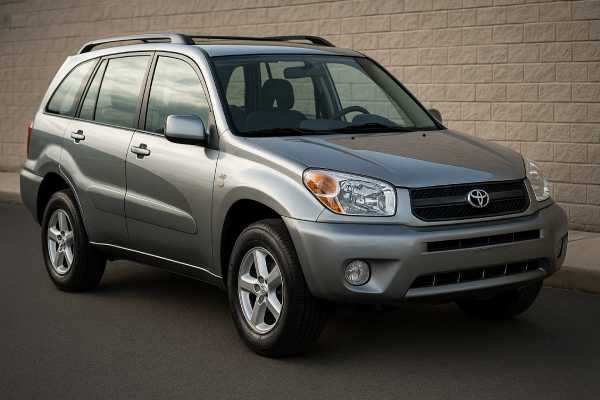
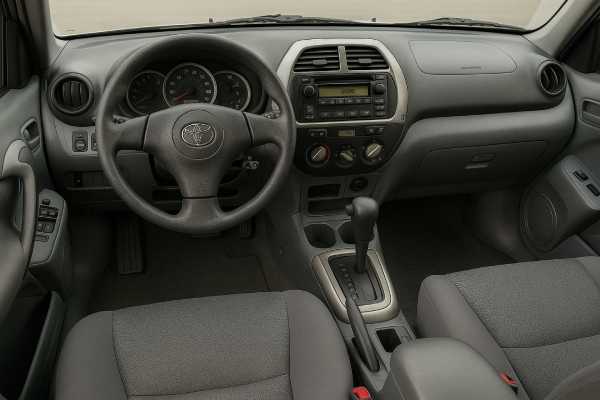
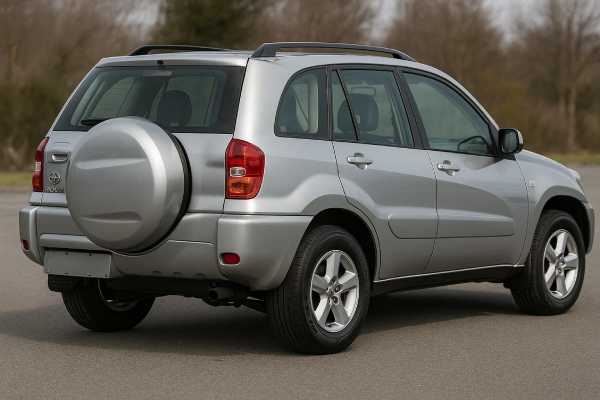
The facelifted second-generation Toyota RAV4 (XA20) with the 1AZ-FE 2.0-liter engine represents a sweet spot in early compact SUV design: compact outside, cleverly packaged inside, and engineered for dependable daily use. The 2003–2005 update brought a mild power bump to a quoted 150 hp, revised styling, and incremental refinements to noise control, safety equipment, and cabin tech. The full-time all-wheel-drive system with a viscous coupling blends surefooted traction in poor weather with the simple, low-maintenance character of a mostly mechanical setup. Owners value the upright driving position, good visibility, and versatile cargo area with a flat load floor and split-fold rear seats. While not fast, the 1AZ-FE is smooth and thrifty when maintained correctly, and parts availability remains excellent. Shoppers should still verify timing-chain health (noise and correlation faults) and keep up with fluids and suspension bushings as mileage climbs. Done right, this facelift RAV4 is a long-lived workhorse.
Fast Facts
- Compact footprint, smart interior packaging, and excellent visibility for city use.
- Simple full-time AWD with viscous coupling adds confidence on wet/snowy roads.
- Proven 1AZ-FE timing-chain engine; parts are plentiful and affordable.
- Watch for aging suspension bushings and exhaust/catalyst leaks after ~150,000 km (93,000 mi).
- Oil and filter every 10,000–15,000 km (6,000–9,000 mi) or 12 months, depending on use.
Navigate this guide
- Detailed Overview
- Specifications and Technical Data
- Trims and Options, Safety and Driver Assistance
- Reliability, Common Issues and Service Actions
- Maintenance and Buyer’s Guide
- Driving and Performance
- How RAV4 Compares to Rivals
Detailed Overview
The facelifted 2003–2005 RAV4 refined Toyota’s successful second-generation formula without losing its original mission: maneuverable size, car-like road manners, and useful traction in everyday weather. Compared with the 2000–2003 pre-facelift models, this update introduced reshaped bumpers and lamps, subtle cabin tweaks, improved sound insulation, and small but noticeable powertrain calibrations. The 1AZ-FE 2.0-liter inline-four remained the core engine for many European markets, now quoted at 150 hp (110 kW) with torque around 192 Nm (142 lb-ft), paired to a 5-speed manual or a 4-speed automatic. The engine uses chain-driven DOHC with VVT-i on the intake cam, aluminum block and head, and multi-port fuel injection—an architecture focused on low mass, efficiency, and reduced maintenance.
The AWD system is full-time and largely mechanical: power splits through a center differential with a viscous coupling that biases torque when slip occurs. There are no low-range gears, so think “secure road car” rather than off-road tool. That said, the short overhangs, predictable traction control programming, and sensible ground clearance make gravel roads, muddy lanes, and ski-season trips easy to tackle on all-season or mild all-terrain tires.
Inside, this RAV4 feels straightforward and durable. The tall seating position and thin pillars aid visibility. The rear bench folds flat in a 50:50 split to transform the cabin into a square, low-load-floor cargo bay. Five-door versions provide the most flexibility, but even the three-door models offer a surprisingly usable second row for short trips. Safety kit includes front airbags and anti-lock brakes across the range, with stability control and side airbags varying by year and trim. While today’s ADAS expectations did not yet exist, crash structure and restraint tuning are a clear step up from the 1990s original.
On the road, the facelift RAV4 is quiet enough at a steady cruise, resists crosswinds well for its size, and rides with an agreeable, slightly firm gait. Steering is light but accurate, and the car corners neutrally when driven smoothly. Performance is modest, especially with the 4-speed automatic, but drivability is strong thanks to well-spaced ratios and a tractable midrange. For buyers prioritizing reliability, ease of ownership, and everyday versatility over outright acceleration or towing, this 2.0-liter AWD RAV4 remains a compelling used choice.
Specifications and Technical Data
Engine and Performance (1AZ-FE)
| Item | Value |
|---|---|
| Code | 1AZ-FE |
| Configuration | Inline-4, DOHC, 16 valves, VVT-i (intake) |
| Displacement | 2.0 L (1,998 cc) |
| Bore × Stroke | 86.0 × 86.0 mm (3.39 × 3.39 in) |
| Compression Ratio | ~9.8:1 |
| Induction | Naturally aspirated |
| Fuel System | Multi-port fuel injection (MPFI) |
| Max Power | 150 hp (110 kW) @ ~6,000 rpm |
| Max Torque | 192 Nm (142 lb-ft) @ ~4,000 rpm |
| Timing Drive | Chain (hydraulic tensioner) |
| Emissions/Efficiency Standard | Euro 3/Euro 4, market-dependent |
| Rated Economy (combined) | ~8.5–9.0 L/100 km (27.7–26.1 mpg US / 33.3–31.4 mpg UK) |
| Real-World Highway @ 120 km/h | ~8.0–8.7 L/100 km (29–27 mpg US / 35–32 mpg UK) |
| Aerodynamics | Cd ≈ 0.35–0.36 (body/trim dependent) |
Transmission and Driveline
| Item | Value |
|---|---|
| Transmissions | 5-speed manual; 4-speed automatic (A/T) |
| Final Drive Ratio | ~4.24–4.56 (varies by transmission/market) |
| Drive Type | Full-time AWD with viscous coupling center differential |
| Differentials | Open front/rear (traction control via ABS) |
| Refuel to Full (typical) | ~3–5 min at pump |
Representative gear ratios (typical range):
- 5-MT: 1st 3.83, 2nd 2.04, 3rd 1.32, 4th 0.97, 5th 0.82, Rev 3.54
- 4-AT: 1st 2.85, 2nd 1.56, 3rd 1.00, 4th 0.71, Rev 2.27
Chassis and Dimensions (5-door representative)
| Item | Value |
|---|---|
| Front/Rear Suspension | MacPherson strut / Double wishbone with trailing links |
| Steering | Rack-and-pinion; ~3.1–3.3 turns lock-to-lock |
| Brakes (F/R) | Ventilated disc / Solid disc |
| Wheels/Tires | 215/70 R16 (typical); options up to 235/60 R16 |
| Ground Clearance | ~190 mm (7.5 in) |
| Approach/Departure Angles | ~28° / ~25° (tire/suspension dependent) |
| Length × Width × Height | ~4,260 × 1,735 × 1,685 mm (167.7 × 68.3 × 66.3 in) |
| Wheelbase | 2,490 mm (98.0 in) |
| Turning Circle (kerb-to-kerb) | ~10.6 m (34.8 ft) |
| Curb Weight | ~1,330–1,420 kg (2,932–3,131 lb) |
| GVWR | ~1,800–1,900 kg (3,968–4,189 lb) |
| Fuel Tank | 57 L (15.0 US gal / 12.5 UK gal) |
| Cargo Volume (VDA, seats up/down) | ~410 / ~1,480 L (~14.5 / ~52.3 ft³) |
Performance and Capability
| Metric | Value |
|---|---|
| 0–100 km/h (0–62 mph) | ~11.0–12.0 s (MT quicker than AT) |
| Top Speed | ~175–180 km/h (109–112 mph) |
| 100–0 km/h Braking | ~38–40 m (125–131 ft) on quality all-seasons |
| Towing Capacity (braked/unbraked) | ~1,500 / ~600 kg (~3,307 / ~1,323 lb) |
| Payload | ~450–520 kg (992–1,146 lb) |
| Roof Load | ~75 kg (165 lb) with approved crossbars |
Fluids and Service Capacities
| System | Specification | Capacity |
|---|---|---|
| Engine Oil | API SL/SM, ILSAC; typical 5W-30 | ~4.3–4.5 L (4.5–4.8 US qt) incl. filter |
| Coolant | Ethylene glycol, silicate-free; 50:50 mix | ~6.5–7.0 L (6.9–7.4 US qt) |
| Manual Transmission | API GL-4/GL-5 75W-90 (per market guidance) | ~2.2–2.4 L (2.3–2.5 US qt) |
| Automatic Transmission | Toyota ATF Type T-IV | ~6.5–7.2 L (6.9–7.6 US qt) total service fill |
| Rear Differential | 75W-90 gear oil | ~0.9–1.1 L (1.0–1.2 US qt) |
| A/C Refrigerant | R-134a | ~500–550 g (17.6–19.4 oz) |
| A/C Compressor Oil | ND-OIL8 (PAG46-type) | ~120–150 mL (4.1–5.1 fl oz) |
Key torque references (typical values; confirm by VIN):
- Spark plugs: ~18–22 Nm (13–16 lb-ft)
- Wheel lug nuts: ~103 Nm (76 lb-ft)
- Engine drain plug: ~39 Nm (29 lb-ft)
Electrical
| Item | Value |
|---|---|
| Alternator Output | ~80–100 A (market/trim dependent) |
| 12V Battery | ~45–60 Ah, JIS/EN form factor |
| Spark Plugs | Iridium (e.g., DENSO IFR6A11); gap ~1.1 mm (0.044 in) |
Safety and Driver Assistance
| Area | Equipment/Result |
|---|---|
| Crash Structure | Front crumple zones, reinforced passenger cell |
| Restraints | Dual front airbags (std.), side airbags (availability by year/trim), front seatbelt pretensioners/limiters |
| Brakes/Stability | ABS standard; traction control/stability control availability by year/trim |
| Child Seats | ISOFIX/LATCH anchors (availability by row and year; check fittings) |
| Headlights | Halogen reflectors (manual leveling on some markets) |
| ADAS | Pre-modern era; no AEB/ACC/LKA |
Trims and Options, Safety and Driver Assistance
Trim landscape (facelift 2003–2005): Trims varied by European market but commonly followed a Base/LE-style hierarchy with mid and high grades adding alloy wheels, front fog lights, roof rails, upgraded audio, and interior trim (leather or Alcantara on some editions). Five-door models dominated family use; three-door versions targeted urban buyers. Mechanical spec remained consistent: 1AZ-FE 2.0 with full-time AWD, 5-MT or 4-AT, disc brakes all around, and the independent rear suspension.
Key options and identifiers:
- Wheels/Tires: 16-inch alloys common; some higher grades bundled unique wheel designs.
- Exterior cues: Body-color bumpers and mirrors on upper trims; black cladding on entry versions.
- Interior: Leather-wrapped steering wheel/shift knob on higher grades; optional heated seats in cold-weather packs.
- VIN/build clues: Engine code 1AZ-FE indicated on under-hood emissions/data label; production date on driver-door jamb; option codes listed on build plate (location varies by market).
Functional differences by trim:
- Stability control (VSC) and traction control (TRC): Offered or standard late in the run on higher trims; earlier cars may rely on ABS-based traction only.
- Side airbags: Availability varies—verify presence by side-seat tags and instrument cluster SRS indication.
- Audio/infotainment: Head units ranged from basic CD/AM-FM to CD changer; steering-wheel audio switches on select trims.
Year-to-year highlights (facelift period):
- 2003: Cosmetic refresh (bumpers, lights), minor NVH improvement, seat fabric updates.
- 2004: Wider availability of stability control on select packages, incremental audio changes.
- 2005: Late-run special editions in some markets (unique wheels/trim); final model-year before full redesign.
Child-seat and family notes: The square cargo bay and wide tailgate aperture make rear-facing seats and strollers easier to load than in many small cars. Isofix/LATCH availability differs by seat and year; always verify anchor locations (plastic caps or tags) and consult the owner’s manual for approved positions.
Safety ratings context: Contemporary tests in North America showed strong frontal crash performance for this generation. Side impact protection depends heavily on side airbags; cars without them score lower in modern comparative views. Head restraints are basic; rear-impact protection is acceptable for its era. Headlight performance is typical early-2000s halogen—clear lenses and quality bulbs matter.
ADAS and calibration after service: With no cameras/radars to align, post-repair calibrations are limited. Wheel-speed sensor integrity (for ABS/traction) and steering-angle sensor zeroing after alignment are the main electronic checks.
Reliability, Common Issues and Service Actions
Overall durability: The 1AZ-FE is widely regarded as a long-life unit when serviced with quality oil at sensible intervals. The AWD hardware is largely mechanical and robust. Age-related issues now dominate, especially on higher-mileage vehicles and those exposed to winter salt.
Common → occasional → rare (prevalence) with severity/cost guidance:
- Common | Low–Medium cost
- Front control-arm rear bushings and sway-bar links: Symptoms: clunks over bumps, vague steering. Cause: rubber degradation. Fix: replace bushings/links; align afterward.
- Exhaust joints and flex sections: Symptoms: raspy note, fumes smell under load. Cause: corrosion/cracking. Fix: replace flex/joint; inspect catalyst and rear silencer hangers.
- Engine top-end seepage (rocker cover gasket): Symptoms: oil misting near cover, slight odor. Cause: gasket hardening. Fix: replace gasket; check PCV valve.
- Occasional | Medium cost
- Timing-chain noise/correlation DTCs (1AZ-FE): Symptoms: rattle at cold start, cam/crank correlation codes. Cause: chain stretch or tensioner/guide wear. Fix: verify oil quality; replace chain, guides, tensioner if out of spec.
- Water pump weep: Symptoms: pink crust/coolant odor. Cause: seal wear. Fix: replace pump and gasket; renew coolant.
- Wheel bearings (rear more often): Symptoms: growl that changes with speed/cornering. Cause: bearing wear. Fix: hub/bearing replacement.
- Occasional | Medium–High cost
- Catalyst efficiency codes (P0420) with aging converters: Symptoms: MIL on, borderline emissions. Cause: catalyst aging or upstream O2 sensor sluggishness. Fix: diagnose with live data; replace sensor(s) first; renew catalyst if confirmed.
- Automatic transmission harsh shifts (4-AT): Symptoms: flare or thump on 1–2 or 2–3. Cause: old ATF, valve-body varnish. Fix: drain-and-fill with T-IV; consider gentle adaptation; valve-body service if persistent.
- Rare | High cost
- Rear subframe corrosion (salt regions): Symptoms: alignment drift, failed MOT/TÜV. Cause: rust. Fix: subframe replacement; check brake lines and fuel lines concurrently.
- Steering rack internal wear: Symptoms: play and knock the column cannot cure. Fix: rack replacement/rebuild.
Electrics and sensors to watch:
Aging MAF sensors and front O2 sensors can nudge economy down and trigger intermittent codes. Coil-on-plug modules are generally reliable; misfires often trace to plugs past service life or intake leaks. ABS wheel-speed sensors are exposed; damage during hub work is common—use penetrating oil and patience when extracting.
Recalls and service campaigns (high-level):
Later industry-wide front airbag inflator actions affected many early-2000s vehicles. Any RAV4 under consideration should be checked for outstanding recall work using official VIN tools; replacement history matters for long-term safety and resale confidence.
Pre-purchase documentation to request:
- Full maintenance history with oil change intervals and coolant/ATF service dates.
- Proof of recall completion (airbag inflator and any market-specific actions).
- Recent alignment readout; uneven tire wear hints at bushing or subframe issues.
- Evidence of timing-chain/noise diagnosis if mileage exceeds ~180,000 km (112,000 mi).
Maintenance and Buyer’s Guide
Practical maintenance schedule (baseline guidance; adapt to use/severity):
- Engine oil and filter: Every 10,000–15,000 km (6,000–9,000 mi) or 12 months. Severe use (short trips/cold) favors the short end. Use quality 5W-30 meeting ILSAC/API spec.
- Engine air filter: Inspect 15,000 km (9,000 mi); replace 30,000–45,000 km (18,000–28,000 mi) or sooner in dusty areas.
- Cabin filter: Replace annually or 15,000–20,000 km (9,000–12,000 mi).
- Spark plugs (iridium): 90,000–100,000 km (56,000–62,000 mi).
- Coolant (long-life, pink): Replace every 5 years/100,000 km (62,000 mi), then 3 years/60,000 km (37,000 mi) thereafter.
- Accessory/serpentine belt: Inspect annually; replace 90,000–120,000 km (56,000–75,000 mi) or at first cracking/noise.
- Manual transmission oil: Replace 60,000–90,000 km (37,000–56,000 mi) with 75W-90 gear oil if shifting feels notchy or use is severe.
- Automatic transmission (T-IV): Drain-and-fill every 60,000–80,000 km (37,000–50,000 mi) to preserve shift quality; avoid aggressive power-flush on high-mileage units.
- Rear differential oil: Replace 60,000–90,000 km (37,000–56,000 mi).
- Brake fluid: Replace every 2 years; moisture control protects ABS modulator.
- Brake pads/rotors: Inspect each tire rotation; typical pad life 30,000–60,000 km (18,000–37,000 mi).
- Wheel alignment and tire rotation: Rotate 10,000–12,000 km (6,000–7,500 mi); check alignment annually.
- Valve clearances: Hydraulic lash—no periodic shim adjustment needed; listen for abnormal tick.
- 12V battery: Test annually after year 4; expect 4–7 years service life depending on climate.
- Timing chain: No fixed interval; inspect by noise/DTCs and cam/crank correlation. Replace chain/guides/tensioner when out of spec.
Fluid specs recap (decision-grade): 5W-30 ILSAC/API for engine; Toyota ATF T-IV for 4-AT; 75W-90 gear oil for MT/differential; ethylene-glycol pink long-life coolant; R-134a refrigerant.
Buyer’s inspection checklist (quick but thorough):
- Underbody: Rear subframe, suspension pick-ups, and brake/fuel lines for rust.
- Driveline: Listen for rear bearing hum and feel for driveline shunt; check CV boots.
- Engine bay: Coolant crust near water pump, oil mist at valve cover, condition of belt and mounts.
- Exhaust: Flex pipe and flange joints; look for catalyst weld repairs.
- Steering and suspension: Control-arm rear bushings, sway links, rear trailing-arm bushings.
- Brakes: Rotor lip, uneven wear, soft pedal (air/moisture).
- Electrics: ABS/airbag lights on key-on self-test; verify they extinguish.
- Interior: Wet carpets (door seals), seat-belt retractors, heater performance (airlock/thermostat).
- Road test: Cold start chain rattle, shift quality (AT), clutch take-up (MT), straight-line braking stability.
Which years/trims to target:
- Best value: 2004–2005 five-door with stability control and side airbags.
- Transmission choice: 5-MT for efficiency and response; 4-AT for simplicity but accept slower acceleration.
- Avoid: Modified suspension lifts and oversized wheels on stock dampers—they degrade ride and CV joint life. Poorly repaired accident cars (check panel gaps, overspray).
Durability outlook: With basic care, 300,000 km (186,000 mi) is realistic. Budget for age-related rubber, exhaust, and cooling components as the odometer climbs. The simplicity of the AWD and the widespread availability of parts keep total cost of ownership attractively low.
Driving and Performance
Everyday character: The facelift RAV4 drives like a well-sorted compact hatchback on stilts. Steering is light at parking speeds and steadies reassuringly on the motorway. Body control is tidy—roll is present but progressive—so confidence builds quickly in damp, twisty conditions. Cabin noise is reasonable for its era; wind rustle from the roof rails and mirrors is noticeable above 110 km/h (68 mph) but rarely intrusive on good tires.
Engine feel: The 1AZ-FE’s square 86×86 mm geometry favors balance over drama. Throttle response is clean; the engine wakes up near 3,000 rpm and pulls usefully to ~6,000. Midrange drivability is the story here, not redline theatrics. With the 5-speed manual, the car feels sprightly in town and adequately flexible on hills. The 4-speed automatic is smooth but short on ratios; kickdown is decisive, yet sustained climbs can prompt hunting between 3rd and 4th. Gentle throttle inputs and anticipating grades help it settle into a quiet cruise.
Ride and handling: On 16-inch wheels with sensible sidewalls, impacts are rounded off without float. The rear double-wishbone layout helps the car stay planted over mid-corner bumps that can unsettle simpler torsion-beam setups. Traction control trims wheelspin unobtrusively when the surface turns slimy; with steady inputs, you can make quick wet-road progress without drama.
Brakes and stability: Pedal feel is firm enough, with decent initial bite on quality pads. Fade is unlikely in normal use; repeated mountain descents ask for engine braking in 3rd to keep temps in check. Straight-line stability is good, even with crosswinds—partly thanks to the short wheelbase and conservative tire sizing.
Real-world efficiency: Expect ~8.5–9.5 L/100 km (27–25 mpg US; 32–29 mpg UK) mixed, ~7.5–8.5 L/100 km (31–28 mpg US; 37–33 mpg UK) at steady 100–110 km/h, and ~9.0–10.5 L/100 km (26–22 mpg US; 31–26 mpg UK) with urban stop-and-go or winter tires. Cold weather adds ~0.5–1.0 L/100 km (1–2 mpg US penalty). Roof boxes and heavy loads noticeably raise consumption at motorway speeds.
Key metrics to set expectations:
- 0–100 km/h: ~11–12 s (MT quicker)
- 50–80 mph (80–130 km/h) in gear: Adequate in 3rd/4th (manual); allow distance for passing with A/T.
- Braking 100–0 km/h: ~38–40 m with healthy pads/rotors.
- Turning circle: ~10.6 m, easy U-turns in town.
Traction and light off-pavement: The viscous-coupling AWD is intuitive in slush and compact snow, helped by predictable ABS/traction tuning. On gravel, the RAV4 tracks straight and recovers neatly from small slides; all-terrain tires transform loose-surface confidence. There is no low-range, so avoid ruts requiring crawl torque or wheel-lifting obstacles; the cooling package is tuned for road duty rather than extended low-speed climbing.
Towing and load: With a braked rating around 1,500 kg, the RAV4 will tow small trailers or a lightweight camper if you mind tongue weight and fit quality brakes on the trailer. Expect a 20–35% consumption penalty when towing and a need for earlier downshifts on grades. Mind transmission temps on the 4-AT; adding an auxiliary cooler is common in hot climates.
How RAV4 Compares to Rivals
Honda CR-V (2nd gen, 2002–2006): The CR-V counters with a roomier back seat and slightly larger cargo bay. Its AWD is reactive rather than full-time, and ride comfort edges the RAV4 on poor surfaces. Toyota’s timing-chain 1AZ-FE is every bit as durable as Honda’s K-series when maintained; parts pricing and availability are similarly favorable. The RAV4’s shorter length makes it easier to park, and its rear suspension gives it a tidier line over mid-corner bumps.
Subaru Forester (SG, 2003–2008): Symmetrical AWD and a lower center of gravity deliver excellent all-weather grip and keen handling. However, naturally aspirated flat-four engines can develop oil leaks and timing-belt maintenance adds a fixed service item. The RAV4’s chain drive and generally lower running costs appeal to long-term owners who prioritize simplicity over Subaru’s more athletic feel.
Nissan X-Trail (T30, 2001–2007): The X-Trail offers more squared-off cargo space and an intuitive All-Mode 4×4-i interface with a lockable coupling. Interior materials and long-term electrical aging tend to favor Toyota, and the RAV4’s steering/ride tuning feels more cohesive day-to-day. If you need the boxiest load area, the Nissan wins; if you want the fewest ownership surprises, the Toyota does.
Hyundai Tucson (JM, 2004–2009): Typically better-equipped for the money on the used market, but early models trail Toyota on material durability and residual values. AWD systems are lighter-duty; suspensions softer. The RAV4’s mechanical polish and resale strength offset the Tucson’s lower initial cost.
Bottom line: The facelift XA20 RAV4 prioritizes reliability, packaging, and ease of use. It gives up some cabin space and straight-line speed to larger or turbocharged rivals but repays with low-drama ownership and excellent parts support. Shoppers who value a compact footprint and trustworthy all-weather traction will find it hard to beat.
References
- 2004 Toyota RAV4 4-door SUV 2004 (Safety Rating)
- 2005 Toyota RAV4 4-door SUV 2005 (Safety Rating)
- Takata Recall Spotlight 2024 (Recall Database)
- Check for Recalls: Vehicle, Car Seat, Tire, Equipment | NHTSA 2025 (Recall Database)
Disclaimer
This article is for informational purposes and is not a substitute for professional diagnosis, repair, or safety advice. Specifications, torque values, service intervals, and procedures vary by VIN, market, production date, and equipment. Always verify details against your vehicle’s official owner’s manual, service literature, and applicable technical bulletins. If you found this guide helpful, please consider sharing it on Facebook or X/Twitter to support xcar’s work.