
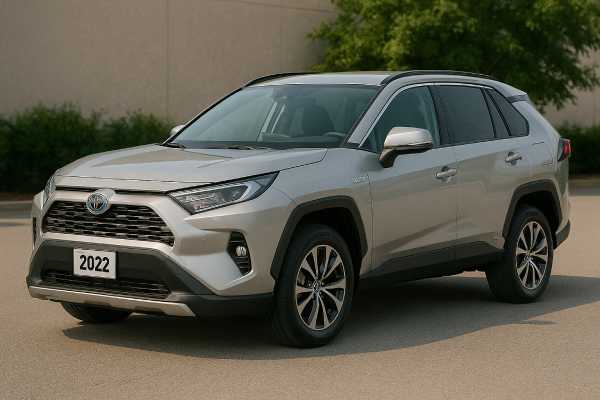
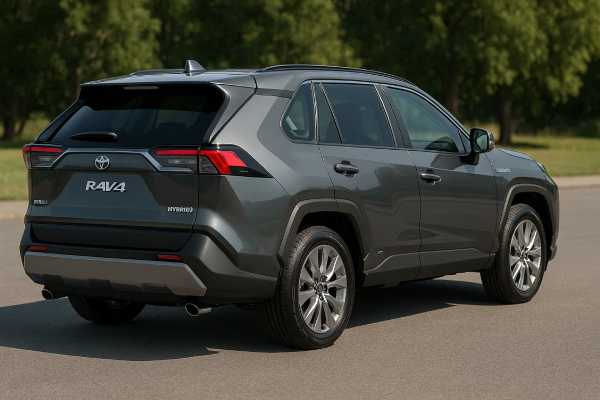
The facelifted Toyota RAV4 Hybrid AWD-i combines proven hybrid hardware with practical packaging and low running costs. Its A25A-FXS 2.5-liter engine works with front and rear electric motors (AWD-i) through Toyota’s planetary eCVT for seamless drive and excellent efficiency. Cabin upgrades in the facelift years brought larger, faster infotainment, clearer instruments, and steady improvements in Toyota Safety Sense. Owners value the roomy cargo hold, relaxed highway manners, and dependability under heavy daily use. Compared with the gas-only RAV4, the hybrid is quicker in real traffic, quieter around town, and markedly more economical without adding complex plug-in charging. This guide focuses on the 2022–present facelift run, distilling specifications, performance, safety context, reliability insights, and a maintenance plan that keeps total cost of ownership low over the long haul.
Fast Facts
- Hybrid strength: ~40 mpg combined (≈5.9 L/100 km) in many trims, yet brisker than the gas 2.5.
- Real utility: square cargo bay, wide-opening rear doors, easy LATCH/ISOFIX access.
- Confident safety story: strong crash protection, improved headlights on many trims, and mature driver-assistance tuning.
- Watch-for: ensure camera/radar calibration after windshield or bumper work; rotate tires to curb outer-shoulder wear on larger wheel packages.
- Typical service rhythm: engine oil and filter every 10,000 miles / 12 months (or 5,000 miles / 6 months in severe service).
What’s inside
- RAV4 Hybrid AWD-i Overview
- Specifications and Technical Data
- Trims and Options, Safety and Driver Assistance
- Reliability, Common Issues and Service Actions
- Maintenance and Buyer’s Guide
- Driving and Performance
- How RAV4 Hybrid Compares to Rivals
RAV4 Hybrid AWD-i Overview
Toyota’s facelift for the XA50 RAV4 Hybrid (beginning model year 2022) refines a formula that already dominated high-efficiency family SUVs. The A25A-FXS “Dynamic Force” 2.5-liter four-cylinder operates on an Atkinson-leaning cycle for thermal efficiency, paired with a traction motor on the front axle and a dedicated rear motor that engages seamlessly for AWD-i traction. There is no driveshaft between axles; the rear motor wakes as needed for launch, wet surfaces, or corner exit stability, trimming parasitic drag at cruise. Total system output is 219 hp (163 kW) with a broad, real-world torque band from the e-motors.
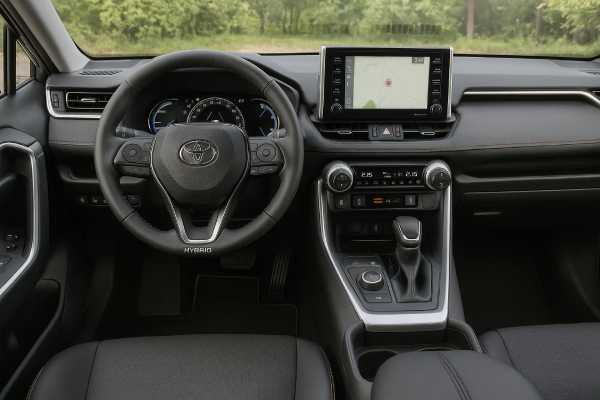
Daily usability remains front and center. Seating is upright with clear outward visibility; the load bay is wide and flat with handy side cubbies. The facelift made meaningful interior changes—larger center displays, quicker processors, and more natural voice control—while retaining physical knobs for climate and volume, which owners appreciate in winter gloves. Ride quality is calm on 17–18-inch wheels; 19-inch packages add steering precision but pass more texture into the cabin. The hybrid’s eCVT manages engine speed transparently in most driving; under heavy throttle the engine is audible but the vehicle responds with decisive forward motion, especially from 20–50 mph where the motors lend instant torque.
Ownership is straightforward. The hybrid system uses long-life coolant, the timing drive is chain-driven, and there’s no alternator or conventional starter to service—the traction system covers start/stop duties. The traction battery is packaged to preserve most of the cargo volume, and hybrid components are designed for the life of the vehicle under normal use. For snowbelt owners, AWD-i with quality winter tires is confident and predictable; for sunbelt commuters, low engine revs and frequent EV glide make the RAV4 Hybrid surprisingly quiet and frugal across suburban routes.
Specifications and Technical Data
Powertrain & Efficiency (HEV)
| Item | Value |
|---|---|
| Engine code | A25A-FXS (Dynamic Force) |
| Layout & valvetrain | Inline-4, DOHC, Dual VVT-i, 16 valves (4/cyl) |
| Bore × stroke | 87.5 × 103.5 mm (3.44 × 4.07 in) |
| Displacement | 2.5 L (2,487 cc) |
| Induction & fueling | Naturally aspirated; D-4S dual injection (DI + PFI) |
| Compression ratio | ~14.0:1 (Atkinson-leaning) |
| ICE max output | ~176 hp (131 kW) @ ~5,700 rpm; ~221 Nm (163 lb-ft) @ ~3,600–5,200 rpm |
| Traction motors | Front MG2 ~88 kW; Rear MGR ~40 kW (AWD-i assist) |
| System voltage | ~250–300 V nominal |
| Battery chemistry | Lithium-ion on most facelift builds (NiMH on some earlier configurations) |
| Combined system output | 219 hp (163 kW) |
| Rated efficiency (EPA) | ~41/38/40 mpg (city/hwy/combined) ≈ 5.7/6.2/5.9 L/100 km |
| Real-world highway @ 120 km/h (75 mph) | ~38–41 mpg US (6.2–5.7 L/100 km), temperature and tire dependent |
| Aerodynamics | Cd ≈0.33–0.34 (trim/wheel dependent) |
Hybrid note: Combined hp is not a simple sum of ICE + motors; it’s limited by inverter and battery power flow.
Transmission & Driveline (Hybrid eCVT)
| Item | Value |
|---|---|
| Transmission | eCVT power-split (planetary) with engine MG1/MG2 coordination |
| Final drive | ~3.7–3.9 (front transaxle; calibration-dependent) |
| Drive type | AWD-i (front traction motor + independent rear electric motor) |
| Rear driveline | No mechanical prop shaft; on-demand rear motor engagement |
| Drive modes | EV (low-load), Eco, Normal, Sport; Trail mode logic for low-mu surfaces |
| Towing (hybrid) | Typically 1,750 lb (794 kg) with proper equipment |
| Refuel to full | ~3–5 minutes typical pump time |
Chassis & Dimensions
| Item | Value |
|---|---|
| Platform | TNGA-K |
| Front suspension | MacPherson strut |
| Rear suspension | Multi-link |
| Steering | Electric power rack; ~14–15:1 ratio |
| Brakes | 4-wheel discs with hybrid brake-by-wire (front ≈328 mm / 12.9 in; rear ≈300 mm / 11.8 in) |
| Wheels/Tires | 17–19 in; 225/65R17, 225/60R18, 235/55R19 common |
| Ground clearance | ≈205–218 mm (8.1–8.6 in) by trim |
| Length / Width / Height | ≈4,600 / 1,855 / 1,700 mm (181.1 / 73.2 / 66.9 in) |
| Wheelbase | 2,690 mm (105.9 in) |
| Turning circle | ≈11.0 m (36.1 ft) curb-to-curb |
| Curb weight | ≈1,660–1,770 kg (3,660–3,900 lb) |
| GVWR | ≈2,185–2,260 kg (4,820–4,985 lb) |
| Fuel tank | ≈55 L (14.5 US gal / 12.1 UK gal) |
| Cargo volume (SAE) | ≈37.5–37.6 ft³ (≈1,060 L) seats up; ≈69.8 ft³ (≈1,977 L) seats down |
Performance & Capability
| Metric | Value |
|---|---|
| 0–60 mph (0–97 km/h) | ~7.5–7.8 s (typical tests) |
| Top speed | ~112–118 mph (180–190 km/h) indicated |
| 100–0 km/h braking | ~38–41 m (125–135 ft), tire-dependent |
| Towing capacity | 1,750 lb (794 kg) typical |
| Payload | ~900–1,000 lb (≈410–455 kg) |
| Roof load | Up to ~75 kg (165 lb) with rated crossbars |
Fluids & Service Capacities
| System | Specification | Capacity |
|---|---|---|
| Engine oil | API SP / ILSAC GF-6 0W-16 (0W-20 acceptable per manual in some climates) | ~4.8 L (5.1 qt) with filter |
| ICE coolant | Toyota Super Long Life (pink), 50/50 premix | ~7–8 L (7.4–8.5 qt) total with hybrid loops |
| Hybrid transaxle fluid | Toyota WS ATF (power-split transaxle) | ~3.5–4.0 L (3.7–4.2 qt) drain & fill |
| Inverter/e-axle coolant | Toyota SLLC (separate loop; verify per VIN) | See service manual (shared capacity in many builds) |
| A/C refrigerant | R-134a or R-1234yf (verify under-hood label) | ~500–600 g (17.6–21.2 oz) |
| A/C compressor oil | ND-OIL8 or ND-OIL12 (by MY) | ~100–130 mL (3.4–4.4 fl oz) |
| Key torque values | Wheel nuts 103 Nm (76 lb-ft); drain plug ~40 Nm (30 lb-ft) typical—verify manual |
Electrical
| Item | Value |
|---|---|
| 12V system | DC-DC converter from HV; no conventional alternator |
| 12V battery | H4/140R or H5 group common; ~45–60 Ah |
| Spark plugs | Long-life iridium; gap ~0.8 mm (0.031 in); typical replacement ~120,000 miles (192,000 km) |
Safety & Driver Assistance
| Item | Value |
|---|---|
| Headlight performance | Good/Adequate on many 2022+ trims with LED projectors |
| ADAS suite | Toyota Safety Sense 2.5/2.5+: AEB (vehicle/pedestrian/cyclist), adaptive cruise, lane keep/centering, road sign assist; Blind Spot Monitor / RCTA widely available; rear auto braking and surround view on upper trims |
| Child-seat provisions | 2 × ISOFIX/LATCH outboard; top tethers ×3; wide rear door aperture |
Trims and Options, Safety and Driver Assistance
Trim overview (North America): LE Hybrid, XLE Hybrid, XLE Premium Hybrid, SE Hybrid, XSE Hybrid, Limited Hybrid, plus the more rugged Woodland Edition (hybrid-only with off-road styling and raised capability touches). All RAV4 Hybrids are AWD-i by design. Visual identifiers: LE/XLE employ simpler projector beams and practical 17–18-inch wheels; XLE Premium and Limited add SofTex seating, larger screens, power liftgate, and richer interior trim. SE/XSE bring sportier fascias, contrast-roof options, and suspension calibrations biased slightly firmer.
Mechanical and functional differences by trim:
- Suspension/tires: SE/XSE calibrations feel tauter; Woodland pairs its look with all-terrain-leaning tires and added roof rack/cargo flexibility.
- Towing setup: Hybrids commonly rate 1,750 lb (794 kg); check the door-jamb label and hitch type before assuming.
- Brakes: Same core package; higher-content trims may run larger-diameter wheels that influence pad compound availability and pricing.
Infotainment and cabin tech: Facelift years brought larger center displays and quicker processors. Wireless Apple CarPlay/Android Auto rolled out broadly, and USB-C ports multiplied. Limited/XSE commonly bundle premium audio (JBL), camera-based digital rearview mirror, and parking assist options.
Safety ratings (context and evolution): The RAV4 family performs well in core crashworthiness. As testing bodies introduced updated side and moderate-overlap procedures, ratings may vary by model year and headlamp specification. In practice, structure, restraint performance, and headlamp quality are strong on many 2022+ builds. Look for trims explicitly listing “Good” headlight packages if you want top marks in rating summaries.
ADAS availability and service notes:
- Standard: Forward collision warning, pedestrian/cyclist AEB (day/night capability), lane departure alert with steering assist, lane tracing (centering) with full-speed adaptive cruise, and road sign assist.
- Common options: Blind Spot Monitor with Rear Cross-Traffic Alert; rear auto braking; surround-view camera; front and rear parking assist.
- Calibration implications: After windshield, bumper, or grille repairs, camera/radar must be calibrated. Misalignment reduces AEB performance and can disable lane centering; expect static targets and a dynamic road drive to complete the procedures.
Year-to-year highlights (facelift era):
- 2022: Lighting signatures and wheel updates; incremental infotainment/ADAS refinements.
- 2023–2024: Widespread larger displays and faster UIs; improved headlight availability across more trims; expanded wireless connectivity.
- 2025: Packaging and software tune-ups as the generation matures; continued emphasis on ADAS consistency.
Reliability, Common Issues and Service Actions
The RAV4 Hybrid AWD-i enjoys an excellent reliability baseline thanks to mature hybrid components and conservative thermal management. Most owners see routine maintenance only through high mileage. Still, smart ownership means knowing typical patterns and quick fixes.
Common (low–medium severity):
- Tire noise/ride on 19-inch wheels: Sharper impacts and more road roar on coarse asphalt. Remedy: choose 17–18-inch tires for comfort; maintain door-label pressures.
- Brake hardware corrosion in snowbelt regions: Hybrids rely on regen, so friction brakes can glaze or corrode. Remedy: periodic firm stops; clean/grease slide pins annually; replace hardware as needed.
- Windshield/camera sensitivity: After glass replacement, uncalibrated cameras can trigger lane-keeping faults or AEB warnings. Remedy: perform static/dynamic calibration per service manual.
Occasional (medium):
- Inverter/transaxle coolant service neglect: Hybrid loops are long-life but not lifetime. Remedy: follow time/mileage guidance; burp air properly to protect power electronics.
- 12V battery aging on short trips: Frequent short cycles, high accessories. Remedy: load-test yearly after year 3; a maintenance charger helps if stored.
Rare (medium–high):
- HV battery module imbalance alerts: Seen predominantly in neglected or extreme-use vehicles. Symptoms: persistent SOC swings, warning lights. Remedy: dealer-level diagnostics; replace modules or pack per policy; inspect cooling fan ducting for debris/pet hair.
- A/C performance variance with R-1234yf: Feels less cold at idle in heatwaves compared with R-134a. Remedy: verify correct charge mass; system behavior may be normal.
Software and calibrations to ask for:
- Hybrid/engine ECU updates that refine engine warmup strategies and noise control.
- ADAS updates that expand pedestrian/night detection windows and improve camera classification.
Recalls and service campaigns: Actions vary by VIN and build date (e.g., occupant classification sensor compliance on certain 2022 builds). Always check an official recall portal before purchase and after body/glass work. Completion is free at franchised dealers; keep the paperwork in the glovebox packet.
Pre-purchase checks (used hybrid):
- Service history showing 10k/12-month oil changes and timely coolant service.
- Brake inspection with photos; ensure even pad thickness and clean sliders.
- Tire wear/alignment report; outer-shoulder wear suggests toe issues, especially on 19-inch tires.
- ADAS demonstration on a road test (lane centering, adaptive cruise, AEB warning behavior).
- Cabin air filter and HV battery cooling path—check for debris in the intake and fan ducting.
- VIN recall check and dealer service printout confirming campaign completion.
Maintenance and Buyer’s Guide
Service schedule (distance/time—whichever comes first):
- Engine oil & filter: 10,000 miles / 12 months (normal) or 5,000 miles / 6 months (severe). Use approved 0W-16 (or the manual-listed alternative).
- Engine air filter: Inspect 15,000 miles; replace 30,000–45,000 miles based on dust load.
- Cabin filter: Replace 15,000–20,000 miles or annually; keep the HVAC intake clean.
- Spark plugs (iridium): Replace 120,000 miles (192,000 km).
- Coolant: First change typically 100,000 miles / 10 years, then 50,000 miles / 5 years (ICE and inverter loops—verify per VIN).
- Hybrid transaxle fluid (WS): No routine change under normal use; for heavy urban service, rideshare, or towing, a drain-and-fill at 60,000–90,000 miles is a sensible preventive.
- Brake fluid: Replace every 3 years regardless of mileage.
- Friction brakes: Inspect at every tire rotation; de-glaze and lube slides annually in salted climates.
- Serpentine/aux belt & hoses: Inspect 30,000 miles / 2 years; replace on cracks/noise.
- Alignment & rotation: Rotate 5,000–7,500 miles; align when you see edge wear or a pull.
- 12V battery: Load-test annually after year three; typical life 4–6 years.
- Underbody care: Rinse after winters; treat paint chips early to prevent corrosion.
Fluids quick list (decision-making):
- Oil: API SP/GF-6 0W-16; ~4.8 L (5.1 qt) with filter; drain plug ~40 Nm (30 lb-ft).
- Coolant: Toyota SLLC pink; ~7–8 L across hybrid/ICE loops.
- Transaxle: Toyota WS; ~3.5–4.0 L drain/fill.
- A/C: R-134a or R-1234yf per label; ~500–600 g charge; compressor oil ND-OIL8/12 per MY.
- Tires: Door-label pressures (often 35–36 psi cold on stock sizes).
DIY and shop tips:
- Oil service: Replace the filter-cap O-ring and crush washer; reset maintenance minder via steering-wheel buttons.
- Brake care on hybrids: Perform a few deliberate, moderate-to-firm friction stops weekly to keep rotors clean since regen reduces pad usage.
- HV battery cooling: Vacuum the intake grille area and inspect the fan path if you carry pets.
- Glass/ADAS work: Photograph sensor brackets before removal; complete static/dynamic calibration immediately after refit.
Buyer’s picks and watch-outs (hybrid):
- Value sweet spot: XLE Hybrid—balanced equipment, comfortable wheel/tire sizes, and excellent economy.
- Feature-rich: Limited Hybrid—premium audio, upgraded headlights on many builds, and broader ADAS options.
- Adventure look with hybrid economy: Woodland Edition (hybrid-only) if you like the stance and accessory ecosystem.
- If comfort matters most: Prefer 17–18-inch wheels and touring-oriented tires; they hush the cabin and smooth expansion joints.
Durability outlook: With routine service and healthy brake maintenance, the hybrid system, e-axles, and eCVT commonly deliver 200,000+ miles (320,000+ km) without internal repairs. The largest cost variables are tires, alignment discipline, and timely coolant and brake-fluid service that protects power electronics and friction-brake hardware.
Driving and Performance
Ride, handling, NVH: The TNGA-K platform brings high body rigidity and predictable responses. On 17–18-inch wheels, the RAV4 Hybrid rides quietly and shrugs off broken pavement. 19-inch packages look sharper but transmit more texture; choose accordingly. Highway tracking is confident with good straight-line stability. Steering weight is light in parking, secure at 70–75 mph, and the chassis reacts cleanly to quick lane changes without wallow.
Powertrain character: The hybrid’s strength is instant low-rpm torque from the motors. Around town, it steps off briskly and often glides electrically at neighborhood speeds. The eCVT coordinates engine and motors so that engine revs rise mainly under heavy load; otherwise, the engine hums quietly at low rpm. Sport mode sharpens pedal mapping and holds engine speed a bit longer for passing. Compared with the gas-only 2.5, the hybrid feels livelier in the 20–50 mph range and quieter in stop-and-go traffic.
Real-world efficiency: Many owners see 38–42 mpg US combined (6.2–5.6 L/100 km) depending on climate, tires, and driving style. At 75 mph (120 km/h) on level highway, 38–41 mpg US is common with climate control at moderate settings. Winter reduces efficiency 10–20% due to cabin heat demands and denser air; pre-conditioning while parked is less relevant than in plug-ins, but a warm garage helps.
Braking and consistency: Blended braking is linear with a stable pedal; the transition from regen to friction is smooth when hardware is clean. Repeated hard stops remain predictable; if pedal travel increases over time, schedule a brake-fluid replacement and inspect caliper slides.
Traction and control: AWD-i engages the rear motor proactively at launch and in low-mu corners. With proper winter tires, snow performance is confident. Stability-control tuning is conservative but non-intrusive in daily driving. Trail mode adjusts throttle/brake logic for loose surfaces, useful on gravel two-tracks.
Load and towing: With 1,750 lb (794 kg) tow capacity typical for the hybrid, small utility trailers, kayaks, or camping gear are realistic. Expect a 20–30% fuel-economy penalty at freeway speeds when towing a boxy load. Downshift with the shifter’s manual gate on long descents to spare friction brakes; the hybrid will also increase regen automatically on grades.
How RAV4 Hybrid Compares to Rivals
Honda CR-V Hybrid (FWD/AWD): Smooth and quiet with strong highway manners and a roomy rear seat. Economy is competitive, and acceleration feels similar. Toyota counters with longer hybrid track record, broad dealer familiarity, and typically stronger resale.
Hyundai Tucson Hybrid: Feature-rich with a plush ride and brisk low-speed response. Real-world economy is close, though some drivers report wider swings in cold weather. Warranty coverage is a strength; Toyota’s long-term reliability reputation and resale often tilt total cost of ownership back toward the RAV4.
Ford Escape Hybrid: Light on its feet and efficient, with an easy-to-use cabin. Towing varies by configuration; Toyota’s AWD-i traction logic and packaging are standouts, and cargo hold shape is often more practical in the RAV4.
Subaru Forester (non-hybrid): Not a hybrid rival but a frequent cross-shop. Outstanding visibility and standard AWD, yet lower fuel economy and slower acceleration than RAV4 Hybrid. If you want snow-belt confidence without hybrid economy, Forester is compelling; if you want both traction and high mpg, RAV4 Hybrid leads.
RAV4 Prime plug-in: The PHEV is quicker and offers EV-only miles, but it’s pricier and heavier. If you can’t charge at home, the regular Hybrid’s simplicity and cost balance will serve better.
Bottom line: The RAV4 Hybrid’s blend of efficiency, pace, space, and long-term reliability still sets the class benchmark. Rivals may match one or two pillars, but few combine all four so consistently.
References
- Gas Mileage of 2023 Toyota RAV4 2023 (EPA Ratings)
- 2023 Toyota RAV4 2023 (Safety Rating)
- 2023 RAV4 Hybrid Owner’s Manual 2023 (Owner’s Manual)
- Look up Safety Recalls & Service Campaigns by VIN 2025 (Recall Portal)
Disclaimer
This article is for informational purposes and is not a substitute for professional diagnosis or repair. Specifications, torque values, fluid types, and maintenance intervals vary by VIN, production date, market, and equipment. Always verify procedures and values against your vehicle’s official service documentation, labels, and the latest technical publications. If this guide helped you, please consider sharing it on Facebook or X/Twitter to support xcar’s work.