
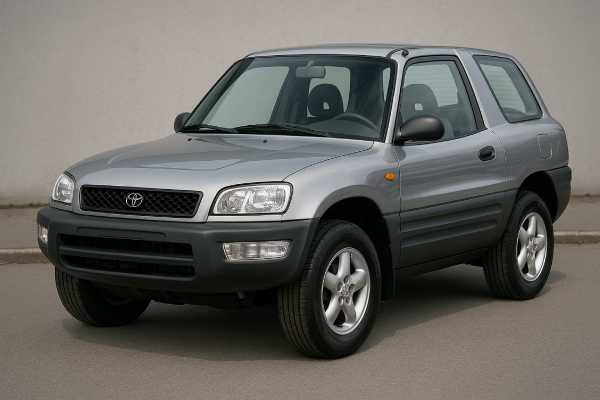
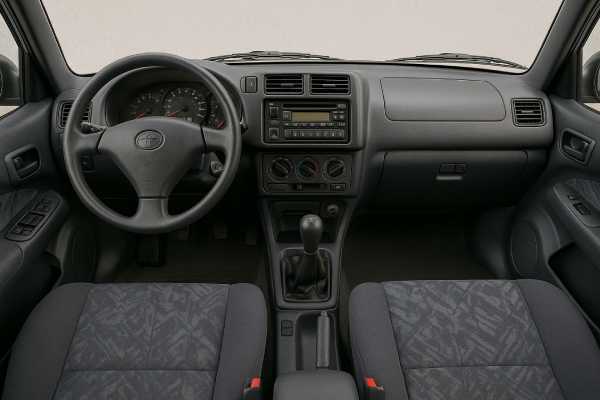
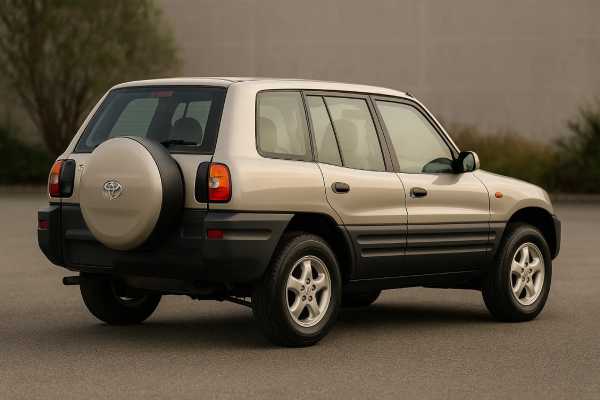
The facelifted first-generation Toyota RAV4 (1998–2000) helped define the modern compact crossover: car-like unibody, independent suspension at all four corners, and a practical two-box body you could park anywhere. In front-wheel-drive form with the 3S-FE 2.0-liter four-cylinder, it prioritizes simplicity and low running costs over flash. You get honest performance, light controls, and cabin space that belies the footprint. The facelift brought minor styling and feature updates while retaining the robust mechanical package—multi-port fuel injection, timing belt, and straightforward service access. This guide focuses on the late-cycle FWD models, translating period specs and contemporary ownership advice into today’s expectations. If you are shopping one or maintaining a keeper, you will find the key dimensions, performance figures, maintenance intervals, and reliability patterns mapped out clearly, with practical context on safety and parts interchange. It is an easy car to live with, provided you keep up with fluids, belts, and corrosion prevention.
Top Highlights
- Compact footprint with impressive cabin room; light, predictable steering makes city driving easy.
- Proven 3S-FE engine known for longevity with routine timing-belt service and quality fluids.
- Real-world 25–27 mpg US highway (≈ 9.4–8.7 L/100 km) when healthy and correctly aligned.
- Watch for age-related rubber (bushings/hoses) and evaporative emissions leaks on older cars.
- Typical oil change interval: 5,000–7,500 mi (8,000–12,000 km) or 6–12 months, depending on use.
What’s inside
- RAV4 FWD 1998–2000 Overview
- RAV4 FWD Specs and Data
- RAV4 Trims and Safety
- Reliability and Common Fixes
- Maintenance and Buyer’s Guide
- Driving and Performance
- RAV4 vs Rivals
RAV4 FWD 1998–2000 Overview
The facelifted XA10 RAV4 refined an already successful recipe. Its fundamentals are simple: a transverse 2.0-liter inline-four (3S-FE), front-wheel drive, a 5-speed manual or 4-speed automatic transaxle, independent suspension (MacPherson strut front, double-wishbone rear), and four-wheel ABS available. The result is low mass, tidy exterior dimensions, and everyday usability that feels more like a hatchback than an SUV.
Model choice spans two-door and four-door bodies in some markets, but in North America the four-door FWD is most common and most practical. Interior packaging is the star: upright seating, good visibility, and a flat load floor with the rear bench folded. The facelift (late 1997 production onward, sold as 1998–2000 in North America) added mild exterior tweaks, revised trim content, and incremental NVH improvements without changing the core mechanicals. The 3S-FE remained naturally aspirated with multi-port fuel injection and a timing belt. Output varies slightly by market and rating convention—late-cycle models are commonly listed around 120–129 hp (89–96 kW) with torque near 181 Nm (133 lb-ft). Expect brisk urban response and adequate highway merging, with the manual making the most of the engine’s midrange.
Ownership strengths remain durability and serviceability. The engine bay is uncluttered, parts are widely available, and the driveline is robust when fluids are replaced on schedule. The front-drive layout keeps complexity and weight lower than the 4WD version, improving fuel economy and reducing wear on joints and bearings. On the downside, age is now the primary challenge: rubber bushings, vacuum lines, evap hoses, and radiator plastics can be brittle. Corrosion depends heavily on climate and care—wheel arches, rear suspension mounts, and fasteners benefit from inspection and protective treatments. If you like straightforward mechanics with compact-car running costs, this late first-gen RAV4 FWD is still a sweet spot.
RAV4 FWD Specs and Data
Below are consolidated specifications for facelift (1998–2000) RAV4 FWD four-door models with the 3S-FE 2.0-liter engine. Figures reflect typical North American equipment; small variations occur by model year and options.
Engine and Performance (3S-FE, ICE)
| Item | Specification |
|---|---|
| Code | 3S-FE |
| Layout & cylinders | Transverse inline-4, DOHC, 16 valves (4 per cyl) |
| Bore × stroke | 86.0 × 86.0 mm (3.39 × 3.39 in) |
| Displacement | 2.0 L (1,998–1,999 cc) |
| Induction | Naturally aspirated |
| Fuel system | Multi-port fuel injection (MPFI) |
| Compression ratio | ~9.5:1 (market/calibration dependent) |
| Max power | 120–129 hp (89–96 kW) @ ~5,400–5,600 rpm |
| Max torque | ~181 Nm (133 lb-ft) @ ~4,400 rpm |
| Timing drive | Belt (external, replace at interval) |
| Emissions standard (period) | Tier 1/LEV-equivalent calibrations (market dependent) |
| Rated economy (period EPA) | City ~21 mpg US; Hwy ~26–27 mpg US; Combined ~23 mpg US (≈ 11.2/9.0–8.7/10.2 L/100 km) |
| Real-world highway @ 75 mph | ~25–27 mpg US (≈ 9.4–8.7 L/100 km), wind/tyre/roof-rack dependent |
| Aerodynamics | Cd not officially published for all variants; small roof accessories increase drag noticeably |
Transmission and Driveline
| Item | Specification |
|---|---|
| Transmission | 5-speed manual (cable-shift) or 4-speed automatic (electronically controlled) |
| Drive type | FWD (open differential) |
| Final drive | ~4.1–4.2 (varies by transaxle/tyre) |
| Traction aids | ABS available; no factory stability control on this generation |
| Refuel to full | Typically under 5 minutes at pump |
Chassis and Dimensions
| Item | Specification |
|---|---|
| Platform | Unibody crossover (XA10) |
| Suspension (front/rear) | MacPherson strut / Double-wishbone |
| Steering | Rack-and-pinion, power-assisted |
| Brakes | Front ventilated discs; rear drums on most FWD (rear discs with certain packages) |
| Wheels/Tyres (typical) | 215/70 R16 on 16×6.5 in wheels (steel or alloy) |
| Ground clearance | ~190 mm (7.5 in), varies with tyres/springs |
| Length × width × height | ~4,115–4,160 × 1,695 × 1,650 mm (162.0–163.8 × 66.7 × 65.0 in) |
| Wheelbase | 2,410 mm (94.9 in) |
| Turning circle (kerb-to-kerb) | ~10.4 m (34.1 ft) |
| Curb weight (typical FWD) | ~1,180–1,260 kg (2,600–2,775 lb) depending on trim and trans |
| GVWR | ~1,690–1,720 kg (3,725–3,790 lb) |
| Fuel tank | ~58 L (15.3 US gal / 12.7 UK gal) |
| Cargo volume | Seats up/down ~540–1,250 L (19–44 ft³) depending on measurement method and spare-wheel placement |
Performance and Capability
| Metric | Value |
|---|---|
| 0–100 km/h (0–62 mph) | ~11–12.5 s (manual quicker than automatic) |
| Top speed | ~170–175 km/h (106–109 mph), gearing/tyres dependent |
| 100–0 km/h braking | ~38–42 m (125–138 ft) in good trim on quality tyres |
| Towing capacity (braked) | ~680–900 kg (1,500–2,000 lb) when properly equipped; check local rating |
| Payload | ~400–480 kg (880–1,060 lb) depending on options |
| Roof load | ~45–75 kg (100–165 lb) with genuine bars; observe bar rating |
Fluids and Service Capacities
| System | Specification / Capacity |
|---|---|
| Engine oil | API SJ/SL 5W-30 (typical); ~3.7–3.9 L (3.9–4.1 US qt) with filter |
| Coolant | Phosphate organic-acid Toyota Long Life; ~6–7 L (6.3–7.4 US qt) mixed 50/50 |
| Manual trans oil | API GL-4/GL-5 75W-90 (check label); ~2.1–2.4 L (2.2–2.5 US qt) |
| Automatic ATF | Dexron III-spec; service fill typically ~3–4 L (3.2–4.2 US qt) after drain/pan |
| Brake fluid | DOT 3 (DOT 4 acceptable); bleed as needed |
| A/C refrigerant | R-134a; charge mass varies by condenser/compressor—verify under-hood label |
| A/C compressor oil | ND-Oil 8 (PAG), quantity per compressor type |
| Key torque specs (essential) | Wheel nuts ≈ 103 Nm (76 lb-ft); spark plugs ≈ 18–22 Nm (13–16 lb-ft); engine drain plug ≈ 35–40 Nm (26–30 lb-ft) — verify per VIN |
Electrical
| Item | Specification |
|---|---|
| Alternator output | ~70–80 A (varies by option) |
| 12 V battery | ~45–60 Ah (common North American group sizes 35/24F; check tray) |
| Spark plugs | Nickel/copper or long-life iridium equivalent; gap ~1.1 mm (0.043 in) |
Safety and Driver Assistance (period equipment)
| Feature | Details |
|---|---|
| Airbags | Dual front airbags standard (late-cycle) |
| ABS | Available/standard by trim/year; no ESC on this generation |
| Child-seat provisions | Rear belts with locking function; ISOFIX/LATCH not widely implemented yet |
| Headlights | Halogen reflectors; aim and lens clarity critical with age |
| Crash-test context | Contemporary US NCAP frontal testing; IIHS moderate-overlap testing for small SUVs became more comprehensive after this generation |
Notes: Power and economy vary slightly by model year, transmission, and market calibration. Always confirm torque values and fluid capacities against the under-hood labels or official service data for the specific VIN.
RAV4 Trims and Safety
Trims and options (late XA10, FWD focus): Regional naming varied, but common themes hold. Base models brought cloth seats, manual HVAC, and steel wheels. Up-level packages added power windows/locks, keyless entry, alloy wheels, rear privacy glass, roof rails, and in some cases a sunroof and upgraded audio. Anti-lock brakes were broadly available; cruise control, leather steering wheel, and rear disc brakes tended to bundle with higher trims or specific option packages. The FWD models typically used rear drums; rear discs appeared more often on 4WD or on optioned examples.
Functional differences to watch for:
- Transmissions: The 5-speed manual feels livelier and returns slightly better highway economy; the 4-speed auto is durable with fresh ATF and correct throttle/kickdown cable adjustment (where fitted).
- Brakes: FWD drum rears are easy to service and adequate with quality friction material; ABS-equipped variants reduce wheel lock on slick surfaces but require careful wheel-speed sensor handling during suspension work.
- Wheels/Tyres: Taller 70-series tyres improve ride and curb protection; all-terrain patterns add noise and can dent economy by 1–2 mpg US.
Year-to-year highlights (facelift window):
- 1998: Styling refresh; option reshuffling; incremental NVH improvements; ABS availability widened in many markets.
- 1999: Minor feature content changes; audio and interior trim tweaks; running updates to emissions equipment and evap hardware.
- 2000: Late-cycle packaging revisions; some markets see standard ABS and additional convenience items on higher trims.
Safety ratings (period context): These late first-gen RAV4s fall under period US frontal crash testing and evolving side-impact procedures. Head restraints and airbag calibrations improved through the cycle. When shopping, verify that the driver’s airbag recall status is up to date (inflator campaigns affected many vehicles built in the late 1990s). Because stability control was not yet standard, tyre choice, brake maintenance, and suspension condition play a major role in day-to-day safety.
Safety systems and ADAS considerations:
- Airbags: Driver and passenger front airbags are standard. Inspect airbag warning lights at key-on and ensure normal self-test behavior.
- Braking/stability: Four-wheel ABS where fitted; no traction control or electronic stability control. Brake proportioning is mechanical.
- Child seats: Use seating positions with the best belt geometry; installation is typically via seatbelt with locking retractor rather than ISOFIX/LATCH anchors.
- Service notes: After hub/bearing or control-arm work on ABS-equipped cars, inspect tone rings and sensor clearances. On vehicles with rear drums and ABS, route wiring carefully to avoid chafing.
Reliability and Common Fixes
The 3S-FE and XA10 platform have a well-earned reputation for longevity when maintained. Most issues you will encounter at this age are either consumables reaching end of life or age-related plastics and seals. Below is a pragmatic map, organized by prevalence and cost/effort.
Common (low–medium cost):
- Timing belt & seals (90–105k mi / 145–170k km or 7–9 years):
Symptoms: Age/time exceeded, belt glazing, seepage at cam/crank seals.
Cause: Normal wear and hardened seals.
Remedy: Replace timing belt, tensioner/idler, cam/crank seals, and water pump while open; refresh accessory belts. - Valve-cover and cam-plug seepage:
Symptoms: Oil film down the rear of the head, burning-oil smell on manifold.
Cause: Aged gasket and half-moon cam plugs.
Remedy: New valve-cover gasket set and cam plugs; clean PCV system to reduce pressure. - EVAP leaks (small leak / purge faults):
Symptoms: MIL on with small-leak codes; fuel smell after hot soak.
Cause: Brittle evap hoses, cracked charcoal canister nipples, loose gas cap.
Remedy: Smoke test; replace hoses and cap; repair canister fittings. - Cooling plastics and radiators:
Symptoms: Hairline cracks at tank crimps; coolant smell.
Cause: Heat cycling and age.
Remedy: Replace radiator; inspect hoses and thermostat; refill with correct coolant. - Suspension bushings/struts:
Symptoms: Clunks, wandering, uneven tyre wear.
Cause: Aged rubber in control arms, sway-bar links, and struts.
Remedy: Renew worn bushings/links; quality struts transform ride and braking stability.
Occasional (medium cost):
- Rear drum hardware wear:
Symptoms: Long pedal travel, pulling, scraping noises.
Cause: Worn shoes/springs and ovalised drums.
Remedy: Rebuild rear drums (shoes, hardware kit, wheel cylinders as required); flush brake fluid. - Automatic transaxle shift feel (4-speed):
Symptoms: Flare or harsh 2–3 shift when hot; hunting on grades.
Cause: Aged ATF, throttle cable misadjustment (where equipped), or worn accumulators.
Remedy: Correct cable setting; service ATF with proper procedure; evaluate mounts; escalate to valve-body work only if needed. - Wheel bearings (front):
Symptoms: Growl that changes with steering load.
Cause: Water ingress; torque events over many years.
Remedy: Press in quality bearings; confirm axle-nut torque; check tone ring if ABS-equipped.
Rare but important (medium–high cost):
- Head-gasket on overheated engines:
Symptoms: Misfire on cold start; coolant loss with clean plugs; oil/coolant mixing if severe.
Cause: Overheat events from neglected cooling systems.
Remedy: Proper diagnosis (block test/compression/leak-down); gasket and machining if out of spec; renew cooling components. - Airbag inflator safety recalls:
Symptoms: Open recall status.
Cause: Population-wide inflator issues.
Remedy: Confirm via official lookup and complete recall at a franchised dealer; no charge to owner.
Corrosion watchpoints:
- Rear wheel arches and lower door seams; subframe mounts; exhaust hangers; hardware under ABS sensor loops. Early prevention with rustproofing and regular rinsing in winter pays off.
Pre-purchase checks to request:
- Full service history (timing-belt dates/mileage, coolant type, ATF changes).
- Proof of completed recalls and any Technical Service Bulletins noted on service records.
- Recent brake fluid flush and evidence of quality tyres with even wear.
- EVAP system inspection results (many emissions checks flag small leaks on older hoses).
- Battery health test and alternator charging voltage.
Maintenance and Buyer’s Guide
Practical maintenance schedule (time or distance, whichever comes first):
- Engine oil & filter: 5,000–7,500 mi (8,000–12,000 km) / 6–12 months. Short-trip or dusty use favors the shorter interval.
- Engine air filter: Inspect 12 months/12,000 mi (20,000 km); replace 24–30,000 mi (40–48,000 km) or sooner in dusty areas.
- Cabin air filter: If fitted, inspect annually; many early units lack a separate cabin filter—retrofit options exist.
- Coolant: Replace every 2–3 years or 30–50,000 mi (48–80,000 km) unless using super-long-life coolant; always mix 50/50 with de-mineralized water.
- Spark plugs: 30–60,000 mi (48–96,000 km) depending on plug type; gap ~1.1 mm (0.043 in).
- Fuel filter: External filter service as fitted; many are in-line under-body—inspect for corrosion and replace by 60–90,000 mi (96–145,000 km) or if pressure drops.
- Timing belt kit & water pump: 90–105,000 mi (145–170,000 km) or 7–9 years; replace tensioner/idler and seals while open.
- Serpentine/aux belts & hoses: Inspect every 12 months; replace at first signs of cracking/glazing or every 60,000 mi (96,000 km).
- Manual trans oil: 30–60,000 mi (48–96,000 km) depending on duty cycle; use correct GL-rating.
- Automatic ATF (drain/pan service): 30–50,000 mi (48–80,000 km); avoid aggressive flushes on high-mileage units—repeat gentle services instead.
- Brake fluid: Flush every 2 years.
- Brakes: Inspect pads/shoes and rotors/drums every 12 months or 12,000 mi (20,000 km).
- Differentials/transfer case: Not applicable on FWD; fewer fluids to service versus 4WD.
- Alignment & tyres: Rotate 5–7,500 mi (8–12,000 km); align annually or after any suspension work; maintain 32–35 psi (220–240 kPa) cold, adjusting for load.
- Valve clearances: Hydraulic lash on most 3S-FE applications is not adjustable; if you suspect ticking, confirm source and follow factory guidance.
- 12 V battery: Test every autumn; typical replacement window 4–6 years.
- A/C system: Inspect annually; do not overcharge; use the correct oil.
Fluid quick-reference (decision-grade):
- Engine oil: 5W-30 API SJ/SL; capacity ~3.8–4.0 US qt (3.7–3.9 L) with filter.
- Coolant: Toyota Long Life (red) or approved equivalent; total system ~6–7 L.
- Manual gearbox: 75W-90 GL-4/GL-5, ~2.1–2.4 L.
- Automatic: Dexron III ATF; pan drain service ~3–4 L.
- Brake fluid: DOT 3 (DOT 4 acceptable).
Essential torque values (verify per VIN): Wheel nuts ≈ 103 Nm (76 lb-ft); spark plugs ≈ 18–22 Nm (13–16 lb-ft); drain plug ≈ 35–40 Nm (26–30 lb-ft).
Buyer’s checklist (what to look for):
- Underside and arches: Inspect rear suspension pick-ups, fuel and brake lines, and arch lips for rust; look for fresh undercoating that may hide corrosion.
- Cooling system: Cold pressure test and cap integrity; look for pink crust at hose joints or radiator tanks.
- Engine bay: Oil leaks at cam/crank seals and valve cover; PCV operation; listen for accessory idler noise.
- Driveline: On manuals, check clutch engagement near mid-travel with no slip or chatter; autos should upshift cleanly when warm with no flare.
- Brakes: Even rotor faces; rear drum shoe thickness and hardware condition; ABS lamp self-test behavior.
- Steering & suspension: Play at tie-rod ends and lower-arm bushings; clunks over speed humps suggest worn sway-bar links or strut mounts.
- Emissions readiness: Scan for pending codes; evap monitors are common hang-ups on older hoses.
- Tyres: Even wear patterns; mismatched sets can upset feel and braking distances.
- Keys & electronics: Verify both keys; central locking and window regulators; dome light and hatch switch.
Recommended years/options: Any facelift (1998–2000) FWD example with documented timing-belt service, ABS, and manual transmission is a sweet driver’s pick. Automatic cars are fine if the fluid is clean and shifts are consistent when hot. Roof rails and a cargo cover add real-world utility with minimal penalty.
Durability outlook: With basic care—fresh coolant, quality oil, and timely belt service—200k mi (320k km) is realistic. Most surprises trace back to deferred maintenance or corrosion, not design flaws.
Driving and Performance
Ride, handling, and NVH: The first-gen RAV4 rides like a compact car with longer suspension travel. On good struts and 70-series tyres, it deals with patchy pavement without crashing, and there is enough compliance for gravel or winter ruts. Steering is light with modest on-center feel; the rack is direct for the era, and the short wheelbase makes tight streets a non-event. Wind and road noise are present at highway speeds compared with newer crossovers, but fresh door seals and quiet-running tyres help substantially. Brake feel is linear when front rotors and pads are quality pieces; rear drum adjustment matters—slack drums lengthen pedal travel and stopping distances.
Powertrain character: The 3S-FE is smoothest between 2,500 and 4,500 rpm. With the manual, you can keep it in the meat of the torque for a responsive, almost eager feel. The automatic shifts early in gentle driving but kicks down promptly when asked; a healthy throttle cable (where used) and clean ATF keep 2–3 upshifts tidy. There is no turbo lag to speak of—just linear NA delivery. The engine tolerates heat and long grades well if the radiator and fan clutch (where fitted) are in good order.
Efficiency in the real world: Around town expect mid-20s mpg US (9–11 L/100 km) depending on trip length and temperature. At 60–65 mph (100–105 km/h), many owners see 27–29 mpg US (8.7–8.1 L/100 km) on proper tyres and alignment; by 75 mph (120 km/h) the figure is more like 25–27 mpg US (9.4–8.7 L/100 km). Winter blends, roof baskets, and all-terrain tyres can cut economy by 5–15 percent.
Key performance metrics (typical):
- 0–60 mph (0–100 km/h): ~10.8–12.0 s depending on transmission and load.
- 80–120 km/h (50–75 mph) passing: Manual cars respond better; plan a downshift with the automatic.
- 100–0 km/h braking: ~38–42 m (125–138 ft) with quality tyres and fresh pads/rotors.
Traction and control: As an FWD crossover without stability control, tyre choice and driver inputs are the primary traction tools. In snow, a good set of true winter tyres transforms the RAV4—ABS will keep wheels from locking but cannot add lateral grip. The chassis is friendly at the limit, and lift-off understeer is gentler than on many period hatchbacks thanks to the longer travel rear suspension.
Load and light towing: The FWD model manages a weekend’s worth of garden-center duty or camping kit comfortably. Keep an eye on rear ride height with heavy loads; fresh rear springs and correct tyre pressures maintain composure. Light towing within local regulations is feasible when the cooling system is healthy; expect a 15–25 percent fuel-economy penalty with a small utility trailer.
RAV4 vs Rivals
The late first-gen RAV4 FWD competed with early compact crossovers and lifted hatches more than traditional SUVs.
- Honda CR-V (RD1/RD2): The CR-V of the era leans pragmatic with a slightly larger cabin and an efficient 2.0-liter, plus a swing-out tailgate and clever picnic table. In FWD trim, its ride is similarly compliant. The RAV4 counters with livelier steering feel and often lower curb weight. CR-V parts availability is on par; both are durable, but the RAV4’s timing belt/water pump job is typically simpler.
- Subaru Forester (SF): Standard AWD and a boxer engine make the Forester the snow-belt hero. However, permanent AWD adds complexity and fuel burn versus the RAV4 FWD. If you do not need AWD, the Toyota’s simpler driveline and often lower maintenance costs are compelling.
- Hyundai Santa Fe (early SM, arriving 2001): Slightly newer and larger, often with more features for the money on the used market. The RAV4 remains the safer long-term bet for parts depth and mechanical simplicity if you prefer to turn your own wrenches.
- Passenger-car alternatives (Corolla/Prizm wagons, period hatchbacks): If you are truly urban-focused, some compact wagons are thriftier. The RAV4’s higher seating, bigger cargo hatch, and robust suspension make it more versatile without feeling truck-like.
Bottom line: If your driving is mostly paved roads with occasional gravel or snow, and you value simple mechanics and low total cost of ownership, the facelifted RAV4 FWD remains one of the most balanced choices in its class. Choose a well-maintained example with documented belt service and a clean underside, and it will feel honest, light on its feet, and easy to keep in top form.
References
- Gas Mileage of 1998 Toyota RAV4 1998 (Fuel Economy)
- Gas Mileage of 2000 Toyota RAV4 2000 (Fuel Economy)
- 20V-033 2020 (Recall Database)
- SCHEDULED MAINTENANCE 1998 (Owner Support/Maintenance)
Disclaimer
This guide is for informational purposes only and is not a substitute for professional diagnosis or repair. Specifications, torque values, fluid capacities, and maintenance intervals vary by VIN, model year, market, and equipment level. Always verify procedures and values against your vehicle’s official service and owner documentation and follow all safety instructions. If this article helped you, please consider sharing it with friends or owners groups on Facebook or X to support xcar’s work.