
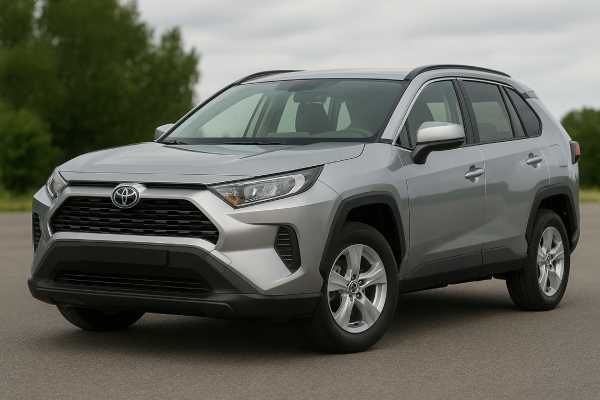
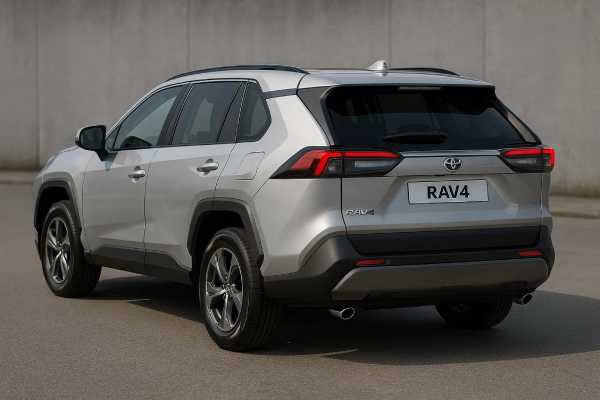
The facelifted Toyota RAV4 FWD (XA50) with the 2.0-litre M20A-FKS gasoline engine targets buyers who want simple ownership, dependable running costs, and a roomy cabin without stepping into hybrid or AWD complexity. The 2022 update sharpened cabin tech and driver-assist features while keeping the proven TNGA-K platform, double-wishbone rear suspension, and the “Direct-Shift” CVT that uses a mechanical launch gear for better response off the line. Real-world economy is competitive for a naturally aspirated compact SUV, and the driving character is calm, predictable, and quiet enough for long commutes. With a large cargo area and straightforward service needs, this FWD RAV4 suits high-mileage drivers, second-car households, and fleets that value durability over flash. Below, you will find verified specifications, maintenance guidance, reliability watch-outs, and how it stacks up against segment rivals.
Fast Facts
- Spacious cabin and large VDA cargo bay (580 L) for family and gear.
- Smooth “Direct-Shift” CVT with launch gear improves low-speed response.
- Toyota Safety Sense suite standard; strong crash-test record.
- Watch for software/recall completion and CVT fluid service under heavy use.
- Oil and filter: every 15,000 km or 12 months (whichever comes first).
What’s inside
- RAV4 2.0 FWD overview
- RAV4 2.0 FWD specs
- RAV4 trims, safety and ADAS
- Reliability and known issues
- Maintenance and buyer’s guide
- Driving and performance
- RAV4 vs rivals
RAV4 2.0 FWD overview
The facelift (2022–present) RAV4 FWD covered here pairs Toyota’s 2.0-litre M20A-FKS “Dynamic Force” four-cylinder with a front-drive layout and the Direct-Shift CVT. In European markets where this engine is offered, output sits in the 173–175 hp (127–129 kW) band with 208 Nm (153 lb-ft) of torque. The engine uses the D-4S system (direct plus port injection), a high 13.0:1 compression ratio, and VVT-iE on intake/VVT-i on exhaust for efficiency and broad mid-range pull. The CVT’s mechanical launch gear reduces slip on getaway, so it feels more like a conventional automatic off the line and then transitions to belt-drive for cruising.
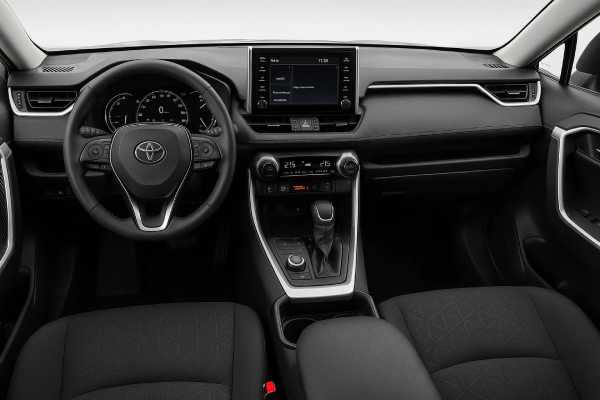
The 2022 update added crisper infotainment (10.5-inch screen depending on grade), a 12.3-inch configurable driver display on higher trims, and additional Toyota Safety Sense functions. Exterior tweaks are subtle—revised LED lighting and wheel designs—preserving the upright, easy-to-see-out stance. Underneath, the TNGA-K platform keeps its independent rear suspension and long wheelbase (2690 mm), which deliver better secondary ride control than earlier RAV4 generations.
For shoppers comparing to the ubiquitous hybrid, this FWD 2.0 is simpler and cheaper to buy, and it avoids high-voltage hardware while still returning realistic 6.9–7.6 L/100 km WLTP combined, depending on tire/wheel selection and equipment. It is perfectly at home in suburban duty cycles, long highway stints, and as a fleet workhorse. The cabin is a strength: wide rear doors, generous back-row legroom, a low cargo floor, and a square aperture that swallows bikes or strollers without drama. Owners prioritizing all-weather traction can consider mechanical AWD variants of the same engine or step to RAV4 Hybrid AWD-i; otherwise, quality all-season or all-weather tires on this FWD model are enough for most European climates.
RAV4 2.0 FWD specs
Below are scannable, model-specific tables based on the facelifted European-market RAV4 FWD with M20A-FKS. Figures can vary slightly by market, trim, tire package, and regulatory cycle; when several official ranges exist, the combined WLTP band is shown.
Engine and Performance (ICE-only)
| Item | Data |
|---|---|
| Code | M20A-FKS (Dynamic Force) |
| Layout & valvetrain | Inline-4, DOHC, 16 valves; VVT-iE (intake), VVT-i (exhaust) |
| Bore × stroke | 80.5 × 97.6 mm (3.17 × 3.84 in) |
| Displacement | 2.0 L (1987 cc) |
| Induction | Naturally aspirated |
| Fuel system | D-4S (direct + port injection) |
| Compression ratio | 13.0:1 |
| Max power | 173–175 hp (127–129 kW) @ ~6600 rpm |
| Max torque | 208 Nm (153 lb-ft) @ ~4300–5200 rpm |
| Timing drive | Chain |
| Emissions standard | Euro 6d (market-dependent) |
| Rated efficiency (WLTP combined) | 6.9–7.6 L/100 km (34.1–30.9 mpg US / 40.9–37.0 mpg UK) |
| Real-world highway @ 120 km/h | ~7.5–8.3 L/100 km (31.4–28.3 mpg US / 37.7–34.0 mpg UK), tire/load/weather dependent |
Transmission and Driveline
| Item | Data |
|---|---|
| Transmission | Direct-Shift CVT (with launch gear) |
| Drive type | Front-wheel drive (FWD) |
| Final drive | Market-calibrated (varies by wheel/tire and emission class) |
| Differential | Open (front) |
| Refuel to full | Approx. 5–6 min at the pump (55 L tank) |
Chassis and Dimensions
| Item | Data |
|---|---|
| Platform | TNGA-K |
| Suspension (front/rear) | MacPherson strut / Double wishbone |
| Steering | Electric power-assisted rack and pinion |
| Brakes | Ventilated front discs; solid rear discs |
| Wheels/tires (typical) | 17–19 in; e.g., 225/60 R18 or 235/55 R19 |
| Ground clearance | ~190–195 mm (7.5–7.7 in) |
| Length × width × height | ~4600 × 1855 × 1685 mm (181.1 × 73.0 × 66.3 in) |
| Wheelbase | 2690 mm (105.9 in) |
| Turning circle (kerb-to-kerb) | ~11.0 m (36.1 ft) |
| Curb weight (range) | ~1480–1670 kg (3263–3682 lb), by trim/equipment |
| Fuel tank (gasoline) | 55 L (14.5 US gal / 12.1 UK gal) |
| Cargo volume (VDA, seats up) | 580 L (20.5 ft³) |
Performance and Capability
| Item | Data |
|---|---|
| 0–100 km/h (0–62 mph) | ~10.7–11.0 s (wheel/tire dependent) |
| Top speed | ~190 km/h (118 mph) |
| Towing capacity (braked/unbraked) | 1500 / 750 kg (3307 / 1653 lb) |
| Payload | Market-label dependent; check VIN plate |
| Roof load | Typically up to 100 kg (220 lb) incl. rack; verify VIN/owner’s manual |
Fluids and Service Capacities
(Always verify by VIN; capacities can vary by emission class and cooling package.)
| System | Spec / Note | Capacity (approx.) |
|---|---|---|
| Engine oil | Toyota-approved 0W-16 or 0W-20, API SP / ILSAC GF-6 | ~4.3–4.6 L (4.5–4.9 US qt) with filter |
| Engine coolant | Toyota Super Long Life (pink); premix 50:50 | ~6–7 L (6.3–7.4 US qt) |
| CVT fluid | Toyota CVT FE (Direct-Shift CVT) | ~8–9 L (8.5–9.5 US qt) for service fill / exchange |
| A/C refrigerant | R-1234yf; compressor oil ND-11 (typ.) | Charge varies by option; see under-bonnet label |
| Key torque examples | Oil drain plug ~40 Nm (30 lb-ft); wheel nuts ~103 Nm (76 lb-ft) |
Electrical
| Item | Data |
|---|---|
| 12V battery | Flooded or AGM, ~45–60 Ah depending on equipment |
| Spark plugs | Long-life iridium; typical gap ~0.8 mm (0.031 in) |
Safety and Driver Assistance
| Item | Data |
|---|---|
| Crash rating (Euro NCAP) | 5-star overall (adult/child/VRU/safety assist strong for the class) |
| Headlights (market) | Projector/LED; performance varies by grade |
| ADAS suite (Toyota Safety Sense) | Pre-Collision with pedestrian/cyclist detection, Adaptive Cruise, Lane Tracing/Lane Departure Alert, Road Sign Assist; Junction support and Emergency Steering Assist availability by year/grade |
RAV4 trims, safety and ADAS
Trims and options (Europe, petrol 2.0 FWD): Availability varies by country, but the typical lineup spans Active (entry), Mid, High, plus appearance-led editions depending on the year (e.g., Style or GR SPORT where petrol is offered). The Active grade usually brings 17-inch wheels, LED headlights, fabric seats, manual tailgate, and Toyota Safety Sense. Mid often adds dual-zone climate, parking sensors/camera, and larger wheels. High may bundle smart entry, power tailgate, heated seats/steering wheel, power driver’s seat, navigation, and premium audio. A panoramic roof and 19-inch alloys are common options on upper trims.
Mechanical differences by trim: On FWD 2.0, the engine and CVT are shared; braking hardware and suspension tuning remain broadly the same. Wheel/tire packages (17–19 in) affect WLTP economy and 0–100 km/h times slightly (you will see ~0.3 s spread). Towing prep (wiring, receiver) and spare wheel type may vary by grade and country.
Infotainment and instruments (facelift): The facelift introduced the 10.5-inch Toyota Smart Connect touchscreen (trim-dependent) with faster processing, cloud navigation, and enhanced voice controls, plus an available 12.3-inch digital driver’s cluster on higher grades. Wireless smartphone integration and connected services vary by region and subscription.
Safety ratings (succinct): The current-gen RAV4 achieved five stars under Euro NCAP testing, with strong adult and child occupant protection and good safety-assist performance for a mainstream SUV. That rating applies across the RAV4 range, including 2.0 petrol 4×2 and 4×4 derivatives when similarly equipped with Toyota Safety Sense.
Airbags, restraints, and child seats: Front, side, curtain, and driver’s knee airbags are typical; ISOFIX/LATCH anchors are provided on the outboard rear seats with clear top-tether points. The rear bench and door openings make fitting bulky rear-facing seats easier than in several rivals. Remember to disable the front passenger airbag when installing a compatible rear-facing child seat in front.
ADAS evolution and calibration notes: With the 2022 updates, Toyota Safety Sense functions gained intersection turn assist and enhanced lane support on many trims. After windscreen replacement or front-end repairs, camera/radar calibration is required; some markets enable dynamic calibration on a prescribed road route, while others need static targets. Wheel alignment and tyre size must match spec for the systems to track lane lines accurately.
Reliability and known issues
Toyota’s 2.0 M20A-FKS and the TNGA-K platform have a solid reputation when serviced on time and fuelled with quality E5/E10 petrol. Still, no vehicle is issue-free; use this section as a focused checklist.
Powertrain
- CVT behaviour (Direct-Shift):
Symptoms: Driveline whine, flare/hang at steady throttle on steep grades, or shudder from rest when fluid is old.
Likely cause: Ageing CVT fluid or software calibration not at the latest level.
Remedy: Fluid exchange with the correct Toyota CVT FE fluid; perform ECU/TCU software update if available; ensure tires are OE size and evenly worn. - Fuel system campaign history:
Symptoms: Rough running, warnings, or rare stall/no-start on affected VIN ranges.
Likely cause: Low-pressure fuel pump running issue addressed by official recalls.
Remedy: Check VIN on the manufacturer’s recall portal and complete dealer remedy free of charge. - Idle quality and carbon:
Symptoms: Slight idle waviness over time (high mileage, short trips).
Likely cause: Intake valve deposits are less common thanks to D-4S port injection, but they can still appear with heavy short-cycle use.
Remedy: Use quality fuel, follow oil schedule, and consider intake cleaning only if misfire or airflow imbalance is verified.
Chassis and body
- Rear suspension bushings (high mileage):
Symptoms: Thumps over sharp edges, rear toe drift, uneven tyre wear.
Likely cause: Wear in multi-link bushings.
Remedy: Replace affected bushings; follow alignment specs and recalibrate ADAS if the front radar/camera view was disturbed. - Wheel bearings (occasional):
Symptoms: Growl that rises with road speed.
Remedy: Replace hub assembly; verify tyre condition and road-noise sources before condemning the bearing. - Corrosion hotspots:
Check: Rear subframe fasteners, exhaust hangers, and underbody seams in salt-belt regions.
Remedy: Clean, treat, and apply corrosion protection; ensure drain holes are clear.
Electrical and infotainment
- Head unit and cluster updates:
Symptoms: Intermittent Bluetooth or navigation lags.
Remedy: Apply multimedia software updates; many markets support over-the-air updates after 2022.
Severity and cost tiers (rule-of-thumb)
- Low: Software updates, minor bushing noise, alignment—€0–€300.
- Medium: Wheel bearing, brake service, tyre sets—€300–€900.
- High: Accident-damage ADAS recalibration with glass replacement, multi-component suspension refresh—€1,000+.
Pre-purchase asks (used examples)
- Full service history with mileage/time stamps.
- Proof of recall/field actions completed (VIN printout).
- Recent brake, coolant, and CVT fluid services (especially for urban delivery use).
- Tyre age/brand match; even wear; no pull or steering wheel off-centre.
- Two working keys and clean OBD scan (no history of powertrain or ADAS DTCs).
Maintenance and buyer’s guide
Practical service schedule (baseline European practice)
(Always check your market’s official maintenance booklet; use severe-service intervals for frequent short trips, extreme cold/heat, dusty roads, or towing.)
- Engine oil and filter: every 15,000 km or 12 months. Use Toyota-approved 0W-16 (preferred for economy) or 0W-20 meeting API SP / ILSAC GF-6.
- Engine air filter: inspect at 15,000 km; replace ~30,000–45,000 km (earlier in dusty regions).
- Cabin filter: 12 months, more often in urban/dusty air.
- Coolant: Toyota Super Long Life; first change often around 160,000 km or 10 years, then every 80,000 km/5 years (market-specific—verify).
- Spark plugs (iridium): inspect around 90,000–120,000 km; replace by manufacturer window or if misfire/erosion is present.
- Aux/serpentine belt: inspect from 60,000 km; replace if cracked/noisy.
- CVT fluid (Direct-Shift CVT): though many booklets list “no schedule,” proactive 60,000–90,000 km exchanges are sensible for longevity, especially in city or tow use—use Toyota CVT FE.
- Brake fluid: every 2 years regardless of km.
- Pads/rotors: inspect at each service; clean/grease slider pins annually in salt climates.
- Alignment and tyre rotation: rotate 10,000–15,000 km; alignment check annually or after impacts; maintain even wear on all four corners.
- 12V battery: test annually from year 3; typical replacement window 4–6 years depending on climate and usage.
- A/C service: check performance annually; refrigerant/oil only by certified techs according to under-bonnet label.
Fluid reference (decision-making quick list)
- Oil: 0W-16 / 0W-20; capacity ~4.3–4.6 L with filter.
- Coolant: Toyota SLLC (pink) premix; ~6–7 L.
- CVT fluid: Toyota CVT FE; ~8–9 L for full service exchange.
- Tyre pressures: follow door-jamb label; adjust for 18–19-inch packages and heavy loads.
- Wheel nut torque: ~103 Nm.
Buyer’s checklist (used)
- Cold start from ambient (listen for rattles, belt squeal, or chain noise).
- Smooth CVT step-off (no shudder), stable rpm at 80–120 km/h.
- Straight-line braking with no steering vibration.
- ADAS status: look for active cruise and lane-keeping icons; verify with a test drive.
- Cargo floor panel and under-floor storage intact; spare wheel present (if specified).
- All updates applied (multimedia and ECU/TCU).
- Towbar installs: confirm harness integration and coding where required.
Recommended years/options
- For the 2.0 FWD, 2022+ facelift units bring better screens and expanded safety features.
- Choose 17–18-inch wheels for comfort and economy; 19-inch wheels add style but nudge consumption upward.
- Consider winter/all-weather tyres in snow-belt regions—FWD traction improves dramatically on suitable rubber.
Durability outlook
With annual servicing, correct fluids, and sensible CVT care, the 2.0 FWD RAV4 is a 200,000+ km proposition with minimal drama. Suspension bushings and wheel bearings are typical wear items; body and paint hold up well with periodic underbody washing in salt climates.
Driving and performance
Ride and handling: The TNGA-K chassis is the quiet hero here. The longer wheelbase and double-wishbone rear end smooth out patchy city tarmac and stabilize the vehicle over motorway undulations. Body roll is present but well controlled; the RAV4 prioritizes predictability over sport. The steering is light at parking speeds and gains steady effort on the move; feedback is muted (class-typical), but straight-line tracking is strong even in crosswinds.
Powertrain character: Off the line, the Direct-Shift CVT’s launch gear gives a normal “first-gear” feel before the CVT portion takes over. In normal driving, throttle response is progressive; “Eco” moderates step-in, while “Sport” lets the engine hold revs longer on grades or during passing. At full load, you will hear more of the naturally aspirated four, but cruise noise is low thanks to tall gearing. There is no turbo lag to manage; overtakes are best planned with a decisive throttle press to trigger the correct ratio.
Efficiency in the real world: Expect ~7.5–8.3 L/100 km at a steady 120 km/h (75 mph) with two occupants and weekend bags on 18-inch wheels. Mixed suburban cycles typically land around 7.0–7.6 L/100 km, dropping into the mid-6s on gentle A-roads with light traffic. In winter, add ~0.5–0.8 L/100 km depending on tyre type, temperature, and HVAC usage. Fitting 19-inch wheels or roof carriers increases consumption.
Noise, vibration, harshness (NVH): At town speeds, tyre and road noise dominate; on coarse motorway asphalt, you will notice tread noise more on 19-inch tyres. Wind noise is modest thanks to the square but well-sealed body. The engine is quiet at 110–130 km/h cruise; uphill at part throttle, it briefly rises in pitch as the CVT reshapes the ratio.
Key metrics that change the verdict
- 0–100 km/h: ~10.7–11.0 s (depending on wheels/weight).
- 80–120 km/h passing: responsive with a firm pedal; plan ahead on steep grades with four aboard.
- Braking feel: consistent and easy to modulate; pedal travel is linear once pads are bedded.
- Turning circle: ~11.0 m, making U-turns and tight carparks straightforward.
Traction and control: On wet cobbles or snowy carparks, modern all-season/winter tires make this FWD RAV4 surprisingly capable. Stability and traction control are conservative but not intrusive in everyday driving. For regular mountain travel or towing near the limit, mechanical AWD 2.0 or Hybrid AWD-i variants are sensible alternatives.
Load and towing: The chassis remains composed with a family load and luggage; braking confidence is good with quality pads/rotors. Towing up to 1500 kg (braked) is feasible; expect a +30–50% consumption penalty at motorway speeds and downshift/taller-rev behavior on long grades.
RAV4 vs rivals
Hyundai Tucson/Kia Sportage 1.6 T-GDi (FWD): Turbo punch and dual-clutch/auto options bring stronger mid-range and better on-paper acceleration. However, real-world economy can swing more with driving style, and DCT smoothness in traffic varies by calibration. The RAV4 counters with simpler hardware, easier creeping in tight traffic, and excellent parts availability.
Mazda CX-5 2.0 Skyactiv-G (FWD): Another naturally aspirated path. The Mazda steers with more feedback and its cabin looks classy, but rear seat/cargo versatility and infotainment speed favour the Toyota after the facelift. Running costs are similar; the RAV4’s CVT is calmer in stop-and-go than Mazda’s geared auto.
Nissan X-Trail/Qashqai (1.3 DIG-T or e-Power): The 1.3 turbo is punchy; e-Power offers an EV-like feel. Yet, long-term simplicity favors Toyota’s 2.0 NA for buyers who keep cars beyond warranty. Cargo size and rear access are stronger points for RAV4.
Honda CR-V 1.5 VTEC Turbo (previous gen) / new hybrid-led CR-V: The turbo CR-V is smooth and spacious; newer CR-V generations lean heavily on hybrid. If you want straightforward petrol ownership, the RAV4 2.0 remains a clean, durable choice with superior parts commonality across Toyota’s range.
Bottom line: If you value space, low hassle, and predictable costs, the RAV4 2.0 FWD stands tall. If you want maximum thrust or the best fuel numbers possible in town, look to the hybrid or turbocharged rivals.
References
- Official Toyota Rav4 2019 safety rating 2019 (Safety Rating)
- New 2023 Toyota RAV4 Focusses on Multimedia, Connectivity and Safety Upgrades 2022 (Press Release)
- RAV4 2022 (Brochure)
- RAV4 2022 (Brochure)
- Toyota Recalls Certain Toyota and Lexus Vehicles 2025 (Recall Database)
Disclaimer
This guide is for informational purposes and is not a substitute for professional diagnosis or repair. Specifications, torque values, capacities, and service intervals vary by VIN, market, model year, and equipment. Always confirm details against your vehicle’s official owner’s manual, service manual, and dealer records. If you found this useful, please share it on Facebook or X/Twitter to support xcar’s work. Thank you.