
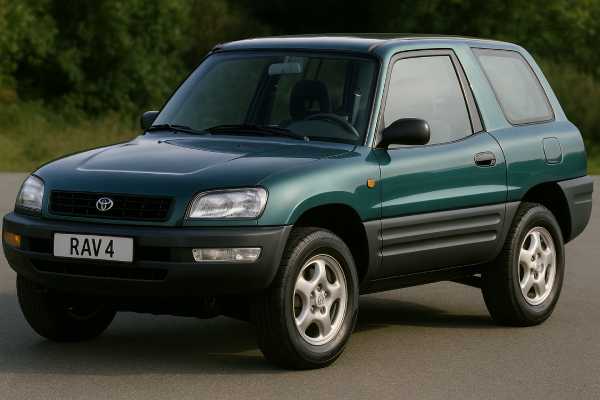
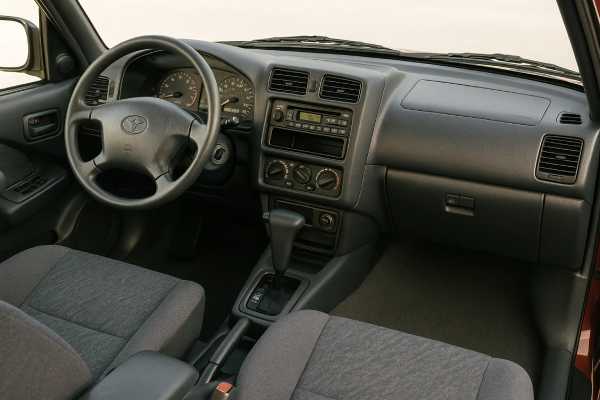
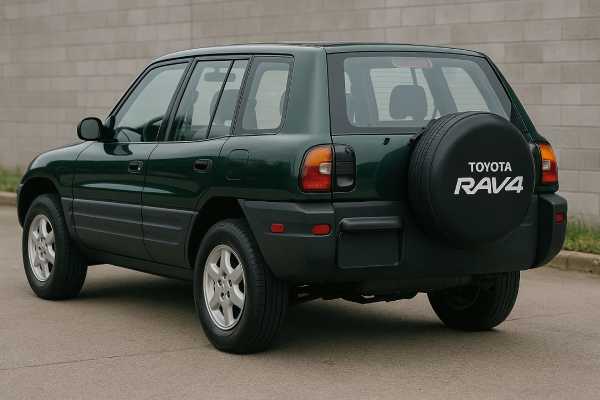
The first-generation Toyota RAV4 in front-wheel-drive form distilled the original “car-like SUV” idea to its most affordable, lightest package. With the 3S-FE 2.0-liter inline-four and a simple FWD layout, it offers low running costs, easy serviceability, and friendly dynamics for daily use. Compared with its 4WD sibling, the FWD model rides a touch lighter and returns better fuel economy while keeping the same tall seating position, flat cargo floor, and durable interior fittings. Owners value the long-lived timing belt engine, straightforward 5-speed manual or 4-speed automatic, and the compact footprint that makes parking easy. This guide focuses on 1996–1997 FWD models sold in North America, detailing specifications, performance, safety ratings, maintenance needs, and real-world ownership considerations—plus how it stacks up against rivals of the era. If you want a simple, honest small SUV that feels more like a hatchback to drive, this is the version most people start with.
Fast Facts
- Light, simple FWD layout improves fuel economy and steering feel in town.
- 3S-FE engine is durable, widely supported, and easy to service with basic tools.
- Cabin packaging is excellent for size; flat cargo floor and split-fold rear seats.
- Watch for age-related rubber and cooling-system refresh needs after ~100k–150k miles (160k–240k km).
- Oil and filter every 5,000–7,500 miles (8,000–12,000 km) or 6–12 months, depending on use.
Explore the sections
- RAV4 XA10 FWD overview
- RAV4 3S-FE specs and data
- 1996–1997 RAV4 trims and safety
- Reliability and common issues
- Maintenance and buyer’s guide
- Driving and performance
- RAV4 vs rivals
RAV4 XA10 FWD overview
The front-wheel-drive first-gen RAV4 (XA10) launched as the most efficient and least complex configuration of Toyota’s original “recreational active vehicle.” For 1996–1997, it paired the 3S-FE 2.0-liter DOHC 16-valve four-cylinder (rated around 120 hp) with either a 5-speed manual or a 4-speed electronically controlled automatic. While the 4WD variant grabbed early headlines for soft-road ability, the FWD version made the strongest case for urban and suburban life: lower weight, fewer driveline components to age, slightly better straight-line response at stop-and-go speeds, and reduced maintenance overhead.
What owners notice first is packaging. In the 4-door body, the RAV4’s upright seating and big glass area deliver excellent visibility. The rear bench folds and tumbles to open a long, flat load floor—useful for bikes or DIY runs. Ride quality is compliant for the era, helped by a long-travel suspension tuned more like a compact car than a truck. With FWD, steering feels a touch lighter on initial turn-in, and torque reactions are muted compared with some period crossovers. Highway stability is respectable; crosswinds can nudge the tall body, but the chassis tracks true at American interstate speeds.
Running costs are where the FWD shines. There’s no rear differential, prop shaft, or transfer case to service or eventually rebuild. Brakes, tires, and bearings are shared with 4WD trims, but wear tends to be gentler on the lighter FWD models. Fuel economy improves versus 4WD, particularly at a steady 60–70 mph (100–115 km/h). Insurance and registration costs were typically lower when new, which still tracks in many markets for older vehicles today.
Limitations are the flip side of that simplicity. Traction in deep snow or steep gravel is bounded by front-axle grip and tire choice. Ground clearance is fine for rutted tracks or winter streets but not designed for rock gardens. Safety equipment reflects late-1990s standards: dual front airbags and ABS (availability varies), but no modern driver-assist features. The 3S-FE uses a timing belt (not a chain), so proactive belt replacement is part of ownership planning. Age now sets the maintenance agenda more than mileage: rubber hoses, mounts, bushings, and original radiators often deserve preventive attention.
For shoppers, the sweet spot is a rust-free, 4-door FWD with complete service history, a healthy cooling system, and records for timing-belt service. The drivetrain’s simplicity rewards basic maintenance; the body and undercarriage condition will make or break long-term satisfaction.
RAV4 3S-FE specs and data
Below are consolidated technical details for 1996–1997 FWD models in North America (4-door shown where dimensions differ by body style). Figures reflect typical factory specifications for the 3S-FE FWD configuration.
Engine and Performance
| Item | Specification |
|---|---|
| Code | 3S-FE, inline-4, DOHC, 16-valve |
| Displacement | 2.0 L (1,998 cc) |
| Bore × stroke | 86.0 × 86.0 mm (3.39 × 3.39 in) |
| Compression ratio | ~9.8:1 |
| Induction / fuel system | Naturally aspirated / multi-port fuel injection |
| Max power | 120 hp (≈89 kW) @ ~5,400 rpm |
| Max torque | 125 lb-ft (≈169 Nm) @ ~4,600 rpm |
| Timing drive | Belt (interference risk is low; replace on time) |
| Recommended fuel | Regular unleaded (87 AKI) |
| EPA economy (2WD) | ~21/26 mpg city/highway (≈11.2/9.0 L/100 km) |
| Real-world highway (75 mph / 120 km/h) | ~26 mpg US (≈9.0 L/100 km), dependent on tires and load |
| Aerodynamics | Cd ~0.35–0.36 (typical for body style; period estimate) |
Transmission and Driveline (FWD)
| Item | Specification |
|---|---|
| Manual | 5-speed transaxle (FWD), cable-shift; clutch hydraulic |
| Automatic | 4-speed electronically controlled FWD transaxle |
| Drive type | Front-wheel drive |
| Differential | Open front differential |
| Final drive | ~3.9:1 (varies by gearbox; verify by VIN plate) |
| Refuel to full | ~5–7 minutes; no transfer/center diff to service |
Chassis and Dimensions (4-door body)
| Item | Specification |
|---|---|
| Suspension (front/rear) | MacPherson strut / double wishbone with trailing links |
| Steering | Rack-and-pinion, power-assisted |
| Brakes | Front ventilated disc / rear drum (ABS availability varies) |
| Wheels / tires | 16×6 in rims; 215/70R16 all-season typical |
| Ground clearance | ~190 mm (7.5 in) |
| Length × width × height | ~4,150 × 1,695 × 1,655 mm (163.4 × 66.7 × 65.2 in) |
| Wheelbase | ~2,410 mm (94.9 in) |
| Turning circle | ~11.0 m (36.1 ft) |
| Curb weight | ~1,265–1,270 kg (≈2,790 lb) |
| GVWR | ~1,800 kg (≈3,970 lb), varies by trim |
| Fuel tank | ~58 L (15.3 US gal / 12.7 UK gal) |
| Cargo volume | Seats up ~760 L (≈26.8 ft³); seats down ~1,600 L (≈56–58 ft³) |
Performance and Capability
| Metric | Figure |
|---|---|
| 0–60 mph (manual/auto) | ~10.5–11.5 s (typical period tests) |
| Top speed | ~165–170 km/h (102–105 mph) |
| Braking 100–0 km/h | ~40–43 m (≈131–141 ft) depending on tires |
| Towing capacity (braked) | ~680 kg (1,500 lb) |
| Payload | ~400–450 kg (880–990 lb) |
| Roof load | ~45–50 kg (100–110 lb) with factory bars |
Fluids and Service Capacities (typical)
| System | Spec / Capacity |
|---|---|
| Engine oil | API SJ/SL, 5W-30 or 10W-30; ~3.9 L (4.1 US qt) with filter |
| Coolant | Phosphate-organic hybrid or equivalent; ~7.7–8.0 L (8.1–8.5 qt) |
| Manual transaxle | GL-4/GL-5 75W-90; ~3.7–3.9 L (3.9–4.1 qt) |
| Automatic transaxle | Dexron III-spec; service fill ~2.5–3.0 L; overhaul ~6–7 L |
| A/C refrigerant | R-134a; typical charge ~500–650 g (18–23 oz) |
| A/C compressor oil | ND-Oil 8 equivalent; ~120 mL (4 fl oz) typical |
| Key torque examples | Wheel lugs ~103 Nm (76 lb-ft); drain plug ~35–40 Nm (26–30 lb-ft) |
Electrical
| Item | Specification |
|---|---|
| Alternator | ~70–80 A output (varies by equipment) |
| 12V battery | Group 35/26R typical; ~45–60 Ah; 500–600 CCA common |
| Spark plugs | Nickel or platinum, heat range equivalent to NGK BKR6EKB-11; gap 1.0–1.1 mm (0.039–0.043 in) |
Safety and Driver Assistance (period features)
| Item | 1996–1997 FWD RAV4 |
|---|---|
| Airbags | Dual front airbags standard |
| ABS | Optional/trim-dependent |
| Traction/ESC | Not available (pre-ESC era) |
| Headlights | Halogen reflectors; aim and lens condition matter with age |
| Crash testing | Moderate-overlap frontal: marginal performance in period tests |
| Child seats | Rear lap-shoulder belts; LATCH not yet standardized |
Notes: Some values vary by body style, gearbox, and production date. Always verify by VIN and the under-hood specification labels when ordering parts or fluids.
1996–1997 RAV4 trims and safety
Trims and options (North America, highlights)
For 1996–1997, the FWD lineup typically centered on “Base” equipment with popular-option packages. Common items included 16-inch wheels, cloth seats, manual HVAC, and cassette or CD audio. Power windows/locks, cruise control, and alloy wheels were often bundled. A 4-door body maximized cargo and rear legroom; a 2-door FWD existed in small numbers, focused on value and maneuverability.
Mechanical/functional differences by trim and options
- Transmissions: 5-speed manual favored responsiveness and economy; 4-speed automatic prioritized ease in traffic. Final-drive and speedometer calibration vary with tire/wheel packages.
- Brakes and ABS: Four-wheel ABS availability depended on package; pedal feel improves with modern pads/hoses and fresh fluid.
- Wheels/tires: 215/70R16 all-seasons were common; steel or alloy rims by package. Narrower snow tires transform winter traction on FWD models.
- Seating and cargo: Split-fold rear bench with tumble-forward function; some trims offered removable rear cushions to optimize cargo height.
Year-to-year changes affecting equipment
- 1996 → 1997: Minor color and audio updates; option availability shuffled; safety content stable. The core powertrain and chassis carried over.
- Late-1997: In some markets Toyota introduced clearly separated 2WD grades; in North America the packaging focus remained on equipment bundles rather than named sub-trims.
Safety ratings (period context)
- Crash tests: First-gen RAV4 four-door models of this era earned modest ratings in moderate-overlap frontal tests typical of late-1990s methodology. Passenger-compartment integrity was adequate to marginal, with higher measured injury risk than modern SUVs.
- Head restraints and seats: Early design; backset and height may not meet current best practices.
- Child restraint provisions: Rear lap-shoulder belts are present; LATCH anchors were not yet standardized (2000s adoption).
ADAS and lighting
Active driver-assistance technologies (AEB, ACC, lane keep) did not exist in this class at the time. Braking performance and nighttime visibility therefore depend on maintenance: fresh pads/rotors, quality tires, proper headlamp lenses and aim. Period halogen reflectors benefit from new bulbs (correct wattage) and restored lenses.
Quick identifiers and build details
- VIN plate and option tags reveal gearbox code and axle ratio; check driver-door jamb.
- Exterior tells: FWD lacks rear differential and prop shaft; under-body is cleaner aft of the fuel tank.
- Interior: Early HVAC sliders, simple column stalks, and a tall, upright dash with excellent sight lines are era hallmarks.
Reliability and common issues
The 3S-FE/FWD drivetrain is among the most durable of 1990s small SUVs when maintained. Age, not design weakness, drives most repairs now. Map issues by prevalence and severity to plan ownership:
Common (low–medium cost)
- Cooling system refresh (80k–150k mi / 130k–240k km): Radiators, hoses, and thermostat age out; symptoms include slow warm-up, seepage at plastic tanks, and high temps on grades. Remedy: radiator and hose kit, thermostat/cap, fresh coolant.
- Rubber wear items: Strut mounts, control-arm bushings, sway-bar links, engine mounts. Symptoms: clunks, vibration at idle, wandering feel. Remedy: quality rubber or OE-style replacements; alignment after front-end work.
- Exhaust heat-shield buzz: Corrosion loosens spot welds; secure with band clamps or replace affected sections.
- Door lock actuators and window regulators: Age-related failure; replace as needed.
Occasional (medium cost)
- Oil seepage—cam/crank seals, valve-cover gasket: Look for wetness at timing cover and bellhousing. Remedy: reseal during timing-belt service to minimize labor duplication.
- Distributor O-ring and internal seal seepage: Misfire or oily plug wells; reseal or replace distributor assembly.
- Brake hydraulics: Rear wheel-cylinder weep or front caliper slide corrosion; rebuild/replace and flush fluid.
Rare (higher cost or caution)
- Head-gasket fatigue (overheats or long-neglected coolant): Typically preceded by cooling issues. Remedy: machine check, MLS gasket, new head bolts; inspect radiator and water pump.
- Automatic transaxle wear: Heat and old fluid accelerate valve-body and clutch issues. Remedy: service with correct ATF, add cooler if towing; rebuilds succeed when hard parts are sound.
- Rust: In salt regions, rear subframe mounts, rocker seams, and brake/fuel lines need close inspection. Structural rust is a walk-away item.
Software/calibrations
OBD-II (from 1996) supports basic ECU updates, but large drivability reflashes were uncommon for this powertrain. Misfire and EVAP codes often trace to vacuum lines, charcoal canister saturation, or aged ignition components rather than mapping faults.
Recalls/field actions (era overview)
This generation saw fewer safety recalls than later models. Actions skew toward labeling, seat components, or equipment-specific items. Always verify status by VIN and keep printed proof with maintenance records. (Official VIN checks and recall databases are linked in the References.)
Pre-purchase checks (ask sellers for evidence)
- Full service history with timing-belt documentation and recent coolant service.
- Cold-start behavior, idle smoothness, and coolant-fan operation.
- Brake-line and underbody rust inspection on a lift.
- Even tire wear and alignment; clunks over sharp bumps suggest bushing or mount wear.
- All HVAC modes, power locks/windows, and rear hatch/tire-carrier alignment.
Maintenance and buyer’s guide
Practical maintenance schedule (baseline; adjust for climate and duty cycle)
- Engine oil and filter: 5,000–7,500 miles (8,000–12,000 km) or 6–12 months. Short-trip or severe use → 5,000 miles/6 months.
- Engine air filter: Inspect every 12 months/12,000 miles (20,000 km); replace as needed.
- Cabin filter: Early models may not have a serviceable cabin filter; retrofit kits exist. Inspect cowl drains and blower intake for debris annually.
- Coolant: Replace every 5 years/60,000 miles (100,000 km) or when pH and freeze protection test out of spec.
- Spark plugs: Conventional nickel 30,000 miles (48,000 km); long-life platinum 60,000 miles (96,000 km). Verify plug type before interval planning.
- Fuel filter: Inline filter, typically every 60,000–90,000 miles (96,000–145,000 km) or when fuel-pressure/flow issues arise.
- Timing belt: 60,000–90,000 miles (96,000–145,000 km) or 7–8 years. Replace water pump, cam/crank seals, and tensioner/idler on the same visit if age suggests.
- Serpentine/aux belts and hoses: Inspect at every oil change; replace 6–8 years or on cracking/glazing.
- Manual-transaxle oil: 60,000 miles (96,000 km) for severe service; 100,000 miles (160,000 km) otherwise.
- Automatic transaxle fluid: Drain-and-fill every 30,000–60,000 miles (48,000–96,000 km) depending on heat/towing; use correct Dexron III-spec fluid.
- Brake fluid: Flush every 2–3 years; inspect pads/rotors each tire rotation.
- Power steering fluid: Inspect yearly; exchange if dark or aerated.
- Alignment and tire rotation: Rotate 5,000–7,500 miles; align annually or after suspension work.
- 12V battery: Load test annually after year 4–5; replace proactively if capacity drops.
- A/C system: Inspect condenser for debris; evacuate/recharge only when performance declines or components are replaced.
Fluid quick-reference (decision-making)
- Engine oil: API SJ/SL 5W-30 preferred; capacity about 3.9 L (4.1 qt) with filter.
- Coolant: Phosphate-compatible ethylene glycol; total fill around 8.0 L.
- Manual transaxle: GL-4/GL-5 75W-90, ~3.8–3.9 L.
- Automatic transaxle: Dexron III service fill varies; plan extra for exchange.
- Brake fluid: DOT 3 or DOT 4 (do not mix old silicone types).
- Torque highlights: Wheel lugs ~103 Nm (76 lb-ft); spark plugs ~18 Nm (13 lb-ft).
Buyer’s checklist
- Corrosion: Rear subframe mounts, pinch welds/rockers, tailgate seam under the spare-wheel carrier, brake and fuel lines.
- Cooling system: Radiator end tanks for hairline cracks; evidence of past overheating.
- Driveline: Manual clutch take-up and synchros; automatic shift quality hot and cold; no shudder on light throttle.
- Suspension/steering: Front control-arm bushings, inner/outer tie-rods, rear trailing-arm and lateral-link bushings.
- Electrics: Charging voltage, grounds, and headlamp connectors (melted plugs indicate resistance/heat).
- Interior: Seat-rail and recliner play; window speed; HVAC mode door function.
- Documentation: Timing-belt proof, coolant service, brake fluid flush history, and any recall completion printouts.
Durability outlook
With clean bodywork and a refreshed cooling/suspension system, a FWD XA10 commonly exceeds 200,000 miles (320,000 km) with routine fluids and timing-belt care. Parts availability is strong, and most repairs are single-day DIY or independent-shop jobs. The main long-term risks are rust in salt climates and neglect of age-sensitive rubber and cooling components.
Driving and performance
Ride and NVH
The FWD RAV4 rides like a compact car with extra suspension travel. Around town, bumps are absorbed without the head toss common to body-on-frame SUVs of the era. On the highway, wind and road noise are noticeable by modern standards but not fatiguing; new door and hatch seals help. The long-travel shocks and relatively tall tire sidewalls deliver good compliance on broken pavement.
Handling and steering
Front-drive weight balance brings predictable understeer at the limit, but everyday responses are neutral and friendly. Steering is light with sufficient on-center feel. Replacing aged struts, top mounts, and front bushings tightens response considerably. All-season tires prioritize comfort; switching to modern touring rubber improves wet grip and braking without hurting ride quality.
Powertrain character
The 3S-FE’s charm is smoothness and linear throttle response, not outright thrust. Low-rpm torque is adequate for city use; the engine wakes up over 3,000 rpm. The 5-speed manual’s ratios keep the engine in its sweet spot, while the 4-speed automatic prefers unhurried driving and occasional kickdowns for merges. Fresh ignition components (coils/distributor cap, wires, plugs) and a clean throttle body restore crisp response in aging examples.
Efficiency
Real-world economy for FWD cars typically aligns with period ratings: low-20s mpg US in mixed driving, mid-20s on steady highway runs (≈9–11 L/100 km). Winter short trips and roof racks can drop figures several mpg. Proper tire pressure, alignment, and synthetic fluids are worth a measurable 1–2 mpg improvement.
Braking and stability
Brake feel is solid if the hydraulic system is healthy. Quality pads/rotors and fresh DOT 3/4 fluid stabilize pedal consistency on long descents. Without modern stability control, the limit behavior depends on tires and driver smoothness—particularly on wet leaves or gravel.
Load and light towing
The FWD RAV4 handles full passenger/cargo loads without drama, though long grades will prompt downshifts. Light trailers up to about 1,500 lb (680 kg) are feasible with a proper Class I/II hitch and transaxle fluid care. Expect a 10–20% fuel-economy penalty when towing or with a fully loaded roof rack.
RAV4 vs rivals
Honda CR-V (first generation, 1997): The CR-V arrived with a bit more power on paper and a standard Real Time 4WD system in many trims. It rides softly and offers clever interior storage. The FWD RAV4 answers with lighter feel, slightly better urban economy, and simpler mechanicals if you don’t need rear-axle traction. Parts and support are abundant for both; the Toyota’s 3S-FE has the longer production footprint across multiple models, aiding engine-bay parts sourcing.
Subaru Forester (1998 launch in North America): The Forester’s standard AWD and boxer engine bring traction and a lower center of gravity, but maintenance costs can rise with head-gasket and exhaust issues as they age. The FWD RAV4 is simpler to live with if your roads are paved and winters are moderate; it also tends to rust less aggressively in non-salt climates.
Suzuki Sidekick/Chevy Tracker: More truck-like ladder frames and low-range gearboxes favor off-road crawling, but on-road comfort, safety, and refinement trail the RAV4. For daily commuting, the Toyota is the more pleasant long-term companion.
Verdict: If you value low running costs, straightforward maintenance, and friendly city dynamics, the FWD XA10 RAV4 remains one of the most sensible 1990s small SUVs to buy and keep—provided you secure a rust-free example and bring its age-related wear items current.
References
- Gas Mileage of 1997 Toyota RAV4 2025 (EPA Ratings)
- 1997 Toyota RAV4 2025 (Safety Rating)
- Vehicle Detail Search – 1997 TOYOTA RAV4 4 DR | NHTSA 2025 (Recall Database)
- Vehicle Detail Search – 1996 TOYOTA RAV4 | NHTSA 2025 (Recall Database)
Disclaimer
This article is for informational purposes and is not a substitute for professional diagnosis or repair. Specifications, torque values, service intervals, and procedures can vary by VIN, production date, body style, market, and equipment. Always verify against your vehicle’s official service documentation and under-hood labels before performing maintenance or ordering parts.
If you found this guide useful, please share it with fellow owners or enthusiasts on Facebook, X/Twitter, or your favorite forum—it helps support xcar’s work.