
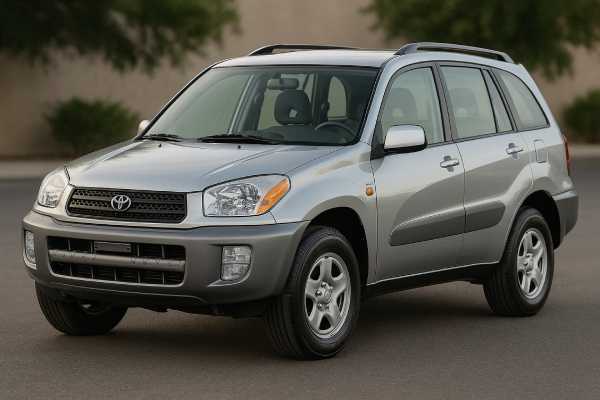
The second-generation Toyota RAV4 (XA20) helped define the small-SUV template: light, car-like, and easy to live with. In front-wheel-drive form with the 1AZ-FE 2.0-liter engine (148 hp), it focuses on simple running costs, practical packaging, and long-term durability. Owners value the chain-driven four-cylinder, straightforward 4-speed automatic or 5-speed manual gearboxes, and a cabin that still feels airy and useful today. This guide concentrates on the 2000–2003 model years with the 2.0-liter gasoline engine and FWD, using North American data where applicable. You will find the key specifications and dimensions, performance and economy, safety results, known issues and service actions, maintenance guidance and buyer tips—plus how it stacks up against period rivals. If you want an affordable, honest, compact SUV you can maintain at home, this RAV4 variant remains one of the easiest to recommend.
At a Glance
- Proven 1AZ-FE 2.0-liter with timing chain; low parts cost and good access for DIY service.
- Compact exterior, upright seating, and flat load floor make it easy to park and pack.
- Caveat: early ECM calibrations on some automatics could cause harsh shifts—confirm updated programming or replacement.
- Typical oil and filter interval: 5,000–7,500 miles (8,000–12,000 km) or 6 months, depending on use and oil spec.
Explore the sections
- Detailed Overview
- Specifications and Technical Data
- Trims and Options, Safety and Driver Assistance
- Reliability, Common Issues and Service Actions
- Maintenance and Buyer’s Guide
- Driving and Performance
- How It Compares to Rivals
RAV4 XA20 2.0 FWD overview
The 2000–2003 Toyota RAV4 FWD with the 1AZ-FE four-cylinder targets owners who want a small utility vehicle that behaves like a compact hatchback. Compared with the first-generation model, the XA20 is stiffer and more refined, and its independent rear suspension and low curb weight give it a surprisingly car-like ride. The 2.0-liter engine uses variable valve timing (VVT-i), multi-point fuel injection, and a durable timing chain. Output is modest—148 hp and roughly 192 Nm (142 lb-ft)—but response is clean, idle is smooth, and maintenance is straightforward. Two transmissions were offered: a 5-speed manual (rare in North America) or a 4-speed electronically controlled automatic. FWD models are simpler and lighter than their AWD counterparts, reducing wear items and improving economy.
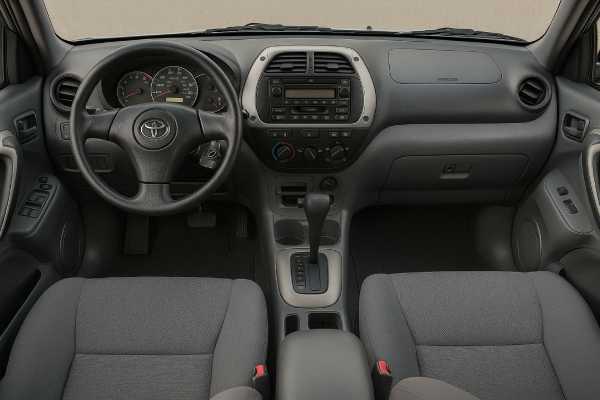
Inside, the XA20’s upright driving position, large glass area, and thin pillars help with visibility. The dash is simple, with climate controls you can operate in gloves, and the rear seatback folds to a low, flat load floor. With seats up, cargo volume is generous for the class; with seats down, the RAV4 can swallow bikes and flat-pack furniture. Safety equipment varies by year and trim, but ABS was widely available and child-seat anchors are provided. There is little in the way of modern driver assistance (no auto emergency braking, lane centering, or adaptive cruise on these years), which simplifies ownership and keeps running costs low.
Where this RAV4 shines is predictable reliability. Fluids and filters are inexpensive, access to service points is good, and the engine bay is not packed tight. Common wear points—struts, control arm bushings, mounts—are cheaper than average to renew. The main caveat to research is the early powertrain control calibration on some automatics that, if ignored, can accelerate transmission wear; updated ECM software or ECM replacement solves it. For shoppers, a clean-bodied, well-maintained FWD 2.0-liter RAV4 with proof of regular fluids and any campaign work remains a smart used-SUV buy.
RAV4 1AZ-FE specs and data
Engine and Performance (ICE)
| Item | Value |
|---|---|
| Code | 1AZ-FE |
| Layout & cylinders | Inline-4, DOHC, 16-valve, VVT-i |
| Valves per cylinder | 4 |
| Bore × Stroke | 86.0 × 86.0 mm (3.39 × 3.39 in) |
| Displacement | 2.0 L (1,998 cc) |
| Induction | Naturally aspirated |
| Fuel system | Multi-point fuel injection (MPI) |
| Compression ratio | ~9.8:1 |
| Max power | 148 hp (110 kW) @ 6,000 rpm |
| Max torque | 192 Nm (142 lb-ft) @ ~4,000 rpm |
| Timing drive | Chain |
| Emissions/efficiency class | ULEV (period certification) |
| Rated economy (EPA, typical) | 23/28 mpg US (city/hwy), ~25 combined (9.4 L/100 km combined) — 4-spd auto; ~24/29 mpg US, ~26 combined for 5-spd manual (8.9–9.8 L/100 km) |
| Real-world highway @ 75 mph | ~8.5–9.0 L/100 km (26–28 mpg US), weather/load dependent |
Notes: Power and torque are for North American gasoline models without AWD losses. Economy varies with transmission, tyre package, and maintenance condition.
Transmission and Driveline
| Item | Value |
|---|---|
| Transmissions | 5-spd manual (E250), 4-spd automatic (U241E) |
| Gear ratios (U241E auto) | 1st 2.847 • 2nd 1.552 • 3rd 1.000 • 4th 0.700 • Rev 2.343 • Final drive ~2.96 |
| Gear ratios (E250 manual, typical) | 1st 3.833 • 2nd 1.913 • 3rd 1.258 • 4th 0.918 • 5th 0.775 • Final drive ~4.23–4.33 |
| Drive type | Front-wheel drive (open differential) |
| Refuel time | ~5 min (from low to full) |
Chassis and Dimensions
| Item | Value |
|---|---|
| Front suspension | MacPherson strut, coil spring, stabilizer bar |
| Rear suspension | Double wishbone, coil spring, trailing arms |
| Steering | Power-assisted rack-and-pinion |
| Brakes | Front ventilated disc; rear drum (most FWD trims) |
| Wheels/Tires | 16-inch rims; common size 215/70R16 |
| Ground clearance | ~190 mm (7.5 in), trim-dependent |
| Length × Width × Height | ~4,245 × 1,735 × 1,680 mm (≈167.2 × 68.3 × 66.1 in) |
| Wheelbase | ~2,490 mm (98.0 in) |
| Turning circle (curb-to-curb) | ~10.6 m (34.8 ft) |
| Curb weight | ~1,290–1,340 kg (2,840–2,950 lb), by trim/trans |
| GVWR | ~1,810–1,845 kg (3,990–4,070 lb) |
| Fuel tank | ~58 L (15.3 US gal / 12.7 UK gal) |
| Cargo volume (SAE) | ~827 L (29.2 ft³) seats up / ~1,930 L (68.3 ft³) seats down |
Performance and Capability
| Metric | Value |
|---|---|
| 0–100 km/h (0–62 mph) | ~10.5–11.0 s (setup-dependent) |
| Top speed | ~170–175 km/h (105–109 mph) |
| Towing (braked) | ~680 kg (1,500 lb), with proper equipment |
| Payload | ~410–450 kg (900–1,000 lb), by trim |
| Roof load | ~45 kg (100 lb) with OE rails/crossbars |
Fluids and Service Capacities
| System | Spec / Capacity |
|---|---|
| Engine oil | API SL/SM 5W-30 (10W-30 in warm climates); ~4.2–4.4 L (4.4–4.6 US qt) with filter |
| Engine oil drain plug | ~27 Nm (20 lb-ft) |
| Coolant | Toyota Long Life (red) 50/50; ~6.1–6.3 L (6.4–6.7 US qt) total |
| Automatic transmission | Toyota ATF Type T-IV; typical drain-and-fill ~3.9 L (4.1 US qt) |
| Manual transmission (E250) | GL-4/GL-5 75W-90; ~3.4 L (3.6 US qt) |
| Power steering | ATF Dexron II/III (period guidance) |
| Air conditioning | R-134a ~0.55 kg (~19–20 oz); compressor oil PAG46 ~120–150 mL (verify underhood label) |
| Spark plugs | Denso SK20R11 / NGK IFR6A11; gap 1.1 mm (0.043 in); tighten ~22 Nm (16 lb-ft) |
| Wheel lug nuts | ~103 Nm (76 lb-ft) |
Electrical
| Item | Value |
|---|---|
| Alternator | ~80–100 A (equipment-dependent) |
| 12V battery | Group 35 or 26R typical; ~45–65 Ah; 500–650 CCA common |
| Spark plug type/gap | Iridium, SK20R11 / IFR6A11; 1.1 mm (0.043 in) |
Safety and Driver Assistance
| Item | Value |
|---|---|
| IIHS (2001–2003) | Moderate overlap front: Acceptable; Side (original test, without side airbags): Poor |
| Head restraints/seat design | Conventional (no active systems on early years) |
| Airbags | Dual front; side airbags not present on 2001–2003 NA FWD models (varied by region/year) |
| ABS/EBD | Widely available; standard on many trims |
| ADAS | Not equipped (no AEB, ACC, LKA, BSD/RCTA on these years) |
| Child seats | LATCH/ISO-fix anchorages; check child-seat fit and tether routing in the owner’s manual |
RAV4 trims, safety and ADAS
Trims and equipment (North America, 2001–2003). In these years, the FWD 2.0-liter RAV4 was typically offered in two trims: Base and L. The Base covers the essentials: cloth seats, manual HVAC, 16-inch steel wheels with 215/70R16 tyres, and a tilt steering column. The L trim adds body-color exterior accents, roof rails, premium cloth, and available alloy wheels. A power sunroof, keyless entry, upgraded audio, and ABS with electronic brake-force distribution appear in option packages. The five-speed manual is uncommon but pairs well with the 2.0-liter in city use. The four-speed automatic was the volume seller and is the transmission behind the key ECM update (see Reliability section). Wheel/tire packages remain 16-inch across the board, keeping tyre pricing friendly.
Functional differences by trim/year. Equipment varied slightly year-to-year (e.g., audio head units, keyless systems), but mechanical differences are minimal within the FWD 2.0-liter range. Suspension tuning is comfort-oriented across trims, and there are no FWD-specific towing or off-road packages beyond wiring kits and dealer accessories. Brakes remain front-vented discs with rear drums on most FWD models; four-wheel discs are more often seen on AWD or later years.
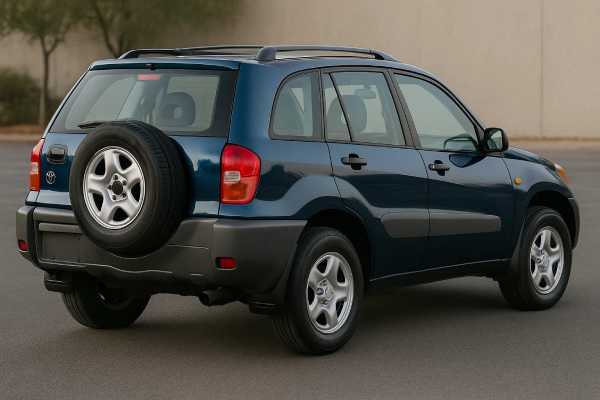
Quick identifiers. Look for five-door body, single tailgate with outside spare (on many models), and a simple, open cargo area with split-fold rear seats. VIN decodes as an ACA26 (FWD, 2.0-liter) for North American market. The under-hood emissions label confirms the 1AZ-FE, and the trans case ID tag identifies manual (E250) or automatic (U241E).
Year-to-year notes (2001–2003). The 2001 model year launches the redesign; 2002 brings minor feature shuffles. Through 2003, side-torso airbags were not part of the typical U.S. FWD equipment, and advanced head restraints and curtain airbags would only appear on later updates. In 2004 (outside our scope), Toyota introduced the 2.4-liter 2AZ-FE and additional safety changes.
Safety ratings. Period crash testing of this generation shows Acceptable performance in the IIHS moderate-overlap frontal crash, with Poor side-impact results for vehicles without side airbags. Buyers should keep this context in mind and, where possible, add side-impact mitigation by choosing newer tyres, maintaining brakes, and ensuring seat and belt mechanisms work as designed.
ADAS and calibrations. These years predate mainstream ADAS. There is no factory forward collision warning, lane departure alert, adaptive cruise, or blind-spot monitoring. Alignment of steering angle sensor and ABS bleeding follow conventional procedures, with no radar or camera calibrations. After body repair, verify airbag SRS connectors, seatbelt pretensioners, and the diagnostic trouble-code memory with a capable scan tool.
Reliability, issues and service actions
Overall track record. The FWD 2.0-liter RAV4 is widely regarded as a low-drama, long-life small SUV if serviced on time. The 1AZ-FE’s timing chain and direct coil-on-plug ignition simplify ownership. Many examples surpass 200k miles (320k km) on original long-blocks with routine fluids and filters.
Common/occasional/rare issues (with severity).
- Common — ECM calibration on automatics (medium–high severity). Early engine control units (ECM/PCM) on 2001–2003 models with the U241E automatic could command inappropriate line pressure and shift timing, leading to harsh shifts, flare, or clutch distress. The factory remedy is ECM reprogramming to a later calibration or ECM replacement (updated part numbers). Prolonged operation with bad logic can shorten trans life; prioritize vehicles with documentation of the fix.
- Common — Oxygen sensors and EVAP valves (low–medium). Aging O2 sensors (especially rear) and EVAP purge/vent valves can trigger MIL/CEL and marginal economy. Replacement is straightforward and parts are inexpensive.
- Common — Suspension wear (low–medium). Front struts, top mounts, and control-arm rear bushings soften with age, causing steering nibble and brake dive. Refreshing dampers, bushings, and an alignment restore the original feel.
- Occasional — Engine mounts (low–medium). The RH mount and dog-bone torque mount compress with age, adding vibration at idle.
- Occasional — Cooling seep/leaks (low–medium). Radiator end tanks and thermostat housings may seep after 15–20 years. Use genuine coolant and new clamps; consider proactive radiator replacement during timing cover or accessory service.
- Occasional — Coil-on-plug misfires (low). Heat and age can weaken coils; replace with quality Denso units and fresh plugs (iridium).
- Rare — Internal engine faults (high). The 1AZ-FE is not generally associated with the head-bolt thread issues more common to early 2AZ-FE engines; catastrophic failures are unusual when oil is maintained.
Service actions, TSBs, and warranty extensions. Toyota issued ECM calibration updates for 2001–2003 RAV4s with the U241E automatic to address shift quality. Many vehicles also received later ECM replacements when calibration alone was insufficient. When shopping, ask for records noting the ECM part number and calibration ID. After purchase, a dealer can confirm via VIN if updates were applied. Other manufacturer communications covered drivability refinements and reflash procedures for the 1AZ-FE.
Driveline and chassis. The FWD layout is simple, but listen for front wheel-bearing grind at highway speeds and inspect CV boots for cracks. Rear drums require occasional adjustment and benefit from periodic hardware refresh. Steering racks generally last, but inner tie-rods can loosen; check for play and uneven tyre wear.
Corrosion watch points. In rust-belt regions, inspect front subframe mounts, rear trailing-arm pick-ups, and fuel and brake lines along the underbody. Door bottoms and the tailgate around the spare-wheel carrier can show bubbling paint; catch and treat early.
Pre-purchase checklist.
- Warm-drive the vehicle; verify smooth 1–2 and 2–3 shifts on automatics.
- Scan for codes and monitors ready status; pay attention to EVAP and O2 tests.
- Confirm ECM update/replacement documentation.
- Inspect tyres (even wear), brakes (no pulsation), and suspension bushings.
- Check for coolant staining, oil seep at the timing cover, and PS hose weeps.
- Review maintenance history and fluid service dates/mileages.
Maintenance and buyer’s guide
Practical maintenance schedule (time/distance). The values below suit typical mixed use and modern oil quality while respecting period guidance. Always adjust for climate and severe use (short trips, extreme temps, heavy loads).
- Engine oil & filter: 5,000–7,500 miles (8,000–12,000 km) or 6 months with API SL/SM 5W-30; sooner for short-trip use.
- Engine air filter: Inspect at 15,000 miles (24,000 km); replace 30,000–45,000 miles (48,000–72,000 km) or when dirty.
- Cabin air filter: Every 15,000–20,000 miles (24,000–32,000 km) or annually.
- Coolant: If filled with Toyota Long Life (red), change every 2–3 years / ~30,000 miles; if converted to Super Long Life (pink), follow 5 years/100,000 miles initial, then 5 years/50,000 miles thereafter.
- Spark plugs (iridium): Every 60,000–90,000 miles (96,000–145,000 km); verify heat-range/type matches SK20R11/IFR6A11.
- Drive/serpentine belt & hoses: Inspect every oil change; replace belts ~60,000–90,000 miles or on cracks/noise; hoses as needed.
- Automatic transmission (U241E): Drain-and-fill ATF Type T-IV every 60,000 miles (96,000 km); pan service and filter/strainer with magnet cleaning on first service or if fluid is dark.
- Manual transmission (E250): GL-4/GL-5 75W-90 every 60,000 miles (96,000 km).
- Brake fluid: DOT 3/4 flush every 2 years regardless of mileage.
- Brakes: Inspect pads/rotors every 10,000–15,000 miles; clean and lubricate drum hardware annually on FWD models with rear drums.
- Alignment/tyre rotation: Rotate every 5,000–7,500 miles; annual alignment if potholes or tyre edge wear appear.
- Valve clearances: Hydraulic lash adjusters not used; 1AZ-FE uses shim-over-bucket—inspect only if symptoms (tick, rough idle) or during major service.
- 12V battery: Load-test annually after year 4; typical life 4–6 years.
- A/C system: Quick performance check pre-summer; respect the R-134a charge label under the hood if servicing.
Fluid specifications and helpful torque values.
- Engine oil: API SL/SM 5W-30; capacity ~4.4 US qt with filter; drain plug ~27 Nm (20 lb-ft).
- Coolant: Toyota LLC (red) 50/50; ~6.1–6.3 L system fill.
- ATF: Toyota Type T-IV; drain ~3.9 L typical; check fluid hot, level ground, after cycling through ranges.
- Manual trans: 75W-90 GL-4/GL-5; ~3.4 L.
- Spark plugs: Denso SK20R11 / NGK IFR6A11; gap 1.1 mm; ~22 Nm (16 lb-ft).
- Wheel lugs: ~103 Nm (76 lb-ft).
Buyer’s guide (what to look for).
- Best bets: Clean-title, stock (or lightly modified) FWD 2.0-liter with documented oil, coolant, and transmission services, recent tyres, and fresh struts/bushings. Manuals are engaging but rarer; automatics are fine if ECM logic is updated and shifts are clean.
- What to avoid: Neglected ATF, obvious shift flare/harshness, evidence of coolant neglect (brown sludge in reservoir), rust-belt rot in subframes and brake lines, hack wiring (stereo/remote start), and mismatched tyres.
- Reconditioning checklist: Oil/fluid baseline, front struts and control-arm bushings, brake refresh and bleed, alignment, engine mounts if idle buzz, and a set of quality plugs/coils if the history is unknown.
- Durability outlook: With sensible maintenance and rust control, a FWD 1AZ-FE RAV4 can deliver another decade of dependable service with low annual spend.
Driving feel, economy and performance
Ride and handling. The XA20 RAV4 is tuned for compliance rather than drama. Around town it feels nimble because of its short wheelbase and light steering effort. At highway speeds, straight-line stability is good for the class, helped by modest tyre sizes that track predictably in rain grooves. Body roll is present but well-controlled; mid-corner bumps settle quickly. Worn dampers or bushings show up as nose dive under braking and float over undulations; a fresh set of struts springs the chassis back to life and reduces secondary motions.
Steering and braking. Steering weight is medium-light with limited on-center feedback, typical of early-2000s electric-assist calibrations? No—this RAV4 uses hydraulic assist, which provides a slightly more natural build-up of effort in tight turns than later electric systems. Braking performance is consistent for commuting duty; the front-vented discs resist fade in daily use, and the rear drums are durable if periodically adjusted and cleaned. Under panic stops on uneven surfaces, ABS action is audible but effective.
Powertrain character. The 1AZ-FE prefers to rev. Throttle mapping is linear and the engine is smooth from idle to 4,500 rpm, with a slightly grainier note near the 6,000-rpm power peak. The 5-speed manual makes the most of the modest output, with a light clutch and positive if not particularly short throws; it’s a pleasant urban pairing. The 4-speed automatic is calm in traffic and happy at steady highway speeds; kickdown is prompt if you dig past half-throttle, though there’s only so much passing punch. If the automatic bangs into 2–3 or flares on part-throttle upshifts, budget for ECM calibration checks and fresh ATF.
Real-world economy. In mixed suburban running, expect 25–27 mpg US (9.4–8.7 L/100 km) in healthy FWD automatics, with 28–30 mpg US highway if you keep speeds to 60–65 mph (100–105 km/h). At 75 mph (120 km/h), ~26–28 mpg US is typical depending on wind and elevation. Cold weather, roof racks, or all-season tyres with aggressive tread will push numbers lower; a fresh air filter, correct tyre pressures, and proper alignment help recover 1–2 mpg.
Performance metrics. Independent tests of period FWD 2.0-liter models report 0–60 mph in roughly 9.8–10.5 seconds for automatics and a tick quicker with the manual. Mid-range 50–80 mph (80–130 km/h) requires a downshift; plan passes accordingly. Braking from 100–0 km/h is stable with mild dive; new front pads/rotors and properly adjusted rear drums tighten initial bite.
Load and light towing. The RAV4 can tow up to 1,500 lb (680 kg) with appropriate hitch and cooler, but you’ll feel the mass in grades and crosswinds. Keep speeds moderate and add margin for braking distances. Roof load is modest at ~100 lb (45 kg); distribute weight low and between the rails to preserve stability.
How it compares to rivals
Honda CR-V (2002–2004, FWD 2.4). The CR-V’s bigger 2.4-liter engine offers more torque and slightly better highway passing, plus a larger cargo bay and more rear legroom. However, parts pricing and insurance can be higher, and the RAV4’s simpler FWD layout with a 2.0-liter can be cheaper to keep over time. Early CR-Vs also had A/C compressor concerns—something the RAV4 largely avoids when charged correctly.
Subaru Forester (2001–2002, 2.5, AWD). Great winter traction and a more wagon-like feel define the Forester. Against that, permanent AWD adds weight and maintenance. Head-gasket concerns on period Subaru 2.5s are well known; the RAV4’s 1AZ-FE avoids similar endemic faults and usually costs less in long-term fluids and tyres (two vs four matched).
Ford Escape/Mazda Tribute (2001–2003, 2.0 I-4/3.0 V6). The Escape offers a roomier cabin and, with the V6, much stronger acceleration. The flip side is higher fuel use, more complex emissions hardware on some variants, and a heavier front end that taxes brakes and tyres. If you don’t need the V6, the RAV4’s 2.0-liter keeps running costs down and has fewer age-related electronics surprises.
Hyundai Santa Fe (2001–2003, 2.4/2.7). Value-packed when new and often cheaper on the used market, but interior durability and ride composure lag the Toyota. Santa Fe powertrains are stout enough, yet cabin squeaks, trim wear, and sensor niggles show up earlier than on an equivalent RAV4.
Bottom line. If you prioritize ease of ownership, predictable reliability, and a compact footprint, the FWD 2.0-liter RAV4 remains one of the most sensible choices from its era. Pick a clean example with documented fluid services and (for automatics) proof of updated ECM programming, and it will likely be the least complicated SUV you own.
References
- 2001 Toyota RAV4 2001 (Safety Rating)
- 2001 Toyota RAV4 2001 (EPA Fuel Economy)
- 2001 RAV4 – Owners’s Manual 2001 (Owner’s Manual)
- 2001 Toyota RAV4 Brochure — Specification Highlights 2000 (Manufacturer Brochure)
Disclaimer
This guide is for informational purposes and is not a substitute for professional diagnosis, repair, or the official service literature for your specific VIN. Specifications, torque values, and service intervals vary by market, year, and equipment. Always verify procedures, capacities, and calibration updates against your vehicle’s owner’s manual and factory service documentation.
If this was helpful, consider sharing it with fellow owners on Facebook or X/Twitter to support xcar’s work.