
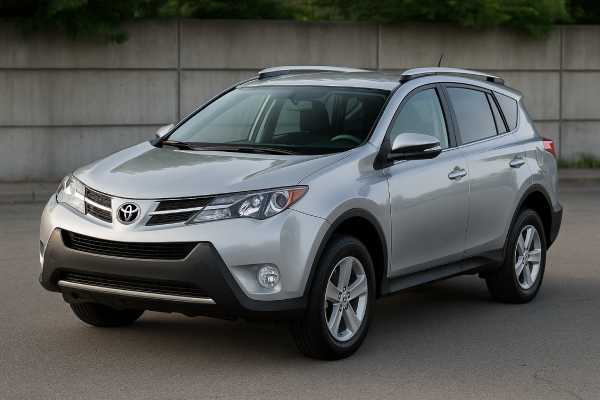
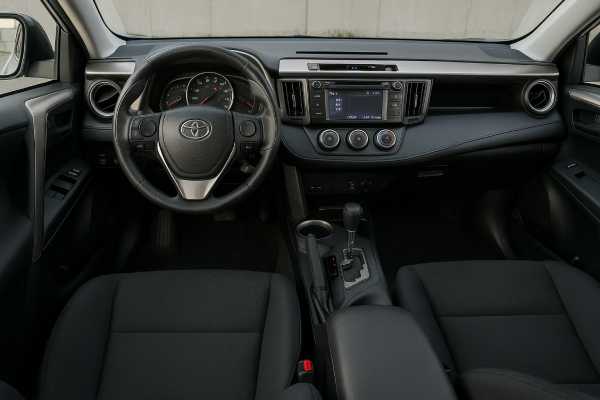
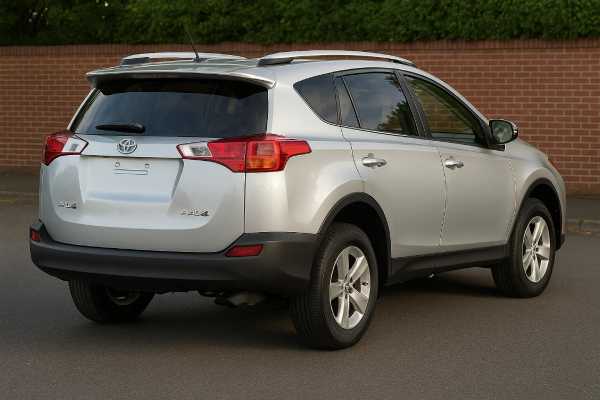
The fourth-generation Toyota RAV4 (XA40) brought the model squarely into the modern compact-SUV era. For 2013–2015, North American front-wheel-drive versions used Toyota’s 2AR-FE 2.5-liter four-cylinder paired with a six-speed automatic, replacing the old four-speed and delivering better drivability and real-world economy. Toyota also redesigned the body to reduce noise, improve aerodynamics, and replace the side-hinged rear door with a top-hinged liftgate—practical changes that owners notice every day. Inside, the cabin moved upmarket with a cleaner dash layout and more cargo room (seats up or folded), while keeping the simple controls and wide visibility buyers expect from a RAV4. Safety content took a step forward (standard backup camera; available Blind Spot Monitor with Rear Cross-Traffic Alert), and IIHS ratings improved mid-cycle. If you want a compact crossover that emphasizes low running costs, easy ownership, and predictable handling more than flash, a well-kept 2013–2015 FWD RAV4 remains a smart, durable pick.
Fast Facts
- Smooth, proven 2.5-liter engine and 6-speed automatic deliver relaxed cruising and low maintenance.
- Big cargo hold for the class (about 38.4 ft³ seats up / 73.4 ft³ seats folded).
- Straightforward ergonomics; wide dealer support and parts availability keep costs predictable.
- Watch for early small-overlap crash results on 2013–2014 builds; 2015 (built after Nov 2014) improved.
- Oil changes: 10,000 miles / 12 months with 0W-20 (tire rotation every 5,000 miles).
Navigate this guide
- RAV4 XA40 FWD overview
- Specifications and technical data
- Trims, options and safety
- Reliability and service actions
- Maintenance and buyer’s guide
- Driving and performance
- How RAV4 compares to rivals
RAV4 XA40 FWD overview
Toyota’s fourth-generation RAV4 arrived for model year 2013 with a clear brief: more utility and refinement without losing simplicity. Under the hood sits the 2AR-FE 2.5-liter inline-four (dual VVT-i), rated at 176 hp (132 kW) and 172 lb-ft (233 Nm). A six-speed automatic transmission became standard, a major update from the previous four-speed. The taller top gears drop revs on the highway; the transmission’s “Sport” mode and the manual “S” gate add a measure of control on grades.
The chassis switched to a MacPherson-strut front and double-wishbone rear suspension tuned for compliance and predictable responses. Steering is electric power assist with a calm on-center feel, which helps the RAV4 track straight on long interstate stretches. Brakes are four-wheel discs with ABS and stability control standard.
Packaging is a highlight. Toyota moved the spare tire inside and adopted a conventional top-hinged liftgate, which makes loading easier in tight parking spaces. The cargo bay is broad and square, with a low lift-over height; split-folding rear seats fold nearly flat, unlocking a genuinely wagon-like load floor. That practicality—paired with a compact exterior footprint—explains much of the model’s long-standing owner loyalty.
Noise, vibration, and harshness (NVH) were reduced over the prior generation through added body sealing and strategic use of high-strength steel. On the road, the cabin is quiet enough for easy conversation at 70–75 mph, and the 2.5-liter’s coarse notes are well muted at part throttle. The 6AT’s programming prioritizes smoothness; kickdown is decisive rather than abrupt.
Equipment moved up a notch in this era. A backup camera became standard across trims, and Toyota’s Entune audio systems added Bluetooth, USB, and available navigation. Available safety tech (Blind Spot Monitor with Rear Cross-Traffic Alert) broadened the RAV4’s appeal to family buyers. Importantly, mid-cycle structural tweaks improved small-overlap crash performance on later 2015 builds (see the Safety section for details).
If your needs center on commuting, errands, light road trips, and the occasional home-improvement run—not towing or off-road work—the 2013–2015 FWD RAV4’s mix of space, efficiency, and low operating costs is exactly on target.
Specifications and technical data
Engine and Performance (ICE)
| Item | Specification |
|---|---|
| Code | 2AR-FE |
| Layout & valvetrain | Inline-4, DOHC, dual VVT-i, 4 valves/cyl |
| Bore × stroke | 90.0 × 98.0 mm (3.54 × 3.86 in) |
| Displacement | 2.5 L (2,494 cc) |
| Induction & fuel | Naturally aspirated; sequential multi-port fuel injection |
| Compression ratio | ~10.4:1 |
| Max power | 176 hp (132 kW) @ 6,000 rpm |
| Max torque | 233 Nm (172 lb-ft) @ 4,100 rpm |
| Timing drive | Chain |
| Emissions/efficiency standard | EPA Light-Duty |
| Rated fuel economy (FWD, 6AT) | 26 mpg combined (23 city / 30 highway) — 9.0 L/100 km combined (10.2 / 7.8) |
| Real highway @ 75 mph | ~29–31 mpg US (8.1–7.6 L/100 km), conditions dependent |
| Aerodynamics | Cd ~0.33 (approximate for body style) |
Transmission and Driveline
| Item | Specification |
|---|---|
| Transmission | 6-speed automatic (ECT-i), model U760E |
| Gear ratios (1st→6th / Rev)* | 3.300 / 1.900 / 1.420 / 1.000 / 0.713 / 0.608 ; Reverse 4.148 |
| Final drive ratio | ~4.07 (typical for FWD application) |
| Drive type | Front-wheel drive |
| Differential | Open (front) |
| Refuel time (gasoline) | ~5 minutes from low to full at pump |
*Ratios shown for the U760E family as fitted to this application.
Chassis and Dimensions
| Item | Specification |
|---|---|
| Suspension (front/rear) | MacPherson strut / double-wishbone |
| Steering | Electric power assist, rack-and-pinion |
| Brakes | 4-wheel disc (front ventilated), ABS/EBD/Brake Assist |
| Wheels/Tires (typical) | 225/65 R17 (LE/XLE) ; 235/55 R18 (Limited) |
| Ground clearance | ~160 mm (6.3 in) |
| Length / Width / Height | 4,570 mm × 1,844 mm × 1,661 mm (179.9 in × 72.6 in × 65.4 in) |
| Wheelbase | 2,660 mm (104.7 in) |
| Turning circle (curb-to-curb) | ~10.6 m (34.8 ft) |
| Curb weight (range, FWD) | ~1,560–1,625 kg (3,435–3,585 lb) |
| GVWR (typical) | ~2,087–2,087+ kg (~4,600 lb) |
| Fuel tank (gasoline) | 60 L (15.9 US gal / 13.2 UK gal) |
| Cargo volume | ~1,087 L / 2,078 L (38.4 ft³ / 73.4 ft³) — seats up / folded (SAE) |
Performance and Capability
| Metric | Value |
|---|---|
| 0–100 km/h (0–62 mph) | ~9.2–9.6 s (FWD) |
| Top speed | ~180–190 km/h (limited; conditions dependent) |
| Braking 100–0 km/h (62–0 mph) | ~38–41 m (125–135 ft), tire/condition dependent |
| Towing capacity | 680 kg (1,500 lb) (braked) |
| Payload (typical) | ~460–460+ kg (~1,000–1,050 lb) |
| Roof load (factory rails) | ~45–68 kg (~100–150 lb), check accessory rating |
Fluids and Service Capacities
| System | Specification | Capacity (approx.) |
|---|---|---|
| Engine oil | Toyota 0W-20 API SN/SN Plus or better | ~4.4 L (4.6 US qt) with filter |
| Engine coolant | Toyota Super Long Life Coolant (SLLC, pink) 50/50 | — consult service manual |
| Automatic transmission | Toyota ATF WS | — service fill varies (~6–7 L typical) |
| A/C refrigerant | R-134a | — charge mass varies by option |
| A/C compressor oil | ND-OIL8 (PAG) | — as specified per system |
| Key torque values | Wheel nuts ~103 Nm (76 lb-ft); spark plugs ~18–22 Nm (13–16 lb-ft) |
Notes: Some capacities vary with production changes and options; verify by VIN in the official service literature before servicing.
Electrical
| Item | Specification |
|---|---|
| Alternator output | ~100–130 A depending on trim/equipment |
| 12V battery | Group 35 or similar, ~48–60 Ah (CCA varies) |
| Spark plugs | Iridium; gap ~0.8 mm (0.031–0.032 in) |
Safety and Driver Assistance
| Item | 2013–2014 | 2015 (built after Nov 2014) |
|---|---|---|
| IIHS small overlap (driver) | Poor | Good |
| IIHS moderate overlap / side / roof / head restraints | Good | Good |
| IIHS Top Safety Pick | — | Yes (builds after Nov 2014) |
| Headlight rating | Not evaluated under later IIHS protocol | Not evaluated under later IIHS protocol |
| ADAS availability | Standard: ABS, stability/traction control, backup camera. Optional: Blind Spot Monitor (BSM) with Rear Cross-Traffic Alert (RCTA). | Same; structure revised on driver side for small-overlap performance. |
| Airbags | Front, side, curtains, driver knee (total 8) | 8 |
Trims, options and safety
Trim walk (FWD, 2013–2015):
- LE: 17-inch steel wheels, cloth seats, manual A/C, keyless entry, cruise control, Bluetooth/USB audio, backup camera, 60/40 split-fold rear seat. Straightforward daily-driver spec.
- XLE: 17-inch alloys, dual-zone automatic climate control, power moonroof, roof rails, fog lamps, upgraded Entune audio with 6.1-inch display, available navigation. Adds comfort features most buyers want without pushing price too high.
- Limited: 18-inch alloys, SofTex-trimmed seats with driver power adjustments, heated front seats, push-button start, auto-dimming mirror, optional JBL audio, available power liftgate (height-adjustable).
Key option packages and identifiers:
- Navigation/JBL Audio: Larger display and premium speakers; look for JBL branding on the door tweeters.
- BSM with RCTA: Indicator icons in side mirrors; useful in dense traffic and parking lots.
- Power liftgate (Limited): Height memory; quickly spotted by the interior switch near the dash and the liftgate motor cover.
- Wheels: LE steel 17s with covers; XLE 17-inch alloys; Limited 18-inch machined alloys.
Year-to-year changes that matter:
- 2013 launch: All-new body, 6-speed automatic, standard backup camera; elimination of the V6 option and third-row seat, a trade-off that netted more cargo room and refinement.
- 2014: Feature alignment and audio updates.
- 2015: Structural changes on the driver-side front for small-overlap crash protection on vehicles built after November 2014 (these are the ones that earn the IIHS Top Safety Pick). When shopping, check the driver’s-door build label for the month/year.
Safety systems and child-seat notes:
- Airbags: Dual-stage front, front-seat side, full-length curtains, and driver knee are standard.
- LATCH: Two lower anchors in the outboard rear positions with top tethers for all three rear seats; good access, but bulky bases may need some maneuvering under the cushion flap.
- ADAS calibration: If windshields or side mirrors are replaced on BSM/RCTA-equipped models, follow factory calibration procedures to avoid false alerts.
- Towing hardware: FWD models are rated to 1,500 lb; use a Class II receiver and verify lighting connections. A transmission cooler isn’t typically required for light loads, but keep speeds moderate in hot weather.
Reliability and service actions
The 2AR-FE four-cylinder and U760E six-speed transmission are known for solid long-term reliability when serviced on time. Owners typically report few surprises; the issues below reflect patterns seen across age, mileage, and climate.
Common / occasional issues
- Front brake vibrations (common, low–medium cost): Pulsation during highway stops points to rotor thickness variation or pad imprint. Remedy: resurface or replace rotors/pads; torque wheels properly (avoid impact-gun over-torque).
- Wind noise from mirror area (occasional, low cost): Door mirror seals can hiss at highway speeds. Remedy: inspect mirror cap fit; replace weatherstrip/seals as needed.
- Hatch trim rattles (occasional, low cost): Liftgate interior trim clips loosen over time. Remedy: reseat with fresh clips; add felt where panels meet.
- Battery aging (common after ~5–7 years): Short-trip use accelerates 12V battery decline. Remedy: test annually; replace proactively before winter.
Powertrain notes
- Engine oil use (occasional on higher mileage): The 2AR-FE rarely consumes oil when maintained, but extended intervals with poor-quality oil can varnish rings. Remedy: switch to high-detergent 0W-20, shorten intervals to 5–7.5k miles temporarily, verify PCV function.
- Transmission feel (rare to occasional): Early life can include soft part-throttle upshifts or mild hunting on rolling terrain—generally “as designed.” Hard shifts or flare under load merit a scan for codes and fluid condition; a fluid exchange (ATF WS) often restores feel.
Chassis and body
- Rear suspension bushings (occasional, medium cost): Double-wishbone rear links can squeak or clunk with age and road salt. Remedy: replace affected bushings/arms; align afterward.
- Wheel bearings (occasional at high mileage): Growling that changes with steering load typically indicates a front hub bearing. Remedy: replace hub/bearing assembly; check torque.
Recalls, campaigns, and software
- Structural safety improvements (2015 builds after Nov 2014): Toyota revised the front structure on the driver side to improve small-overlap performance—this is not a recall but a running change; shoppers may prefer these builds.
- Electronic parking-brake wiring (later XA40 years): Not applicable to 2013–2015 FWD models.
- General recall diligence: Always run an official VIN check and confirm completion printouts before purchase.
Pre-purchase checklist
- Full service history (oil every 10k/12 mo or earlier; proof of tire rotations).
- Brake thickness and rotor runout measurements.
- Suspension play check (rear links, front strut mounts).
- Transmission fluid condition (WS should be red/clean; dark/burnt indicates heat).
- Tire brand/age and even wear; alignment printout desirable.
- Build date verification for 2015 (after 11/2014 preferred for safety ratings).
Maintenance and buyer’s guide
Practical service schedule (time/distance = whichever comes first)
- Engine oil & filter: 10,000 miles / 12 months with full-synthetic 0W-20 (shorten to 5–7.5k miles if lots of short trips or towing).
- Engine air filter: Inspect 15,000; replace ~30,000 miles (sooner in dusty areas).
- Cabin filter: 15,000–20,000 miles or annually.
- Coolant (SLLC): First replacement at 100,000 miles / 10 years; then every 50,000 miles / 5 years.
- Spark plugs (iridium): 120,000 miles (inspect earlier for misfire under load).
- Serpentine belt & hoses: Inspect every 15,000–30,000; replace if cracked or glazed (often 90k–120k).
- Automatic transmission (ATF WS): “Lifetime” under normal use, but many owners do a drain-and-fill every 60,000–90,000 miles to preserve shift quality and longevity.
- Brake fluid: Replace every 3 years.
- Brake pads/rotors: Inspect at each tire rotation (5,000 miles).
- Tires/rotation: Rotate every 5,000 miles; check alignment annually or with any uneven wear/pull.
- 12V battery: Test annually after year 4; typical life 5–7 years.
- PCV valve & throttle body: Inspect/clean at ~60,000 miles for stable idle and low oil use.
Fluid specs and capacities (quick reference)
- Engine oil: 0W-20 API SN or later; ~4.6 qt (with filter).
- ATF: Toyota ATF WS; service fill varies by procedure (~6–7 L typical).
- Coolant: Toyota SLLC (pink), premix 50/50.
- Fuel: Regular unleaded (87 AKI).
- Tire pressures (typical): 33–35 psi cold (front/rear; check door-jamb sticker).
Buyer’s tips
- Best value sweet spot: Clean 2014–2015 XLE with documented maintenance; 2015 built after 11/2014 adds the structural improvement that earns IIHS Top Safety Pick.
- What to avoid: Neglected fleet or ride-share vehicles; mismatched tires; obvious towing hardware paired with heat-stressed ATF.
- Easy wins in reconditioning: New cabin filter, fresh wiper blades, brake service with proper torquing, and a drain-and-fill on ATF WS can transform feel.
- Durability outlook: With simple upkeep, 200,000-plus miles is realistic. Suspension bushings, wheel bearings, and dampers are the usual age-related wear items; the 2AR-FE bottom end and chain drive are stout.
Driving and performance
Ride, handling, and NVH:
The XA40’s structure feels tighter than the prior RAV4, and the double-wishbone rear end helps it absorb sharp impacts without the “hop” some compact SUVs exhibit. The steering is light at parking speeds and settles on center by 50 mph, so it’s low-effort in town and calm on the freeway. Body roll is present but progressive; the RAV4 prefers smooth, early inputs to abrupt stabs, which suits family duty.
Powertrain character:
The 2.5-liter four builds torque early enough for easy stop-and-go, and the six-speed picks higher gears quickly to keep revs down. Throttle response is linear. Selecting Sport sharpens kickdown for passing, and the manual gate is handy for engine braking on descents. Wide-open throttle brings a coarse note above 4,500 rpm, but the cabin tuning keeps it from droning at cruise.
Real-world economy:
Owners commonly see 28–31 mpg US (7.6–8.4 L/100 km) on long highway legs at 70–75 mph in fair weather with two aboard and luggage. Mixed suburban use hovers around 24–27 mpg (8.7–9.8 L/100 km). Winter blends, short trips, and roof racks can pull numbers down a few mpg.
Key metrics and feel:
- 0–60 mph: Mid-9-second range (FWD) with typical all-season tires and a light load.
- 50–70 mph passing: Confident if you pre-select 4th or use a firm throttle to prompt a two-gear kickdown.
- Braking: Straight and stable; pedal feel is firm after a few hard stops if rotors are healthy.
- Towing/load behavior: Up to 1,500 lb is fine with decent trailer brakes. Expect a 10–20% fuel-economy hit and earlier downshifts on grades. Keep trans fluid fresh if you tow annually.
Traction and control:
As a FWD model, grip depends on tires. With quality all-seasons, the stability system intervenes smoothly in the wet; in light snow, a winter tire set markedly improves take-off and braking. Ground clearance is modest, so treat rutted tracks and deep snow with care.
How RAV4 compares to rivals
- Honda CR-V (2013–2015): Slightly roomier back seat and similar cargo space; the CR-V’s CVT arrives for 2015 with excellent economy but a different driving feel. The RAV4’s 6-speed automatic is more conventional and generally more durable under heat.
- Mazda CX-5 (2013–2015): Best steering/handling in class; the 2.5-liter CX-5 is quicker but rides firmer and can be noisier on coarse pavement. RAV4 wins for long-trip quietness and dealer network size.
- Subaru Forester (2014–2015): Standard AWD and great visibility; CVT behavior and interior trim quality can be divisive. RAV4 FWD is thriftier in mild climates and simpler mechanically.
- Ford Escape (1.6/2.0 EcoBoost): Strong turbo torque, especially the 2.0T, but higher complexity and more variability in long-term maintenance. RAV4’s naturally aspirated setup ages gently.
- Chevrolet Equinox (2.4): Comfortable ride and space, but economy and power trail the Toyota. RAV4’s resale and maintenance consistency are stronger.
Bottom line: The 2013–2015 RAV4 FWD centers on low-stress ownership: roomy cabin, honest efficiency, and minimal drama. You’ll find sportier options and more trail-oriented ones, but few that feel this easy to live with for a decade.
References
- All-New 2013 Toyota RAV4 Makes World Debut at Los Angeles International Auto Show 2012 (Press Kit)
- 2013 RAV4 Combines Bold Style, Performance and Class-leading Fuel Efficiency 2012 (Media Release)
- Gas Mileage of 2015 Toyota RAV4 2015 (Official EPA Data)
- 2015 Toyota RAV4 2015 (Safety Rating)
- SAFETY RECALL 23TA13 (Remedy Notice) 2023 (Recall Database)
Disclaimer
This article is for informational purposes and is not a substitute for professional diagnosis or repair. Specifications, capacities, torque values, safety ratings, and service intervals can vary by VIN, model year, market, and equipment. Always verify details against your vehicle’s official owner’s manual and service information before performing maintenance or repairs.
If this guide helped, please consider sharing it with fellow enthusiasts and owners on Facebook, X/Twitter, or your favorite forum to support xcar’s work.