
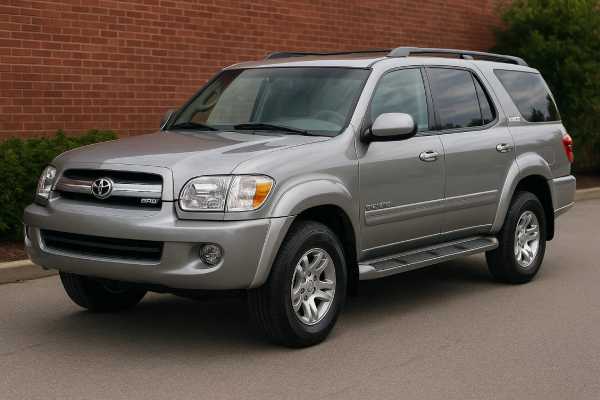
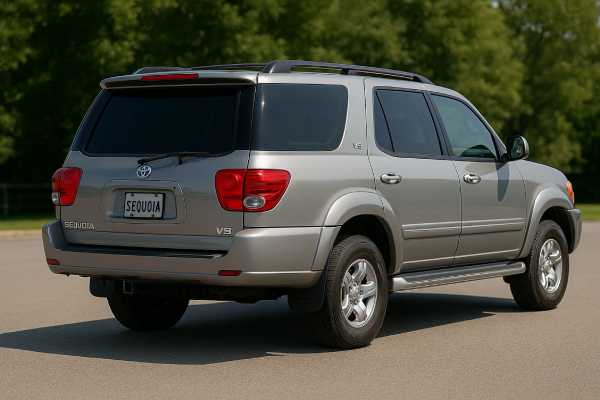
The 2005 facelift Toyota Sequoia 4WD (UCK45) is the most polished version of the first-generation Sequoia. It combines Toyota’s 2UZ-FE 4.7 liter V8 with variable valve timing (VVT-i), a stronger 5-speed automatic transmission, and a full-time 4WD system aimed at real-world use on highways, snow, and light trails.
This is a traditional body-on-frame SUV: big, stable, and built for towing and long-distance trips rather than tight parking garages and fuel-sipping commutes. Inside, it offers genuine three-row seating for up to eight people, flexible cargo space, and a comfortable ride that feels more like a refined truck than a soft crossover.
Today, a 2005 Sequoia 4WD is attractive if you value durability and capability over modern tech and efficiency. Age brings its own challenges—rust, worn suspension, and neglected timing belts—but a structurally sound, well-maintained UCK45 can still deliver many years of dependable service. This guide covers specs, reliability, maintenance, and how it compares to other full-size SUVs.
Top Highlights
- 2UZ-FE 4.7 liter V8 with VVT-i produces about 282 hp and 325 lb-ft, prioritizing low-end torque and longevity over peak output.
- Full-time Multi-Mode 4WD with locking center differential and low range gives confident traction in snow, mud, and on steep grades.
- Tow rating around 6,200 lb (4WD) and three-row seating for up to eight make it a versatile family and utility vehicle.
- Timing belt and water pump should be replaced roughly every 90,000 miles (about 145,000 km) or 8–9 years, whichever comes first.
- Expect mixed fuel economy in the low- to mid-teens (mpg US), so ongoing fuel cost should be part of the ownership plan.
Contents and shortcuts
- Toyota Sequoia UCK45 in detail
- Technical specs for Sequoia 4WD
- Trims, options and safety tech
- Reliability issues and service actions
- Maintenance planning and buying tips
- Driving dynamics and 4WD performance
- Sequoia UCK45 versus rivals
Toyota Sequoia UCK45 in detail
The facelifted 2005 Toyota Sequoia 4WD (UCK45) is the final, most developed stage of the first-generation Sequoia. Underneath, it shares much of its structure with the first-generation Tundra pickup: a ladder frame, independent double-wishbone front suspension, and a coil-sprung solid rear axle. That truck-based core defines how it drives, tows, and ages.
For 2005, the big news was the upgrade of the 2UZ-FE V8 to a VVT-i version and the move from a 4-speed to a 5-speed automatic. Variable valve timing sharpened throttle response and broadened the torque curve, while the extra gear improved both acceleration and cruising refinement. The Sequoia is not a performance SUV, but it accelerates confidently and feels unstrained at highway speeds.
The 4WD system is a full-time “Multi-Mode” design. In normal driving, power is split between the axles through a center differential so you can safely use 4WD on dry pavement. When conditions worsen, you can lock the center differential for a fixed torque split, and select low range for deep snow, mud, or steep climbs. Factory skid plates protect the front suspension, transfer case, and fuel tank on most 4WD models.
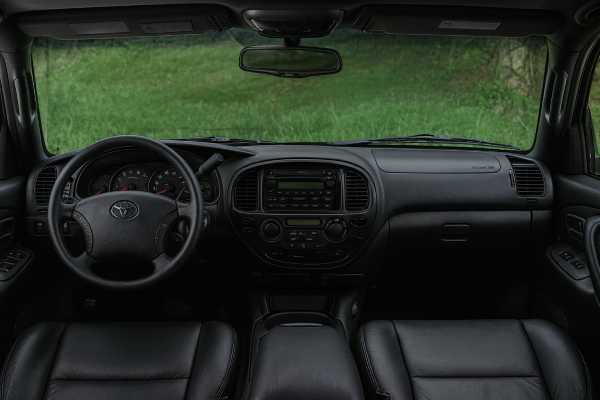
Inside, the Sequoia offers three rows and up to eight seats. The second row folds and tumbles, and the third row can be folded or removed to create a large, mostly flat load floor. Cabin materials are durable rather than luxurious, but the layout is straightforward, with large controls and clear instrumentation. Equipment levels depend on trim and packages, ranging from cloth seats and basic audio to leather, heated seats, and JBL-branded sound systems.
Overall, the UCK45 is best understood as a long-lived, heavy-duty family vehicle: more capable and rugged than most crossovers, but also larger, thirstier, and simpler in terms of electronics and driver assistance.
Technical specs for Sequoia 4WD
Engine and performance
| Item | Specification (2005 Sequoia 4WD, 2UZ-FE VVT-i) |
|---|---|
| Engine code | 2UZ-FE i-FORCE V8 with VVT-i |
| Layout and valvetrain | 90° V8, DOHC, 32 valves |
| Displacement | 4.7 L (about 4,664 cc) |
| Induction | Naturally aspirated |
| Fuel system | Sequential multi-port electronic injection |
| Compression ratio | Around 10.0:1 (VVT-i version) |
| Maximum power | Approx. 282 hp @ 5,400 rpm |
| Maximum torque | Approx. 325 lb-ft @ 3,400 rpm |
| Timing drive | Rubber timing belt with idlers and tensioner |
| Recommended fuel | Regular unleaded gasoline |
| Emissions class | Early Tier 2 / LEV II or similar, market dependent |
In independent testing, a healthy 4WD Sequoia of this generation typically reaches 60 mph in the mid- to high-8-second range, depending on load, tires, and test conditions. That is entirely adequate for merging, overtaking, and towing.
Fuel economy and efficiency
EPA-style figures for a 2005 Sequoia 4WD with the 5-speed automatic are roughly:
| Condition | Approximate consumption | Approximate economy |
|---|---|---|
| City | around 18 L/100 km | about 13 mpg US |
| Highway | around 14.7 L/100 km | about 16 mpg US |
| Combined | around 15.7 L/100 km | about 15 mpg US |
Real-world owners commonly report:
- 11–13 mpg US in stop-and-go city use.
- 13–15 mpg US in mixed driving.
- 14–17 mpg US on steady highway runs at 65–70 mph with stock-size tires and modest loads.
With a 26.4 gallon (roughly 100 liter) fuel tank, a practical range of 280–350 miles (450–560 km) between fills is typical.
Transmission and driveline
| Item | Specification |
|---|---|
| Transmission | 5-speed electronically controlled automatic (ECT) |
| Drive type | Full-time 4WD with Multi-Mode transfer case |
| 4WD modes | 4HI (open center diff), 4HI locked, 4LO locked |
| Center differential | Lockable, planetary type |
| Transfer case | 2-speed, skid-plate protection (4WD) |
| Rear differential | Hypoid gear, usually open; axle ratio around 3.9:1 (varies slightly) |
| Traction aids | TRAC traction control and Vehicle Stability Control (VSC) |
The 5-speed automatic’s extra ratio compared with the earlier 4-speed helps the engine stay in its torque band on hills and keeps revs lower at highway speeds, reducing noise and fuel consumption.
Chassis and dimensions
| Item | 2005 Sequoia 4WD |
|---|---|
| Body construction | Ladder frame, body-on-frame SUV |
| Front suspension | Independent double wishbone, coil springs, stabilizer bar |
| Rear suspension | 5-link solid rear axle, coil springs, stabilizer bar |
| Steering | Engine speed–sensing power rack-and-pinion |
| Front brakes | Ventilated discs |
| Rear brakes | Ventilated discs |
| Common wheel/tyre sizes | 16″ or 17″ wheels with P265-section tires |
| Overall length | 203.9 in (about 5,180 mm) |
| Wheelbase | 118.1 in (about 3,000 mm) |
| Overall height | roughly 74 in (varies with roof rack) |
| Ground clearance | about 10.6 in (around 269 mm) |
| Turning circle | roughly 42 ft curb-to-curb (about 13 m) |
Weight, towing, and capacities
| Item | Approximate value (4WD) |
|---|---|
| Curb weight | around 5,000–5,050 lb (equipment dependent) |
| GVWR | about 6,700 lb |
| Payload | around 1,600–1,700 lb |
| GCWR | about 12,000 lb |
| Maximum towing | up to about 6,200 lb when properly equipped |
| Fuel tank | about 26.4 US gal (100 L) |
Approximate cargo volumes:
| Seating configuration | Volume (SAE) |
|---|---|
| Behind 3rd row | around 26–27 ft³ |
| Behind 2nd row | around 65 ft³ |
| Behind 1st row | around 128 ft³ |
Fluids, service capacities, and electrical
Values vary slightly by market and exact configuration; treat these as planning figures and confirm with official documents.
| System | Approximate capacity | Typical specification |
|---|---|---|
| Engine oil with filter | ~6.2 L (6.6 US qt) | High-quality 5W-30 (or region-appropriate grade) |
| Engine coolant | ~13–14 L | Long-life ethylene glycol coolant (Toyota Super Long Life or equivalent) |
| Transmission (full fill) | ~10–12 L | Toyota ATF WS |
| Transfer case | ~1.4 L | GL-5 75W-90 gear oil |
| Front differential | ~1.1–1.2 L | GL-5 75W-90 |
| Rear differential | ~3.5–3.8 L | GL-5 75W-140 |
| Brake fluid | As needed for flush | DOT 3 or DOT 4 as specified |
| Power steering | ~1 L | ATF-type fluid to spec |
Electrical basics:
| Item | Typical value |
|---|---|
| Alternator output | around 130–150 A depending on trim |
| 12 V battery | Large-group flooded or AGM, around 70–80 Ah |
| Spark plugs | Long-life iridium, correct heat range and gap per manual |
Trims, options and safety tech
Trim levels and feature sets
The 2005 Sequoia 4WD range is built around two main trims:
- SR5 4WD – The more utilitarian model but still well equipped.
- Limited 4WD – The upscale version with more comfort and appearance features.
Typical SR5 4WD equipment includes:
- Fabric-trimmed seats; power-adjustable front seats on many trucks.
- 60/40 split fold-down and tumble second row; 50/50 split third row.
- Manual or simple automatic climate control with rear vents.
- Cruise control, power windows, locks, and mirrors.
- 16″ steel or alloy wheels; roof rack often optional.
- Available towing package with hitch receiver and wiring.
Typical Limited 4WD equipment adds:
- Leather-trimmed heated front seats, sometimes with driver memory.
- Available second-row captain’s chairs with a removable center console.
- Dual-zone automatic climate control, often with rear-seat controls.
- 17″ alloy wheels, body-color overfenders, and extra chrome trim.
- JBL premium audio, optional navigation, and optional rear-seat DVD system.
- Frequently a standard power moonroof and roof rack.
Because equipment depends on original buyer choices and regional packages, the best way to confirm features is to decode the build from the VIN or use a dealer printout.
Option packages and quick identifiers
Common package themes include:
- Appearance / Sport packages – Upgraded wheels and body trim.
- Luxury or Convenience packages – Leather, heated seats, moonroof, auto climate, and premium audio.
- Towing package – Larger hitch, proper wiring and, on some trucks, extra cooling.
Quick identifiers in a used vehicle:
- Leather, heated seats, and 17″ wheels typically point to a Limited.
- Factory roof rack, color-matched mirrors, and fog lamps suggest higher equipment.
- A neatly integrated hitch and wiring connector often indicate a factory or dealer tow package.
Safety equipment
By 2005, the Sequoia offers a solid mix of active and passive safety features for its era:
- Airbags
- Dual-stage front airbags.
- Available front seat-mounted side airbags.
- Available roll-sensing side curtain airbags for first and second rows.
- Star Safety–type systems (terminology varies by region)
- Four-wheel ABS with Electronic Brake-force Distribution.
- Brake Assist to increase pressure in panic stops.
- Traction control to reduce wheelspin.
- Vehicle Stability Control (VSC) to help correct understeer or oversteer.
- Child-seat and occupant protection
- LATCH anchors for child seats in the second row, plus top tether points.
- Child-protector rear door locks.
- Height-adjustable front seat belts with pretensioners and force limiters on many models.
Crash-test coverage is more limited than on modern SUVs, and ratings can vary slightly by configuration. As a tall, body-on-frame SUV from the mid-2000s, it does not match the latest unibody crossovers in crash and rollover performance, but in its time it was considered competitive.
ADAS and calibration
Modern camera- and radar-based driver assistance (adaptive cruise, lane keeping, automatic emergency braking) was not yet fitted to this generation Sequoia. Driver aids are primarily ABS, traction control, and stability control.
After major suspension or steering work—or repairs involving yaw or steering-angle sensors—the VSC system may need calibration. If VSC/TRAC/ABS warning lights stay on after a repair, it is often worth having a shop with Toyota-compatible diagnostic equipment perform a full system check and calibration.
Reliability issues and service actions
Overall reliability picture
The 2UZ-FE V8 and 5-speed automatic transmission are well-regarded for their ability to cover very high mileage with relatively few serious problems, provided maintenance is not neglected. Many Sequoias reach 250,000–300,000 miles with original major components.
Most of the issues that appear on 2005 Sequoias are age- and usage-related: corrosion in harsh climates, worn suspension and steering components, and problems caused by deferred maintenance.
Common engine and cooling issues
- Timing belt and water pump neglect (common, high impact)
The timing belt is a service item. Many used trucks are overdue because the engine keeps running smoothly and the belt is out of sight. A failed belt can leave you stranded and may damage the engine. Ideally, the belt, idlers, tensioner, and water pump are replaced as a kit, along with fresh coolant. - Oil leaks (occasional, moderate impact)
Valve cover gaskets, cam seals, and front crank seals can seep over time. Left unattended, leaks can contaminate rubber parts, create smells, and make future repairs messier. - Cooling system aging (occasional, moderate impact)
Radiators, hoses, and thermostats are all now old enough that proactive replacement is wise, especially for tow vehicles. Radiator end tanks and heater cores can also show their age.
Transmission, transfer case, and driveline
The automatic transmission and 4WD components are generally durable but still benefit from care:
- Old or burned ATF (common)
Long intervals or the belief in “lifetime” fluid can lead to harsh shifting and premature wear. Regular drain-and-fill services help keep the transmission healthy. - Transfer case and differential service (often overlooked)
Many owners do not realize these have separate fluids. Fresh gear oil reduces noise and wear and is especially important for frequent 4WD or towing use. - Front CV joint and axle wear (occasional)
Torn CV boots, especially in salty climates, can lead to joint noise and eventual failure.
Suspension, steering, and braking
Almost all first-generation Sequoias now need or have had significant suspension work:
- Lower ball joints and control arm bushings
As mileage rises, these often develop play, causing clunks, wandering, and uneven tire wear. Replacement restores steering precision and safety. - Rear suspension bushes and shocks
Worn rear bushes can make the back of the vehicle feel loose; tired shocks reduce control, especially with towing or heavy loads. - Brakes and rotors
Warped front rotors and sticking caliper slide pins are common on heavy SUVs. Quality components and proper lug-nut torque help minimize recurrence.
Corrosion and body
In regions with heavy road salt use, frame rust is a major concern:
- Frame rail and crossmember rot
The rear of the frame, suspension mounts, and areas around the fuel tank and spare tire can see significant corrosion. Advanced rust may require welding or replacement sections and can limit the remaining life of the vehicle.
Body panels usually fare better, though lower door edges, tailgate, and underbody fasteners can show surface rust.
Recalls and service actions
Over the years, the 2005 Sequoia has been included in several recalls and service campaigns, commonly including:
- Airbag inflator recalls on driver and/or passenger airbags.
- Updates to stability-control or ABS behavior on some model years.
- Occasional campaigns involving seat heaters or other specific components.
For any individual vehicle, it is essential to check the VIN through the official manufacturer or government recall site and confirm all campaigns have been completed. Dealers can print out a recall and service history, which is valuable paperwork to keep with the vehicle.
Pre-purchase reliability checklist
When evaluating a used 2005 Sequoia 4WD:
- Inspect the frame and underbody thoroughly, ideally on a lift.
- Verify timing belt and water pump replacement with dated receipts.
- Scan for diagnostic codes in engine, ABS, VSC, and airbag modules.
- Check suspension and steering for play, noises, and uneven tire wear.
- Confirm 4WD operation in 4HI, 4HI locked, and 4LO.
- Test HVAC and electronics, including the rear heater/A/C and tailgate glass.
A truck that passes these checks and has clear service records is far more likely to deliver trouble-free ownership.
Maintenance planning and buying tips
Practical maintenance schedule
The exact schedule depends on market and usage, but a sensible baseline for a 2005 Sequoia 4WD used in mixed conditions might look like:
- Engine oil and filter – Every 5,000 miles (8,000 km) or 6 months, especially with short trips, towing, or dusty conditions.
- Engine air filter – Inspect every 15,000 miles (24,000 km); replace around 30,000 miles or sooner in dusty areas.
- Cabin air filter – Replace every 15,000–20,000 miles (24,000–32,000 km) or annually.
- Spark plugs (iridium) – Replace around 90,000–120,000 miles (145,000–190,000 km).
- Timing belt, tensioner, idlers, and water pump – Replace about every 90,000 miles (145,000 km) or 8–9 years, whichever comes first.
- Serpentine/auxiliary belt – Inspect at each oil change; typically replace every 60,000–90,000 miles (96,000–145,000 km).
- Coolant – For long-life coolant, replace about every 5 years or 100,000 miles (160,000 km) after the factory fill, then at shorter intervals.
- Automatic transmission fluid – Drain-and-fill every 30,000–60,000 miles (48,000–96,000 km), with the shorter end for towing or mountain use.
- Transfer case and differentials – Replace gear oil every 50,000–60,000 miles or more often for frequent 4WD or towing.
- Brake fluid – Flush every 2–3 years regardless of mileage.
- Brake pads and rotors – Inspect at every tire rotation; replace pads well before they reach minimum thickness.
- Power steering fluid – Renew periodically to reduce pump and rack wear.
- Tire rotation and alignment – Rotate every 5,000–7,500 miles; align when you notice pulling or uneven wear.
- 12 V battery – Load-test yearly after 4–5 years, replace proactively after 5–7 years depending on climate.
Always verify fluid specifications and capacities for your exact VIN in the owner’s manual or service manual.
Fluid and torque notes (for decision-making)
- Engine oil: high-quality 5W-30 (or manufacturer-approved equivalent) is a common recommendation.
- Gear oils: GL-5 75W-90 for front differential and transfer case; GL-5 75W-140 for the rear differential is typical.
- Coolant: use a Toyota-compatible long-life coolant; do not mix incompatible types.
Common torque values (to be confirmed in a manual):
- Wheel lug nuts: typically around 110–115 Nm (80–85 lb-ft).
- Oil drain plug: often around 30–40 Nm range.
- Differential and transfer case plugs: typically in the 35–50 Nm range.
Buyer’s guide: what to seek or avoid
Better candidates:
- Trucks from dry or mild climates with minimal frame and underbody rust.
- Vehicles with documented timing-belt changes and regular fluid services.
- Examples with stock or modestly upgraded suspension and tires, not heavily lifted or heavily modified.
- Sequoias with factory tow packages if you intend to tow.
Higher-risk candidates:
- Vehicles with obvious frame perforation, heavy scale, or flaking metal, especially near suspension mounts.
- Trucks with persistent warning lights (ABS, VSC, TRAC, airbag) and no scan reports.
- Vehicles with unknown or clearly neglected timing-belt history.
- Heavily modified trucks (large lifts, oversize wheels, improvised towing setups) without receipts and proper alignment records.
Long-term durability outlook
A 2005 Sequoia 4WD that passes a serious inspection and has its major maintenance up to date can provide many more years of service. The powertrain is capable of high mileage, and parts availability remains strong thanks to its shared components with other Toyota trucks.
The main long-term costs are:
- Fuel, which will be substantial compared with a smaller modern SUV.
- Periodic suspension and brake overhauls as wear items age out.
- Occasional rust prevention or repair in exposed markets.
For owners who understand and accept those trade-offs, the Sequoia UCK45 remains a compelling, long-lived full-size SUV.
Driving dynamics and 4WD performance
Ride, handling, and comfort
On the road, the Sequoia 4WD feels solid and substantial. The long wheelbase and coil-sprung rear axle help it absorb bumps smoothly, especially at highway speeds. The ride is generally comfortable and well controlled rather than floaty, provided shocks and bushings are in good condition.
Body roll in corners is noticeable, which is normal for a tall, body-on-frame SUV. The steering is lighter than in many modern trucks and does not provide sports-car levels of feedback, but straight-line stability is good. At motorway speeds, wind and road noise are present but not overwhelming, and the V8 hums quietly in the background.
Cabin comfort depends heavily on the condition of seats, shocks, and tires. A Sequoia with fresh dampers, good tyres, and intact seat padding feels composed and relaxed, even when fully loaded with passengers and luggage.
Powertrain character
The 2UZ-FE V8 is tuned for smoothness and torque. It pulls strongly from low revs, which is ideal for moving a heavy SUV and trailer. The 5-speed automatic usually upshifts early in gentle driving, keeping revs low and noise down, but responds promptly with downshifts when you ask for more power.
There is no turbo lag to worry about, so power delivery is predictable. For towing or long mountain climbs, manually selecting a lower gear on the shifter can help keep engine speed in the optimal range and avoid frequent up- and downshifts.
Real-world efficiency and range
Owners who drive gently and maintain stock tyre sizes tend to see:
- Around 12–14 mpg US in primarily city driving.
- Around 14–16 mpg US in mixed driving.
- Around 15–17 mpg US on long, steady highway runs around 65–70 mph.
Heavier loads, higher speeds, lift kits, aggressive all-terrain tyres, roof racks, and trailers will all push consumption further into the low teens or even single digits.
With its large fuel tank, many owners prefer to refuel well before the low-fuel light, especially when towing or travelling in remote areas.
4WD system and off-road traction
The Multi-Mode full-time 4WD system is well suited to real-world use:
- 4HI (open center differential) works on any surface, including dry pavement, and provides stable handling in mixed conditions.
- 4HI locked is ideal for snow, loose gravel, and mud where additional traction is needed.
- 4LO locked offers extra torque and control for steep climbs, descents, or technical sections.
Ground clearance and skid plates allow the Sequoia to handle rough dirt roads, rutted tracks, and snow-covered routes without drama when on suitable tyres. Its size and overhangs do limit it in very tight or rocky terrain, so it is more of a capable back-road and overland vehicle than a dedicated rock crawler.
Towing and load behavior
When kept within its tow rating and set up correctly, the Sequoia tows with confidence:
- The ladder frame and long wheelbase contribute to stability.
- The V8 and 5-speed transmission provide enough torque for mid-size travel trailers, boats, and car trailers.
- Trailer brakes and, ideally, a brake controller are strongly recommended for heavier loads.
When heavily loaded or towing near its maximum rating, it is normal to see fuel economy drop significantly and transmission temperatures rise during long climbs. A well-maintained cooling system and sensible driving (downshifting early, moderating speed) go a long way toward protecting the drivetrain.
Sequoia UCK45 versus rivals
Against Chevrolet Tahoe/Suburban
Compared with the contemporary Chevrolet Tahoe or Suburban, the Sequoia often scores higher in perceived long-term reliability and interior fit-and-finish, while the GM trucks may offer a broader range of engines, more drivetrain options, and sometimes slightly better on-paper fuel economy.
Parts for GM trucks can be cheaper and more widely available in some regions, but the Toyota tends to hold its value better and attract buyers who want to keep their SUV for a very long time with fewer major repairs. In many markets, the used price difference reflects that perception.
Against Ford Expedition
The Ford Expedition is a direct competitor with similar dimensions, seating capacity, and towing ability. Depending on model year and engine, the Expedition may offer more power on paper and an independent rear suspension that improves ride and third-row comfort.
On the other hand, some generations of Expedition have more complex issues with engines, exhaust manifolds, spark plug service, or rust in particular areas. Buyers focused on a conservative, proven powertrain often gravitate toward the Sequoia, even if the Ford offers more modern features or slightly better fuel economy in certain trims.
Against Nissan Armada / Infiniti QX56
The first-generation Nissan Armada and its luxury sibling, the Infiniti QX56, bring strong V8 performance and a more overtly upscale interior in higher trims. They can feel more responsive than the Sequoia when lightly loaded and are popular among drivers who like a more aggressive character.
However, some Armada/QX56 examples have a more complicated track record with transmission, rear axle, and electrical issues. By contrast, the Sequoia is more conservative in design and tuning, which many owners interpret as a sign of long-term durability.
Where the Sequoia 4WD stands out
Key strengths:
- Very robust V8 and transmission when maintained.
- Comfortable ride and quiet cabin for a body-on-frame SUV of its era.
- Full-time 4WD with locking center differential for mixed climates and light off-road use.
- Strong parts support and a large knowledge base shared with other Toyota trucks.
Key compromises:
- Poor fuel economy compared with modern crossovers and some later full-size SUVs.
- Lack of advanced driver assistance systems and modern infotainment.
- Potentially serious frame rust in harsh climates if not inspected and treated.
For buyers who value reliability, capability, and a traditional truck feel over modern gadgets and efficiency, a clean 2005 Sequoia UCK45 remains a very attractive option in the used full-size SUV market.
References
<a href="https://xr793.com/wp-content/uploads/2022/01/2005-Toyota-Sequoia-Specs.pdf">KZ5019_Seq_ebrch_em4.indd</a> 2004 (Specs brochure)<a href="https://www.fueleconomy.gov/feg/bymodel/2005_Toyota_Sequoia_4WD.shtml">Gas Mileage of 2005 Toyota Sequoia 4WD</a> 2023 (Fuel Economy Data)<a href="https://www.toyota.com/owners/resources/owners-manuals/sequoia/2005">Owner's Manual | Toyota Sequoia | Toyota Owners</a> 2005 (Owner’s Manual)<a href="https://toyota-club.net/files/techdata/ttx/sequoia_30.htm">Toyota-Club.Net - Fluids & capacities - Sequoia (2000-2007)</a> 2018 (Fluids and Capacities)<a href="https://parts.olathetoyota.com/when-should-i-replace-the-timing-belt">When Should I Replace The Timing Belt? | Olathe Toyota Parts Center</a> 2015 (Timing Belt Guidance)
Disclaimer
This article is for informational purposes only and is not a substitute for professional diagnosis, repair, or safety inspection. Specifications, torque values, maintenance intervals, and procedures can vary by VIN, production date, market, and equipment level. Always confirm details using the official owner’s manual, factory service information, and current manufacturer or regulatory documentation for your specific vehicle, and consult a qualified technician when in doubt.
If you found this guide useful, please consider sharing it with other drivers and enthusiasts—on Facebook, X/Twitter, or relevant owner communities—to support xcar’s work and help more people make informed decisions about the Toyota Sequoia.