
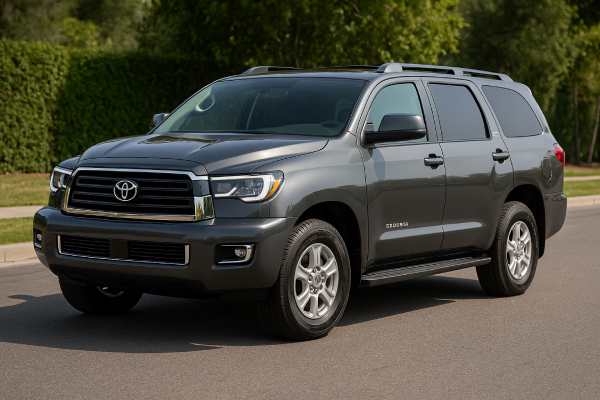
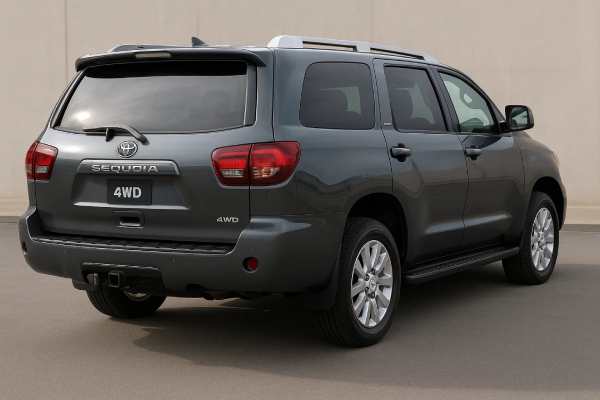
The facelifted 2018–2022 Toyota Sequoia 4WD (USK65) sits in a small group of body-on-frame SUVs that can genuinely tow, carry eight people, and survive years of hard use with relatively few complaints. Under the hood is the long-running 3UR-FE 5.7-liter V8 paired with the AB60 6-speed automatic and a robust Multi-Mode 4WD system with low range. This combination is simple, proven, and tuned more for durability than cutting-edge efficiency.
For owners, the appeal is straightforward: predictable mechanicals, strong towing, generous interior space, and a reputation for lasting beyond 200–300,000 miles with sensible maintenance. The facelift brought standard Toyota Safety Sense P, updated lighting, and trim-specific features like TRD Sport and a more luxurious Platinum. Fuel economy and size are the main compromises, especially in dense cities, but if you need a vehicle that can tow 3+ tonnes and still get the family to school every day, the 4WD Sequoia remains a realistic, if thirsty, workhorse.
Fast Facts
- 5.7-liter 3UR-FE V8, 381 hp and 544 Nm, Multi-Mode 4WD with low range and Torsen center differential.
- Strong towing: up to about 3,200 kg (around 7,000+ lb) braked and generous payload for people and cargo.
- Known for long engine and gearbox life, but fuel consumption averages roughly 14 mpg combined (about 16.8 l/100 km).
- Watch for frame and underbody rust in road-salt regions, plus age-related 4WD actuator and suspension wear.
- Plan engine oil and filter changes every 5,000–7,500 miles (8,000–12,000 km) or 6–12 months depending on use and climate.
What’s inside
- 4WD Sequoia facelift overview
- USK65 4WD specs and data
- Sequoia 4WD trims and safety tech
- 4WD reliability, issues, and actions
- Maintenance plan and buyer guide
- Driving performance in 4WD use
- How the 4WD Sequoia stacks up
4WD Sequoia facelift overview
The 2018 facelift for the second-generation Sequoia focused less on sheet metal and more on features and safety. Mechanically, the 4WD USK65 model continues with the same 3UR-FE 5.7-liter naturally aspirated V8 and 6-speed automatic that the platform is known for. What changed was the standardization of Toyota Safety Sense P, updated front fascia and lighting, and a clearer separation between SR5, TRD Sport, Limited, and Platinum trims.
This 4WD version uses a truck-style frame shared with the Tundra, with fully independent suspension at all four corners. That combination is unusual in the segment and gives the Sequoia a mix of towing stability and improved ride compared with old-school solid-rear-axle SUVs. The four-wheel independent suspension also helps packaging: adults can realistically use the third row, and cargo volume with seats folded is immense.
The Multi-Mode 4WD system is a key difference from the 2WD USK60 variant. In everyday driving, the Sequoia tends to behave like a rear-drive SUV, but an electronically controlled center differential can send torque to the front axle when conditions demand it. There is a selectable low-range setting for steep grades or slow off-road work, and the center diff can be locked for consistent torque split on loose surfaces. Ground clearance of around 254 mm (10 in) and approach/departure angles around 27°/21° are enough for rough forest roads, snow, and light overlanding, provided you respect the size and overhangs.
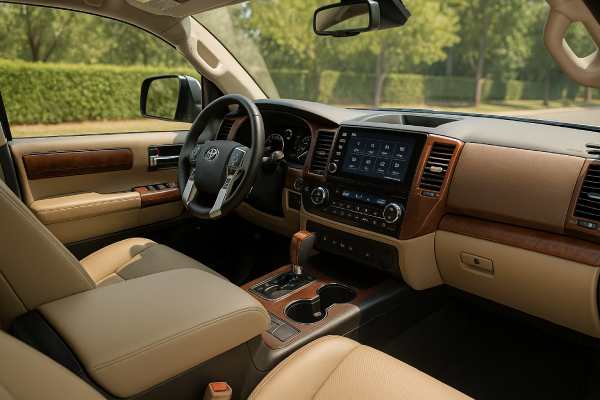
Inside, the Sequoia remains practical and straightforward rather than ultramodern. Compared with newer rivals, the infotainment and dash design feel older, but the controls are simple, the seating position is commanding, and visibility is good for such a large vehicle. Owners who value physical buttons, easy-to-read gauges, and a “truck-like” feel often see this as a plus rather than a drawback.
In ownership terms, the trade-off is clear: you get a simple, robust V8/4WD setup with strong towing and long-term durability, but you pay at the pump and need space to maneuver and park a 5.2-meter-long, 2-meter-wide SUV.
USK65 4WD specs and data
This section focuses on the 2018–2022 facelifted Sequoia 4WD (USK65) with the 3UR-FE 5.7-liter V8 and 6-speed automatic. Values can vary slightly by model year and trim, but the ranges below reflect the typical 4WD configuration.
Engine and performance
| Item | Specification |
|---|---|
| Engine code | 3UR-FE |
| Layout | 90° V8, longitudinal |
| Valvetrain | DOHC, 4 valves per cylinder, Dual VVT-i |
| Displacement | 5.7 l (5,663 cc) |
| Bore × stroke | 94.0 mm × 102.0 mm |
| Compression ratio | 10.2 : 1 |
| Induction | Naturally aspirated |
| Fuel system | Sequential multi-port fuel injection |
| Max power | 381 hp @ 5,600 rpm |
| Max torque | ~544 Nm (401 lb-ft) @ 3,600 rpm |
| Redline / max speed | ~6,000 rpm |
| Emissions standard | ULEV-II (US market) |
| Rated combined economy | ~16.8 l/100 km (14 mpg US combined) |
| Typical highway (owner) | 13–15 l/100 km (15–18 mpg US) |
| Typical city (owner) | 18–21 l/100 km (11–13 mpg US) |
Aerodynamics are not the priority here; the body is tall and bluff, and real-world consumption at 120 km/h (75 mph) is closer to the high end of the highway range, especially with roof boxes or large mirrors and tires.
Transmission and driveline
| Item | Specification |
|---|---|
| Transmission | 6-speed automatic, AB60-series (ECT-i) |
| Gearbox type | Torque-converter automatic |
| Drive type | 4WD (Multi-Mode with low range) |
| Center differential | Torsen limited-slip, lockable |
| Transfer case | 2-speed, electronic control selector |
| Rear differential | Conventional open diff (no factory locker) |
| Final drive ratio (typical) | ~4.30:1 (varies slightly by trim/options) |
| 4WD modes | 2WD (on some markets), 4-High, 4-High locked, 4-Low |
Where fitted, Tow/Haul mode revises shift strategy to keep the engine in its torque band on grades and during heavy towing.
Chassis, weight, and dimensions
| Item | Specification |
|---|---|
| Body type | 5-door full-size SUV, body-on-frame |
| Front suspension | Double wishbone, coil springs, anti-roll bar |
| Rear suspension | Double wishbone, coil springs, anti-roll bar; air suspension on Platinum |
| Steering | Rack-and-pinion, hydraulic assist |
| Front brakes | Ventilated discs, ~353 mm (13.9 in) |
| Rear brakes | Ventilated discs, ~345 mm (13.6 in) |
| Wheelbase | 3,099 mm (122.0 in) |
| Length | 5,210 mm (205.1 in) |
| Width | 2,029 mm (79.9 in) |
| Height | ~1,956 mm (77.0 in) |
| Ground clearance | ~254 mm (10.0 in) |
| Turning circle | ~11.6 m (38.1 ft) |
| Curb weight (4WD) | ~2,715–2,722 kg (5,986–6,001 lb) |
| GVWR | ~3,311 kg (7,300 lb) |
| Max payload | ~590 kg (1,300 lb), trim-dependent |
| Fuel tank capacity | ~100 l (26.4 US gal; 22 UK gal) |
| Cargo volume (approx.) | 535–3,401 l (18.9–120.1 ft³) with seats folded |
Wheel and tire packages:
- SR5 / many TRD Sport: 18-inch alloys with 275/65 R18 tires.
- Limited / Platinum and some TRD Sport: 20-inch alloys with 275/55 R20 tires.
Performance and towing
| Metric | Value (typical 4WD model) |
|---|---|
| 0–100 km/h (0–62 mph) | ~7.5–8.0 s |
| 0–60 mph | ~6.7–7.0 s |
| Top speed (limited) | ~180 km/h (112 mph) |
| Towing capacity (braked) | Up to ~3,220 kg (~7,100 lb), spec-dependent |
| Towing capacity (unbraked) | Market-limited, often ~680–750 kg |
| Roof load (with rails/crossbars) | Typically ~75–100 kg (165–220 lb) |
Fluids, service capacities, and basic electrical
Values can vary by year and region; always confirm for a specific VIN.
| System | Typical specification |
|---|---|
| Engine oil | 0W-20 (full synthetic), approx. 7.5 l |
| Engine coolant | Toyota Super Long Life coolant, ~12.4 l |
| Automatic transmission | Toyota WS ATF, approximate total 10–12 l |
| Front/rear differential | Hypoid gear oil, usually 75W-85 or 75W-90 |
| Transfer case | ATF or gear oil depending on spec, ~1–2 l |
| A/C refrigerant | R-134a; charge near 700–900 g (varies) |
| Alternator output | Roughly 180 A (high for towing and loads) |
| 12 V battery | Group 27 or similar, ~710+ CCA typical |
| Spark plugs | Iridium, long-life; gap ~1.1 mm |
Sequoia 4WD trims and safety tech
For the facelifted 2018–2022 Sequoia, the 4WD system could be specified on all major trims. The basic mechanical package stays the same, but equipment, suspension tuning, and interior features vary enough to matter for buyers.
Trim and option structure (4WD focus)
SR5 4WD
- The “workhorse” grade with cloth or basic leatherette, 18-inch wheels, and standard towing package.
- Key features: tri-zone climate control, power driver’s seat, roof rack, running boards, and a moonroof in many markets.
- Seat layout: 8-seat (second-row bench) most common; some options for 7-seat captain’s chairs.
- Mechanically, SR5 4WD uses standard suspension tuning and the Multi-Mode 4WD without additional off-road hardware beyond skid plates and traction aids.
TRD Sport 4WD
- Introduced with the facelift as a more road-focused performance appearance package.
- Distinguishing cues: black or dark-finish 20-inch wheels, unique grille and accents, TRD-branded shift knob and trim pieces.
- Mechanical changes: firmer Bilstein-type shock absorbers and TRD anti-roll bars for flatter on-road cornering. This improves body control but can feel slightly busier on broken pavement compared with SR5.
Limited 4WD
- Positioned as a comfort and convenience upgrade.
- Adds leather upholstery, heated front seats, power liftgate, power-folding third row, and extra sound insulation.
- Second-row sunshades, a higher-grade audio system, and more driver-assist sensors are common.
- Still uses steel rear springs rather than the air suspension found on Platinum.
Platinum 4WD
- The flagship; if you tow and carry passengers frequently, this is often the most pleasant to live with.
- Key features: perforated leather, heated and ventilated front seats, heated second row, and a rear entertainment system on many models.
- Rear load-levelling air suspension and Adaptive Variable Suspension with Comfort/Normal/Sport modes. This helps maintain ride height under trailer tongue weight or when the vehicle is fully loaded.
- Additional exterior and interior trim, plus more advanced mirror and memory systems.
Quick identifiers and build clues
- Badging: TRD Sport and Platinum have distinct badges on the tailgate; SR5 and Limited rely more on wheel and trim cues.
- Wheels: black 20-inch wheels signal TRD Sport; polished 20s with a more upscale design usually belong to Limited or Platinum.
- Interior cues: perforated leather and a Blu-ray rear entertainment screen almost always indicate Platinum; a simpler head unit and basic cloth are hallmarks of a lower-spec SR5.
- VIN/build codes: the USK65 chassis code identifies the 4WD V8 model; detailed trim and package information can be decoded from the full VIN and option build sheet.
Safety ratings and crash structure
The Sequoia platform dates from the late 2000s, and while it has seen safety upgrades, it does not always match the very latest unibody crossovers in crash-test results or pedestrian protection. However, frontal and side occupant protection remains competitive among large body-on-frame SUVs.
Key points:
- Strong occupant cell with extensive use of high-strength steel in critical areas.
- Multiple airbags: dual-stage front airbags, front seat side airbags, three-row curtain airbags, plus driver and front passenger knee airbags.
- Designed around US crash standards; rollover resistance is constrained by height and mass, but electronic stability control and Active Traction Control (A-TRAC) help mitigate this.
Toyota Safety Sense P and driver assistance
From the facelift onward, all grades benefit from an expanded active safety suite:
- Pre-Collision System with Pedestrian Detection: uses radar and camera to warn of frontal collisions and apply brake assist and automatic braking when needed.
- Lane Departure Alert with Sway Warning: monitors lane markings and steering input to detect drift; alerts the driver but does not aggressively steer like some modern lane-keeping systems.
- Dynamic Radar Cruise Control: adaptive cruise that can maintain distance in traffic; tuning is conservative but smooth.
- Automatic High Beams: switches between low and high beams based on traffic ahead.
- Blind Spot Monitor and Rear Cross-Traffic Alert: standard on many facelift models, particularly Limited and Platinum; very useful given the Sequoia’s size.
- Star Safety System: includes ABS, traction and stability control, electronic brake-force distribution, brake assist, and Smart Stop Technology (brake override).
Calibration matters after repairs: any windshield replacement, front bumper work, or radar sensor replacement may require dealer-level recalibration of the TSS-P system to restore correct function.
4WD reliability, issues, and actions
The Sequoia 4WD with the 3UR-FE V8 has a strong reputation for durability, especially when compared with some rival turbocharged or more complex engines. That does not mean it is problem-free, but most issues follow predictable patterns.
Engine and ancillaries (ICE-specific)
Common and occasional issues
- Timing chain, guides, and tensioners (rare to occasional): the 3UR-FE uses a chain rather than a belt. Under normal maintenance, the chain lasts the life of the engine, but long oil-change intervals, poor oil quality, or sludge formation can accelerate guide and tensioner wear. Symptoms include cold-start rattles, timing correlation codes, or cam/crank sensor codes. Remedy is chain, guide, and tensioner replacement, which is labor-intensive.
- Water pump seep or leakage (occasional): look for dried coolant traces around the pump or coolant smell. Replacement as part of preventive maintenance once the vehicle passes 150,000–200,000 km is common.
- Oil leaks (occasional): cam cover gaskets and timing cover sealant are known seep points over time. Usually a medium-cost repair unless neglected to the point of oil contamination of rubber components.
- Air injection pump and valves (occasional): secondary air injection components can suffer moisture ingestion or carbon buildup, triggering emissions codes and limp-home modes. Bypass kits exist, but the proper fix is replacement and ensuring the system stays dry.
Fuel and ignition
- The 3UR-FE is tolerant of regular unleaded fuel, but detonation control systems work harder on poor-quality fuel. Occasional carbon buildup on intake valves and piston crowns may appear at very high mileage but is not as severe as on some direct-injection engines.
- Coil-on-plug ignition is robust; misfires generally trace to aging plugs, coils, or injector issues rather than a fundamental design weakness.
Driveline and 4WD system
For the 4WD USK65, several additional components deserve attention:
- Transfer case actuator (occasional): infrequent use, old grease, and corrosion can lead to slow or failed 4WD engagement. Using 4WD modes periodically (including low range on loose surfaces) helps keep the system moving. In severe cases, the actuator must be removed and repaired or replaced.
- Front differential and CV joints (occasional): heavy off-road use or oversize tires accelerate wear. Listen for clicking on full lock, whine under load, or leaks at seals.
- Driveshaft clunks (common but minor): many owners report a “thunk” on take-off or after stops, often due to slip-yoke lubrication. Regular greasing of the prop-shaft fittings usually cures or reduces this.
Suspension, steering, and brakes
- Rear air suspension on Platinum (occasional): air springs and height sensors can fail with age, leading to sag or incorrect ride height. Conversion kits to steel springs exist, but the OEM system can be repaired if comfort is a priority.
- Bushings, ball joints, and shocks (expected wear): given the vehicle’s mass, front lower control-arm bushings, sway-bar links, and rear bushings wear faster on poor roads. Expect shock absorber replacement around 160,000–200,000 km or sooner if frequently towing.
- Brake rotors and calipers: large discs provide strong braking, but seized slide pins and uneven pad wear appear in salted climates. Regular cleaning and lubrication during brake services prevent many issues.
Corrosion and body
- Frame and underbody corrosion (regional): in high-salt regions, the Sequoia’s frame and rear subframe can develop scale rust and, in extreme cases, perforation if not treated. Inspect frame rails, suspension mounting points, and the rear crossmember thoroughly.
- Exhaust system: manifolds and flanges can crack or leak over time, especially when frequently heat-cycled by towing.
Recalls, TSBs, and service campaigns
Over the 2018–2022 period, Sequoias have seen recalls for items such as fuel pumps and various electronic control issues, along with earlier airbag-related campaigns that can still overlap with facelift years. These typically affect defined VIN ranges.
Owners and buyers should:
- Run a VIN check through official recall databases.
- Ask a Toyota dealer to print the campaign and TSB completion history.
- Confirm that fuel-system and airbag-related campaigns are completed, as these have direct safety or drivability implications.
Maintenance plan and buyer guide
A disciplined maintenance routine is the main reason some Sequoias reach very high mileage with minimal major work. Below is a practical, conservative schedule for an average 4WD USK65 in mixed use. Always adapt to driving conditions, climate, and local guidance.
Practical maintenance schedule (typical use)
- Engine oil and filter:
- Normal mixed use: every 10,000 miles / 16,000 km or 12 months.
- Heavy towing, short trips, or extreme temperatures: every 5,000–7,500 miles / 8,000–12,000 km or 6–9 months.
- Engine air filter: inspect every 15,000 miles / 24,000 km; replace at 30,000–45,000 miles or sooner in dusty conditions.
- Cabin air filter: replace every 15,000–20,000 miles (24,000–32,000 km) or 1–2 years.
- Spark plugs (iridium): typically around 120,000 miles / 190,000 km; earlier if misfires or fuel economy issues appear.
- Cooling system:
- Initial coolant replacement around 100,000 miles / 160,000 km or 10 years.
- Subsequent changes at ~50,000 miles / 80,000 km or 5 years.
- Automatic transmission fluid (WS ATF):
- Light duty: drain and fill every 60,000–80,000 miles (100,000–130,000 km).
- Heavy towing: shorten to 40,000–60,000 miles (65,000–100,000 km).
- Front and rear differentials / transfer case: drain and fill every 30,000–60,000 miles (50,000–100,000 km), sooner with off-road or trailer use.
- Brake fluid: flush every 2–3 years regardless of mileage.
- Brake pads and rotors: inspect at least every 10,000–15,000 miles (16,000–24,000 km); heavy Sequoias can wear pads quickly with city use or towing.
- Serpentine belt and accessory drive: inspect yearly; replace around 90,000–120,000 miles (145,000–190,000 km) or at signs of cracking or noise.
- Suspension and steering: full inspection every 30,000 miles (50,000 km); check ball joints, tie rods, bushings, shocks, and rear air springs where fitted.
- Wheel alignment and tire rotation: rotation every 5,000–7,500 miles (8,000–12,000 km); alignment check yearly or whenever uneven wear appears.
- 12 V battery: test yearly after 4–5 years; plan replacement around 5–7 years depending on climate.
Key torque and specification notes (for decision-making)
- Wheel lug nuts: typically around 150–160 Nm (111–118 lb-ft) depending on wheel size.
- Engine oil drain plug and filter housing: moderate torque; overtightening can damage threads or housings, so verifying in a model-specific manual is essential.
- Critical suspension fasteners (control arms, ball joints, steering components) should always be torqued to spec at ride height.
Because values vary with year, market, and axle options, treat any generic torque figures as guidance only and confirm against an official service manual before work.
Buyer’s checklist for used Sequoia 4WD (2018–2022)
When evaluating a used facelift Sequoia 4WD:
- Service history
- Look for consistent oil changes with the recommended grade.
- Confirm ATF, diff, and transfer case services if mileage exceeds 100,000 km.
- Check records for coolant, brake fluid, and spark plug replacement on higher-mileage examples.
- Rust and underbody condition
- Inspect frame rails, crossmembers, rear suspension mounts, and brake/fuel lines.
- Pay attention to trucks from snowbelt regions or coastal areas.
- 4WD system function
- Engage all 4WD modes (including low range) on a suitable loose surface.
- Listen for binding, grinding, or failure to engage/disengage.
- Suspension and steering
- Drive over uneven surfaces at different speeds; listen for clunks or knocking.
- Check Platinum air suspension for level ride height and absence of “bouncing” or sagging.
- Brakes and wheels
- Inspect rotor condition (grooves, lips, rust).
- Ensure no pulling under braking and that the pedal feel is firm and consistent.
- Electronics and safety systems
- Confirm that ABS, VSC, and 4WD warning lights perform normal bulb-check cycles only.
- Test radar cruise, lane departure alert, blind spot monitoring, and rear cross-traffic alert.
- Interior wear and practicality
- Operate all seat adjustments, especially power-folding third row and sliding second row.
- Check for water leaks or dampness around the tailgate and roof rails.
Recommended trims and years
- Best all-rounder: Limited 4WD – a strong balance of equipment, comfort, and fewer complex suspension parts than Platinum.
- Towing and long-distance touring: Platinum 4WD – air suspension and extra comfort features make it the nicest place to spend hours but factor in potential air-suspension maintenance.
- Budget but capable: SR5 4WD – simpler interior and equipment but keeps the full mechanical and 4WD capability.
Overall durability is excellent if fluids are changed regularly, corrosion is managed early, and the 4WD system is exercised instead of left unused for years.
Driving performance in 4WD use
The Sequoia 4WD feels like exactly what it is: a large, comfortable, truck-based SUV tuned more for confidence and predictability than for sharp handling. Owners stepping out of a minivan or crossover will notice the extra size and weight, but also the reassuring sense of robustness.
Ride, handling, and NVH
- Ride comfort: The independent rear suspension and relatively long wheelbase deliver a smooth ride over highway expansion joints and moderate bumps. On SR5 and Limited, the standard suspension feels soft and composed; Platinum’s adaptive dampers add an extra layer of control, especially with a heavy load.
- Body roll: As expected in a tall SUV, there is noticeable lean in tighter corners. TRD Sport’s firmer shocks and thicker anti-roll bars reduce roll and quicken responses, but the Sequoia never feels like a sports SUV, and that is not its mission.
- Steering: Hydraulic power steering gives consistent weight but limited feedback. At parking speeds, effort is moderate; at highway speeds, the steering is calm and stable, which matters when towing.
- Noise levels: The big V8 is quiet at cruise and produces a restrained growl under load. Wind noise is modest considering the size, though large mirrors and roof racks can add some roar. Tire noise depends heavily on the tire choice; all-terrains will be louder than highway tires.
Powertrain character
The 3UR-FE and the 6-speed automatic form a relaxed, predictable pair:
- Throttle response: Smooth and linear, with plenty of low-end torque. Peak torque arriving around 3,600 rpm means you rarely need to rev the engine hard for normal driving.
- Transmission behavior: In normal mode, the gearbox upshifts early for economy and downshifts in a measured way. Tow/Haul mode holds gears longer and avoids unnecessary shifts on grades. Kickdown is slower than in some modern 8–10-speed rivals, but the response is consistent.
- Passing performance: 50–80 mph (80–130 km/h) passing is more than adequate, especially with a downshift into 4th or 3rd gear, but acceleration naturally softens as load and trailer weight increase.
Real-world efficiency and range
For the 4WD USK65, realistic owners’ figures tend to cluster around:
- City: 18–21 l/100 km (11–13 mpg US; 13–16 mpg UK).
- Highway at 100–110 km/h (60–70 mph): 13–15 l/100 km (15–18 mpg US).
- Mixed: roughly 16–18 l/100 km (13–15 mpg US).
Driving at 120 km/h (75 mph) or with a roof box, off-road tires, or heavy cargo can push consumption toward the higher end; towing a large travel trailer can add 30–50% to fuel use, depending on profile and speed.
With a 100-liter tank, practical range is often in the 450–650 km (280–400 mile) window, depending on conditions.
4WD behavior, traction, and control
Multi-Mode 4WD and A-TRAC give the Sequoia real all-weather and light off-road capability:
- Normal use: Many owners run in 2WD or standard 4-High on wet or snowy roads; the system transitions smoothly.
- Center diff lock: Useful on loose surfaces (gravel, sand, deep snow) where a fixed torque split reduces wheelspin and hunting. Avoid using it on high-grip pavement to prevent driveline wind-up.
- Low range: Provides the extra torque multiplication needed for steep climbs/descents, crawling in mud, or maneuvering heavy trailers up ramps.
- A-TRAC and stability control: Brake-based traction control can shuffle torque to gripping wheels when a tire lifts or spins. It is not a replacement for locking differentials, but for occasional off-road trips on moderate trails, it is sufficient.
Tires play a big role: aggressive off-road tires help in mud and snow but cost fuel and add noise; highway-oriented all-seasons keep the Sequoia quiet and efficient but are less effective in deep loose surfaces.
Towing and load behavior
Here the Sequoia 4WD stands out:
- Stability: The long wheelbase and relatively wide track make it a very stable tow platform when properly loaded and hitched.
- Braking: Large discs and electronic trailer sway control help keep combinations in control, though trailer brakes and correct brake controller setup are essential.
- Temperature management: The V8 and transmission are designed with towing in mind, and factory tow packages include appropriate cooling. Even so, monitoring transmission behavior and avoiding unnecessary gearing on steep grades is good practice.
- Fuel penalty: Plan on a sizable increase in fuel consumption when pulling large travel trailers or boats, often into the low single-digit mpg (high 20s l/100 km) with big frontal area loads.
How the 4WD Sequoia stacks up
In the 2018–2022 model years, the Sequoia 4WD competes with vehicles like the Chevrolet Tahoe/Suburban, GMC Yukon, Ford Expedition, and Nissan Armada. Each has a different mix of strengths, but certain patterns emerge.
Against Chevrolet Tahoe/Suburban and GMC Yukon
- Powertrain: GM’s 5.3- and 6.2-liter V8s often achieve better fuel economy and, in the case of the 6.2, stronger performance. However, the 3UR-FE is widely regarded as at least as durable, with fewer reports of certain lifter and fuel-management issues seen in some rivals.
- Ride and handling: Newer GM SUVs with independent rear suspension feel more modern and composed, especially on rough highways. The Sequoia’s older platform still rides well but cannot match the very latest tuning.
- Interior and tech: GM’s interiors and infotainment generally feel newer and more premium, with more USB ports and digital interfaces. The Sequoia counters with simpler controls and fewer complicated features to age or break.
Against Ford Expedition
- Engine: The Expedition’s turbocharged V6 is more efficient and often feels faster, especially when towing in thin air or at elevation. The Sequoia’s naturally aspirated V8 trades some efficiency for a very linear, predictable power delivery and a simpler design.
- Transmission: The Expedition’s 10-speed automatic keeps the engine in its sweet spot but adds complexity. The Sequoia’s 6-speed is less modern but easier to service and diagnose.
- Cabin: The Expedition’s interior packaging and third-row space are excellent. The Sequoia remains competitive in overall room and cargo volume but feels older in design.
Against Nissan Armada
- Power: Both offer strong V8s; the Armada’s V8 is also known for durability, though some owners report higher fuel consumption in real use.
- Chassis: Both are body-on-frame SUVs with serious towing abilities. The Sequoia generally has an edge in long-term parts availability and dealer network depth in many markets.
- Reliability: Toyota’s track record for long-term reliability and resale value tends to be stronger, especially past 150,000 miles / 240,000 km.
Who the Sequoia 4WD is best for
The facelifted 2018–2022 4WD Sequoia is particularly well-suited to:
- Families needing eight seats plus true towing capacity, not just occasional utility.
- Owners who prioritize long-term durability over cutting-edge infotainment or maximum fuel savings.
- Drivers who regularly deal with snow, gravel roads, or light off-roading and appreciate simple, predictable 4WD hardware.
- Buyers planning to keep the vehicle well into high mileage, where the reputation of the 3UR-FE and Toyota’s parts ecosystem become major advantages.
It is less ideal for those who:
- Spend most of their time in dense cities or tight parking structures.
- Are highly sensitive to fuel costs or environmental impact and would consider a more efficient crossover or hybrid.
- Want the very latest driver-assist automation and interior tech.
For the right owner, the Sequoia 4WD (USK65) remains one of the more honest full-size SUVs: a big, durable truck with a comfortable cabin, serious towing ability, and a powertrain designed to survive long after the note is paid off.
References
- 2019 Toyota Sequoia: The Family Vehicle Ready for Everything – Toyota USA Newsroom 2018 (Product Overview)
- Vehicle Detail Search – 2019 TOYOTA SEQUOIA | NHTSA 2019 (Safety Ratings and Recalls Database)
- Toyota Sequoia II (facelift 2017) 5.7 V8 VVT-i (381 Hp) 4WD ECT-i | Technical specs, data, fuel consumption, Dimensions 2025 (Technical Specifications)
Disclaimer
This article is for informational purposes only and is not a substitute for professional diagnosis, repair, or safety advice. Specifications, torque values, service intervals, and procedures can vary by VIN, production date, market, trim level, and installed equipment. Always verify critical data and repair steps against the official service documentation, owner’s manual, and technical bulletins for your specific vehicle, and consult a qualified technician when in doubt.
If you found this guide useful, consider sharing it with other owners and enthusiasts on platforms like Facebook or X/Twitter to support xcar’s work and help more people make informed decisions about their Toyota Sequoia.