
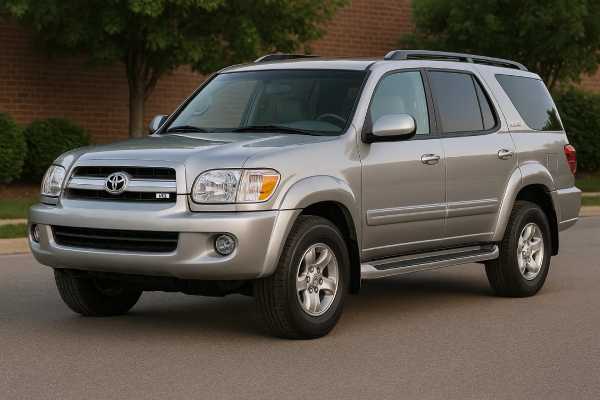
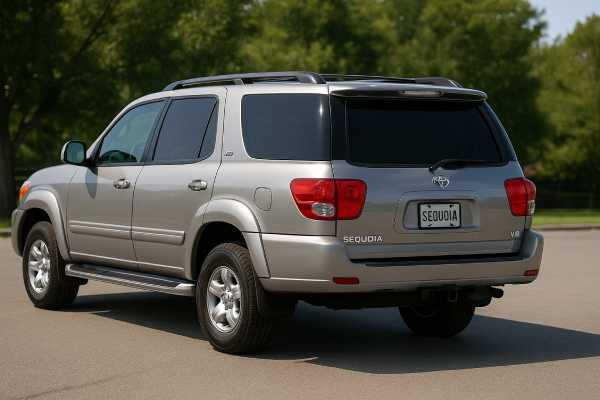
The 2005 facelift Toyota Sequoia with the 2UZ-FE 4.7-liter V8 is the most mature evolution of the first-generation SUV. This guide focuses on the two-wheel-drive UCK35 variant, which is actually rear-wheel drive despite some catalog shorthand calling it “FWD.” It combines a truck-grade ladder frame with a refined, VVT-i-equipped V8 and a 5-speed automatic, giving it stronger performance and smoother shifting than the 2001–2004 models.
Inside, the facelift Sequoia offers eight-seat practicality, improved safety features, and a quieter ride. It can still tow up to around 6,500 lb when properly equipped, making it suitable for trailers, boats, and long-distance family travel. At this age, condition and maintenance history matter much more than trim badge. If you understand its strengths, known weak points, and realistic running costs, the 2005 Sequoia UCK35 can still be a very dependable and comfortable full-size SUV.
Key Takeaways
- VVT-i 2UZ-FE 4.7-liter V8 with 282 hp delivers strong low-end torque and long service life when maintained correctly.
- Body-on-frame construction, generous ground clearance, and simple rear-wheel-drive layout make it durable and relatively easy to service.
- Age-related issues include frame and underbody corrosion, VSC/TRAC warning light problems, and wear in suspension and steering components.
- Timing belt and water pump are best replaced about every 90,000 miles (roughly 145,000 km) or 8–9 years, together with belts and seals.
- Expect typical mixed-use fuel economy around 13–15 mpg US (about 18–21 L/100 km), so fuel costs and good tyres must be part of any budget.
Section overview
- Facelift Toyota Sequoia UCK35 essentials
- Specs and powertrain for Sequoia 2005
- Sequoia facelift trims and safety gear
- Reliability patterns and common faults
- Maintenance strategy and buyer guidance
- Driving character and real-world performance
- How this Sequoia compares to rivals
Facelift Toyota Sequoia UCK35 essentials
The 2005 facelift Sequoia represents a meaningful update of Toyota’s first full-size SUV for the North American market. Externally, it is easy to spot by its revised grille, reshaped headlights and taillights, and updated bumpers. These changes modernized the appearance while keeping the basic boxy, practical profile that owners appreciated.
Underneath, the UCK35 Sequoia is still built on a Tundra-derived ladder frame, with independent front suspension and a coil-sprung live rear axle. That layout gives it a distinctly “truck-like” feel in terms of robustness and towing manners, while careful suspension tuning keeps ride quality surprisingly soft for a body-on-frame vehicle. In two-wheel-drive form, power is sent to the rear axle only; there is no transfer case or front differential, which saves weight and slightly improves fuel economy compared with 4WD versions.
The big mechanical story for the facelift is the upgrade to a VVT-i version of the 2UZ-FE V8 and the switch from a 4-speed to a 5-speed automatic. Variable valve timing boosts both power and torque, and the extra gear helps the engine stay in its sweet spot more often. The result is stronger mid-range performance and quieter, lower-rpm cruising.
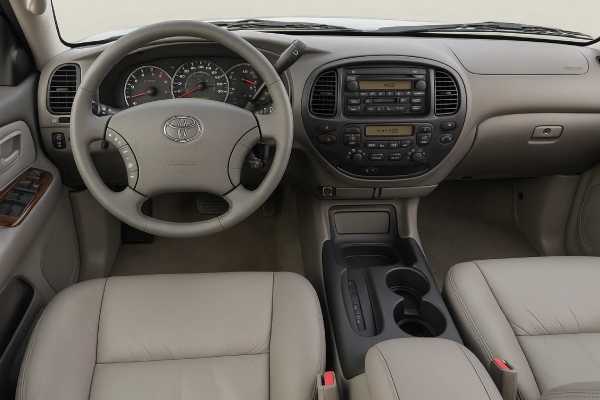
Inside, the Sequoia offers three rows of seats with space for up to eight passengers. The second row folds and tumbles to allow access to the third row. The third row itself can be folded or tumbled forward to create a substantial, flat load floor. Depending on trim and options, you may find features such as leather upholstery, a power moonroof, JBL-branded audio, rear-seat DVD entertainment, and automatic climate control with separate rear controls.
The overall character of a 2005 UCK35 is that of a long-lived workhorse: straightforward controls, robust mechanicals, and very high long-term parts support thanks to its overlap with the Tundra pickup. The main trade-offs are fuel consumption, overall size in tight urban settings, and the realities of owning a roughly 20-year-old vehicle that may require suspension and rust remediation.
Specs and powertrain for Sequoia 2005
Engine and performance data
For 2005, the Sequoia’s 2UZ-FE 4.7-liter V8 gained variable valve timing (VVT-i), increasing both peak output and mid-range flexibility compared with earlier years.
| Item | Value (typical 2005 Sequoia 2WD) |
|---|---|
| Engine code | 2UZ-FE i-Force V8 with VVT-i |
| Configuration | 90° V8, DOHC, 32 valves (4 per cylinder) |
| Displacement | 4.7 l (about 4,663 cc) |
| Bore × stroke | 94.0 × 84.0 mm (3.70 × 3.31 in) |
| Compression ratio | Around 10.0:1 on VVT-i versions |
| Induction | Naturally aspirated |
| Fuel system | Sequential multi-port electronic injection |
| Maximum power | 282 hp (210 kW) @ 5,400 rpm |
| Maximum torque | 325 lb-ft (441 Nm) @ 3,400 rpm |
| Recommended fuel | Unleaded gasoline, typically 87 AKI or higher |
| Timing drive | Rubber timing belt with idlers and tensioner |
| Emissions classification | Early Tier 2 / LEV II light truck, depending on state and equipment |
In independent testing, a healthy 2005 Sequoia 2WD usually accelerates from 0–60 mph in the high-8-second range. That’s not quick by modern performance SUV standards, but it is more than adequate for highway merging and towing, especially given the vehicle’s size and weight.
Fuel economy and efficiency
EPA-style ratings for a 2005 Sequoia 2WD with the 5-speed automatic are in the ballpark of:
| Condition | Approximate consumption | Approximate economy |
|---|---|---|
| City | about 16.8 L/100 km | 14 mpg US |
| Highway | about 13.8 L/100 km | 17 mpg US |
| Combined | about 15.7 L/100 km | 15 mpg US |
Real-world numbers depend heavily on driving style, climate, tire choice, and load. Many owners report:
- 11–13 mpg US in short-trip city use.
- 13–15 mpg US in mixed driving.
- 14–17 mpg US on steady highway runs at 65–70 mph with stock-size tires and a light load.
With a fuel tank around 26.4 US gallons (roughly 100 liters), practical range is usually between about 280 and 350 miles (450–560 km) before refueling.
Transmission and driveline
The facelift Sequoia 2WD uses a 5-speed electronically controlled automatic and a rear-wheel-drive layout:
| Item | Value |
|---|---|
| Transmission | 5-speed automatic (ECT) |
| Drive type | 2WD, rear-wheel drive |
| Traction control | TRAC, using brake and engine torque intervention |
| Final drive ratio | Typically around 3.9:1 (varies slightly by axle code) |
| Rear differential | Open; some markets may see a limited-slip option |
Compared with the earlier 4-speed, the 5-speed provides closer gear spacing and a taller top gear, making acceleration stronger and cruising quieter at the same time.
Chassis and dimensions
Typical 2005 Sequoia 2WD specifications:
| Item | Value |
|---|---|
| Body construction | Body-on-frame (ladder frame) |
| Front suspension | Independent double wishbone, coil springs, stabilizer bar |
| Rear suspension | 5-link solid rear axle, coil springs, stabilizer bar |
| Steering | Engine speed–sensing power rack-and-pinion |
| Brakes | 4-wheel ventilated discs with ABS, EBD, and Brake Assist |
| Wheel size (common) | 16- or 17-inch alloys depending on trim |
| Overall length | 203.9 in (about 5,180 mm) |
| Overall width | roughly 73 in (about 1,850–1,900 mm) |
| Overall height | around 73 in (about 1,860 mm) for 2WD models |
| Wheelbase | 118.1 in (about 3,000 mm) |
| Ground clearance | about 10 in (around 254 mm) |
| Turning circle | roughly 42 ft curb-to-curb (about 13 m) |
| Curb weight | around 4,875–5,000 lb (about 2,210–2,270 kg) |
| GVWR | about 6,600 lb (about 2,994 kg) |
| Fuel tank | about 26.4 US gal (roughly 100 L) |
| Seating capacity | 8 occupants |
Cargo volume figures (approximate):
| Seating configuration | Volume (SAE) |
|---|---|
| Behind 3rd row | about 26–27 ft³ (roughly 750 L) |
| Behind 2nd row | about 65 ft³ (roughly 1,850 L) |
| Behind 1st row | about 128 ft³ (roughly 3,630 L) |
Performance and towing capability
Typical numbers for a well-maintained 2WD Sequoia with the VVT-i V8:
| Metric | Approximate value |
|---|---|
| 0–60 mph (0–97 km/h) | roughly 8.5–8.9 s |
| 0–100 km/h (0–62 mph) | roughly 9.0–9.3 s |
| 1/4 mile | high 16-second range at around 80 mph |
| 60–0 mph braking | roughly 130–140 ft depending on tires and brake condition |
| Towing capacity | up to 6,500 lb (about 2,950 kg) properly equipped |
| Payload | roughly 1,600–1,725 lb (about 725–780 kg), depending on trim |
These figures depend on exact trim, wheel/tire combination, presence of towing package, and the specific market; always confirm with the door-jamb labels and owner’s manual.
Fluids and service capacities (typical)
Values can vary slightly; treat these as planning figures only.
| System | Specification (typical) | Approximate capacity |
|---|---|---|
| Engine oil | 5W-30 (or appropriate grade meeting Toyota/API spec) | about 6.3–7.0 L (roughly 6.6–7.4 US qt) with filter |
| Engine coolant | Toyota Super Long Life (red/pink) premix | about 11–13 L full system |
| Automatic transmission | Toyota ATF Type T-IV or equivalent | about 10–12 L for full fill; 3–5 L per drain-and-fill |
| Rear differential | GL-5 gear oil, often 75W-140 | around 3.5–4.0 L |
| Power steering | ATF-type fluid to spec | roughly 1 L |
| Brake fluid | DOT 3 or DOT 4 (per manual) | as required for flush (usually <1 L) |
Electrical basics:
| Item | Value (typical) |
|---|---|
| Alternator | around 130–150 A depending on trim and equipment |
| 12 V battery | large group-size flooded or AGM battery, ~70–80 Ah |
| Spark plugs | long-life iridium; gap and part number per service data |
Sequoia facelift trims and safety gear
Trim levels and equipment
In 2005, the Sequoia lineup is organized mainly into SR5 and Limited trims, both available as 2WD (UCK35) or 4WD (UCK45). The underlying engine, transmission, and chassis are the same; differences mostly relate to comfort, convenience, and cosmetic equipment.
Typical features on a 2WD SR5 include:
- Cloth upholstery with manually adjustable front seats (some with power lumbar).
- 16-inch steel or alloy wheels with all-season tires.
- Manual or simple automatic climate control, depending on package.
- Basic audio with CD player; steering-wheel audio controls on better-equipped examples.
- Power windows, locks, and mirrors; cruise control.
- Available packages adding alloy wheels, fog lights, roof rack, and upgraded audio.
A 2WD Limited usually adds:
- Leather seating, heated front seats, and more power seat adjustment.
- 17-inch alloy wheels as standard.
- Automatic climate control with rear-seat controls.
- JBL premium audio, often with in-dash changer.
- Available rear-seat DVD entertainment system.
- Power moonroof and roof rack on many vehicles.
- Additional body-color and chrome exterior trim.
Exact specification varies by region and original buyer options, so a used Sequoia may mix features from several package levels. If towing capability is important, look for signs of a factory towing package: receiver hitch, proper wiring connector at the rear, and transmission and power steering coolers.
Facelift changes specific to 2005
Compared with the 2004 model year, the 2005 facelift brought:
- The VVT-i 2UZ-FE V8, boosting power to 282 hp and torque to 325 lb-ft.
- A 5-speed automatic replacing the older 4-speed unit.
- Revised front and rear lighting and exterior trim.
- Evolving packaging for side curtain airbags, stability control, and entertainment options.
These changes make 2005–2007 models more desirable for many buyers, especially those who value stronger performance and a more modern feature set.
Safety equipment
For its time, the 2005 Sequoia includes a solid set of passive and active safety systems:
- Airbags: Dual front airbags are standard. Many facelift trucks add seat-mounted front side airbags and roll-sensing side curtain airbags for the first and second rows.
- Brakes: Four-wheel ventilated discs, with Anti-lock Braking System (ABS) and Electronic Brake-force Distribution (EBD). Brake Assist provides extra pressure in panic stops.
- Stability and traction: Vehicle Stability Control (VSC) and TRAC traction control are available or standard on most trims, using sensors and selective braking to help correct skids and reduce wheelspin.
- Child-seat support: LATCH anchors in the second row, along with top tether points, ease installation of modern child seats.
Crash-test data for this exact year and configuration can be limited in public databases, but earlier and related models give a baseline expectation. As with all early-2000s trucks, structural and restraint performance is not at the level of current-generation SUVs, so the Sequoia should be evaluated in the context of its era.
ADAS and calibration considerations
Modern advanced driver assistance systems such as adaptive cruise control, lane-keeping assist, and automatic emergency braking were not yet common when the first-generation Sequoia was designed. As a result, the 2005 model lacks these technologies. Driver aids are largely limited to:
- ABS, EBD, and Brake Assist.
- Traction control and stability control.
- Clear instrumentation and, on some models, rear entertainment that can keep passengers occupied.
After major suspension or steering repairs, or after collision work, the steering angle sensor and VSC system may require recalibration. If stability control feels overly intrusive or warning lights remain on, a shop with the correct diagnostic tools should confirm that all calibrations and relearns have been completed.
Reliability patterns and common faults
General reliability picture
The 2UZ-FE V8 and associated driveline components are among the Sequoia’s strongest assets. With regular oil changes, timely timing-belt service, and proper coolant and ATF maintenance, it is common to see these engines surpass 250,000–300,000 miles (400,000–480,000 km) without major internal repairs. The 5-speed automatic is similarly robust under normal use.
From a reliability standpoint, the main threats are age, climate, and maintenance history rather than fundamental design flaws. Two trucks of the same year can have radically different outlooks depending on how they were driven and kept.
Common issue areas
1. Stability control and warning lights
TRAC, VSC, ABS, and Check Engine lights are common complaints on aging Sequoias. Underlying causes include:
- Failed or contaminated wheel-speed sensors.
- Damaged or corroded wiring to ABS sensors and modules.
- Faulty yaw rate or acceleration sensors.
- Engine faults (such as EVAP leaks) that cause the stability system to disable itself as a precaution.
Diagnosis starts with scanning all modules for stored codes, not just the engine. Some faults are inexpensive, such as a single wheel-speed sensor or loose connector. Others, like a failing ABS/VSC control unit, can be costly. On a pre-purchase inspection, make sure no warning lights remain on once the engine is running and the vehicle is driven a short distance.
2. Frame and underbody corrosion
In regions that use road salt, frame rust can be a deciding factor on whether a Sequoia is worth saving. Problems include:
- Scaling and perforation of frame rails and crossmembers.
- Rust at rear suspension mounts and fuel-tank straps.
- Heavy corrosion around the spare-tire hoist, trailer hitch, and rear bumper supports.
Some Toyota truck models have been subject to frame-corrosion inspection and repair programs. Even if a particular Sequoia is no longer eligible, any previous frame-related work should be documented. For used buyers, a thorough inspection on a lift—ideally by a shop familiar with Toyota trucks—is non-negotiable.
3. Suspension and steering wear
By 15–20 years, many suspension and steering components will have reached the end of their first life:
- Front lower ball joints and control arm bushings can develop play or noise.
- Rear control arm bushings may crack, leading to a loose-feeling rear end.
- Shocks and struts often lose damping, resulting in floaty or bouncy behavior.
- Steering racks can develop leaks or internal wear, causing vague on-center feel.
While most of these repairs are not unusually complex, they can be expensive if several items are due at once. On a test drive, pay attention to clunks, squeaks, wandering, and uneven tire wear.
4. Braking system issues
Warped brake rotors and pulsation under braking are common on heavy SUVs, especially when inexpensive components are used or lug nuts have been over-tightened. Preventive steps include:
- Using quality rotors and pads.
- Ensuring proper torquing of wheel nuts.
- Flushing brake fluid every 2–3 years to reduce internal corrosion.
Sticking calipers and rusty brake lines can also develop in harsh climates and should be checked during inspections.
5. Powertrain leaks and sensors
Typical age-related issues include:
- Valve cover gasket leaks, especially near the rear of the engine.
- Front crankshaft and camshaft seal seepage.
- Exhaust leaks and occasional catalyst efficiency codes on high-mileage vehicles.
- Individual ignition coil failures causing misfires under load.
Most of these issues are manageable if caught early. Oil leaks, in particular, should not be ignored, as they can deteriorate rubber parts and make future repairs more difficult.
Recalls and service actions
By now, a 2005 Sequoia may have been subject to several recalls or service campaigns, including:
- Airbag inflator recalls (Takata and related) for front airbags in many trucks of this era.
- Software updates or revised components for ABS/VSC behavior on certain model years.
Because recall coverage changes over time, the safest approach is to run the vehicle’s VIN through the official Toyota recall site or a government database. Completed recalls should be documented on service records; outstanding recalls are usually performed free of charge at a dealer.
Pre-purchase reliability checklist
If you are considering a 2005 Sequoia UCK35, ask for or perform:
- Full underside inspection – frame rails, crossmembers, suspension mounts, brake lines, and fuel tank area.
- Diagnostic scan – check engine, ABS, VSC/TRAC, and airbag modules for current and historic codes.
- Timing belt history – confirm belt, tensioner, and water pump replacement with receipts.
- Suspension and steering evaluation – look for clunks, pulling, or vague steering.
- Brake check – inspect pad and rotor condition and test for pulsation or pulling.
- HVAC and electronics test – verify all climate functions, rear A/C, power windows, locks, mirrors, and tailgate glass.
A Sequoia that passes these checks—especially with documented servicing—has a very good chance of providing many more years of solid service.
Maintenance strategy and buyer guidance
Practical maintenance schedule (distance or time)
Actual intervals depend on climate and use; always cross-check with your owner’s manual. A practical approach for a 2005 Sequoia 2WD looks like this:
- Engine oil and filter – Every 5,000 miles (8,000 km) or 6 months if driving includes short trips, towing, or dusty conditions. Under mostly highway use, up to 7,500 miles (12,000 km) can be acceptable with high-quality oil.
- Engine air filter – Inspect every 15,000 miles (24,000 km); replace about every 30,000 miles (48,000 km) or sooner in dusty areas.
- Cabin air filter – Replace every 15,000–20,000 miles (24,000–32,000 km) or annually.
- Spark plugs (iridium) – Replace around 90,000–120,000 miles (145,000–190,000 km). Earlier replacement is reasonable if misfires occur.
- Fuel filter – Often integrated in the tank on this generation; typically serviced only when the pump module is replaced, unless your local guidance specifies otherwise.
- Timing belt, idlers, tensioner, and water pump – Around 90,000 miles (145,000 km) or 8–9 years, whichever comes first. This is high-priority preventive maintenance.
- Serpentine/auxiliary belt – Inspect at every oil change; usually replaced every 60,000–90,000 miles (96,000–145,000 km).
- Coolant – First change around 100,000 miles (160,000 km) or 10 years on factory fill, then every 50,000 miles (80,000 km) or 5 years thereafter, using the correct Toyota Super Long Life Coolant.
- Automatic transmission fluid – Drain-and-fill every 30,000–60,000 miles (48,000–96,000 km), more often if towing or driving in mountainous areas.
- Rear differential oil – Replace roughly every 60,000–90,000 miles (96,000–145,000 km); shorter intervals for heavy towing.
- Brake fluid – Flush every 2–3 years regardless of mileage.
- Brake pads and rotors – Inspect at least annually or at each tire rotation; replace pads well before they reach minimum thickness.
- Power steering fluid – Renew or exchange every 60,000–90,000 miles.
- Wheel alignment and tire rotation – Rotate every 5,000–7,500 miles; align after suspension work or when abnormal wear appears.
- 12 V battery – Load-test annually after about 4–5 years; replace in the 5–7-year window depending on climate and use.
Fluid choices and key torque values (high level)
For decision-making and discussion with your mechanic:
- Use Toyota-approved ATF, coolant, and brake fluid whenever possible to avoid compatibility issues.
- For engine oil, a high-quality 5W-30 synthetic is suitable for most climates; in very hot or heavy-duty use, some owners adopt heavier grades based on local guidance.
- Wheel lug nuts on similar Toyota trucks are often specified around 80–85 ft-lb (about 110–115 Nm); always verify your exact spec.
- Drain and fill plugs on differentials and the transmission typically fall in the roughly 25–40 ft-lb range; again, confirm in the service manual.
When in doubt, follow the most recent official technical documentation for your VIN rather than generic online advice.
Used-buying guidance: what to seek and what to be wary of
Better choices:
- 2005–2007 Sequoias with clear timing-belt and water-pump replacement records.
- Trucks from dry or mild climates with minimal frame rust.
- Vehicles that show consistent oil changes, regular fluid services, and documented brake and suspension work.
- Examples with factory towing packages if you plan to pull a trailer.
Higher risk choices:
- Vehicles with significant frame rust or visible perforation, even if they seem mechanically sound.
- Trucks with persistent VSC/TRAC/ABS/Check Engine lights, especially when the seller cannot show recent diagnostic reports.
- Heavily modified vehicles (large lifts, oversize wheels, improvised towing setups) without evidence of professional work and proper alignment.
Long-term durability outlook
A structurally solid UCK35 Sequoia that receives timely fluid services, timing-belt jobs, and sensible upgrades can easily deliver another decade of use. The 2UZ-FE and Aisin 5-speed are known for tolerating high mileage if they are not abused. Electronics are relatively simple and usually repairable without exotic tools.
The main long-term costs are fuel, tires, and periodic “catch-up” jobs when you first acquire the vehicle (suspension refresh, full fluid change, brakes). Once those are done, the Sequoia settles into a predictable maintenance rhythm. For many owners, that trade-off is acceptable in exchange for a very stable, comfortable, and versatile full-size SUV.
Driving character and real-world performance
Ride, handling, and NVH
On the road, the 2005 Sequoia UCK35 feels like a traditional full-size SUV, but a well-mannered one. The driving position is high with a commanding view, and the controls are straightforward. Steering is relatively light, particularly at parking speeds, and becomes slightly firmer at highway pace. Road feel is not as communicative as in some smaller vehicles, but straight-line stability is very good.
The coil-sprung rear suspension and long wheelbase help the Sequoia glide over broken pavement and expansion joints. On good shocks and stock wheel sizes, the ride is plush without being sloppy. Excess body roll in corners is noticeable if you push hard, but responses are predictable and progressive. The Sequoia is better suited to calm, confident driving than aggressive cornering.
Noise, vibration, and harshness (NVH) levels are reasonable for a body-on-frame design. The V8 is smooth and refined, with a muted growl under acceleration and minimal vibration at idle. Wind and road noise are present but not overwhelming; later-gen crossovers are quieter, but the Sequoia remains comfortable for long motorway trips.
Powertrain behavior
The VVT-i 2UZ-FE is tuned for easy torque rather than high-rpm thrills. It produces useful pull from low revs, which helps the Sequoia launch smartly from a stop even when loaded. The 5-speed automatic takes advantage of this torque, shifting early and keeping the engine in the mid-range band where it feels strongest.
Kickdown response is generally prompt when you demand passing power, and the gearbox does a good job of downshifting on grades without hunting excessively. On long climbs or when towing, it will hold lower gears; using the manual “4” or “3” positions can provide additional control and help manage transmission temperatures.
Real-world efficiency and range
Drivers who are gentle on the throttle and maintain moderate speeds tend to see the best fuel economy from the Sequoia. Some patterns:
- Urban runs with many stops: 11–13 mpg US.
- Mixed suburban and highway use: 13–15 mpg US.
- Long highway journeys at 65–70 mph: 14–17 mpg US with a light load and stock tires.
Any of the following will typically reduce economy:
- Larger, heavier all-terrain or mud-terrain tires.
- Roof racks, cargo boxes, or other aerodynamic add-ons.
- Heavy towing or carrying a full complement of passengers and cargo.
- Extended idling in very hot or cold weather with climate control running.
With a large fuel tank, many owners plan refueling stops based on comfort and convenience rather than the last possible mile; it is wise not to regularly run the tank extremely low to avoid fuel-pump stress.
Load carrying and towing behavior
One of the Sequoia’s key strengths is its ability to handle heavy loads without complaint. With the factory tow package and proper setup, it can tow up to around 6,500 lb. When towing in the 3,000–4,000 lb range, the vehicle feels secure and composed, provided tongue weight is kept within limits and trailer brakes are properly adjusted.
Practical notes for towing:
- A weight-distributing hitch is recommended near the upper end of the rating.
- Trailer brakes are essential for heavier loads, especially in mountainous areas.
- Keeping the cooling system and transmission fluid in top condition is critical; consider adding an auxiliary cooler if your vehicle does not already have one.
- Check tire pressures (vehicle and trailer) carefully before long trips.
When simply loaded with passengers and cargo but not towing, the Sequoia remains stable. The rear suspension drops slightly but continues to control the body well if shocks and springs are healthy.
How this Sequoia compares to rivals
Versus Chevrolet Tahoe/Suburban
Compared with contemporary Chevrolet Tahoe and Suburban models, the 2005 Sequoia 2WD takes a more conservative engineering approach. GM trucks of the era offer a wider array of V8 engines and options and sometimes slightly better on-paper fuel economy or towing figures in certain configurations. However, many owners and technicians consider the 2UZ-FE V8 and its 5-speed automatic to be especially robust when regularly serviced.
Interior style is largely a matter of taste. GM’s cabin designs may feel more “American” and familiar to some shoppers, while the Sequoia emphasizes straightforward controls and Toyota’s typical build quality. Parts prices can be higher for the Toyota, but so can long-term component durability.
Versus Ford Expedition
The Ford Expedition of this era uses a different mechanical strategy, with Ford modular V8 engines and, on some models, independent rear suspension. That gives a somewhat different ride and handling balance and can be attractive for towing and highway comfort. At the same time, certain Expeditions have a more mixed reliability record, with issues in areas like spark plug removal, suspension components, and rust on specific model years.
The Sequoia often wins favor among buyers who prefer a simpler suspension layout and a reputation for fewer drivetrain surprises over very long mileage. In many markets, used Sequoias also hold their value better than comparable Expeditions.
Versus Nissan Armada / Infiniti QX56
The first-generation Nissan Armada and its upscale sibling, the Infiniti QX56, offer strong performance and, in some cases, more luxurious interior appointments than the Sequoia. They can be very appealing to drive when in good condition, thanks to powerful V8s and confident road manners.
However, early examples have a more varied track record for transmission, rear axle, and electrical issues. For buyers primarily focused on long-term durability and predictable upkeep, the Sequoia often feels like the safer, lower-risk choice, especially if frame rust is carefully screened out.
Where the Sequoia shines and where it feels dated
Strengths:
- Proven V8 and transmission with excellent longevity under proper maintenance.
- Comfortable ride, quiet cabin for its class, and simple, robust controls.
- Strong parts support and a huge knowledge base thanks to overlap with Tundra pickups.
- Eight-seat configuration and large cargo capacity when rows are folded.
Limitations:
- High fuel consumption compared with more modern V6 or diesel SUVs.
- Lack of modern ADAS features such as automatic emergency braking or lane-keeping assistance.
- Cabin and infotainment feel clearly from the early 2000s.
For buyers who accept those trade-offs, the 2005 Toyota Sequoia UCK35 remains a compelling used choice. It suits families, outdoor travelers, and anyone who wants a dependable, tow-capable SUV with a straightforward mechanical layout and a long track record of reliability.
References
- 2005 Toyota Sequoia Specifications 2004 (Brochure/Specification Sheet)
- Gas Mileage of 2005 Toyota Sequoia 2023 (Fuel Economy Database)
- Toyota Manuals and Warranties | Toyota Owners 2024 (Owner’s Manuals Portal)
- 2005 TOYOTA SEQUOIA | NHTSA 2024 (Recall Database)
- Toyota Sequoia 2024 (Model Overview and Historical Summary)
Disclaimer
This article is for informational purposes only and is not a substitute for professional diagnosis, repair advice, or factory service procedures. Specifications, capacities, torque values, maintenance intervals, and available equipment can vary by VIN, production date, market, and trim level. Always confirm critical data and procedures using your vehicle’s official owner’s manual, factory service manual, and current manufacturer or regulatory documentation before carrying out any work.
If you found this guide useful, you are welcome to share it on platforms such as Facebook, X/Twitter, or relevant owner forums to support xcar’s work and help other Toyota Sequoia owners find accurate, model-specific information.