
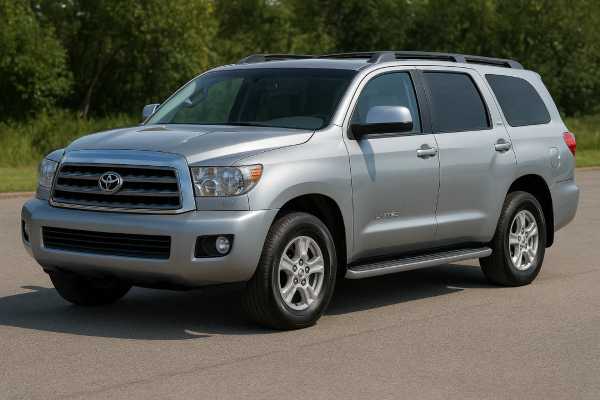

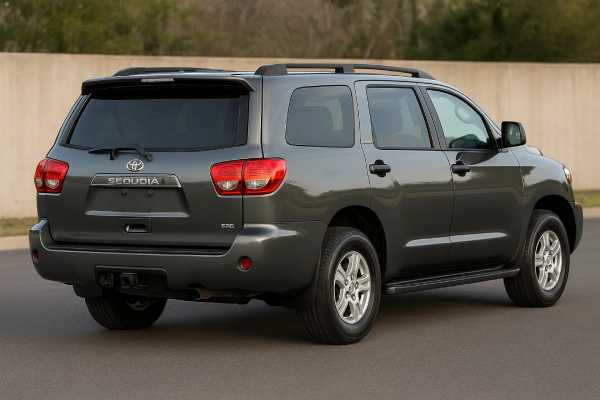
The 2008–2009 Toyota Sequoia RWD with the 2UZ-FE 4.7-liter V8 (platform code UCK60) is an interesting mix of old and new. It belongs to the second-generation Sequoia, with a stiffer, fully boxed frame and independent rear suspension, but it keeps the proven 4.7 V8 instead of the newer 5.7. Rated at 276 hp and 314 lb-ft, this engine is more about smooth, predictable torque and long life than headline performance.
In rear-wheel-drive form, the UCK60 is aimed at owners who want full-size SUV space, serious tow capacity, and Toyota durability, without the extra cost and complexity of four-wheel drive. It is especially common in SR5 trim, where the 4.7 was the default engine, and often serves as a family hauler, road-trip vehicle, and tow rig all in one. This guide focuses specifically on the 2008–2009 Sequoia RWD 4.7, covering technical specs, trims, safety, known reliability patterns, a practical maintenance plan, driving behaviour, and how it compares with rival full-size SUVs.
Fast Facts
- Second-generation Sequoia RWD with fully boxed frame, independent rear suspension, and 2UZ-FE 4.7 V8 rated at 276 hp and 314 lb-ft.
- Typical tow capacity around 7,500–7,800 lb when properly equipped; enough for mid-size campers, boats, or work trailers.
- Real-world fuel economy usually falls in the 13–16 mpg range, depending on load, tyres, and driving style.
- Key ownership caveats: timing belt and water pump every 90,000–100,000 miles, plus attention to rear suspension bushings and underbody corrosion.
- Routine rhythm: oil and filter every 5,000 miles or 6 months, with tyre rotation on the same interval and drivetrain fluids every 30,000–60,000 miles.
Section overview
- 2008–2009 Sequoia RWD Overview
- Toyota Sequoia 2UZ-FE Specs
- Sequoia UCK60 Trims and Safety
- Reliability Issues and Service Actions
- Ownership Maintenance and Buying Advice
- Driving Behaviour and Real Economy
- Sequoia RWD Versus Key Rivals
2008–2009 Sequoia RWD Overview
For 2008, Toyota completely redesigned the Sequoia. The new generation is larger, more powerful in most trims, and noticeably more refined on the road. The UCK60 RWD variant sits at the base of the range in many markets, pairing the outgoing 4.7-liter 2UZ-FE V8 with a 5-speed automatic transmission and a simpler rear-wheel-drive layout.
The key shift from the first generation is structural and chassis-related. The frame is fully boxed and significantly stiffer, which improves crash performance, towing stability, and NVH (noise, vibration, and harshness). The rear suspension switches from a solid axle to an independent double-wishbone setup. That change delivers a smoother ride and a much more usable third row, as the rear floor can sit lower and flatter. In everyday use, the second-generation Sequoia feels less “truck-like” inside, even though it remains body-on-frame and very capable.
The 4.7 V8 is familiar from earlier Sequoias, Tundras, and Land Cruisers. In this application it produces 276 hp and 314 lb-ft, delivered in a smooth, linear fashion. It lacks the punch of the optional 5.7, but still pulls confidently in normal driving and moderate towing. For many owners, the real draw is its long record of reliability and its tolerance for hard use when basic maintenance is respected.
Rear-wheel drive simplifies the driveline: there is no transfer case, front differential, or front CV axles. That means fewer rotating parts, slightly better fuel economy than a comparable 4WD truck, and fewer components to service. In warm or mostly dry climates, RWD is sufficient with quality tyres. In snow-belt regions, many owners pair the Sequoia with proper winter tyres, relying on stability control and traction control rather than four-wheel drive.
Inside, the 2008–2009 Sequoia feels much more modern than the first generation. The dashboard design is more sculpted, storage is improved, and the third row finally folds flat into the floor on most trims, making cargo loading far easier. Cabin materials are still more functional than luxurious, but the overall impression is of a robust, well-organised environment rather than bare utility.
In short, the 2008–2009 Sequoia RWD 4.7 combines:
- Proven engine and transmission.
- A more sophisticated chassis and suspension.
- Big-SUV space and towing capability.
The downsides are predictable: higher fuel use, large outer dimensions, and the reality that these vehicles are now more than a decade old, with all the age-related wear that implies.
Toyota Sequoia 2UZ-FE Specs
This section summarises key technical data for the 2008–2009 Toyota Sequoia RWD with the 2UZ-FE 4.7-liter V8. Values can vary slightly by market and trim, so always confirm against the official documentation for your specific truck.
Engine and Performance
| Item | Specification |
|---|---|
| Engine code | 2UZ-FE |
| Configuration | 90° V8, cast-iron block, aluminium heads |
| Valvetrain | DOHC, 32 valves, VVT-i on intake cams |
| Displacement | 4.7 L (about 4,664 cc) |
| Bore × stroke | approx. 94.0 mm × 84.0 mm (3.70 in × 3.31 in) |
| Compression ratio | roughly 9.6–10.0:1 depending on market |
| Induction | Naturally aspirated |
| Fuel system | Multi-port fuel injection |
| Maximum power | 276 hp around 5,400 rpm |
| Maximum torque | 314 lb-ft around 3,400 rpm |
| Recommended fuel | Regular unleaded (check local handbook) |
| Timing drive | Rubber timing belt driving both camshafts |
The 2UZ-FE is not tuned for peak output in this application; instead, it prioritises mid-range torque, smoothness, and durability. The timing belt must be treated as a scheduled maintenance item, not a lifetime component.
Efficiency and Emissions
| Item | Typical figure (RWD, 4.7 V8) |
|---|---|
| City fuel economy | around 14 mpg US |
| Highway fuel economy | around 17 mpg US |
| Combined estimate | roughly 15–16 mpg US |
| Typical real-world mixed | often 13–16 mpg depending on load and tyres |
These numbers assume stock tyres, no lift, and mostly steady driving. Aggressive all-terrain tyres, roof boxes, and heavy towing will reduce economy noticeably.
Transmission and Driveline
| Item | Specification |
|---|---|
| Transmission | 5-speed automatic with overdrive (Aisin family) |
| Drive type | Rear-wheel drive |
| Gearbox control | Electronically controlled with adaptive logic |
| Final drive ratio | typically around 3.90–4.10:1 depending on axle |
| Rear differential | Hypoid gear, open differential |
The 5-speed automatic is a well-known unit from earlier Toyota trucks. Regular fluid changes are the main requirement for long life, especially if the vehicle tows.
Chassis and Dimensions
| Item | Approximate value (2008–2009 RWD 4.7) |
|---|---|
| Construction | Fully boxed ladder frame |
| Front suspension | Independent double wishbone, coil springs, stabiliser bar |
| Rear suspension | Independent double wishbone, coil springs, stabiliser bar |
| Steering | Rack-and-pinion, hydraulic power assist |
| Brakes | 4-wheel discs with ABS, brake assist, electronic brake-force distribution |
| Wheelbase | about 122 in (3,099 mm) |
| Overall length | roughly 205–206 in (≈5,210 mm) |
| Overall width | around 79–80 in (≈2,010–2,030 mm) |
| Overall height | about 77 in (≈1,955 mm) with roof rack |
| Fuel tank | roughly 26–27 US gal (≈98–102 L) |
| Seating capacity | up to 8 passengers |
Performance and Capability
| Item | Approximate value |
|---|---|
| 0–60 mph | high-8 to low-9 seconds (unladen) |
| Top speed | electronically limited, usually around 110–115 mph |
| Maximum towing capacity | typically up to about 7,500–7,800 lb with tow package |
| Payload | usually 1,300–1,500 lb depending on build |
| Turning circle | roughly 39 ft (≈12 m) curb-to-curb |
Fluids and Service Capacities (typical)
Always confirm exact capacities and specifications in the official manual for your VIN and market.
| System | Typical specification and capacity |
|---|---|
| Engine oil | 5W-30, about 6.5 qt (≈6.1 L) with filter |
| Engine coolant | Toyota Super Long Life coolant, roughly 11–13 qt (≈10–12 L) |
| Automatic transmission | Toyota WS ATF, about 11–12 qt (≈10–11 L) total |
| Rear differential | 75W-90 GL-5 gear oil, roughly 3 qt (≈2.8 L) |
| Power steering | ATF-type fluid as specified |
| A/C refrigerant | R-134a; exact charge on under-hood label |
Electrical and Safety Snapshot
| Item | Description |
|---|---|
| Alternator | around 130 A output depending on equipment |
| 12 V battery | group size 24F or 27F commonly used |
| Spark plugs | long-life platinum or iridium, 120,000-mile change interval typical |
| Airbags | front, front side, and side-curtain airbags for all three rows on most specs |
| Active safety | ABS, stability control, traction control, brake assist |
Sequoia UCK60 Trims and Safety
While the second-generation Sequoia range includes SR5, Limited, and Platinum trims, the 4.7 RWD configuration is most often found in SR5 form, particularly in North America. Understanding the trim structure helps you know what to expect from a given truck and what may have been retrofitted or changed over time.
SR5 4.7 RWD
The SR5 4.7 RWD is the typical “entry” Sequoia of this era, but it is already well equipped by full-size SUV standards.
Common features include:
- 8-passenger seating with a second-row bench (captain’s chairs on some optioned trucks).
- Cloth upholstery, usually with a power-adjustable driver’s seat.
- Manual or automatic climate control, frequently with separate rear controls.
- 18-inch alloy wheels, with tyre sizes tuned for comfort and moderate off-road use.
- Basic audio system, sometimes upgraded with more speakers or a subwoofer.
- Roof rails, running boards, and factory tow package on many vehicles.
Mechanically, SR5 4.7 RWD trucks share the same engine, transmission, and basic brake package. Tow-package hardware (auxiliary coolers, hitch rating, wiring) and wheel/tyre packages can vary, so it is worth checking the build sticker and hitch rating on any specific truck.
Limited and Platinum Context
Although this article focuses on the 4.7 RWD configuration, it helps to know where it sits within the broader range:
- Limited models typically pair with the 5.7 engine and a 6-speed automatic, adding leather, upgraded audio, and more comfort features.
- Platinum versions add further luxury and sometimes advanced suspension features such as rear air suspension or adaptive damping.
In some markets and early production, a 4.7 might appear in higher trims, but it is less common. If you specifically want the simpler 4.7 RWD driveline, always confirm the engine code and transmission type, not just the badge.
Safety Systems and Ratings
Standard safety equipment on 2008–2009 Sequoias typically includes:
- Dual front airbags with multi-stage deployment.
- Front seat-mounted side airbags.
- Roll-sensing side-curtain airbags that cover all three rows in most builds.
- Three-point belts at all seating positions and child-seat anchors (LATCH) on second-row seats.
- Anti-lock brakes, brake assist, and electronic brake-force distribution.
- Vehicle Stability Control and traction control.
Crash-performance results from period testing show strong frontal and side-impact protection for occupants, with rollover resistance in line with other full-size SUVs of the time. The tall body and high center of gravity are inherent to this class, so careful tyre selection and suspension maintenance are important for best stability.
Advanced driver-assistance systems as we know them today—automatic emergency braking, lane-keeping assist, blind-spot monitoring—are not part of the original specification. This is one reason many owners choose to retrofit backup cameras, parking sensors, or modern head units to aid low-speed manoeuvring.
Post-Repair Calibrations
After major suspension or steering work, the stability-control system may require recalibration of:
- Steering-angle sensor zero point.
- Yaw-rate sensor zero point (often done through a simple procedure with the diagnostic tool).
Because there are no radar or camera sensors in the factory setup, repairs after minor collisions are simpler than on newer vehicles, but all restraint and structural repairs must still follow the official service procedures.
Reliability Issues and Service Actions
The Sequoia UCK60 with the 2UZ-FE 4.7 and 5-speed automatic enjoys a strong reputation for longevity, but age and usage patterns have revealed recurring themes. Viewing problems through the lenses of prevalence (common, occasional, rare) and cost (low, medium, high) helps set expectations.
Engine and Cooling System
Common, generally low to medium cost:
- Timing belt and water pump: This is a scheduled job, not a failure. If the belt snaps, you risk breakdown and possibly internal damage. When the belt is replaced, smart owners also replace the water pump, tensioner, idlers, and front oil seals in one visit.
- Valve-cover gasket leaks: Hardened rubber gaskets can seep oil, often noticed as a smell or light smoke near the exhaust manifolds. Replacement is straightforward but labour-intensive enough that it is worth combining with spark-plug service.
- Accessory belt and pulley wear: Squeaks, chirps, or wobbling pulleys signal that a belt and idler refresh is due.
Occasional, medium cost:
- Radiator and hoses: Plastic end tanks and rubber hoses age out. Proactive replacement of radiator, upper and lower hoses, and thermostat is often cheaper than dealing with an overheated engine on the side of the road.
- Starter motor wear: After high mileage, the starter can crank slowly or intermittently. Replacement with a quality unit cures the issue and is usually a once-per-ownership job.
Oil consumption on a healthy 2UZ-FE is typically modest. Significant usage often hints at neglected oil changes, PCV-system problems, very high mileage, or external leaks rather than a design fault.
Fuel, Exhaust, and Emissions
Over time, owners and technicians commonly encounter:
- Aging oxygen sensors leading to check-engine lights and altered fuel trims. Replacing the affected sensors usually restores performance and economy.
- Catalytic converter wear or theft, especially in regions where converter theft is common. Genuine replacements can be expensive, so prevention (parking and physical security measures) is worthwhile.
- Evaporative-emissions leaks from cracked hoses or failing valves, which can be irritating to diagnose but are usually not structurally serious.
Transmission and RWD Driveline
The 5-speed automatic paired with the 4.7 is robust when kept cool and supplied with clean fluid.
- Shift flare or roughness is often improved with a series of drain-and-fill ATF changes. Extreme neglect or heavy towing without sufficient cooling can shorten transmission life.
- Driveshaft clunk or vibration can arise from dry slip joints or worn U-joints. Proper greasing and timely U-joint replacement typically resolve these symptoms.
Because this variant is RWD, it avoids common 4WD-specific problems like transfer-case chain stretch, front-differential noise, or failed front CV joints, lowering both risk and complexity.
Suspension, Steering, and Brakes
Independent rear suspension brings benefits but also more bushings:
- Rear control-arm and toe-link bushings can wear and crack, causing a loose feel, clunks, or a sensation of the rear “steering” over bumps.
- Front lower ball joints and control-arm bushings carry the weight of the V8 and front end; worn parts manifest as noises over bumps, wandering, or uneven tyre wear.
- Shock absorbers and struts degrade gradually; by 150,000 miles many originals are well past their best. Replacing them transforms body control and confidence.
The brake system itself is simple but sensitive to corrosion:
- Sticking caliper slide pins, rusty rotors, and uneven pad wear are common on older vehicles.
- Brake judder under moderate-to-hard stops often points to rotor thickness variation or warping, especially at the front.
Body, Frame, and Electrical
Frame and underbody corrosion remains the biggest long-term threat in road-salt climates:
- Inspect frame rails, crossmembers, suspension mounts, and the area around the spare wheel carefully.
- Brake and fuel lines can suffer from external corrosion, particularly near brackets and where dirt accumulates.
Other recurring issues:
- Rear hatch handle and latch failures, often due to brittle plastic and frequent use; many owners fit stronger aftermarket metal handles.
- Window regulators and lock actuators that slow or fail, especially on high-use doors and the rear hatch glass.
- Age-related electronic issues with audio units, HVAC panels, seat heaters, and sensors; these are usually annoyances more than fundamental reliability threats.
Recalls and Service Campaigns
The 2008–2009 Sequoia has been subject to several recall campaigns over its life, including:
- Airbag and occupant-sensor updates.
- Adjustments related to accelerator pedal design and safe pedal operation.
- Software changes to braking and stability-control behaviour in certain conditions.
Before purchase, and periodically during ownership, owners should:
- Run the VIN through official recall lookup tools.
- Confirm that all recall work has been completed with supporting documentation.
- Pay special attention to any campaigns involving airbags, brakes, and stability systems.
Technical service bulletins (TSBs) also exist for concerns like driveability in specific conditions, noise/vibration issues, and updated maintenance advice. A dealer or specialist with access to factory information can review whether relevant TSBs apply to your truck.
Ownership Maintenance and Buying Advice
A clear, realistic maintenance plan is the key to getting the best from a 2008–2009 Sequoia RWD 4.7. Because many of these vehicles now have six-figure mileage, it is wise to assume some “catch-up” work unless records prove otherwise.
Practical Maintenance Schedule
This schedule suits mixed use with occasional towing. Adjust intervals for severe conditions.
- Engine oil and filter: Every 5,000 miles or 6 months using quality 5W-30 oil. Short-trip, dusty, or hot-climate use argues for the shorter end of the range.
- Engine air filter: Inspect at 15,000 miles; replace about every 30,000 miles or sooner if dirty.
- Cabin air filter: Replace every 20,000–30,000 miles or 2–3 years.
- Spark plugs: Replace long-life plugs around 120,000 miles or 10–12 years.
- Cooling system: Replace coolant around 100,000 miles or 10 years the first time, then every 50,000 miles or 5 years.
- Automatic transmission fluid: Drain-and-fill every 30,000–60,000 miles, especially for vehicles that tow or see high heat.
- Rear differential oil: Replace every 30,000–60,000 miles with the correct gear oil.
- Brake fluid: Flush every 3 years regardless of mileage.
- Brake pads and rotors: Inspect at least annually; replace pads when they near minimum thickness and rotors when warped or below spec.
- Serpentine belt and hoses: Inspect yearly; expect replacement around 90,000–120,000 miles or at the first sign of cracking, glazing, or swelling.
- Timing belt and water pump: Replace around 90,000–100,000 miles or every 9–10 years, whichever comes first.
- Tyre rotation and alignment: Rotate tyres every 5,000–7,500 miles; check alignment when tyres show uneven wear or after suspension work.
- 12 V battery: Test yearly after the third year; plan for replacement roughly every 4–6 years.
Fluid Specifications and Key Torques (typical)
Always confirm in the official manual, but as a rough guide:
- Engine oil: 5W-30 meeting Toyota specifications; about 6.5 qt with filter.
- Differential oil: 75W-90 GL-5.
- Transmission fluid: Toyota WS ATF.
- Oil drain plug torque: often around 29 lb-ft (about 39 Nm).
- Wheel lug nuts: commonly in the 80–90 lb-ft range.
- Spark plugs: typically about 13–15 lb-ft for long-life plugs.
Pre-Purchase Inspection Checklist
For a used 2008–2009 Sequoia RWD 4.7, consider the following checks essential:
- Confirm engine and drivetrain
- Verify that the truck indeed has the 4.7 V8 and 5-speed automatic, not the 5.7/6-speed combination.
- Frame and rust
- Inspect frame rails, crossmembers, and rear suspension pickup points.
- Check brake and fuel lines for corrosion, especially near clip points.
- Timing-belt documentation
- Look for clear evidence of timing-belt and water-pump replacement, including mileage and date.
- If uncertain, treat the job as due and budget accordingly.
- Fluids and leaks
- Check engine oil, ATF, coolant, and differential oil for level and condition.
- Look underneath for oil, coolant, or ATF drips; inspect axle seals and the rear main seal area.
- Suspension and steering
- Drive at a variety of speeds on mixed surfaces, listening for clunks and watching for wandering or instability.
- Inspect for excessive play in ball joints, control-arm bushings, and rear links.
- Tyres and alignment
- Uneven wear may indicate alignment issues, worn suspension, or frame concerns.
- A matched set of quality tyres is a good sign of careful ownership.
- Brakes
- Note pedal feel and any pulsing or pulling when braking.
- If possible, inspect pad thickness and rotor condition.
- Interior and electrics
- Test all windows, locks, seat adjustments, HVAC functions (including rear controls), audio, and any navigation or rear entertainment.
- Check for signs of water leaks, especially around the sunroof (if fitted) and rear quarter windows.
- Recalls and service history
- Run a VIN-based recall check and ask for dealer or workshop records.
- A thick folder of receipts is often worth more than a small gap in mileage.
Long-Term Durability Outlook
With sensible maintenance, a Sequoia UCK60 4.7 RWD can realistically deliver many years and several hundred thousand miles of service. Engines and transmissions often outlast the body and chassis, especially where corrosion is controlled. The most serious risks usually arise from neglected cooling systems, skipped timing-belt intervals, or severe rust, not from inherent design flaws.
Owners who adopt a “truck-first” mindset—budgeting for tyres, brakes, shocks, and occasional suspension refurbishments—tend to have very few unpleasant surprises. Those who treat it like a small crossover may be caught off guard by the cost of consumables and big-SUV fuel bills.
Driving Behaviour and Real Economy
From the driver’s seat, the 2008–2009 Sequoia RWD 4.7 feels like a modernised take on a traditional full-size SUV. It still rides on a frame and carries substantial mass, but independent suspension and improved sound insulation give it a calmer, more composed character than many earlier trucks.
Ride, Handling, and Noise
On typical city streets and highways, the Sequoia rides comfortably. The independent rear suspension helps the back of the vehicle follow bumps more smoothly, reducing the “hop” often felt in solid-axle SUVs and pickups. Small, sharp imperfections are absorbed well, while larger undulations can produce some gentle float if the shocks are tired.
Body roll in corners is present but predictable. The steering is light, with modest feedback, and the truck responds most happily to smooth, deliberate inputs rather than sudden direction changes. Stability control stands ready to intervene if grip is exceeded, and the overall sense is of a vehicle tuned for security and ease rather than sportiness.
Noise levels at highway speeds are reasonable for a tall, boxy vehicle. Tyre choice has a big impact: highway-terrain tyres keep noise lower, while aggressive all-terrain or mud-terrain patterns add a steady hum. Wind noise around the mirrors and roof rack remains noticeable but not overwhelming.
Powertrain Character
The 2UZ-FE 4.7 V8 feels refined and relaxed. It idles quietly and delivers a smooth surge of torque when you lean on the throttle. There is no turbo lag to manage, and the engine’s response is very linear, making it easy to drive smoothly in traffic and while manoeuvring trailers.
The 5-speed automatic favours early upshifts and low revs in normal driving. It does not shift as quickly or as often as modern multi-speed gearboxes, but it is straightforward and predictable. When you request full throttle, it will drop one or two gears and pull strongly enough for safe highway merging and passing. On long grades, it will hold intermediate gears to maintain speed without frequent hunting.
Compared with the 5.7-liter option, the 4.7 feels more measured but still suitable for most normal tasks. If your use is mainly commuting, road trips, and moderate towing, the 4.7 is more than adequate, with the benefit of a long track record for reliability.
Real-World Fuel Economy
Official ratings suggest mid-teens mpg for 4.7 RWD trucks, and everyday experience tends to match.
Expect roughly:
- City driving: around 12–14 mpg, depending on traffic, trip length, and how often the engine warms fully.
- Highway cruising at 65–70 mph: around 15–17 mpg on stock tyres, decreasing at higher speeds or in strong headwinds.
- Mixed driving: most owners see about 13–16 mpg overall.
Fitting larger tyres, adding roof racks or cargo boxes, carrying heavy loads, or towing at speed all increase consumption. Keeping tyres properly inflated, avoiding unnecessary idling, and driving at moderate highway speeds are the simplest ways to maximise range.
Towing and Load Behaviour
As a tow vehicle, the Sequoia RWD 4.7 is more than competent for mid-size loads:
- Stability is good with a correctly adjusted weight-distributing hitch and functioning trailer brakes.
- The long wheelbase and stiff frame help keep the trailer under control in crosswinds and during lane changes.
- Engine and transmission temperatures stay in a sensible range if the cooling system is healthy and lower gears are used on long climbs.
The main trade-off is fuel consumption. With a large boxy trailer, it is easy to see single-digit mpg, especially at higher highway speeds. When towing regularly, it pays to:
- Stay on top of transmission and differential fluid changes.
- Watch for any sign of overheating or slipping.
- Use engine braking, rather than relying solely on the service brakes, on long descents.
Sequoia RWD Versus Key Rivals
The 2008–2009 Sequoia RWD 4.7 does not exist in a vacuum. Buyers often cross-shop it against the Ford Expedition, Chevrolet Tahoe/GMC Yukon, and Nissan Armada from similar years. Each has its own strengths, so it helps to see where the Sequoia stands.
Against Ford Expedition
The contemporary Expedition offers:
- Independent rear suspension, similar to the Sequoia, with a comfortable ride and low, flat cargo floor.
- A range of V8 engines and, in later years, more advanced powertrains.
However, long-term reliability can vary more widely, and some owners report more frequent repairs on suspension and drivetrain components as the vehicle ages. The Sequoia’s 2UZ-FE engine and Aisin automatic are widely regarded as long-lived when maintained, with relatively few catastrophic failures.
If you value slightly softer ride tuning, a lower load floor, and a more “domestic” parts ecosystem, the Expedition has appeal. If your priority is a conservative, high-mileage powertrain, the Sequoia is often the preferred choice.
Against Chevrolet Tahoe and GMC Yukon
GM’s Tahoe and Yukon, and their Suburban/Yukon XL siblings, bring:
- An extremely wide choice of trims and powertrains.
- Deep aftermarket support for performance, suspension, and cosmetic modifications.
- Often lower purchase prices in some used markets due to sheer numbers.
The Sequoia answers with:
- A strong reputation for engines and transmissions that reach high mileage with basic care.
- Interior materials that tend to age well, with fewer cracked dashboards and failing switches than some rivals.
- Fender-to-fender Toyota parts support, shared with Tundra and other truck lines.
If you plan to lift, tune, and heavily modify your SUV, a GM platform may be the easier path. If you want a largely stock, long-term family and towing vehicle with minimal drama, the Sequoia makes a very strong case.
Against Nissan Armada
The first-generation Armada offers:
- Strong acceleration and competitive tow ratings.
- A distinctive styling and cabin feel that some buyers prefer.
On the downside, owners and technicians often report:
- More frequent electrical and driveline problems at higher mileage.
- Rust issues in harsh climates that can limit long-term viability.
By contrast, the Sequoia 4.7 RWD is widely viewed as a safer long-term bet. Even if it lacks some of the Armada’s sense of urgency, its track record for durability is a key reason families and businesses choose it.
Who the 2008–2009 Sequoia RWD 4.7 Suits Best
This particular Sequoia configuration is a good fit if you:
- Need a full-size, body-on-frame SUV with real tow capacity and space for up to eight people.
- Value a naturally aspirated V8 and conventional automatic transmission with a long reliability history.
- Live in a climate where rear-wheel drive, traction control, and winter tyres (if needed) are sufficient.
- Are comfortable with mid-teens fuel economy and the running costs of a large truck-based vehicle.
It is a less ideal match if you want cutting-edge driver-assistance tech, maximum efficiency, a compact footprint, or the extra traction of four-wheel drive for frequent off-road or deep-snow use. For many owners, though, a well-maintained 2008–2009 Sequoia RWD 4.7 combines the best traits of Toyota’s older, overbuilt trucks with the comfort and space of a modern large SUV.
References
- 2008 Toyota Sequoia Owner’s Manual and Warranty Information 2008 (Owner’s Manual)
- 2008 TOYOTA SEQUOIA Vehicle Details and Ratings 2008 (Recall Database)
- Fuel Economy of the 2008 Toyota Sequoia 2008 (Fuel Economy Data)
- Used 2008 Toyota Sequoia SR5 Specs and Features 2008 (Specifications)
- The All-New 2008 Sequoia Has a New Larger More Powerful Engine and Lower Suggested Pricing 2008 (Press Release)
Disclaimer
This article is for informational purposes only and is not a substitute for professional diagnosis, repair, or safety inspection. Specifications, torque values, fluid capacities, and service intervals can vary by VIN, market, trim, and equipment. Always verify critical data and procedures against the official Toyota service documentation and follow all applicable safety precautions and regulations when inspecting, maintaining, or modifying your vehicle.
If you found this guide helpful, please consider sharing it with other Sequoia owners or enthusiasts on platforms such as Facebook or X/Twitter to support xcar’s work and help more people make informed decisions about their vehicles.