
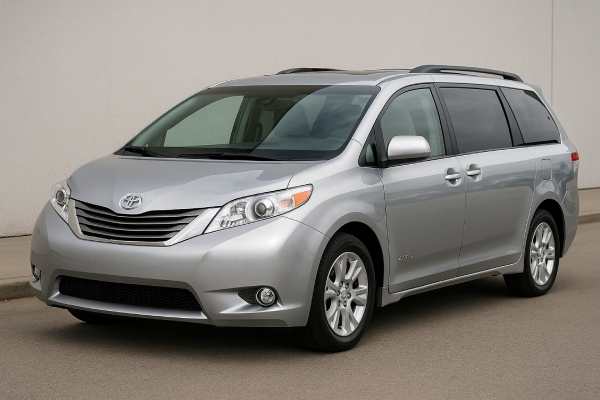
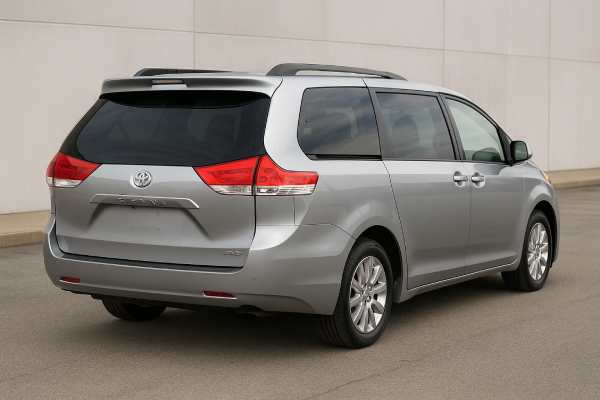
The Toyota Sienna AWD (XL30) with the 2GR-FE 3.5-litre V6 sits in a rare niche: a family minivan that can genuinely cope with bad weather and rough roads while still feeling refined and easy to live with. Introduced for the 2011 model year in most markets but often grouped as 2010–2014 XL30 generation, this Sienna combines a proven V6, a six-speed automatic transmission, and an electronically controlled all-wheel-drive system with run-flat tyres instead of a conventional spare.
For owners, the appeal is straightforward: strong, effortless acceleration even with seven passengers on board, a very flexible cabin, and the security of AWD in snow and heavy rain. Operating costs are higher than a four-cylinder or front-wheel-drive Sienna, mostly due to fuel use, tyre costs, and extra driveline servicing. But if you need three rows, cargo space, and all-weather traction in one package, this XL30 AWD is still one of the most rational options on the used market.
Essential Insights
- Strong 3.5 l V6 and AWD give confident passing power and winter traction even with a full family and luggage.
- Spacious, flexible cabin with comfortable seating for seven and a flat-folding third row makes it practical as a daily people-mover.
- Proven 2GR-FE V6 and six-speed auto are generally durable if serviced on time, but water pump, cooling, and oil leaks should be watched.
- AWD system and mandatory run-flat tyres add cost; expect tyre replacement and driveline fluids to be more expensive than on FWD models.
- Plan engine oil and filter changes every 8,000–10,000 km or 6–12 months (whichever comes first) using 0W-20 oil that meets Toyota specifications.
Start here
- AWD Sienna XL30 overview
- AWD powertrain specs and data
- All-wheel-drive trims and safety
- AWD reliability issues and fixes
- Maintenance plan and buying advice
- Driving feel and winter performance
- Sienna AWD rivals comparison
AWD Sienna XL30 overview
The XL30-generation Toyota Sienna arrived for the 2011 model year with a complete redesign: new body, upgraded interior, and revised powertrains. The AWD models pair the 2GR-FE 3.5-litre V6 with a six-speed automatic and an on-demand all-wheel-drive system that normally drives the front wheels and sends torque rearward when slip is detected. This layout keeps everyday fuel consumption reasonable while still improving traction on snow, ice, and wet roads.
With 266 hp and around 245 lb-ft of torque, the AWD Sienna accelerates more like a mid-size sedan than a traditional van. It has enough reserve power to merge quickly, hold highway speeds on long grades, and tow up to 3,500 lb (about 1,600 kg) when properly equipped. That capability, plus three rows of seats, makes it attractive for families who pull small campers, boats, or utility trailers.
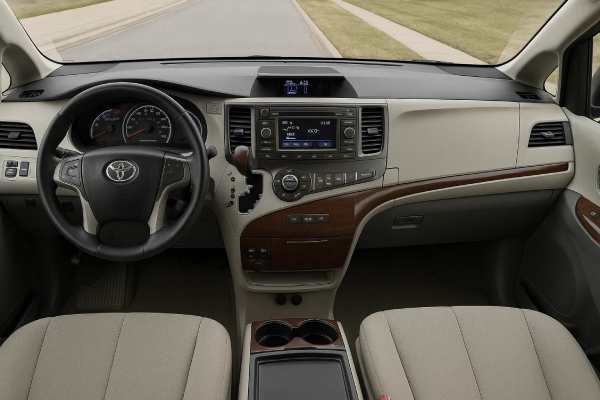
Inside, the XL30 platform brought a more car-like driving position and a wider cabin. Most AWD versions are seven-seaters with captain’s chairs in the second row and a split-folding third row that folds into the floor. The interior materials are practical rather than luxurious, but the layout is intuitive, and visibility is generally excellent. Sound insulation is good for the class, with engine noise mostly noticeable under full throttle.
Compared with front-wheel-drive Siennas, AWD models sit slightly higher and use run-flat tyres instead of a spare. This makes roadside punctures less stressful but raises tyre costs and can stiffen the ride. The system also adds weight, so fuel economy is a bit worse. For buyers in milder climates who never see snow, the extra cost may not be justified. For those who regularly drive in winter or on steep, wet roads, the AWD XL30 often feels like cheap insurance.
In short, the Toyota Sienna AWD (XL30) offers a rare combination of minivan space, V6 performance, and genuine all-weather traction, backed by Toyota’s long-term durability record. The rest of this guide focuses on the details that matter in ownership: specs, maintenance, reliability, and how it stacks up against rivals.
AWD powertrain specs and data
Engine and performance (2GR-FE V6)
| Item | Specification |
|---|---|
| Engine code | 2GR-FE |
| Configuration | 60° V6, DOHC, 24 valves (4 per cylinder) |
| Displacement | 3.5 l (3,456 cc) |
| Bore × stroke | approx. 94.0 mm × 83.0 mm (3.70 in × 3.27 in) |
| Induction | Naturally aspirated |
| Fuel system | Sequential multi-port fuel injection |
| Compression ratio | ~10.8 : 1 |
| Max power | 266 hp (about 198 kW) @ 6,200 rpm |
| Max torque | about 332 Nm (245 lb-ft) @ 4,700 rpm |
| Timing drive | Chain-driven camshafts (no scheduled belt change) |
| Recommended fuel | Regular unleaded (typically 87 AKI / 91 RON) |
| Emissions standard | US LEV/ULEV equivalent depending on market |
Real-world performance is brisk for a minivan. Independent tests typically show 0–60 mph times in the high-7-second range for AWD V6 Siennas, with strong mid-range pull for passing. The engine’s character is smooth and quiet at light throttle, becoming more vocal but still refined when revved.
Fuel economy and efficiency (AWD V6)
Official ratings vary slightly by year and market, but US EPA figures for a 2011 AWD V6 Sienna are approximately:
- City: 16 mpg (about 14.7 l/100 km)
- Highway: 22 mpg (about 10.7 l/100 km)
- Combined: 18 mpg (about 13.1 l/100 km)
Owner-reported data tend to cluster around 18–20 mpg combined (roughly 11.8–14.0 l/100 km), depending on driving style, climate, and load. Short-trip city driving and heavy use of roof boxes or trailers can push consumption higher; steady 100–110 km/h highway cruising with a light foot can get closer to the official figures.
At a steady 120 km/h (75 mph), a realistic expectation is around 11–12 l/100 km (19–21 mpg US), assuming stock tyres and no roof cargo. Strong headwinds, winter tyres, and cold weather can easily drop that by 1–2 l/100 km.
Transmission and AWD driveline
| Item | Specification |
|---|---|
| Transmission type | 6-speed automatic (torque converter) |
| Drive type | On-demand AWD (front-biased) |
| Normal torque split | Primarily front-wheel drive, rear engages as needed |
| AWD hardware | Electronically controlled coupling to rear differential |
| Traction aids | Stability control, traction control, ABS with EBD |
| Tow rating (properly equipped) | Up to 3,500 lb (approx. 1,587 kg) |
The six-speed’s calibration prioritises smoothness over ultra-sharp shifts. Kickdown is usually prompt, and the gearbox will hold lower gears sensibly on hills. There is no low-range; this AWD system is meant for weather and light off-pavement work, not rock-crawling.
Chassis and dimensions (typical AWD V6)
| Item | Specification (approximate) |
|---|---|
| Overall length | ~5,085 mm (200.2 in) |
| Overall width | ~1,985–1,990 mm (78.2 in) |
| Overall height | ~1,765–1,770 mm (about 69.5–69.7 in) |
| Wheelbase | 3,030 mm (119.3 in) |
| Ground clearance | about 165–170 mm (6.5–6.7 in) |
| Curb weight (AWD V6) | roughly 1,975–2,000 kg (4,350–4,400 lb) depending on trim |
| Fuel tank capacity | about 79 l (21 US gal) |
| Seating | 7 seats (most AWD trims) |
| Cargo volume | around 1,100+ l (≈ 39 ft³) behind 3rd row; over 4,200 l (≈ 150 ft³) with rear rows folded/stowed |
Suspension is a MacPherson-strut front layout and a rear torsion-beam or trailing-arm setup with coil springs, tuned for comfort. Brakes are four-wheel discs with ABS; rotor sizes and wheel diameters vary slightly by trim, but AWD models typically use 17- or 18-inch wheels.
Performance and capability summary
- 0–100 km/h (0–62 mph): roughly 8 seconds (trim and load-dependent).
- Top speed: electronically limited; usually around 180–190 km/h (112–118 mph) in most markets.
- Braking: typical 100–0 km/h stopping distances in the mid-40-metre range with good tyres.
- Roof load: often around 75–100 kg (165–220 lb) including rack; always confirm with the specific vehicle’s labels and manual.
Fluids, service capacities, and key specs (typical)
| System | Specification (check local manual for exact values) |
|---|---|
| Engine oil | 0W-20, meeting Toyota spec; ~6.0–6.5 l (≈ 6.3–6.9 US qt) with filter |
| Engine coolant | Toyota Super Long Life coolant, premixed; capacity roughly 8–10 l total system |
| ATF | Toyota WS ATF; drain-and-fill quantity typically ~3–4 l (full dry fill higher) |
| Rear differential | Hypoid gear oil (often 75W-90 GL-5); capacity around 1 l |
| Transfer case / AWD coupling | Toyota-specified gear or ATF fluid; small capacity (≈ 0.5–1.0 l) |
| A/C refrigerant | R-134a; exact charge printed under hood |
| Spark plugs | Long-life iridium; typical gap around 1.0 mm (0.039–0.043 in) |
Always validate exact capacities and torque values for drain plugs, wheel nuts, and suspension fasteners in the official service manual for the specific VIN and market.
All-wheel-drive trims and safety
In North America, the AWD XL30 Sienna was generally offered on higher trims rather than as a base option. The exact combinations vary slightly by year and market, but typical AWD offerings include:
- LE AWD (7-passenger) – the most common value choice, with cloth seats, power sliding doors on at least one or both sides, and basic infotainment.
- XLE AWD – adds leather trim, heated seats, more power features, and additional comfort options such as tri-zone climate control and upgraded audio.
- Limited AWD – the range-topper, with premium audio, advanced navigation for the era, power tailgate, extra interior trim, and more noise insulation.
AWD models use run-flat tyres instead of carrying a full-size spare. On Limited AWD, larger alloy wheels and more equipment add further weight and cost. When inspecting a used Sienna AWD, verify that the vehicle still runs appropriate run-flat tyres, or that a proper spare-wheel conversion has been done with correct jack and storage solution.
Trim-level mechanical and feature differences
- Suspension and steering: Spring and damper tuning is slightly firmer on higher trims due to wheel/tyre packages, but the basic geometry remains the same. Steering is electrically assisted, light at parking speeds, and reasonably stable on the highway.
- Brakes: Rotor sizes can differ slightly between trims, but all AWD V6 models have four-wheel discs and ABS with electronic brake-force distribution.
- Towing package: Some AWD versions include a tow prep package (upgraded cooling and wiring). Confirm the presence of the correct hitch, wiring, and cooler hardware rather than assuming any Sienna can tow maximum rated capacity.
Passive safety
Every AWD XL30 Sienna comes with a comprehensive airbag suite and structural enhancements:
- Dual-stage front airbags for driver and front passenger.
- Front-seat side torso airbags.
- Full-length side curtain airbags covering all three rows.
- Driver’s knee airbag.
- Energy-absorbing steering column and crush zones front and rear.
- Three-point belts for all seating positions, with pretensioners and force limiters in the front seats.
- ISOFIX/LATCH anchorage points for child seats in the second row, plus top tether points for additional positions.
Crash-test bodies have rated the XL30 Sienna strongly in most major categories, with good scores in moderate-overlap frontal, side-impact, roof strength, and head restraint tests for the 2011–2014 models. The Sienna of this era was frequently listed among the better-performing minivans in independent safety comparisons.
Active safety and driver assistance
Because this generation predates widespread advanced driver-assistance tech, equipment is simpler than on modern vans:
- Standard on all models
- Electronic Stability Control (ESC) and traction control.
- Four-wheel ABS with brake assist and electronic brake-force distribution.
- Tyre pressure monitoring system.
- Rearview camera on many trims from the early years; by mid-cycle, it became much more common across the range.
- Available or trim-dependent features (market and year specific)
- Parking sensors (front and rear) on XLE and Limited.
- Blind-spot monitoring with rear cross-traffic alert on later, higher-spec models.
- Wide-angle rear camera view when combined with certain navigation systems.
There is no factory adaptive cruise control, lane-keeping assistance, or autonomous emergency braking on these model years. From an ownership perspective, that simplifies maintenance and reduces the risk of expensive radar or camera calibration issues, but buyers who prioritise the latest ADAS features should look to newer generations.
AWD reliability issues and fixes
The AWD XL30 Sienna with the 2GR-FE V6 is generally regarded as one of the more robust minivans of its era, but no 10–15-year-old vehicle is trouble-free. Below is a practical breakdown of typical issues by system, with emphasis on prevalence, cost impact, and what to look for.
Engine and cooling system
Common or occasional concerns:
- Water pump seepage or failure
- Symptoms: Coolant smell, pink residue around the pump, slow coolant loss, or overheating if neglected.
- Likely cause: Age-related wear of the pump’s seal and bearings.
- Remedy: Replace water pump, often combined with a new serpentine belt and fresh coolant. Labour cost is moderate; parts are not unusual.
- Valve cover gasket and oil leaks
- Symptoms: Oil smell after driving, oily residue on the engine block or subframe, minor drips on the driveway.
- Likely cause: Hardened gaskets and seals with age and heat.
- Remedy: Replace valve cover gaskets and associated seals; clean engine exterior. Catch early to avoid oil on rubber components and exhaust.
- Carbon accumulation in throttle body and intake
- Symptoms: Slightly unstable idle, throttle lag, or minor surging at low speeds.
- Likely cause: Normal deposits from fuel and crankcase vapours.
- Remedy: Throttle body cleaning and, if needed, intake cleaning during routine service.
The 2GR-FE uses a timing chain rather than a belt. True chain stretch is rare when oil changes are done on schedule with the correct 0W-20, but extended drain intervals or low oil levels can accelerate wear. Rattling at cold start, timing-correlation codes, or poor running under load warrant further investigation.
Transmission and AWD system
The six-speed automatic is usually durable if its fluid stays in good condition. It is officially “filled for life” in some materials, but experience suggests changing the ATF at reasonable intervals is healthy.
Typical issues include:
- Harsh or delayed shifts
- Symptoms: Firm engagement into Drive or Reverse, or occasional flare between gears.
- Cause: Old ATF, adaptive learning quirks, or, less commonly, solenoid issues.
- Fix: Fluid drain-and-fill or staged replacements; software updates where applicable; diagnosis if symptoms persist.
- AWD coupler or rear differential leaks
- Symptoms: Oil spots under the centre/rear of the van, humming sounds at speed, or clunks when engaging drive.
- Cause: Aged seals, vent issues, or long intervals without fluid changes.
- Fix: Replace seals as needed and refill with the correct fluid; check for bearing or gear damage if noise is present.
- Prop-shaft and bearing noise
- Symptoms: Drumming, vibration, or a low-frequency hum that changes with speed.
- Cause: Worn centre support bearings or universal joints.
- Fix: Replace the shaft assembly or components, depending on parts availability in your region.
Regular inspection of AWD components during services helps catch leaks or wear before they become expensive repairs.
Chassis, brakes, and body
- Sliding door cables and latches
- Power sliding doors can develop issues with cables, latches, or rollers, especially in salt-belt regions or if they are not lubricated. A door that struggles to close, reverses unexpectedly, or makes grinding noises should be inspected before the cable fails outright.
- Suspension bushings and struts
- At this age, front strut mounts, control arm bushings, and rear suspension bushings may be worn. Symptoms include clunks, looseness over bumps, and vague steering. Replacing worn components restores ride quality and tracking.
- Brake hardware and corrosion
- Sliding pins and parking brake mechanisms can seize in harsh climates. Periodic cleaning and lubrication, along with proper brake fluid changes, are important to maintain even braking and avoid premature pad/rotor wear.
Tyres and wheels (run-flats)
All AWD XL30 Siennas left the factory with run-flat tyres because there is no underfloor space for a spare. Owners often underestimate the cost of replacing them and the impact on ride comfort.
- Expect higher tyre prices than comparable non-run-flat tyres.
- Some owners convert to conventional tyres and add a compact spare solution; this can improve comfort and grip but must be done thoughtfully to maintain safety and legal compliance.
- Always check the age and condition of run-flats on a used AWD Sienna; old or unevenly worn tyres can cause AWD binding or ABS/ESC calibration issues.
Recalls, TSBs, and extended coverage
Over the years, 2011–2014 Siennas have had multiple recalls covering items such as labelling, sliding doors, and airbag components. For a prospective buyer or owner:
- Run a VIN check on Toyota’s official recall site and through your local Toyota dealer to confirm all campaigns are completed.
- Ask for printed service history with recall and warranty work.
- Pay attention to any communication about sliding door reinforcement or spare tyre carrier issues (more common on FWD, but history is still relevant).
Maintenance plan and buying advice
A sensible maintenance plan is the best way to keep a Toyota Sienna AWD XL30 reliable into high mileage. Toyota’s official schedule varies slightly by market, but the following is a practical baseline. Always cross-check with the handbook for your specific region.
Practical maintenance schedule (typical, time/distance based)
- Engine oil and filter – Every 8,000–10,000 km or 6–12 months, whichever comes first, with 0W-20 oil that meets Toyota’s specification. Short-trip or severe use (cold climate, lots of idling, towing) justifies the shorter interval.
- Engine air filter – Inspect every 20,000 km; replace around 40,000 km or sooner in dusty areas.
- Cabin air filter – Replace every 15,000–20,000 km or annually, especially if you use the HVAC heavily.
- Coolant – Toyota’s Super Long Life coolant is often first replaced around 160,000 km or 10 years, then every 80,000 km or 5 years. Many used-vehicle buyers choose to refresh coolant proactively for peace of mind.
- Spark plugs – Iridium plugs typically last up to 160,000–190,000 km (100,000–120,000 miles). Check for misfires, poor economy, or hard starting as the vehicle ages.
- Fuel filter – Usually integrated in the tank and not a frequent service item unless there are symptoms; confirm requirements in the official service data.
- Serpentine/auxiliary belt – Inspect at each service from ~80,000 km; replace if cracked, glazed, or noisy. Many owners pre-emptively renew it with the first water pump change.
- Automatic transmission fluid (ATF) – Even where labelled “lifetime,” a drain-and-fill every 60,000–80,000 km is a reasonable precaution. Avoid aggressive “flushing”; staged fluid renewals are safer on older transmissions.
- Rear differential and AWD coupling fluids – Replace every 60,000–80,000 km, especially if the vehicle tows or sees heavy winter use.
- Brake fluid – Change every 2–3 years regardless of mileage to prevent internal corrosion and maintain pedal feel.
- Brake pads and rotors – Inspect at least annually; front brakes on a loaded minivan do a lot of work. Listen for squeal, grinding, or pulsation under braking.
- Tyre rotation and alignment – Rotate every 8,000–10,000 km with each oil change; align after suspension work or if you notice uneven wear or pulling. AWD systems are happier when all four tyres match in size and wear.
- 12 V battery – Test annually after the 4–5-year mark; the sliding doors and electronics are sensitive to low voltage. Replace at first sign of weakness rather than waiting for a no-start in winter.
Buyer’s checklist for a used Sienna AWD XL30
When viewing a candidate vehicle:
- Service records
- Look for regular oil changes, coolant and ATF services, and documentation of any water pump or sliding door work. Long gaps or missing records increase risk.
- AWD system health
- Test for any unusual noises or vibration at speed. On a gravel surface, gently accelerate from rest and feel whether the rear seems to engage. Uneven-diameter or mismatched tyres are a red flag.
- Underbody and corrosion
- Inspect subframes, suspension mounting points, brake and fuel lines, and, if visible, the rear differential casing. Salt-belt vehicles may show surface rust; active flaking and holes require more caution.
- Tyres and wheels
- Check tyre age (DOT date), tread depth, and evenness of wear. Verify whether the vehicle still uses run-flats or has a documented spare-wheel retrofit.
- Interior and sliding doors
- Operate both sliding doors repeatedly using both the power buttons and manual operation. Watch for hesitations, chimes, or reversals that suggest worn cables or misadjusted sensors. Check third-row folding function and seat tracks.
- Cooling and leaks
- Look for coolant staining around the water pump and radiator, oil on the engine block or around the valve covers, and any burnt-oil smells after a drive.
- Electronics and accessories
- Test all windows, locks, power seats, HVAC modes, rear climate control, entertainment systems, and the backup camera. Faulty screens and cameras are not safety-critical but can be costly to fix.
Recommended years/trims and long-term outlook
For the 2010–2014 XL30 AWD Sienna, most buyers target:
- LE AWD for a balance of cost, features, and simpler equipment.
- XLE AWD if you value additional comfort and are comfortable with more electrical complexity.
- Limited AWD suits those wanting maximum luxury, but budget for higher purchase price and potentially more to fix (adaptive lighting, premium audio, etc.).
Later years in the run may incorporate minor refinements and additional features, but overall mechanical differences are modest. With proper maintenance and care, a Sienna AWD of this generation can comfortably exceed 250,000–300,000 km (155,000–185,000 miles) while still feeling tight, making it a strong candidate for long-term family use.
Driving feel and winter performance
On the road, the AWD XL30 Sienna feels more like a large car than a commercial van. The steering is light at parking speeds and steadies up convincingly on the highway. Body roll is present but well-controlled, and the suspension tuning prioritises comfort over sharp turn-in. On smooth roads, the ride is supple; on rougher surfaces, the combination of a tall body and stiff-sidewall run-flat tyres can make impacts feel more pronounced than in some rivals running conventional tyres.
Noise, vibration, and harshness (NVH) levels are generally pleasant. Wind noise is modest, helped by good door sealing and the relatively aerodynamic shape for a minivan. Road noise largely depends on tyre choice and wear; fresh, quality run-flats or a carefully chosen conventional tyre set can make a noticeable difference. The V6 is quiet cruising at 2,000–2,500 rpm, with a muted growl only appearing when you push past half throttle.
In daily driving, throttle response is linear and predictable. The six-speed automatic usually chooses gears sensibly, dropping down promptly for passing and holding lower gears on hills with light engine braking. There is no sport mode in the modern sense, but the gearbox adapts fairly well to a mix of city and highway driving. With a full load of passengers and luggage, you can feel the extra mass, yet the engine still has reserve for confident merging.
Winter and low-grip behaviour
The AWD system is the main differentiator from most competitors. On wet or snowy roads:
- Take-offs from slick junctions are much less dramatic; the system shuffles torque rearward before the front wheels have a chance to spin wildly.
- Stability control steps in smoothly if you provoke understeer, trimming power and, when needed, braking individual wheels.
- On long, snowy grades or icy ramps, the Sienna feels significantly more secure than a similar FWD minivan on the same tyres.
The limiting factor remains tyre choice. Even with AWD, dedicated winter tyres dramatically improve braking and cornering grip on snow and ice. Run-flat winter tyres are more limited and expensive, but for regular winter driving, they are worth strong consideration.
Real-world economy and towing behaviour
In mixed driving with moderate loads:
- Expect city consumption around 14–16 l/100 km (15–17 mpg US).
- Highway runs at 100–110 km/h often fall in the 10–11.5 l/100 km range (20–23 mpg US) if you drive smoothly.
- A realistic long-term combined figure for family use is 11.5–13 l/100 km (18–21 mpg US).
When towing a small camper or boat near the 3,500 lb limit, fuel use can rise significantly—typically by 25–40% depending on terrain and speed. Pay attention to transmission temperatures when towing in hot weather and use lower gears on long climbs to reduce heat. Properly maintained brakes and quality trailer brakes are essential for stable, confident stopping.
Overall, the driving experience is calm, predictable, and confidence-inspiring rather than sporty. For many buyers of an AWD minivan, that is exactly the point.
Sienna AWD rivals comparison
During the 2010–2014 period, the Sienna’s main minivan rivals were the Honda Odyssey, Chrysler Town & Country, Dodge Grand Caravan, Nissan Quest, and Kia Sedona. Among these, the Sienna stood out as the only mainstream model to offer an all-wheel-drive option in many markets.
Versus Honda Odyssey
- Drivetrain: Odyssey remained front-wheel drive only, even though its V6 engines were strong and efficient. In snow-belt regions, this gave the Sienna a clear traction advantage.
- Driving feel: Many testers found the Odyssey a bit sharper and more engaging to drive, with slightly better steering feedback and flatter cornering.
- Interior: Both offer flexible seating; Odyssey often wins on clever small-item storage, while the Sienna’s layout feels more straightforward and the AWD version sacrifices underfloor spare-tyre storage to the run-flat system.
- Reliability: Later Odyssey automatics improved but still have a more mixed reputation than the Sienna’s V6/AWD combination when it comes to very high mileage.
Versus Chrysler Town & Country / Dodge Grand Caravan
- Powertrains: Chrysler’s 3.6-litre V6 is powerful and reasonably efficient but only drives the front wheels in this era.
- Features: The famous Stow ’n Go seating system makes the Chrysler vans very flexible for cargo, but seat comfort can be lower than the Sienna’s.
- Reliability and ageing: The Sienna typically holds up better in terms of powertrain durability, sliding door mechanisms, and interior wear, though it can be more expensive to purchase on the used market.
Versus Nissan Quest and Kia Sedona
- Both the Quest and Sedona offer decent V6 power and comfortable cabins but lack AWD.
- Interior design and materials can feel more “niche” (Quest) or more basic (older Sedona) compared with the Toyota.
- Long-term parts availability, resale value, and dealer network strength usually favour the Sienna.
When the Sienna AWD makes the most sense
Choose the XL30 Sienna AWD if:
- You regularly face snow, steep unpaved driveways, or wet, hilly roads.
- You need genuine seven-seat flexibility and occasional towing ability.
- You value straightforward mechanicals and a long track record of Toyota minivan durability more than cutting-edge infotainment or driver-assist tech.
If you live in a warm, flat region and mostly do highway driving, a front-wheel-drive Sienna or rival may be more economical to run. But for all-weather family use, the AWD XL30 Sienna occupies a strong and still quite unique spot in the used-car landscape.
References
- HIGHLIGHTS: 2011 TOYOTA SIENNA 2010 (Manufacturer media and specifications)
- Gas Mileage of 2011 Toyota Sienna 2011 (Official fuel economy data)
- 2011 Toyota Sienna 2011 (Safety Rating)
- Vehicle Detail Search – 2011 TOYOTA SIENNA 2011 (Recall Database)
- 2011 Toyota Sienna MPG 2023 (Owner-reported fuel consumption data)
Disclaimer
This article is intended for general informational purposes only and does not replace professional diagnosis, repair advice, or the official documentation for your specific vehicle. Specifications, torque values, service intervals, and procedures can vary by VIN, production date, market, and installed equipment. Always confirm critical data against your vehicle’s owner’s manual, official service literature, and the guidance of a qualified technician before carrying out any work.
If you found this guide useful, consider sharing it with other owners or shoppers on platforms such as Facebook or X/Twitter. It helps support the ongoing effort to create clear, detailed, and practical xcar resources for enthusiasts and everyday drivers alike.