
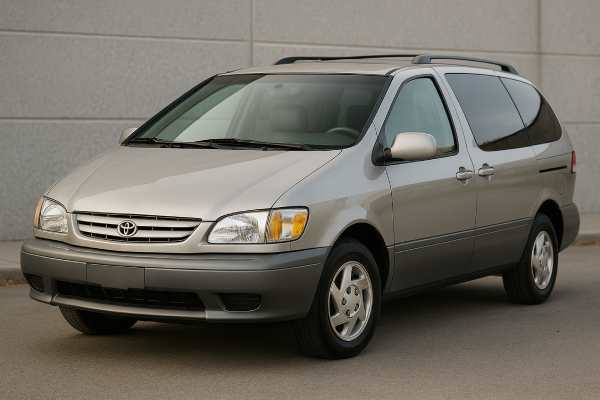
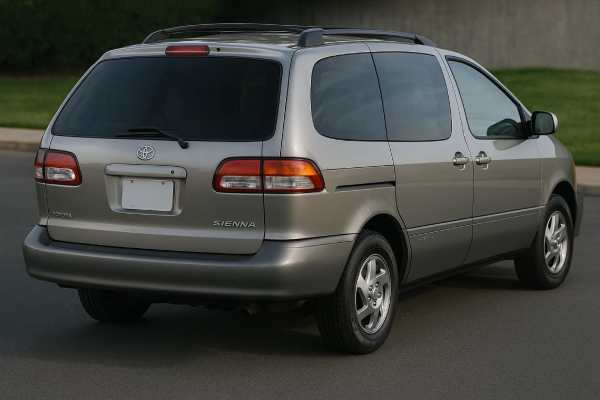
The facelifted first-generation Toyota Sienna FWD (XL10) is a classic family van that blends Camry-like manners with minivan practicality. For the 2001–2003 model years (facelift introduced in late 2000), Toyota updated the styling and added the VVT-i version of the 1MZ-FE 3.0-litre V6, raising output to around 210 hp while keeping fuel consumption reasonable for the era.
Built on an extended Camry platform and sold mostly in North America, this Sienna is compact by modern minivan standards, which many owners actually prefer: it is easier to park, lighter, and generally simpler to work on. It is also known for very strong crash performance for its time, with optional side airbags and available stability control on higher trims.
This guide focuses specifically on the facelift FWD XL10 Sienna with the 3.0-litre 1MZ-FE V6, covering hard specs, dimensions, real-world performance, reliability, maintenance expectations, and how it stacks up against period rivals if you are buying or keeping one today.
Top Highlights
- Refined 3.0 l 1MZ-FE VVT-i V6 with about 210 hp and good low-rpm torque for seven-passenger use.
- Compact exterior size, light steering and soft suspension make urban and suburban driving easy.
- Strong crash test performance for its era, with available side airbags and stability control on some trims.
- Watch for oil sludge history and confirm timing belt and water pump replacement around 90,000–100,000 miles (150,000–160,000 km).
- Plan on engine oil and filter changes every 5,000 miles / 8,000 km or 6 months on these older V6 engines.
Section overview
- Facelift Sienna XL10 detailed view
- Sienna FWD XL10 specs sheet
- Facelift trims equipment and safety
- Reliability issues on facelift Sienna
- Maintenance and buyer guide tips
- Driving feel and performance
- Sienna XL10 rivals comparison
Facelift Sienna XL10 detailed view
The facelift XL10 Sienna represents the last and most mature evolution of the first-generation van. Toyota kept the basic packaging but quietly fixed details that early owners had criticised: the front bumper, grille and headlights were reshaped, the rear lamps updated, and the dashboard controls made easier to operate. Under the skin, the biggest change for this FWD model is the adoption of the VVT-i version of the 1MZ-FE 3.0-litre V6, producing roughly 210 hp and about 220 lb-ft of torque. That extra power is noticeable when merging with a full load of passengers.
This Sienna is a unibody minivan on an extended Camry platform. That means it drives more like a car than the older, mid-engined Previa it replaced. The steering is light, the ride is soft, and noise levels are generally low at typical highway speeds. The trade-off is that, compared with today’s large vans, cabin width and overall length are smaller, so third-row space and cargo room behind it are more modest. For many families, though, the smaller footprint makes daily life easier.
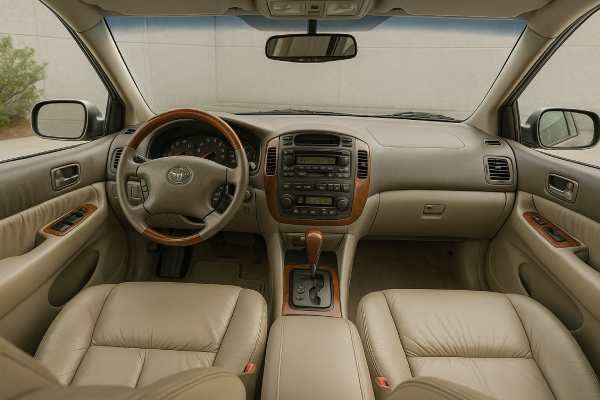
Inside, the facelift years brought incremental improvements in materials and ergonomics rather than radical redesigns. The simple analogue gauges, large HVAC knobs and straightforward audio controls age well and are easy to use with gloves. The second-row captain’s chairs on many LE and XLE vans are removable, and the third-row bench folds and can be taken out for larger loads, though it is not the “fold-into-floor” style of later generations.
From an ownership point of view, the facelift FWD XL10 strikes a useful balance: it offers better performance and safety equipment than earlier first-generation Siennas, while still retaining relatively simple mechanicals, a conventional four-speed automatic and minimal electronics compared with later vans. That simplicity, plus Toyota’s parts support, helps keep long-term running costs manageable as long as key maintenance items have been handled correctly.
Sienna FWD XL10 specs sheet
The tables below summarise key technical data for the facelifted FWD Toyota Sienna XL10 with the 1MZ-FE VVT-i 3.0-litre V6. Exact numbers can vary slightly by trim, model year and market, but these are representative figures for 2001–2003 North American models.
Engine and performance
| Item | Specification |
|---|---|
| Engine code | 1MZ-FE (VVT-i) |
| Type | 60° V6, DOHC, 24 valves |
| Displacement | 3.0 l (2,994 cc) |
| Bore x stroke | 87.5 mm × 83.0 mm (3.44 in × 3.27 in) |
| Compression ratio | About 10.5 : 1 |
| Induction | Naturally aspirated, multi-port fuel injection |
| Max power | ~210 hp (156 kW) @ 5,800 rpm |
| Max torque | ~220 lb-ft (298 Nm) @ 4,400 rpm |
| Timing drive | Toothed belt (interference-risk if neglected) |
| Recommended fuel | Regular unleaded petrol (87 AKI in US) |
| Emissions rating (US) | LEV / ULEV depending on market |
| Official economy (US EPA) | Approx. 19 mpg city / 24 mpg highway |
| Typical real-world mixed | Roughly 18–20 mpg US (11–13 l/100 km) |
Transmission and driveline
| Item | Specification |
|---|---|
| Transmission | 4-speed automatic, electronically controlled |
| Common gearbox code | U140E (FWD) |
| Drive type | Front-wheel drive |
| Final drive ratio | ~3.74 : 1 (varies slightly by trim/year) |
| 1st / 2nd / 3rd / 4th | ~2.81 / 1.52 / 1.00 / 0.70 |
| Reverse | ~2.30 |
| Differential | Open front differential |
| Towing capacity (braked) | Around 1,587 kg (3,500 lb) with tow package |
Chassis, suspension and brakes
| Item | Specification |
|---|---|
| Front suspension | MacPherson strut, coil springs, anti-roll bar |
| Rear suspension | Torsion-beam axle, coil springs, anti-roll bar |
| Steering | Rack-and-pinion with hydraulic power assist |
| Turning circle | ~12.2 m (40 ft) curb-to-curb |
| Front brakes | Ventilated discs |
| Rear brakes | Drums (disc upgrades available in some markets) |
| Wheels | 15 × 6.5 in steel (alloy optional) |
| Tyres | 205/70 R15 all-season (OEM size) |
Dimensions and weights
| Item | Specification |
|---|---|
| Overall length | ~4,930 mm (194.2 in) |
| Overall width | ~1,865 mm (73.4 in) |
| Overall height | ~1,700 mm (67.3 in) |
| Wheelbase | ~2,900 mm (114.2 in) |
| Ground clearance | ~150 mm (5.9 in) |
| Curb weight (typical) | ~1,775–1,780 kg (3,900–3,950 lb) |
| GVWR | ~2,380 kg (5,247 lb) |
| Seats | 7 (2 + 2 + 3) on most trims |
| Fuel tank capacity | ~79 l (20.9 US gal) |
| Cargo behind 3rd row | ~753 l (~26.6 ft³) |
Performance
| Metric | Approximate value (FWD, 1MZ-FE VVT-i) |
|---|---|
| 0–60 mph (0–97 km/h) | About 9.0–9.5 s |
| 0–100 km/h | About 9.5–10.0 s |
| Top speed (governed) | Around 180 km/h (112 mph) |
| 80–120 km/h passing | Adequate, ~7–8 s in 3rd gear |
| Max tow rating | ~1,587 kg (3,500 lb) with proper equipment |
| Typical payload | ~600 kg (about 1,300 lb) including occupants |
Fluids and service capacities (typical)
Always verify for your exact VIN and market.
| System | Spec / Fluid | Approx. capacity |
|---|---|---|
| Engine oil | API SL or better, 5W-30 | ~4.7 l (5.0 US qt) with filter |
| Engine coolant | Toyota long-life coolant, ~50/50 mix | ~8–9 l (8.5–9.5 US qt) |
| Automatic transmission | Toyota Type T-IV ATF (or approved equivalent) | ~7–8 l (7–8.5 US qt) for full drain/refill |
| Power steering | ATF-type fluid | ~1 l (~1 US qt) |
| Brake system | DOT 3 or DOT 4 | ~0.7–0.9 l |
| A/C refrigerant | R-134a | ~0.65–0.75 kg |
| Spark plugs | Long-life platinum/iridium, gap ~1.1 mm | 6 plugs |
Key torque values (typical reference only)
| Fastener | Torque |
|---|---|
| Wheel nuts | ~103 Nm (76 lb-ft) |
| Engine oil drain plug | ~39 Nm (29 lb-ft) |
| Spark plugs | ~18–22 Nm (13–16 lb-ft) |
| Front wheel lug nuts (if alloys) | Same as above; retighten after 50–100 km |
Facelift trims equipment and safety
During the facelift years, the FWD XL10 Sienna was sold primarily in three trim levels: CE, LE and XLE. All use the same basic drivetrain, but comfort and safety equipment, wheel options and interior features vary meaningfully by trim and year.
Trim and option overview
- CE
The entry model, often used as a fleet or budget family van. Typically includes manual sliding doors, cloth seats, basic audio, steel wheels, and fewer convenience features. Air conditioning and cruise control may be optional depending on region. Some very early facelift CEs lack certain power accessories buyers expect today, such as power rear windows. - LE
The volume model and often the sweet spot. LE usually adds power windows and locks, better seat fabrics, upgraded audio, and more interior storage features. Many LE vans have dual sliding doors, with the right-hand door powered on better-equipped examples. Roof rails, captain’s chairs in the second row and privacy glass are common. - XLE
The top trim for most markets. XLE typically brings alloy wheels, automatic climate control (or at least more advanced HVAC controls), premium audio (often JBL-branded), available leather seats, power sliding doors (sometimes both sides), and a power driver’s seat. Cosmetic touches include more body-colour trim and additional interior wood-tone accents.
Year-to-year changes within the facelift run are subtle. Certain option packages, such as rear entertainment, premium audio with more speakers, or a “Symphony” or similar package with luxury touches, were offered in specific years and usually on LE and XLE trims.
Recognising facelift and trim at a glance
- Facelift cues: reshaped headlamps and grille, revised front bumper and tail lamps compared with 1998–2000 models.
- CE vs LE/XLE: CE vans often show black exterior trim and steel wheels; LE/XLE usually have body-colour trim and alloys. XLE often has more chrome accents and a more upscale interior (wood-tone panels, sometimes leather).
- The build label in the driver’s door jamb and the VIN decode can confirm model year and trim; an experienced dealer or parts department can pull exact spec from the VIN.
Safety equipment and ratings
For its time, the first-generation Sienna tested very well in crash tests. The facelifted models retain the same basic structure and safety cage, and in many markets all years from 1998–2003 share the same good results in the IIHS moderate overlap frontal test, with strong ratings for occupant protection.
Standard safety equipment typically includes:
- Dual front airbags.
- Front seatbelt pretensioners and force limiters.
- Anti-lock braking system (ABS).
- Child-seat anchor points in the second row and sometimes third row.
- Daytime running lights in many markets.
Important options for safety:
- Front seat-mounted side torso airbags: optional on many LE and XLE vans; valuable for side impact protection.
- Vehicle Stability Control (VSC): became available on higher trims in the facelift years. This is especially worthwhile if you drive in poor weather or with a full load.
- Traction control: often bundled with ABS and VSC in option groups.
There is no camera-based advanced driver assistance (no automated emergency braking, adaptive cruise or lane-keeping) on this generation. The most advanced electronic aid is stability control, plus basic traction control and ABS.
When evaluating a used Sienna, confirm which safety options the van actually has. Side airbags and VSC can significantly change the vehicle’s safety profile, particularly in side impacts or on slippery roads.
Reliability issues on facelift Sienna
The facelift FWD XL10 Sienna has a strong reputation for longevity, but it is now a 20-plus-year-old vehicle. Condition, maintenance history and climate matter more than any single model-year reputation. Below is a practical map of common issues, grouped by system.
Engine (1MZ-FE VVT-i)
- Oil sludge and oil consumption
Early 1MZ-FE engines became known for sludge formation when oil changes were neglected or cheap oil was used. The facelift VVT-i version is somewhat better, but risk remains if service intervals were long. Symptoms include burnt-oil smell, dark oil soon after changes, and noisy lifters. Remedy is frequent oil changes with quality oil, PCV system checks and, in severe cases, professional engine cleaning or replacement. - Timing belt and water pump
The V6 uses a timing belt, with a typical recommended change interval of about 90,000 miles (145,000 km) or 7 years. Many owners replace the water pump, idlers and tensioner at the same time. A neglected belt can fail and risk serious engine damage. - Valve cover and cam seal leaks
Oil leaks around the upper engine are common as seals age. They usually start as sweaty, dirty areas before progressing to visible drips on the exhaust, sometimes causing smells. Repair means replacing valve cover gaskets and, if needed, cam seals. - Ignition components
Individual coil-on-plug units and spark plugs eventually fail, especially if plugs were not changed on schedule. Misfires under load, rough idle and check-engine lights (often P030x codes) are typical. Correct diagnosis and replacement with quality components are key.
Transmission and driveline
- 4-speed automatic (U140E)
Generally robust if fluid has been changed periodically. Long neglect can lead to harsh shifts, flare between gears or delayed engagement when selecting Drive or Reverse. In early stages, a fluid drain and refill plus shift-solenoid cleaning or replacement can help; severe wear may need a rebuild. - Driveshafts and CV joints
Typical wear items on higher-mileage vans. Clicking on full lock turns or noticeable vibration under load point to worn CV joints.
Steering, suspension and brakes
- Power steering rack leaks
Many older Siennas show damp or actively leaking steering racks, particularly where the lines enter the rack. Symptoms include a growing need to top up fluid, wet subframe areas and eventually heavier steering. Minor leaks can be monitored; heavy leaks usually require rack replacement. - Struts, shocks and bushings
Original dampers are long past their best by now. Bouncy or floaty ride, nose-dive under braking and uneven tyre wear are clues. Front lower control-arm bushings and stabiliser bar links also wear, causing clunks over bumps and vague steering. - Brake wear and corrosion
Front discs handle most of the braking and may warp or rust if the vehicle sits unused. Rear drums can accumulate dust and corrosion, leading to noise or reduced parking brake effectiveness. Regular inspections and cleaning are important, especially in rust-belt climates.
Body, corrosion and sliding doors
- Rust hotspots
In regions that use road salt, pay close attention to: rear wheel arches, lower edges of the tailgate, the front subframe and suspension mounting points. Surface rust is manageable; structural corrosion can be a deal-breaker. - Sliding door mechanisms
Both manual and power doors can suffer from worn rollers, cables and latches. Symptoms include heavy doors, grinding noises or doors that will not latch properly. Parts are still widely available, but repairs can be labour-intensive.
Electrical and interior
- Age-related issues include failing window regulators, sticking door-lock actuators, intermittent instrument-panel illumination and worn HVAC control knobs. These are usually annoyances rather than major failures, but they are worth checking before purchase.
Recalls and service campaigns
First-generation Siennas had various recalls over issues such as sliding door latches, fuel system components and, like many vehicles of the era, airbag-related campaigns. The safest approach is to run the VIN through your region’s official recall checker and ask a Toyota dealer to confirm completion.
Overall, when maintained properly, it is common to see facelift XL10 Siennas surpass 200,000 miles (320,000 km) with original major components. The main risk comes from deferred maintenance, hidden rust and poor oil-change history.
Maintenance and buyer guide tips
A thoughtful maintenance plan and a disciplined pre-purchase inspection will determine whether your facelift Sienna is a dependable workhorse or an ongoing project. The guidance below assumes average mixed use and can be adapted for heavy towing, extreme climates or mostly city driving.
Core maintenance schedule (typical, always verify against your manual)
- Engine oil and filter: every 5,000 miles / 8,000 km or 6 months. Shorter intervals are wise if most trips are short or in very hot or cold climates.
- Engine air filter: inspect annually, replace every 30,000 miles / 50,000 km or sooner in dusty conditions.
- Cabin air filter (if fitted): replace every 15,000–20,000 miles / 24,000–32,000 km or 1–2 years.
- Spark plugs: long-life plugs typically every 60,000–90,000 miles (100,000–145,000 km). Inspect earlier if misfires occur.
- Coolant: long-life coolant usually first change at around 100,000 miles / 160,000 km or 8–10 years, then every 50,000 miles / 80,000 km or 5 years. Many owners choose more conservative intervals on older vehicles.
- Automatic transmission fluid: drain and refill every 30,000–60,000 miles (50,000–100,000 km); shorter intervals are cheap insurance.
- Brake fluid: every 2–3 years regardless of mileage. Moisture absorption is time-based.
- Brake pads and rotors: inspect at least annually. Replace pads when 3 mm or less friction material remains; measure rotor thickness and runout.
- Power steering fluid: inspect yearly; flush every 60,000–90,000 miles (100,000–145,000 km) or when dark/contaminated.
- Timing belt and water pump: typically every 90,000 miles / 145,000 km or 7 years. Many technicians replace the water pump, tensioner, idlers and front oil seals during the same job.
- Serpentine / accessory belt and hoses: inspect every oil change; typically replace belts around 90,000 miles or at the first sign of cracking or glazing; hoses as they harden or swell.
- Tyre rotation and alignment: rotate every 5,000–7,500 miles (8,000–12,000 km); check alignment annually or after impacts or tyre wear issues.
- Wheel bearings, suspension and steering: visual and physical inspection at least every 2 years or 30,000 miles.
- 12 V battery: test annually after year 4–5; many last 5–7 years in moderate climates.
Fluids and specs to keep in mind
- Engine oil: 5W-30 meeting Toyota’s specifications for gasoline engines of the era. Some owners in hot climates move to 10W-30; follow local guidance.
- Coolant: Toyota red/pink long-life or super long-life coolant, not generic green unless fully flushed and refilled to one system type.
- ATF: Toyota Type T-IV or an approved equivalent; avoid mixing with later WS fluids unless specifically permitted.
Buyer’s inspection checklist
When buying a facelift FWD XL10 Sienna, try to work through the following list:
- Service history
- Look for proof of regular oil changes, at least every 5,000–7,500 miles.
- Confirm timing belt and water pump replacement, ideally with invoices.
- Check for documented transmission fluid service.
- Engine condition
- Cold start: listen for knocking, rattles or excessive lifter noise.
- Watch for blue smoke on start-up or acceleration (oil consumption).
- Check for oil leaks at valve covers, timing covers and oil pan.
- Cooling system
- Look for crusty deposits around the radiator, water pump or hose joints.
- Confirm that the engine reaches and holds normal temperature and that the heater works well.
- Transmission and driveline
- Gear changes should be smooth with minimal flare.
- No clunks when shifting between Drive and Reverse.
- Check for vibrations under load that might indicate worn CV joints.
- Steering, suspension and brakes
- Test drive over varied surfaces: listen for clunks, rattles or squeaks.
- Check that the vehicle tracks straight, with steering wheel centred.
- Inspect tyres for uneven wear suggesting alignment or suspension issues.
- Body and rust
- Inspect wheel arches, door bottoms, tailgate lower edge, and underbody subframes.
- Check sliding door tracks, step areas and jack points for corrosion.
- Interior and electrics
- Test all power windows, locks, mirrors, seat adjustments and HVAC controls.
- Verify operation of both sliding doors (especially power doors) and the rear hatch.
Recommended trims and years
If you are focused on safety and value, many shoppers aim for:
- LE or XLE facelift models with documented maintenance, side airbags and stability control where available.
- Rust-free examples from dry or mild climates, even if mileage is higher.
- Vans with recent timing belt/water pump service and fresh tyres and brakes; these items can quickly add up.
Avoid heavily neglected vans with missing service history, severe rust, or signs of transmission abuse (burnt ATF, strong jolts, slipping under load), as restoring them can easily exceed the value of the vehicle.
Driving feel and performance
On the road, the facelift FWD XL10 Sienna feels exactly like what it is: a Camry-based minivan tuned for comfort rather than sport. That is good news for most families. The 3.0-litre 1MZ-FE VVT-i V6 is smooth and quiet at idle, with a gentle growl when pushed. Torque arrives early enough that the van moves off smartly from a stop, even with several passengers on board.
The four-speed automatic shifts calmly and unobtrusively in normal driving, with a soft, almost lazy character. It will kick down promptly enough for overtakes, but manual selection of “3” on long grades can help keep the gearbox out of repeated up- and down-shifts. Compared with later five- or six-speed automatics, the gearing is longer and there are fewer ratios, but for typical suburban and highway speeds the setup is entirely adequate.
Ride quality is soft and compliant. The Sienna absorbs potholes and expansion joints well, though on worn shocks older vans can feel floaty or wallowy. The compact footprint and light steering effort make manoeuvring easy, and the turning circle is tight for a seven-seat van, which helps in tight car parks and driveways. Straight-line stability at motorway speeds is generally good, especially on fresh suspension components and quality tyres.
In corners, the XL10 Sienna leans more than a modern crossover, but grip is predictable and the chassis telegraphs its limits clearly. On wet or snowy surfaces, the combination of front-wheel drive and good all-season tyres provides secure traction; vans equipped with stability control offer an extra safety margin when drivers are surprised by sudden manoeuvres or changing conditions. Braking performance is reasonable, though front brake components are not oversized, so heavy mountain use or frequent towing may benefit from upgraded pads and careful cooling management.
Real-world fuel economy
Owners typically report:
- City driving: roughly 13–15 l/100 km (16–18 mpg US) in stop-start conditions.
- Highway at 100–120 km/h (60–75 mph): commonly around 9–10 l/100 km (23–26 mpg US) with a light load.
- Mixed use: many vans land in the 11–12 l/100 km (19–21 mpg US) range.
Driving style, climate, tyre choice and load have noticeable effects. Short, cold journeys with heavy idling can push consumption higher. Towing or carrying full loads typically increases fuel use by 20–40 percent compared with solo highway cruising.
Towing and load behaviour
When kept within its rated limits and properly equipped with a transmission cooler and correct hitch, the Sienna can tow up to around 1,587 kg (3,500 lb). Stability is generally good thanks to the long wheelbase, but braking distances increase and the transmission works harder, especially on grades. Downshifting early and keeping speeds moderate preserves mechanicals and improves control. For most owners, the Sienna is more of an occasional tow vehicle than a heavy-duty hauler, but it handles normal family trailers and small campers well.
Sienna XL10 rivals comparison
When new, the facelift FWD XL10 Sienna competed against a strong field of minivans: the second-generation Honda Odyssey, Chrysler Town & Country and Dodge Grand Caravan, Ford Windstar and early Kia Sedona models. On today’s used market, those same vans (and early second-generation Sienna XL20 models) form the realistic alternatives.
Versus Honda Odyssey (1999–2004)
- Strengths of Sienna
- Generally simpler and often more reliable automatic transmission than early Odyssey gearboxes, which became known for failures in some years.
- Smoother, quieter ride with a softer character that many families appreciate.
- Easier packaging for tight urban spaces thanks to slightly smaller footprint.
- Advantages of Odyssey
- More powerful V6 in many trims and slightly sharper handling.
- Very flexible interior with fold-flat rear seats and strong third-row room.
For buyers who prioritise trouble-free ownership over maximum space and power, a well-maintained facelift XL10 Sienna can be a safer long-term bet than some early Odysseys.
Versus Chrysler Town & Country / Dodge Grand Caravan (around 2001–2003)
- Strengths of Sienna
- Strong record for long-term powertrain reliability when serviced correctly.
- Better corrosion resistance in many markets.
- Simpler electrical systems with fewer odd intermittent faults.
- Advantages of Chrysler vans
- Often lower purchase prices and abundant parts in North America.
- More configuration options and sometimes richer feature sets (power tailgates, more entertainment options).
Shoppers who value a low buy-in cost and are comfortable wrenching may look at Chrysler vans; those who want low-drama daily use often gravitate to the Sienna.
Versus Ford Windstar / early Freestar
- The Sienna usually wins on engine and transmission durability, resale value and availability of quality aftermarket parts.
- Ford vans can be very cheap to buy but have a mixed record on transmissions, rust and certain suspension components.
Versus early Kia Sedona
- Early-2000s Sedonas offered good equipment for the price but generally lag behind the Sienna in long-term durability, interior material quality and corrosion resistance.
Versus second-generation Sienna (XL20, 2004 onwards)
- The later XL20 is larger, more powerful, and more flexible inside, with improved crash performance and available all-wheel drive.
- The facelift XL10 is smaller, lighter and simpler, which some owners prefer, and it can be cheaper to buy.
If you need maximum space, power sliding doors on both sides, and the most modern safety for a family road-trip machine, a second-generation Sienna may be worth the extra money. If you want a compact, straightforward minivan that is easy to maintain and park, and you find a rust-free facelift XL10 FWD Sienna with excellent history, it can still be a very sensible choice today.
References
- 2003 Sienna – Owners’s Manual 2003 (Owner’s Manual)
- 2003 Toyota Sienna Specs and Features 2025 (Specifications)
- Toyota 1MZ-FE 3.0L Engine Specs, Problems, Reliability, Oil, Info 2021 (Engine Technical Data)
- Toyota Sienna – Wikipedia 2024 (Model Overview)
- The Trendsetting Sienna: Celebrating 25 Years of Toyota’s Game-Changing Van 2022 (History and Background)
Disclaimer
This article is for informational purposes only and is not a substitute for professional diagnosis, repair or safety advice. Specifications, torque values, service intervals and procedures can vary by VIN, model year, market, equipment level and running production changes. Always confirm all data and procedures against the official service manual, technical bulletins and parts information for your specific vehicle, and consult a qualified technician where appropriate.
If you found this guide useful, you are welcome to share it with other owners and enthusiasts on platforms such as Facebook or X/Twitter to support xcar’s work and help more people make informed decisions about their Toyota Sienna.