
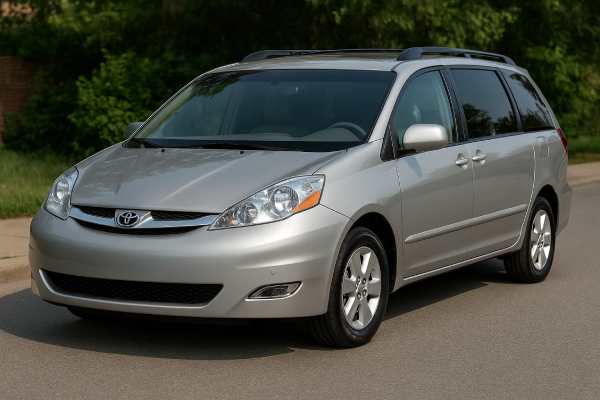
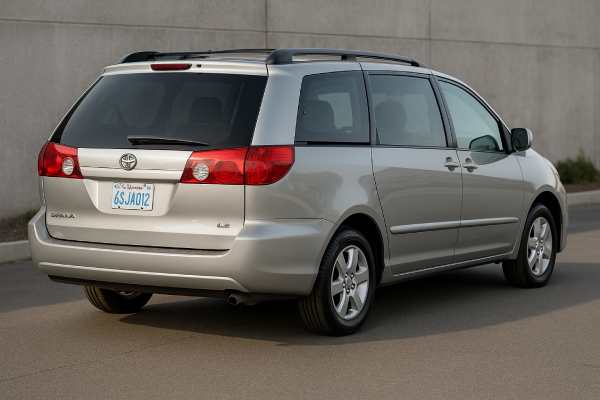
The facelifted second-generation Toyota Sienna (XL20) with the 3.5 litre 2GR-FE V6 is often seen as the “sweet spot” of this minivan’s life cycle. From the 2007 model year onward, the Sienna FWD combined a strong, chain-driven 266 hp V6 with a smooth 5-speed automatic, giving it noticeably better performance than the earlier 3.3 litre engine while keeping the calm ride and quiet cabin that owners expect. The facelift years (2006–2010) also brought updated styling, improved interior trim and a broader spread of safety equipment, including available or standard stability control and full-length side curtain airbags in many markets.
For family buyers and shuttle operators, this generation stands out for long-distance comfort, flexible seating for seven or eight passengers and a reputation for high-mileage durability. At the same time, there are a few well-known issues—such as the VVT-i oil line update and sliding door wear—that are important to understand if you plan to buy or keep one for the long term.
Owner Snapshot
- Strong 266 hp 3.5 litre V6 and 5-speed automatic give confident acceleration even with a full load.
- Spacious, flexible cabin with folding third row and removable/adjustable second row suits family, shuttle, or mobility use.
- Watch for VVT-i oil line updates, spare tyre cable corrosion and aging power sliding door hardware on high-mileage vans.
- Typical service interval: engine oil and filter every 5,000–7,500 miles (8,000–12,000 km) or 6–12 months, depending on use and oil type.
Navigate this guide
- Toyota Sienna XL20 FWD overview
- Sienna XL20 engine and specs
- Facelift trims, equipment and safety
- Reliability of the 2GR-FE Sienna
- Maintenance and used-buying guidance
- Driving experience and real-world economy
- Sienna XL20 versus rival vans
Toyota Sienna XL20 FWD overview
The XL20 Sienna is the second generation of Toyota’s North American minivan, built for the 2004–2010 model years. The facelift from 2006 onward introduced revised front and rear styling, updated lighting, and a mild refresh of the interior materials and options. From 2007, the major mechanical change arrived: the earlier 3.3 litre V6 was replaced by the 3.5 litre 2GR-FE engine, rated at 266 hp and paired with a 5-speed automatic. This article focuses on those facelift front-wheel-drive (FWD) 3.5 litre models, roughly 2007–2010.
In layout, the Sienna is a classic long-wheelbase family van: three rows of seats, a tall roof, twin sliding rear doors and a large tailgate. The FWD version uses a conventional layout with a transverse V6 and a simple front-drive transmission, which is lighter and mechanically simpler than the all-wheel-drive (AWD) variant. Many owners deliberately choose FWD to avoid run-flat tyres and extra driveline complexity associated with AWD versions.
Interior packaging is one of the Sienna’s strengths. The long 3,030 mm (119.3 in) wheelbase and boxy body create generous legroom in all three rows. Second-row seats slide fore and aft and can be removed on many trims, while the “Split & Stow” third row folds into a rear floor well to form a flat load area. With the third row stowed and second row out or tumbled forward, the Sienna can swallow bulky furniture, building materials or several large suitcases with ease.
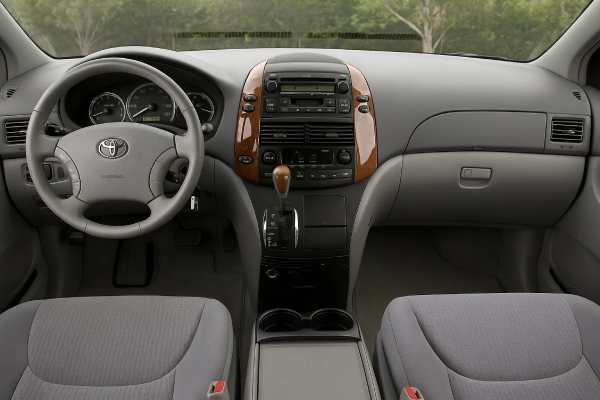
The facelifted cabin design is conservative but easy to live with. Controls are grouped high on the centre stack, and visibility is generally excellent thanks to large windows and well-placed mirrors. Higher trims add touches like leather upholstery, power sliding doors, power tailgate and upgraded audio or rear entertainment systems, which broaden the Sienna’s appeal to both families and airport shuttle services.
From a safety and usability perspective, key advantages of these facelift FWD models include available stability control, multiple airbags, strong crash structure and long-term parts availability. The main compromises are a soft, somewhat floaty handling character, dated infotainment by modern standards and the need to check for age-related wear on doors, suspension and corrosion-prone areas under the body.
Sienna XL20 engine and specs
This section summarises the key technical data for the facelift Sienna FWD with the 3.5 litre 2GR-FE V6 and 5-speed automatic transmission, using typical figures for the 2007–2010 model years. Small variations exist between markets and trims, so always verify against your vehicle’s documentation.
Engine and performance (2GR-FE)
| Item | Specification |
|---|---|
| Engine code | 2GR-FE |
| Configuration | 60° V6, aluminium block and heads |
| Valvetrain | DOHC, 24 valves, dual VVT-i (intake and exhaust) |
| Displacement | 3.5 L (3,456 cc) |
| Bore × stroke | 94.0 mm × 83.0 mm (3.70 × 3.27 in) |
| Compression ratio | Approx. 10.8:1 |
| Induction | Naturally aspirated |
| Fuel system | Sequential multi-port fuel injection |
| Maximum power | 266 hp (about 198 kW) @ ~6,200 rpm |
| Maximum torque | 245 lb-ft (about 332 Nm) @ ~4,700 rpm |
| Timing drive | Chain (no timing belt) |
| Recommended fuel | Regular unleaded (often 87 AKI in North America) |
The 2GR-FE is known for smooth, strong power delivery. Dual VVT-i lets the engine pull cleanly from low revs without feeling sluggish, yet it is happy to rev high when merging or overtaking. The chain-driven cams avoid routine timing belt replacements, which is attractive for long-term owners, although the chain and tensioners still require healthy oil supply and quality lubrication.
Transmission and driveline
| Item | Specification |
|---|---|
| Transmission | U151E 5-speed automatic with lock-up torque converter |
| Drive type | Front-wheel drive |
| 1st gear | Approx. 4.24:1 |
| 2nd gear | Approx. 2.36:1 |
| 3rd gear | Approx. 1.52:1 |
| 4th gear | Approx. 1.05:1 |
| 5th gear | Approx. 0.76:1 |
| Reverse | Approx. 3.38:1 |
| Final drive ratio | Around 3.08:1 |
| Differential | Open front differential |
In everyday driving, this gearbox favours smooth, early upshifts and keeps engine speeds low for refinement. It is not a fast-shifting performance transmission, but it is generally durable when fluid is kept in good condition.
Chassis and dimensions
Values below represent a typical FWD 3.5 litre Sienna of this generation; expect small variations by trim and equipment.
| Item | Specification |
|---|---|
| Front suspension | MacPherson struts, coil springs, anti-roll bar |
| Rear suspension | Torsion beam axle, coil springs, gas dampers |
| Steering | Power-assisted rack-and-pinion |
| Front brakes | Ventilated discs with ABS, EBD and Brake Assist |
| Rear brakes | Solid discs |
| Typical wheels/tyres | 16 × 6.5 in wheels, 215/65 R16 all-season tyres (higher trims may use 17 in alloys) |
| Overall length | Around 5,105 mm (201.0 in) |
| Width | Around 1,965 mm (77.4 in) |
| Height | Around 1,750 mm (68.9 in) |
| Wheelbase | 3,030 mm (119.3 in) |
| Ground clearance | Roughly 175 mm (6.9 in) |
| Turning circle | Around 11.2 m (36.7–36.8 ft) kerb-to-kerb |
| Curb weight | Approx. 1,880–1,900 kg (4,140–4,190 lb) depending on trim |
| GVWR | Around 2,580 kg (about 5,700 lb) |
| Fuel tank | About 79 L (21.0 US gal, 17.3 UK gal) |
| Cargo volume | Roughly 1.2 m³ behind 3rd row, around 2.7 m³ behind 2nd row, and over 4.2 m³ with rear rows folded or removed |
Performance and capability
| Item | Specification (typical FWD 3.5) |
|---|---|
| 0–60 mph | Around 7.5–8.0 seconds |
| 0–100 km/h | Around 8.0–8.5 seconds |
| Top speed | Electronically limited, roughly 180–185 km/h (112–115 mph) |
| Braked towing capacity | Typically 1,587 kg (3,500 lb) with tow package |
| Payload | Often around 640–650 kg (1,400–1,430 lb) |
| Roof load rating | Commonly around 75 kg (165 lb) – confirm per market |
Fluids and key service data (typical)
Always confirm capacities and torque values for your specific VIN and market. Typical guidance:
- Engine oil: roughly 6.1 L (about 6.4 US qt) with filter. Many markets specify 5W-30 or 0W-20 meeting current API standards.
- Coolant: long-life ethylene glycol coolant; total capacity around 9–10 L.
- Automatic transmission fluid: Toyota WS ATF; service drain-and-fill around 3–4 L.
- Brake fluid: DOT3 or DOT4, replaced on time rather than mileage alone.
- Wheel nuts: typically about 100–110 Nm (75–80 lb-ft).
Electrical basics include an alternator in the ~130 A range, a 12 V battery of roughly 55–70 Ah depending on market and equipment, and long-life iridium spark plugs gapped around 1.1 mm.
Facelift trims, equipment and safety
Trims and options overview
Trim naming varies by region, but in North America the facelift Sienna FWD usually came in these main grades:
- CE – Entry model, typically with fabric seats, simpler audio, manual sliding doors and basic wheel trims.
- LE – Popular mid-grade with more power features, upgraded audio, optional power sliding doors and an available 8-seat layout.
- XLE – Comfort-focused trim with more upscale interior materials, power sliding doors, optional power tailgate and additional convenience features.
- XLE Limited – Top specification with leather upholstery, sunroof, premium audio, more chrome trim and the fullest equipment list.
Mechanical hardware is largely shared across trims in FWD 3.5 litre form: same engine, same 5-speed automatic and broadly similar suspension and brake setups. Differences are mainly in wheel size, tyre type and optional tow or suspension packages rather than fundamental changes to the chassis.
Visually, lower trims often have steel wheels with covers and more basic interior fabrics, while XLE and Limited models add alloy wheels, leather, faux wood trim, more detailed gauge clusters and extra steering-wheel controls. Some markets also offered specific packages for towing, rear entertainment, navigation or convenience, so a used Sienna’s actual features can vary widely even within the same trim name.
Safety equipment and ratings
By the facelift years, the Sienna’s safety specification was strong for its class. Key standard or commonly available items include:
- Dual-stage front airbags.
- Front seat-mounted side airbags.
- Full-length curtain airbags covering all three rows.
- Three-point belts for all seating positions, with front pretensioners and force limiters.
- LATCH/ISOFIX points in second-row seating positions and tether anchors for appropriate seats.
- Anti-lock brakes (ABS) with electronic brake-force distribution (EBD) and Brake Assist.
Stability control availability varies by year and market. Early facelift years sometimes offered Vehicle Stability Control (VSC) and traction control as optional equipment on some trims. Later model years more often made VSC standard, especially in markets where regulation pushed electronic stability control uptake. When shopping used, it is worth confirming that the specific van you are considering has VSC and that the system is free of warning lights.
Independent crash testing from major organisations has generally rated the Sienna highly for frontal and side impact protection when equipped with side and curtain airbags. Where it tends to lag more modern designs is in head restraint and seat performance for whiplash, reflecting the era’s seat design rather than major structural weakness. Overall, for a mid-2000s minivan, passive safety is a strong point.
ADAS and driver assistance
These facelift Siennas pre-date the now-familiar advanced driver assistance suites. You will not find factory lane keeping assist, autonomous emergency braking or radar-based adaptive cruise on this generation. Safety technology is focused on:
- ABS, EBD and Brake Assist.
- Vehicle Stability Control and traction control.
- Tyre pressure monitoring system (TPMS) in many later facelift years.
- Optional parking sensors and rear-view camera on certain trims and packages.
Because electronic driver aids are relatively simple by modern standards, calibration after repairs is usually confined to basic steering angle sensor resets or alignment checks rather than complex radar or camera procedures. However, if you retrofit aftermarket cameras or sensors, they should be installed with care to avoid interfering with existing wiring and systems.
For family buyers, the safety “must-haves” on a used facelift Sienna FWD are side and curtain airbags, stability control and a properly installed child seat solution that works with the LATCH/ISOFIX and belt layouts. Many owners also value a factory or aftermarket reverse camera for easier manoeuvring in tight spaces.
Reliability of the 2GR-FE Sienna
The Sienna with the 2GR-FE V6 has a very good reputation for longevity, but like any aging vehicle it has specific weak points. Understanding them helps you budget and prioritise preventative work.
Engine and ancillaries
1. VVT-i oil supply hose (on earlier engines)
Early versions of the 2GR-FE used a rubber-section oil hose to feed the VVT-i system. With age and heat, that rubber segment can degrade and leak. In the worst case, a sudden rupture can dump a large amount of engine oil, risking serious damage if the engine continues running with low oil pressure.
Most affected Siennas should, by now, have had this hose replaced with an all-metal pipe as part of service campaigns or preventative maintenance. On any used example, especially from the earlier facelift years, ask for documentation or have a knowledgeable technician visually confirm that a metal line is fitted. If not, replacement should be treated as urgent.
2. Water pump seepage
Coolant seepage from the water pump is a fairly common age-related issue. Symptoms include dried coolant traces near the pump, a slowly dropping coolant level or light squeaking noises from the front of the engine. Replacing the pump is straightforward but can be combined with a new serpentine belt and tensioner to make the most of labour spent in that area.
3. Oil leaks and gasket aging
Typical long-term aging points include valve cover gaskets and timing cover sealant. Minor dampness is common and may not justify immediate repair, but leaks that drip onto exhaust components or drive belts should be addressed. A pre-purchase inspection should include a careful look from underneath for fresh leaks.
4. General engine durability
With regular oil changes using correct-specification oil, many 2GR-FE engines run well past 200,000 miles (over 320,000 km) without internal overhaul. Because the engine uses port fuel injection, heavy intake valve carbon buildup is less of a concern than on many later direct-injection engines.
Transmission and driveline
The U151E 5-speed automatic is considered a robust unit, especially compared with some rival minivans’ gearboxes from the same era. Common patterns include:
- Rough or delayed shifts on vans that have gone a long time without fluid changes.
- Occasional solenoid-related shift issues at high mileage.
- Harsh engagement when shifting into Drive or Reverse if engine mounts or internal components are worn.
Toyota often described the transmission fluid as “lifetime,” but in practice, periodic drain-and-fill changes are wise, particularly if the vehicle has towed regularly or seen heavy city use. Proactive fluid maintenance significantly improves the odds of a long, trouble-free transmission life.
Front driveshafts and CV joints can wear on high-mileage vans, especially if boots crack and allow in dirt and moisture. Wheel bearings are another common wear item, often revealed by a humming noise that increases with speed and changes slightly when cornering.
Sliding doors, tailgate and body
Minivan sliding doors are under heavy mechanical stress, and the Sienna is no exception.
- Power sliding door cables can fray or seize, especially in harsh climates or if they are never lubricated. Symptoms include grinding noises, jerky movement or doors stopping halfway. Replacing the cable and mechanism is not cheap but is a one-time fix when done properly.
- Door latches and rollers can wear, leading to rattles, difficulty latching or sagging doors. Many components are replaceable individually, so issues can often be resolved without replacing the entire door.
- Power tailgate mechanisms (where fitted) should be tested repeatedly on a potential purchase; slow, noisy or inconsistent operation may indicate impending motor or strut issues.
A particular rust concern relates to the spare tyre carrier cable on some Sienna FWD models in road-salt regions. Over time, the cable can corrode and weaken, potentially allowing the spare wheel to drop. There have been safety recalls addressing this risk, so it is important to check recall completion and to visually inspect the carrier for corrosion.
Beyond that, typical corrosion hotspots include underbody rails, rear subframe areas, exposed brake and fuel lines and the lower seams of doors and tailgate. In mild climates, rust is often limited, but in snow-belt regions, an inspection on a lift is essential.
Suspension, steering and brakes
As the vans age, expect to encounter:
- Worn front struts and mounts, causing knocking noises or a floaty, under-damped ride.
- Rear shock absorber wear and bush deterioration, often noticeable as extra wallow over bumps.
- Inner and outer tie rod end wear, leading to vague steering feel or clunking sounds over rough surfaces.
- Occasional steering rack seepage.
- ABS wheel-speed sensor faults from corrosion or wiring damage.
Most of these are moderate-cost repairs that are very common on older minivans. Because the Sienna is a heavy vehicle, quality replacement parts and good alignment are important in restoring proper ride and handling.
Recalls and service campaigns
Across its production run, the XL20 Sienna has been subject to several recalls and service campaigns, including but not limited to:
- Spare tyre carrier cable inspection and reinforcement or replacement in certain rust-belt markets.
- VVT-i oil hose replacement on affected 2GR-FE engines.
The exact campaigns vary by country and year, so the safest approach is to run the vehicle identification number (VIN) through the official Toyota or government recall website and to ask a dealer to print a campaign completion history where possible.
Pre-purchase reliability checklist
When evaluating a facelift Sienna FWD 3.5:
- Confirm the VVT-i oil line has been updated to the metal version.
- Check for recall completion, especially for the spare-tyre carrier in regions with road salt.
- Test all sliding doors and the tailgate, manually and via power switches, listening for grinding or stalls.
- Look underneath for rust on frame rails, subframes, brake lines and the spare-tyre carrier assembly.
- Drive at both city and highway speeds, paying attention to transmission shifts, bearing noise and straight-line tracking.
- Scan for warning lights (ABS, VSC, airbag, check engine) and have codes read before purchase if anything is lit.
Maintenance and used-buying guidance
Practical maintenance schedule
The factory maintenance schedule varies by year and market, but the following is a practical baseline for a facelift Sienna FWD 3.5 used in mixed conditions:
- Engine oil and filter
- Normal driving: every 7,500 miles (12,000 km) or 12 months.
- Severe service (short trips, city use, towing, extreme temperatures): every 5,000 miles (8,000 km) or 6 months.
- Engine air filter
- Inspect every 15,000 miles (24,000 km).
- Replace around 30,000 miles (48,000 km), or sooner in dusty conditions.
- Cabin air filter
- Replace every 15,000–20,000 miles (24,000–32,000 km) or annually.
- Spark plugs (iridium)
- Typical replacement interval around 120,000 miles (192,000 km).
- Coolant
- First change often around 100,000 miles (160,000 km) or 10 years for long-life coolant.
- Subsequent changes every 5 years or 50,000 miles (80,000 km).
- Automatic transmission fluid (WS ATF)
- Optional in some official schedules, but a sensible interval is every 50,000–60,000 miles (80,000–100,000 km) for drain-and-fill service.
- Brake fluid
- Replace every 2–3 years regardless of mileage.
- Brake pads and rotors
- Inspect at least annually, or more often if you tow or drive in hilly areas. Replace when pad thickness or rotor condition is out of specification.
- Power steering fluid
- Inspect annually, top up as needed; consider a partial exchange around 100,000 miles (160,000 km).
- Serpentine belt and tensioner
- Inspect at each service; replace typically between 90,000 and 120,000 miles (145,000–190,000 km) or when cracks or noise appear.
- Timing chain system
- No scheduled replacement, but listen for chain rattle at start-up and pay attention to any timing-related diagnostic codes. Repair if symptoms appear.
- Tyre rotation and alignment
- Rotate tyres every 5,000–7,500 miles (8,000–12,000 km).
- Check alignment when fitting new tyres, after significant pothole impacts, or if the vehicle pulls or wears tyres unevenly.
- 12 V battery
- Begin annual testing after about 4 years of service; many last 5–7 years depending on climate and usage.
Fluid specifications (summary)
Always follow the owner’s manual or service information for your exact vehicle, but typical specifications include:
- Engine oil: 5W-30 or 0W-20, meeting current API categories suitable for petrol engines.
- Coolant: genuine long-life Toyota coolant or equivalent phosphate-organic acid technology (P-OAT) coolant in the correct colour and concentration.
- Automatic transmission fluid: Toyota WS; avoid mixing with other ATF types.
- Brake fluid: DOT3 or DOT4.
- Power steering: suitable ATF-type fluid, as specified on cap/manual.
Correct fluids and change intervals are especially important for high-mileage vehicles, as they directly affect component life.
Buyer’s guide: inspection points
When considering a used facelift Sienna FWD 3.5, add these checks to your usual used-car inspection:
1. Paperwork and history
- Look for a consistent service history with reasonable intervals.
- Check for evidence of coolant and transmission fluid changes, not just engine oil.
- Confirm recall and service campaign completion.
2. Engine and drivetrain
- Start the engine from cold, listening for rattles or knocks at start-up and during warm-up.
- On the test drive, ensure the transmission shifts smoothly in all gears and under varying throttle.
- Verify that cruise control holds speed smoothly and that there is no vibration under acceleration that could indicate worn mounts or driveshafts.
3. Suspension and brakes
- Drive over mixed road surfaces, listening for clunks or rattles from front struts or rear suspension.
- Brake firmly from higher speed to check for steering wheel vibration (warped rotors) or pull to one side.
- With the vehicle parked, rock the steering wheel gently to feel for excessive play.
4. Body, interior and doors
- Inspect sliding door tracks, cables and seals; look for dents, rust or misalignment.
- Test power sliding doors and power tailgate (if fitted) multiple times using both key fob and interior switches.
- Lift carpets in the rear where possible to check for signs of water ingress.
- Inspect the spare tyre carrier and cable for corrosion and check that the spare can be raised and lowered safely.
Recommended years and trims
For most buyers, later facelift years bring the best balance of equipment, refinement and safety. In many markets, 2008–2010 models offer the combination of the 3.5 litre engine, standard stability control on more trims and incremental improvements in interior and electronics.
Trims such as LE and XLE often make the best long-term ownership propositions, combining key comfort and safety features without the highest purchase prices and repair costs of fully loaded models. Fleet, rental or hard-used commercial vans can be tempting on price but may require significant reconditioning, particularly in suspension, interior trim and door mechanisms.
Driving experience and real-world economy
Powertrain character
On the road, the 2GR-FE V6 is one of the Sienna’s standout characteristics. Even with a full complement of passengers and luggage, acceleration is brisk by minivan standards. Throttle response is smooth and predictable, with enough low-rpm torque to get moving smartly without needing to floor the pedal. When you do ask for more power, the engine revs willingly and delivers confident passing performance on highways.
The 5-speed automatic shifts unobtrusively in normal driving. Upshifts are early and smooth, keeping the engine near its torque band and avoiding unnecessary noise. Under heavier throttle, the transmission holds gears longer and will kick down decisively for overtaking. It is not as quick or clever as modern multi-speed automatics, but its behaviour is easy to understand and live with.
At highway speeds, the engine usually hums quietly at relatively low revs thanks to the overdrive top gear and tall final drive ratio. Engine noise is rarely the dominant sound; road and wind noise become more noticeable, especially on coarser surfaces or with older tyres.
Ride, handling and NVH
The Sienna’s suspension tuning prioritises comfort over agility, which suits its role as a family and shuttle vehicle.
- Ride comfort: The suspension smooths out small to medium bumps well. On very broken surfaces or with worn struts, the van can feel a bit floaty, but with fresh components it provides a composed, relaxed ride that passengers appreciate.
- Handling: There is noticeable body roll in faster corners, and the steering is light and fairly isolated. This is not a vehicle aimed at spirited driving; instead, it encourages a calm, measured style.
- Noise and vibration: Cabin isolation is good for the era. At urban speeds, the Sienna is quiet enough for easy conversation in all three rows. At motorway speeds, wind noise from the large mirrors and body can become more noticeable, but the overall refinement remains competitive with other minivans of its time.
Braking performance is adequate, and pedal feel is typically light but consistent. As with any heavy vehicle, the condition of tyres, pads, rotors and fluid has a major influence on braking confidence.
Traction, stability and winter behaviour
In dry and moderately wet conditions, FWD traction is usually sufficient even with the torquey V6. The stability control system monitors wheel-speed and yaw rate to help keep the vehicle in line during abrupt manoeuvres, and traction control limits wheelspin on slippery surfaces.
In snow and ice, the main limiting factor is tyre choice. With quality winter or all-weather tyres, FWD Siennas can cope well with typical winter conditions. AWD versions provide extra margin for deep snow or steep, slippery grades, but they add complexity and, in some cases, require run-flat tyres. For many drivers, especially in milder climates, a FWD Sienna with good tyres and stability control offers an acceptable balance.
Real-world fuel economy
Actual fuel consumption depends heavily on driving style, climate, load and terrain. Rough expectations for a healthy FWD 3.5 Sienna are:
- City driving: roughly 13–15 L/100 km (15–18 mpg US, 18–22 mpg UK) in mixed urban use with frequent stops.
- Highway cruising (100–120 km/h / 60–75 mph): about 9–11 L/100 km (21–26 mpg US, 25–31 mpg UK), assuming moderate load and careful speed management.
- Mixed driving: many owners see around 10–11.5 L/100 km (20–23 mpg US, mid-20s mpg UK).
Short trips, heavy loads, roof racks and aggressive acceleration all increase consumption. Regular maintenance, correct tyre pressures and smooth driving help keep fuel use closer to the lower end of these ranges.
Load carrying and towing behaviour
With a rated braked towing capacity of around 3,500 lb (1,587 kg) when properly equipped, the Sienna can handle:
- Small to medium camping trailers.
- Utility trailers with building materials or household goods.
- Small boats or personal watercraft.
When towing, expect:
- Noticeable increase in fuel consumption, often 30–50% higher than solo highway running.
- More frequent downshifts on hills as the transmission keeps the engine in its torque band.
- Slightly longer stopping distances, making trailer brakes and proper weight distribution very important.
Under full passenger and cargo load, the Sienna remains stable but may sit lower at the rear. Fresh rear springs and dampers, along with correct tyre pressures, are important for maintaining proper stance and control.
Sienna XL20 versus rival vans
When comparing the facelift Sienna FWD 3.5 to its period rivals—the Honda Odyssey, Chrysler Town & Country/Dodge Grand Caravan, Kia Sedona/Hyundai Entourage and Nissan Quest—several patterns emerge.
Powertrain and performance
- Toyota Sienna FWD 3.5
- Strong V6 power, smooth delivery and chain-driven timing.
- Generally robust 5-speed automatic when serviced.
- Honda Odyssey (3rd generation)
- Similar or slightly sharper performance, with a V6 that revs eagerly.
- Some years are associated with higher rates of automatic transmission issues, making maintenance history critical.
- Chrysler/Dodge minivans
- Available V6 engines provide adequate performance, but some transmissions and ancillary components have a reputation for more frequent issues as vans age.
- Kia Sedona / Hyundai Entourage
- Competitive V6 power and good value on the used market, but corrosion and long-term parts availability can be more variable in some regions.
In pure powertrain terms, the Sienna and Odyssey are usually regarded as class leaders, with the Sienna often seen as slightly more conservative but also more “set-and-forget” when it comes to long-term durability.
Reliability and ownership costs
The Sienna’s major mechanical components—especially the 2GR-FE engine and U151E transmission—are well proven. While no vehicle is free of issues, the balance of evidence suggests:
- Sienna owners frequently see high mileages with relatively modest major repairs when maintenance is kept up.
- Odyssey owners may face higher risk of transmission-related repairs in certain years, though many vans still provide long service.
- Chrysler/Dodge vans can be cheaper to buy but may require more frequent, smaller repairs, especially as they age.
- Sedona and Quest models may offer lower prices but should be carefully inspected for rust, suspension wear and electrical issues.
Routine service costs on a Sienna are usually mid-pack: genuine parts are not the cheapest but tend to last well, and the simple FWD layout keeps some labour costs predictable.
Space, comfort and features
All of these minivans offer three rows of seating and large cargo areas, but their character differs:
- Sienna: Emphasises a soft, quiet ride and straightforward controls. The Split & Stow third row and removable/adjustable second row give very good flexibility. Materials are durable, if not the flashiest, and the cabin feels like a comfortable long-distance space.
- Odyssey: Often regarded as slightly more driver-focused, with firmer steering and a touch more agility. Seating layouts are clever, and interior design feels a bit more car-like.
- Chrysler/Dodge with Stow ‘n Go: The ability to fold both second and third rows into the floor is extremely practical. However, seats can be thinner and less comfortable for long trips, and ride quality often trails Toyota and Honda.
- Sedona/Quest: Vary by generation, but typically offer good space and decent features; the main trade-off is the long-term durability picture and resale value.
The Sienna’s strength lies in being easy to live with and comfortable over time, with a cabin that wears gracefully when cared for.
Safety and long-term outlook
In terms of passive safety, the Sienna and Odyssey are typically the best-performing among their contemporaries, with strong frontal and side crash results when correctly equipped with airbags. Later rivals introduce more advanced active safety systems, but within the 2006–2010 window, all lack modern lane-keeping and automatic emergency braking.
For buyers today, the facelift Sienna FWD 3.5 stands out as:
- A strong candidate for long-term ownership if you prioritise mechanical robustness and comfort.
- A practical choice for families, shuttle operators and those who need occasional towing but do not require AWD.
- A sensible compromise between purchase price, running costs, and real-world reliability, provided you choose a rust-free, well-maintained example.
References
- 08_SE_Eng_V2_LR 2008 (Specifications Sheet)
- Used 2008 Toyota Sienna Minivan – Specs & Features 2024 (Specifications)
- 2008 Toyota Sienna 2025 (Safety Rating)
- Safety Recall – A9E Certain 1998 through 2010 Toyota Sienna Vehicles Equipped with a Spare Tire Severe Corrosion of Spare Tire Carrier Cable 2010 (Recall Database)
- Extension of Limited Service Campaign (LSC) 90K 2014 (TSB)
Disclaimer
This article is for informational purposes only and is not a substitute for professional mechanical diagnosis, inspection or repair. Specifications, torque values, service intervals and procedures can vary by VIN, model year, market, trim level and installed equipment. Always verify critical information against the official owner’s manual, service literature and technical documentation for your specific vehicle, and follow applicable safety procedures and local regulations.
If you found this guide useful, you are welcome to share it on platforms such as Facebook, X/Twitter or owners’ forums to support xcar’s work and to help other Toyota Sienna owners and buyers make informed decisions.