
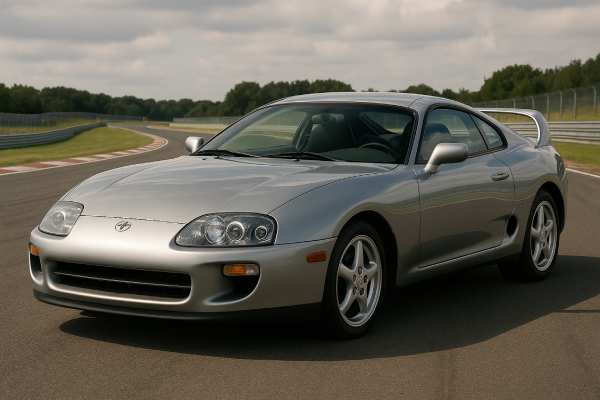
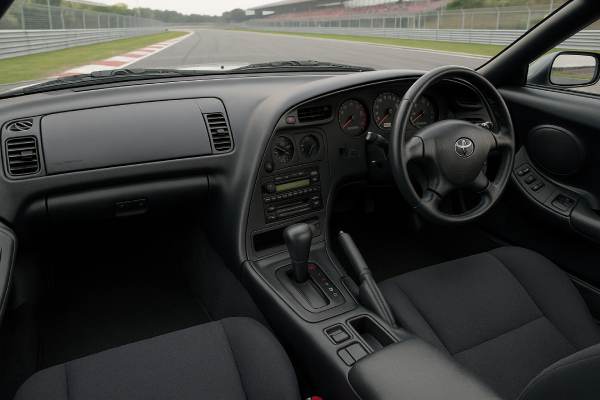
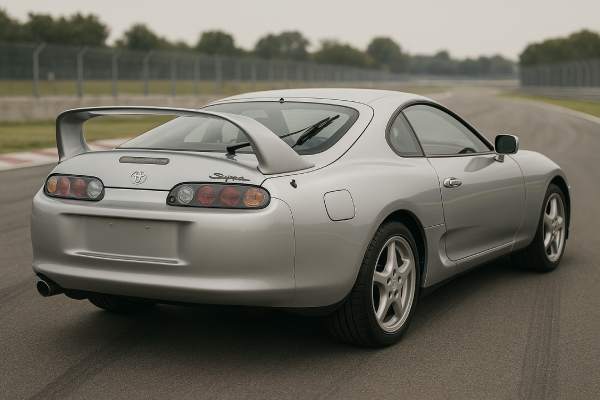
The facelifted Toyota Supra JZA80 with the 2JZ-GE engine is the naturally aspirated side of the legendary Mk4 story. From the mid-1990s through 2002 in Japan (and earlier in export markets), this 3.0-litre inline-six offered a smoother, more approachable take on the Supra formula than the twin-turbo RZ, while still sharing the same basic chassis, suspension, and cabin layout.
In facelift form, the 2JZ-GE gained variable valve timing, a modest bump in power, and small but meaningful tweaks to refinement and emissions. The result is a car that feels genuinely special on a back road, yet can still be driven daily without drama. For many owners, the attraction is a mix of classic 1990s design, bulletproof engine reputation, and the potential to modify later if desired. This guide focuses specifically on the facelift 2JZ-GE JZA80: what it is, how it’s built, how it drives, what goes wrong, and what to check before buying one today.
Fast Facts
- Naturally aspirated 2JZ-GE 3.0l inline-six with VVT-i in most facelift markets, rated around 225 hp and 284 Nm.
- Double-wishbone suspension, rear-wheel drive, and near-neutral balance make it rewarding even without turbo power.
- Engine and driveline are extremely robust, but age-related issues (cooling system, bushings, electronics) now matter more than mileage alone.
- Timing belt and water pump are best replaced roughly every 90,000–100,000 km (60,000 mi) or 6–7 years, regardless of low usage.
Navigate this guide
- Toyota Supra JZA80 overview
- Toyota Supra JZA80 specifications
- Supra JZA80 trims and safety
- JZA80 reliability and issues
- Supra JZA80 maintenance guide
- JZA80 driving and performance
- How JZA80 Supra compares
Toyota Supra JZA80 overview
The JZA80 Supra arrived in the early 1990s as Toyota’s flagship sports coupe, but the facelift era from roughly 1996 onward sharpened the package. Externally, the facelift brought revised headlamps and tail lamps, a tidier front bumper, and small trim updates. Under the skin, the key change for the 2JZ-GE engine in Japan and many other markets was the adoption of variable valve timing (VVT-i), which improved mid-range torque, emissions, and fuel efficiency without radically changing peak output.
In naturally aspirated form, the Supra was positioned as the more liveable partner to the twin-turbo RZ. You still get the same fundamental ingredients: a stiff chassis, double-wishbone suspension all round, rear-wheel drive, and a cabin laid out for serious driving. But the 2JZ-GE is quieter, smoother, and less highly stressed than its turbocharged sibling. In markets such as Japan, the SZ and SZ-R trims offered a mix of equipment levels and transmissions, including the desirable six-speed V161 manual on later SZ-R models.
During the facelift years, official power for the VVT-i 2JZ-GE clustered around 225 hp (225 PS in some markets) with torque in the low-280 Nm range. Export models without VVT-i, especially earlier North American cars, were typically rated slightly lower on paper. In practice, real-world performance depends more on transmission, gearing, and condition than on these small rating differences.
The Supra’s role also shifted as the 1990s ended. Emissions regulations and changing buyer tastes made large straight-six sports cars harder to justify, and sales declined. Japan kept the car in production until 2002, but European sales ended earlier and North American deliveries stopped after the 1998 model year. That makes later VVT-i naturally aspirated cars relatively rare, especially outside Japan, and contributes to their current desirability among enthusiasts who prefer the NA driving experience or plan a high-quality engine swap or build.
Today, a facelift JZA80 2JZ-GE sits in an interesting niche. It is less extreme and often less modified than turbo cars, yet shares their fundamental structure and parts compatibility. For buyers, that means a better chance of finding an unmolested example, but it also demands careful inspection: every Mk4 Supra is now an ageing performance car, and many have lived hard lives. The following sections dig into the exact specifications, safety equipment, reliability patterns, and maintenance needs so you can judge whether this particular Supra fits your priorities.
Toyota Supra JZA80 specifications
The figures below focus on a typical facelift naturally aspirated JZA80 Supra with the 2JZ-GE engine and rear-wheel drive, using factory data and widely accepted reference values. Small differences occur between manual and automatic cars and between markets, but the overall picture is consistent.
Engine and performance
| Item | Specification |
|---|---|
| Engine code | 2JZ-GE (VVT-i on most facelift models) |
| Configuration | Inline-6, DOHC, 24 valves, aluminium head, cast-iron block |
| Displacement | 3.0 l (2,997 cc) |
| Bore × stroke | 86.0 × 86.0 mm (3.39 × 3.39 in) |
| Compression ratio | ~10.0:1 (market-dependent) |
| Induction | Naturally aspirated |
| Fuel system | Sequential multi-port electronic fuel injection |
| Max power | ~225 hp (≈166 kW) @ ~6,000 rpm (facelift VVT-i NA markets) |
| Max torque | ~284 Nm (≈210 lb-ft) @ ~4,800 rpm |
| Recommended fuel | Premium unleaded (≈RON 95+ / AKI 91+) |
| Emissions standard | Varies by market (e.g., Japan 96 regulations) |
| Official combined consumption | Typically 11–13 l/100 km (≈18–21 mpg US) |
| Real-world highway @120 km/h | Around 9–10 l/100 km (≈23–26 mpg US) when stock |
| Valvetrain drive | Timing belt with hydraulic tensioner |
| Firing order | 1-5-3-6-2-4 |
| Aerodynamic drag coefficient | Approx. Cd 0.31 (NA models, with standard rear spoiler) |
These numbers give a realistic picture of how the facelift 2JZ-GE Supra performs when stock. Power is modest by modern turbo standards, but linear delivery, smooth revs, and a broad torque plateau make it feel stronger than the figures suggest in everyday use.
Transmission and driveline
Facelift naturally aspirated Supras were offered with both manual and automatic transmissions. Availability of each varied by market and trim.
| Item | Specification |
|---|---|
| Drive type | Rear-wheel drive (FR) |
| Manual transmission (5-speed) | Toyota W58, close-ratio 5-speed |
| W58 gear ratios | 1st 3.286, 2nd 1.894, 3rd 1.276, 4th 1.000, 5th 0.783, Rev ~3.768 |
| Manual transmission (6-speed) | Getrag V161 on SZ-R (mainly JDM, facelift period) |
| V161 gear ratios | 1st 3.724, 2nd 2.246, 3rd 1.541, 4th 1.205, 5th 1.000, 6th 0.818, Rev 3.192 |
| Automatic transmission | A340E 4-speed electronically controlled automatic |
| A340E gear ratios | 1st 2.804, 2nd 1.531, 3rd 1.000, 4th 0.705, Rev 2.393 |
| Typical final drive ratios | ≈4.083 or ≈4.27 on NA cars (varies by spec and trans) |
| Differential type | Open differential on most NA cars; Torsen LSD on some higher-spec and SZ-R variants |
The W58 manual suits daily road use and light track work, while the V161 six-speed in SZ-R models brings longer legs and a more exotic feel. The A340E automatic is durable if serviced correctly, but fluid age and heat become significant factors as the cars get older.
Chassis and dimensions
The JZA80 chassis is one of the main reasons the Supra still feels special. The double-wishbone suspension geometry, relatively wide track, and stiff shell all contribute to predictable, stable handling.
| Item | Specification |
|---|---|
| Front suspension | Double wishbone with coil springs, gas dampers, anti-roll bar |
| Rear suspension | Double wishbone with coil springs, gas dampers, anti-roll bar |
| Steering | Rack-and-pinion with power assistance |
| Front brakes | Ventilated disc, sliding caliper (larger four-pot discs reserved for many turbo/RZ cars) |
| Rear brakes | Ventilated disc, single-piston caliper |
| Typical wheel/tyre sizes (NA) | 16-inch alloys, approx. 225/50 R16 front, 245/45 R16 rear (varies by market) |
| Length | ≈4,515–4,520 mm (≈177.8 in) |
| Width | ≈1,810 mm (≈71.3 in) |
| Height | ≈1,275 mm (≈50.2 in) |
| Wheelbase | ≈2,550 mm (≈100.4 in) |
| Track (front/rear) | Around 1,520 / 1,535 mm (varies slightly by wheel/tyre) |
| Ground clearance | Roughly 130 mm (≈5.1 in) in stock form |
| Turning circle | Around 5.4 m curb-to-curb |
| Kerb (curb) weight | Typically 1,420–1,520 kg (3,130–3,350 lb) depending on equipment and transmission |
| Fuel tank | 70 l (≈18.5 US gal) |
| Luggage volume | ≈185–310 l (6.5–11.0 ft³) depending on measurement method and seat position |
Fluids and service capacities (typical)
Values below are typical for a stock 2JZ-GE JZA80; always confirm against the specific service manual and VIN.
| System | Capacity (approx.) | Notes |
|---|---|---|
| Engine oil (with filter) | ≈5.2–5.5 l (5.5–5.8 US qt) | High-quality 5W-30 or 10W-30 meeting current API spec, adjusted for climate |
| Engine coolant | ≈7.3–8.0 l (7.7–8.5 US qt) | Ethylene glycol long-life coolant, typically 50:50 mix |
| Manual gearbox (W58) | ≈1.7–2.0 l | GL-4/GL-5 75W-90 or factory-equivalent |
| Manual gearbox (V161) | ≈1.8–2.0 l | Specialized fluid recommended; many owners use very specific GL-4 oils |
| Automatic (A340E) | ≈7–8+ l total fill | Toyota ATF Type IV or compatible; partial drain/fill replaces ~2–4 l |
| Rear differential | ≈1.2–1.4 l | GL-5 75W-90 or 80W-90; LSD-compatible oil if fitted |
| Brake fluid | ~0.8–1.0 l | DOT 3 or DOT 4, replaced regularly |
| Power steering | ~1.0 l | ATF-type fluid as specified by Toyota |
Electrical and safety basics
| Item | Specification |
|---|---|
| Charging system | 12 V alternator, typically 80–90 A on NA cars |
| 12 V battery (typical) | Lead-acid, roughly 45–70 Ah, 300–600 A CCA depending on supplier |
| Airbags | At least driver and front passenger airbags in most facelift markets |
| ABS | Four-channel ABS standard on most facelift cars |
| Traction control | Available/standard in many higher-spec markets; implementation varies |
These specifications give a solid technical snapshot. For exact figures for a particular car, always cross-check with the original owner’s manual and the Toyota service documentation for that VIN.
Supra JZA80 trims and safety
Across its production run, the JZA80 Supra was sold in a variety of trims, and the facelift naturally aspirated cars continued that pattern. Exact naming and equipment differ by region, but the key idea is simple: SZ-type grades for NA cars, RZ-type for twin-turbo cars, and a mix of base and higher-spec sub-grades within those families.
In Japan, facelift period naturally aspirated cars were most commonly found as SZ and SZ-R:
- SZ – Entry-level NA trim, typically with the 2JZ-GE, 5-speed W58 manual or 4-speed A340E automatic, cloth seats, and smaller braking package.
- SZ-R – Higher-spec NA trim, adding the six-speed V161 manual, sportier suspension calibration, often a limited-slip differential, and upgraded interior touches.
Europe and other export regions tended to see fewer variations, and in many markets the naturally aspirated Supra disappeared earlier than the turbo models. The United States, for instance, dropped the NA Supra before the end of the 1990s. As a result, late-production facelift 2JZ-GE VVT-i cars are mostly JDM or specialist import vehicles in many countries.
Trim level also influenced wheels, tyre sizes, audio systems, and some convenience features (such as automatic climate control or leather seats), but mechanically the facelift NA cars share far more than they differ. The six-speed SZ-R is the most coveted NA trim because it combines the charismatic 2JZ-GE with the same gearbox architecture used in twin-turbo RZ models.
From a safety perspective, the JZA80 reflects 1990s design priorities. Most facelift cars offer:
- Dual front airbags (driver and passenger).
- Three-point front seatbelts with pretensioners and load limiters.
- ABS as standard, with four-channel control.
- Strong passenger cell with substantial longitudinal rails and side-impact structure.
Electronic driver assistance is limited. Traction control and, in some markets, rudimentary stability-type interventions were available, but there is no modern lane-keeping, adaptive cruise control, or advanced emergency braking. The car predates mainstream Euro NCAP testing for this class and era, and comprehensive IIHS or NHTSA crash-test datasets are not available in the way they are for newer vehicles. That does not mean the Supra is unsafe, but it does mean you should view it through a classic-car lens rather than expecting modern crash performance.
Child-seat accommodation is also basic. The rear seats are small, and ISOFIX/LATCH anchorages were not standardised at the time. If you plan to carry children, you will likely be using seatbelt-routed child seats with careful attention to installation.
In practical ownership terms, the most important “safety options” are not trim codes but condition and maintenance. Original-spec brakes in good shape, correctly sized and high-quality tyres, a healthy ABS system and steering, and a corrosion-free shell will have more impact on real-world safety than whether the car is an SZ or SZ-R. When evaluating a prospective purchase, always look beyond badges: inspect the structure, test the brake performance, verify airbag warning lights behave correctly on start-up, and check for evidence of crash repair.
JZA80 reliability and issues
The 2JZ-GE-powered JZA80 has a strong reputation for reliability, and in many respects it lives up to that legend. The basic engine architecture is robust, the transmissions are sturdy when serviced, and the electronics are simpler than on many modern cars. However, time is catching up with every Mk4 Supra. Even well-kept facelift examples now face age-related wear, corrosion, and parts availability challenges.
A sensible way to think about reliability is by system, severity, and when the problems tend to appear.
Engine and ancillaries (generally very robust, age-sensitive):
- Timing belt, idlers, and water pump – The 2JZ-GE uses a belt, not a chain. Neglected belts, noisy idlers, or weeping water pumps are common on cars with patchy history. Symptoms include belt squeal, coolant loss, and overheating. The fix is a full timing kit and pump replacement, often combined with new cam and crank seals.
- Cam cover and front engine seals – Hardened gaskets and seals can lead to oil seepage down the block, sometimes mistaken for more serious leaks. This is usually a medium-cost repair, but oil leaks onto belts or mounts should be addressed promptly.
- Cooling system – Radiators, plastic tanks, heater cores, and hoses degrade with age and heat cycles. Overheating is still relatively rare on well-maintained cars, but when it happens it is often due to a partially blocked radiator or old hoses. A preventive cooling-system refresh is strongly recommended on any newly acquired car.
- Ignition system – Coil packs, leads (where fitted), and connectors age, leading to misfires under load. Many cars have had piecemeal repairs; a thorough check and replacement of worn components restores smooth running.
Fuel and intake (usually low-severity):
- Idle air control and throttle body deposits – Sticking idle valves and carbon build-up can cause unstable idle, stalling, or hunting. Cleaning and recalibration normally solve this.
- Aged fuel pumps and filters – After decades, original pumps and filters may struggle under high load, especially on cars that sit for long periods. Preventive replacement is inexpensive compared with the cost of being stranded or chasing intermittent lean faults.
Transmission and driveline:
- W58 manual – Generally reliable at stock power, but high-mileage units can suffer from synchro wear (especially 2nd and 3rd gear), leading to crunching or difficulty selecting gears. Regular high-quality oil changes help, but rebuilds are sometimes needed.
- V161 six-speed – Very strong but expensive to repair or replace. Noise, rough shifting, or difficulty engaging gears should be taken seriously; parts availability is more limited.
- A340E automatic – When maintained, it is durable. Neglected fluid leads to shudder, flare, or harsh changes. On a used car, evidence of recent, correct fluid service is reassuring.
- Differential and driveshaft – Most issues are wear-related: diff whine, backlash, or vibration from tired universal joints and centre bearings. These are fixable but labour-intensive compared with more modern modular driveline designs.
Chassis, suspension, and steering:
- Bushings and ball joints – Front lower control arm bushes and ball joints, rear subframe and control arm bushes, and anti-roll bar links all wear out with age. Symptoms include clunks, vague steering, uneven tyre wear, and imprecise handling. Re-bushing a Supra is not cheap but transforms the driving feel.
- Dampers and springs – Original dampers are well beyond their best on most cars. Many Supras now run aftermarket coilovers; quality varies widely. Poorly chosen suspension can harm both comfort and safety.
- Rust and corrosion – While not as notorious as some contemporaries, the JZA80 can rust around rear arches, sills, underbody seams, and front chassis rails (especially near the battery or after accident repairs). Cars from salty-road climates need careful inspection underneath, including subframes and suspension pick-up points.
Electrical and interior:
- Aging wiring and connectors – Engine-bay connectors, earth points, and dash harnesses can suffer from corrosion or brittle insulation, leading to intermittent faults.
- Instrument cluster and switchgear – Fading LCDs, sticky switches, and worn column stalks are common. Most issues are nuisance-level rather than catastrophic.
Recalls, TSBs, and extended coverage:
Mk4 Supras have had fewer large-scale campaigns than some other 1990s models, but airbag-related recalls and occasional service bulletins have existed in certain markets. It is essential to run a VIN check through official channels and to verify completion of outstanding campaigns. Because many surviving cars are imports, the first registration country and current country may differ; check both Toyota’s local site and national safety authority databases.
Overall, a well-maintained facelift 2JZ-GE Supra is still capable of high reliability, but the margin for neglect is much smaller than when the cars were young. The high cost of some parts, particularly for rare trim-specific items, also means that “cheap” cars can become expensive quickly if they need comprehensive mechanical and cosmetic restoration.
Supra JZA80 maintenance guide
Owning a facelift JZA80 Supra 2JZ-GE can be straightforward if you follow a structured maintenance plan and choose specialists who understand the platform. The engine is forgiving, but age and performance use mean that sticking to generic “normal car” intervals is no longer enough.
Core service schedule (typical guidance)
Intervals below are sensible starting points for a mostly stock car in mixed use. Always adapt to your climate, driving style, and the specific recommendations in the official service documentation.
| Item | Interval (distance/time) | Notes |
|---|---|---|
| Engine oil and filter | Every 8,000–10,000 km (5,000–6,000 mi) or 12 months | Quality synthetic 5W-30 or 10W-30; shorten interval for track use |
| Engine air filter | Every 30,000 km (20,000 mi) or 2–3 years | Inspect sooner in dusty conditions |
| Cabin filter (if fitted) | Every 24 months | Many early cars lack a pollen filter; retrofits are possible |
| Spark plugs | 60,000–100,000 km (40,000–60,000 mi) depending on type | Use OEM-equivalent heat range and gap |
| Fuel filter | Around 80,000–100,000 km (50,000–60,000 mi) | Particularly important on older or imported cars |
| Coolant | Every 3–5 years | Use Toyota-approved long-life coolant and proper bleed procedure |
| Timing belt, tensioner, idler, water pump | Roughly every 90,000–100,000 km (60,000 mi) or 6–7 years | Replace cam and crank seals at the same time |
| Auxiliary/serpentine belts and hoses | Inspect annually; replace every 5–7 years | Cracks, glazing, or oil contamination justify earlier replacement |
| Manual gearbox oil | Every 60,000–80,000 km (40,000–50,000 mi) | Correct spec is crucial for shift quality, especially V161 |
| Automatic transmission fluid | 40,000–60,000 km (25,000–40,000 mi) | Prefer staged drain/fill over “power flush” on old units |
| Differential oil | Every 60,000 km (40,000 mi) | LSD-compatible fluid where applicable |
| Brake fluid | Every 2 years | Use DOT 4; flush thoroughly |
| Brake pads and discs | Inspect at every service | Check for uneven wear and disc run-out |
| Steering and suspension | Full inspection every 2 years or 30,000 km | Look for play, leaks, and bush degradation |
| Wheel alignment and tyre rotation | Alignment check annually or on new tyres; rotate every 10,000–12,000 km | Essential on cars with aftermarket suspension/wheels |
| 12 V battery | Test annually; plan replacement every 4–6 years | Age is as important as mileage |
Fluids, torque values and practical notes
For owners who intend to do some maintenance themselves, a few practical details help:
- Drain plug torques – Engine oil drain is typically in the mid-20s ft-lb (check exact figure in the manual). Over-tightening can strip threads in the sump.
- Coolant bleeding – The inline-six layout makes bleeding relatively simple, but air pockets can still form. Always run the heater, monitor level after the first few heat cycles, and check for leaks.
- Transmission and differential oils – Always undo the fill plug before the drain plug to avoid discovering a stuck fill plug with an empty housing.
Using genuine Toyota parts or high-quality aftermarket equivalents for critical components (timing kits, water pumps, suspension arms) is strongly recommended. Cheap pattern parts may work initially but can fail prematurely and undermine the car’s reliability and resale value.
Buyer’s guide and inspection checklist
When viewing a facelift 2JZ-GE Supra, treat it as both a performance car and a classic:
- History and paperwork
- Look for continuous service records, especially for timing belt changes, coolant replacements, and transmission/differential services.
- Check import documentation if the car is a JDM or grey-market example.
- Engine and cooling system
- Start from cold and watch for rattles, belt squeal, or rough idle.
- Inspect for oil leaks at the front and rear of the engine, cam covers, and around the oil pan.
- Check coolant colour and smell; look for dried residue around radiator, water pump, and hoses.
- Driveline and transmission
- On manuals, feel for synchro issues (especially 2nd and 3rd) and listen for whines or clunks on overrun.
- On automatics, test for smooth upshifts and downshifts, and ensure lock-up behaves normally at steady speeds.
- Suspension, steering, and brakes
- Listen for knocks over bumps, and pay attention to steering play or tramlining.
- Inspect tyres for uneven wear, which can indicate worn bushings or poor alignment.
- Body, structure, and corrosion
- Examine rear arches, sills, floorpans, and front chassis rails carefully.
- Look for overspray, inconsistent panel gaps, or signs of repaired accident damage.
- Interior, electronics, and modifications
- Verify that all instruments, windows, lights, and climate controls work correctly.
- Be cautious of extensive wiring modifications (alarms, audio, engine management) without documentation.
- Ask specifically about any performance modifications and how they were tuned; even NA cars are often modified or prepared for future turbo conversions.
For many buyers, the best facelift 2JZ-GE Supra is a lightly modified or sympathetically restored example with clear evidence of recent major maintenance. Cars that are cheap because they “just need a few small jobs” often require a full suspension refresh, cooling-system overhaul, and brake work, all of which add up quickly.
JZA80 driving and performance
On the road, the facelift 2JZ-GE Supra delivers a distinctively different experience from its twin-turbo siblings while still feeling every bit like a serious sports coupe. The naturally aspirated engine is smoother and more linear, the noise level is lower at a cruise, and the car is easier to modulate in everyday traffic.
Engine character and response
The 2JZ-GE’s key strengths are refinement and linearity. It pulls cleanly from low revs, especially with VVT-i, and builds power steadily toward the 6,000–6,500 rpm region. There is no big surge as on the turbo cars; instead, you get a broad torque band that makes the car tractable in city driving and relaxed on the motorway. Throttle response is crisp for a cable-throttle 1990s engine, and the car rarely feels flat unless heavily over-geared.
With the five-speed W58, the gearing is relatively tall, prioritising quiet highway cruising over ultimate acceleration. The six-speed SZ-R models feel livelier thanks to tighter spacing, especially between 2nd, 3rd, and 4th gears. Automatic cars are softer and more relaxed; kickdown response is adequate but not instantaneous by modern standards, and the transmission benefits from being in good health with fresh fluid.
Handling, ride, and brakes
The double-wishbone suspension delivers excellent front-end precision and predictable mid-corner behaviour. At sane road speeds, the NA Supra tends to feel neutral with a hint of safe understeer on turn-in and easy-to-manage throttle adjustability. The rear end communicates clearly when grip is starting to go, especially on quality tyres.
Ride quality in stock form is firm but not harsh. On good roads, the car feels planted; on poorly surfaced roads, the short wheelbase and tight damping can make it a little busy, particularly if the car is on aftermarket coilovers or oversize wheels. Noise levels are quite civilised for a 1990s performance coupe, though wind noise around the frameless doors can increase with age and worn seals.
Braking performance on NA cars is solid but not as spectacular as the larger turbo brake package. For enthusiastic driving, fresh discs and pads, high-boiling-point fluid, and good tyres are critical. The ABS calibration is conservative by modern standards but works effectively when everything is in good condition.
Performance metrics and real-world pace
Period figures and later testing suggest that a healthy facelift NA Supra with manual transmission typically delivers:
- 0–100 km/h (0–62 mph) in roughly 6.5–7.2 seconds, depending on gearbox, weight, and conditions.
- Top speed in the region of 230–240 km/h (around 140–150 mph), sometimes electronically limited.
These numbers are modest alongside modern turbocharged hot hatches, but the subjective sensation is different: the car feels long-legged, stable, and composed at speed, with a particularly satisfying balance on flowing roads.
Fuel economy is reasonable for a 3.0-litre 1990s performance car. Expect:
- City: often 14–16 l/100 km (15–17 mpg US) in stop-start driving.
- Highway at 100–120 km/h: around 9–10 l/100 km (23–26 mpg US) in stock form.
- Mixed driving: typically 11–13 l/100 km (18–21 mpg US), depending on use and gearing.
Cold weather, short trips, or frequent high-rpm driving will push consumption higher. Many owners accept this as part of the character, but if you need outstanding fuel efficiency, the Supra is not the ideal choice.
Traction and use under load
The rear-wheel-drive layout, relatively low factory torque, and good weight distribution mean traction is generally excellent on dry roads with quality tyres. In wet or cold conditions, older stability electronics and the car’s power-oversteer potential demand respect. A limited-slip differential, where fitted, improves traction out of slow corners but can make the car slightly more reactive if provoked.
The Supra can handle occasional track days or spirited mountain drives if maintained properly, but repeated high-load use reveals weaknesses in tired components. Old dampers, marginal cooling systems, and worn bushings become noticeable quickly. At the same time, the chassis feels notably more stable and composed than many period rivals when driven near its limits.
How JZA80 Supra compares
Comparing a facelift 2JZ-GE Supra to its period rivals means looking not just at straight-line numbers but at character, reliability, and long-term ownership.
Against Japanese contemporaries
- Nissan 300ZX (Z32) – The 300ZX twin-turbo generally out-accelerates an NA Supra in stock form, but it is more complex to maintain and can be more demanding on cooling and access. The Supra’s engine bay is relatively straightforward, and the 2JZ platform has better long-term parts and tuning support in many regions.
- Mazda RX-7 (FD) – The RX-7 is lighter and sharper, with more immediate steering and a more “on-its-toes” feel. However, its twin-rotor engine demands meticulous maintenance and careful warm-up, and rebuilds are more common. The NA Supra trades some agility for comfort, durability, and easier ownership.
- Mitsubishi GTO/3000GT – Mitsubishi’s heavy, all-wheel-drive GT is more of a high-speed cruiser than a pure driver’s car. The Supra feels more precise and less complex mechanically, particularly in NA form.
Against European and American coupes
- BMW E36/E46 inline-six coupes – Contemporary BMW six-cylinder coupes offer similar everyday usability and strong chassis dynamics, but corrosion, electronics, and cooling systems can be more fragile. The 2JZ’s reputation for mileage tolerance and tuning headroom often tips enthusiasts toward the Supra.
- Chevrolet Camaro / Ford Mustang (1990s) – American V8 coupes typically offer more low-rpm torque and a different sound and character, but they are often less precise in steering and suspension tuning than the Supra was from the factory. The Toyota feels more refined and sophisticated, albeit with less straight-line grunt in NA form.
Within the Supra family
Perhaps the most important comparison is between the naturally aspirated JZA80 and the twin-turbo RZ:
- The turbo RZ is much faster and more collectable, with significantly higher values and a stronger motorsport halo. It is also more likely to have been heavily modified, raced, or extensively tuned, which can complicate buying decisions.
- The 2JZ-GE facelift car offers a gentler ownership curve. Insurance is often lower, fuel and consumable demands are modest, and the car is more tolerant of everyday commuting. For many drivers, the NA engine provides enough performance while keeping operating costs and mechanical stress down.
In today’s market, a clean facelift 2JZ-GE Supra often appeals to three main groups:
- Purist drivers who want a balanced, naturally aspirated car with a great chassis and classic feel.
- Enthusiasts planning a high-quality build, starting with a sound shell and a robust NA engine before moving to more power.
- Collectors who value originality, particularly in rare SZ-R six-speed or low-mileage examples.
If you want raw acceleration and big-power tuning, the turbo path still makes more sense. If you prioritise reliability, balanced performance, and a more approachable day-to-day experience, the facelift 2JZ-GE JZA80 Supra remains a compelling and surprisingly usable option, provided you choose carefully and invest in correct maintenance.
References
- Supra Owner’s Manual 1999 (Owner’s Manual)
- Toyota Manuals and Warranties | Toyota Owners 2025 (Owner’s Manual Portal)
- Gas Mileage of 1997 Toyota Supra 1997 (Fuel Economy Data)
- Vehicle Detail Search – 1995 TOYOTA SUPRA | NHTSA 1995 (Safety and Recall Database)
- Fluids & capacities – Supra (1993-2002) 2010 (Technical Data – Fluids and Capacities)
Disclaimer
This article is for informational purposes only and is not a substitute for professional diagnosis, repair, or inspection. Specifications, torque values, fluid capacities, and service intervals can vary by VIN, production date, market, equipment level, and previous modifications. Always verify any procedure or value against the official Toyota service manual, technical documentation for your specific vehicle, and local regulations. If you are unsure about any maintenance or repair work, consult a qualified technician with experience on the JZA80 Supra.
If you found this guide useful, you are welcome to share it with other enthusiasts via social platforms such as Facebook or X/Twitter to help support careful, informed ownership of these cars.