
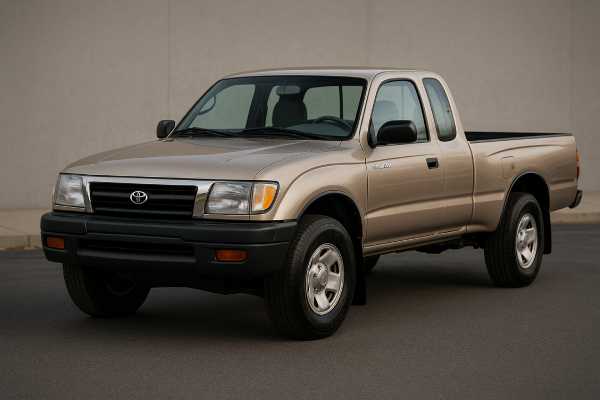
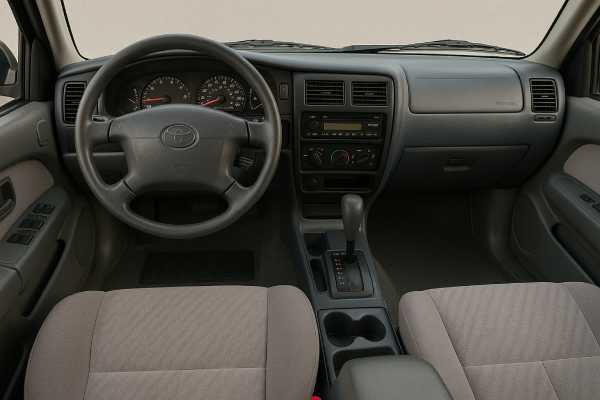
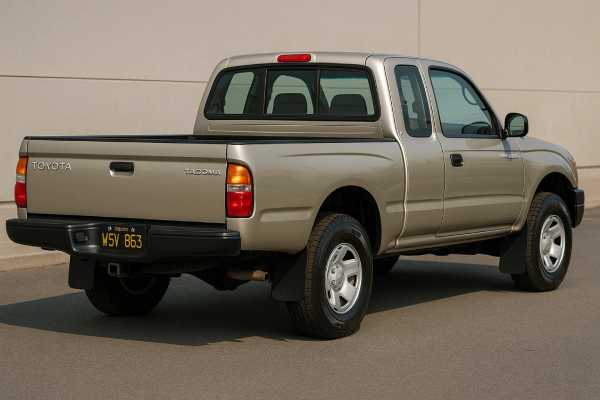
The first-generation Toyota Tacoma 2WD with the 2RZ-FE 2.4-liter engine sits in a sweet spot between classic simplicity and modern usability. Built on the N140 platform from 1995 to 2000, this compact pickup replaced the older Hilux-based “Toyota Pickup” in North America and was engineered with more focus on comfort, safety, and refinement while still keeping a sturdy ladder frame and leaf-spring rear axle.
In 2WD form with the 2.4-liter four-cylinder, you’re looking at the most straightforward version of the truck: rear-wheel drive, a naturally aspirated DOHC engine, and usually a 5-speed manual. Output of roughly 142 hp and 160 lb-ft won’t win drag races, but it’s enough for daily use and light work, especially given the Tacoma’s relatively low curb weight.
What really makes this configuration stand out is its longevity. The iron-block 2RZ-FE has a timing chain instead of a belt and routinely crosses 250,000–300,000 miles with routine maintenance, with many owners reporting even more. Combine that with a robust frame (notwithstanding the well-known rust campaign), simple electrics, and easy parts availability, and you get an ideal “do-everything” small truck—provided you buy the right example and stay ahead of corrosion and age-related wear.
Fast Facts – Tacoma 2WD 2.4
- 2RZ-FE 2.4-liter DOHC four-cylinder is simple, chain-driven, and known to exceed 250,000+ miles with basic care.
- Light, compact 2WD chassis delivers good maneuverability and relatively low running costs versus V6 4×4 models.
- Major ownership caveats: frame corrosion on 1995–2000 trucks and lower ball joint wear/recalls on some model years.
- Typical oil and filter change interval is 5,000–7,500 miles (8,000–12,000 km) or 6–12 months, with shorter intervals for heavy use or dusty conditions according to Toyota owner’s manuals for this era.
Navigate this guide
- Toyota Tacoma 2WD 2.4 Overview
- Tacoma 2RZ-FE Specs and Data
- Tacoma 2WD Trims and Safety
- Reliability and Known Tacoma Issues
- Ownership Maintenance and Buying Guide
- Driving Feel and Real Performance
- Tacoma 2WD Versus Key Rivals
Toyota Tacoma 2WD 2.4 Overview
When Toyota launched the first-generation Tacoma for the 1995½ model year, the 2WD 2.4-liter variant was the “honest base truck” of the lineup. It used the N140 chassis with a fully boxed frame at the front, open C-section rails toward the rear, and traditional body-on-frame construction. Compared with the outgoing Hilux-based pickup, the Tacoma had a more compliant front suspension, better crash performance, and a cabin tuned for North-American expectations of comfort.
The 2RZ-FE engine powered nearly all 4×2 regular cabs and many Xtracab models from 1995–2000. It’s a 2.4-liter inline-four with dual overhead cams, 16 valves, and multi-point fuel injection, rated at about 142 hp and 160 lb-ft (217 Nm) of torque depending on year and calibration. Power is modest, but the engine is under-stressed, and the design is tuned for low-to-mid-range torque rather than high-rpm thrills. Owners who keep up on oil changes and valve clearances frequently see these engines outlast the rest of the truck.
Configuration-wise, most 2WD 2.4 Tacomas were sold as:
- Regular Cab, short bed: 3-seat work truck, manual steering on some early base models, 14–15″ wheels.
- Xtracab (extended cab), 6-ft bed: small rear jump seats, more storage space, and usually slightly higher curb weight and GVWR.
Automatic transmissions (4-speed) were available, but the five-speed manual is common and better matched to the engine’s character. Towing capacity for the 2.4-liter 2WD is typically around 3,500 lb (about 1,600 kg) when properly equipped, with payload often in the 1,400–1,700 lb (635–770 kg) range depending on cab and options.
Efficient packaging is another strength. Compared with full-size trucks of the same era, the Tacoma’s footprint is small, but the bed is still large enough for motorcycles, yard equipment, and construction materials. The steering is quick enough for tight parking lots, and the turning circle is very manageable for city use. At the same time, the truck retains a straightforward, analog feel—cable throttles, hydraulic steering, and minimal driver aids.
The main trade-offs are age-related. Most examples are now 25–30 years old, so the key questions move away from “Is the Tacoma platform good?” (it is) to “How well has this specific truck been maintained, and what has rust done to it?” Toyota’s later frame corrosion Customer Support Program is a reflection of that concern—especially in salt-belt states.
Tacoma 2RZ-FE Specs and Data
This section focuses on a typical 1995–2000 Toyota Tacoma 2WD Xtracab 2.4 (142 hp) 5-speed manual, which uses the N140 platform and 2RZ-FE engine. Exact values vary slightly by year, cab style, options, and market, but the figures below are representative.
Engine and Performance
| Item | Specification | Notes |
|---|---|---|
| Engine code | 2RZ-FE | RZ-family inline-four |
| Layout and valvetrain | Inline-4, DOHC, 16 valves, shim-over-bucket | No hydraulic lifters; manual valve adjustment required |
| Displacement | 2.4 L (≈2,392–2,438 cc) | Minor differences by source; Toyota lists ~2.4 L |
| Bore × stroke | 95 mm × 86 mm (3.74″ × 3.39″) | Oversquare design |
| Compression ratio | 9.5:1 | Regular unleaded recommended |
| Induction | Naturally aspirated | No turbo/supercharger from factory |
| Fuel system | Multi-point EFI | Electronic fuel injection |
| Max power | ~142 hp (106 kW) @ 5,000–6,000 rpm | Varies slightly by year/spec |
| Max torque | ~217 Nm (160 lb-ft) @ 4,000–4,400 rpm | Broad, low-rpm torque band |
| Timing drive | Dual chain system | Chain wear becomes relevant at high mileage |
| Firing order | 1-3-4-2 | Standard Toyota I4 pattern |
Factory-style consumption figures for a 2WD 2.4 regular-cab 5-speed are roughly 22 mpg city / 25–27 mpg highway (US), equivalent to about 10–11 L/100 km city and 8.5–9.5 L/100 km highway. Many owners reporting careful highway driving with light loads see close to 28–29 mpg US (~8.1 L/100 km).
Real-world, expect:
- Mixed driving: ~20–23 mpg US (8–11 L/100 km)
- Heavily loaded/towing: high-teens mpg, with noticeable drops when pushing beyond 60–65 mph (100–105 km/h)
0–60 mph (0–97 km/h) is typically in the 11–12 second range with a manual transmission, and top speed is around 105 mph (≈170 km/h)—plenty for normal highway use but not performance-oriented.
Transmission and Driveline
Most 2WD 2.4 Tacomas used a 5-speed manual; a 4-speed automatic was optional.
5-speed manual (typical 2.4 4×2)
| Gear | Ratio |
|---|---|
| 1st | 3.95 |
| 2nd | 2.14 |
| 3rd | 1.38 |
| 4th | 1.00 |
| 5th | 0.81 |
| Reverse | 4.09 |
| Final drive | ≈4.10 (varies slightly by year/axle code) |
- Drive type: Rear-wheel drive (RWD) only (non-PreRunner 2WD).
- Differential: Open rear diff from factory; aftermarket limited-slip units are common upgrades for traction.
There is no transfer case or low-range gearing on normal 2WD trucks, so off-road crawling ability is limited versus 4×4 models.
Chassis, Dimensions, and Weights
Figures below are for a typical 1995–2000 Tacoma 2WD Xtracab 2.4 manual.
| Item | Metric | Imperial |
|---|---|---|
| Length | 5,055 mm | 199.0 in |
| Width | 1,689 mm | 66.5 in |
| Height | 1,560 mm | 61.4 in |
| Wheelbase | 3,096 mm | 121.9 in |
| Ground clearance | 215 mm | 8.5 in |
| Fuel tank | 57 L | 15.1 US gal |
| GVWR (max weight) | 1,928 kg | 4,250 lb |
Curb weight varies with cab and equipment. Regular-cab 2WD manuals can be as light as ~2,560 lb (≈1,160 kg), while better-equipped Xtracab trucks approach 3,200–3,400 lb (1,450–1,540 kg).
Suspension and brakes:
- Front: Double-wishbone/coil spring, with anti-roll bar on most trims.
- Rear: Solid axle with leaf springs.
- Front brakes: Ventilated discs;
- Rear brakes: Drums.
- Steering: Rack-and-pinion, power-assisted on most.
Typical wheel and tyre packages:
- Base: 14–15″ steel wheels with 195/75R14 or 205/75R15 tyres.
- Higher trims: 15–16″ wheels with 235-section tyres; TRD/appearance packages used wider 16″ alloys.
Capability and Capacities
While official towing and payload figures vary, a typical 2WD 2.4 Tacoma manual is rated for:
- Towing: ~3,500 lb (1,590 kg) when properly equipped.
- Payload: Often 1,400–1,700 lb (≈635–770 kg), depending on GVWR and curb weight.
Fluids (approximate for 2.4 2WD Xtracab):
- Engine oil capacity: ~5.5 L (5.8 US qt) with filter; Toyota typically specifies 5W-30 for this era.
- Coolant: ~7.8 L (8.2 US qt) of ethylene-glycol coolant mixed 50/50 with distilled water.
- Manual transmission: ~2.1–2.4 L of GL-4/GL-5 75W-90 (check exact box code).
- Differential (rear): ~1.2–1.4 L of GL-5 75W-90.
Electrical (typical, varies by build):
- Alternator output: ~70 A, 12 V on stock units.
- 12 V battery: Group 24F or 35, usually around 550–600 CCA from the factory, with higher-CCA replacements widely available.
Safety and Driver Assistance (Spec Level)
For 1995–2000 2WD Tacomas:
- Airbags: Driver airbag standard from launch; passenger airbag added in later first-gen years (timing varies by market/trim).
- ABS: Four-wheel ABS optional on many 2WD models, not universally fitted.
- Traction/stability control: Not available on this generation.
- Child-seat anchors (LATCH/ISOFIX): Not fitted on early first-gen trucks; child seats rely on belts and tether anchors where installed.
This means safety performance depends heavily on configuration and year—and is one reason the next section looks at ratings and equipment in more detail.
Tacoma 2WD Trims and Safety
Across 1995–2000, the 2WD 2.4-liter Tacoma was sold in several trim levels, with names and content varying slightly by model year:
- Base / Regular Cab: Vinyl bench seat, minimal sound insulation, manual windows and locks, 14–15″ steel wheels.
- DX: Still work-oriented but could add air conditioning, power steering, and appearance tweaks.
- SR5: More comfort equipment—cloth seats, improved trim, upgraded audio, and sometimes alloy wheels.
- Limited (later years): More upscale equipment, but often paired with V6; relatively rare in 2.4-liter 2WD form.
On a 2RZ-FE 2WD, the main mechanical differences between trims are:
- Tyre and wheel packages: SR5 and later special packages could use wider 15–16″ tyres, modestly improving grip and stability.
- Rear axle ratios: “Towing” or “economy” axle codes vary slightly (often near 4.10:1), affecting highway rpm.
- Options: ABS, limited-slip differential (via accessory/aftermarket), and tow packages.
Identifiers and build data
Quick ways to identify exactly what you’re looking at:
- VIN plate and door jamb decal list GVWR, axle codes, paint, and build plant.
- Engine code (2RZ-FE) appears on the emission label under the hood.
- Wheel lug count: 2WD non-PreRunner trucks use 5-lug wheels; 4WD/PreRunner use 6-lug.
Safety Ratings
Independent testing on first-gen Tacomas is more limited than on modern trucks and often focuses on specific configurations and years.
- IIHS moderate-overlap frontal test (1998 Tacoma, regular cab): Overall rating Acceptable. The structure held up reasonably well, but there was notable intrusion into the driver’s footwell, with a Poor rating for left-leg injury measures. Restraints and head protection were rated Good.
- Side, small overlap, roof strength: These tests weren’t performed to modern IIHS protocols on 1990s Tacomas.
- NHTSA frontal/side ratings: Many first-gen Tacoma variants have sparse or no federal star ratings in the public database; when present, ratings are typically middling compared with newer trucks.
The big picture: in its day the Tacoma compared well to other compact pickups, but by modern standards it lacks crumple-zone sophistication, side-impact protection, and advanced restraints.
Safety Systems and ADAS
For 1995–2000 2WD Tacomas, a realistic equipment snapshot is:
- Passive safety:
- Driver airbag standard; passenger airbag phased in during the late 1990s.
- Three-point front belts with pretensioners in later years.
- No side airbags or curtain airbags.
- Active safety:
- Optional four-wheel ABS (check for ABS lamp at key-on and ABS unit in engine bay).
- No electronic stability control, no traction control, and no brake assist.
Advanced driver-assistance systems simply do not exist on this generation: no factory lane-keeping, no adaptive cruise, and no automatic emergency braking. For buyers coming from modern vehicles, it’s important to mentally recalibrate: following distances, speeds, and wet-weather expectations all need more margin.
From a practical standpoint, the safety story is:
- A structurally sound small truck for its era.
- Much safer than older carbureted pickups with no airbags.
- Not remotely on par with 2010s-onward midsize trucks in terms of crash survivability or active safety nets.
Reliability and Known Tacoma Issues
Mechanically, the Tacoma 2WD with the 2RZ-FE is one of the most durable combinations Toyota has put on the road. The engine and basic driveline are extremely robust; most real problems are age-, maintenance-, or environment-related.
Engine and Powertrain
Overall reliability is excellent. The 2RZ-FE is widely regarded as capable of 250,000–300,000+ miles (400,000–500,000+ km) with routine maintenance, and some examples have exceeded 500,000 miles.
Common patterns and what to look for:
- Valve clearance noise (common, low–medium severity):
- Symptoms: Ticking noise from top of engine, especially at idle and cold start.
- Cause: Shim-over-bucket valvetrain with no hydraulic lifters; clearances drift over time.
- Remedy: Check and adjust valve clearances every ~30,000–60,000 miles; budget for shims and labour.
- Oil seepage and consumption (occasional, medium severity):
- Symptoms: Wet cam cover gasket, minor drips, gradual oil level drop between changes.
- Cause: Aging seals and gaskets; sometimes valve-stem seals or piston rings at very high mileage.
- Remedy: Replace cam cover gasket, monitor consumption, inspect PCV system and leaks; refresh seals as needed.
- Timing chain wear (occasional at high mileage, potentially high severity):
- Symptoms: Rattling at start-up, abnormal noise from timing cover, cam/crank correlation codes on OBD-II trucks.
- Cause: Worn chain, plastic guides, or tensioner after high mileage, especially with poor oil change history.
- Remedy: Replace chain, guides, tensioner, and associated seals; you’re preventing possible catastrophic failure.
- Cooling system aging (occasional, moderate):
- Symptoms: Overheating, coolant loss, brown coolant, poor heater output.
- Cause: Old radiator cores, clogged passages, tired water pumps, stuck thermostats.
- Remedy: Replace radiator if corroded, renew hoses and thermostat, flush coolant; check for combustion gases if overheating was severe.
Fuel and ignition issues—MAF sensor contamination, worn plugs/wires, dirty injectors—show up as rough idle or hesitation, but they’re routine age-related maintenance more than design flaws.
Transmissions (both manual and auto) are generally stout if fluid changes were done. Watch for:
- Notchy shifting or synchro wear on high-mileage 5-speeds, especially 2nd and 3rd gear.
- Torque-converter shudder or delayed shifts on neglected automatics; a fluid and filter service can help if caught early.
Frame Rust and Corrosion
The single biggest systemic issue for 1995–2000 Tacomas—2WD and 4WD—is frame corrosion.
Toyota introduced a Customer Support Program in 2008, extending frame corrosion perforation coverage to 15 years with unlimited mileage for 1995–2000 Tacomas sold in certain markets. If perforation was found, Toyota would either repair or repurchase the truck.
Key points:
- The original program window has now expired for all 1995–2000 trucks.
- Many frames were replaced; others received corrosion-resistant treatment, while some never saw the dealer despite eligibility.
- Rust tends to concentrate around:
- Rear leaf-spring hangers and shackles
- Inside the fully boxed frame rails where moisture collects
- Crossmembers near the fuel tank and spare tyre
Any prospective purchase should include:
- Full frame inspection with a hammer or pick, paying close attention to seams and boxed sections.
- Checking for weld marks, part number stickers, or unusually clean black paint that might indicate a replacement frame.
A severely rusted frame is often uneconomical to repair correctly; at minimum, it should heavily discount the truck.
Suspension, Steering, and Lower Ball Joints
Another widely discussed concern:
- Lower ball joints (LBJs) – serious but manageable:
- Some 1995–2004 Tacomas were covered by a Toyota recall and technical service bulletins for LBJ wear.
- Symptoms: Wandering steering, clunks over bumps, uneven tyre wear; in extreme cases, joint separation causing collapse of the front corner.
- Remedy: Replace LBJs with OEM or high-quality parts on a preventive basis (often every 100,000 miles or sooner on rough roads) and torque bolts to spec.
Other age-related chassis items:
- Worn leaf-spring bushings, front control-arm bushings, and shocks/struts.
- Steering rack leaks and inner tie-rod play.
- Surface rust on rear axle housings and brake backing plates.
None of these are unique to the Tacoma, but the lighter front end of a 2WD 2.4 means suspension parts sometimes last longer than on V6 4×4 models.
Electrical and Miscellaneous
The electrical system is simple and generally reliable:
- 70 A alternator and basic wiring harness; failures usually show up as charging or starting issues on very old trucks.
- Aging connectors and grounds can cause intermittent check-engine lights; cleaning and re-pinning fixes most problems.
Interiors age well but you may see cracked dashboards in hot climates, worn seat bolsters, and sagging headliners.
Recalls, TSBs, and Service Actions
Important campaigns affecting 1995–2000 Tacomas include:
- Frame corrosion Customer Support Program: 15-year unlimited-mileage coverage for frame perforation on 1995–2000 trucks.
- Lower ball joint recall: Selected model years and VIN ranges; aimed at replacing LBJs supplied in earlier production.
For any individual truck, use:
- The NHTSA VIN lookup and
- Toyota’s official owners/recall portal
to confirm which recalls or campaigns applied and whether they are complete.
Ownership Maintenance and Buying Guide
Because most Tacoma 2WD N140s are now decades old, a solid maintenance strategy and careful pre-purchase inspection matter more than any brochure spec.
Practical Maintenance Schedule (Guideline)
Always confirm against the official owner’s manual for your exact year, engine, and market, but the following is a realistic baseline for a 2RZ-FE 2WD truck, assuming mixed use.
Fluids and filters
- Engine oil and filter:
- Every 5,000 miles (8,000 km) or 6 months for heavy use/short trips.
- Up to 7,500 miles (12,000 km) or 12 months for light highway use.
- Use quality 5W-30 meeting at least the original API specification.
- Engine air filter: Inspect at every oil change; replace every 15,000–30,000 miles (24,000–48,000 km) or sooner in dusty conditions.
- Cabin filter: Early Tacomas often don’t have a traditional cabin filter; if a retrofit kit is installed, inspect annually.
- Fuel filter: Replace every 60,000–90,000 miles (96,000–145,000 km) or per manual; contamination or rust in lines warrants earlier replacement.
- Coolant: Replace every 2–3 years or 30,000–50,000 miles (48,000–80,000 km) unless specific long-life coolant and interval are listed for your truck.
- Manual transmission oil: Change every 60,000 miles (96,000 km) with GL-4/GL-5 75W-90.
- Differential oil: Change every 60,000 miles; sooner if towing or off-road use.
- Brake fluid: Flush every 2–3 years regardless of mileage.
Ignition and timing
- Spark plugs: Typically copper plugs with ~30,000-mile intervals; if high-quality platinum/iridium are fitted, some owners stretch longer but annual inspection is wise.
- Timing chain: No fixed replacement interval, but evaluate chain, guides, and tensioner condition at major service milestones (200k+ miles, or when noise/fault codes indicate).
- Valve clearances: Check and adjust every ~30,000–60,000 miles. Tight valves can burn seats and cause compression loss.
Chassis and consumables
- Tyre rotation and alignment: Rotate every 5,000–7,500 miles; align whenever you change suspension parts or notice uneven wear.
- Brake pads and rotors: Inspect every 12 months or 15,000 miles; rear drums need occasional shoe and hardware checks.
- Belts and hoses: Inspect annually; replace accessory belts every 60,000 miles or when cracked, and coolant hoses every 10 years or when soft/cracked.
- Lower ball joints and steering components: Inspect at least annually; replace LBJs proactively with OEM parts around 100k miles or sooner if play is detected.
- 12 V battery: Test yearly after 4–5 years of age; group 24F/35 replacements are inexpensive insurance.
Buyer’s Inspection Checklist
When shopping for a Tacoma 2WD 2.4 from this era, focus on:
1. Frame and body
- Inspect the frame rails inside and out with a light and pick, especially:
- Rear leaf-spring hangers and shackle mounts
- Crossmembers near the fuel tank and spare
- Inside boxed sections around the cab mounts
- Look for perforation, swelling, or flaking layers of rust; surface rust is normal, structural rot is not.
- Check bed floor seams, cab corners, and inner fenders for corrosion.
2. Engine and driveline
- Cold start test: engine should start promptly, idle smoothly, and not rattle excessively.
- Listen for valve tick and timing-chain noise; a little ticking is normal, harsh rattling is not.
- Look for oil leaks around cam cover, timing cover, rear main area, and axle seals.
- On a manual, verify smooth shifts without grinding; on an automatic, test for flare or shudder under light throttle.
3. Suspension and steering
- Jack the front and check for play in lower ball joints, tie-rods, and wheel bearings.
- Drive over rough pavement listening for clunks or knocking.
- Check tyre wear patterns—feathering or cupping points toward alignment or bushing issues.
4. Brakes and wheels
- Confirm even braking with no pull to one side.
- Inspect rear drums for leak or backing plate rust; front rotors for deep grooves.
5. Documentation
- Look for:
- Consistent oil-change history
- Evidence of recall and frame-program work (dealer invoices or notes)
- Recent replacement of wear items (clutch, tyres, ball joints, shocks)
Which Years and Trims to Target?
For a 2WD 2.4-liter Tacoma, sensible choices often include:
- 1998–2000 trucks with:
- 2RZ-FE, 5-speed manual
- Documented frame inspection or replacement
- ABS if you value it (especially in wet climates)
- SR5-equipped Xtracabs if you want better seats and more cabin storage.
Consider avoiding—or heavily discounting—trucks with:
- Obvious frame perforation or poorly patched rust.
- Evidence of severe front-end or underbody crash repair.
- Heavily modified suspensions (extreme lifts or cuts) unless done by a known professional and properly aligned.
With the right example, long-term ownership costs are low: parts are widely available, the engine is forgiving, and DIY-friendly design keeps labour bills reasonable.
Driving Feel and Real Performance
Driving a Tacoma 2WD 2.4 today feels refreshingly analog. There’s no drive-mode selector, no turbo lag, and no electronic safety net stepping in mid-corner—it’s just a light compact truck that does exactly what your right foot and hands tell it to do.
Powertrain Character
The 2RZ-FE is not a powerhouse, but it’s cooperative:
- Throttle response: Linear and predictable via a cable throttle, with decent low-rpm pull for city use.
- Torque delivery: The engine hits its stride between ~2,500 and 4,000 rpm; beyond that, it makes more noise than additional thrust.
- Manual transmission feel: Throws are medium-length with a notchy, mechanical character; worn trucks may feel vague if bushings and fluids are neglected.
Around town, the truck keeps up with traffic easily. Steeper highway grades will require downshifts into 4th or even 3rd, especially if you’re carrying a load or towing close to the 3,500-lb rating.
Automatics are relaxed but sap some of the already modest power; plan passes with a bit of runway.
Ride, Handling, and NVH
The Tacoma’s ride reflects its work-truck origins:
- Ride quality: Unladen, the rear leaf springs can be choppy over broken pavement, especially with high-pressure load-rated tyres. Add 150–300 lb (70–135 kg) in the bed and ride improves noticeably.
- Handling: Steering is reasonably quick with good on-center feel. Body roll is modest for a body-on-frame truck, though you’ll feel the high center of gravity compared with a car.
- Noise and vibration:
- The 2RZ-FE has more inherent vibration than smaller, balance-shafted engines, and some coarseness creeps in at high rpm.
- Wind and tyre noise are present at freeway speeds but not overwhelming in a well-sealed cab.
Compared with V6 4×4 Tacomas, the 2WD 2.4 feels more nimble thanks to less weight over the front axle and lower ride height. In rain or light snow, however, traction is limited—especially with an empty bed and no limited-slip differential—so winter tyres and some ballast in the bed make a big difference.
Real-World Efficiency and Range
In daily mixed use, a healthy 2RZ-FE 2WD typically returns:
- City: 18–21 mpg US (11–13 L/100 km) depending on traffic and driving style.
- Highway: 23–27 mpg US (8.5–10 L/100 km) at 60–70 mph (100–115 km/h).
- Combined: Around 20–23 mpg US (10–12 L/100 km).
Cold weather, short trips, and roof racks will trim a few mpg; gentle driving, taller tyres, and good alignment can add them back.
With a 57-L (15.1-gal) tank, realistic highway range sits in the 350–400 mile (560–640 km) zone between fill-ups.
Towing and Load Behaviour
Within its limits, the 2WD 2.4 handles towing and payload competently:
- Towing: A well-maintained truck towing a 2,000–3,000 lb (900–1,360 kg) trailer tracks straight at highway speeds, provided tyres and brakes are in good condition. Expect fuel consumption to drop into the mid-teens mpg.
- Payload: Hauling 1,000–1,400 lb (450–635 kg) of cargo squats the rear but keeps the truck within its design envelope. Upgraded shocks can improve control.
The key is honesty: this is a compact pickup, not a modern full-size. Add trailer brakes when appropriate, keep speeds sensible, and avoid maxing out both tow and payload simultaneously.
Tacoma 2WD Versus Key Rivals
When new, the Tacoma 2WD 2.4 competed with trucks like the Ford Ranger 2.3, Chevrolet S-10/GMC Sonoma 2.2, Mazda B-Series, and Nissan Frontier 2.4. On today’s used market, those same rivals—and their reputations—still matter.
Reliability and Ownership Costs
Against peers, the Tacoma 2.4’s main advantage is powertrain durability:
- The 2RZ-FE’s iron block, chain drive, and conservative output make it more long-lived than many domestic four-cylinders of the era, several of which were more prone to head-gasket, timing-belt, or bottom-end issues.
- Nissan’s KA24DE 2.4-liter is also robust, but parts availability and rust resistance of their frames can be less favourable in some regions.
That said, Tacoma’s frame-rust saga erases part of this advantage if you buy a heavily corroded example. An S-10 with a solid frame can be a better bet than a Tacoma with perforated rails.
Driving Experience
Compared with its contemporaries:
- Ford Ranger:
- Similar power and straight-axle rear; some Rangers feel a bit more refined on-road, but their interiors age less gracefully.
- Chevy S-10/GMC Sonoma:
- V6 models feel stronger, but base four-cylinder versions often feel more coarse than the 2RZ-FE.
- Nissan Frontier:
- Comparable ride quality and often better stock seats, but more variable rust and reliability stories depending on engine and plant.
Where the Tacoma stands out is consistency. Most examples feel broadly similar in steering, braking, and control weighting; there are fewer “bad years” to avoid in terms of engine design.
Market Values and Use Cases
Because of its reputation, a clean Tacoma 2WD 2.4 often commands more money than rivals in equal condition. That premium can be justified if:
- The frame is clean or replaced.
- Maintenance records show regular fluid changes and front-end work.
- The truck hasn’t been abused off-road or overloaded.
Best-fit use cases for this specific configuration:
- Daily driver plus light hauling where low running costs matter more than outright performance.
- Long-term, low-miles work truck for small trades, landscaping, or property maintenance.
- Project platform for a simple, reliable mini-truck—mild suspension upgrades, camper shell, or period-correct wheels—without chasing big power.
For buyers who need heavy towing, frequent mountain passes with big loads, or modern crash protection and ADAS, a newer midsize or full-size truck is a better fit. But if you want a small, honest, mechanically straightforward pickup you can maintain in a home garage, the Tacoma 2WD N140 with the 2RZ-FE remains one of the strongest options on the used market.
References
- Toyota 2000 Tacoma Owner’s Manual (OM35751U) 2000 (Owner’s Manual)
- 1998 Toyota Tacoma 1998 (Safety Rating)
- Toyota Tacoma I xTracab 2.4 (142 Hp) 2025 (Technical Data)
- Toyota Extends Tacoma Frame Rust Warranty to 15 Years 2008 (Customer Support Program)
- 1995 Toyota Tacoma Specs, Prices, VINs & Recalls 2024 (Specification Database)
Disclaimer
This article is for informational purposes only and is not a substitute for professional diagnosis, repair, or inspection by a qualified technician. Specifications, torque values, service intervals, and procedures can vary by VIN, model year, market, equipment, and previous repairs or recalls. Always verify critical data against your vehicle’s official owner’s manual, service manual, and current manufacturer documentation, and follow all applicable safety procedures when working on any vehicle.
If you found this guide helpful, consider sharing it with other owners or enthusiasts on social platforms such as Facebook or X/Twitter to support xcar’s work and help more people make informed decisions about their Tacoma.