
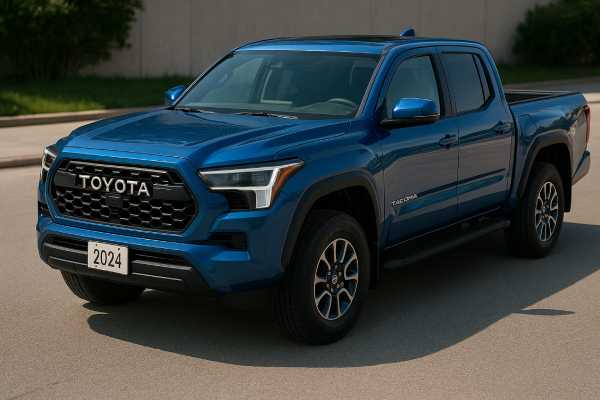
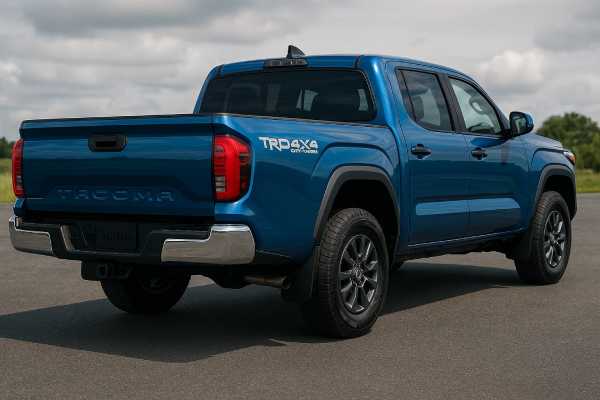
The fourth-generation Toyota Tacoma 4×4 (N400) with the T24A-FTS 2.4 litre turbo engine in its 228 hp tune is the new “working base” of the lineup. It replaces the old 3.5 V6 with a lighter, more efficient powertrain, modern safety tech, and a much more refined cabin, while keeping the ladder-frame toughness that made earlier Tacomas popular with owners who actually use their trucks.
This configuration typically sits in SR and lower mid trims, offering part-time four-wheel drive, the same TNGA-F chassis as the Tundra and Land Cruiser, and a mix of leaf- or coil-spring rear suspensions depending on grade. You get real low-range gearing, solid payload for a mid-size truck, and respectable efficiency for a gasoline 4×4. At the same time, early owners are dealing with new-platform teething issues, including a significant rear brake hose recall on 4×4 models. This guide walks through specs, capability, reliability and maintenance so you can decide whether this 4×4 Tacoma fits your use case long-term.
Top Highlights
- Turbocharged 2.4 litre four-cylinder (T24A-FTS) delivers 228 hp and strong low–mid-range torque for daily use and light towing.
- New TNGA-F ladder frame, upgraded suspension and four-wheel disc brakes give a more composed ride and better braking than the previous generation.
- Toyota Safety Sense 3.0 with lane assistance and automatic emergency braking is standard on all 2024–present Tacoma 4×4 models.
- Key ownership caveat: 2024–2025 Tacoma 4WD trucks with specific wheel/brake combinations are subject to a rear brake hose recall; separate 2025 4x4s face a front driveshaft recall.
- Typical oil and filter interval is 10,000 miles / 12 months under normal service; many owners and independent shops recommend 5,000 miles / 6 months for heavy towing or frequent off-road use.
Guide contents
- Tacoma 4×4 turbo overview
- Tacoma 2.4 4×4 specs guide
- Tacoma 4×4 grades and safety tech
- Reliability patterns and workshop actions
- Maintenance schedule and buyer tips
- Driving behaviour, traction and economy
- How the 4×4 Tacoma stacks up
Tacoma 4×4 turbo overview
The N400 Tacoma 4×4 with the 228 hp T24A-FTS engine is the “entry” four-wheel-drive model, but it is not a stripped-down relic. It shares its TNGA-F frame and basic hardware with much more expensive TRD and hybrid grades, so you are getting the same underlying architecture as the top of the range.
In this tune, the 2.4 litre turbo four-cylinder is aimed at buyers who want genuine 4WD traction but do not need the 278 hp or hybrid outputs. Think contractors, outdoor users, and owners who carry gear more often than they tow at the limit. The engine’s low- and mid-range torque is a marked improvement over the outgoing 3.5 V6, especially at everyday RPMs and on grades, while real-world fuel economy is about on par with the previous V6 4×4 despite better performance.
Depending on trim and cab/bed, the 228 hp 4×4 is available with an eight-speed automatic or a six-speed intelligent manual. The manual version may be tuned slightly higher (up to 270 hp and 310 lb-ft) in some configurations, but this article focuses on the automatic’s 228 hp/243 lb-ft baseline because that is the most common spec in North America and aligns with the rated fuel economy figures.
The 4×4 system is a traditional part-time layout with a two-speed transfer case. On most trims, you get a rear limited-slip differential via brake-based traction control; some off-road grades add a mechanical rear locker and curated drive modes (Multi-Terrain Select, CRAWL control). Even in basic form, the 4×4 Tacoma has generous ground clearance, good approach and departure angles for a mid-size truck, and underbody protection in higher trims.
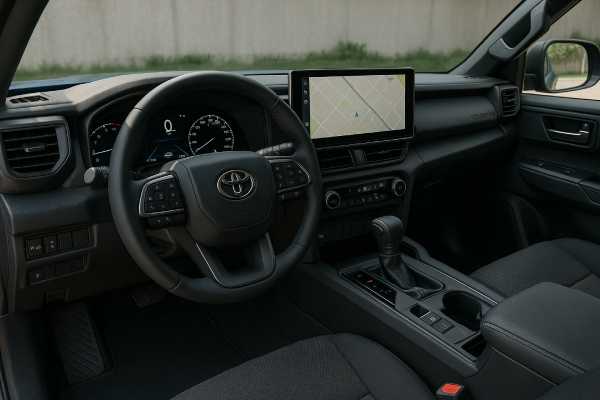
Inside, the new cabin fixes long-standing complaints. The driving position is higher and more natural, there is better adjustment in the seat and steering wheel, and controls feel more like a modern SUV than an old work truck. Standard screen sizes and connectivity vary by trim, but even low-spec 4×4 models get a large central touchscreen, wired or wireless smartphone integration, and the latest Safety Sense suite, making this configuration suitable as both a work tool and a daily family vehicle.
Tacoma 2.4 4×4 specs guide
Engine and performance
For the 228 hp 4×4 variant, the Tacoma uses Toyota’s latest 2.4 litre turbocharged inline-four, coded T24A-FTS.
| Item | Value (Tacoma 4×4, 228 hp tune) |
|---|---|
| Engine code | T24A-FTS |
| Layout and valvetrain | Inline-4, DOHC, 16 valves |
| Displacement | 2.4 L (2,393 cc) |
| Induction | Single turbocharger, intercooler |
| Fuel system | Direct injection (with port assist on some applications) |
| Compression ratio | Approx. 11.0:1 |
| Max power | 228 hp (≈170 kW) |
| Max torque | 243 lb-ft (≈330 Nm) |
| Timing drive | Chain driven |
| Emissions standard | Market-dependent LEV/Euro-equivalent |
| Official combined economy (4×4 auto) | About 21 mpg US (≈11.2 L/100 km) |
| City / highway (4×4 auto) | About 19 / 24 mpg US (≈12.4 / 9.8 L/100 km) |
Real-world highway numbers for non-hybrid Tacomas at 120 km/h (75 mph) tend to sit around the low-20s mpg, which is consistent with the official ratings when tyres and ride height remain stock.
Transmission and driveline
| Item | Value |
|---|---|
| Transmission (auto) | 8-speed automatic, torque converter |
| Transmission (manual, where offered) | 6-speed intelligent manual with rev-matching and anti-stall |
| Drive type | Part-time 4×4 with 2H / 4H / 4L |
| Transfer case | 2-speed, lever or rotary-switch actuated (trim-dependent) |
| Differentials | Front open; rear open with brake-based traction, mechanical locker on TRD Off-Road/Pro |
| Typical axle ratio | ~3.9–4.3:1 depending on tyre and tow package combination |
| Towing capacity (228 hp 4×4) | Typically 3,500 lb (1,588 kg) when properly equipped |
| Payload range (4×4 non-hybrid) | Roughly 1,230–1,700 lb (558–771 kg) depending on cab/bed/trim |
Toyota varies gearing and tow ratings by trim, tyre size and tow package, so always confirm the exact numbers on the door jamb sticker of the individual truck.
Chassis and dimensions
Figures below are representative of a Double Cab, 5 ft bed 4×4 non-hybrid Tacoma; expect small variations by trim, wheel and suspension package.
| Item | Value (approximate) |
|---|---|
| Platform | TNGA-F body-on-frame |
| Front suspension | Double wishbone with coil springs, stabiliser bar |
| Rear suspension | Leaf springs (SR and some SR5); multi-link coils on many higher trims |
| Steering | Electric power steering |
| Brakes | 4-wheel discs with ABS and EBD |
| Wheelbase | 131.9 in (≈3,350 mm) |
| Overall length | ≈213.0 in (≈5,410 mm) |
| Width (without mirrors) | ≈77.9 in (≈1,980 mm) |
| Height | ≈74–75 in, depending on tyres/trim |
| Ground clearance | ~9.5–11.0 in (≈240–280 mm), trim and tyre dependent |
| Fuel tank capacity | ≈18.2 US gal (≈69 L) |
| Curb weight (4×4 non-hybrid) | Roughly 4,400–4,800 lb (1,996–2,177 kg) |
Performance and capability
Independent testing of higher-output non-hybrid 4×4 Tacomas shows 0–60 mph in about 7.0 seconds. The 228 hp tune in heavier 4×4 configurations is more modest, typically in the mid-8-second range to 60 mph, but still well within class norms for a base engine.
| Metric | Typical value / notes |
|---|---|
| 0–60 mph (96 km/h) | ≈8–9 s (estimate for 228 hp 4×4 auto) |
| Top speed | ≈105–110 mph (electronically limited, trim-dependent) |
| Braking (100–0 km/h) | Competitive for the class; varies with tyre package |
| Max towing (228 hp 4×4) | Generally 3,500 lb (1,588 kg) |
| Max towing (i-FORCE 4×4 higher output) | Up to roughly 6,000–6,500 lb with correct configuration |
| Roof load | Typically 150–165 lb (75–75 kg) dynamic with factory rails; confirm for your market |
The 228 hp 4×4 Tacoma is well-suited to lighter trailers, small boats, and camper shells, but regular heavy towing is better handled by the stronger i-FORCE or hybrid versions.
Fluids and service data (indicative)
Exact capacities vary; always confirm against documentation for your VIN.
| System | Specification (example) | Approx. capacity |
|---|---|---|
| Engine oil | SAE 0W-20 API SP full synthetic | ≈5.9 US qt (≈5.6 L) with filter |
| Engine coolant | Toyota Super Long Life Coolant (pink) | ≈10–11 L total fill |
| ATF (8-speed auto) | Toyota ATF WS | ≈7–8 L for full exchange |
| Manual gearbox | 75W-85 GL-4/GL-5 (per manual) | ≈2–3 L |
| Front diff | 75W-85 GL-5 | ≈0.9–1.0 L |
| Rear diff | 75W-85 GL-5 | ≈1.5–2.0 L |
| Transfer case | Toyota gear oil, typically 75W-90 | ≈1.0–1.5 L |
| A/C refrigerant | R-1234yf | Model-specific charge amount |
Electrical basics:
- Alternator output is typically around 130–150 A on non-hybrid Tacomas.
- The 12 V battery is a pickup-size group with around 600–700 CCA, depending on market and equipment.
Tacoma 4×4 grades and safety tech
Trims and options for the 228 hp 4×4
The 228 hp 4×4 configuration is centred on SR and similar work-oriented trims in most markets. It combines four-wheel drive with a simpler feature set and the lower engine tune, keeping price and complexity down while still delivering TNGA-F underpinnings.
Typical characteristics:
- SR 4×4
- i-FORCE 2.4, 228 hp with 8-speed auto (manual in limited combinations).
- Leaf-spring rear suspension on XtraCab and many Double Cab trucks.
- Two-speed transfer case with 2H/4H/4L.
- Smaller wheels and a more modest interior, but the same core structure and safety systems as higher trims.
- SR-based fleet/work specs
- Often add cruise control, extra USB ports and convenience features without changing the fundamental powertrain or 4×4 hardware.
Moving up into TRD Off-Road, TRD Sport, Limited and Trailhunter generally brings the higher-output 278 hp or i-FORCE MAX hybrid, rear coil suspension, upgraded shocks, locking rear differentials, and larger wheel/tire packages. Treat those as separate variants: they share the engine family but offer different outputs and capabilities.
Visual identifiers for a 228 hp 4×4 include plain “i-FORCE” badging without “MAX”, SR-style trim cues, smaller wheels, and a lower tow rating on the door jamb label compared with i-FORCE MAX trucks.
Safety ratings
The 2024 Tacoma crew cab has been tested by major safety organisations and has earned strong crashworthiness ratings, including recognition as a Top Safety Pick in certain headlight and trim combinations. The cab structure and airbag layout are shared across 4×4 trims, so the 228 hp variant benefits from the same basic engineering.
Key safety features:
- Front, side, curtain and driver’s knee airbags.
- Improved head restraints and seat designs compared with the prior generation.
- Strong small-overlap and moderate-overlap crash performance for the crew cab.
NHTSA star ratings continue to roll out by cab and drivetrain, but the overall package is clearly engineered to meet modern crash standards.
Safety systems and ADAS
All new Tacoma 4x4s get Toyota Safety Sense 3.0 as standard equipment, typically including:
- Pre-Collision System with pedestrian and cyclist detection.
- Lane Departure Alert with Steering Assist plus Lane Tracing Assist when adaptive cruise is active.
- Full-speed Dynamic Radar Cruise Control.
- Road Sign Assist and Automatic High Beams.
Additional systems, depending on trim and packages:
- Blind Spot Monitor with Rear Cross-Traffic Alert.
- Parking sonar and, on higher trims, a 360° camera with off-road views.
- Trailer sway control integrated into stability control.
ADAS calibration is critical after windshield replacement, front bumper repairs, suspension lifts, or wheel/tire changes. Many procedures require a scan tool and targets or a specialised alignment bay, so plan for this when modifying the truck.
Because of the rear brake hose recall that specifically targets 4×4 Tacomas with certain wheel and brake combinations, any buyer or owner of a 2024–2025 4×4 should run a VIN check and confirm that the brake hose and driveshaft-related recalls have been completed. Dealers can provide a printout showing recall and campaign status; keep this with the service records.
Reliability patterns and workshop actions
Where the platform stands so far
The N400 Tacoma is still early in its lifecycle, so long-term reliability statistics are limited. The good news is that the T24A-FTS 2.4 turbo is already used in other Toyota and Lexus models, where it has not shown systematic hard failures when serviced correctly. That said, it brings the usual turbo/DI realities: sensitivity to oil quality, PCV control, and intake cleanliness over time.
So far, the most important reliability stories for Tacoma 4×4 owners involve recalls and early production refinements rather than major mechanical flaws.
Emerging issues and their impact
1. Rear brake hose recall (common, high severity)
Some 2024–2025 Tacoma 4WD trucks with particular wheel and brake setups were built with rear brake hoses that can be damaged by mud and debris, potentially leading to leaks and reduced braking. The official remedy is a recall campaign in which dealers replace both rear brake hoses with improved parts. Owners should verify that this work has been completed before using the truck off-road or for towing.
2. Front driveshaft recall (limited, high severity)
Certain 2025 Tacoma 4WD trucks are involved in a separate recall relating to front driveshaft joints manufactured from improper material. In the worst case, joint failure could affect vehicle control or allow movement when parked on some full-time 4WD designs. Affected trucks require dealer inspection and replacement of the driveshaft assembly where necessary.
3. Typical turbo DI wear mechanisms (occasional, medium severity)
As with other turbocharged, direct-injected engines:
- Intake valve deposits can build up over time, especially with short-trip use.
- Sludge formation or oil breakdown from extended intervals can accelerate turbo and timing-chain wear.
- PCV system performance and intercooler plumbing should be inspected periodically on high-mileage or heavily used trucks.
None of these are currently widespread failures in N400 Tacomas, but they are sensible watch-points as mileage accumulates.
4. Driveline, suspension and corrosion
The fully boxed TNGA-F frame is an improvement over older Tacoma designs, but no ladder frame is immune to rust. Trucks run in salty climates still need:
- Annual underbody washing.
- Regular inspection of frame rails, crossmembers, leaf/coil mounts and welds.
- Prompt treatment of stone chips and surface rust.
Off-road use accelerates wear on bushings, ball joints, and steering components. Lifted trucks or those with larger tyres should be checked frequently for driveline vibration and alignment issues.
Software, TSBs and calibrations
New platforms usually see a series of Technical Service Bulletins over the first few years. Common themes include:
- Engine and transmission software updates to improve shift quality, throttle response, and refinement.
- ADAS calibrations to address nuisance warnings or camera/radar issues.
- Infotainment updates to fix bugs, freezing or compatibility problems.
When buying or servicing a Tacoma 4×4, ask for a printout of applied TSBs and confirm that there are no outstanding software or safety campaigns.
Pre-purchase service actions
Before committing to a used N400 Tacoma 4×4:
- Confirm all safety recalls (brake hoses, driveshaft, and any regional campaigns) are closed.
- Verify documented oil changes at realistic intervals, ideally with invoices showing correct oil type.
- Look for evidence of differential, transfer case and transmission services if the truck has towed or seen frequent 4WD use.
- Inspect for signs of hard off-road use: bent skid plates, dented crossmembers, damage to exhaust or fuel tank areas, and excessive underbody scrapes.
Maintenance schedule and buyer tips
Practical maintenance schedule
A simple, robust maintenance plan for a non-hybrid Tacoma 4×4 2.4 turbo can look like this (always confirm with your manual):
- Every 5,000–6,000 miles (8,000–10,000 km) or 6 months
- Engine oil and filter in heavy-use conditions (towing, off-road, short trips).
- Tyre rotation and pressure check.
- Visual inspection for leaks, damaged boots, and loose steering or suspension parts.
- Every 10,000 miles (16,000 km) or 12 months
- Engine oil and filter for normal-duty use.
- Cabin air filter inspection and replacement as needed.
- Brake system inspection (pads, rotors, lines, hoses, parking brake).
- Every 30,000–40,000 miles (50,000–65,000 km)
- Engine air filter (sooner in dusty environments).
- Front and rear differential oil changes, especially if you see regular 4WD use.
- Transfer case oil change.
- Every 60,000–90,000 miles (96,000–145,000 km)
- Automatic transmission fluid drain-and-fill.
- Manual gearbox oil (if equipped).
- Spark plugs, especially on a turbo DI engine.
- Comprehensive suspension and steering inspection for bushing and joint wear.
- Every 100,000–120,000 miles (160,000–190,000 km)
- Coolant replacement with Toyota Super Long Life Coolant.
- More detailed inspection of frame, brake hard lines, and mounting points.
Brake fluid should be replaced roughly every 3 years regardless of mileage. The timing chain is not a scheduled replacement item, but you should monitor for chain rattle on start-up and any timing correlation codes that suggest stretch or tensioner wear.
Key fluids and torque considerations
For most owners, the main decision points are:
- Use 0W-20 full synthetic oil that meets Toyota’s latest specifications.
- Stick with ATF WS in the automatic and the recommended GL-5 grades in diffs and transfer case.
- Use the correct coolant type; mixing coolants can reduce service life and protective qualities.
When doing your own work, always follow factory torque specs. As a rough orientation:
- Oil drain plugs typically fall around 30–40 lb-ft.
- Wheel lug nuts are usually around 80–90 lb-ft.
These are examples only; always verify exact values in official data before tightening fasteners.
Buyer’s checklist for the 4×4 Tacoma
When inspecting a Tacoma 4×4 228 hp, new or used:
- Underbody and frame: Look for impact damage, bends in crossmembers, and any signs of patchy undercoating that might conceal rust.
- Brake hoses and lines: On 2024–2025 trucks, check that rear brake hoses look new and are properly routed, and ask for recall paperwork.
- Driveline: In both 2H and 4H, drive at low speed and listen for clunks, grinding or binding. Engage 4L on an appropriate surface and confirm smooth operation.
- Cooling system: Check coolant level and condition; look around hose joints and the water pump area for crusty residue or staining.
- Electronics and ADAS: Test adaptive cruise, lane tracing, road sign assist, cameras and parking sensors. Persistent warnings can mean calibration or hardware problems.
- Tyres and alignment: Uneven wear hints at alignment issues, bent components or poor-quality lift installations.
Long-term outlook
The N400 Tacoma 4×4 combines Toyota’s long-standing strengths—body-on-frame durability, parts support, and resale value—with a more modern turbo engine and electronics package. The trade-offs are predictable: more software, more sensors, and more need to follow maintenance schedules closely. With recalls addressed and fluids changed sensibly, there is every reason to expect the 228 hp 4×4 Tacoma to deliver long service life for owners who keep up with care and keep rust at bay.
Driving behaviour, traction and economy
Ride, handling and NVH
The TNGA-F chassis and new suspension geometry make the N400 Tacoma more settled than its predecessor. Even leaf-spring 4×4 SR models feel better tied down over broken pavement than older trucks, while coil-spring rear suspensions on higher trims deliver an appreciably smoother ride.
Steering feel is more precise, with a more natural on-centre stance on the highway. The taller driving position and improved seat adjustment help reduce fatigue on long drives. Cabin refinement is also better: wind and tyre noise are lower, and the engine is better insulated at cruising speeds, though you will still hear it when the turbo is working hard.
On dirt and gravel, the Tacoma feels secure and predictable. Unladen, the rear end can still skip a little over sharp washboard, but damping is improved and the stability control system is tuned to allow some slip before intervening, especially in the right drive mode.
Powertrain character
The 2.4 turbo in 228 hp trim is tuned for torque and efficiency rather than outright performance:
- Off-idle pull is strong enough that starts feel relaxed even with mild grades.
- The 8-speed automatic keeps revs low at cruise but kicks down promptly when you ask for more power.
- There is a hint of lag if you floor the accelerator from very low revs, but for normal driving the response is smooth and predictable.
With the manual gearbox, the higher tune available in some markets makes the truck more spirited, particularly off the line and on back roads. The intelligent manual’s rev-matching and hill-hold functions help in traffic and off-road crawling.
Real-world efficiency
Owners of non-hybrid 4×4 Tacomas generally see:
- Around 17–20 mpg US in busy city use.
- Around 21–24 mpg US on the highway at 65–75 mph, depending on wind, terrain and tyres.
- Mixed averages in the 19–22 mpg US range for everyday commuting and weekend use.
Lifts, large all-terrain or mud-terrain tyres and roof racks can easily cut 2–3 mpg from those figures, especially at motorway speeds where aerodynamic drag dominates. Towing within the 3,500 lb rating typically reduces fuel economy by 30–40%.
Traction, off-road behaviour and towing
With its part-time 4×4 system, low range and availability of a rear locker on some trims, the Tacoma 4×4 is fully capable for most recreational off-road use:
- In 4H, it handles snowy roads, wet fields and rough tracks with confidence.
- In 4L, low gearing and the turbo’s torque let you crawl obstacles without excessive throttle.
- A rear locker (where fitted) plus traction control and terrain modes help on loose climbs and off-camber situations.
For towing, the 228 hp 4×4 is best treated as a light-to-moderate tower:
- Stability is good with properly set up trailers under 3,500 lb.
- Tow/Haul mode adjusts shift points and engine braking on grades.
- Braking remains strong, but a well-configured trailer brake controller is essential for heavier loads.
Drivers who frequently tow near the top of the mid-size class or cross very mountainous terrain should consider the more powerful i-FORCE or hybrid variants, which provide extra torque and higher tow ratings.
How the 4×4 Tacoma stacks up
The 228 hp Tacoma 4×4 competes directly with entry and mid-level four-wheel-drive versions of the Chevrolet Colorado, GMC Canyon, Ford Ranger, Nissan Frontier and Jeep Gladiator.
Colorado and Canyon bring strong turbo engines, big towing numbers and polished on-road manners, but rely heavily on higher output tunes to feel their best. They suit buyers who value acceleration and towing above long-term simplicity.
Ford Ranger offers a similarly modern turbo four and strong towing, with an interior layout that feels very up to date. It leans slightly more toward on-road refinement and performance than base Tacomas, while the Toyota leans into long-term durability and off-road-friendly trims.
Nissan Frontier keeps a naturally aspirated V6 and more traditional character. Its strengths are simplicity and a proven drivetrain; its weaknesses are higher fuel consumption and less comprehensive driver assistance coverage.
Jeep Gladiator is in many ways a different proposition: open-air capability and extreme off-road potential at higher cost, weight and fuel consumption. Compared to the Tacoma, the Gladiator is more of a lifestyle vehicle, while the Tacoma is easier to live with as a daily driver.
For many buyers, the Tacoma 4×4’s biggest advantages are:
- Toyota’s durability reputation and deep dealer/parts network.
- Strong resale values in most markets.
- A huge aftermarket ecosystem for suspension, armour, storage and overlanding equipment.
Its main drawbacks are:
- Less outright performance than some turbo rivals at similar price points.
- The complexity of a modern turbo/DI engine compared with older naturally aspirated Tacomas.
- Early recall activity that needs to be carefully tracked and confirmed for any truck you buy.
If you want a mid-size 4×4 that blends real off-road capability, solid towing for most recreational users, and long-term parts support, the 228 hp Tacoma 4×4 is a very capable and sensible base to build on.
References
<a href="https://pressroom.toyota.com/2024-toyota-tacoma-is-the-ultimate-adventure-machine/">2024 Toyota Tacoma is the Ultimate Adventure Machine</a> 2023 (Manufacturer Newsroom)<a href="https://www.fueleconomy.gov/feg/bymodel/2024_Toyota_Tacoma.shtml">Gas Mileage of 2024 Toyota Tacoma</a> 2024 (Fuel Economy Data)<a href="https://www.iihs.org/ratings/vehicle/toyota/tacoma-crew-cab-pickup/2024">2024 Toyota Tacoma</a> 2024 (Safety Rating)<a href="https://www.nhtsa.gov/vehicle/2024/Toyota/Tacoma">Vehicle Detail Search - 2024 Toyota Tacoma | NHTSA</a> 2024 (Recall Database)<a href="https://pressroom.toyota.com/toyota-recalls-certain-2024-2025my-toyota-tacoma-4-wheel-drive-trucks/">Toyota Recalls Certain 2024-2025MY Toyota Tacoma 4-Wheel Drive Trucks</a> 2025 (Recall Notice)
Disclaimer
This article is for informational purposes only and is not a substitute for professional diagnosis, repair, or safety advice. Specifications, torque values, fluid capacities, service intervals and procedures can vary by VIN, production date, market and equipment package. Always confirm details using the official owner’s manual, repair manual and current technical information for your specific vehicle, and follow all safety instructions when working on or around a vehicle.
If you found this guide helpful, you are welcome to share it with other owners and enthusiasts on platforms such as Facebook or X/Twitter to support xcar’s work and help more people make informed decisions about their Tacoma.