
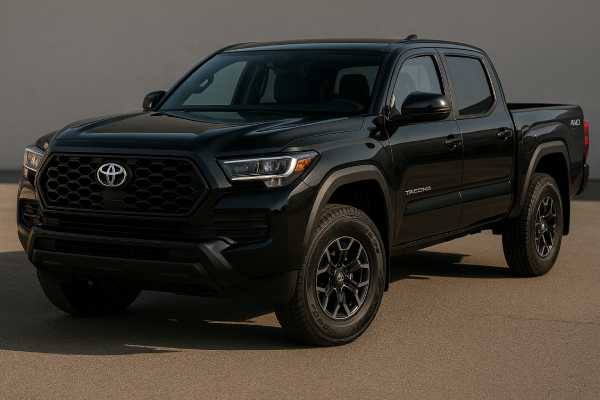
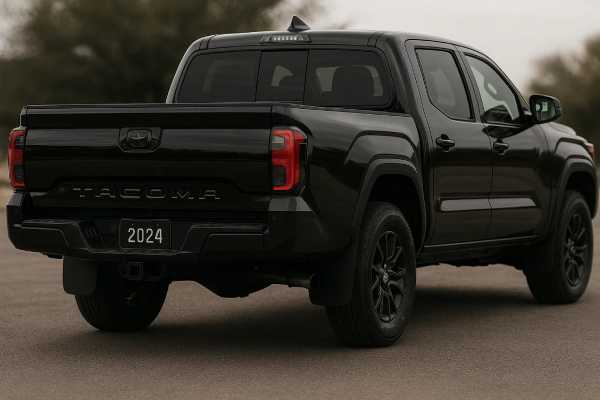
The 2024-on Toyota Tacoma 4×4 (N400) with the 270 hp T24A-FTS 2.4-litre turbo four and six-speed manual is a rare thing in today’s market: a mid-size pickup that still caters to drivers who enjoy shifting their own gears. Under the new N400 chassis, Toyota has paired a modern ladder frame and available coil-spring rear suspension with a compact, high-output turbo engine and a familiar part-time 4×4 system.
This 270 hp tune is focused on enthusiasts who want control and mechanical feel more than outright refinement. It trades some smoothness for a direct driving experience, respectable towing figures, and a strong low- to mid-range torque curve. At the same time, Toyota Safety Sense, improved crash performance, and modern infotainment make it easier to live with as an everyday truck.
This guide walks through the key specs, engineering, real-world behaviour, known issues, and ownership patterns to help you decide whether this specific Tacoma 4×4 manual suits your needs.
Essential Insights
- 270 hp T24A-FTS turbo four with 310 lb-ft gives stronger low-rpm pull than the old V6, especially off-road and when towing.
- Six-speed manual and part-time 4×4 system make this one of the last truly driver-focused mid-size pickups.
- New N400 frame, multi-link rear (on most 4×4 trims), and modern safety systems improve comfort and crash protection over the previous generation.
- Early recalls have targeted rear brake hoses and digital instrument clusters; checking recall completion is important before purchase.
- Typical oil change interval is 10,000 miles / 12 months in normal use, but 5,000 miles / 6 months is wise for frequent towing or off-road use.
Navigate this guide
- Tacoma 270 hp 4×4 profile
- Tacoma 270 hp specs breakdown
- Tacoma 4×4 trims and protection
- Long term reliability outlook
- Ownership maintenance and purchase advice
- On road and off road behaviour
- Tacoma 270 hp versus competitors
Tacoma 270 hp 4×4 profile
The 270 hp 4×4 manual version of the N400 Tacoma occupies a very specific niche in the lineup. It uses the T24A-FTS 2.4-litre turbocharged four-cylinder in a slightly detuned state compared with the 278 hp automatic variant, but keeps a strong 310 lb-ft torque output. The engine is paired with a six-speed manual gearbox and a traditional part-time 4×4 system with a two-speed transfer case, aimed at buyers who prioritise driver involvement and mechanical simplicity.
In practice, this configuration is most commonly found on Double Cab 4×4 models in work-oriented SR trim and enthusiast-focused TRD Sport and TRD Off-Road grades. These trucks share the same basic architecture: a boxed ladder frame, independent front suspension, and either a multi-link coil-spring rear axle (on most higher trims) or leaf springs on some work variants. Ground clearance and approach/departure angles are competitive, especially when fitted with the available off-road suspension and all-terrain tyres.
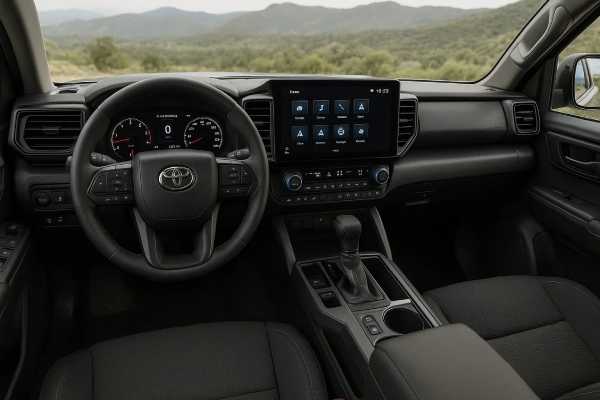
Inside, the 270 hp Tacoma feels more modern than prior generations, with a tall, upright dashboard, large central screen, and plenty of physical controls that can be used with gloves. Seating position, steering wheel adjustment, and pedal layout all suit medium to tall drivers well, although the rear seat remains tight for adults on longer journeys. The six-speed manual adds a long, truck-like shift throw and a clutch that demands some familiarity, but it gives a level of connection that automatic rivals cannot match.
Ownership appeal centres on a combination of Toyota’s track record for durability, the flexibility of the turbocharged four-cylinder for towing and off-road work, and the rare chance to buy a new body-on-frame pickup with three pedals. For drivers who care less about absolute refinement and more about feel, the 270 hp 4×4 manual Tacoma stands out as a deliberate, old-school choice in a modern wrapper.
Tacoma 270 hp specs breakdown
Engine and performance (T24A-FTS 270 hp tune)
The 270 hp Tacoma 4×4 uses the i-FORCE 2.4-litre T24A-FTS engine in a specific calibration for the manual gearbox:
| Item | Specification |
|---|---|
| Engine code | T24A-FTS |
| Layout and cylinders | Inline-4, DOHC, 4 valves per cylinder |
| Displacement | 2.4 L (2393 cc) |
| Induction | Turbocharged (single turbo) |
| Fuel system | Direct and port injection (D-4ST) |
| Compression ratio | 11.0 : 1 |
| Max power | 270 hp (approx. 201 kW) @ ~5400 rpm |
| Max torque | 310 lb-ft (approx. 421 Nm) @ ~2800 rpm |
| Timing drive | Chain |
| Emissions standard | US Tier 3 / LEV III equivalent |
| Recommended fuel | Regular unleaded (87 AKI) in most markets |
Fuel economy and efficiency for a 4×4 Double Cab with six-speed manual and short bed are typically rated around:
| Cycle | mpg US | L/100 km (approx.) |
|---|---|---|
| City | 18 mpg | ~13.1 L/100 km |
| Highway | 23 mpg | ~10.2 L/100 km |
| Combined | 20 mpg | ~11.8 L/100 km |
Real-world reports at 120 km/h (75 mph) often sit slightly below the official highway rating, especially on trucks with off-road tyres or added accessories. A realistic highway consumption figure for a lightly modified 4×4 manual is around 11–12 L/100 km (19–21 mpg US), with heavier loads or lift kits pushing it higher.
Transmission and driveline
The 270 hp N400 4×4 manual uses a six-speed gearbox from Toyota’s RC family combined with a part-time transfer case and solid rear axle.
| Item | Specification |
|---|---|
| Transmission type | 6-speed manual (iMT rev-matching available) |
| Likely transmission family | RC60F derivative |
| 1st gear | 4.78 : 1 (approx.) |
| 2nd gear | 2.42 : 1 |
| 3rd gear | 1.44 : 1 |
| 4th gear | 1.00 : 1 |
| 5th gear | 0.78 : 1 |
| 6th gear | 0.64 : 1 |
| Reverse | ~4.07 : 1 |
| Final drive ratio | Around 4.30 : 1 on manual 4×4 trims |
| Drive type | Part-time 4×4, 2H / 4H / 4L, rear limited-slip or locker depending on trim |
| Transfer case | Two-speed, electronic-actuated on most trims |
Short gearing in 1st keeps low-speed manoeuvring and off-road crawling manageable, while double overdrive (5th and 6th) helps keep engine revs down at highway speeds. The trade-off is a noticeable gap between 1st and 2nd that encourages higher-rpm shifts when accelerating briskly.
Chassis, dimensions and capacities
Figures below describe a typical 2024 Tacoma 4×4 Double Cab short-bed manual (TRD-type configuration). Exact numbers vary slightly by trim and equipment.
| Item | Specification (approx.) |
|---|---|
| Frame | Boxed ladder frame, high-strength steel |
| Front suspension | Independent double wishbone with coil springs |
| Rear suspension (most 4×4 trims) | Multi-link solid axle with coil springs (leafs on some work trims) |
| Steering | Electric power steering |
| Brakes | 4-wheel discs, ventilated front; ABS with EBD |
| Wheelbase | 131.9 in (3350 mm) |
| Length | 213.0 in (approx. 5410 mm) |
| Width (without mirrors) | 77.9 in (approx. 1980 mm) |
| Height | ~74.4 in (approx. 1890 mm), trim-dependent |
| Ground clearance | Around 9.5 in (approx. 241 mm) on off-road trims |
| Approach / departure / breakover | Roughly 32.5° / 22.2° / 24.7° (off-road-oriented trims) |
| Curb weight | ~4760 lb (approx. 2160 kg) |
| GVWR | ~6170 lb (approx. 2800 kg), trim-dependent |
| Fuel tank | ~21.1 US gal (approx. 80 L) |
Cargo and towing figures:
| Item | Specification (approx.) |
|---|---|
| Bed length | 5-ft bed standard, 6-ft optional on some trims |
| Payload | ~1350–1400 lb (610–635 kg) for typical 4×4 manual Double Cab |
| Max towing capacity | Up to ~6400 lb (2900 kg) when properly equipped |
| Roof load | Typically 165–220 lb (75–100 kg) with appropriate racks |
Fluids and service capacities (typical values)
Always confirm exact capacities and fluid specs by VIN and market, but common figures for the 2.4-litre turbo 4×4 manual are:
| System | Fluid and spec | Approx. capacity |
|---|---|---|
| Engine oil | 0W-8 or 0W-20, API SP / ILSAC GF-6 | ~5.3 L (5.6 US qt) including filter |
| Engine coolant | Toyota Super Long Life or equivalent | ~7–8 L (7.4–8.5 US qt) |
| Manual transmission | GL-4 or GL-5 75W-85 / 75W-90 (per manual) | ~2.5–3.0 L |
| Transfer case | Gear oil per manual spec | ~1.3–1.5 L |
| Front differential | Gear oil per manual spec | ~1.0–1.2 L |
| Rear differential | Gear oil per manual spec (often 75W-85 / 75W-90) | ~2.3–2.7 L |
| A/C refrigerant | R-1234yf, exact charge by label | Model-specific |
| A/C compressor oil | ND-type POE oil | Model-specific |
Electrical
| Item | Specification (typical) |
|---|---|
| Alternator | ~130–150 A output, depending on trim and equipment |
| 12 V battery | ~60–70 Ah, ~600–700 CCA, Group 24F or similar |
| Spark plugs | Long-life iridium, gap around 0.7–0.8 mm; replacement interval often 80,000–100,000 miles |
Safety and driver assistance
The N400 Tacoma introduces a more modern safety structure and a full Toyota Safety Sense suite:
| System / Rating | Details (2024 Crew Cab) |
|---|---|
| Overall IIHS rating | Top Safety Pick for 2024 crew-cab models with specific headlights |
| Moderate overlap front (updated) | Acceptable to Good depending on configuration |
| Small overlap front | Generally Good on driver and passenger sides |
| Side impact | Good |
| Head restraints and seats | Good |
| Headlights | Mix of Acceptable and Marginal depending on trim and lighting package |
| Front crash prevention | Good performance in vehicle-to-vehicle and vehicle-to-pedestrian tests |
| ADAS features (TSS) | Pre-collision with pedestrian and cyclist detection, lane departure alert and steering assist, lane-tracing assist, adaptive cruise control, road sign assist, automatic high beams; blind-spot monitoring and rear cross-traffic alert available or standard on many trims |
Tacoma 4×4 trims and protection
Where the 270 hp 4×4 manual fits in the range
The 270 hp i-FORCE 4×4 manual powertrain is offered on a limited number of 2024-on Tacoma trims, most of them Double Cab models:
- SR 4×4 Double Cab – often the entry point for the 270 hp manual combination, focused on work use, steel wheels, more basic interior, but still with core safety tech.
- TRD Sport 4×4 Double Cab – street- and light-trail-oriented, with sport-tuned suspension, larger wheels, and a more feature-rich cabin.
- TRD Off-Road 4×4 Double Cab – adds off-road-specific suspension tuning, all-terrain tyres, underbody protection, and often a locking rear differential and terrain-select modes.
The manual transmission is typically limited to the 2.4-litre i-FORCE engine; hybrid i-FORCE MAX and many higher-spec luxury trims are automatic-only.
Key mechanical and functional differences by trim
From an ownership perspective, choosing between trims shapes how the truck feels and what hardware you get:
- Suspension and ride
- SR 4×4 may use a simpler rear suspension and smaller wheels for durability and cost.
- TRD Sport prioritises on-road control, with firmer damping and larger wheels but sometimes less compliance on broken pavement.
- TRD Off-Road tends to ride more comfortably at speed over rough surfaces thanks to off-road-tuned dampers and taller-sidewall tyres.
- Driveline hardware
- Many TRD Off-Road manuals include an electronic locking rear differential and a more advanced 4×4 control interface.
- Crawl Control and multiple terrain modes are often packaged with off-road trims and specific option bundles.
- Tow and payload ratings
- Manual 4×4 configurations commonly fall short of the highest available Tacoma tow ratings (which are reserved for certain automatic configurations), but a properly equipped 270 hp manual can still tow around 6400 lb.
- Payload varies by trim: SR-type models may offer slightly higher payload thanks to fewer comfort options.
Safety equipment and ratings by trim
All modern N400 Tacomas, including the 270 hp 4×4 manual, benefit from the same core structure and airbag layout:
- Front, side, curtain and driver’s knee airbags as standard.
- Three-point belts on all seating positions with pre-tensioners in front.
- LATCH/ISOFIX anchor points in the rear outboard seats for child seats.
- Electronic stability control, traction control, and trailer sway control across the board.
Toyota Safety Sense features are standard on every new Tacoma, though the exact contents can vary. Higher trims are more likely to include:
- Full-speed dynamic radar cruise control.
- Lane-tracing assist that actively centres the truck in its lane.
- More advanced parking aids (front and rear sonar, panoramic camera systems).
- Better headlight systems (projector LEDs or adaptive arrays), which help achieve higher safety ratings.
Crash ratings from independent bodies are usually tied to body style, weight, and headlight performance rather than specific powertrain tunes. The 270 hp 4×4 manual, as a Double Cab 4×4, fits squarely into the tested configuration that achieved Top Safety Pick when paired with the better headlight options.
Calibration implications after repairs
With the amount of driver assistance hardware on the N400, certain repairs on a 270 hp Tacoma 4×4 demand post-service calibrations:
- Windshield replacement may require recalibration of forward-facing cameras.
- Front bumper or grille work can disturb radar sensors.
- Suspension lifts or significant alignment changes can affect lane-keeping and pre-collision performance, sometimes needing reconfiguration or at least verification.
For owners planning heavy modifications – bigger tyres, lifts, aftermarket bumpers – budget both for the mechanical work and for ADAS checks afterwards to maintain proper function.
Long term reliability outlook
Because the 270 hp 4×4 manual Tacoma is part of a new generation, long-term data is still developing. However, it is built on familiar design principles and shares hardware with other Toyota models using the T24A-FTS engine. That lets us draw careful, early conclusions while flagging areas to watch.
Engine and powertrain patterns
Early experiences with the 2.4-litre turbo in various Toyota products show generally robust performance when serviced on time, but some themes are worth monitoring:
- Turbocharged four-cylinder character – The T24A-FTS can feel and sound busier than the outgoing V6, especially in the higher-load manual 4×4 application. Occasional vibrations and noise are more a refinement concern than an outright reliability problem.
- Oil quality and change intervals – Turbocharged engines are sensitive to oil condition. Sticking rigidly to 10,000-mile oil changes on a truck that tows or sees a lot of off-road time is optimistic; 5,000-mile changes with high-quality oil give more margin against deposit build-up and turbo wear.
- Cooling system – There are no widespread cooling issues yet, but pay attention to coolant leaks around hoses and plastic fittings as the trucks age, especially in hot climates or where towing is common.
The manual gearbox introduces its own points of interest:
- Shift quality and noise – Owners report long throws, a wide gap between 1st and 2nd, and some gear whine at higher speeds, especially in 6th. Mild whine under load can be normal; a pronounced growl or notchiness that worsens over time suggests checking fluid level, condition, and possibly synchroniser wear.
- Clutch wear – Trucks driven off-road or in heavy traffic with frequent hill starts may see clutch wear sooner than highway-only examples. Judder, engagement near the very top of pedal travel, or slipping under load are signs to investigate.
Chassis, body and corrosion
Toyota has a long history of frame and underbody corrosion concerns on older Tacomas. The N400 frame uses more protective coatings and better design, but owners should still be proactive:
- Regularly rinse the frame, inner leaf-spring or link mounts, and rear axle housing, especially if you drive on salted winter roads or off-road in mud.
- Inspect drain holes in frame rails to ensure they are not clogged.
- Pay attention to welded seams near the rear suspension and tow hitch for early rust signs.
The new multi-link coil-spring rear on many 4×4 trims can improve comfort but adds bushings and links that will age. Listen for knocks, clunks, or wandering from the rear; worn bushings or dampers are common mid-life service items rather than structural failures.
Recalls, TSBs and software updates
By the time you read this, several important campaigns may already apply to 2024–2025 4×4 Tacomas, including 270 hp manual trucks:
- Rear brake hose recall – Certain 4-wheel-drive Tacomas with 16-inch rear brakes and 17-inch wheels can experience mud and dirt build-up inside the wheel that abrades the rear brake hoses. Over time, this can cause a brake fluid leak and reduced braking performance. The remedy is replacement of the rear brake hoses with an updated design at no cost.
- Instrument cluster software recall – Some Tacomas are part of a wider campaign addressing digital instrument clusters that may fail to display vital information (speed, warning lights) at startup. Fixes typically involve a software update or, in some cases, component replacement.
In addition to formal recalls, watch for technical service bulletins (TSBs) that address:
- Manual transmission gear whine, particularly in 5th/6th under load.
- Calibration tweaks to engine management for drivability issues such as hesitation or surging.
- Infotainment bugs, including intermittent disconnections from smartphone integration.
Always check recall status by VIN through official channels and ask for printed dealer records showing completed campaign work.
Pre-purchase checks for used buyers
If you are looking at a used 270 hp 4×4 manual Tacoma, ask for:
- A full service history with clear intervals for oil, coolant, and gear oils.
- Proof that brake hose and instrument cluster recalls have been completed.
- Evidence of proper break-in and fluid services if the truck has been used for towing from new.
- Inspection notes for clutch condition, any driveline noises, and underbody corrosion.
Given the truck’s off-road appeal, spend extra time under the vehicle checking for bent skid plates, impacts to the fuel tank or exhaust, and damage to suspension arms or steering components.
Ownership maintenance and purchase advice
Practical maintenance schedule (typical guidance)
Always follow the maintenance schedule in your official manual, but the outline below is a practical starting point for a 270 hp Tacoma 4×4 used in mixed driving:
- Engine oil and filter – Every 10,000 miles / 12 months in light use; every 5,000 miles / 6 months if you tow, drive off-road regularly, or see extreme temperatures.
- Engine air filter – Inspect every 15,000 miles / 2 years; replace every 30,000 miles sooner if you drive in dusty conditions.
- Cabin air filter – Replace every 15,000–20,000 miles (or annually in dusty/pollen-heavy areas).
- Coolant – First change around 100,000 miles / 10 years, then every 50,000 miles / 5 years, or as specified in the manual.
- Spark plugs – Long-life iridium plugs typically last 80,000–100,000 miles; inspect earlier if misfires or rough running appear.
- Manual transmission oil – Replace around 60,000 miles in mixed use; sooner (30,000–40,000) if you tow regularly or drive in high ambient temperatures.
- Transfer case and differentials – 30,000–60,000 miles depending on usage; shorter intervals for frequent 4×4 use, water crossings, or towing.
- Brake fluid – Replace every 2–3 years regardless of mileage.
- Brake pads and rotors – Inspect at every service; off-road use and towing will wear fronts more quickly.
- Serpentine/auxiliary belts and hoses – Inspect at least every 30,000 miles; replace cracked, glazed, or noisy parts.
- Tyre rotation and alignment – Rotate every 5,000–7,500 miles; check alignment if you notice pulling, uneven wear, or after off-road impacts.
- 4×4 system exercise – Engage 4H and 4L periodically, even if you do not need them, to keep mechanisms lubricated.
- 12 V battery – Load-test annually after three years; typical replacement window is 4–6 years.
For trucks with heavy modifications (bumpers, winches, larger tyres), treat service intervals on driveline fluids and brakes as the “severe use” schedule.
Key fluid specifications and torque examples
Typical values (verify for your specific truck):
- Engine oil – 0W-8 or 0W-20 meeting Toyota’s latest specs; torque for oil drain plug often around 40 Nm (30 lb-ft).
- Wheel lug nuts – Commonly in the 130–150 Nm (95–110 lb-ft) range; check your door-jamb label or manual.
- Differential drain/fill plugs – Often around 50–60 Nm (37–44 lb-ft), but exact values vary.
Using correct torque helps avoid stripped threads in aluminium housings and prevents leaks or warped brake rotors.
Buyer’s guide: what to look for
When shopping for a 270 hp 4×4 manual Tacoma:
- Service history – Prefer trucks with clear, documented maintenance, especially early oil changes and regular inspections.
- Clutch and gearbox feel – On a test drive, check for:
- Smooth engagement without slipping in higher gears under full throttle.
- No grinding when shifting at moderate rpm.
- Only mild, consistent whine in top gear; loud or changing noises point to potential wear.
- 4×4 operation – Engage 4H and 4L on a loose surface and confirm smooth engagement/disengagement with no grinding or warning lights.
- Suspension and steering – Listen for clunks over bumps and feel for wandering at highway speeds; these can signal bushing or alignment issues.
- Underbody and frame – Look for off-road impacts, rust starting around welds or brackets, and any non-factory welds or repairs.
- Electronics and ADAS – Confirm that all driver assistance functions, cameras, and sensors work and that there are no persistent warning lights.
Which years and trims to prioritise
Because this is a new generation, you are primarily choosing between early build 2024 trucks and later 2025-on models:
- Later builds with recall work completed from the factory or early in life are ideal.
- For more comfortable daily driving with occasional trails, a TRD Sport 4×4 Double Cab manual offers a good mix of equipment and the 270 hp drivetrain.
- For more serious off-roading, a TRD Off-Road 4×4 manual with skid plates, locking rear differential, and suitable tyres is the better starting point.
Overall, the 270 hp manual 4×4 Tacoma should offer a long service life if maintained properly. It is best suited to owners who value tactility and mechanical simplicity over the last word in refinement and efficiency.
On road and off road behaviour
Ride, handling and refinement
On the road, the 270 hp Tacoma 4×4 manual remains very much a truck. Compared with softer, more car-like rivals, it feels more upright, with a noticeable body-on-frame character:
- Ride quality – Over smooth pavement the truck is composed, but broken city streets and expansion joints can reveal a firm, sometimes jittery ride, especially on sport-tuned or large-wheel trims. Off-road-oriented suspensions often feel more settled on rough surfaces, at the expense of some roll in quick transitions.
- Steering – Electric power steering provides reasonable accuracy but modest feedback. Straight-line stability on the highway is generally good once aligned and correctly loaded, though large all-terrain tyres will naturally add some wander.
- Noise, vibration and harshness – Wind and tyre noise are well controlled by mid-size truck standards. The 2.4-litre turbo can sound coarse when worked hard, and manual-equipped trucks transmit more drivetrain vibration to the cabin than their automatic counterparts.
Braking performance is solid, with disc brakes and electronic aids providing predictable stops. Instrumented testing on a TRD Sport manual shows stopping distances around 121 ft from 60 mph, which is respectable for the class when the truck is on appropriate tyres and properly loaded.
Powertrain character and performance
The 270 hp / 310 lb-ft tune of the T24A-FTS is designed to provide strong mid-range torque rather than a high-revving top end. In daily use:
- The engine pulls confidently from low rpm, especially in 2nd and 3rd, making it easy to climb grades and tow moderate loads.
- Turbo lag is modest but present; smooth driving comes from keeping the engine in the mid-range and timing throttle and clutch inputs well.
- The six-speed manual’s short 1st gear makes starting on hills easy, but the jump to 2nd requires either a higher-rpm shift or a quick, positive gearchange to keep the engine on boost.
Real-world instrumentation shows:
- 0–60 mph in roughly 7.9 seconds for a TRD Sport 4×4 Double Cab manual.
- Quarter-mile times around 16 seconds at just under 90 mph.
These figures are slower than some automatic rivals and even slightly behind the automatic Tacoma tune, but still adequate for a mid-size pickup focused on utility rather than outright performance.
Fuel economy and range in the real world
EPA-type numbers of around 20 mpg combined for a 4×4 manual Tacoma are realistic if you drive moderately and keep the truck close to stock. In everyday use:
- Steady-state highway cruising at legal speeds can achieve 23–24 mpg (around 10 L/100 km) on stock tyres.
- City driving with frequent stops often yields figures closer to 17–19 mpg (12–14 L/100 km).
- Towing a medium trailer or adding a rooftop tent, larger tyres, and armour can easily reduce economy by 20–30%.
Owners who prefer to preserve the clutch and drivetrain often find that short-shifting and using the engine’s torque, rather than revving it out, brings the best balance of performance and economy.
Off-road traction and control
In off-road conditions, the 270 hp 4×4 manual Tacoma feels most at home:
- Part-time 4×4 with low range allows controlled crawling over rocks, ruts, and steep descents.
- Locking rear differential (where fitted) greatly improves traction in loose or crossed-axle situations, especially with the manual gearbox, where maintaining momentum is vital.
- Terrain modes and crawl control (on equipped trims) help manage throttle and braking on surfaces like sand, mud, and loose rock, but many drivers with manual trucks still prefer traditional pedal control.
Ground clearance and angles are competitive, though you will want proper skid plates if you plan to use the truck’s capability regularly. Manual-equipped trucks especially benefit from driver skill: smooth clutch control and correct line choice minimise wheelspin and driveline shock.
Load and towing behaviour
When towing within its rated limit and properly set up:
- The 270 hp Tacoma 4×4 manual maintains speed reasonably on level ground and moderate grades, but you will downshift more often than with torquier rivals.
- Cooling systems are designed for towing, but watch coolant and oil temperatures on long climbs in hot weather; shifting earlier to keep revs in the torque band can reduce stress.
- Expect fuel consumption to worsen significantly while towing; a 25–40% increase over solo driving is common, depending on trailer size and aerodynamics.
The truck’s relatively short wheelbase compared with full-size pickups makes careful loading, proper hitch setup, and good trailer brakes especially important for stability.
Tacoma 270 hp versus competitors
The Tacoma 4×4 (N400) 270 hp manual finds itself in a field of mostly automatic-only rivals. This shapes its strengths and weaknesses.
Versus Ford Ranger and Chevrolet Colorado
The latest Ford Ranger and Chevrolet Colorado both offer powerful turbocharged four-cylinder engines with more torque than the Tacoma, and their automatic transmissions are generally smoother and quicker. They also tend to feel more refined on-road, with cabins that are quieter and suspensions tuned more for comfort.
Where the Tacoma stands apart:
- Manual transmission availability – The Tacoma is one of the only mid-size pickups still offering a manual with 4×4, which is a deciding factor for some buyers.
- Off-road hardware and aftermarket support – There is strong support for lifts, armour, and expedition gear, and the TRD Off-Road / Sport trims with the manual fit naturally into that ecosystem.
- Perceived long-term durability – Many buyers expect Toyota’s turbo-four and body-on-frame design to hold up well once early recalls and calibrations have been addressed.
However, if you prioritise effortless on-road performance, smooth automatic shifts, and the latest tech, the Ranger and Colorado feel more modern.
Versus Nissan Frontier and Honda Ridgeline
The Nissan Frontier sticks with a naturally aspirated V6 and 9-speed automatic, delivering strong linear power but offering no manual option. The Honda Ridgeline, being unibody and all-automatic, focuses on car-like comfort and daily usability rather than traditional truck feel.
Compared to these:
- The Tacoma’s 2.4-litre turbo provides strong mid-range torque similar to or better than the V6 competition, but can sound busier under load.
- Ride and refinement generally favour the Ridgeline and, to a lesser extent, the Frontier on pavement; the Tacoma leans into its “truckiness.”
- For serious off-road use, the Tacoma’s available hardware, angles, and manual gearbox appeal more than the Ridgeline’s soft-roader approach and even than the Frontier’s more conventional setup.
Who the 270 hp 4×4 manual Tacoma suits best
The 270 hp N400 Tacoma 4×4 manual is not the obvious choice for buyers who want the smoothest, quietest mid-size truck with the highest tow rating and best fuel economy. Instead, it is an excellent fit if you:
- Prefer a manual transmission and are willing to accept some refinement compromises to have it.
- Plan to keep the truck long term, value a strong aftermarket, and are comfortable following a strict maintenance routine.
- Spend a meaningful amount of time off-road or on rough roads, where the ladder frame, 4×4 system, and available lockers matter more than soft ride or plush interior trims.
If those priorities match your needs, the Tacoma 4×4 270 hp manual offers a uniquely engaging ownership experience in a market that is rapidly moving away from three-pedal trucks.
References
- 2024 Tacoma 2024 (Model Overview)
- 2024 Toyota Tacoma Specifications | Toyota.com 2024 (Specifications)
- Gas Mileage of 2024 Toyota Tacoma 2024 (Fuel Economy Data)
- 2024 Toyota Tacoma Crew cab pickup 2024 (Safety Rating)
- Toyota Recalls Certain 2024-2025MY Toyota Tacoma 4-Wheel Drive Trucks 2025 (Recall Notice)
Disclaimer
This article is for informational purposes only and is not a substitute for professional diagnosis, repair, or official service information. Specifications, torque values, fluid types, and maintenance intervals can vary by VIN, market, model year, trim level, and installed equipment. Always confirm details against your vehicle’s official owner’s manual, workshop manual, and current manufacturer service publications, and follow local regulations and safety procedures.
If you found this guide useful, consider sharing it with other owners or prospective buyers on social platforms such as Facebook or X/Twitter. It helps support xcar’s work in producing detailed, independent automotive information.