
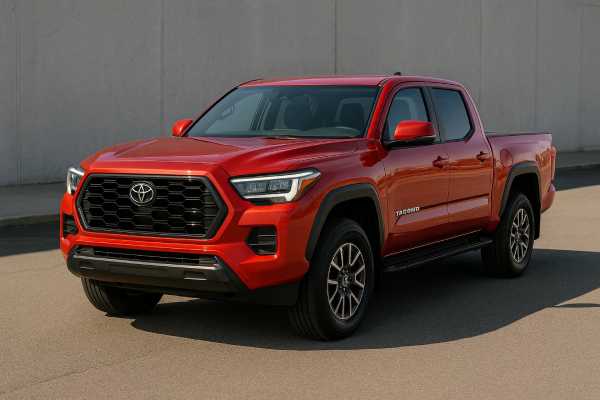
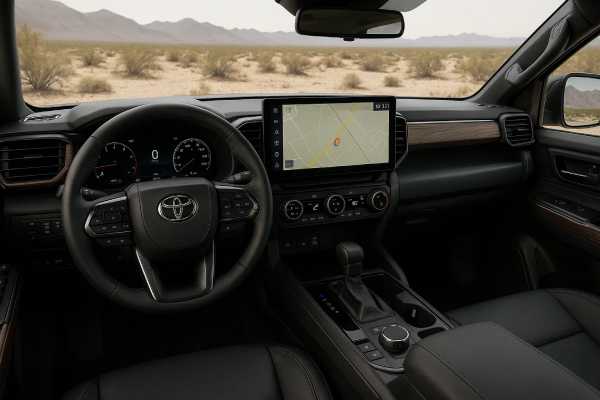
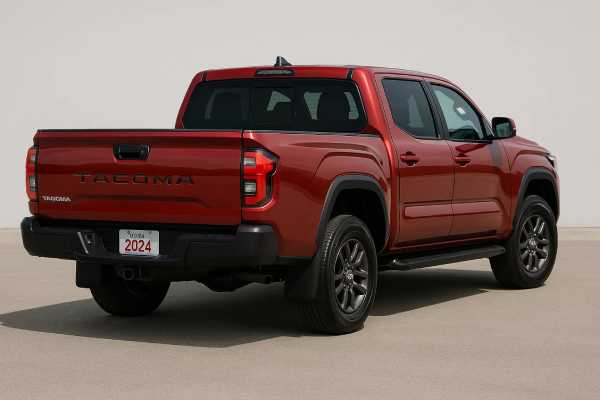
The fourth generation Toyota Tacoma 4×4 (N400) with the 2.4 litre T24A-FTS turbo engine is a major reset for Toyota’s midsize truck. Instead of simply refreshing the old chassis, Toyota moved the Tacoma onto the TNGA-F body-on-frame platform, added a coil-spring rear suspension on most trims, and made the 2.4 litre turbo four the heart of the line. In this 278 hp 4×4 configuration, the truck targets owners who need real off-road traction and towing, but still drive mostly on pavement and care about refinement, safety tech, and fuel costs.
This guide focuses on the non-hybrid i-FORCE Tacoma 4×4 with the 278 hp tune, explaining what you actually get in terms of specs, performance, ownership costs, and long-term durability. If you are cross-shopping Colorado, Ranger, Frontier, or Ridgeline, or trading out of a third-generation Tacoma, the goal is to help you understand where this truck advances, where it still feels like a classic Tacoma, and what to watch for over the next decade of ownership.
Top Highlights
- Strong 2.4 litre turbo engine (278 hp, 4×4) with broad mid-range torque for towing and highway passing.
- New TNGA-F frame and coil-spring rear suspension greatly improve ride quality and stability versus the old leaf-spring trucks.
- Toyota Safety Sense 3.0 with adaptive cruise, lane assist, and automatic emergency braking is standard on all trims.
- Turbo engine is more sensitive to oil quality and warm-up; short-trip or heavy-towing users should favour 5,000 mile (8,000 km) oil changes.
- Typical basic maintenance: oil and filter every 10,000 miles or 12 months (shorter in severe use), tyre rotation every 5,000–6,000 miles.
Navigate this guide
- Tacoma 4×4 278 hp overview
- Specifications and technical data
- Trims, options and safety tech
- Reliability and common issues
- Maintenance and buyer guidance
- On road and off road performance
- How Tacoma 4×4 compares to rivals
Tacoma 4×4 278 hp overview
The 278 hp Tacoma 4×4 pairs Toyota’s T24A-FTS 2.4 litre turbocharged four-cylinder with an eight-speed automatic and a part-time dual-range four wheel drive system. In this tune, the engine delivers strong torque from low rpm, which is more important for real-world truck work than peak horsepower. It effectively replaces the old 3.5 litre V6 while offering better fuel economy and stronger mid-range.
All N400 Tacomas sit on the TNGA-F platform shared with the Tundra, Land Cruiser, and 4Runner. For the Tacoma, that means a boxed, high-strength steel frame, wider track, and increased torsional rigidity. Most 4×4 trims use a five-link rear suspension with coil springs instead of the previous leaf springs, which dramatically improves ride and traction over uneven surfaces. Leaf springs are still used on some work-focused configurations, but the typical 278 hp 4×4 double cab truck will have the coil-spring setup.
In terms of packaging, the 4×4 is offered mainly as a Double Cab (four full doors) with either a shorter bed suited to daily use and parking garages, or a longer bed for those who carry bulky loads more often than passengers. Toyota positioned this 278 hp non-hybrid engine as the volume powertrain, with the more powerful i-FORCE MAX hybrid sitting above it and lower-output versions of the same 2.4 litre engine used in base models.
On the technology side, every 2024-on Tacoma includes Toyota Safety Sense 3.0, a large central touchscreen, wireless phone mirroring, and connected services. The cabin is a big step up from the previous generation in perceived quality, ergonomics, and noise control, while still using durable materials that should tolerate outdoor and work use.
As a total package, the Tacoma 4×4 278 hp aims to combine modern comfort and safety with the durability, compact footprint, and resale value that have made Tacomas a default choice in the midsize pickup segment.
4×4 Tacoma technical specifications
Engine and performance (T24A-FTS i-FORCE)
| Item | Specification |
|---|---|
| Engine code | T24A-FTS |
| Layout and cylinders | Inline-4, DOHC, 16 valves |
| Displacement | 2.4 l (2,393 cc) |
| Induction | Turbocharged, intercooler |
| Fuel system | Direct and port fuel injection |
| Compression ratio | Approx. 11.0 : 1 (model-dependent) |
| Max power | 278 hp (approx. 207 kW) |
| Max torque | Around 317 lb-ft (approx. 430 Nm) from low rpm |
| Timing drive | Chain-driven DOHC |
| Emissions standard | U.S. EPA and CARB compliant (varies by state) |
| Rated economy (4×4 automatic) | Around 20–21 mpg city, 23–24 mpg highway (U.S.) |
| Recommended fuel | Regular unleaded, premium recommended for heavy towing or hot climates |
Real-world highway consumption at 120 km/h (75 mph) is typically in the mid-20 mpg US range when unladen, assuming all-terrain tyres are not overly aggressive. With larger tyres, roof racks, or constant load in the bed, expect several mpg less.
Transmission and driveline
| Item | Specification |
|---|---|
| Transmission | 8-speed automatic (electronically controlled) |
| Drive type | Part-time 4×4, rear-wheel drive in 2H |
| Transfer case | Two-speed with high and low range |
| Rear differential | Open or electronic locking, depending on trim |
| Front differential | Open |
| 4×4 operation | Shift-on-the-fly between 2H and 4H (low range requires stop or crawl) |
| Crawl / drive modes | Available on off-road-oriented trims (Crawl Control, Multi-Terrain Select) |
Chassis and dimensions (typical Double Cab 4×4)
Values vary slightly by trim, bed length, and equipment; the figures below describe a typical 4×4 Double Cab:
| Item | Specification (approximate) |
|---|---|
| Platform | TNGA-F body-on-frame |
| Front suspension | Independent double wishbone with coil springs |
| Rear suspension | Five-link solid axle with coil springs (most 4×4 trims) |
| Brakes | Four-wheel discs, front ventilated |
| Steering | Electric power steering |
| Wheelbase | Approx. 3,280 mm (129 in) |
| Length | Around 5,400 mm (212–214 in) by bed |
| Width (mirrors folded) | Around 1,940–1,945 mm (76–77 in) |
| Height | Around 1,800–1,890 mm (71–74 in), by trim and tyres |
| Ground clearance | Around 235–270 mm (9.3–10.6 in), trim-dependent |
| Approach / departure / breakover | Roughly mid-30s / mid-20s / low-20s degrees on off-road trims |
| Curb weight | Typically 2,050–2,200 kg (4,510–4,850 lb), by bed and equipment |
| GVWR | Around 2,880–2,950 kg (6,340–6,500 lb) |
| Fuel tank | Approx. 68–70 l (18–18.5 US gal) |
Performance and capability
Exact figures vary slightly between trims, but the 278 hp Tacoma 4×4 sits in this band:
| Item | Typical value |
|---|---|
| 0–100 km/h (0–62 mph) | Approximately 7.0–7.5 s |
| 0–60 mph | Typically high-6s to low-7s seconds |
| Top speed | Around 180 km/h (112 mph), limited |
| Braked towing capacity | Up to around 2,948 kg (6,500 lb) when properly equipped |
| Payload | Roughly 650–800 kg (1,400–1,750 lb), depending on trim and bed |
| Roof load | Suitable for typical roof racks and tents within rating (check specific trim plate) |
Fluids, service and electrical (typical values)
Always confirm by VIN, but for planning purposes:
| System | Notes |
|---|---|
| Engine oil | 0W-20 full synthetic meeting Toyota specifications; capacity a little over 5 l with filter |
| Engine coolant | Toyota Super Long Life pink coolant, premixed; long-life interval |
| Automatic transmission fluid | Toyota WS or equivalent; drain and fill intervals recommended under severe use |
| Differentials / transfer case | GL-5 gear oil (often 75W-85 or similar); change more often if towing or off-roading |
| A/C refrigerant | R-1234yf on most modern Toyota trucks |
| 12 V battery | Maintenance-free AGM or flooded, group size varies by market |
| Spark plugs | Long-life iridium; replacement typically at 90,000–120,000 miles (145,000–190,000 km) |
In addition, the truck includes a high-output alternator suitable for accessories and a robust electrical architecture designed to support extra lighting, winches, and camping gear when wired correctly.
Tacoma 4×4 trims and safety tech
The 278 hp 4×4 configuration appears across several trims rather than being tied to a single grade. Availability varies by market, but in North America you will generally see this engine and 4×4 driveline in SR, SR5, TRD Sport, TRD Off-Road and some higher trims when ordered without the hybrid system.
Trim and equipment differences
- SR 4×4: Work-oriented with durable interior materials and smaller wheels. The 278 hp engine combined with 4×4 gives strong capability even in this base spec. Suspension tuning favours load carrying more than plush ride.
- SR5 4×4: Adds more comfort features, nicer interior trims, and more wheel and tyre options. Often the sweet spot if you value everyday comfort but still want a simple, robust truck.
- TRD Sport 4×4: Street-biased suspension tuning, larger wheels and tyres, body-colour exterior pieces, and sport seats. Better on twisty roads and smooth pavement, slightly less ideal for rocky trails due to wheel size and tyre profile.
- TRD Off-Road 4×4: Off-road-oriented dampers, all-terrain tyres, underbody protection, and (on many configurations) an electronic rear differential lock, terrain modes, and optional Crawl Control.
Visual identifiers include distinctive grille inserts, wheel designs, badges on the doors or tailgate, and interior colour schemes. Build sheets, VIN-decoded window stickers, and the axle code on the door jamb can help verify that a used truck has the correct 4×4 hardware and differential type.
Safety ratings
The 2024 crew cab Tacoma with four wheel drive has been rated a Top Safety Pick by the Insurance Institute for Highway Safety when configured with specific headlight and crash prevention packages. It achieves strong scores in the updated side impact test and original moderate overlap front crash. Headlight performance varies by trim and options, so higher trims with advanced lighting systems tend to score better.
At the time of writing, there is no Euro NCAP rating because the Tacoma is primarily a North American product. For buyers outside the U.S. and Canada, local regulations and frontal offset tests may differ slightly.
Safety systems and driver assistance
Every N400 Tacoma, including 278 hp 4×4 variants, comes standard with Toyota Safety Sense 3.0, which typically includes:
- Pre-collision system with pedestrian and cyclist detection.
- Full-speed adaptive cruise control.
- Lane departure alert with lane centring or assist.
- Road sign assist (reads speed limit and some warning signs).
- Automatic high beams.
Additional features available or standard on higher trims may include blind spot monitoring with rear cross-traffic alert, parking sensors, a 360-degree camera system, and rear seat reminder.
From a practical standpoint, body structure and airbag coverage are significantly improved versus earlier generations. Expect multiple front, side, curtain, and knee airbags, along with active head restraints and modern seatbelt pre-tensioners. Owners should be aware that windscreen replacements, bumper repairs, or suspension changes may require calibration of radar and camera systems; budget for this when insuring and modifying the truck.
Long term reliability and known issues
The 278 hp Tacoma 4×4 is still a new model, so long-term patterns are emerging rather than fully established. However, the underlying 2.4 litre turbo engine family and TNGA-F chassis are already in use in other Toyota products, which gives useful clues.
Engine and turbo system
So far, the T24A-FTS has not shown widespread catastrophic failures, but a few themes are worth noting:
- Oil quality and change intervals: Turbocharged direct-injection engines are more sensitive to oil degradation than naturally aspirated units. Owners who tow, drive short distances, or operate in extreme temperatures should consider 5,000 mile (8,000 km) oil changes rather than stretching to the maximum recommended interval.
- Carbon build-up and fuel quality: The combination of direct and port fuel injection is designed to reduce intake valve deposit build-up compared with older direct-only engines, but consistent high-quality fuel and occasional longer highway drives still help keep the intake and combustion system clean.
- Turbo hoses and sensors: On early production vehicles, some owners report isolated boost-related fault codes traced to hoses, clamps, or sensors. These are usually fixed under warranty with updated parts and software.
Transmission and driveline
The eight-speed automatic has already appeared in other Toyota/ Lexus models. Known behaviours include occasional shift “hunting” at light throttle or early calibration quirks, many of which are addressed by software updates or learning adaptations. Regular fluid changes, particularly if you tow or drive in mountainous terrain, are a smart prevention measure even if the official schedule calls the unit “lifetime fill.”
The part-time 4×4 system and mechanical components (transfer case, differentials, CV joints) use well-proven Toyota designs. Premature wear is uncommon when fluid changes are done on time and tyres are kept matched in size and wear. Long-term owners of previous Tacomas will still want to inspect front axle seals, driveshaft joints, and transfer case leaks every few years, especially after severe off-road use.
Chassis, suspension and corrosion
The new boxed frame and coil-spring rear suspension are more robust and comfortable, but still need periodic checks:
- Watch for early wear in suspension bushings and ball joints if you drive regularly on washboard roads or carry heavy loads.
- Trucks used in rust-belt climates should receive regular underbody washing and, ideally, a high-quality rust-proofing treatment. Focus on frame seams, crossmembers, and behind wheel arch liners.
Recalls and service campaigns
Toyota has already announced recalls on certain 2024–2025 Tacoma 4-wheel drive trucks related to braking components. When considering a new or used truck, run the VIN through the official recall lookup in your region and verify that all actions have been completed. Dealers can also check for technical service bulletins (TSBs) that update software for engine and transmission control modules, infotainment systems, or driver assistance sensors.
Pre-purchase checks
For early used examples, ask for:
- Complete service records, especially engine oil and drivetrain fluid changes.
- Documentation showing recall and TSB work completed.
- Evidence of professional alignment and tyre rotations, which suggests careful owners.
- A thorough inspection of frame, suspension, and underbody for off-road damage or corrosion.
Given Toyota’s track record, the 278 hp Tacoma 4×4 should be a durable long-term truck as long as the turbo engine’s needs are respected: timely oil changes, proper warm-up, and cooling-down under heavy load.
Maintenance schedule and buyer guidance
Toyota publishes market-specific maintenance schedules, but the following pattern reflects what many dealers and independent specialists recommend for the 2.4 litre turbo 4×4 Tacoma. Distances are approximate; always check your owner’s manual and adjust for severe use (towing, dusty roads, extreme temperatures, heavy city driving).
Core maintenance intervals (typical)
| Item | Suggested interval |
|---|---|
| Engine oil and filter | Every 10,000 miles / 12 months; 5,000 miles / 8,000 km in severe use |
| Engine air filter | Inspect every 10,000 miles; replace around 30,000–40,000 miles (more often in dust) |
| Cabin air filter | 15,000–20,000 miles or 1–2 years |
| Coolant | First replacement typically around 100,000 miles (160,000 km) or 10 years, then shorter intervals |
| Spark plugs | Around 90,000–120,000 miles, depending on market guidance |
| Brake fluid | Every 2–3 years regardless of mileage |
| Automatic transmission fluid | Drain and fill every 60,000–75,000 miles if towing or off-roading regularly |
| Front and rear differentials | 30,000–60,000 miles, more often with heavy towing or deep-water crossings |
| Transfer case fluid | 30,000–60,000 miles, aligned with differential services |
| Tyre rotation and balance | Every 5,000–6,000 miles, at least at each oil change |
| Alignment check | Annually or after any off-road trip or pothole strike that affects steering feel |
| 12 V battery test | At each annual service after year three |
Belts, hoses, and coolant lines should be visually inspected at each service. While the timing chain is nominally “lifetime,” unusual rattles on cold start, timing correlation codes, or metal in the oil all warrant immediate professional investigation.
Fluid specifications (typical planning values)
- Engine oil: 0W-20 full synthetic, API SN or better; Toyota Genuine or equivalent.
- Coolant: Toyota Super Long Life (pink), pre-mixed; do not mix with generic green coolant.
- ATF: Toyota WS or equivalent meeting the same specification.
- Differentials/transfer case: GL-5 gear oil, viscosity tailored to your climate (75W-85 or similar).
- Power steering and brake systems: Use fluids specified on the reservoir caps and in the manual; never mix types.
Key torque values to keep in mind include wheel lug nuts (typically in the 95–100 lb-ft range) and tow hitch fasteners (follow the accessory manufacturer’s specs). Over-tightened lugs are a common cause of warped brake rotors and damaged studs.
Buyer’s guide: what to look for
For new trucks, your main choices revolve around trim, bed length, and whether the more complex hybrid system is worth the extra power. If you specifically want the 278 hp non-hybrid 4×4, verify:
- The build sheet shows the correct engine code and tuning (i-FORCE, not i-FORCE MAX).
- The truck has the differential type, tyre package, and suspension you need (street-biased Sport vs off-road packages).
- Towing package, integrated trailer brake controller, and electrical harnesses are installed if you plan to tow regularly.
For used examples, add the following checks:
- Frame and suspension inspection for rust, off-road damage, or bent components.
- Evidence of proper fluid maintenance and any turbo-related work.
- Smooth operation of the four wheel drive system, including 4H and 4L engagement without grinding or binding on loose surfaces.
- Functioning safety systems, including adaptive cruise control, lane assist, and parking sensors.
The long-term outlook is positive: if maintained properly, the Tacoma 4×4 278 hp should deliver the long life and resale value previous Tacomas are known for, with better comfort, safety, and performance than earlier generations.
On road and off road performance
Day-to-day, the Tacoma 4×4 278 hp feels very different from the old V6 trucks. The turbo four produces strong low-rpm torque, so the truck moves smartly away from lights without having to rev hard. In normal driving, the eight-speed automatic keeps revs low and quiet. The engine note is more muted and mechanical than a naturally aspirated V6, but it settles down on the highway and blends into the background.
Ride and handling
The coil-spring rear suspension brings a substantial improvement in ride quality over broken pavement and expansion joints. Unladen, there is still some firmness—this is a truck designed to carry payload—but the bobbing and shudder that characterised previous Tacomas are greatly reduced. Steering effort is light but not vague, and the truck feels more stable at speed, especially in crosswinds or on rutted highways.
Body roll is well controlled for a body-on-frame pickup, particularly on TRD Sport models. Off-road-oriented trims with softer dampers and taller tyres lean more in corners but ride better on dirt roads and washboard surfaces. All-terrain tyres add grip off-road but may increase noise slightly on the highway.
Powertrain character
With 278 hp and a healthy torque curve, the Tacoma 4×4 accelerates briskly for its class. Passing from 80–120 km/h (50–75 mph) is confident, especially if you pre-emptively drop a gear using the transmission’s manual or sport modes. Some drivers notice a moment of lag if they tip into the throttle suddenly from very low rpm, which is normal for a turbo engine; the eight-speed’s programming does a decent job of masking it in everyday driving.
Transmission behaviour continues to be a talking point. Light-footed drivers may feel the gearbox shift frequently to chase fuel economy. Using sport mode or manually selecting a gear often results in more predictable response, particularly on hilly roads or when towing.
Real-world efficiency
In mixed driving, many owners report fuel economy in the high-teens to low-20s mpg (U.S.) for 4×4 trucks on all-terrain tyres, which is an improvement over previous V6 models. Steady highway cruising at legal speeds can push figures into the mid-20s mpg range if the truck is lightly loaded and aerodynamically clean (no large roof racks or tents).
Towing near the rated maximum or driving into strong headwinds, especially with a high-profile trailer, will significantly increase consumption. A 30–40 percent fuel economy penalty under sustained heavy towing is common for turbo petrol engines in this class.
Traction and off-road control
Engaging 4H on loose surfaces adds stability and confidence, especially in rain, snow, or on graded dirt roads. Trucks equipped with a locking rear differential, Crawl Control, and Multi-Terrain Select can tackle surprisingly difficult terrain when driven carefully. The combination of good approach and departure angles, decent breakover clearance, and a wide spread of low-range gearing makes the truck suitable for technical trails as long as belly protection and tyre choice match the terrain.
Stability and traction control are tuned to balance safety and progress. On off-road trims, dedicated modes allow more wheelspin where useful while still protecting driveline components.
When loaded with camping gear or towing a moderate trailer, the Tacoma 4×4 remains stable if the load is correctly distributed and tongue weight is within limits. Downhill braking performance is solid, but as with any midsize truck, sustained steep descents warrant careful gear selection and speed management to avoid overheating brakes.
How Tacoma 4×4 compares to rivals
The 278 hp Tacoma 4×4 competes with the Chevrolet Colorado / GMC Canyon 2.7 turbo, Ford Ranger 2.3 turbo and 2.7 V6, Nissan Frontier 3.8 V6, and Honda Ridgeline V6 all-wheel drive. Each has a slightly different character.
Strengths of the Tacoma 4×4
- Resale and brand trust: Tacomas historically retain value extremely well. The new generation is likely to follow that pattern if no major long-term issues emerge.
- Off-road-ready trims: Factory-engineered suspensions, lockers, and electronics are well integrated and backed by warranty. Aftermarket support is extensive and growing for the new chassis.
- Safety and driver assistance: Standard Toyota Safety Sense on all trims means you do not have to step up to a high-line package just to get adaptive cruise or AEB.
- Packaging for real use: The bed, tie-downs, step solutions, and in-bed power provisions are all thoughtfully designed for camping, DIY, and light commercial work.
Where rivals may be stronger
- Power and torque: Colorado/Canyon and some Ranger powertrains offer more peak torque than the non-hybrid Tacoma, which shows up when towing near maximum capacity or accelerating uphill with a heavy trailer.
- Ride and refinement on road: The unibody Honda Ridgeline has a smoother, more car-like ride and quieter cabin, though it cannot match the Tacoma’s off-road toughness or frame-based towing manners.
- Price and incentives: Depending on market conditions, domestic brands may offer more aggressive discounts on similarly equipped trucks, narrowing or reversing the cost advantage of the Tacoma over time.
Who the Tacoma 4×4 278 hp suits best
- Owners who need genuine 4×4 ability but will still drive thousands of highway miles each year.
- People planning to keep the truck 8–15 years and value reliability and parts availability over cutting-edge power.
- Buyers who want a broad ecosystem of accessories, from mild overland setups to hardcore off-road builds, without having to reinvent the wheel.
If you prioritise maximum towing and outright acceleration, a higher-output rival or the Tacoma hybrid may be a better fit. If you want a balanced, durable, and well-supported midsize truck with strong safety credentials and everyday usability, the 278 hp Tacoma 4×4 remains one of the most rounded choices in the class.
References
- Toyota Recalls Certain 2024-2025MY Toyota Tacoma 4-Wheel Drive Trucks 2025 (Recall Database)
- 2024 Tacoma Owner’s Manual 2024 (Owner’s Manual)
- 2024 Toyota Tacoma 2024 (Specifications and Features)
- Gas Mileage of 2024 Toyota Tacoma 2024 (Fuel Economy Data)
- 2024 Toyota Tacoma crew cab pickup 2024 (Safety Rating)
Disclaimer
This article is intended for general informational purposes only and does not replace professional diagnosis, service, or repair advice. Specifications, torque values, maintenance intervals, and procedures can vary by model year, VIN, market, trim level, and installed equipment. Always confirm critical data and procedures using the official owner’s manual, warranty and maintenance guide, and service documentation for your specific vehicle, and consult a qualified technician before performing any work.
If you found this guide useful, please consider sharing it with other enthusiasts and owners on social platforms such as Facebook or X/Twitter. It is a simple way to support xcar’s work and help more drivers make informed decisions about their trucks.