
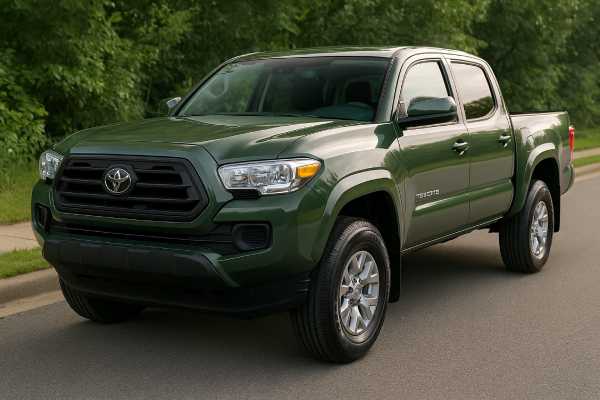
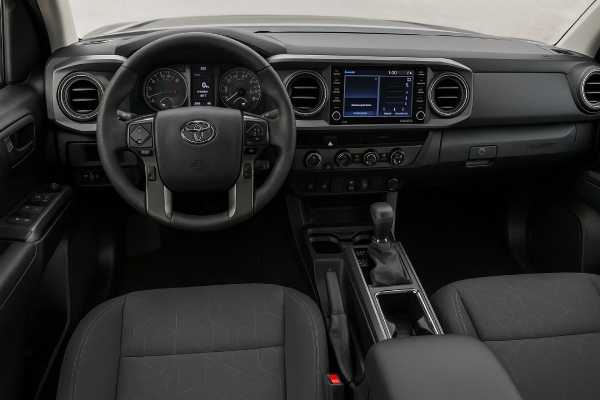
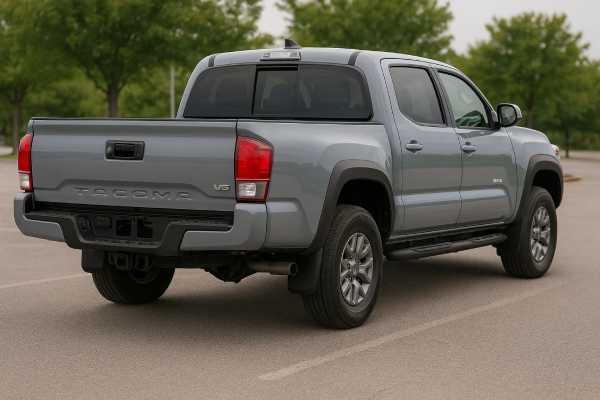
The 2020–2023 facelifted Toyota Tacoma 4×4 with the 2GR-FKS 3.5 litre V6 is the last and most mature evolution of the third-generation “N300” truck. It combines a modern Atkinson-capable V6, a six-speed manual or automatic, and a traditional body-on-frame chassis that many buyers still prefer for long-term ownership and off-road work. The facelift years brought useful upgrades: larger touchscreens with Android Auto and Apple CarPlay, improved driver assistance and small interior refinements, while keeping the same basic drivetrain and frame.
This guide focuses on the 4×4 V6 models, especially Double Cab trucks used as daily drivers, overlanders and light workhorses. We will walk through hard numbers (power, dimensions, towing and payload), real-world performance and efficiency, known reliability patterns, maintenance planning, and how the Tacoma compares to other midsize pickups if you are buying used.
At a Glance
- 3.5 litre 2GR-FKS V6 (278 hp, 265 lb-ft) with part-time 4×4 and low range; max tow rating around 6,400–6,800 lb when properly equipped.
- Strong resale value, dense aftermarket support and a simple, proven ladder frame make it attractive for long-term ownership and modification.
- Real-world consumption typically around 11–13 L/100 km (18–21 mpg US) mixed for 4×4 automatics; heavier tyres, lifts and roof loads push this higher.
- Pay close attention to fuel-pump recall coverage, transmission calibration updates and underbody corrosion inspections, especially in salted-road regions.
- Plan routine service roughly every 5,000 miles / 6 months (oil, rotation, inspections), with more extensive checks at 15,000–30,000 mile intervals.
Navigate this guide
- Tacoma 3.5 V6 4×4 overview
- Tacoma 3.5 V6 specs and data
- Tacoma trims, safety and driver aids
- Reliability, issues and service actions
- Maintenance planning and buyer guide
- Driving feel, towing and efficiency
- How Tacoma V6 4×4 compares
Tacoma 3.5 V6 4×4 overview
The facelifted 2020–2023 Tacoma 4×4 V6 sits at the end of the third-generation N300 run (2016–2023). It keeps the same basic hardware—2GR-FKS 3.5 litre V6, six-speed manual or automatic gearbox, and part-time four-wheel drive—but benefits from updated multimedia, standard Toyota Safety Sense and some small ergonomic tweaks such as revised seats and available power driver adjustment.
For most buyers, the key configuration is a Double Cab 4×4 with the automatic transmission and either the 5-foot short bed or 6-foot long bed. These trucks ride on a fully boxed front frame section with open-channel rails aft, double-wishbone front suspension and a leaf-spring solid rear axle. Ground clearance is around 9.4 in (239 mm), with approach and departure angles that vary by trim but roughly sit in the high-20s to low-30s degrees at the front and low-20s at the rear.
The 2GR-FKS itself is a 3,456 cc aluminium V6 with dual overhead cams, 24 valves and Toyota’s D-4S combined direct and port fuel injection. It can shift between an Atkinson-like efficiency mode and a conventional Otto cycle via wide-range variable valve timing on the intake cams (VVT-iW), which helps meet modern emissions standards while still delivering 278 hp at 6,000 rpm and 265 lb-ft (359 Nm) at 4,600 rpm.
On the road, the Tacoma leans more toward durability than plushness. Even in the facelift years the cabin feels narrower and more upright than some rivals, and the rear seat is best for children or short adults on long trips. However, the ergonomics are straightforward, visibility is good for a modern pickup, and the basic controls (transfer-case lever or knob, rear locker switch, terrain modes, crawl control on TRD Off-Road/Pro) are simple and robust.
If you are shopping used, think of this generation as a conservative, proven design with modest refinement and class-leading resale value rather than the most modern or efficient midsize truck.
Tacoma 3.5 V6 specs and data
This section focuses on typical 2020–2023 Tacoma Double Cab 4×4 V6 configurations. Exact figures vary by cab, bed length and trim, so always confirm against the build sheet or manual for a specific VIN.
Engine and performance (2GR-FKS)
| Item | Value |
|---|---|
| Engine code | 2GR-FKS V6 |
| Layout | 60° V6, aluminium block and heads, DOHC, 24 valves, 4 valves/cyl |
| Displacement | 3.5 L (3,456 cc) |
| Bore × stroke | 94.0 mm × 83.0 mm (3.70 in × 3.27 in) |
| Compression ratio | 11.8:1 |
| Induction | Naturally aspirated |
| Fuel system | Toyota D-4S (direct + port injection) |
| Valve timing | Dual VVT-i, VVT-iW on intake (Atkinson-capable) |
| Max power | 278 hp (207 kW) @ 6,000 rpm |
| Max torque | 265 lb-ft (359 Nm) @ 4,600 rpm |
| Emissions standard | ULEV III (North America, typical) |
| Timing drive | Chain (no routine belt interval) |
| Recommended fuel | 87 AKI unleaded (regular) |
Efficiency (typical 4×4 automatic, EPA-like):
| Cycle | mpg US | L/100 km (approx.) |
|---|---|---|
| City | 18 | ~13.1 |
| Highway | 22 | ~10.7 |
| Combined | 20 | ~11.8 |
Real-world highway consumption at 120 km/h (75 mph) with stock tyres is often in the 11–12 L/100 km (19–21 mpg US) range; lift kits, racks, tents and aggressive all-terrains can easily add 1–3 L/100 km.
Transmission and driveline
| Item | Value |
|---|---|
| Transmission choices | 6-speed manual or 6-speed ECT automatic (V6) |
| 6-MT ratios (V6) | 3.98 / 2.02 / 1.32 / 1.00 / 0.85 / 0.71, R 3.39 |
| 6-AT ratios (V6) | 3.60 / 2.09 / 1.49 / 1.00 / 0.69 / 0.58, R 3.73 |
| Final drive | Typically 3.909 (V6 4×4 auto); some trims 4.30 |
| Drive system | Front-engine, part-time 4×4 with 2H / 4H / 4L |
| Transfer case | Electronically shifted two-speed, 4-pinion planetary low range |
| Rear differential | Open; electronic locking diff on TRD Off-Road and TRD Pro |
| Traction aids | A-TRAC brake-based traction, Auto LSD (2WD), hill-start assist; Multi-terrain Select and Crawl Control on off-road trims |
Chassis, dimensions and capacities
Figures below are representative for 4×4 Double Cab V6 models (short bed unless noted).
| Item | Value |
|---|---|
| Frame | Ladder frame, boxed front section, open C-channel rear |
| Front suspension | Double wishbone, coil springs, gas shocks, anti-roll bar |
| Rear suspension | Solid axle, leaf springs, gas shocks |
| Steering | Rack-and-pinion with power assist |
| Brakes | Front ventilated discs, rear drums with ABS/EBD |
| Wheelbase | 3,236 mm (127.4 in); 3,571 mm (140.6 in) long-bed |
| Overall length | ~5,392 mm (212.3 in) short bed; 5,728 mm (225.5 in) long bed |
| Width (w/overfenders) | ~1,910 mm (75.2 in) |
| Height | ~1,793–1,819 mm (70.6–71.6 in, depending on trim) |
| Ground clearance | ~239 mm (9.4 in) |
| Approach angle | ~29–35° (trim-dependent; TRD Pro highest) |
| Departure angle | ~23–24° (trim-dependent) |
| Turning circle | ~12.4 m (40.6–40.8 ft) |
| Fuel tank | ~80 L (21.1 US gal) |
| Typical curb weight | ~1,900–2,020 kg (4,180–4,450 lb) depending on trim |
| GVWR | ~2,540–2,630 kg (5,600–5,800 lb) (varies by configuration) |
Capability:
| Item | Value |
|---|---|
| Max towing (V6 4×4, properly equipped) | up to ~2,900–3,085 kg (6,400–6,800 lb) |
| Typical payload (V6 4×4 Double Cab) | ~525–645 kg (1,155–1,420 lb) |
| Roof load (guideline) | Usually ~75–100 kg including rack; confirm in manual |
Fluids, service and electrical (high level)
Exact fluid specs and capacities vary by market and axle; check the service manual for VIN-specific data.
- Engine oil: 0W-20 synthetic, Toyota-approved; capacity roughly 5.5–6.0 L including filter.
- Coolant: Toyota Super Long Life Coolant (pink, premixed); extended-life, but still requires periodic replacement.
- ATF (6-speed auto): Toyota WS fluid; drain-and-fill or full exchange around 60,000–100,000 miles is common for severe use.
- Differential/transfer case oils: Toyota-specified gear oil (often 75W-85 or similar).
- A/C refrigerant: R-134a on this generation.
- Charging and electrical: alternator output and 12 V battery spec vary with equipment; most trucks use a mid-size flooded battery and about 100–130 A alternator; off-road or winch use may justify an upgraded AGM battery.
Tacoma trims, safety and driver aids
Across 2020–2023 the Tacoma 4×4 V6 line-up typically includes SR, SR5, TRD Sport, TRD Off-Road, TRD Pro and Limited grades, with some market-specific variations.
- SR / SR5 4×4 V6
Basic work-oriented trims. You get steel wheels or simple alloys, fabric interiors, and fewer comfort features. Mechanically they share the same V6 and 4×4 system, but no rear locker on most SR/SR5 trucks. - TRD Sport
Street-biased: firmer “sport-tuned” suspension, usually 17-inch or 18-inch wheels with lower-profile tyres, hood scoop, and available smart key. No rear locker on many Sport trims, and the suspension is tuned more for on-road response than articulation. - TRD Off-Road
The sweet spot for mixed use. Adds off-road dampers, an electronic locking rear differential, Multi-terrain Select, Crawl Control and more aggressive tyres. - TRD Pro
Flagship off-road package: Fox internal-bypass shocks, 1-inch front lift, skid plates, unique wheels, all-terrain tyres, and higher approach angle. - Limited
The “luxury” take: leather, sunroof, larger wheels and more chrome, but less ideal off-road due to wheel/tyre and bumper geometry.
Quick identifiers include TRD badges, hood scoops (TRD Sport), heritage grilles (some special editions), Fox or Bilstein shocks visible behind the wheels, and interior clues like leather with contrast stitching on TRD Pro or Limited. VIN decoding and build sheets from a Toyota dealer are the safest way to confirm exact equipment.
Safety ratings
For 2020, the Tacoma Double Cab earned an IIHS Top Safety Pick award when equipped with specific headlights. Crashworthiness is Good in most categories, including driver-side small-overlap and original moderate overlap tests. Passenger-side small-overlap is Acceptable, and updated side-impact testing on this generation is rated Marginal. Headlight performance varies by trim from Good to Marginal, while the standard front crash-prevention system (Toyota Safety Sense) scores well in vehicle-to-vehicle tests.
NHTSA testing for a representative 2020 Tacoma 4WD configuration shows an overall rating of four stars, with five stars for side impact and slightly weaker performance in certain frontal or rollover sub-categories.
Safety systems and ADAS
All facelift-era Tacomas get Toyota Safety Sense P (TSS-P), which includes:
- Pre-Collision System with Pedestrian detection (forward AEB).
- Lane Departure Alert (LDA) with steering-wheel vibration.
- Automatic High Beams (AHB).
- Dynamic Radar Cruise Control (DRCC) – mainly at highway speeds.
In addition, the Star Safety System brings ABS, EBD, Brake Assist, Vehicle Stability Control (VSC), Traction Control (TRAC) and Smart Stop brake-override logic. Side-curtain, front, side torso and driver knee airbags are standard. Child-seat anchors (LATCH/ISOFIX) are present on the rear seats, though ease of use is somewhat limited by anchor access.
Blind-spot monitoring with rear cross-traffic alert is optional on many trims and standard on upper grades. Parking sensors, cameras and a 360° surround-view monitor become available higher in the range, and off-road models gain underbody and front-facing camera views to assist with obstacles.
After collision repair (especially front-end or windshield work), radar and camera calibration is critical. Many ADAS-related diagnostic trouble codes can only be properly cleared after a static or dynamic calibration sequence using a Toyota-capable scan tool.
Reliability, issues and service actions
The 2GR-FKS Tacoma is widely regarded as a durable truck when serviced on time, but certain patterns are worth understanding if you are buying or maintaining one.
Engine and cooling
The 2GR family uses a timing chain rather than a belt, so there is no fixed replacement interval. Long oil-change intervals or poor-quality oil can accelerate chain guide and tensioner wear, leading to rattle at start-up or timing correlation faults. Keeping to 5,000-mile/6-month services is a safe conservative approach.
Common V6 issues across applications include:
- Water pump seepage and external coolant leaks at higher mileages.
- Thermostat housing or crossover leaks on some engines.
- VVT-i noise on cold start from oil starvation to cam phasers if oil is dirty.
- Carbon build-up on intake valves due to the direct-injection portion of D-4S (less severe than DI-only engines thanks to port injection, but still possible over time).
If you see unexplained coolant loss, sweet odours or crusty deposits around the water pump or thermostat housings, budget for proactive repairs before overheating damages the engine.
Fuel pump recall
A major item for this generation is the low-pressure fuel pump recall involving Denso-supplied in-tank pumps that can fail due to impeller deformation. A failed pump can cause warning lamps, rough running, no-start conditions or stalling while driving. Toyota’s remedy is to replace the fuel pump assembly with an improved part, free of charge.
Not all 2020–2023 Tacomas are affected, and the coverage has been amended and expanded several times. Always:
- Check the VIN on Toyota’s owner site and your local safety authority’s recall lookup.
- Obtain dealer documentation showing the recall is complete.
- If you experience intermittent stalling or no-start, verify recall status before paying out of pocket.
Transmission and driveline
The six-speed automatic in the Tacoma is mechanically robust but often criticised for hesitant, gear-hunting behaviour and occasional shudder or harsh shifts. Owners report delayed engagement when shifting from Park/Reverse to Drive and hunting between gears at light throttle. Software updates (TCU reflash) can significantly improve behaviour on some trucks.
When test-driving a used truck:
- Pay attention to cold starts and the first few shifts.
- Check for flare (rpm rising before upshift), shudder, or bangs when selecting gears.
- Confirm there are no stored transmission codes and that the ATF is clean and not burnt.
Transfer cases and differentials are generally strong, but heavily off-roaded trucks can develop clunks, whining or binding if fluids are neglected or if lifts and larger tyres overload components.
Chassis and corrosion
Earlier Tacomas are subject to frame corrosion campaigns, reflecting reports of more-than-normal frame rust in high-salt regions and the application of a corrosion-resistant compound or frame replacement in severe cases. While 2020+ trucks use an updated frame and are not covered by those specific campaigns, they still operate in the same environments, so underbody inspection is essential.
Look closely at:
- Inside and outside of frame rails (especially near rear leaf mounts).
- Brake and fuel lines, crossmembers, and skid plate mounting points.
- Bed seams and cab mounts.
Software, electronics and later recalls
Beyond the fuel pump issue, more recent recalls and service campaigns have targeted various control modules and components on Toyota trucks. Some include Tacomas among multiple models and can involve software updates as well as hardware replacement.
Whenever you buy or service a Tacoma:
- Run the VIN through Toyota and national recall tools.
- Ask for a printout of open campaigns and completed actions.
- Keep recall paperwork with the service history to support resale value.
Maintenance planning and buyer guide
Practical maintenance schedule (summary)
Toyota’s own maintenance guides and dealer schedules broadly converge on service every 5,000 miles or 6 months, with additional items layered at 15,000–30,000 mile intervals and more frequent checks for hard use (towing, dust, short trips).
A sensible baseline for a 2020–2023 Tacoma 4×4 V6:
- Every 5,000 miles / 6 months
- Engine oil and filter (0W-20 synthetic, Toyota-approved).
- Tyre rotation and pressure check (including spare).
- Brake pad/shoe visual inspection.
- Fluid-level checks (coolant, ATF for leaks, power steering if applicable, brake, washer).
- Every 15,000 miles / 18 months
- Engine air filter (earlier in dusty use).
- Cabin air filter.
- Detailed underbody corrosion and leak inspection.
- Every 30,000–40,000 miles (48,000–64,000 km)
- Front and rear differential oil change.
- Transfer case oil change.
- Brake fluid flush (3–4 years max, regardless of mileage).
- Around 60,000–90,000 miles (96,000–145,000 km)
- Automatic transmission fluid service (drain-and-fill or equivalent, using Toyota WS).
- Coolant replacement according to the coolant label and manual.
- Serpentine/aux belt inspection and replacement if cracked or noisy.
The timing chain is inspection-only: listen for rattle at start-up, check for timing correlation codes and follow any guidance from Toyota bulletins. For trucks that see heavy off-road or towing use, shorten fluid intervals, especially for diffs and transfer case.
The 12 V battery often lasts 4–6 years in typical climates; load testing around year 4 helps avoid surprise failures. For overland builds with fridges and winches, upgrading to a higher-capacity AGM battery and checking alternator output under load is wise.
Buyer’s checklist
When shopping for a used 2020–2023 Tacoma 4×4 V6:
- Paperwork and history
- Full service history with 5,000-mile/6-month maintenance.
- Recall printout showing the fuel pump and any other campaigns completed.
- Evidence of diff/transfer-case fluid changes by 60,000–80,000 miles on work or off-road trucks.
- Chassis and body
- Inspect frame rails and crossmembers for rust scale, perforation, or poor-quality undercoating hiding corrosion.
- Look for bent skid plates, rock rash on crossmembers and dented exhaust components—signs of heavy off-roading.
- Engine bay
- Check coolant level and look for pink staining at water pump weep holes or thermostat housings.
- Inspect for oil leaks around cam covers, timing cover, and rear main area.
- Cold start should be quick, with no extended cranking or loud chain/valvetrain clatter.
- Transmission and driveline
- Smooth engagement from Park/Reverse to Drive; minimal delay or bang.
- No hunting or shudder at light throttle cruise; test both city and motorway speeds.
- In 4H and 4L, engagement should be smooth, with no grinding or refusal to shift when used correctly.
- Rear locker (if fitted) should engage within a few seconds at low speeds on loose surfaces.
- Electronics and ADAS
- Verify operation of radar cruise, lane departure alert and pre-collision warnings.
- Check for warning lights after startup and during a full test drive.
- Inspect windscreen and front bumper: recent replacements should have documentation for ADAS calibration.
Recommended years, trims and options
For the 2020–2023 period, the Tacoma 4×4 V6 is relatively consistent mechanically, so focus on trim and use case:
- Best all-rounder: TRD Off-Road Double Cab 4×4
Rear locker, off-road suspension and terrain aids, but still civilised for daily use. - Towing and long-distance road use: TRD Sport or Limited with tow package
Slightly firmer on-road manners and more comfort features, especially if you rarely use low-range off-road. - Hardcore off-road: TRD Pro
Most capable from the factory but also most expensive; ride is firmer and payload can be slightly lower.
Avoid trucks with unclear recall status, poor service records or obvious off-road abuse unless priced accordingly. Overall, the long-term durability outlook is excellent when maintenance is conservative and corrosion is kept in check.
Driving feel, towing and efficiency
On the road, the Tacoma feels like a traditional body-on-frame truck. Steering is medium-weighted and reasonably direct on centre, but the tall ride height and relatively narrow cabin mean it never feels as planted as a unibody SUV. The suspension is tuned more for robustness than suppleness, so unloaded trucks—especially TRD Off-Road and Pro with firmer dampers and all-terrain tyres—can feel busy over patched urban surfaces.
Noise, vibration and harshness levels are acceptable for the class but not class-leading. Expect some tyre hum from more aggressive rubber, a noticeable but not intrusive V6 growl under load and a bit of wind noise around the mirrors and A-pillars at motorway speeds.
Powertrain character
The 2GR-FKS V6 makes its best power higher in the rev range. Below about 2,000 rpm it can feel modestly torquey but not punchy; once it spins past 3,000 rpm it pulls strongly to 6,000 rpm. The six-speed automatic is geared relatively tall in the upper ratios for fuel economy, leading to frequent downshifts on grades or when overtaking. Some drivers perceive this as “gear hunting” or sluggish response, though later transmission calibrations improve behaviour.
The manual gearbox is rare but gives the driver more control over revs and helps keep the engine in its sweet spot off-road and when towing. Clutch feel is generally friendly, though heavy traffic will of course be more tiring than with the automatic.
Off-road traction and control
With its part-time 4×4, low range, decent ground clearance and short overhangs, the Tacoma 4×4 is very capable on dirt trails, snow and rough tracks. TRD Off-Road and Pro models add Crawl Control, Multi-terrain Select, better dampers and an electronic rear locker, making them well-suited for moderate rock work and slippery climbs straight from the showroom.
Stability control is reasonably lenient in 4L, and the brake-based A-TRAC system helps manage wheelspin when the locker is off. Tyre choice makes a noticeable difference: stock all-terrains balance road noise and traction, while more aggressive mud-terrains improve grip at the cost of fuel economy and braking performance on wet pavement.
Towing and load behaviour
Properly equipped V6 4×4 Tacomas can tow up to about 6,400–6,800 lb (roughly 2,900–3,100 kg) with a weight-distributing hitch. Payload typically falls in the 1,150–1,400 lb (520–640 kg) range, depending on trim.
In practice:
- Stay well within the tow rating if you are pulling a tall, boxy trailer; the modest torque and six-speed gearbox will work hard in hilly terrain.
- Monitor transmission temperatures where possible, and consider an auxiliary transmission cooler for frequent towing in hot climates.
- Under load, the rear leafs can sag; air-bags or progressive add-a-leaf setups can help while still keeping articulation off-road.
Under moderate tow or full load, expect fuel consumption to rise by 30–50% compared to solo highway driving. Long highway grades may see the truck holding 3rd or 4th gear around 3,500–4,500 rpm, which is normal for this engine.
Real-world efficiency
As noted earlier, official ratings for V6 4×4 automatics sit around 18/22/20 mpg US (city/highway/combined), corresponding roughly to 13.1 / 10.7 / 11.8 L/100 km. Owners commonly report:
- 12–14 L/100 km (17–20 mpg US) in mixed commuting.
- 10–11 L/100 km (21–24 mpg US) steady-state at 90–100 km/h (55–62 mph) on stock tyres.
- 14–16+ L/100 km (15–17 mpg US) with lifts, roof tents and aggressive tyres, or when towing.
Driving smoothly, keeping speeds reasonable and minimising roof loads are the easiest ways to preserve range.
How Tacoma V6 4×4 compares
In the 2020–2023 midsize pickup space, key rivals for the Tacoma 4×4 V6 include the Chevrolet Colorado / GMC Canyon, Ford Ranger, Jeep Gladiator and Nissan Frontier.
Strengths versus rivals
- Long-term reliability and resale
Toyota’s reputation and the Tacoma’s proven platform give it some of the highest residual values in the class. Many owners plan for 10–15 years of use, which supports a strong aftermarket ecosystem (suspension, armour, campers, etc.). - Off-road capability out of the box
TRD Off-Road and TRD Pro trims are trail-ready without extensive modifications, with features like Crawl Control, Multi-terrain Select, lockers and robust skid-plate options. While rivals like the Gladiator Rubicon or Colorado ZR2 may ultimately be more capable in extreme situations, they are also more specialised and expensive. - Simplicity and familiarity
The Tacoma’s part-time 4×4 system, naturally aspirated V6 and conventional six-speed gearboxes are familiar to many technicians and DIY owners. In contrast, newer turbos and 10-speed transmissions in rivals can feel more complex to some buyers.
Trade-offs and weaknesses
- Performance and refinement
Some rivals’ turbo engines and newer transmissions often feel quicker and more flexible in everyday driving. The Tacoma is adequate but not fast, with modest low-rpm torque and a gearbox that can feel dated. - Ride and cabin space
The Gladiator and Colorado in particular can ride more smoothly and feel wider inside. Tacoma’s rear seat space is on the tighter side, especially for tall adults on long trips. - Fuel economy
Turbocharged rivals frequently deliver better on-paper and real-world efficiency, particularly on the highway. Tacoma’s V6, while reasonably efficient for a naturally aspirated truck engine, is not the mpg leader.
Who the Tacoma V6 4×4 suits best
The facelifted 2020–2023 Tacoma 4×4 V6 is a strong fit if:
- You want a long-term, keep-it-for-a-decade truck more than the latest tech.
- You prioritise reliability, resale and off-road capability over maximum performance and luxury.
- You are comfortable with regular maintenance and rust prevention, especially in harsh climates.
If you care more about fast acceleration, quiet highway cruising and a more spacious cabin, a Ranger, Colorado/Canyon or full-size half-ton might suit better. But for many owners who value durability and an enormous support community, the N300 Tacoma remains a very compelling choice.
References
- 2020 Tacoma Product Information 2019 (Product Information)
- 2020 Warranty & Maintenance Guide 2019 (Owner’s Maintenance Guide)
- 2020 Toyota Tacoma crew cab pickup 2020 (Safety Rating)
- Vehicle Detail Search – 2020 TOYOTA TACOMA PU—-EC 4WD 2020 (Safety Rating)
- Toyota Recalls Certain Toyota and Lexus Vehicles 2025 (Recall Information)
Disclaimer
This article is for informational purposes only and does not replace professional diagnosis, repair advice or access to official service literature. Specifications, torque values, service intervals and procedures can vary by VIN, production date, market and installed equipment. Always confirm critical data against your vehicle’s owner’s manual, official service manual, technical service bulletins and recall information from Toyota and relevant safety authorities before performing maintenance or repairs.
If you found this guide useful, consider sharing it with other owners on social platforms such as Facebook or X/Twitter to help support xcar’s work and keep more Tacoma buyers informed.