
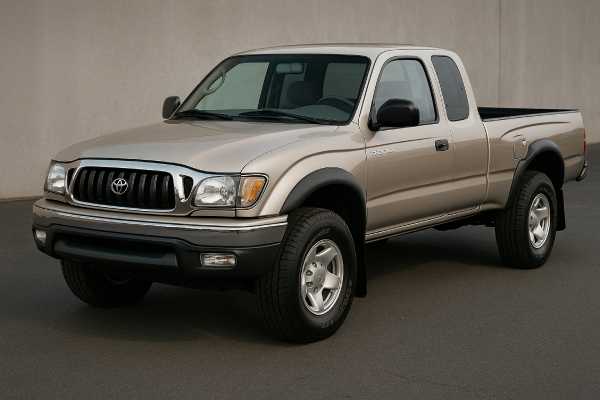
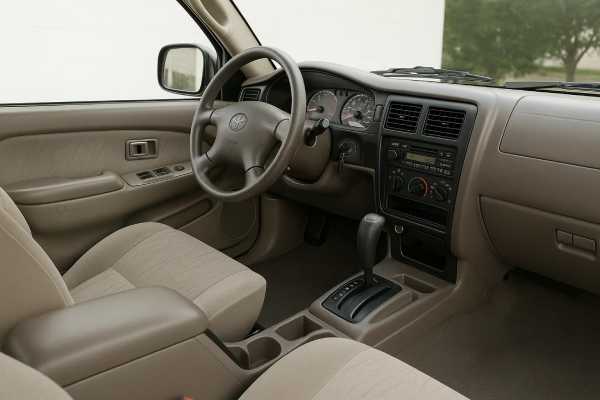
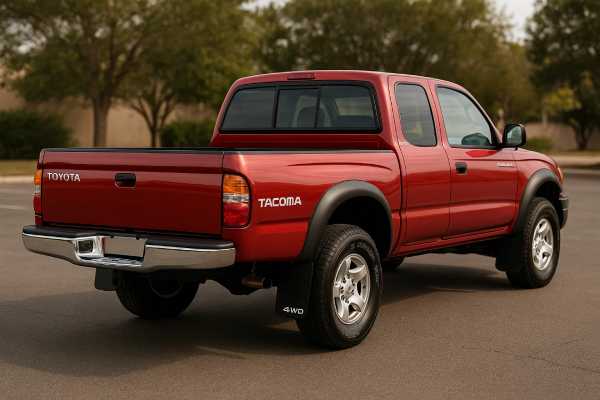
The facelift Toyota Tacoma 4×4 (N140) with the 3RZ-FE 2.7 litre four-cylinder is one of those trucks that quietly gets hard work done for decades. Built from 2001 to 2004, it combines a simple, durable drivetrain with just enough comfort and safety features to make daily use realistic, even today. The 3RZ-FE is a big-displacement inline-four with a timing chain, sturdy bottom end, and a reputation for running well past 300,000 km when serviced.
In 4×4 form, the Tacoma uses a traditional ladder frame, a manual or automatic gearbox, and a two-speed transfer case with a proper low range. It is not fast or particularly quiet, but it is honest: light enough to feel nimble, strong enough to tow small trailers, and compact enough for tight trails. This article walks through the technical data, reliability patterns, maintenance strategy, and how the facelift 3RZ-FE 4×4 compares with rivals for work, overlanding, or mixed daily use.
Top Highlights
- Robust 3RZ-FE 2.7 four-cylinder with timing chain, known for very long service life if oil changes are kept up.
- Simple part-time 4×4 system with manual transfer case and low range, easy to service and highly trusted off road.
- Compact dimensions and relatively light curb weight make it manoeuvrable on trails and in city traffic.
- Watch for frame rust on 1995–2004 trucks and verify completion of the front lower ball joint recall before buying.
- Typical engine oil and filter service interval: every 5,000 mi / 8,000 km or 6 months for mixed use.
What’s inside
- Facelift 3RZ-FE 4×4 essentials
- 3RZ-FE 4×4 technical data
- Facelift grades equipment and safety
- Long-term reliability and known faults
- Ownership maintenance and buying guide
- On-road manners and off-road ability
- How this Tacoma stacks up to rivals
Facelift 3RZ-FE 4×4 essentials
The 2001–2004 facelift Tacoma 4×4 with the 3RZ-FE engine is the last stretch of the first-generation N140 platform. The facelift brought updated headlights and grille, minor interior trim changes, and incremental safety improvements, but the core engineering stayed the same: a compact body-on-frame pickup offering regular cab and Access Cab layouts, with a part-time four-wheel drive system and either a five-speed manual or four-speed automatic transmission.
The 3RZ-FE is a 2.7 litre inline-four petrol engine with double overhead camshafts, four valves per cylinder, and multi-port fuel injection. It produces about 150 hp and roughly 177 lb-ft (around 240 Nm) of torque, with a strong low and mid-range. Unlike many smaller four-cylinders, it uses a relatively large displacement and square 95 mm by 95 mm bore and stroke, so it feels more like a small truck engine than a car motor. A timing chain reduces scheduled replacement work, though chain health still depends on oil quality.
In this 4×4 configuration, the Tacoma uses a live rear axle on leaf springs and an independent front suspension with torsion bars or coils (depending on specific trim and region). A two-speed transfer case gives high and low ranges, and most trucks use open differentials front and rear. Some trims pair the 3RZ-FE with a limited-slip rear differential, which noticeably improves traction on loose surfaces.
Why pick the 3RZ-FE 4×4 instead of the V6? The V6 5VZ-FE offers more power and higher tow ratings, but adds weight, complexity, and often higher fuel and maintenance costs. The four-cylinder 4×4 sits in the sweet spot for owners who value simplicity, durability, and everyday running costs more than outright performance. It is also easier to work on in a home garage than many newer trucks, with good access to most components.
That said, age now matters more than mileage alone. These trucks are two decades old. Their key strengths are a robust engine, proven drivetrain, and a large parts ecosystem, but real-world value depends heavily on frame condition, suspension wear, and how carefully previous owners maintained them. For buyers willing to inspect carefully and budget for some refurbishment, the facelift 3RZ-FE 4×4 Tacoma remains one of the most sensible compact 4×4 pickups on the used market.
3RZ-FE 4×4 technical data
This section summarises the main technical data for the facelift 2001–2004 Tacoma 4×4 with the 3RZ-FE engine. Figures can vary by year, cab style, gearbox, and market; always cross-check against the VIN and local documentation.
Engine and performance
| Item | Value |
|---|---|
| Engine code | 3RZ-FE |
| Type | Inline-4, petrol, DOHC, 16 valves |
| Displacement | 2.7 L (2,693 cc) |
| Bore × stroke | 95.0 mm × 95.0 mm |
| Valvetrain | DOHC, 4 valves per cylinder, bucket tappets |
| Induction | Naturally aspirated |
| Fuel system | Multi-port fuel injection (MPFI) |
| Compression ratio | Approx. 9.5 : 1 |
| Max power | ~150 hp (112 kW) @ ~4,800 rpm |
| Max torque | ~177 lb-ft (240 Nm) @ ~4,000 rpm |
| Timing drive | Chain, hydraulic tensioner |
| Emissions standard (US) | Tier 1 / LEV era, varies by state and year |
| Recommended fuel | Unleaded petrol, typically 87–91 AKI depending on market |
The 3RZ-FE’s relatively long stroke and conservative tuning favour torque over top-end power. In practice, the engine pulls well from low revs, especially with the manual gearbox, but needs revs for highway passing.
Transmission and driveline
| Item | Value |
|---|---|
| Transmissions | 5-speed manual or 4-speed automatic (region-dependent) |
| Manual gearbox | R150F (typical pairing with 3RZ-FE 4×4) |
| Automatic gearbox | A340F 4-speed electronically controlled |
| Drive type | Part-time 4×4, rear-drive default |
| Transfer case | 2-speed, high and low range, manual lever |
| Low-range ratio | Approx. 2.0–2.6 : 1 (varies slightly by case code) |
| Front differential | Open, hypoid gear |
| Rear differential | Open or limited-slip (depending on trim/option) |
| Typical final drive ratios | Approx. 4.10–4.30 : 1 on 4×4 2.7 models |
Exact axle ratios differ with cab style and equipment; checking the axle code on the VIN plate or build label is the right way to confirm.
Chassis and dimensions
Typical figures for a 3RZ-FE 4×4 facelift Tacoma (regular/access cab; bed length and trim can change these measurements slightly):
| Item | Value (approximate) |
|---|---|
| Frame | Ladder frame, body-on-frame construction |
| Front suspension | Independent, double wishbone with torsion bar or coil spring |
| Rear suspension | Solid axle with leaf springs |
| Steering | Recirculating ball or rack-and-pinion (market/trim dependent), power-assisted |
| Front brakes | Ventilated disc |
| Rear brakes | Drum |
| Wheels and tyres | Commonly 15 in rims; typical tyre 235/75 R15 or similar |
| Length | ~4,900–5,100 mm (193–201 in) |
| Width | ~1,690–1,790 mm (67–70 in) excluding mirrors |
| Height | ~1,700–1,780 mm (67–70 in) |
| Wheelbase | ~2,670–3,040 mm (105–120 in) depending on cab/bed |
| Ground clearance | Typically around 200–230 mm (8–9 in), stock tyres/suspension |
| Turning circle | Roughly 11–12 m (36–39 ft), curb-to-curb |
| Curb weight | ~1,550–1,750 kg (3,420–3,860 lb), by cab/gearbox |
| GVWR | Around 2,268–2,540 kg (5,000–5,600 lb), configuration-dependent |
| Fuel tank | About 60–65 L (15–17 US gal) |
Performance and capability
Real-world performance depends heavily on axle ratio, tyre size, and altitude, but typical values for a stock 3RZ-FE 4×4 are:
| Item | Value (approximate) |
|---|---|
| 0–100 km/h (0–62 mph) | Roughly 11–13 s (manual slightly quicker than automatic) |
| Top speed | Around 160 km/h (100 mph), gearing and tyres limited |
| Towing capacity | Typically up to ~1,587 kg (3,500 lb) with proper equipment |
| Payload | Often in the 600–750 kg (1,300–1,650 lb) range, per build spec |
| Roof load | Usually around 70–100 kg (150–220 lb) including rack, check manual |
Factory tow ratings vary with cab style, gearbox, axle ratio, and whether a tow package is fitted. Always verify against the specific truck’s documentation and local regulations.
Fluids and service capacities (typical)
Values below are representative for the 3RZ-FE Tacoma 4×4 powertrain; always confirm by VIN and service manual.
| System | Spec and capacity (approximate) |
|---|---|
| Engine oil | 5W-30 or 10W-30 API-rated petrol engine oil; ~5.4 L (5.7 US qt) with filter |
| Engine coolant | Ethylene glycol long-life coolant, typical 50:50 mix; roughly 9–11 L (9.5–11.5 US qt) total system |
| Manual gearbox (R150F) | GL-4/GL-5 gear oil, often 75W-90; around 2–2.5 L (2.1–2.6 US qt) |
| Automatic (A340F) | ATF (Toyota Type T-IV or equivalent); several litres total, ~2–4 L (2–4 qt) per drain and refill |
| Front diff | Gear oil, usually 75W-90 GL-5; around 1–1.3 L (1–1.4 US qt) |
| Rear diff | Gear oil, usually 75W-90 GL-5; around 1.3–1.7 L (1.4–1.8 US qt) |
| Transfer case | Gear oil or ATF, depending on case; often 75W-90; ~1–1.5 L (1–1.6 US qt) |
| A/C refrigerant | R-134a, approximate charge 500–700 g (17–25 oz), model dependent |
Electrical and ignition
| Item | Value (typical) |
|---|---|
| Alternator output | Around 80–90 A on most 3RZ-FE Tacomas |
| 12 V battery | Commonly 60–70 Ah, 500–600 CCA group size (varies by market) |
| Spark plugs | Nickel or platinum, heat range to Toyota spec |
| Spark plug gap | Typically around 1.0–1.1 mm (0.039–0.043 in) |
Safety and driver assistance
The facelift Tacoma predates the modern ADAS era. Safety equipment is basic by current standards:
- Front airbags for driver and passenger on most facelift trucks.
- Three-point belts in outboard seats, lap belt for some centre positions.
- Anti-lock brakes (ABS) available or standard on many 4×4 trims, especially later years.
- No factory autonomous emergency braking, adaptive cruise, lane-keeping assist, or blind-spot monitoring.
Crash test results vary by cab style, but moderate overlap frontal tests for this generation fall into the “Acceptable” range in some independent evaluations, with no side or small-overlap testing during the original production period. Owners should treat it as a reasonably safe small truck for its era, but not comparable to modern pickups with advanced crumple structures and full airbag coverage.
Facelift grades equipment and safety
The facelift Tacoma 3RZ-FE 4×4 was offered in several trims, depending on market and year. In North America, common names include base, SR5, and TRD Off-Road packages, layered over regular cab and Access Cab body styles. Other markets may use different grade names, but the core mechanical package is similar.
Trims and visual identifiers
- Base 4×4
Typically steel wheels, simpler interior trim, cloth seats, and fewer power features. Look for unpainted or body-colour bumpers without flares and a basic gauge cluster. Many of these work trucks will have vinyl floors. - SR5 4×4
The volume trim for private owners. Often adds alloy wheels, nicer seat fabric, tachometer (if not standard), more sound insulation, and convenience features such as power windows and locks. Exterior cues include chrome or colour-matched bumpers, wheel-arch flares on some versions, and SR5 badging. - TRD Off-Road (where fitted to 3RZ-FE)
More commonly associated with the V6, but in some markets and years, four-cylinder 4×4 trucks could be equipped with TRD suspension components, upgraded shocks, and possibly a limited-slip differential. Look for TRD decals, specific alloy wheels, and a slightly firmer ride.
Mechanical and functional differences by trim
The engine remains the same across 3RZ-FE 4×4 trims, but several functional differences matter to buyers:
- Differential and traction – A limited-slip rear differential or specific axle ratio may be tied to particular packages. Trucks ordered for towing or off-road use are more likely to have desirable axle ratios and traction aids.
- Suspension and tyres – Off-road or TRD packages may include firmer shocks, slightly higher ride height, and more aggressive all-terrain tyres from the factory, improving rough-road performance at some cost to ride comfort and fuel use.
- Tow preparation – Factory tow packages can add a transmission cooler (automatic), heavier wiring, and a receiver hitch. On used trucks, many hitches are aftermarket; confirm wiring quality and cooler fitment before towing near rated limits.
Year-to-year changes (2001–2004)
Across these facelift years, changes are relatively minor:
- Subtle updates to colours, upholstery, audio systems, and minor trim details.
- Incremental safety improvements and airbag availability.
- Option mix adjustments, especially near the end of the generation when Toyota prepared for the second-generation Tacoma.
Because hardware changes are small, buyers should focus more on overall condition, rust levels, and service history than on fine-grained year differences.
Safety ratings and equipment
For this generation, regulatory crash tests show adequate but not outstanding performance:
- Frontal crash performance – Moderate-overlap frontal tests for similar 2001–2004 Tacomas are typically rated in the mid-range (e.g., “Acceptable”), with reasonable protection for the driver but less margin than newer designs.
- Side impact and rollover – Many tests of this era did not include side airbags or modern rollover evaluations. Narrow-track, tall pickups like the Tacoma are inherently more rollover-prone than low sedans, especially with lifts or large tyres.
- Child seat installation – Early ISOFIX/LATCH systems may be absent or limited, depending on market. Parents often rely on seat belts and top-tether anchors; check that anchors are present, not corroded, and that the rear seating position suits your child seats.
Electronic driver assistance is effectively limited to ABS. There is no factory stability control on most 2001–2004 Tacomas in many markets, and certainly no lane or collision-avoidance systems. Drivers must rely on good tyres, proper loading, and conservative speeds for safety.
Long-term reliability and known faults
The 3RZ-FE 4×4 Tacoma has an excellent reputation for durability, but time reveals some consistent patterns. For a two-decade-old truck, condition and maintenance history matter more than original design alone.
Engine and fuel system
Common issues, roughly ordered by how often they appear:
- Oil leaks (common, low–medium cost)
Valve cover gaskets, cam seals, and front crank seals can seep as rubber ages. Symptoms include oil odour, small drips, and grime around the timing cover. Remedy is seal replacement; often done alongside other front-engine work like belts or water pump. - Timing chain noise and guides (occasional, medium cost)
The chain itself is long-lived, but stretched chains or worn guides/tensioners can cause rattling at startup or when hot, and in severe cases, cam/crank correlation faults. Ignoring serious noise can eventually risk valve timing issues. Remedy is chain, guides, and tensioner replacement with quality parts. - Cooling system age (common, medium cost)
Radiators, hoses, and water pumps are now old on many trucks. Symptoms include coolant smell, rising temperatures on climbs, or visible crust on joints. Proactive replacement of radiator, thermostat, hoses, and pump around high mileage is good insurance. - Fuel injectors and sensors (occasional, medium cost)
Misfires, rough idle, or poor fuel economy can come from tired injectors, oxygen sensors, or a dirty throttle body. Proper diagnosis with scan data and fuel trims is important; randomly replacing parts can get expensive.
Overall, bottom-end engine failures are rare if oil changes are consistent and the engine is not badly overheated.
Driveline and 4×4 system
- Front lower ball joints (significant, medium–high risk if ignored)
Toyota issued a recall on front lower ball joints for many 1995–2004 Tacomas after cases of excessive wear and, in extreme situations, joint separation. Symptoms include wandering steering, clunks over bumps, and abnormal tyre wear. Remedy is replacement with updated parts and correct torque. Any potential purchase should have recall status checked by VIN and ball joints inspected for play. - Front CV joints and boots (common on lifted or off-roaded trucks)
Torn CV boots, clicking on turns, or vibration under load can indicate worn joints. Replacement is straightforward but should be done with quality remanufactured or new axles. - Manual gearbox wear (occasional, medium cost)
Some owners report notchy shifts, synchro wear (especially 2nd/3rd), or gear whine at high mileage. Use of the correct gear oil and gentle shifts when cold help. Rebuilds are possible but not cheap. - Transfer case and differential leaks (occasional)
Pinion seals, axle seals, and transfer case gaskets can seep with age. Left unattended, they can lead to low oil levels and premature wear. Regular underbody inspections and fluid-level checks are essential on an older 4×4.
Chassis and body
- Frame corrosion (high priority in rust-belt regions)
1995–2004 Tacomas are well-known for frame rust in areas that use road salt. Severe corrosion at the rear leaf-spring mounts, along the main rails, or near the steering box can be structural. Toyota has run various frame inspection and replacement or buy-back programmes in some regions, but not all trucks qualify today. Any prospective purchase should be inspected thoroughly on a lift, including tapping along the frame rails and checking for previous repairs. - Suspension bushings and steering wear (common, moderate cost)
Worn control-arm bushings, steering rack bushings, and ball joints cause vague steering, clunks, and uneven tyre wear. Re-bushing the front end and fitting fresh shocks can make a truck drive almost like new. - Interior age and electronics (low–medium impact)
Window regulators, door lock actuators, and aged plastics are normal wear items. Most electrical issues come from corroded grounds or accessory wiring rather than major harness failures.
Recalls, service campaigns, and software
Beyond the lower ball joint recall, various regional campaigns have addressed rust and other concerns on older Tacomas. Buyers should:
- Run the VIN through the official recall database in their country.
- Ask a dealer to print a campaign/recall completion history if possible.
- Verify that any frame or suspension work was done to manufacturer or better standards.
The 3RZ-FE uses simple engine management by modern standards, and software updates are limited. When drivability issues arise, basic diagnostics (checking fuel trims, misfire counters, and sensor outputs) are usually enough; reflashes are rarely the primary fix.
Ownership maintenance and buying guide
A well-structured maintenance plan is what turns the 3RZ-FE Tacoma 4×4 from “old truck” into “reliable long-term tool.” Below is a practical schedule for mixed use; always adapt to local climate and usage.
Core maintenance intervals (typical guidance)
- Engine oil and filter – Every 5,000 mi / 8,000 km or 6 months, whichever comes first. Short-trip or dusty use may justify shorter intervals.
- Engine air filter – Inspect annually; replace every 20,000–30,000 mi (30,000–50,000 km) or sooner in dusty conditions.
- Cabin filter (if equipped) – Every 15,000–20,000 mi (25,000–30,000 km) or 1–2 years. Some early trucks may not have a cabin filter from the factory.
- Spark plugs – Conventional copper plugs often around 30,000 mi (50,000 km); long-life or platinum plugs can go longer, but age (10+ years) is a good reason to renew regardless of mileage.
- Coolant – Replace every 5 years / ~100,000 km, then every 3–5 years depending on coolant type and climate.
- Fuel filter – If external and serviceable, around 60,000–90,000 mi (100,000–150,000 km). Some variants use in-tank filters.
- Timing chain – No fixed interval, but inspect for noise and timing correlation issues as mileage climbs past ~200,000 km. Replace chain, guides, and tensioner if noisy or out of spec.
- Serpentine/aux belts and hoses – Inspect yearly; replace when cracked, glazed, or after 6–10 years.
- Manual gearbox oil – Change every 30,000–60,000 mi (50,000–100,000 km) depending on towing and off-road use.
- Automatic transmission fluid – Drain and fill every 30,000–60,000 mi, sooner for heavy towing. Avoid “power flushes” on very old, neglected units.
- Transfer case and diffs – Replace oils every 30,000–50,000 mi (50,000–80,000 km), especially after water crossings or heavy off-road work.
- Brake fluid – Flush every 2–3 years; moisture absorption over time is the main concern.
- Brakes – Inspect pads, shoes, and rotors/drums at least annually; more often if towing or off-road.
- Wheel alignment and tyre rotation – Rotate tyres every 5,000–8,000 mi (8,000–12,000 km). Check alignment yearly or after suspension work.
- Valve clearances – The 3RZ-FE uses shim-over-bucket tappets; clearances can drift over high mileage. Many engines never need adjustment, but checking at least once in the truck’s life (e.g., around 200,000 km) is wise.
- 12V battery – Load-test yearly after year 3–4; replace proactively at 5–7 years of age.
Fluid specs and torque values (key examples)
- Engine oil drain plug torque often around 35–40 Nm (26–30 lb-ft).
- Wheel lug nuts typically around 100–110 Nm (74–81 lb-ft).
- Spark plug torque around 18–25 Nm (13–18 lb-ft) on clean, dry threads; always follow plug and manual guidance.
Use Toyota-approved fluids or quality equivalents. In very hot or heavy-use environments, moving from 5W-30 to a heavier high-temperature oil may be advisable, but follow local recommendations.
Buyer’s checklist
When inspecting a facelift 3RZ-FE 4×4 Tacoma:
- Frame and underbody
- Look for deep rust flaking, holes near rear leaf-spring mounts, and heavy corrosion around steering and crossmembers.
- Inspect previous welding or plating repairs; good-quality work is straight, well-finished, and properly coated.
- Front suspension and steering
- Jack up the front and check for play in lower ball joints, tie rods, and wheel bearings.
- Look for leaking shocks, uneven tyre wear, or a steering wheel that doesn’t return to centre smoothly.
- Driveline and 4×4 function
- Engage 4H and 4L on a loose surface, confirming engagement, no harsh grinding, and no alarming noises.
- Listen for clunks from driveshaft joints or differentials on take-up.
- Engine health
- Cold start: engine should fire quickly without heavy knocking or chain rattle.
- Warm idle: steady, no misfire, no obvious smoke.
- Check for oil or coolant contamination, leaks around timing cover and rear main area.
- Cooling system
- Confirm that the truck reaches operating temperature and stays there on a sustained test drive.
- Inspect radiator and hoses for age and previous repairs.
- Interior and electrics
- Test all windows, locks, gauges, and HVAC, including A/C at idle and at speed.
- Look for signs of water leaks (wet carpets, musty smell) which may indicate rust or poor windshield/seal work.
- Paperwork
- Ask for service records (oil changes, timing chain or cooling system work).
- Obtain proof of recall completion, especially for lower ball joints and any frame or rust campaigns in your region.
Long-term durability outlook
A facelift 3RZ-FE 4×4 Tacoma with a solid frame and documented maintenance can realistically serve for many more years and hundreds of thousands of kilometres. The limiting factors are usually corrosion and the cost of renewing suspension, steering, and drivetrain components, not catastrophic engine failure. For many owners, a thorough “baseline” service after purchase—fluids, belts, brakes, and bushings—followed by steady preventative maintenance delivers a truck that is both dependable and inexpensive to own relative to buying a newer, more complex 4×4.
On-road manners and off-road ability
Despite its age, the facelift 3RZ-FE Tacoma 4×4 still feels composed if it is in good mechanical condition. It is not luxurious, but the driving experience is predictable and easy to live with.
Ride, handling, and NVH
The ladder frame and leaf-sprung rear axle give a firm, slightly bouncy ride when unladen, especially with heavy-duty springs. With some weight in the bed, the rear settles and ride quality improves noticeably. Good shocks and fresh bushings make a large difference; neglected trucks can feel harsh and jittery.
Steering is relatively slow by modern standards but stable on the highway. On-centre feel is good when the steering system is tight; worn components can make the truck wander, which some owners mistakenly attribute to tyres or alignment alone. Wind and road noise are higher than in modern midsize pickups, particularly above 110 km/h (70 mph), but many owners find it acceptable for medium-distance journeys.
Powertrain character
The 3RZ-FE’s character depends heavily on gearing:
- Manual 5-speed – Best match to this engine. Shorter gearing lets the 2.7 stay in its torque band, and downshifts are clean. Acceleration is adequate up to normal highway speeds, with a useful surge in the mid-range for passing when the engine is kept above about 3,000 rpm.
- Automatic 4-speed – Smoother in traffic but less eager on hills. Kickdown response is reasonable, but the gearbox may hunt between gears on grades when combined with oversize tyres or heavy loads.
In both cases, the engine is smooth and willing but clearly working at higher speeds, especially with stock aero and tyres. Owners often accept this, trading refinement for simplicity and longevity.
Real-world fuel economy
Actual consumption depends on axle ratio, tyre size, lift, and driving style, but typical numbers for a stock or mildly modified 3RZ-FE 4×4 are:
- City – Around 13–15 L/100 km (15–18 mpg US, 18–21 mpg UK).
- Highway (100–110 km/h / 60–70 mph) – Often 10–12 L/100 km (19–24 mpg US, 23–29 mpg UK) if driven gently.
- Mixed use – Many owners see 12–13 L/100 km (18–20 mpg US, 21–24 mpg UK).
Large all-terrain tyres, roof racks, lift kits, and heavy bumpers can easily add 1–3 L/100 km to these figures. Keeping tyre pressures correct and maintaining the engine and drivetrain pay off noticeably in fuel economy.
4×4 system behaviour and traction
The part-time 4×4 system is simple and effective:
- 2H for dry pavement.
- 4H for low-grip conditions such as gravel, snow, or muddy tracks.
- 4L for technical terrain, steep climbs/descents, or heavy pulling at low speed.
Because there is no centre differential, 4H should not be used on high-traction dry pavement to avoid driveline binding. Off road, the relatively short wheelbase, good approach/departure angles (in stock form), and modest width make the Tacoma easy to place on narrow trails.
Traction is good with quality tyres, but open differentials can limit progress in crossed-axle situations. A limited-slip rear differential or aftermarket locker transforms its capability. The chassis responds well to mild suspension and tyre upgrades; even a modest lift and slightly larger all-terrains give noticeable gains for overlanding and trail use.
Load and towing behaviour
Within its rated tow and payload limits, the 3RZ-FE 4×4 handles small campers, utility trailers, and work loads competently:
- Towing – Expect to downshift on long grades and accept slower acceleration. Transmission cooling (especially for automatics) and good trailer brakes are critical. Fuel consumption can rise by 25–50% when towing near rated capacity.
- Payload – The leaf-sprung rear axle is happy carrying tools, camping gear, or building materials. Keep loads within the GVWR and ensure weight is properly distributed; overloading or stacking weight high in the bed increases rollover risk and punishes rear suspension components.
Overall, the facelift 3RZ-FE Tacoma 4×4 feels like a compact, honest work truck with enough refinement for daily use, but without the isolation, weight, or complexity of newer midsize 4x4s.
How this Tacoma stacks up to rivals
When these trucks were new, key competitors included the Nissan Frontier/Hardbody, Chevrolet S-10/GMC Sonoma, Mazda B-Series/Ford Ranger, and various compact pickups in export markets. On today’s used market, buyers often cross-shop later second-generation Tacomas, Nissan Frontiers/Navaras, and even mid-2000s Hilux models in some regions.
Strengths versus rivals
- Engine durability – The 3RZ-FE is widely regarded as one of Toyota’s most robust four-cylinder truck engines. Many rivals of the era used smaller or more stressed four-cylinders that did not age as gracefully, or V6 engines with more complex issues.
- Drivetrain simplicity – The manual transfer case, straightforward 4×4 system, and timing-chain engine make it attractive for remote travel and markets with limited service support.
- Parts availability – First-generation Tacomas have a strong aftermarket and shared components with other Toyota models. Consumables and common wear parts are easy to source and often reasonably priced.
- Resale and community knowledge – High resale values reflect demand, and the platform benefits from extensive community documentation, guides, and upgrade options.
Trade-offs and weaknesses
- Rust exposure – Frame corrosion issues are more prominent on Tacomas than on some rivals in rust-prone regions. A well-kept Tacoma is excellent; a rusty one can be nearly worthless. Some competitors, notably certain Rangers and Frontiers, also rust, but the Tacoma’s frame campaigns highlight how serious this can be.
- Cab space and comfort – Compared with newer midsize trucks, the first-gen Tacoma feels narrow and basic inside. Long-legged drivers may find seating less comfortable on long trips.
- Safety and crash performance – Many modern rivals (even later first- and second-generation models) offer better crash structures, more airbags, and stability control. For families, this may outweigh the mechanical simplicity of the older truck.
Against newer Tacomas and modern midsize pickups
Compared with the second-generation Tacoma (mid-2000s onwards) and current midsize pickups:
- The facelift 3RZ-FE 4×4 is lighter, simpler, and typically cheaper to maintain.
- It lacks the power, towing capacity, and crash protection of newer platforms.
- Electronics are minimal, which is a plus for some overlanders and a minus for those wanting modern infotainment, comfort, and ADAS features.
Who the facelift 3RZ-FE 4×4 suits best
This truck makes the most sense for:
- Owners who prioritise longevity, simplicity, and DIY-friendly maintenance over outright performance and luxury.
- Enthusiasts building a compact overland or trail rig where light weight, compact size, and a proven drivetrain matter.
- Buyers in milder climates where frame rust is less severe, or who can inspect thoroughly and budget for rust repair.
It is less suitable for buyers needing maximum tow ratings, modern safety suites, or car-like refinement. In those cases, a newer Tacoma, Hilux, Frontier, ranger, or full-size pickup may be a better match.
References
- 3RZ-FE (2.7 EFI) engine 2010 (Engine Technical Overview)
- RCONL-05V225-8890.pdf 2005 (Recall Notice – Front Suspension Lower Ball Joint)
- Used 2001 Toyota Tacoma – Specs & Features 2024 (Specifications Summary)
- Toyota Tacoma I 2.7 4WD 1995-2004 SUV Specs 2023 (Model Specifications)
- Crash Test Safety Ratings – 2002 Toyota Tacoma 2020 (Crash Test Ratings Overview)
Disclaimer
This article is for informational purposes only and is not a substitute for professional diagnosis, repair, or official service literature. Specifications, torque values, fluid capacities, and maintenance intervals can vary by VIN, market, model year, and installed equipment. Always confirm all technical data and procedures against the official owner’s manual, workshop manual, and current service bulletins for your specific vehicle. If you are unsure about any inspection or repair, consult a qualified technician.
If you found this guide useful, please consider sharing it with other owners and enthusiasts on platforms like Facebook or X/Twitter. Your support helps xcar continue producing detailed, independent technical content.