
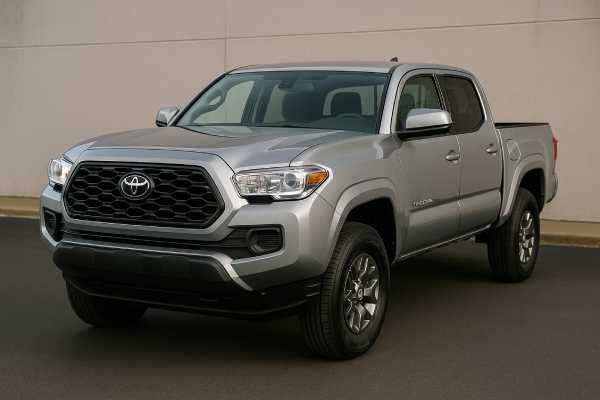
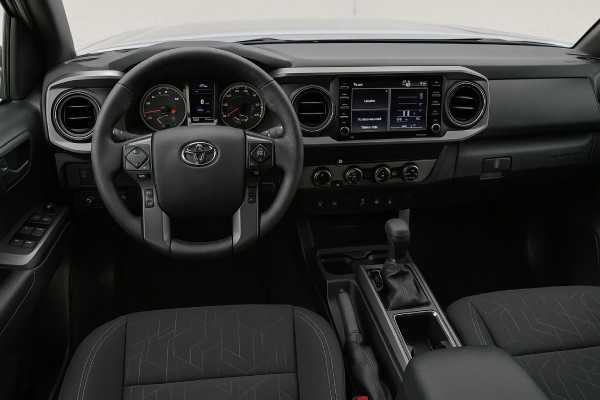
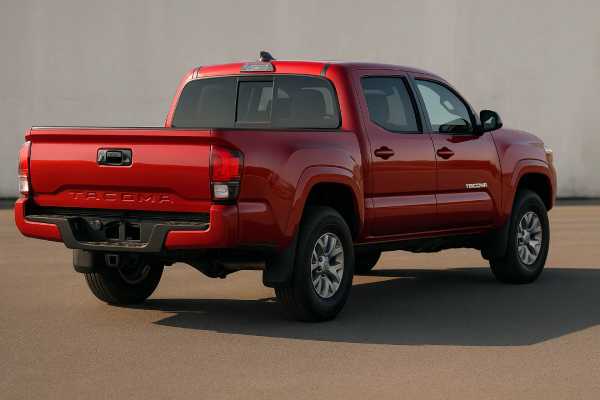
The 2020–2023 Toyota Tacoma RWD with the 2TR-FE 2.7 litre engine sits at the practical end of the Tacoma range. It shares the same N300 platform and basic chassis hardware as the more powerful 3.5 V6 trucks, but focuses on simplicity, predictable running costs, and a lower entry price. With 159 hp, hydraulic steering, and rear-wheel drive, it is aimed at owners who spend most of their time on paved roads, light construction sites, or mild gravel rather than deep mud and rock crawling.
The facelift that arrived for 2020 matters more than it first appears. It brought modern infotainment with Apple CarPlay and Android Auto, updated front-end styling, and wider adoption of Toyota Safety Sense. Underneath, the 2TR-FE remained a proven, chain-driven four-cylinder that has a long track record in global Toyota pickups. This guide walks through the key specs, performance, reliability patterns, maintenance expectations, and how the RWD 2.7 compares to rivals so you can decide if it fits your use case and budget.
Fast Facts
- 2TR-FE 2.7 litre four-cylinder is chain-driven, port-injected, and known for long life with regular oil changes.
- RWD layout with robust ladder frame and leaf-spring rear axle gives predictable road manners and good payload capacity.
- Towing is limited to around 3,500 lb (about 1,600 kg), so heavy trailers or large campers are better matched to the V6.
- Plan engine oil and filter changes every 10,000 miles (16,000 km) or 12 months under normal conditions, halved for heavy use.
Section overview
- Facelift Tacoma 2.7 RWD Summary
- Tacoma 2.7 RWD Specs and Data
- Tacoma RWD Trims and Safety
- Reliability Patterns and Fixes
- Maintenance Schedule and Buying Guide
- Driving Behaviour and Efficiency
- RWD Tacoma Against Rivals
Facelift Tacoma 2.7 RWD Summary
The 2020–2023 facelift did not change the basic recipe of the Tacoma 2.7 RWD, but it made the truck easier to live with every day. At its core, you still have a body-on-frame pickup with a solid rear axle, leaf springs, and a naturally aspirated four-cylinder engine driving the rear wheels through a six-speed automatic transmission. For many owners, that familiarity is precisely the appeal.
Visually, the facelift brought a refreshed grille, available LED headlights on higher trims, and detail tweaks to wheels and interior trims. More importantly, the cabin finally gained modern connectivity: a larger touchscreen, Apple CarPlay and Android Auto, and improved camera and audio options. These upgrades make the RWD 2.7 a much more convincing daily driver or light-duty work truck than pre-2020 models, especially for drivers who spend hours in traffic.
Mechanically, the 2TR-FE remains a 2.7 litre inline-four with dual overhead cams, variable valve timing, and a timing chain. In this application it produces about 159 hp and 180 lb-ft of torque, tuned more for durability than outright performance. The modest output means acceleration is relaxed, especially with a loaded bed, but fuel use and maintenance costs are predictable.
This configuration is most attractive to buyers who:
- Drive mainly on-road or on light dirt/gravel.
- Prioritise simple, robust engineering over maximum tow ratings.
- Want a mid-size truck but do not need the power or complexity of the 3.5 litre V6 and four-wheel drive hardware.
If you understand those trade-offs, the 2.7 RWD can be one of the lowest-risk, easiest-to-own Tacomas in the third-generation lineup.
Tacoma 2.7 RWD Specs and Data
This section focuses on the 2020–2023 Tacoma 2.7 litre RWD (primarily SR and SR5 grades) in North American specification. Exact numbers can vary slightly by cab, bed length, and market, but the tables below capture the core technical data owners and buyers usually need.
Engine and Performance
| Item | Specification |
|---|---|
| Engine code | 2TR-FE |
| Configuration | Inline 4-cylinder, aluminium head, cast-iron block |
| Valvetrain | DOHC, 16 valves, variable valve timing |
| Displacement | 2.7 l (2,694 cc) |
| Bore × stroke | 95.0 mm × 95.0 mm (3.74 in × 3.74 in) |
| Induction | Naturally aspirated |
| Fuel system | Multi-port fuel injection |
| Compression ratio | Around 10.0 : 1 |
| Max power | 159 hp @ ~5,200 rpm |
| Max torque | ~180 lb-ft (about 244 Nm) @ ~3,800 rpm |
| Recommended fuel | Regular unleaded petrol |
| Timing drive | Chain (no scheduled replacement) |
| Emissions standard | Meets contemporary US LEV III / Tier 3 requirements |
Transmission and Driveline
| Item | Specification |
|---|---|
| Transmission | 6-speed automatic, electronically controlled |
| Drive type | Rear-wheel drive (4×2) |
| Rear differential | Open, with electronic traction and stability control support |
| Final drive ratio | Around 4.30 : 1 (varies slightly by configuration) |
| Manual mode | Sequential shift gate on automatic selector |
| Tow/haul mode | Available; alters shift mapping for loads and grades |
Chassis and Dimensions (typical 4×2 Access or Double Cab)
| Item | Specification |
|---|---|
| Platform | N300 third-generation Tacoma, body-on-frame |
| Front suspension | Double wishbone with coil springs and gas shocks |
| Rear suspension | Leaf springs with solid axle, gas shocks |
| Steering | Hydraulic power-assisted rack-and-pinion |
| Front brakes | Ventilated disc (approx. 10.8–11.3 in) |
| Rear brakes | Drum |
| Wheelbase | ~3,236 mm (127.4 in) |
| Overall length | ~5,390–5,395 mm (212.3 in) depending on bed |
| Overall width | About 1,890 mm (74.4 in) excluding mirrors |
| Overall height | Around 1,790 mm (70–71 in) |
| Ground clearance | Roughly 240 mm (9.4 in) |
| Fuel tank capacity | ~80 l (21.1 US gal) |
Performance and Capability
| Item | Specification |
|---|---|
| 0–100 km/h (0–62 mph) | Roughly 9.5–10.5 s depending on load and cab style |
| Top speed | Typically limited to around 180 km/h (112 mph) |
| Braking (100–0 km/h) | In the 40–45 m range with healthy brakes and tyres |
| Max towing capacity | Around 1,588 kg (3,500 lb) for 2.7 RWD models |
| Payload | Roughly 570–730 kg (1,260–1,600 lb) depending on configuration |
| Roof load | Sufficient for typical racks/roof tents when using rated hardware |
Fluids, Capacities and Electrical
Values below are typical for the 2.7 RWD facelift models; always check your specific VIN documentation.
| System | Specification and Capacity (approximate) |
|---|---|
| Engine oil | 0W-20 synthetic, around 5.1 l (5.4 US qt) with filter |
| Engine coolant | Long-life ethylene glycol, roughly 8–9 l (9+ US qt) total fill |
| Automatic transmission | Toyota WS ATF, roughly 9–10 l (complete dry fill; less on drain-and-fill) |
| Rear differential | Hypoid gear oil, usually 75W-85 or 75W-90, around 1.5–2.0 l |
| A/C refrigerant | R-134a, charge in the ~500–600 g region (varies by option) |
| Spark plugs | Long-life iridium, gap around 1.0 mm (0.039 in) |
| Alternator | Typically around 130 A output |
| 12 V battery | Commonly Group 24F, around 550–600 CCA depending on market |
Safety and Driver Assistance Equipment Summary
| System | Details (2020–2023 2.7 RWD) |
|---|---|
| Airbags | Front, side, curtain, and driver’s knee airbags |
| ABS and stability control | Four-channel ABS, stability control, traction control, brake assist |
| Toyota Safety Sense | Pre-collision system with pedestrian detection, lane departure alert, automatic high beams, adaptive cruise control |
| Camera systems | Rear-view camera standard; upgraded displays on higher trims |
| Child-seat provisions | Lower anchors and top tether points on rear seating positions |
These specs make it clear that the 2.7 RWD is built around robustness rather than cutting-edge performance, but with a solid foundation of safety and modern basic tech.
Tacoma RWD Trims and Safety
In the facelift years, the 2.7 litre RWD powertrain is primarily paired with the more affordable SR and SR5 grades. Higher trims like TRD Off-Road, TRD Sport, and Limited are almost always configured with the 3.5 litre V6, so if you specifically want the four-cylinder RWD truck, you will typically be shopping the lower and mid-range trims.
On the SR, the 2.7 RWD is often found with:
- Access Cab or Double Cab.
- Basic cloth upholstery and hard-wearing interior trims.
- Steel or simple alloy wheels, usually 16 inches.
- Manual seat adjustments and less complex infotainment, but with the facelift touchscreen and smartphone integration.
SR5 adds more comfort and cosmetic content:
- Nicer interior fabrics and trim accents.
- Alloy wheels, fog lamps on many builds.
- Additional storage and convenience features in the cabin.
- Wider availability of option and appearance packages, including some towing and convenience bundles.
Mechanically, SR and SR5 2.7 RWD models share the same engine and basic driveline. Differences are mostly in tyre/wheel packages, suspension tuning (slight spring rate differences), and optional tow-related equipment like a hitch receiver and wiring.
From a safety and driver assistance perspective, the facelift era is strong for this model:
- Toyota Safety Sense is standard on all trims, bringing automatic emergency braking, lane departure alert, adaptive cruise control, and automatic high beams.
- A rear-view camera is standard.
- Blind spot monitoring and rear cross-traffic alert are available on better-equipped SR5 trucks and certain appearance or convenience packages.
Crash performance for crew/Double Cab Tacomas in this generation is generally solid, with good ratings in most major impact categories from independent testers. Headlight performance and small overlap passenger-side results can vary by year and trim; later models and higher trims with upgraded lighting tend to perform better. The RWD trucks share their core crash structure and restraint systems with the 4×4 variants.
If you plan to add accessories like lift kits, heavy bumpers, or winches, keep in mind that:
- Changes to ride height, alignment, or bumpers can affect sensor alignment for the pre-collision system and radar cruise.
- Windshield replacement may require camera recalibration.
- Wheel and tyre changes can alter braking distances and stability control behaviour if they significantly change grip or overall diameter.
For a simple, low-drama ownership experience, many buyers aim for a 2021–2023 SR5 2.7 RWD with blind spot monitoring, upgraded infotainment, and the convenience/tow bundles. These trucks pair the simplest engine with the most useful day-to-day safety and comfort features.
Reliability Patterns and Fixes
The 2TR-FE engine has a reputation for durability across multiple Toyota models worldwide. In the 2020–2023 Tacoma 2.7 RWD, most problems are minor or age-related rather than catastrophic, provided the truck is serviced on time.
You can think of issues in three rough bands: engine and cooling, driveline and chassis, and electronics/safety systems.
Engine and cooling (generally low to medium severity):
- Water pump seepage: A common ageing issue on higher-mileage trucks. Symptoms include faint coolant smell, dried coolant traces, or slow coolant loss. The fix is water pump replacement with new seals and fresh coolant.
- Timing cover and cam carrier oil seeps: Over time, small oil stains at the front or side of the engine can appear. They are usually slow leaks that can be monitored, but heavy seepage should be resealed to prevent belt contamination and mess.
- Carbon build-up on throttle body: Rough idle, hesitant throttle response, or unstable low-speed running can result from contamination. Cleaning the throttle body and performing an idle relearn typically resolves this.
Driveline and chassis (low to medium severity):
- Driveshaft or U-joint vibration: Particularly on trucks that tow regularly or run at highway speeds with imbalanced tyres. You may feel a buzz at certain speeds. Diagnosis involves checking tyre balance, U-joints, and driveshaft alignment; replacement of worn joints is straightforward.
- Rear leaf spring noise: Squeaks or clunks over bumps are often due to bushings or leaf pack movement. Shimming, lubrication, or in some cases replacing leaf springs/bushings solves the issue.
- Front suspension wear: Ball joints and control arm bushings can wear under rough-road use. Symptoms are wandering steering, clunks, or uneven tyre wear. Replacing worn components and completing a proper alignment restores behaviour.
Electronics, safety, and recalls (varied impact, generally medium complexity but covered by campaigns where applicable):
- Fuel pump recall: Certain Tacomas were part of a wider Toyota campaign to replace low-pressure fuel pumps that could fail and cause stalling. The remedy is pump replacement with an improved part, carried out by dealers.
- Airbag and seat occupant detection updates: Some VIN ranges may be covered by airbag or occupant classification recalls or technical service bulletins. The fix is a software update or component replacement.
- Toyota Safety Sense sensor faults: Misalignment, damage, or poor calibration after bodywork or windshield replacement can trigger warning lights and disable assistance systems. The remedy is proper sensor inspection and recalibration with factory procedures.
Corrosion is less severe on the third-generation Tacoma than on some older models, but in harsh winter-salt regions, you should still inspect:
- Frame rails, especially near welds, cross-members, and spring mounts.
- Brake lines and fuel lines running along the frame.
- Bed seams and tailgate edges.
For a used purchase, ask specifically for:
- Proof of completed recalls via official VIN check printout.
- Records of regular oil changes with the correct grade.
- Cooling system service and any water pump or radiator replacements.
- Documentation of transmission and differential fluid changes if the truck has towed regularly or worked hard.
In most cases, when issues do arise, they are repairable with widely available parts, and labour is straightforward because the 2.7 engine bay is less crowded than the V6 configuration.
Maintenance Schedule and Buying Guide
A well-structured maintenance plan is the main reason many 2.7 RWD Tacomas reach high mileage with few surprises. The outline below gives practical intervals; always cross-check against your market’s official schedule and adjust for severe use (heavy towing, frequent short trips, or dusty conditions).
Practical Maintenance Schedule (typical guidance)
| Item | Normal Use Interval | Severe Use Considerations |
|---|---|---|
| Engine oil and filter | Every 10,000 miles (16,000 km) or 12 months | Halve interval to 5,000 miles (8,000 km) for towing, hot climates, or heavy city use |
| Engine air filter | Inspect yearly; replace every 30,000 miles (48,000 km) | More often in dusty environments |
| Cabin air filter | Every 15,000–20,000 miles (24,000–32,000 km) | Yearly if you drive in urban smog or dust |
| Spark plugs (iridium) | Around 120,000 miles (190,000 km) | Replace sooner if misfire or performance issues occur |
| Coolant | First change around 100,000 miles (160,000 km), then every 50,000 miles (80,000 km) | Shorten interval if towing or in extreme climates |
| Automatic transmission fluid | 60,000–90,000 miles (96,000–145,000 km) drain-and-fill | Closer to 60,000 miles if towing or in heavy city use |
| Rear differential oil | Around 60,000 miles (96,000 km) | More frequent for repeated towing or off-road use |
| Brake fluid | Every 3 years regardless of mileage | More often in humid climates if tests show contamination |
| Brake pads/rotors | Inspect at every service; replace as needed | Hard use and towing accelerate wear |
| Steering, suspension, and alignment | Quick check at each service; full alignment every 2–3 years or after impacts | Annually if you frequently hit potholes or carry heavy loads |
| Tyre rotation and balance | Every 5,000–10,000 miles (8,000–16,000 km) | Follow truck’s rotation pattern; rotate more often if you tow |
| Serpentine belt and hoses | Inspect every service from 60,000 miles; replace as cracking or noise appears | Replace pre-emptively around 100,000 miles if signs of ageing |
| 12 V battery | Test yearly after year three; expect 4–6 year life | Shorter life in very hot or very cold climates |
Because the 2TR-FE uses a timing chain, there is no scheduled belt replacement. Instead, you monitor for chain rattle, timing correlation faults, or oil pressure/flow issues; these are rare when oil changes are on time.
Buyer’s checklist for used Tacoma 2.7 RWD (2020–2023)
When evaluating a used truck:
- Service history: Look for evidence of regular oil changes, at least yearly, and coolant/transmission services after mid-life.
- Recalls and TSBs: Ask the seller for a printout or screenshot showing all recalls completed via an official VIN check.
- Frame and underbody: Inspect frame rails, cross-members, leaf spring mounts, and brake/fuel lines for rust, dents, or poorly repaired damage.
- Driveline and transmission: On a test drive, check for smooth shifts, no slipping or harsh flares, and absence of vibration at highway speeds.
- Cooling and HVAC: Confirm stable temperatures, properly functioning heater and A/C, and no sweet coolant smell in the cabin.
- Electronics and ADAS: Make sure warning lights cycle correctly at start-up, all Toyota Safety Sense functions operate, and there are no error messages.
Recommended configurations:
- SR or SR5 2.7 RWD with Double Cab if you carry passengers often; Access Cab if you prioritise bed length and lower weight.
- Trucks with completed fuel pump recall and a documented transmission fluid change by around 60,000–80,000 miles (96,000–130,000 km), especially if used for work.
- 2021–2023 trucks if you value incremental infotainment and safety tweaks, although 2020 already benefits from the major facelift changes.
If you mainly haul light loads and drive on paved roads in a mild climate, a well-maintained 2.7 RWD Tacoma can be one of the best long-term ownership bets in the mid-size pickup segment.
Driving Behaviour and Efficiency
On the road, the 2.7 RWD Tacoma feels honest and straightforward. You notice its truck roots, but it is still comfortable for commuting if you accept that it is tuned for work rather than sport.
Ride, handling, and noise:
- The ladder frame and leaf-spring rear axle give a firm, slightly bouncy ride when the bed is empty. A few hundred pounds of cargo or tools in the back usually smooths it out.
- Hydraulic steering offers a natural, slightly heavy feel at low speeds and decent straight-line stability on the highway.
- Body roll is well-controlled for a truck of this type, though the tall stance still means moderate lean in tight corners.
- Cabin noise is acceptable: you will hear tyre roar and some wind noise at motorway speeds, but the refined four-cylinder and good sealing keep it from being fatiguing.
Powertrain character:
- With 159 hp moving a mid-size pickup, acceleration is steady rather than quick. Merging and overtaking are fine when planned, but you often need to downshift and use the upper half of the rev range.
- The six-speed automatic prefers early upshifts for economy, but tow/haul mode and manual selection help keep the engine in its torque band on hills or while towing.
- Throttle response is predictable and linear. There is no turbo lag to manage, which many owners appreciate in low-traction or tight manoeuvres.
Real-world efficiency:
Official fuel-economy ratings for the 2.7 RWD sit around:
- City: roughly 11.8–12.4 l/100 km (20–19 mpg US).
- Highway: roughly 10.2–10.7 l/100 km (23–22 mpg US).
- Combined: around 11.2 l/100 km (21 mpg US).
In mixed driving at moderate speeds with light loads, many owners see numbers close to the combined rating. Highway consumption at 120 km/h (75 mph) typically lands in the 10.5–11.5 l/100 km range (about 20–22 mpg US), depending on tyres, rack systems, and wind conditions. Heavy towing, large roof racks, or aggressive all-terrain tyres can add several litres per 100 km.
Load and towing behaviour:
- Within its 3,500 lb (about 1,600 kg) tow rating, the 2.7 RWD is stable and predictable when the trailer is correctly loaded with appropriate tongue weight and a good brake controller.
- On long grades and hot days, expect lower speeds and frequent downshifts; this is normal for the engine output. Using tow/haul mode and manually dropping a gear to keep revs in the mid-range helps manage transmission temperatures.
- With a full bed or trailer attached, braking distances increase, so high-quality tyres and well-maintained brakes are important.
Overall, the RWD 2.7 Tacoma feels happiest as a light hauler and daily driver, not as a high-speed tower or off-road assault vehicle. Treat it that way, and it rewards with predictable manners and manageable fuel bills.
RWD Tacoma Against Rivals
In the facelift years, the Tacoma 2.7 RWD competes with other mid-size pickups configured with base engines and two-wheel drive, as well as with its own V6 and 4×4 siblings. Understanding where it stands helps you decide if it is the right compromise.
Against other Tacomas:
- Versus 3.5 V6 RWD: The V6 offers stronger acceleration and higher tow ratings, but brings extra complexity (combined port and direct injection, more components) and slightly higher fuel use. If you regularly tow near 3,500 lb or carry heavy loads in hilly terrain, the V6 is the more relaxed choice. For light duty and city use, the 2.7 is usually sufficient and simpler.
- Versus 4×4 models: Four-wheel drive greatly improves traction in snow, mud, and off-road conditions, and certain TRD trims bring locking differentials and tuned suspension. However, they cost more to buy, weigh more, and add maintenance for extra driveline components. In warm, dry regions with mainly paved driving, the RWD configuration avoids those costs without much downside.
Versus rival trucks with base engines:
- Chevrolet Colorado / GMC Canyon four-cylinder: These rivals offer competitive payload but often feel less refined in chassis tuning and long-term perceived durability. Their base engines are similar or slightly stronger on paper, but many buyers still gravitate to the Tacoma for resale and reliability reputation.
- Nissan Frontier (earlier generation four-cylinder): The older four-cylinder Frontier is basic and honest but feels more dated in cabin and safety tech than the 2020–2023 Tacoma. The newer Frontier with a V6 standard generally beats the 2.7 Tacoma on power but may not match Toyota’s long-term fleet track record yet.
- Ford Ranger 2.3 EcoBoost (RWD): The turbocharged Ranger significantly outguns the Tacoma 2.7 on torque and towing, and may be more efficient when driven gently. However, it uses a more complex boosted powertrain that some buyers find less reassuring for very long-term ownership without meticulous maintenance.
Where the 2.7 RWD Tacoma shines:
- Long-term durability and resale value, especially in markets where Toyota trucks are heavily trusted.
- Simpler engine technology, which many DIY owners and independent workshops are comfortable servicing.
- Standard advanced safety suite even in base trims, thanks to Toyota Safety Sense.
Where it compromises:
- Performance at altitude, under full load, and when towing near the limit.
- Maximum tow and payload numbers compared with V6 or turbocharged rivals.
- Cabin space, ride quality, and tech versus the very newest mid-size pickups, though the 2020 facelift narrowed that gap.
If you need a mid-size pickup primarily for city and suburban duty, light site work, and occasional towing, and you prioritise low hassle and predictable costs, the facelift 2.7 RWD Tacoma remains a very rational choice. If you regularly pull heavy trailers, drive off-road for work, or demand brisk acceleration, the V6 or a more powerful competitor will fit better.
References
<a href="https://www.fueleconomy.gov/feg/bymodel/2020_Toyota_Tacoma.shtml">Gas Mileage of 2020 Toyota Tacoma</a> 2020 (Fuel Economy Data)<a href="https://manuals.plus/toyota/2020-toyota-tacoma-product-information">2020 Toyota Tacoma Product information</a> 2020 (Product Specifications)<a href="https://toyota-club.net/files/faq/18-11-12_faq_2tr-fe_eng.htm">2015 - 2TR-FE 2.7 VVT-i</a> 2015 (Engine Technical Overview)<a href="https://www.iihs.org/ratings/vehicle/toyota/tacoma-crew-cab-pickup">Toyota Tacoma crew cab pickup</a> 2022 (Safety Rating)<a href="https://www.nhtsa.gov/vehicle/2020/TOYOTA/TACOMA%25202WD">2020 TOYOTA TACOMA 2WD</a> 2020 (Recall and Safety Data)
Disclaimer
This article is intended for general informational purposes and does not replace professional diagnosis, repair advice, or the official service documentation for your specific vehicle. Specifications, fluid capacities, torque values, maintenance intervals, and available equipment can vary by VIN, model year, trim level, market, and previous repairs or modifications. Always confirm critical data and procedures against the official owner’s manual, workshop literature, and current technical bulletins for your truck, and consult a qualified technician when in doubt.
If you found this guide useful, consider sharing it with other owners or buyers on social platforms such as Facebook or X/Twitter. It helps support the work that goes into producing detailed, model-specific information like this.