
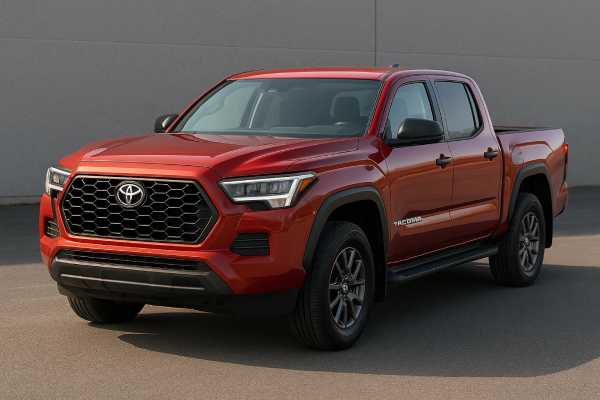
The fourth generation Toyota Tacoma 4×4 Hybrid (i-FORCE MAX) is Toyota’s answer to buyers who want serious off road capability without giving up day to day efficiency. It combines the T24A-FTS 2.4 litre turbocharged four cylinder with an integrated electric motor and a compact high voltage battery, delivering a system output of 326 hp and a very strong 465 lb ft of torque in key trims such as TRD Sport, TRD Off Road, Limited, Trailhunter and TRD Pro. This truck rides on a boxed frame, offers coil spring rear suspension on higher trims, and carries Toyota’s latest Safety Sense driver assist suite. At the same time, it remains a midsize pickup that will fit in most garages, tow around 6,000 lb when properly equipped, and still return fuel economy that is competitive with many non hybrid rivals. For owners who mix city commuting, highway trips and real off road use, the hybrid Tacoma 4×4 is one of the most versatile packages in the segment.
Top Highlights
- Strong combined output (326 hp and 465 lb ft) gives effortless acceleration, especially when loaded or towing.
- Hybrid system improves real world fuel economy versus non hybrid Tacomas while keeping a conventional 8 speed automatic and transfer case.
- Off road focused trims add low range, locking rear differential, available front stabilizer bar disconnect and trail tuned shocks for serious capability.
- Added complexity from the hybrid system (HV battery, power electronics and cooling) means more components to monitor over the long term.
- Typical oil change interval is 10,000 miles (16,000 km) or 12 months under normal use, with 5,000 mile (8,000 km) intervals advisable for heavy towing or dusty driving (always verify for your market).
Contents and shortcuts
- Hybrid Tacoma 4×4 fundamentals
- Hybrid powertrain and specs
- Hybrid trims, options and safety
- Reliability and service actions
- Maintenance plan and buyer guide
- Hybrid driving and performance feel
- Hybrid Tacoma against its rivals
Hybrid Tacoma 4×4 fundamentals
The hybrid Tacoma 4×4 (often branded “i-FORCE MAX”) sits at the top of the N400 Tacoma range. It pairs a turbocharged 2.4 litre T24A-FTS four cylinder engine with an electric motor packaged inside the 8 speed automatic transmission and a compact nickel metal hydride high voltage battery under the rear seat. The total system output of 326 hp and 465 lb ft is a large step up from the non hybrid 2.4, and torque is delivered much earlier in the rev range thanks to the motor assist.
Unlike some hybrids that use an eCVT or unique transaxle layout, the Tacoma hybrid retains a longitudinal engine, conventional transfer case and driveshafts. That keeps the truck familiar to technicians and makes it easier to pair the hybrid system with existing 4×4 hardware, including low range, a locking rear differential on many trims, and in some models a disconnecting front stabilizer bar for improved articulation. From a buyer’s point of view, the truck still feels like a classic body on frame 4×4, just with more punch and better efficiency.
Chassis wise, the N400 Tacoma moves to a stiffer boxed frame with extensive use of high strength steel. Many hybrid 4×4 trims also gain a coil sprung multi link rear suspension rather than traditional leaf springs, improving ride quality and axle control on broken surfaces. Higher trims layer on off road shocks (Bilstein, FOX or Old Man Emu depending on model), skid plates, all terrain tyres, and unique off road drive modes with crawl control and downhill assist.
The hybrid system is targeted at buyers who do a mix of urban driving, highway runs and off road or towing use. It offers an efficiency gain in stop start and low load conditions, extra torque for towing or steep grades, and the ability to recover energy on descents. The relatively small battery means it is not designed for extended EV only driving; instead, it is a power assist and energy saving system.
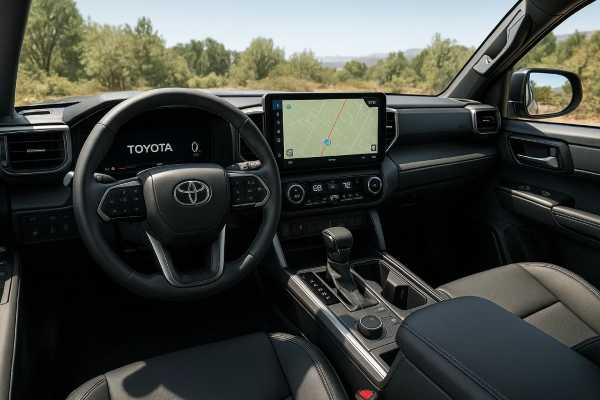
In day to day ownership, the hybrid Tacoma remains a traditional midsize pickup: double cab, 5 or 6 foot bed depending on trim, familiar ergonomics, and a cabin that now features a large central touchscreen, digital cluster on upper trims, and plentiful storage. The hybrid powertrain is essentially transparent in use, which is ideal for owners moving up from older Tacomas or other non hybrid trucks.
Hybrid powertrain and specs
This section focuses on the technical details of the Tacoma 4×4 hybrid. Figures can vary slightly between trims and markets; always confirm against the build sheet and local documentation.
Engine and performance (i-FORCE MAX hybrid)
| Item | Detail |
|---|---|
| Engine code | T24A-FTS turbocharged inline four |
| Displacement | ~2.4 L (2393 cc) |
| Layout and valvetrain | Longitudinal I-4, DOHC, 4 valves per cylinder, dual VVT-i |
| Induction | Single twin scroll turbocharger, intercooler |
| Fuel system | Direct plus port fuel injection (D-4S type) |
| Compression ratio (approx.) | Around 10.5:1 (varies by application) |
| Max system power | 326 hp (about 243 kW) |
| Max system torque | 465 lb ft (about 630 Nm) |
| Timing drive | Chain driven camshafts |
| Emissions / efficiency std. | Meets current US EPA / CARB LEV III light duty standards in North America |
| Rated fuel economy (hybrid 4WD) | Typically 22–23 mpg city, 23–24 mpg highway, 23–24 mpg combined depending on trim (US EPA) |
At highway speeds around 120 km/h (75 mph), owners can expect consumption in the mid 20 mpg US range in calm conditions, with a noticeable drop when running aggressive all terrain tyres, roof racks or heavy accessories.
Hybrid system and battery
| Item | Detail |
|---|---|
| Hybrid type | Parallel hybrid with single traction motor between engine and transmission |
| Motor location | Integrated into 8 speed automatic transmission bellhousing |
| Battery chemistry | Nickel metal hydride (NiMH) |
| Nominal battery capacity | Around 1.9 kWh (gross), air cooled and packaged under rear seat |
| System voltage (approx.) | High voltage system in the 270–300 V class |
| EV operation | Short EV assist and very low speed manoeuvring; not intended for long EV only driving |
| Regeneration | Brake energy recovery blended with hydraulic braking via brake by wire |
Transmission and driveline
| Item | Detail |
|---|---|
| Transmission | 8 speed automatic with integrated electric motor (no manual on hybrid) |
| Drive type | Part time 4×4 with 2H, 4H, 4L (lever or dial depending on trim) |
| Transfer case | Two speed, chain driven, low range around 2.57:1 (approximate) |
| Differentials | Front open differential; rear locking differential on many hybrid off road trims; auto limited slip via brake control on others |
| Final drive ratio | Varies by trim, commonly mid 3s to low 4s (check axle code) |
| Crawl control | Available on off road trims, uses ABS and engine/motor torque control |
| Terrain modes | Multi Terrain Select with dedicated modes for dirt, sand, mud and rock in upper trims |
Chassis and dimensions (typical double cab short bed hybrid 4×4)
Values vary slightly by trim (TRD Sport vs Trailhunter vs TRD Pro), but the following is representative.
| Item | Approximate value |
|---|---|
| Frame | Boxed ladder frame, high strength steel |
| Front suspension | Double wishbone with coil springs, stabilizer bar |
| Rear suspension | Multi link coil spring (on most hybrid trims) |
| Steering | Electric power assisted rack and pinion |
| Front brakes | Ventilated discs, around 328 mm (12.9 in) diameter |
| Rear brakes | Solid discs, around 319 mm (12.6 in) diameter |
| Wheelbase | About 3,270 mm (128.7 in) for double cab short bed |
| Overall length | Around 5,400–5,460 mm (212–215 in) depending on bumper and tyre package |
| Width (without mirrors) | About 1,930 mm (76 in) |
| Height | Roughly 1,800–1,890 mm (71–74 in) depending on trim and tyres |
| Ground clearance | Around 265–295 mm (10.4–11.6 in), higher on TRD Pro / Trailhunter |
| Approach / departure angles | Mid 30s / high 20s degrees on off road trims, lower on street oriented models |
Performance and capability
| Item | Typical value / comment |
|---|---|
| 0–60 mph (0–97 km/h) | Low to mid 6 second range for lighter trims |
| Top speed | Typically limited around 110–115 mph (175–185 km/h) |
| Maximum towing (hybrid 4×4) | Up to about 6,000 lb (≈ 2,720 kg) when properly equipped |
| Typical payload | Often in the 1,500–1,700 lb (≈ 680–770 kg) range, depending on trim |
| Roof load | Commonly around 165–220 lb (75–100 kg) dynamic; higher static when parked with a rooftop tent (check manual) |
Hybrid towing ratings vary with cab, bed, axle ratio and package, but they are competitive with other midsize trucks and adequate for midsize campers and small boats.
Fluids and service capacities (guidance level)
Exact capacities depend on model year and drivetrain; always verify by VIN:
- Engine oil: around 5.0–5.5 L (5.3–5.8 US qt) of 0W-20 synthetic meeting Toyota specifications.
- Engine coolant: approximately 7–8 L (7.4–8.5 US qt) of Toyota Super Long Life Coolant (pink) premix.
- Automatic transmission fluid: Toyota WS (World Standard); a typical drain and fill is in the 3–4 L (3.2–4.2 qt) range, more for complete exchanges.
- Transfer case and differentials: 75W-85 or 75W-90 GL-5 gear oil, typically 0.7–1.5 L (0.7–1.6 qt) per housing.
- A/C refrigerant: R-1234yf with a specific charge weight per label.
Torque specs for wheel nuts, drain plugs, and suspension components differ by model and fastener size; the service manual or workshop database is essential before any torque critical work.
Electrical and safety systems
- 12 V battery: conventional AGM or flooded 12 V battery in the engine bay; sizing may vary by trim.
- High voltage system: service plugs and safety interlocks under the rear seat area; only trained personnel should open HV covers.
- Safety suite: Toyota Safety Sense 3.0 including pre collision system with pedestrian detection, lane departure alert with steering assist, adaptive cruise control, lane tracing assist and road sign assist on most trims.
Hybrid trims, options and safety
For North America, the hybrid 4×4 system is available primarily on higher Tacoma trims. Lineups can vary by year, but the i-FORCE MAX hybrid is typically available or standard on TRD Sport, TRD Off Road and Limited, and standard on Trailhunter and TRD Pro. Early model years may restrict the hybrid to certain double cab configurations, so it is important to check the window sticker or build sheet.
Trim and equipment themes
- TRD Sport Hybrid: More on road biased with sport tuned suspension, 18 inch wheels, body colour fender flares and a focus on comfort and tech.
- TRD Off Road Hybrid: Skid plates, off road tuned shocks, selectable rear locker, terrain modes and usually all terrain tyres.
- Limited Hybrid: More comfort oriented with premium interior, larger infotainment screen, panoramic view monitor and additional driver aids.
- Trailhunter and TRD Pro (Hybrid only): Factory overland or hard core off road builds with unique dampers (Old Man Emu or FOX), underbody protection, armour style bumpers, all terrain or mud terrain tyres and accessories like onboard air or bed mounted rails.
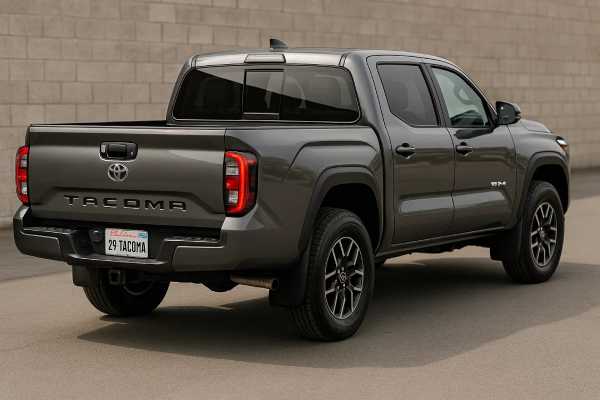
Hybrid specific identifiers include i-FORCE MAX badging on the tailgate and engine cover, hybrid labels on some interior graphics and, on certain trims, unique digital cluster layouts that show energy flow and regeneration.
Options and packages
Buyers can typically add:
- Premium audio and larger infotainment displays.
- Panoramic or multi terrain monitor camera systems for off road manoeuvring.
- Advanced towing package with trailer brake controller and extra cooling.
- Appearance packages (blackout trims, special wheels).
Package content and availability vary by market and model year; check the order guide if you are cross shopping used examples.
Safety ratings
The 2024 Tacoma double cab has been tested under the latest, tougher crash protocols and has earned strong ratings in many configurations, thanks to improved small overlap protection, updated airbag strategies and stronger roof and side structures. Headlight performance and rear seat restraints were areas of focus in the redesign versus the previous generation.
Euro NCAP had not yet published a separate rating for the hybrid Tacoma at the time of writing, and the truck is primarily targeted at North American and some other regional markets, so most safety data will come from IIHS and NHTSA.
Safety systems and ADAS
All hybrid Tacoma 4×4 models include a comprehensive active safety suite:
- Pre collision system with pedestrian and cyclist detection.
- Full speed adaptive cruise control.
- Lane departure alert with steering assist and lane tracing function.
- Road sign assist and proactive driving assist in some trims.
- Blind spot monitor and rear cross traffic alert on most mid and upper trims.
- Rear seat reminder and safe exit assist on better equipped models.
In addition, the Tacoma uses eight or more airbags depending on configuration, including curtain airbags that extend to the rear cab, side torso airbags and advanced multi stage front airbags.
From a service standpoint, remember that many ADAS components (radar units, camera modules) require calibration after windshield replacement, front end collision repairs or significant ride height modifications. When lifting or heavily modifying a hybrid Tacoma, plan for professional ADAS calibration.
Reliability and service actions
Because the hybrid Tacoma 4×4 is new (2024 onward), long term reliability data is still limited. However, we can draw from Toyota’s general track record with hybrids and the shared T24A-FTS engine family used in other models.
Engine and hybrid system
- Engine durability: The T24A turbo four has seen service in several Toyota and Lexus models in both non hybrid and hybrid forms. Early reports suggest generally good durability when serviced on time with quality 0W-20 oil and when fuel of appropriate octane is used. Watch for any signs of oil consumption or leaks at the cam cover and front timing cover as mileage builds.
- Carbon build up: As with many direct injection engines, intake valve deposits can accumulate over time. Driving with regular highway runs and using quality fuel helps. Some owners choose periodic intake cleaning around 60,000–80,000 miles (100,000–130,000 km).
- Hybrid battery and electronics: The relatively small NiMH pack and single traction motor are less stressed than in full EVs. Toyota hybrids have historically shown slow battery degradation, and many systems run cool thanks to careful thermal management and conservative power draw. Expect normal service life measured in many years, but avoid blocking under seat vents and keep cabin filters clean.
Cooling and thermal management
The hybrid adds cooling circuits and heat exchangers for the electric motor, transmission and power electronics. Any sign of coolant loss, hybrid system warnings or unusual fan noise should be investigated promptly. When operating in hot climates or towing near the limit, verify that the radiator, intercooler and condenser fins are not clogged with debris.
Driveline and chassis
With high torque at low rpm, the hybrid places more load on driveline components:
- Listen for clunks or lash in the transfer case and differentials, especially on lifted or heavily used trucks.
- Check CV boots and front driveshaft joints, particularly on trucks used extensively off road.
- Inspect suspension bushings, ball joints and steering components for play after significant off road use or oversized tyres.
Software, TSBs and recalls
As with many modern vehicles, early production Tacomas may receive software updates:
- Engine and transmission control updates can address shift quality, drivability, or check engine lights related to emissions or sensor thresholds.
- Hybrid control module updates may refine the interaction between engine, motor and brake system, improving smoothness when transitioning between regenerative and friction braking.
- ADAS systems may receive calibration or software changes to reduce false alerts or improve lane centring.
Owners should periodically check for Technical Service Bulletins (TSBs) and recall notices through Toyota’s official site or government recall databases, using the truck’s VIN. For a pre purchase inspection, ask for a printout of completed campaigns and confirm that any open campaigns are scheduled.
Reliability outlook
Toyota’s hybrid technology has a strong track record, and the Tacoma hybrid uses a relatively straightforward single motor layout rather than a complex multi motor system. The main unknowns are long term durability of the new frame, suspension design, turbocharged engine under heavy towing, and potential corrosion on trucks used in harsh winter climates. With regular maintenance, sensible modifications and prompt attention to warning lights or fluid leaks, the hybrid Tacoma 4×4 is expected to be a durable platform, but buyers should still budget for higher future repair costs than a simpler, naturally aspirated older Tacoma.
Maintenance plan and buyer guide
A structured maintenance plan is key to keeping the hybrid Tacoma 4×4 reliable. The table below gives a practical schedule; always adapt it to your market’s official maintenance guide and your usage pattern.
Practical maintenance schedule (typical North American guidance)
| Item | Interval (distance / time) | Notes |
|---|---|---|
| Engine oil and filter | 10,000 miles / 12 months (normal); 5,000 miles / 6 months (severe) | Use 0W-20 API / ILSAC oil meeting Toyota specs |
| Engine air filter | Inspect 15,000 miles; replace 30,000–45,000 miles | Shorten interval in dusty use |
| Cabin air filter | 15,000–20,000 miles or 1 year | Important for hybrid cooling airflow if shared ducts |
| Coolant (engine and hybrid loop) | Around 100,000 miles / 10 years first change, then every 50,000 miles / 5 years | Confirm exact hybrid interval in official manual |
| Spark plugs | 90,000–120,000 miles (145,000–190,000 km) | Use iridium plugs to OEM spec and torque correctly |
| Fuel filter | Usually in tank and “lifetime”; inspect if drivability issues occur | Replace when needed or when pump module is serviced |
| Automatic transmission fluid | 60,000–100,000 miles depending on use | More frequent changes for towing and off road use |
| Transfer case and differentials | 30,000–60,000 miles depending on severe vs normal use | Shorter intervals for frequent 4×4 use, mud and water crossings |
| Brake fluid | 3 years initially, then every 2–3 years | Essential for consistent pedal feel and corrosion resistance |
| Brake pads and rotors | Inspect at every service | Watch for rust lip in salted regions |
| Serpentine / accessory belts | Inspect from 60,000 miles; replace when cracked or noisy | Hybrid still has belt driven ancillaries |
| Hoses and cooling lines | Inspect every service | Pay attention to hybrid coolant hoses and connections |
| Wheel alignment and tyre rotation | Rotate every 5,000–7,500 miles; alignment check annually | Important for even tyre wear and ADAS camera aim |
| 12 V battery | Test annually from year 3; replace around year 5–7 as needed | A weak 12 V can cause hybrid no start conditions |
| HV battery and hybrid check | As per Toyota hybrid service inspection intervals | Use factory test procedures only |
Timing on the hybrid Tacoma uses a chain rather than a belt, so there is no fixed replacement mileage. Instead, listen for rattles on cold start, monitor for timing correlation fault codes, and inspect oil condition. Prolonged oil neglect can accelerate chain and tensioner wear.
Buyer’s guide tips
When shopping for a used hybrid Tacoma 4×4:
- Service history: Look for documented oil changes at or before the recommended intervals, plus at least one driveline fluid service if mileage is high.
- Recalls and campaigns: Ask the seller for a recent printout of recall and TSB work and verify the VIN through official channels.
- Hybrid health: Confirm there are no hybrid system warning lights, the truck starts and shuts down cleanly, and the engine transitions are smooth. A dealer can perform a hybrid health check if you want baseline data.
- Underbody inspection: Look for frame and suspension corrosion, damaged skid plates, bent control arms and leaking shocks.
- Modification quality: Many Tacoma owners add lifts, larger tyres and accessories. Check that any lift kit is from a reputable brand, that alignment and ADAS calibration were done afterwards, and that no wires or hoses have been stretched or chafed.
- Towing and usage: Heavy towing, frequent off road trips and high payload use are fine if maintenance kept pace. Evidence includes trailer brake controller, worn hitch, and heavy duty tyres—look for corresponding fluid service and suspension inspection records.
Overall, a well maintained hybrid Tacoma 4×4 should offer long service life with reasonable running costs, especially if you take a proactive approach to fluids, corrosion prevention and software updates.
Hybrid driving and performance feel
On the road, the hybrid Tacoma 4×4 feels noticeably stronger than non hybrid variants. The electric motor fills in low end torque, so the truck moves off the line briskly with little hesitation, even with passengers and gear aboard. Mid range passing performance is a standout: the combination of turbo boost and electric assist gives strong response for highway merges and overtakes, and the 8 speed automatic usually keeps the engine in the meat of its torque band.
Shift behaviour in normal drive mode favours efficiency, with relatively early upshifts in gentle driving. Sport modes hold gears longer and downshift more readily, which can be useful on grades or when towing. Because the hybrid retains a conventional step gear transmission and transfer case, engine braking in low range still feels familiar off road, and the hybrid system adds regeneration on descents to reduce brake use.
Ride quality depends a lot on trim. Coil sprung rear suspension and well tuned shocks give the hybrid Tacoma a more composed ride over broken pavement than older leaf sprung models, especially with some load in the bed. Off road oriented trims with aggressive tyres can be noisier and a bit more jittery on sharp bumps but pay that back with greater grip and durability on trails.
Cabin noise is generally well controlled for the class; wind and tyre noise at 70–75 mph are present but not intrusive. Under hard acceleration, the turbo four makes itself heard, but the note is more purposeful than harsh. At low speeds, the engine will often shut off and restart as the hybrid system manages power; most drivers acclimate quickly and many barely notice the transitions.
Off road impressions
The hybrid torque delivery helps in technical terrain. Having strong torque available just off idle makes it easier to climb ledges and work through loose sections in 4L, especially with the rear locker engaged. Crawl control and Multi Terrain Select can be valuable for less experienced drivers, though some seasoned off roaders prefer manual throttle and brake control. The key is to avoid abrupt throttle inputs that might overwhelm traction on slick surfaces.
Efficiency in real use
In mixed driving with a light load, many owners will see combined fuel economy in the low to mid 20 mpg US range, with steady highway runs hovering in that band and city use sometimes doing slightly better thanks to regenerative braking and engine stop start. Heavy accessories, roof racks, lift kits and aggressive tyres can easily pull economy down by 2–4 mpg.
Towing a medium size trailer near the 6,000 lb limit will significantly increase consumption; seeing high teens mpg or lower is normal in that scenario, but the hybrid’s extra torque makes the experience less stressful than a lower power non hybrid. Temperatures remain stable as long as cooling systems are healthy, though long mountain grades still warrant downshifting and sensible speed management.
Hybrid Tacoma against its rivals
The hybrid Tacoma 4×4 competes in a rapidly evolving midsize truck segment where turbocharged and electrified powertrains are becoming the norm.
Versus non hybrid Tacoma
Compared with the standard 2.4 litre i-FORCE Tacoma, the hybrid offers:
- Noticeably more torque and better acceleration, particularly when loaded or towing.
- Improved fuel economy in city and mixed use, with similar highway numbers at steady speeds.
- More complex hardware and higher purchase price, which may or may not be offset by fuel savings depending on mileage and fuel costs.
For drivers who mostly cruise unloaded on the highway, the non hybrid may be sufficient. For those who tow, haul or drive in hilly or urban environments, the hybrid’s power and efficiency make a compelling case.
Versus other midsize trucks
- Ford Ranger and Chevrolet Colorado/GMC Canyon: These rivals offer strong turbo petrol engines and, in some trims, excellent towing and payload. However, at the time of writing they do not offer a full hybrid option in North America, so the Tacoma hybrid stands out for those seeking electrified assistance without moving to a full size truck.
- Jeep Gladiator: Offers open air freedom and solid axles for traditional off road enthusiasts, but fuel economy is lower and there is no hybrid powertrain yet.
- Nissan Frontier: Simple, robust V6 power and conventional 4×4 hardware, but again without the hybrid efficiency angle and with fewer advanced driver aids in some trims.
In terms of safety, the latest Tacoma with Toyota Safety Sense and strong crash performance compares well with rivals that are still catching up to the newest test protocols. In interior tech, large screens, over the air capable infotainment and modern camera systems keep it competitive, though some users find Toyota’s user interface learning curve steeper than that of certain competitors.
For buyers who value a blend of proven hybrid technology, genuine off road capability and the familiarity of a traditional 4×4 layout, the Tacoma hybrid occupies a unique niche. It is not the cheapest midsize truck and it is not a full EV or plug in hybrid, but as an all rounder for work, travel and recreation, it is one of the most versatile configurations in the current Tacoma family.
References
- 2024 Toyota Tacoma is the Ultimate Adventure Machine – Toyota USA Newsroom 2023 (Product and Technical Overview)
- Gas Mileage of 2024 Toyota Tacoma 2024 (Official EPA Fuel Economy Data)
- 2024 Toyota Tacoma 2024 (IIHS Safety Rating)
- 2024 Toyota Tacoma Brochure 2023 (Manufacturer Brochure and Specifications)
Disclaimer
This article is for informational purposes only and is not a substitute for professional diagnosis, repair or inspection. Specifications, torque values, fluid capacities, maintenance intervals and available equipment can vary by VIN, market, trim level and model year. Always confirm details against your vehicle’s official owner’s manual, warranty and maintenance guide, and factory service documentation before performing work or making purchase decisions.
If you found this guide useful, consider sharing it with other enthusiasts and owners on platforms such as Facebook, X/Twitter or your favourite forums. It helps support xcar’s work and makes it easier for others to find reliable, well researched information.