
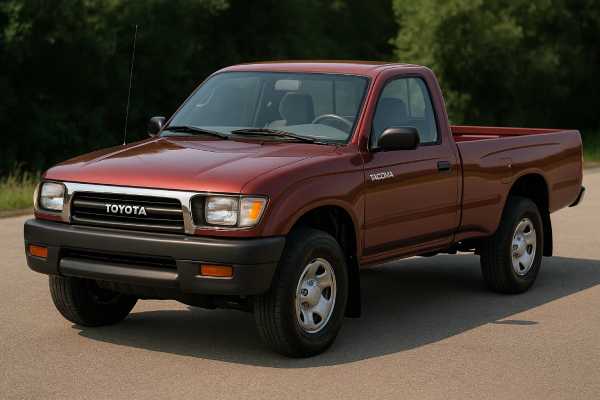
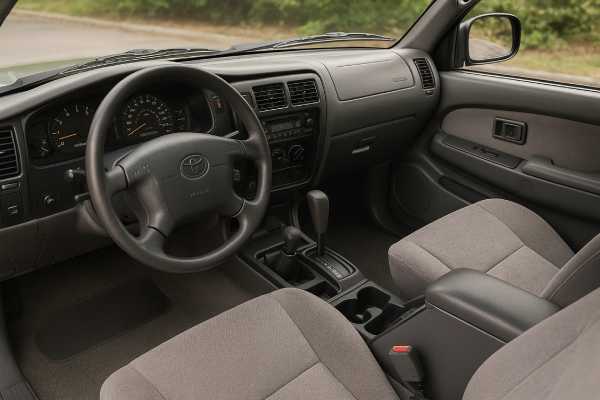
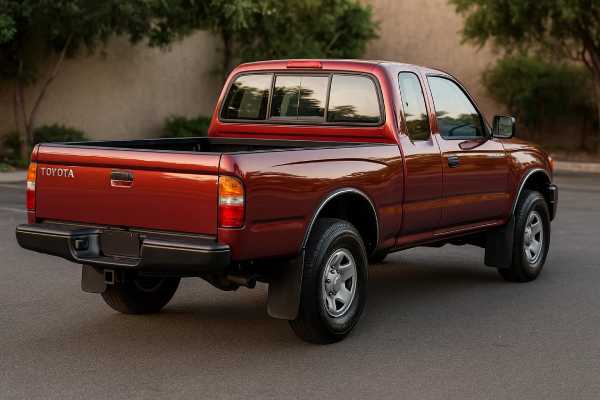
For many owners, the rear-wheel drive Toyota Tacoma with the 5VZ-FE 3.4-litre V6 is the “sweet spot” of the first generation. Built on the N140 platform from 1995 to 2000, this configuration combines a stout ladder frame, simple rear-wheel drive, and a strong naturally aspirated V6 that feels noticeably more muscular than the four-cylinder trucks. It is still small enough to park easily, but it can tow, haul, and cruise at highway speeds with less effort and noise than the 2.4- or 2.7-litre models.
From an ownership point of view, the Tacoma RWD 3.4 offers straightforward mechanicals, good parts availability, and a long track record in pickups and SUVs. At the same time, there are age-related issues to watch, including frame corrosion and timing-belt neglect. In this guide we will walk through specifications, dimensions, performance, reliability patterns, maintenance recommendations, and how the 5VZ-FE RWD Tacoma stacks up against rival compact trucks of the era.
Fast Facts
- Strong 3.4-litre 5VZ-FE V6 with about 190 hp and 220 lb-ft gives easier towing and merging than the four-cylinder Tacomas.
- Rear-wheel drive layout is simpler than 4×4, with fewer wear points and better fuel economy than a comparable 4WD V6.
- Typical tow ratings up to about 1,590–2,268 kg (3,500–5,000 lb) depending on configuration and tow package.
- Watch for frame rust, timing-belt history, and lower ball joint recall completion on high-mileage trucks.
- A practical oil and filter interval is 8–10,000 km or 6 months with quality 5W-30 to keep the V6 healthy.
What’s inside
- Tacoma 3.4 RWD overview
- Tacoma 5VZ-FE RWD specs
- RWD trims and safety package
- Reliability of 5VZ-FE RWD Tacoma
- Maintenance plan and buying guide
- Driving character and performance
- Tacoma 3.4 RWD vs rivals
Tacoma 3.4 RWD overview
The first-generation Tacoma arrived for the 1995 model year as Toyota’s more refined replacement for the older Hilux-based pickup in North America. The goal was to make a compact truck that still worked hard but drove more like a car, with better ride comfort, safety, and refinement. The N140 platform underpinned multiple versions: four-cylinder and V6, 2WD and 4WD, Regular Cab and Xtracab, and later crew-cab derivatives in some markets.
The 5VZ-FE 3.4-litre V6 was the premium engine in the Tacoma lineup. It also powered the 4Runner and T100/Tundra, which means parts and diagnostic knowledge are widely shared. In Tacoma form, it produces roughly 190 hp at 4,800–4,800 rpm and 220 lb-ft around 3,600 rpm, giving a relaxed, flexible feel that many owners prefer over the buzzy four-cylinder trucks.
Rear-wheel drive Tacomas with the V6 target drivers who:
- Spend most of their time on-road
- Tow small to medium trailers (campers, small boats, utility trailers)
- Prefer lower running costs and fewer components than a 4×4, but still want a strong frame and drivetrain
Compared with the four-cylinder 2WD Tacoma, the 3.4-litre RWD variant offers better acceleration, more confident passing, and less strain when loaded, at the cost of slightly higher fuel consumption and more complex timing-belt maintenance. Compared with the 4×4 V6, it is lighter, more economical, and mechanically simpler, though obviously less capable on soft surfaces or steep trails.
The overall package is appealing as a durable, medium-duty work truck or light-duty tow vehicle that can also serve as everyday transport, especially in regions where snow and off-road use are limited.
Tacoma 5VZ-FE RWD specs
This section focuses on the 1995–2000 rear-wheel drive Tacoma with the 5VZ-FE 3.4-litre V6. Exact numbers vary slightly by body style, model year, and market; always confirm against your VIN-specific manual or build sheet.
Engine and performance (5VZ-FE)
| Item | Specification |
|---|---|
| Engine code | 5VZ-FE V6 |
| Displacement | 3.378 L (3,378 cc) |
| Layout | 60° V6, iron block, aluminium heads |
| Valvetrain | DOHC, 4 valves per cylinder |
| Bore × stroke | 93.5 × 82.0 mm (approx.) |
| Induction | Naturally aspirated |
| Fuel system | Multi-point fuel injection |
| Compression ratio | ~9.6:1 |
| Max power | ~190 hp (142 kW) @ ~4,800–4,800 rpm (market dependent) |
| Max torque | ~298 Nm (220 lb-ft) @ ~3,600 rpm |
| Timing drive | Rubber timing belt with idlers and tensioner |
| Firing order | 1-2-3-4-5-6 |
| Recommended fuel | Unleaded regular (typically 87 AKI in North America) |
The 5VZ-FE has a broad torque curve and is known for smoothness and longevity when the timing belt and cooling system are maintained correctly.
Transmission and driveline (RWD)
| Item | Manual RWD | Automatic RWD |
|---|---|---|
| Transmission | 5-speed manual (R150E family, typical) | 4-speed automatic (A340E family, typical) |
| Drive type | Rear-wheel drive (RWD) | Rear-wheel drive (RWD) |
| Final drive ratios | Often 3.58–3.91 (varies by GVWR and tow package) | Similar range, with specific codes by year |
| Differential | Open rear differential; limited-slip optional in some markets | |
| Axle | Solid rear axle with leaf springs |
The RWD layout avoids a transfer case and front differential, reducing weight and mechanical complexity compared with 4×4 versions.
Chassis and dimensions
Typical values for a late-1990s V6 RWD Xtracab Tacoma:
| Item | Value |
|---|---|
| Length | ~5,055 mm (199.0 in) |
| Width | ~1,690–1,720 mm (66.5–67.7 in) |
| Height | ~1,550–1,575 mm (61–62 in) |
| Wheelbase | ~3,096 mm (121.9 in) for Xtracab |
| Ground clearance | ~200–210 mm (7.9–8.3 in), slightly lower than 4×4 |
| Curb weight | ~1,580–1,640 kg (3,480–3,615 lb) |
| GVWR | ~2,270–2,360 kg (5,000–5,200 lb) |
| Fuel tank | ~68 L (18.0 US gal) on many V6 models |
Suspension, steering and brakes:
| System | Layout |
|---|---|
| Front suspension | Independent double wishbone with coil springs and anti-roll bar |
| Rear suspension | Solid axle with leaf springs |
| Steering | Power-assisted rack-and-pinion (most RWD models) |
| Brakes | Front ventilated discs, rear drums; 4-wheel ABS available/optional |
Performance and capability
| Metric | Typical value (RWD V6) |
|---|---|
| 0–100 km/h (0–62 mph) | Approximately 9–10 s (unladen, automatic slightly slower) |
| Top speed | Around 170–180 km/h (105–112 mph), gear and governor limited |
| Towing capacity | Often 1,590–2,268 kg (3,500–5,000 lb) with tow package |
| Payload | Typically 650–900 kg (1,430–1,980 lb) depending on configuration |
Check the specific door-jamb sticker and owner’s manual for your truck; the tow rating depends heavily on axle ratio, cooling package, and hitch equipment.
Fluids, capacities and key torque values
(Always confirm for your exact year and market.)
| System | Spec / capacity | Notes |
|---|---|---|
| Engine oil | 5W-30; approx. 5.1–5.4 L with filter | 8–10,000 km or 6 months in mixed use |
| Engine coolant | Toyota long-life coolant (red); ~8–9 L 50/50 mix | 80–100,000 km or 5 years |
| Manual gearbox | 75W-90 GL-4/GL-5, ~2.2–2.5 L | Shorter intervals with towing |
| Automatic transmission | Toyota Type T-IV, total capacity ~8–9 L | Drain-and-fill uses less |
| Rear differential | 75W-90 GL-5, ~2.5–2.7 L | Change every 60–80,000 km |
| Power steering | ATF or specific PS fluid as specified | Level checks at each service |
| Brake fluid | DOT 3 or DOT 4 | Flush every 2–3 years |
Indicative torque values:
- Wheel nuts: ~100–110 Nm (74–81 lb-ft)
- Oil drain plug: ~35–40 Nm (26–30 lb-ft)
- Spark plugs: ~18–22 Nm (13–16 lb-ft)
- Rear axle U-bolts: refer to manual; torque is critical for clamp load
Electrical
Typical equipment includes:
- Alternator output around 70–80 A depending on trim
- 12 V battery in the 40–60 Ah range with 500–600 CCA (varies by replacement choice)
- Standard spark plugs from factory, with many owners upgrading to longer-life plugs at belt service
RWD trims and safety package
While badging and equipment changed slightly over the 1995–2000 run, the V6 RWD Tacoma generally came in a small set of trims with overlapping options.
Common trims and equipment
Typical North American V6 RWD configurations included:
- Base / DX RWD V6
- Cloth or vinyl bench or split bench
- Manual windows and locks
- Steel wheels
- Often Regular Cab, sometimes Xtracab
- SR5 RWD V6
- Upgraded cloth seats and interior trim
- Optional power windows and locks
- Alloy wheels and extra chrome or colour-keyed exterior pieces
- More audio and convenience options
- Limited / special packages (market dependent)
- Appearance upgrades, premium audio, or specific wheel/tyre packages
- Some markets offered sport or towing packages with upgraded cooling and hitch provisions
Mechanical differences between trims are modest:
- Spring rates and rear axle ratios may change with tow or payload packages.
- Wheel and tyre sizes vary; larger wheels can slightly affect gearing feel and ride.
- Limited-slip differentials may be fitted as part of certain option groups.
For identification, check:
- The VIN plate for engine, transmission, and axle codes.
- Option codes on build stickers (where present) for LSD and tow packages.
Safety ratings
Formal crash-test coverage for 1990s compact pickups is more limited than for modern vehicles, but available data shows that:
- Frontal crash performance was acceptable for the era, with decent occupant protection but higher injury metrics than modern trucks.
- Many RWD Tacomas of this generation were not tested in side or rollover protocols that later became standard, so comparison with modern scores is difficult.
Buyers should treat these trucks as robust but basic: strong frame and cab, but lacking later-generation crumple zones, side airbags, and sophisticated restraint systems.
Safety systems and driver assistance
Standard and optional safety equipment for the 1995–2000 Tacoma RWD V6 typically includes:
- Airbags
- Driver airbag standard
- Passenger airbag phased in and improved over the production run
- Seat belts and child restraints
- Three-point belts for front occupants
- No ISOFIX/LATCH; child seats rely on belt routing
- Xtracab jump seats are not ideal for child restraints; always check manual guidance
- Braking and stability
- Power-assisted front disc / rear drum brakes
- Load-sensing proportioning valve for the rear circuit
- Four-wheel ABS optional or standard on some higher trims, particularly in later years
- No stability control, traction control, or modern ADAS
- Lighting and visibility
- Halogen headlamps adequate for the period but dim compared with modern projectors/LEDs
- Additional driving lights and upgraded bulbs are common aftermarket additions, but must be aimed correctly and kept road-legal
After any front or side impact, it is important to:
- Confirm proper airbag lamp behaviour (on at key-on, off after self-test)
- Check seat-belt retractors and pre-tensioners for damage or lock-up
- Inspect frame rails and steering components for bends or misalignment
Reliability of 5VZ-FE RWD Tacoma
The 5VZ-FE V6 has a strong reputation for reliability across Tacoma, 4Runner and T100 applications. Most high-mileage failures trace back to skipped timing-belt services, chronic overheating, or severe rust rather than design flaws. The RWD layout simplifies the driveline and removes 4×4-specific problems, but age introduces its own concerns.
Engine and cooling system
Common issues, by prevalence and cost:
- Timing belt and idlers (common, medium cost)
- Symptoms: Squeaks, chirps, belt wear, or simply age with unknown history.
- Root cause: Belt and bearings age out around 150,000–160,000 km or 90–100,000 miles.
- Remedy: Replace belt, tensioner, idler pulleys and usually the water pump in one service. Labour is moderate but straightforward for a specialist.
- Valve cover and cam seals (common, low to medium cost)
- Symptoms: Oil smell on hot shutdown, wetness around cover perimeter, light oil leaks on block.
- Root cause: Hardened valve cover gaskets and seals after many heat cycles.
- Remedy: Replace gaskets, check PCV system, clean external surfaces. Cam and crank seals are often renewed during timing-belt work.
- Coolant leaks and overheating (occasional, high severity)
- Symptoms: Coolant smell, low expansion bottle level, temperature spikes.
- Root cause: Ageing radiator plastic tanks, hoses, and, in some cases, head gasket issues if severely overheated.
- Remedy: Replace radiator and hoses proactively on older trucks; diagnose any overheating immediately to avoid head damage.
- Knock or oxygen sensor faults (occasional, low to medium cost)
- Symptoms: Check engine light, reduced fuel economy, sluggish performance.
- Root cause: Sensor ageing or wiring issues.
- Remedy: Confirm with diagnostics and replace sensors with quality parts.
Fuel and ignition system
- Dirty injectors and throttle bodies are expected on high-mileage trucks and can cause rough idle or hesitation. Cleaning or replacing injectors, along with fresh plugs and wires, often restores smoothness.
- Coil-on-plug failures are not a major theme on the 5VZ-FE, but individual coils or leads can fail with age; misfire codes will guide diagnosis.
Driveline and chassis
Because the truck is RWD, there is no transfer case or front differential to service or repair. The focus shifts to:
- Driveshaft and U-joints
- Look for vibration on acceleration or deceleration; worn U-joints or an out-of-balance shaft are typical causes.
- Rear differential
- Generally robust with regular fluid changes; listen for whine or clunk on throttle transitions.
- Automatic transmission
- The A340E family is durable if fluid is kept clean and temperature under control. Lack of maintenance can lead to shift flare or harsh engagement.
Suspension and steering wear items:
- Front lower ball joints, tie-rod ends, and control-arm bushes all wear over time. Toyota has issued recalls and TSBs for certain steering and suspension components on this era of Tacoma; confirming completion is important for safety and tyre wear.
- Rear leaf springs may sag or crack under repeated heavy loads, especially in rust-prone climates.
Frame and body corrosion
Frame rust is a major topic with first-generation Tacomas. In salt-belt regions, frames can rust from the inside out, leading to perforation and safety issues. Toyota has conducted frame inspection and, in some cases, frame replacement or buyback programs covering specific VIN ranges.
Key actions:
- Inspect frame rails from front to rear, focusing on areas near suspension mounts and crossmembers.
- Look inside boxed areas with a borescope or by removing plugs, if possible.
- Check bed mounts, cab corners, and brake/ fuel lines for corrosion.
A structurally sound frame is more important than any mechanical issue, because mechanical items are far easier to repair or replace.
Recalls, TSBs and extended coverage
For 1995–2000 Tacoma models, official records list multiple recalls and technical service bulletins, commonly relating to:
- Lower ball joints and steering components
- Leaf springs and rear suspension hardware
- Airbag and seat-belt systems
- Frame corrosion inspection and treatment programs
To verify:
- Obtain the full VIN.
- Run a recall check through the official safety authority or Toyota site for your region.
- Ask for documentation of any frame or suspension campaigns, especially in rust-prone areas.
Maintenance plan and buying guide
Given the age of these trucks, a smart maintenance plan blends catching up on deferred work with an ongoing schedule suited to your use.
Practical maintenance schedule
Approximate intervals for mixed use (city, highway, light towing):
- Engine oil and filter – every 8–10,000 km or 6 months; shorter (5–7,000 km) for heavy towing or frequent short trips.
- Engine air filter – inspect every 15,000 km, replace about every 30,000 km or sooner in dusty conditions.
- Fuel filter – if serviceable (not in-tank only), change around 80–100,000 km.
- Spark plugs – standard plugs commonly around 30–40,000 km; long-life plugs can stretch further but should still be checked when the timing belt is serviced.
- Timing belt and water pump – roughly every 145–160,000 km or 90–100,000 miles, or 8–10 years (whichever comes first). Replace idlers, tensioner, and cam/crank seals while in there.
- Coolant – renew every 80–100,000 km or 5 years with the correct long-life coolant.
- Accessory belts and hoses – inspect at every service; replace belts roughly every 80–100,000 km and hoses when soft, swollen, or cracked.
- Manual gearbox, differential – change gear oil around every 60–80,000 km; sooner with frequent towing.
- Automatic transmission – pan service or drain-and-fill every 60–80,000 km is a reasonable target on an older truck.
- Brake fluid – flush every 2–3 years regardless of mileage.
- Brake pads and shoes – inspect at each tyre rotation; replacement intervals vary widely with driving style.
- Tyre rotation and alignment – rotate tyres every 10–12,000 km; align whenever the truck pulls, the steering wheel is off-centre, or suspension work has been done.
- 12 V battery – test annually from the 4-year mark, expect 4–6 years of life in typical climates.
Fluid specifications and capacities for planning
When ordering supplies:
- Engine oil capacity sits slightly above 5 L with filter, so a 5-L jug plus a top-up bottle is usually sufficient.
- Gear oils for the manual gearbox and rear axle total around 4–5 L of 75W-90.
- Coolant volume allows a typical 4–5 L of concentrate mixed with an equal amount of distilled water.
Always follow torque specifications from the factory manual for components like spark plugs, drain plugs and alloy housings.
Buyer’s guide checklist
When inspecting a Tacoma RWD V6 today:
- Frame and body
- Look for severe rust, particularly on the frame near suspension mounts and crossmembers.
- Check bed supports, cab mounts, and the underside of the cab floor.
- Engine and cooling
- Ask for evidence of timing-belt replacement (mileage and date).
- Inspect radiator, hoses, and coolant colour; avoid trucks with repeated overheating stories.
- Look for oil leaks at valve covers, front of engine, and rear main area.
- Transmission and driveline
- On a manual, check for smooth shifts and clutch engagement without slip or chatter.
- On an automatic, shifts should be decisive but not harsh, with no shudder on lock-up.
- Listen for driveline vibration or clunks on throttle transitions.
- Suspension and steering
- Drive over broken pavement to listen for clunks or rattles.
- Jack the front axle and check for play in ball joints and tie rods.
- Paperwork and recalls
- Request service records covering belt changes, fluid services, and any major repairs.
- Confirm recall and frame-inspection status using the VIN.
Which years and trims to target
- Trucks with documented timing-belt and water-pump service within the last 5–7 years are very desirable.
- In rust-prone regions, a truck with documented frame inspection or replacement under Toyota campaigns is worth a premium.
- Simpler trims (Base or SR5 without extreme modifications) tend to be easier to keep reliable than heavily altered or performance-tuned examples.
With a good history, the 5VZ-FE RWD Tacoma can be a long-term, low-drama workhorse with manageable running costs.
Driving character and performance
On the road, the RWD 3.4-litre Tacoma feels noticeably livelier than its four-cylinder siblings. The V6 engine pulls strongly from low revs and is quiet when cruising, while the lighter RWD chassis (versus 4×4) makes the truck feel more agile and efficient.
Ride, handling and NVH
- Ride: Firm but not harsh when unladen; improves with moderate load in the bed. The rear leaf springs can feel busy over sharp bumps, especially when empty.
- Steering: Light and direct for a body-on-frame truck, with good straight-line stability at highway speeds.
- Handling: Predictable rear-drive balance; traction is good in the dry but can be limited on wet or loose surfaces without weight in the bed.
- Noise: Engine noise is well-controlled; wind and tyre roar become more noticeable above 110 km/h, reflecting the truck’s age and aerodynamics.
Compared with 4×4 models, the RWD Tacoma sits a little lower and feels slightly more planted on paved roads, with less body roll and less driveline drag.
Powertrain character
- Low-speed response: Strong torque from around 1,800–2,000 rpm makes city driving easy and reduces gear-hunting on grades.
- Transmission behaviour:
- Manual trucks reward drivers who like to choose their own gears and can hold revs in the V6’s sweet spot.
- Automatics shift smoothly; with healthy fluid and correct throttle cable or sensor adjustment, kickdown is responsive enough for safe passing.
Real-world fuel economy for a V6 RWD Tacoma often falls in the 13–14 L/100 km range (17–18 mpg US) in mixed driving, with steady highway use achieving slightly better and short-trip city use returning worse. These numbers depend heavily on driving style, gearing, and load.
Towing and load behaviour
The Tacoma 5VZ-FE RWD is well-suited to modest trailers:
- With a properly set up hitch and trailer brakes, towing within the rated 3,500–5,000 lb feels manageable.
- On long grades, the V6 holds speed better than the four-cylinders, though downshifts and higher revs are normal.
- Fuel consumption rises noticeably under sustained towing, often into the 16–18 L/100 km (13–15 mpg US) bracket.
With payloads in the 400–600 kg range, the truck remains composed, provided springs and shocks are in good condition. Near the upper payload limit, expect more rear-end bounce and some nose-up stance.
Tacoma 3.4 RWD vs rivals
When new, the Tacoma 3.4 RWD competed directly with the Nissan Frontier, Ford Ranger, Mazda B-Series, Chevrolet S-10/GMC Sonoma, and similar compact pickups. On today’s used market, several differences stand out.
Strengths of the Tacoma RWD V6
- Engine durability – the 5VZ-FE is widely regarded as one of the most robust V6 engines of its era, with relatively few inherent weaknesses beyond normal belt and cooling-system maintenance.
- Resale value – Tacomas tend to hold value better than many rivals, reflecting demand and perceived reliability.
- Aftermarket and support – parts supply is excellent, and there is a deep pool of community knowledge and documentation.
- Driving feel – the combination of compact size, strong V6, and RWD makes for a truck that feels punchy and nimble by 1990s standards.
Where competitors may be preferable
- Some later Rangers and Frontiers developed more modern interiors, better seat ergonomics, and, eventually, more advanced safety features.
- Certain domestic trucks offered stronger factory tow ratings or heavier-duty payload packages.
- In specific markets, rivals may be cheaper to buy used due to lower nameplate demand, even when condition is similar.
Who the 3.4 RWD Tacoma suits best
This configuration is an especially good fit if:
- You primarily drive on-road and want strong, fuss-free power with simple RWD hardware.
- You tow modest loads several times a year and prefer a compact truck over a full-size pickup.
- You value long-term durability and parts availability more than the latest features or infotainment.
It may not be the best fit if:
- You need regular off-road capability or deep-snow traction (a 4×4 or dedicated winter tyres may be a better choice).
- You prioritise modern crash protection, side airbags, and advanced driver aids.
- You need heavy-duty towing above mid-size ratings.
For many owners, however, a well-kept Tacoma RWD with the 5VZ-FE remains a practical, long-lived truck that can still serve as a primary vehicle decades after it left the factory.
References
- TOYOTA Service Information 2024 (Service Manual and Technical Data)
- Toyota Owners – Resources and Manuals 2024 (Owner’s Manuals)
- Gas Mileage of 1998 Toyota Tacoma 2024 (Fuel Economy Data)
- Vehicle Detail Search – 1998 TOYOTA TACOMA 2024 (Recall Database)
- 1999 Toyota Tacoma Xtracab V6 – Specs 2024 (Specification Summary)
Disclaimer
This article is intended for informational purposes only and is not a substitute for professional diagnosis, repair, or safety assessment. Specifications, capacities, torque values, service intervals, and procedures can vary by VIN, model year, market, equipment level, and prior modifications.
Always confirm critical data against the official owner’s manual, factory service literature, and current technical bulletins for your specific vehicle, and follow all applicable safety and legal requirements when performing inspections or repairs.
If you found this guide useful, please consider sharing it with other owners or enthusiasts via your preferred platforms (such as Facebook or X/Twitter). Your support helps xcar continue to produce detailed, model-specific technical content.