
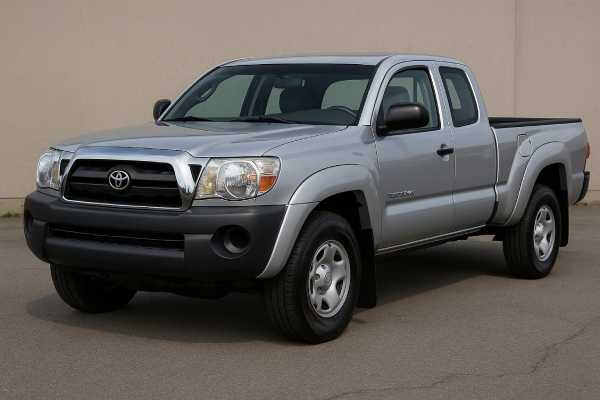
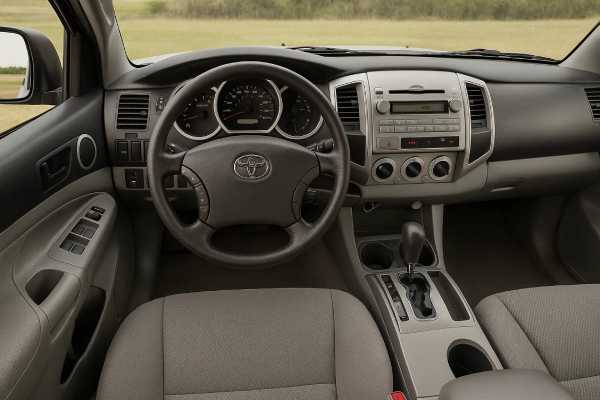
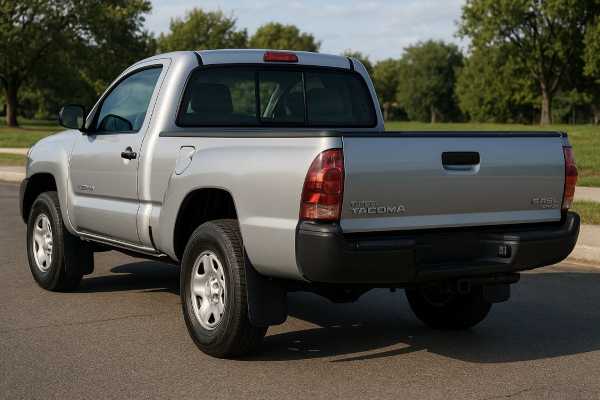
The second-generation Toyota Tacoma RWD (N220) with the 2TR-FE 2.7-liter four-cylinder engine sits in a useful sweet spot. It is more refined and spacious than the first-generation truck, but still simple enough that most major systems are mechanical and easy to understand. For many owners, that translates into predictable running costs and a long practical service life when maintenance is done on time.
The 2TR-FE itself is a square 2.7-liter engine with double overhead cams, four valves per cylinder, variable valve timing on the intake side, and a timing chain instead of a belt. Power is modest at 159 hp, but torque is broad and usable for daily driving and light towing. In rear-wheel-drive form, the Tacoma is lighter and more economical than 4×4 versions while sharing the same core chassis and cabin.
This guide explains what the 2005–2011 Tacoma 2.7 RWD can genuinely do, where it shines, and which reliability and maintenance points deserve attention before you buy or long after you own one.
Fast Facts
- 2TR-FE 2.7-liter four-cylinder uses a timing chain, DOHC and intake VVT-i, and has a strong reputation for long life with regular oil changes.
- RWD Tacomas are lighter and more fuel-efficient than 4×4 models, yet still rated to tow up to about 3,500 lb (1,588 kg) when properly equipped.
- Frame and leaf-spring related corrosion concerns affect many 2005–2010 trucks; documented inspection or repairs are extremely important.
- A sensible baseline engine oil and filter interval is 5,000 miles (8,000 km) or 6 months, with shorter intervals for heavy loads, hot climates or dusty use.
What’s inside
- Second-gen Tacoma 2.7 RWD profile
- Engine and specs for 2TR-FE Tacoma
- Tacoma N220 trims and safety
- 2TR-FE Tacoma reliability notes
- Maintenance schedule and buying tips
- On-road and load performance
- Tacoma 2.7 RWD versus rivals
Second-gen Tacoma 2.7 RWD profile
When Toyota launched the second-generation Tacoma for the 2005 model year, the 2.7-liter 2TR-FE RWD variant quickly became the rational choice for buyers who valued simplicity and operating cost over raw performance. The N220 chassis brought a stiffer frame, a larger and more comfortable cabin, and a composite inner bed structure compared with the first generation, while keeping a conventional ladder-frame pickup layout.
In rear-wheel-drive form, the Tacoma is mechanically simpler than 4×4 and PreRunner models. There is no front differential or transfer case to service, and fewer rotating parts mean slightly better fuel economy and fewer components to wear out. At the same time, RWD trucks share the same core cab, bed and many suspension pieces, so they can still function as genuine work vehicles, small-business fleet trucks or daily drivers with a capable bed.
The 2TR-FE engine is the heart of this setup: a 2.7-liter, naturally aspirated inline-four with DOHC and VVT-i on the intake cam. It is tuned for low and mid-range torque, helping the Tacoma move confidently in city traffic and on secondary roads despite modest peak power. With the five-speed manual transmission, the engine feels most responsive, as you can keep it in its torque band. The four-speed automatic emphasizes smoothness and durability; it can feel short on ratios by modern standards but works well when maintained.
Cab and bed choices matter for usability. Regular Cab RWD trucks are light and economical, often used by fleets or trades. Access Cab (extended cab) and Double Cab versions are heavier but more family-friendly, with proper rear seating in the Double Cab. Bed lengths of about 5 and 6 feet are typical, with the composite inner bed resisting dents and corrosion.
For today’s owner, a 2.7 RWD Tacoma is best viewed as a durable, compact-to-midsize utility vehicle. It will not win drag races, but it will reliably haul, commute and tow small loads while asking relatively little in return if you keep on top of fluids and rust prevention.
Engine and specs for 2TR-FE Tacoma
Engine and performance data
The 2TR-FE engine used in 2005–2011 Tacoma 2.7 RWD models has the following key characteristics:
| Item | Value (2TR-FE) |
|---|---|
| Engine code | 2TR-FE |
| Displacement | 2.7 L (2,693 cc) |
| Layout and cylinders | Inline-4, DOHC, 16 valves |
| Bore × stroke | 95.0 mm × 95.0 mm (3.74 × 3.74 in) |
| Induction | Naturally aspirated |
| Fuel system | Multi-point fuel injection |
| Compression ratio | Around 9.6:1 |
| Max power (Tacoma tune) | About 159 hp (118 kW) @ ~5,200 rpm |
| Max torque | About 246 Nm (181 lb-ft) @ ~3,800 rpm |
| Timing drive | Chain (no fixed replacement interval) |
| Variable valve timing | VVT-i on intake cam |
Factory acceleration figures vary by cab, axle ratio and gearbox, but a regular-cab 2.7 RWD with a manual typically reaches 0–100 km/h (0–62 mph) in roughly 10–11 seconds. Automatic trucks are usually a little slower. Top speed is generally electronically limited slightly above highway limits and is not a key selling point.
Fuel economy and range
Official fuel-economy ratings for 2.7 RWD Tacomas show a mixed figure in the low 20s in mpg US (roughly 10.5–11.5 L/100 km), with manual trucks slightly more efficient on the highway and automatics performing similarly in town.
In real-world use, owners commonly report:
- City: around 11–13 L/100 km (18–21 mpg US).
- Highway (100–110 km/h / 60–70 mph): around 9–10 L/100 km (23–26 mpg US).
- Mixed driving: often 10–11.5 L/100 km (20–23 mpg US).
With a fuel tank of roughly 80 L (about 21 US gallons), a sensible mixed-driving range is about 400–500 miles (640–800 km), leaving a reserve.
Transmission and driveline
The most common pairings for 2.7 RWD Tacomas are:
- 5-speed manual transmission from the R-series.
- 4-speed electronically controlled automatic from the A340 family.
Key mechanical points:
- Drive type: rear-wheel drive (4×2), with an open rear differential on most trims.
- Axle ratios: typically in the low-to-mid 3s (around 3.58–3.73:1) for 2.7 RWD trucks, depending on cab and tow package.
- No transfer case or front differential, reducing driveline complexity and fluid-service requirements compared with 4×4 models.
The manual gearbox offers more control, especially when hauling or on grades, while the automatic favors smoothness and ease of use in stop-and-go traffic.
Chassis, dimensions and capacities
Using a typical mid-cycle Tacoma 2.7 RWD as an example:
| Item | Approximate value |
|---|---|
| Body style | Regular Cab or Access Cab or Double Cab pickup |
| Drive | Rear-wheel drive (4×2, non-PreRunner) |
| Wheelbase | Around 2,794–3,246 mm (110–128 in), depending on cab/bed |
| Overall length | Around 4,837–5,260 mm (190–207 in) |
| Width (without mirrors) | Around 1,834–1,895 mm (72–75 in) |
| Height | Around 1,670–1,780 mm (66–70 in) |
| Curb weight | Roughly 1,520–1,700 kg (3,350–3,750 lb), higher for larger cabs |
| Payload capacity | Up to roughly 744 kg (1,640 lb) on some Regular Cab 2WD models |
| Fuel tank | Around 80 L (21 US gal) |
| Bed length | About 5 or 6 ft, depending on configuration |
Suspension and brakes (typical RWD 2.7 Tacoma):
- Front: double wishbone independent suspension with coil springs and gas shocks.
- Rear: solid axle with leaf springs.
- Steering: rack-and-pinion with hydraulic assist.
- Brakes: front ventilated discs, rear drums, ABS on most trims.
Towing, payload and roof load
For 2005–2011 Tacomas with the 2.7 engine, typical published limits are:
- Maximum braked towing: approximately 1,588 kg (3,500 lb) with the correct tow package, hitch and wiring, and within GVWR limits.
- Typical payload: roughly 500–750 kg (1,100–1,650 lb), depending on cab, bed and trim.
- Roof load: commonly around 70–100 kg (155–220 lb) with a suitable rack, as specified in the owner’s manual.
These figures assume a structurally sound frame, healthy brakes and suspension, and correctly rated tyres. Aftermarket lifts, oversized tyres or heavy steel bumpers can reduce real-world comfort and safety when towing near the limit.
Tacoma N220 trims and safety
Trims and key equipment differences
In the 2005–2011 period, 2.7 RWD Tacomas were offered in several core trims, though naming and details differ by market:
- Base / Work Truck
Regular Cab or Access Cab, vinyl or basic cloth seats, manual windows and locks, simple audio and steel wheels. These trucks are lighter and often carry the highest payload ratings. They are popular in fleets and with trades where easy cleaning and durability matter more than comfort. - SR5
Adds power windows and locks, upgraded cloth, more audio and convenience features, and cosmetic enhancements. SR5 trucks are common as mixed-use vehicles that serve both as daily drivers and weekend haulers. - PreRunner (2WD, raised)
Although still rear-wheel drive, PreRunner trucks sit higher and share more components with 4×4 models such as suspension arms and stance. They often have larger tyres and a more aggressive appearance. Mechanically they remain 2WD, but replacement parts for suspension can be closer to 4×4 pricing.
Functionally important trim differences include:
- Axle ratio variations between Base and SR5/PreRunner trucks, which change towing behavior and highway rpm.
- Wheel and tyre packages, which affect ride comfort, noise and braking.
- Equipment such as cruise control, advanced audio, and upgraded seats, especially in Double Cab SR5 models.
Safety ratings
Second-generation Tacomas received improved crash structures compared with earlier trucks. In major frontal crash tests of 2005–2011 extended and double-cab configurations, the Tacoma generally scored well in:
- Moderate-overlap front impact (driver protection).
- Structure and safety-cage performance.
- Head, neck, chest and leg injury measures in those specific tests.
That said, modern test protocols such as small-overlap front, updated side-impact tests and advanced headlight evaluations were either not applied or not comparable for many 2005–2011 trucks. Passive safety is respectable for the mid-2000s, but these Tacomas do not match the crash performance of newer midsize pickups with more airbags and refined structures.
Safety systems and driver assistance
Typical safety and support systems for a 2005–2011 Tacoma 2.7 RWD include:
- Dual front airbags for driver and front passenger.
- Three-point belts at all outboard seating positions.
- Anti-lock braking system (ABS) on most trims.
- In some later model years and higher trims, side airbags and electronic stability control may be present.
Advanced driver-assistance systems such as automatic emergency braking, lane-keeping assistance, radar cruise control and blind-spot monitoring were not offered. Owners often add aftermarket reverse cameras, upgraded headlamps or parking sensors to improve day-to-day safety.
For child seats, Double Cab trucks usually provide rear seating with proper belt geometry and, in some markets, LATCH/ISOFIX-style anchors. However, hardware and guidelines differ by year and region, so the owner’s manual should be checked for approved seating positions and weight limits.
Recalls and structural concerns
Important safety-related campaigns for 2005–2011 Tacomas include:
- Rear leaf spring fracture recall (primarily PreRunner and 4×4):
Certain trucks were recalled because rear leaf springs could crack over time and, in rare cases, contact and damage the fuel tank. Even if your 2.7 RWD is not part of the exact campaign, all leaf packs and mounts should be inspected for cracks, corrosion and damage. - Frame corrosion inspection and treatment or replacement:
In rust-prone regions, Toyota initiated programs to inspect and, if necessary, repair, treat or replace frames on 2005–2010 Tacomas. Documentation of such inspections or replacements is a major positive when evaluating a used truck.
Owners and buyers should also check for any airbag-related campaigns and other outstanding recalls by running the vehicle’s VIN through official recall lookup tools or local regulatory databases.
2TR-FE Tacoma reliability notes
Engine and fuel system
The 2TR-FE engine is generally viewed as a robust, low-drama powerplant:
- Common, usually low-severity issues
- Minor oil seepage from valve cover gaskets and front crank seals as engines age.
- Carbon and varnish buildup on the throttle body and idle-control passages, causing unstable idle or occasional stalling; usually fixed with cleaning and, if necessary, gasket replacement.
- Ignition coil and spark plug wear, showing up as intermittent misfires under load or at idle.
- Less common but important concerns
- Long intervals between oil changes or use of poor-quality oil can accelerate timing-chain and tensioner wear on very high mileage engines. Symptoms include rattling at cold start, cam/crank correlation codes, and rough running.
- Cooling system neglect, particularly where original radiators and hoses are still in place. Cracked plastic tanks, clogged cores and brittle hoses can all appear in trucks that are now 10–20 years old.
In normal use with 5,000–7,500 mile oil changes and periodic coolant replacement, it is common for 2TR-FE engines to surpass 200,000–250,000 miles (320,000–400,000 km) without internal mechanical repairs.
Driveline and chassis
Because 2.7 RWD Tacomas lack transfer cases and front differentials, there are fewer driveline components to service than on 4×4 trucks. Common wear areas include:
- Driveshaft U-joints and center bearings
High-mileage trucks can develop driveline vibrations or clunks when shifting between drive and reverse. Worn U-joints and, on longer-wheelbase models, center support bearings are typical culprits. Regular greasing (if fittings are present) and timely replacement keep the driveline smooth. - Rear differential seals and breathers
Age and heat cycles can cause pinion seals or axle seals to weep. If left unchecked, low oil levels accelerate gear wear. Breather blockages can also pressurize the housing. A quick check for dampness around seals and regular fluid inspection are good habits. - Suspension and steering joints
Control-arm bushings, ball joints and tie-rod ends gradually wear out. Symptoms include wandering steering, uneven tyre wear, clunks over bumps, or a loose-feeling front end. On heavily loaded trucks or those driven on rough roads, these parts may need attention sooner than on lightly used examples.
Frame, body and corrosion
Rust is one of the main long-term threats to second-generation Tacomas:
- Trucks used in snow-belt regions or near the coast may show significant corrosion on frame rails, crossmembers and mounting points.
- Critical areas include rear leaf-spring mounts, steering-gear mounts, fuel-tank brackets, and the spare-tire carrier area.
- In advanced cases, flaking, deep scaling and perforation can require extensive repairs or render the truck uneconomical to fix.
Frame replacement or documented rustproofing work, where available, significantly improves the long-term prospects of a truck. Even in drier climates, underbody inspections are important to identify early rust and address it before it spreads.
Electrical and accessories
Electrical issues on N220 Tacomas tend to be minor:
- Window regulators, door lock actuators and blower-motor resistors can fail with age.
- Instrument cluster lighting or individual gauge faults occasionally appear on very high mileage trucks.
- Aftermarket wiring for stereos, alarms or auxiliary lighting is a common source of intermittent faults if installed poorly.
Most of these problems are more of an annoyance than a major reliability concern, but they are worth checking on a test drive.
Pre-purchase reliability checklist
For a used 2.7 RWD Tacoma, request or check:
- Comprehensive service history, including oil changes, coolant replacement and any transmission or differential fluid services.
- Evidence of frame inspection, treatment or replacement where applicable in your region.
- Records of suspension and steering repairs (ball joints, tie rods, control-arm bushings).
- Documentation of any driveline work such as U-joints, wheel bearings or differential resealing.
- Printed proof that all safety recalls have been checked and addressed.
A truck with a moderate odometer but excellent maintenance and a sound frame is often a better buy than a lower-mileage example with unknown history and visible corrosion.
Maintenance schedule and buying tips
Practical maintenance roadmap
Always follow the exact schedule in your Tacoma’s owner’s manual, but the following makes a practical baseline for a 2TR-FE Tacoma 2.7 RWD:
- Every 5,000 miles / 8,000 km or 6 months
- Engine oil and filter.
- Visual inspection for leaks (engine, transmission, differential, coolant).
- Brake inspection (pads/shoes, hoses, lines, fluid level).
- Tyre rotation and pressure check.
- Every 15,000–20,000 miles / 24,000–32,000 km
- Replace engine air filter; more often if driving in dust.
- Inspect cabin air filter and replace as necessary.
- Inspect drive belts, tensioners and pulleys.
- Inspect steering and suspension joints (ball joints, tie rods, bushings).
- Every 30,000 miles / 48,000 km or 3 years
- Replace brake fluid.
- Inspect and, if warranted, replace differential and transmission fluids, especially in trucks used for towing or in high-heat environments.
- Inspect fuel system components and lines; replace serviceable fuel filters where applicable.
- Every 60,000 miles / 96,000 km
- Coolant change, unless your specific manual indicates a different interval for the coolant type used.
- Detailed inspection of wheel bearings, hub seals and brake hardware.
- Every 100,000–120,000 miles / 160,000–190,000 km
- Replace spark plugs (interval varies with plug type).
- Transmission fluid service if not already performed.
- Thorough frame and underbody inspection for corrosion and cracks.
Because the 2TR-FE uses a timing chain, there is no routine replacement, but noisy starts, chain rattle or timing-related fault codes on very high mileage engines should be investigated promptly.
Fluid specifications and useful torque values
Exact specifications differ by year and market, but common guidance includes:
- Engine oil: 5W-30 meeting Toyota specifications, capacity typically around 5.7–6.0 US quarts with filter.
- Manual transmission: API GL-4/GL-5 75W-90 gear oil (check manual for exact specification).
- Automatic transmission: Toyota ATF WS or the specified ATF for your year; capacity depends on whether you are doing a drain-and-fill or a more extensive service.
- Differential: GL-5 75W-90 gear oil.
- Coolant: Toyota Super Long Life coolant or compatible premix.
Useful torque values (always verify for your specific truck):
- Wheel lug nuts: around 110–115 Nm (81–85 lb-ft).
- Spark plugs: around 18–22 Nm (13–16 lb-ft), depending on plug size and design.
Using a torque wrench rather than “feel” helps protect wheel studs and threaded aluminium components.
Buyer’s guide: key inspection points
When shopping for a Tacoma 2.7 RWD, a structured inspection helps avoid surprises:
- Frame and underbody
- Inspect frame rails, crossmembers and mounting points for flaking rust, perforation and poorly repaired sections.
- Check rear leaf-spring mounts, steering-gear mounts and fuel-tank brackets carefully.
- Suspension and steering
- Look for uneven tyre wear, wandering steering or shimmy that may indicate worn ball joints or tie rods.
- Listen for clunks or knocks over bumps, suggesting worn bushings or shock absorbers.
- Driveline
- Test for vibration under acceleration or at steady highway speeds, which may signal U-joint or centre bearing wear.
- Shift between drive and reverse and listen for excessive clunks.
- Engine and cooling system
- Check for oil and coolant leaks, condition of belts and hoses, and stable operating temperature.
- Verify smooth idle and acceleration without misfires or hesitation.
- Interior and electrical
- Confirm that all gauges, warning lights and switchgear work correctly at start-up and while driving.
- Look for signs of water intrusion under carpets or behind trim, especially around rear windows and door seals.
Which years and trims to favor
Rather than a single “best” year, it is usually wiser to prioritize:
- Trucks with complete maintenance documentation and a visibly solid frame.
- Base or SR5 2.7 RWD models from dry climates for simple, durable work use.
- PreRunner 2WD trucks only if you specifically want the raised stance and are comfortable with slightly more complex suspension hardware.
Avoid trucks with severe corrosion, unclear histories, or heavy modifications unless you are prepared for extra maintenance and potential repair costs.
On-road and load performance
Ride, handling and noise
On pavement, the Tacoma 2.7 RWD feels like a traditional mid-2000s body-on-frame pickup:
- Steering is light and accurate enough, with modest feedback.
- The front suspension manages bumps reasonably well, but the unladen rear leaf springs can feel bouncy over sharp edges and expansion joints.
- The ride improves noticeably when there is a moderate load in the bed, such as tools or weekend gear.
At highway speeds, straight-line stability is generally good if alignment, tyre condition and suspension components are all in order. Wind and tyre noise are more noticeable than in modern midsize trucks, but the cabin is comfortable enough for long journeys with proper maintenance of door seals and suspension.
Powertrain character
The 2TR-FE’s character suits steady, unhurried driving:
- Power builds smoothly with revs, and the engine is happiest in the 2,500–4,500 rpm range.
- With the manual transmission, the truck feels more alert, as you can downshift proactively to keep revs up when merging, climbing hills or towing.
- The four-speed automatic shifts smoothly and tends to upshift early for economy, which can make it feel a bit lazy unless you press the pedal decisively or manually select lower gears on grades.
There is no turbo lag to manage, and the throttle response is predictable. This makes it easy to modulate traction on wet or dusty surfaces, especially with an open rear differential and light rear axle load.
Real-world efficiency
In everyday use, 2.7 RWD Tacomas often meet or slightly exceed their official fuel-economy ratings if driven sensibly:
- Gentle acceleration, early upshifts (with the manual) and moderate highway speeds help.
- Larger tyres, lift kits, roof racks, heavy accessories and high cruising speeds can significantly reduce fuel economy.
- Regular maintenance—especially clean air filters, healthy oxygen sensors and correct tyre pressures—helps keep consumption in check.
Owners who mostly run highway miles at steady speeds often report the most favorable figures, while short, cold-city trips and heavy idling push consumption toward the upper end of the expected range.
Load and towing behavior
Within its rated limits, the Tacoma 2.7 RWD is a capable light hauler:
- Hauling:
- A few hundred kilograms in the bed settle the rear suspension and may improve ride comfort.
- Near-max payloads make suspension condition and tyre selection critical; sagging springs or tired shocks should be addressed before regular heavy hauling.
- Towing:
- With a properly braked trailer under about 3,500 lb (1,588 kg), the 2.7 can tow confidently on mixed terrain, though acceleration will be modest.
- Sustained towing at or near the limit in hilly or hot conditions requires careful attention to transmission temperatures (for automatics), cooling system health, and braking performance.
Used sensibly, the Tacoma 2.7 RWD can manage small travel trailers, boats or equipment trailers, but it is not a heavy tow rig. If your typical trailer weight is near the maximum, or you frequently drive in mountains, you may want to look at a V6 or larger truck.
Tacoma 2.7 RWD versus rivals
Versus contemporary midsize pickups
During 2005–2011, the Tacoma 2.7 RWD competed with models such as the Nissan Frontier, Ford Ranger (in some markets), Chevrolet Colorado/GMC Canyon and various regional pickups. Compared with many of those rivals, the Tacoma generally offers:
- A strong reputation for reliability, particularly of the 2TR-FE engine and basic drivetrain.
- High resale values, which make used examples more expensive but often reflect lower long-term repair costs and continued demand.
- A deep aftermarket ecosystem for suspension, bed, storage and utility upgrades.
Disadvantages relative to some competitors include:
- A plainer interior in many trims, with fewer soft-touch materials and features than later rivals.
- A four-speed automatic that feels dated beside newer six- or eight-speed units.
- Safety and convenience technology that now lags far behind modern pickups.
For buyers who prioritize long-term dependability and parts availability over gadgets and luxury finishes, the Tacoma still stands out.
Compared with later Tacoma generations
Against the third-generation Tacoma and other modern midsize trucks, the 2005–2011 2.7 RWD shows clear trade-offs:
Advantages
- Simpler emissions and electronics systems, making diagnostics and long-term ownership more straightforward.
- Slightly smaller exterior footprint, which can be an advantage in city parking and on narrow roads.
- Often lower purchase price compared with newer trucks, while still offering respectable utility.
Disadvantages
- Fewer airbags, weaker crash performance by current standards and no factory advanced driver-assistance systems.
- Older infotainment technology and fewer comfort features such as advanced seat adjustments or modern connectivity.
- An automatic transmission with fewer gears and less refined shift logic.
For owners comfortable with an analog driving experience and basic tech, these drawbacks are manageable. Drivers who want the latest safety and comfort features should consider newer models.
Ideal owner profile
The 2005–2011 Tacoma 2.7 RWD suits buyers who:
- Need a reliable, economical light-duty pickup for commuting, home projects and occasional towing.
- Prefer simpler mechanical systems they or an independent shop can maintain without complex diagnostics equipment.
- Are willing to prioritize condition and rust history over model year alone and to invest in preventive maintenance and underbody care.
It is less ideal for drivers who:
- Regularly tow at or near the truck’s maximum rating over long distances.
- Depend on 4×4 traction for snow, mud or off-road work.
- Place high value on cutting-edge safety, connectivity and comfort features.
For the right owner, a well-chosen Tacoma 2.7 RWD can deliver many more years of dependable service, especially if it comes with a clean frame, solid maintenance records and a sensible driving and loading pattern.
References
- Owner’s Manual 2005 (Owner’s Manual)
- Gas Mileage of 2007 Toyota Tacoma 2007 (Fuel Economy Data)
- 2011 Toyota Tacoma 2011 (Safety Rating)
- Look up Safety Recalls & Service Campaigns by VIN 2025 (Recall Database)
- Toyota 2TR-FE 2.7L Engine Specs, Problems, Reliability, Info 2020 (Engine Technical Overview)
Disclaimer
This article is for informational purposes only and is not a substitute for professional diagnosis, repair advice or official service documentation. Specifications, torque values, maintenance intervals and procedures may vary by VIN, model year, market and installed equipment. Always confirm critical information using the official owner’s manual, factory service literature and current technical bulletins for your specific vehicle, and consult a qualified technician when planning or performing inspections and repairs.
If you found this guide helpful, please consider sharing it with other owners and enthusiasts on platforms such as Facebook or X (Twitter). Your support helps xcar continue producing detailed, independent technical content for drivers and DIY users.