
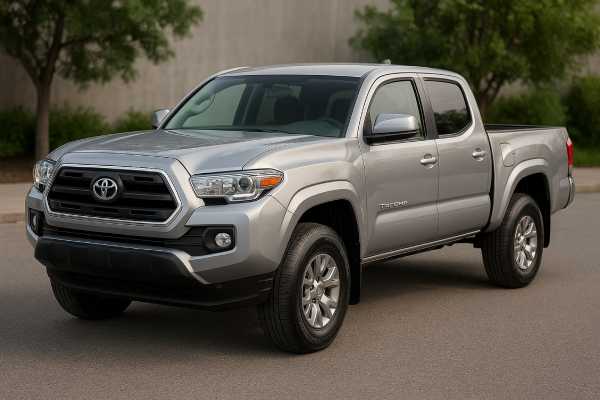
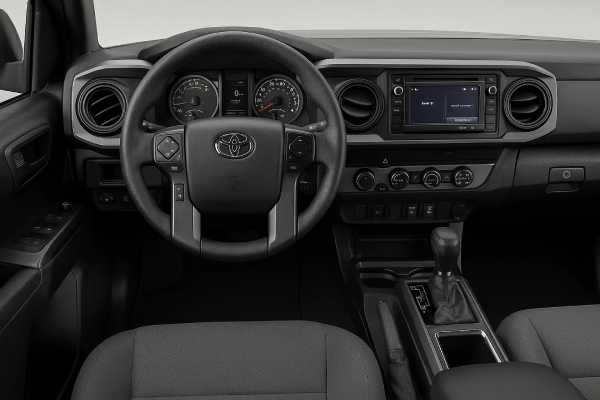
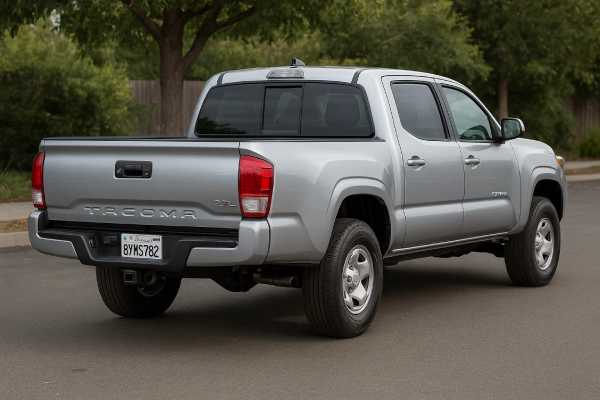
The 2016–2019 Toyota Tacoma RWD with the 2TR-FE 2.7 litre four-cylinder engine sits at the practical end of the Tacoma range. It trades headline power and heavy tow ratings for simplicity, durable hardware, and lower running costs. For many owners, especially in dry or urban regions, rear wheel drive and the four-cylinder engine are all they need for commuting, light hauling, and occasional trips onto gravel or dirt.
This N300 generation brought a stiffer frame, updated styling, and a more modern cabin compared with the previous N220, while keeping the same basic 2.7 engine architecture that has proven itself in many Toyota trucks. From 2018 onward, Toyota Safety Sense P became standard, adding useful driver assistance to a platform that was already known for strong crash performance.
This guide walks through the key specs, strengths, weak points, and ownership realities so you can decide whether a 2.7 RWD Tacoma is the right fit for your needs and budget.
At a Glance
- Proven 2TR-FE 2.7 litre four-cylinder with timing chain, good for high mileage if serviced on time.
- RWD layout and lighter front end make it efficient and predictable on pavement and light gravel.
- Payload is competitive for a mid-size truck, and bed access is easier than on many taller 4x4s.
- Watch for frame corrosion inspections on early years in salty climates and vacuum pump TSB compliance.
- Plan oil and filter changes every 5,000 miles (8,000 km) or 6 months, whichever comes first.
What’s inside
- Toyota Tacoma 2.7 RWD In Focus
- Tacoma 2.7 RWD Specs and Data
- RWD Tacoma Trims and Protection
- Dependability Issues and Service Actions
- Service Schedule and Buying Advice
- On-Road Feel and Performance
- Tacoma RWD Against Rivals
Toyota Tacoma 2.7 RWD In Focus
The 2016–2019 Tacoma RWD 2.7 targets drivers who want a mid-size truck that is easy to live with every day, not just a weekend off-road toy. It uses Toyota’s 2TR-FE 2.7 litre four-cylinder petrol engine with dual overhead cams, 16 valves, and a timing chain. Output is about 159 hp and 180 lb-ft of torque, delivered through a six-speed automatic to a conventional rear axle.
Compared with V6 and 4×4 Tacomas, the four-cylinder RWD versions are lighter at the front, slightly more fuel efficient, and cheaper to buy. They are popular as fleet trucks, service vehicles, and daily drivers in warmer climates where four-wheel drive adds cost without regular benefit. In real-world use, the engine feels adequate rather than fast, but it is smooth and has a reputation for running high mileage when maintained.
The N300 frame is stiffer than the earlier generation, and the cabin benefits from improved sound deadening and more modern infotainment. Safety also stepped up, especially from model year 2018 when Toyota Safety Sense P (with automatic emergency braking and adaptive cruise control) became standard across the lineup.
However, the 2.7 RWD Tacoma is not a perfect truck. Its six-speed automatic can hunt between gears on grades, the engine can sound strained when fully loaded, and fuel economy is merely average for a four-cylinder truck due to the tall, boxy body. The ride can also feel firm when the bed is empty. Understanding these compromises is important if you plan to tow near capacity or do long highway trips.
If your use case is mostly city and suburban driving, occasional light towing, and you value low complexity and Toyota’s track record more than outright speed, this configuration sits in a very sensible sweet spot.
Tacoma 2.7 RWD Specs and Data
Engine and Performance (2TR-FE 2.7)
| Item | Value (approximate) |
|---|---|
| Engine code | 2TR-FE |
| Configuration | Inline-4, DOHC, 16 valves |
| Valves per cylinder | 4 |
| Bore × stroke | 95.0 × 95.0 mm (3.74 × 3.74 in) |
| Displacement | 2.7 L (2,693 cc) |
| Induction | Naturally aspirated |
| Fuel system | Sequential multi-point fuel injection |
| Compression ratio | ~10.2:1 |
| Max power | 159 hp (118 kW) @ ~5,200 rpm |
| Max torque | 180 lb-ft (244 Nm) @ ~3,800 rpm |
| Timing drive | Chain |
| Emissions / test cycle | US EPA / Low Emission standards (varies by state) |
| Rated economy (2WD auto) | ~19 mpg city / 23 mpg highway / 21 mpg combined |
| Real-world highway @ 120 km/h | Typically 10–11 L/100 km (21–24 mpg US) |
| Aerodynamics (typical) | Cd ≈ 0.38–0.40, mid-size pickup profile |
These figures vary slightly by cab, bed length, and model year, but they capture the common 2.7 RWD automatic configuration.
Transmission and Driveline
| Item | Value |
|---|---|
| Transmission | 6-speed automatic (Aisin, electronically controlled) |
| Gear ratios (typical) | 1st ~3.60, 2nd ~2.09, 3rd ~1.49, 4th ~1.00, 5th ~0.69, 6th ~0.58, Reverse ~3.73 |
| Final drive ratio | Around 4.30 (varies slightly by axle/grade) |
| Drive type | Rear wheel drive |
| Rear differential | Open; automatic limited-slip via brake-based traction control |
| Transfer case | Not fitted (RWD model) |
The six-speed automatic is tuned for fuel economy, which explains its willingness to upshift early and occasionally hunt between gears on rolling terrain.
Chassis and Dimensions (typical Double Cab 2WD)
| Item | Value (approximate) |
|---|---|
| Front suspension | Coil-spring double wishbone with stabilizer bar |
| Rear suspension | Leaf-spring solid axle |
| Steering | Rack-and-pinion, power-assisted |
| Front brakes | Ventilated discs (approx. 278–296 mm) |
| Rear brakes | Drums |
| Wheel / tyre packages | Commonly 245/75 R16 or 265-section tyres on 16–17 in rims |
| Ground clearance | About 238 mm (9.4 in) |
| Length | ~5,390 mm (212.3 in) |
| Width (without mirrors) | ~1,890 mm (74–75 in) |
| Height | ~1,780 mm (70 in), depending on trim |
| Wheelbase | ~3,234 mm (127.3 in) Double Cab |
| Turning circle (kerb-to-kerb) | Around 12.2 m (40 ft) |
| Curb weight (2.7 RWD DC) | Roughly 1,850–1,900 kg (4,070–4,190 lb) |
| GVWR | Typically ~2,540–2,630 kg (5,600–5,800 lb) |
| Fuel tank capacity | About 79–80 L (21.1 US gal) |
| Bed length options | ~1.52 m (5 ft) or ~1.83 m (6 ft) |
Performance and Capability
| Item | Value (approximate) |
|---|---|
| 0–100 km/h (0–62 mph) | Around 10.5–11.5 s (unladen, auto) |
| Top speed (governed) | In the 175–185 km/h (108–115 mph) range |
| Towing capacity (2.7 RWD) | Typically up to 1,587 kg (3,500 lb) when properly equipped |
| Payload | Often 590–700 kg (1,300–1,550 lb), trim-dependent |
| Roof load | Generally 75–100 kg (165–220 lb) with proper rack |
The four-cylinder RWD is best treated as a light- to medium-duty tow vehicle. It can tow a small camper, utility trailer, or pair of motorcycles, but hills will require patience.
Fluids and Service Capacities (guideline values)
Always confirm for your specific VIN:
| System | Spec / Grade (typical) | Capacity (approx.) |
|---|---|---|
| Engine oil | 0W-20 API SN or later full synthetic | ~5.5–6.0 L (5.8–6.3 US qt) |
| Engine coolant | Toyota Super Long Life Coolant (pink) 50:50 | ~8–9 L (8.5–9.5 US qt) |
| Automatic transmission fluid | Toyota WS (World Standard) | ~8–10 L (8.5–10.5 US qt) total fill |
| Rear differential | 75W-85 or 75W-90 GL-5 gear oil | ~2–2.5 L (2.1–2.6 US qt) |
| A/C refrigerant | R-134a (early) or R-1234yf (later) | Charge typically 500–600 g (18–21 oz) |
| Torque examples | Wheel nuts ~113 Nm (83 lb-ft); oil drain plug ~39 Nm (29 lb-ft) |
Electrical
| Item | Value |
|---|---|
| Alternator output | Around 130 A on many 2.7 models |
| 12 V battery | 48–65 Ah range, typical group size 24F/27F |
| Spark plugs | Iridium, long-life |
| Plug change interval | Often 60,000–120,000 miles (96,000–192,000 km) depending on market guidance |
Safety and Driver Assistance Data (headline view)
- Multiple airbags: front, side, and curtain coverage.
- Stability control, traction control, ABS, brake assist, and electronic brake-force distribution standard.
- Rear-view camera standard across this period.
- From 2018, Toyota Safety Sense P standard on all grades: pre-collision system with pedestrian detection, lane departure alert with sway warning, automatic high beams, and dynamic radar cruise control.
- Crash testing in this generation typically shows strong side-impact performance and solid frontal scores, with some trucks limited by headlight or small-overlap ratings depending on trim and equipment.
RWD Tacoma Trims and Protection
For 2016–2019, the 2.7 RWD engine was mainly offered on the work-leaning grades and entry-level trims. Availability varies by market, but the pattern below captures the typical North American landscape.
Trims and Options (RWD, 2.7 focus)
- SR
- Often the most common 2.7 RWD grade.
- Steel wheels, basic cloth interior, simpler audio unit.
- Manual air conditioning and more hard-wearing interior plastics.
- Ideal fleet or work-truck base; many white single- or access-cab SRs in service roles.
- SR5
- 2.7 RWD available on some body styles.
- Alloy wheels, upgraded infotainment, extra storage and trim features.
- More sound insulation and comfort equipment, making it a better daily driver.
- Special packages
- Utility or “Work Truck”–style packages with vinyl floors and easy-clean surfaces.
- Appearance packages adding colour-keyed bumpers, fog lights, or different wheel designs.
On RWD four-cylinder trucks, major mechanical differences between trims are limited. Spring rates and wheel/tyre packages can change ride and handling, but the engine, transmission, and rear axle are largely shared. Tow-package content (hitch, wiring, auxiliary coolers) is more often bundled with V6 trucks, so many 2.7 RWD owners add hitches and wiring aftermarket.
Quick identifiers for a 2.7 RWD:
- No 4×4 selector or transfer-case lever/knob in the cabin.
- Engine cover and emissions label listing 2.7L 2TR-FE.
- Rear axle without a front differential or driveshaft present.
- On many trucks, badging simply reads “Tacoma” without explicit displacement marking.
Safety Ratings
Across 2016–2019, the N300 Tacoma generally performs well in crash testing:
- Federal crash testing in the US typically shows:
- Overall: around four out of five stars.
- Side impact: often five stars.
- Rollover: around four stars, consistent with tall, narrow pickups.
- Independent insurance and crash-test organisations often rate:
- Moderate overlap frontal and side: Good.
- Roof strength: Good.
- Small overlap tests: results depend on cab configuration and model year; some trucks see lower ratings on the passenger side in early years.
Headlight and forward-collision prevention ratings can vary sharply by trim. Halogen reflector lamps sometimes score lower, while upgraded projector or LED units perform better. Trucks equipped with Toyota Safety Sense P usually achieve higher front-crash-prevention scores than early models without it.
Safety Systems and Driver Assistance
Core systems shared across most 2.7 RWD Tacomas include:
- Passive safety
- Dual front airbags, front-seat side airbags, and curtain airbags for front and rear rows on Double Cab models.
- Front seatbelt pretensioners and load limiters.
- Child-seat anchors (LATCH/ISOFIX equivalents) on rear outboard seating positions in Double Cabs.
- Stability and braking
- Vehicle stability control and traction control standard.
- Anti-lock brakes with electronic brake-force distribution and brake assist.
- Hill-start assist control on many automatic trucks.
- Toyota Safety Sense P (TSS-P)
- Standard on all grades from 2018 onward.
- Includes pre-collision braking with pedestrian detection, lane departure alert with sway warning, dynamic radar cruise control, and automatic high beams.
- Requires proper camera and radar calibration after windshield replacement, front-end collision repair, or major suspension changes.
When buying used, it is worth confirming whether a 2016 or 2017 truck has TSS-P (it may be unavailable or only present on specific packages), and verifying that any windshield replacement or collision repair was followed by a correct ADAS calibration.
Dependability Issues and Service Actions
The 2TR-FE Tacoma has an overall strong reliability record, with many trucks reaching very high mileage on the original long block. However, the N300 generation does have recurring themes owners and buyers should understand.
Engine and Powertrain
- Oil changes skipped or stretched
- Symptoms: Sludge deposits, noisy valvetrain, or VVT-related fault codes.
- Likely cause: Long intervals with low-quality oil in a chain-driven DOHC engine.
- Remedy: Shortened oil-change intervals with quality 0W-20; in severe cases, top-end cleaning or component replacement.
- Vacuum pump knocking noise (brake booster vacuum)
- Symptoms: Tapping or knocking noise from the front of the engine, sometimes tied to brake usage.
- Cause: Known issue leading to a technical service bulletin covering 2016–2019 Tacoma among other models.
- Remedy: Replacement of the vacuum pump assembly with a revised part under the TSB; verify completion by service records.
- Automatic transmission behaviour
- Symptoms: Gear hunting on mild grades, occasional shudder at low speeds, or harsh downshifts.
- Cause: Shift programming tuned for fuel economy, plus aged transmission fluid.
- Remedy: Software calibration updates where applicable and periodic drain-and-fill fluid service, especially for trucks used for towing or city stop–start driving.
Chassis, Frame, and Corrosion
- Frame rust concerns
- Prevalence: More significant in rust-belt regions and in vehicles regularly exposed to road salt or coastal environments.
- Symptoms: Flaking rust on frame rails, crossmembers, and suspension mounting points, sometimes progressing to perforation on older examples.
- Actions: Toyota has previously run corrosion-related campaigns on certain Tacoma years and frames; while the N300 is newer than the worst-affected early trucks, 2016–2017 sit in the overlap of some service communications.
- Remedy: Thorough inspection on a lift; probe inside boxed sections, check around rear leaf-spring mounts and spare-tyre hoist; treat surface rust early and investigate any perforation with a dealer, especially where regional frame programmes have existed.
- Leaf springs and rear suspension
- Symptoms: Sagging rear ride height, squeaks, or broken leafs, especially on trucks frequently run overloaded.
- Cause: Heavy or repeated loading beyond rated payload and corrosion in harsh climates.
- Remedy: Replace springs as an assembly; upgraded leaf packs are common for owners who tow or haul regularly.
Electrical and Electronics
- Infotainment quirks
- Bluetooth pairing issues, occasional frozen screens, or intermittent backup camera image loss have been reported.
- Many issues are improved with software updates; some require head-unit replacement.
- Sensor faults and warning lights
- Wheel-speed sensors, oxygen sensors, and EVAP components occasionally fail with age and mileage, triggering warning lamps.
- Diagnosis with a capable scan tool is important to avoid unnecessary parts swapping.
Recalls, TSBs, and Extended Coverage
Key items to be aware of:
- Vacuum pump TSB: Addresses knocking noise from the vacuum pump that affects brakes and NVH; covers 2016–2019 Tacoma among other models.
- Brake-related recalls (specific years): Some late N300 Tacomas (2018–2019) have recall campaigns relating to brake components; always verify for your VIN.
- Airbag and restraint system actions: Industry-wide airbag issues and Tacoma-specific seat or sensor campaigns may apply depending on year and build.
Owners should:
- Use the official recall lookup for their country by VIN to confirm that all recalls and field service actions have been completed.
- Ask the selling dealer for a print-out of open campaigns and TSBs addressed.
Pre-Purchase Reliability Checklist
When shopping for a 2016–2019 Tacoma 2.7 RWD:
- Listen for unusual engine noises at idle and under light load, especially from the front of the engine (vacuum pump and accessory drives).
- Inspect the frame thoroughly, particularly in snow-belt regions. Pay extra attention to weld seams and leaf-spring mounts.
- Check for smooth, consistent shifting; drive on a moderate incline to see how the transmission behaves.
- Confirm that ABS, stability control, and airbag warning lamps illuminate at key-on and go out after start.
- Verify that all keys, remotes, and, where fitted, advanced safety features work as expected.
Service Schedule and Buying Advice
A sensible maintenance plan is essential for any truck, especially a vehicle that may be used for towing or commercial work. The Tacoma’s official schedule can vary slightly by market and use case, but the following intervals give a practical baseline.
Core Maintenance Intervals (typical guidance)
- Engine oil and filter
- Every 5,000 miles (8,000 km) or 6 months, whichever comes first.
- Use 0W-20 full synthetic meeting current API standards.
- Engine air filter
- Inspect every 15,000 miles (24,000 km); replace around 30,000 miles (48,000 km), sooner in dusty conditions.
- Cabin air filter
- Replace every 15,000–20,000 miles (24,000–32,000 km) or annually in dusty or urban environments.
- Coolant
- Toyota Super Long Life Coolant typically first at around 100,000 miles (160,000 km) or 10 years, then at shorter intervals; confirm in the official maintenance guide.
- Spark plugs (iridium)
- Commonly 60,000–120,000 miles (96,000–192,000 km) depending on guidance; they often last to the upper range if the engine is healthy.
- Fuel filter
- Integrated with the pump in many modern Toyotas; usually “lifetime” unless contaminated fuel is suspected.
- Automatic transmission fluid (WS)
- While some literature refers to “lifetime” fluid, many specialists recommend inspection by 60,000 miles (96,000 km) and drain-and-fill every 60,000–80,000 miles for trucks that tow or see heavy city use.
- Differential oil
- Replace around every 60,000 miles (96,000 km), or sooner after heavy towing or deep-water exposure.
- Brake fluid
- Renew approximately every 2–3 years regardless of mileage.
- Drive belts and hoses
- Inspect at every service from 60,000 miles onward; replace at the first signs of cracking, glazing, or stiffness.
- Timing chain
- No set replacement interval; instead, listen for rattles at cold start, monitor timing correlation codes, and follow diagnostic procedures if symptoms appear.
- Tyre rotation and alignment
- Rotate every 5,000–7,500 miles (8,000–12,000 km).
- Check alignment annually or after impacts, tyre replacement, or suspension work.
- 12 V battery
- Testing annually from year 3 onward; replacement often needed around year 5–7 in harsh climates.
Buyer’s Inspection Checklist
When evaluating a used 2016–2019 Tacoma 2.7 RWD:
- Exterior and frame
- Inspect frame rails, crossmembers, and bed mounts for corrosion or repairs.
- Check bed floor and inner fenders for dents and repairs that might indicate heavy use.
- Driveline and suspension
- Look for leaks at the rear differential, transmission pan, and axle seals.
- Check for play or noise from front ball joints, tie rods, and rear leaf-spring shackles.
- Cooling system
- Inspect for coolant residue around water pump, hoses, and radiator end tanks.
- Verify that the engine warms up normally and does not overheat under load.
- Brakes and tyres
- Measure pad and rotor thickness; look for uneven wear that might suggest seized calipers or poor alignment.
- Confirm tyre age and condition; uneven patterns can reveal suspension or alignment issues.
- Electrical and interior
- Test all windows, locks, infotainment functions, and backup camera operation.
- Confirm that steering wheel controls, cruise control, and (if fitted) TSS-P functions work correctly.
Recommended Years, Trims, and Configurations
- Early years (2016–2017)
- Offer the lowest entry cost but may lack standard TSS-P and have had more exposure to corrosion in harsh climates.
- Attractive if you live in a dry region and can confirm clean frame condition and recall/TSB completion.
- Later years (2018–2019)
- Benefit from Toyota Safety Sense P on all models, minor refinement improvements, and more complete data on long-term reliability.
- Ideal choice if you want maximum active safety and the newest hardware within this 2.7 RWD generation.
For most buyers who prioritise safety and plan to keep the truck long term, a 2018–2019 Tacoma 2.7 RWD with documented dealer servicing is usually worth the price premium.
On-Road Feel and Performance
The 2.7 RWD Tacoma drives quite differently from its V6 4×4 siblings. It is lighter, simpler at the front axle, and tuned more for everyday road use than off-road extremes.
Ride, Handling, and Noise
On paved roads, the Tacoma feels solid and predictable. The ladder frame and leaf-spring rear suspension are tuned to carry weight, so the ride can be a little firm and choppy when the bed is empty, especially over sharp joints and broken tarmac. Adding 100–200 kg (200–400 lb) of tools, gear, or ballast in the bed noticeably smooths things out.
The steering is reasonably direct for a truck of this size, with a consistent on-centre feel and moderate weight. It is not sports-car precise, but it tracks straight on the highway and feels composed in lane changes. Body roll is present but well controlled.
Cabin noise is improved over the previous generation, with better door seals and sound insulation. Engine noise is most noticeable under heavy throttle, where the 2.7 works harder to move the truck. At a steady highway cruise, wind and road noise dominate instead of the engine, and conversations are generally comfortable.
Powertrain Character
The 2TR-FE is tuned for durability more than drama. Below 3,000 rpm, torque is modest but usable for city driving. The six-speed automatic does its best to keep revs low, upshifting early to save fuel. When you ask for more acceleration, it will drop one or two gears and let the engine spin closer to its power peak near 5,000 rpm.
This behaviour can be interpreted in two ways:
- Daily driving: In town and at moderate speeds, the powertrain feels smooth and easy-going.
- Loaded or hilly driving: With a trailer or steep grades, the engine can feel busy and the transmission may hunt between gears to maintain speed.
Adaptive learning and occasional software updates can slightly improve shift quality, but expectations should be realistic: this is a non-turbo four-cylinder moving a mid-size body-on-frame truck.
Real-World Economy and Range
For the 2.7 RWD automatic, real-world reports typically fall into these ranges:
- City driving: Around 18–20 mpg US (11.8–13.1 L/100 km) depending on traffic and payload.
- Highway at 60–70 mph (100–115 km/h): Often 21–24 mpg US (9.8–11.2 L/100 km) when driven steadily.
- Mixed use: Around 20–21 mpg US (~11–12 L/100 km) is common.
The 21-gallon fuel tank offers a comfortable mixed-driving range in the 360–420 mile (580–675 km) area between fills when driven sensibly.
Traction and Control
Even without four-wheel drive, the Tacoma 2.7 RWD is competent in many real-world conditions:
- Stability and traction control help manage wheelspin on wet pavement and gravel.
- With appropriate all-season or all-terrain tyres and some weight in the bed, light snow and dirt roads are manageable.
- For deep mud, heavy snow, or frequent off-roading, a 4×4 Tacoma or another 4WD truck will offer more security and capability.
Towing and Load Behaviour
Within the typical 3,500 lb (1,588 kg) tow rating and well under payload limits:
- The truck remains stable with a properly balanced trailer and good hitch setup.
- Braking distances increase, as expected, but remain predictable when trailer brakes are functioning correctly.
- In hilly terrain, expect downshifts and high engine revs to maintain speed; using the transmission’s manual mode on long descents can improve control and reduce brake wear.
Fuel consumption under tow can rise by 30–50% depending on trailer shape and weight, so planning fuel stops is wise on long trips.
Tacoma RWD Against Rivals
In the 2016–2019 time frame, the Tacoma 2.7 RWD competed with other mid-size trucks like the Chevrolet Colorado/GMC Canyon 2.5, Nissan Frontier 2.5/4.0, and later, the revived Ford Ranger. Each has its own strengths.
Where the Tacoma 2.7 RWD Shines
- Long-term durability
- Toyota’s track record for engine, transmission, and major component longevity is a major draw.
- The naturally aspirated 2.7 with a timing chain and conservative tune appeals to owners who keep trucks for a decade or longer.
- Resale value
- Used-market demand for Tacomas is strong, especially in regions where they have a reputation for reliability.
- This helps offset the higher purchase price compared with some competitors.
- Aftermarket support
- There is a huge ecosystem of parts, from bed accessories and suspension upgrades to seat covers and electronics.
- Fleet-friendly simplicity of the 2.7 RWD makes it easy to upfit as a service truck or light work vehicle.
- Standard active safety (later years)
- From 2018, Toyota Safety Sense P is standard, making the Tacoma one of the better-equipped trucks in its class in terms of forward collision mitigation and adaptive cruise in everyday trims.
Where Rivals Have an Edge
- Power and refinement
- GM’s 3.6 V6 and later turbo engines, as well as Ford’s EcoBoost units, offer stronger acceleration and more relaxed towing performance.
- Some competitors also offer more refined ride tuning, especially in crew-cab highway-oriented models.
- Fuel economy
- Certain rival four-cylinder or diesel options can match or exceed the Tacoma’s economy while delivering more torque, particularly at lower revs.
- Interior tech and comfort
- In this generation, Tacoma’s infotainment and interior materials are functional but not always class-leading.
- Some rivals provide larger screens, more USB ports, or more car-like seating and storage solutions.
Who the Tacoma 2.7 RWD Suits Best
- Drivers who prioritise reliability and predictable running costs over outright performance.
- Owners in dry or warm climates where four-wheel drive is rarely required.
- Small-business or fleet operators who value a straightforward, repairable truck with strong resale.
- Private buyers who tow moderately and mostly carry light to medium payloads, rather than maxing out capacity on every trip.
If you frequently tow near the top of the rating, live in a mountainous or snow-heavy region, or want the quickest acceleration in the segment, a V6 or turbocharged rival—or a Tacoma V6 4×4—may be a better fit. But if you want a long-lived, honest mid-size truck for everyday work and commuting, the Tacoma 2.7 RWD remains a compelling and sensible choice.
References
- TACOMA 2016 (Quick Reference Guide)
- Toyota Manuals and Warranties | Toyota Owners 2024 (Owner’s Manual Portal)
- Gas Mileage of 2017 Toyota Tacoma 2017 (Fuel Economy Data)
- 2019 Toyota Tacoma 2019 (Safety Rating)
- Check for Recalls: Vehicle, Car Seat, Tire, Equipment 2025 (Recall Database)
Disclaimer
This article is for informational purposes only and is not a substitute for professional diagnosis, repair, or official service information. Specifications, torque values, fluid capacities, and maintenance intervals can vary by model year, VIN, market, trim level, and installed equipment. Always confirm critical data and procedures against the official owner’s manual, warranty and maintenance guide, and service manual applicable to your specific vehicle.
If you found this guide helpful, consider sharing it with other owners or buyers on social platforms such as Facebook or X/Twitter. Your support helps xcar continue producing detailed, independent technical content.