
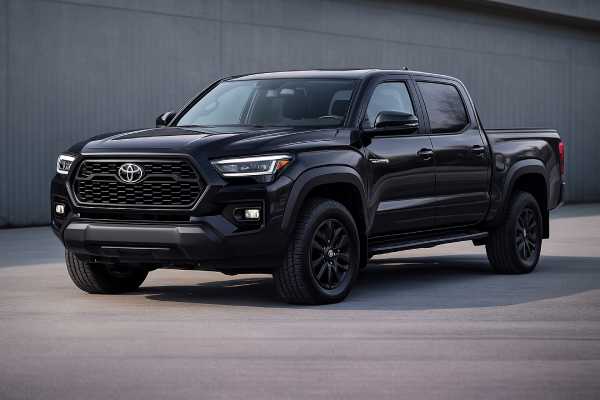
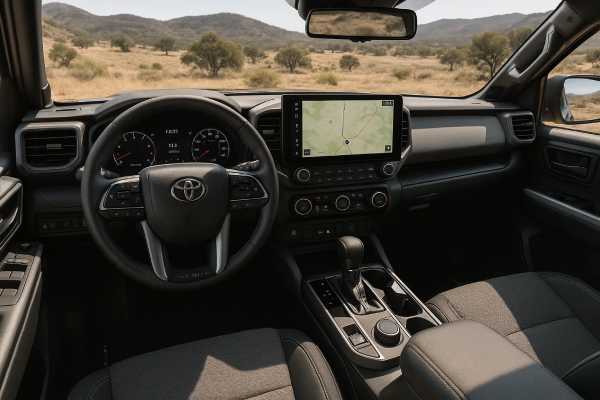
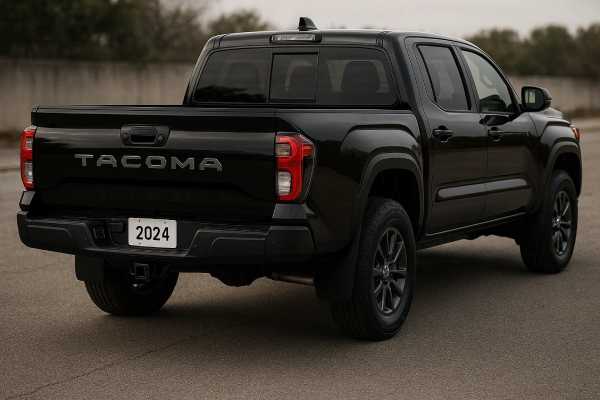
The fourth generation Toyota Tacoma (N400) marks a major update for one of the most important midsize pickups on the market. In rear wheel drive form with the 278 hp T24A-FTS 2.4 litre turbo engine, it targets buyers who mainly drive on-road but still need real truck capability. The new TNGA-F ladder frame, revised suspension, and much more modern cabin move the Tacoma closer to full-size comfort while preserving the durability and work ethic that built its reputation.
The 278 hp i-FORCE engine replaces the old 3.5 litre V6 and brings a broader torque band, better efficiency, and stronger mid-range acceleration. Paired with an eight speed automatic and a simpler RWD driveline, this configuration offers easier access, lower running costs, and slightly higher payload than comparable 4×4 models. This guide walks through the key specs, performance, reliability patterns, safety systems, and maintenance planning so you can decide whether the 278 hp RWD N400 Tacoma is the right tool for your work and life.
Owner Snapshot
- 2.4 litre turbo i-FORCE (278 hp, 317 lb-ft) delivers strong low-rpm torque and quicker response than the old V6.
- RWD layout reduces weight, cost, and mechanical complexity while improving on-road fuel economy and payload.
- TNGA-F frame, upgraded suspension, and Toyota Safety Sense 3.0 make it safer and more refined than the previous generation.
- Early trucks may be affected by brake hose and software campaigns; always check recall status by VIN before purchase.
- Typical engine oil and filter interval is 10,000 miles / 12 months in normal use, or 5,000 miles / 6 months for heavy towing or dusty conditions.
Section overview
- Toyota Tacoma RWD 278 hp overview
- Tacoma RWD detailed specifications
- RWD trims, equipment and safety
- Reliability issues and service actions
- Maintenance planning and buying tips
- Driving experience and performance
- Tacoma RWD compared with rivals
Toyota Tacoma RWD 278 hp overview
The rear wheel drive 278 hp Tacoma sits at the core of the N400 range. All new Tacomas now use the turbocharged 2.4 litre T24A-FTS engine, but the higher-output i-FORCE calibration paired with the eight speed automatic is where most retail buyers end up. In this tune, the engine produces 278 hp and 317 lb-ft of torque, replacing the previous 3.5 litre V6 while improving torque delivery at lower revs and reducing fuel consumption.
The new TNGA-F platform is shared with larger Toyota trucks and SUVs but scaled for midsize duties. It uses a boxed ladder frame, increased high-strength steel content, and improved crossmember design to deliver higher torsional rigidity without a huge weight penalty. Ride and refinement improve, especially in double cab models with coil-sprung rear suspension, while certain RWD variants retain leaf springs for maximum payload and a more traditional “truck” feel.
The RWD 278 hp configuration targets owners who spend most of their time on pavement, tow moderate loads, and occasionally travel on dirt or gravel roads. Compared with 4×4 versions, it offers:
- Lower ride height and easier step-in.
- Slightly better EPA-rated fuel economy.
- Lower purchase price and fewer driveline components to service.
Towing capacity for properly equipped double cab RWD models typically reaches around 6,400 lb, with payload figures in the 1,500–1,650 lb range depending on trim and equipment. That is enough for small to medium travel trailers, boats, and job-site trailers when loaded intelligently.
Inside, the Tacoma finally feels up to date, with larger touchscreens, improved ergonomics, and more storage. Toyota Safety Sense 3.0 is standard, so even an SR5 RWD benefits from adaptive cruise control, lane assistance, and automatic emergency braking. For many buyers in mild climates, this 278 hp RWD combination is the sweet spot between everyday usability and true truck capability.
Tacoma RWD detailed specifications
This section focuses on the non-hybrid, 278 hp i-FORCE RWD Tacoma, using a double cab with eight speed automatic as a representative example. Exact figures vary slightly by trim, bed length, and options.
Engine and performance (T24A-FTS i-FORCE)
| Item | Specification |
|---|---|
| Engine code | T24A-FTS |
| Layout and valvetrain | Inline-4, DOHC, 16 valves |
| Displacement | 2.4 l (2393 cc) |
| Bore × stroke | 87.5 × 99.5 mm |
| Induction | Turbocharged, intercooler |
| Fuel system | Combined direct and port injection (D-4ST type) |
| Compression ratio | 11.0 : 1 (typical) |
| Max power | 278 hp (approx. 207 kW) @ around 6000 rpm |
| Max torque | 317 lb-ft (430 Nm) from low to mid rpm |
| Recommended fuel | Regular unleaded (higher octane can improve resistance to knock) |
| Emissions standard | Current US Tier 3 / LEV III equivalent |
Typical EPA-style economy for 2WD 278 hp double cab models:
| Cycle | mpg US | Approx. l/100 km |
|---|---|---|
| City | ~20–21 | ~11.2–11.8 |
| Highway | ~25–26 | ~9.0–9.4 |
| Combined | ~22–23 | ~10.2–10.7 |
Real-world figures vary with tyre choice, accessories, and driving style. Trucks with stock-size all-season tyres and moderate highway speeds often match or slightly exceed these combined numbers, while large all-terrain tyres, lifts, and roof racks can drop consumption into the high teens.
Transmission and driveline
| Item | Specification |
|---|---|
| Transmission | 8-speed automatic (ECT-i) |
| Gears | 8 forward, 1 reverse |
| Drive type | Rear wheel drive (4×2) |
| Differential | Rear open differential with brake-based traction control; “auto LSD” function on many trims |
| Tow/haul mode | Dedicated shift strategy for towing or heavy loads |
| Manual mode | Sequential manual selection via shift lever |
Final drive ratios and internal gear ratios can vary by axle code and trim, but the overall strategy is clear: short lower gears for brisk acceleration and strong low-speed control, and taller top gears to keep revs down at highway speeds.
Chassis and dimensions
Representative dimensions for a double cab, 5 ft bed RWD Tacoma:
| Item | Metric | Imperial |
|---|---|---|
| Frame | TNGA-F body-on-frame, boxed rails | |
| Front suspension | Double wishbone, coil springs, stabilizer bar | |
| Rear suspension | Rigid axle; leaf springs or multi-link coils (trim dependent) | |
| Brakes | 4-wheel discs, ventilated front and rear, ABS with EBD | |
| Length | ~5410 mm | ~213.0 in |
| Width (without mirrors) | ~1970 mm | ~77.6 in |
| Height | ~1880–1895 mm | ~74.0–74.6 in |
| Wheelbase | 3350 mm | 131.9 in |
| Ground clearance | Slightly lower than 4×4; still generous for job site use | |
| Turning circle | ~12.9–13.5 m | ~42–44 ft |
| Curb weight | ~1935–1980 kg | ~4260–4365 lb |
| GVWR | ~2620–2730 kg | ~5770–6025 lb |
| Fuel tank | ~69 l | ~18.2 US gal |
Payload and towing vary by configuration:
| Metric | Typical value |
|---|---|
| Max payload | ~684–753 kg (≈1500–1660 lb) |
| Max braked towing | Up to ~2900 kg (≈6400 lb) with tow package |
| Unbraked towing | Limited by local regulations and manufacturer limits |
| Roof load | Often ~75–100 kg (165–220 lb) dynamic with rated rack |
Always rely on the doorjamb and owner’s manual for precise numbers for your specific truck; they override generic figures.
Performance and capability
| Item | Approximate value (278 hp RWD, double cab) |
|---|---|
| 0–60 mph | ~7.0–7.6 s depending on trim and tyres |
| Quarter mile | Mid-15 s at ~90–92 mph |
| Top speed | Electronically limited (around 106–110 mph) |
| 60–0 mph braking | Typically around 110–121 ft on quality tyres |
These metrics position the Tacoma near the stronger end of the midsize pickup class for acceleration, especially considering its robust tow ratings and body-on-frame construction.
Fluids and service capacities (approximate)
Always confirm capacities and specifications in official service documentation for your VIN.
| System | Specification | Approx. capacity |
|---|---|---|
| Engine oil | 0W-20 full synthetic, latest API / ILSAC grade | ~5.3 l (5.6 US qt) including filter |
| Engine coolant | Toyota Super Long Life pink pre-mix | ~12.1 l (12.8 US qt) |
| Automatic transmission | Toyota WS ATF | Drain/refill quantity lower than total fill (dealer data) |
| Rear differential | GL-5 hypoid gear oil, 75W-85 or 75W-90 | Capacity varies with axle |
| Power steering | Electric (no conventional fluid) | – |
| A/C refrigerant | R-1234yf | Charge by label |
| A/C compressor oil | ND-type POE | Charge by label |
Electrical
| Item | Typical specification |
|---|---|
| Alternator | High-output unit sized for accessories and towing (amperage depends on trim) |
| 12 V battery | Conventional or AGM, ~60–70 Ah, ~600–700 CCA |
| Spark plugs | Long-life iridium, nominal 100,000-mile interval |
RWD trims, equipment and safety
The 278 hp RWD powertrain is available on several trims that sit above the base SR in the Tacoma lineup. Exact combinations vary by market and model year, but the following trims are typical for this engine and driveline:
- SR5 RWD (278 hp): Often the entry point to the higher-output engine. Offers cloth interior, decent infotainment, and key convenience options without a heavy price tag.
- TRD PreRunner (RWD only): A lifted, rugged-looking RWD truck with off-road-inspired suspension tuning, all-terrain tyres, and distinct styling. It keeps RWD simplicity but adds ground clearance and approach angle.
- TRD Sport RWD: Road-biased setup with sport-tuned suspension, larger wheels, and more equipment. Designed for drivers who value sharper responses on pavement.
- Limited RWD: Premium trim with more sound insulation, leather or high-grade upholstery, larger screens, and nearly all comfort and tech features fitted as standard.
Mechanical differences that matter in daily use:
- Suspension:
- TRD PreRunner may retain leaf springs for payload and a tougher ride, suiting owners who frequently haul or prefer a traditional truck feel.
- TRD Sport and many SR5 RWD double cabs use coil-sprung rears for improved comfort and rear axle control.
- Tyres and wheels:
- TRD PreRunner typically uses more aggressive all-terrain tyres and slightly smaller wheels for sidewall compliance.
- TRD Sport and Limited tend to use larger wheels and more road-focused tyres that enhance steering precision and braking grip on tarmac.
- Towing and payload:
- Leaf-sprung RWD variants often carry higher payload ratings.
- Coil-sprung variants prioritize passenger comfort while still supporting practical payloads and tow ratings.
Safety equipment and ratings
All N400 Tacomas share the same underlying crash structure and airbag layout, which includes:
- Front, side, curtain and driver’s knee airbags.
- Three-point seatbelts with pre-tensioners in front.
- LATCH/ISOFIX anchors in rear outboard seats for child seats.
- Electronic stability control, traction control, and trailer sway control.
The crew cab Tacoma, which covers most 278 hp RWD double cabs, has earned strong crash test scores and a Top Safety Pick award from major testing bodies when equipped with higher-rated headlights. Headlight performance and front crash prevention scores can vary by trim and lighting package, so safety-conscious buyers should check which exact configuration was tested and match it closely when ordering or shopping used.
Toyota Safety Sense 3.0 and ADAS
Toyota Safety Sense 3.0 is standard and typically includes:
- Pre-collision system with pedestrian and cyclist detection.
- Lane departure alert with steering assist.
- Lane tracing assist when adaptive cruise control is active.
- Full-speed dynamic radar cruise control.
- Road sign assist and automatic high beams.
Most higher trims add:
- Blind spot monitor and rear cross-traffic alert.
- Front and rear parking sensors, sometimes with automatic braking.
- Panoramic or multi-view camera systems.
Because these systems depend on precisely aligned cameras and radar units, any windshield replacement, front bumper repair, or suspension lift should be followed by a calibration procedure. Ignoring calibration can lead to false alarms, reduced effectiveness, or disabled safety features.
Reliability issues and service actions
The N400 Tacoma is still new, so long-term data for the 278 hp RWD variant is limited. However, the design builds on Toyota’s experience with turbocharged four cylinder engines in other models and the company’s history of durable pickups. Early patterns and campaigns highlight a few areas to monitor.
Engine and transmission
The T24A-FTS turbo four uses a conservative boost strategy and combined port/direct injection, which reduces the likelihood of severe intake valve carbon build-up. With high-quality oil and sensible service intervals, it is expected to be durable. Key points:
- Oil quality and change intervals:
Turbochargers are sensitive to oil degradation. Trucks used for towing, repeated short trips, or high-heat environments benefit from 5,000 mile oil changes rather than stretching to the maximum nominal interval. - Cooling system health:
Regular coolant changes and inspection of hoses and plastic fittings are important as the engine operates at high specific output. Overheating events can rapidly age head gaskets and turbochargers. - Transmission behaviour:
The eight speed automatic generally shifts smoothly and avoids frequent hunting if you keep software current and drive within its design envelope. Harsh shifting or odd behaviour in certain modes is often addressed with updated calibration rather than mechanical repair.
Chassis and corrosion
While the N400 frame improves corrosion resistance compared with older generations, any body-on-frame truck can suffer if neglected:
- RWD trucks that see job-site use or coastal exposure should have the frame, suspension mounts, and bed crossmembers rinsed regularly.
- Drain holes in frame rails should be kept clear so mud and salty water cannot accumulate.
- Any chips in underbody coatings should be touched up before rust spreads.
Suspension components such as bushings, ball joints, and dampers are wear items. Noise over bumps, wandering at highway speeds, or uneven tyre wear are early signs of parts needing attention rather than indicators of fundamental design faults.
Recalls, campaigns and software updates
As production continues, Toyota has announced and may continue to announce recalls and service campaigns affecting certain Tacoma builds. Examples include:
- Brake hose campaigns:
On some trucks, including specific model years and configurations, rear brake hoses may be subject to potential abrasion from debris or suspension movement. The remedy typically involves inspection and replacement with revised parts. - Instrument cluster or infotainment software:
Certain vehicles may require software updates to correct display glitches, warning behaviour, or connectivity issues.
Because campaigns can expand over time, owners should:
- Check recall status regularly using the VIN on official manufacturer or regulatory websites.
- Ask dealers for a printout of completed and outstanding campaigns at each service visit.
- Keep receipts and documentation of any recall or TSB work for reference and resale value.
Prevalence, severity and cost
At this early stage:
- Most issues appear occasional rather than widespread.
- Many fixes are low to medium cost when handled under warranty or as part of campaigns.
- There are no clear signs of systemic engine or transmission design faults on properly maintained trucks.
Pre-purchase reliability checks
For a used 278 hp RWD Tacoma:
- Ask for a complete service history with dates, mileage and fluid types.
- Confirm all recall and service campaigns are completed.
- Inspect for coolant stains, oil leaks around the cam cover, timing cover or oil pan, and any unusual smells after a hot soak.
- Listen for driveline noises, harsh shifts, or clunks during a varied test drive.
- Look at the underside for bent crossmembers, heavy rust, or signs of off-road impacts.
A truck that passes these checks and shows consistent maintenance is likely to deliver the long-term durability associated with the Tacoma name.
Maintenance planning and buying tips
Practical maintenance schedule
Always align your maintenance with the official schedule for your region, but the outline below is a realistic plan for long-term ownership.
- Engine oil and filter
- Normal use: every 10,000 miles or 12 months.
- Heavy use (towing, off-road, high heat, frequent short trips): every 5,000 miles or 6 months.
- Engine air filter
- Inspect at 15,000 miles / 2 years.
- Replace at 30,000 miles, or more often in dusty or sandy environments.
- Cabin air filter
- Replace every 15,000–20,000 miles or annually for best HVAC performance.
- Coolant
- Initial change around 100,000 miles or 10 years.
- Subsequent changes at shorter intervals (for example, every 50,000 miles or 5 years) as recommended.
- Spark plugs (iridium)
- Inspect at 60,000 miles; replace around 80,000–100,000 miles.
- Fuel system
- Follow manufacturer guidance; many modern systems use a tank-integrated filter that is not serviced routinely.
- Periodic use of fuel system cleaners that meet manufacturer standards can help keep injectors clean.
- Timing chain and turbocharger
- No fixed replacement interval.
- Investigate new rattles at start-up, chain stretch codes, persistent misfires, or notable turbo whine under load.
- Serpentine belt and hoses
- Inspect by 30,000 miles.
- Plan replacement around 90,000–100,000 miles, or sooner if cracking or glazing appears.
- Automatic transmission fluid (ATF)
- Many schedules list no change or very long intervals, but a 50,000–60,000 mile drain-and-fill is a sensible precaution, especially for trucks that tow.
- Rear differential oil
- Replace every 30,000–60,000 miles depending on use, particularly if towing or driving off-road.
- Brake fluid
- Flush every 3 years regardless of mileage.
- Brakes (pads and rotors)
- Inspect at every service; replace as needed based on wear and condition.
- Tyres and alignment
- Rotate every 5,000–10,000 miles.
- Check alignment after impacts, suspension changes, or when you see uneven tread wear.
- 12 V battery
- Begin annual testing after year three.
- Replace at the first sign of slow cranking, dim lights during start, or poor reserve capacity in cold weather.
Fluid specifications and torque values (examples)
Exact values are VIN- and market-specific, but general guidance includes:
- Engine oil: 0W-20 full synthetic meeting the latest Toyota specifications.
- ATF: Toyota WS for the eight speed automatic.
- Differential oil: Hypoid gear oil of the specified viscosity (often 75W-85 or 75W-90 GL-5).
- Wheel lug nuts: Commonly around 135–150 Nm (100–110 lb-ft).
- Drain plugs: Differentials and gearbox plugs usually fall in the 40–60 Nm range; always confirm.
Using the correct fluids and torques prevents leaks, warped rotors, and cracked housings, and helps maintain warranty coverage.
Buyer’s guide: inspection and selection
Inspection checklist
- Exterior and body:
- Look for mismatched paint, panel gaps, or overspray suggesting repairs.
- Check door shuts and tailgate alignment.
- Frame and underside:
- Inspect frame rails, crossmembers, and suspension mounts for rust, dents, or non-factory welds.
- Look at the fuel tank, exhaust, and skid plates for off-road damage.
- Suspension and steering:
- Listen for clunks on bumps.
- Make sure the truck tracks straight on a flat road with minimal steering correction.
- Engine and gearbox:
- Start from cold and listen for abnormal rattles.
- Check for smooth, consistent shifting and no hesitation or flares from the transmission.
- Brakes and tyres:
- Feel for vibrations during braking that might suggest warped rotors.
- Confirm tyre wear is even and appropriate for the truck’s claimed usage.
- Electronics and ADAS:
- Test all driver assistance features on a short drive.
- Ensure there are no warning lights or persistent messages on the instrument cluster.
Trims to consider
- Best value all-rounder: SR5 RWD double cab with 278 hp and tow package. It balances price, equipment, and capability.
- Sporty daily driver: TRD Sport RWD for better on-road handling and a more premium interior.
- RWD with off-road stance: TRD PreRunner if you want the lifted look and some off-road hardware but do not need 4×4.
Avoid heavily modified trucks (large lifts, wheels, or tuning) unless you can verify the quality of the parts and work, confirm alignments are correct, and verify that safety systems have been recalibrated where necessary.
Driving experience and performance
On the road, the 278 hp RWD Tacoma feels more modern and responsive than its predecessor. The low-end and mid-range torque from the turbocharged 2.4 litre engine means the truck moves off briskly from a stop and handles steep grades and on-ramps without drama.
Powertrain feel
- Throttle response:
There is a short moment of turbo lag if you mash the accelerator from very low rpm, but in normal driving the engine responds quickly and the automatic downshifts smoothly. - Transmission behaviour:
The eight speed shifts unobtrusively in normal and eco modes. In sport or tow/haul mode, it holds gears longer and reacts faster to throttle inputs, making the truck feel more alert. - NVH (noise, vibration, harshness):
At light throttle, the engine is relatively quiet and unobtrusive. Under heavy load it becomes more vocal and mechanical than the old V6, but not harsh. The RWD layout eliminates some extra noise from front driveline components found in 4×4 versions.
Ride and handling
The TNGA-F chassis, revised suspension geometry, and improved damping bring the Tacoma closer to crossovers in everyday comfort while keeping the firm control expected from a work truck.
- RWD coil-sprung trucks:
Double cab RWD models with coil-sprung rears ride more smoothly over broken pavement and washboard surfaces. They feel less prone to “bed hop” when unladen and are more composed on long highway journeys. - RWD leaf-sprung trucks (like some PreRunner variants):
These feel more traditional, with a slightly busier ride when empty but excellent stability with cargo in the bed. They are a good choice for frequent hauling.
Steering is electrically assisted and tuned to be light at parking speeds and suitably weighted on the highway. It does not offer sports-car feedback, but it is accurate and predictable.
Fuel economy and range
In mixed use, many owners can expect:
- Around 21–23 mpg combined in mostly on-road driving with a light to moderate foot.
- Mid-20s mpg on longer highway runs at legal speeds, especially on stock-size tyres.
- High-teens mpg when towing aerodynamic trailers or driving aggressively.
The 69 litre fuel tank gives a practical real-world range of 350–450 miles between fills for most drivers, depending on load and terrain.
Traction, stability and towing behaviour
As a rear wheel drive truck, the Tacoma behaves predictably:
- Dry and wet pavement:
Traction control and stability control intervene smoothly if you over-apply throttle on wet or loose surfaces. A good set of tyres makes a bigger difference than the mere presence of 4×4 for day-to-day driving. - Snow and loose surfaces:
RWD trucks are more traction-limited here. Winter tyres, some ballast over the rear axle, and gentle driving are essential if you live in a cold climate but do not want 4×4. - Towing:
Stay within tow ratings, use a properly set up brake controller, and engage tow/haul mode. The engine’s early torque and the transmission’s close ratios help maintain speed on grades, though you should expect frequent downshifts and increased noise under load. Fuel consumption will rise significantly with heavy trailers, often by 30–40%.
Overall, the 278 hp RWD Tacoma drives like a modern, refined truck on pavement but still feels robust and predictable when tasked with work.
Tacoma RWD compared with rivals
The Tacoma RWD 278 hp competes directly with rear wheel drive versions of the Ford Ranger, Chevrolet Colorado, GMC Canyon, Nissan Frontier and, in a more crossover-like niche, the Honda Ridgeline.
Power and efficiency
- The Tacoma’s 278 hp and 317 lb-ft place it near the upper middle of the class.
- Some rivals offer more torque on paper, but gearing and curb weight keep real-world performance close.
- Fuel economy is competitive, especially in RWD form, though unibody alternatives like the Ridgeline can edge out the Tacoma in pure highway efficiency.
Towing and payload
- With a towing capacity around 6,400 lb and a payload in the 1,500–1,650 lb range, the Tacoma RWD is strong enough for most recreational and light commercial use.
- Colorado/Canyon and Ranger may offer slightly higher maximum tow ratings in their most focused towing configurations, but the Tacoma’s figures are more than adequate for typical midsize truck duties.
Comfort and interior
- The N400 generation narrows the gap to rivals significantly in cabin space, ergonomics and tech.
- Colorado/Canyon and Ranger can feel more car-like inside, while the Ridgeline offers the most crossover-style interior and ride.
- The Tacoma leans into a robust, utilitarian design with large physical controls and materials chosen for durability rather than luxury, which many truck buyers prefer.
Reliability and resale
The Tacoma’s strongest competitive advantage is its reputation for long-term durability and high resale values. While the new engine and electronics add complexity, Toyota’s conservative tuning and broad global use of the T24A-FTS engine suggest a continued focus on reliability. For buyers planning to keep a truck for a decade or more, this can outweigh small differences in initial price, power, or fuel economy.
In short, if you prioritise a proven brand reputation, strong tow and payload ratings, and a more modern driving experience than the previous Tacoma generation, the RWD 278 hp N400 is a compelling choice. Rivals may win on specific metrics, but the Tacoma’s overall balance and ownership track record keep it near the top of many shopping lists.
References
- All-New 2024 Toyota Tacoma Is Adventure Ready Out of the Box 2023 (Press Release)
- 2024 Toyota Tacoma Features 2024 (Model Features)
- 2024 Toyota Tacoma Specifications 2024 (Specifications)
- 2024 Toyota Tacoma crew cab pickup 2024 (Safety Rating)
- Toyota Recalls Certain 2024–2025MY Toyota Tacoma 4-Wheel Drive Trucks 2025 (Recall Notice)
Disclaimer
This article is for informational purposes only and is not a substitute for professional diagnosis, repair, or official service information. Specifications, torque values, fluid types, and maintenance intervals can vary by VIN, production date, market, trim level, and installed equipment. Always confirm procedures and values against the official owner’s manual, service manual, technical bulletins, and current manufacturer guidance for your specific vehicle, and consult a qualified technician when performing inspection, diagnosis, or repair.
If you found this guide useful, please consider sharing it with other owners and prospective buyers on platforms such as Facebook or X/Twitter. Your support helps xcar continue producing detailed, independent technical and ownership content.